Movie Review: The Banality of a Party Family and a Nazi “Company Man” in “The Zone of Interest”

Hannah Arrendt’s famous phrase “The Banality of Evil,” gets beaten to death by anyone trying to describe the ordinary folk who commit extraordinary crimes, be they fictional villains or political, military or historically genocidal figures who shock the world both with their psychopathy and their everyday, “quiet next door neighbor” dullness.

But it’s best applied as she intended, to the monsters who perpetrated the Holocaust. That routine heartlessness, cruelty and widespread complicity is at the heart of Jonathan Glazer’s quietly horrific “The Zone of Interest.”

Very loosely based on the Martin Amis novel, which fictionalized the family life and sexual shenanigans of the commandant of Aushwitz, “Zone” is a cryptic, underexplained tale that buries us in banality and educates us about evil.

Simply put, we see a company man — SS camp commandant Rudolf Höss (Christian Friedel) try to come off as a casual careerist, hobnobbing with industrialists looking to improve their profits in the “manufacturing” side of the vast German concentration camp, looking for efficiencies from contractors who have designed a quicker, faster, mass-extermination-ready crematorium, pocketing stolen loot from the Gypsies, Slavs, homosexuals and Jews and enjoying the comforts of slave labor, not just for the camp, but for keeping his comfortable home just outside the gates.

I kept thinking of the late Tom Wolfe”s lampoon of Southern affluence and gentility, “A Man in Full,” as Höss dons his boots and mounts his horse to ride through the “Arbeit macht frei” gate to work each day, as he took a smoke while removing the boots for an Auschwitz inmate to clean and polish or blithley wanders the large, immaculate garden that another inmate was responsible for keeping.

Sandra Hüller of “Toni Erdmann” and the recent “Anatomy of a Fall” is Hedwig, the matriarch of the household, mother of five Höss children, who jokes to her visiting mother that the officers’ wives and perhaps even the inmates, refer to her as “The Queen of Auschwitz (in German with English subtitles).”

She may be the most monstrous figure here. The British director of “Sexy Beast” and “Under the Skin” makes Hedwig EveryGerman who “doesn’t want to know,” but we know does. She parcels out confiscated clothing, tries on a stolen fur coat, and when a young servant is clumsy, inattentive or otherwise provocative, Hedwig lets drop that she could have “your ashes” scattered over the fields and forest surrounding the death camp that sits on the other side of that wall topped with barbed wire.

She knows exactly what’s happening, and what her entire lifestyle is built on.

One chilling moment has their Hitler youth tween son sorting “teeth” with gold fillings at bedtime, something he admits to when his much younger brother wants to know what he’s doing under the covers.

Continue reading
Posted in Reviews, previews, profiles and movie news | Comments Off on Movie Review: The Banality of a Party Family and a Nazi “Company Man” in “The Zone of Interest”

Movie Review: John Woo’s dialogue-free Holiday Shoot-em-up — “Silent Night”

Action auteur John Woo returns to the sort of gangland tale that made him for “Silent Night,” a holiday shoot-em-up with a pun for its title.

A month or so back, David Fincher made a hit-man thriller that was so buried in self-serious voice-over narration that it talked itself to death. Woo’s “Silent Night,” his first Hollywood release in 20 years, is the anti-“Killer.”

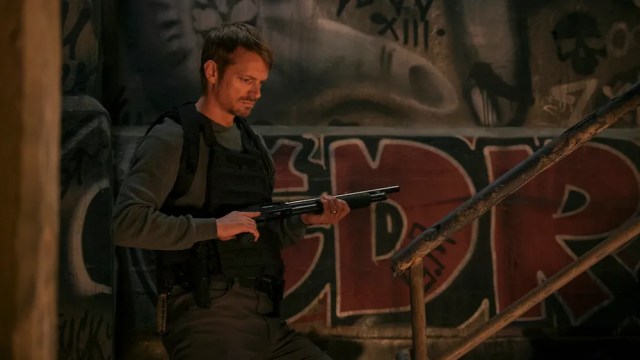
Nobody talks. Not our hero, a father (Joel Kinnaman) who loses his little boy in a drive-by and his voice when an equally silent killer (Harold Torres) tries to execute him. Not the hero’s wife (Catalina Sandino Moreno, excellent). Not the cop on the case (Kid Cudi).

Robert Archer Lynn’s script touches on one of the guiding principles of Woo World gangland — “No women, no kids” must be harmed. That’s the jumping off point for a father’s voiceless resolve to avenge his kid, murdered as he took a ride on his new training wheeled-bike on Christmas Day.

“Brian” (Kinnaman) gets a calendar for the next year, and on Dec. 24, scrawls “Kill them All!” with his sharpie.

The film shows us an exhaustive year of prep–physical conditioning, buying and customizing for war a weathered Mustang, taking Youtube tutorials on how to kill with a knife, visiting the firing range to master the art of pistol marksmanship.

We glimpse the beginnings of his hunt in fictional Las Palomas, New Mexico (Texas plates on some of the cars), and skip over the hard stuff like how our hero finds his quarries, his net-searching knowhow left unseen as he magically finds the “most wanted gangsters” in this metropolis while the cops never do.

Brian stops to mourn, here and there. Quietly weeping, he is the embodiment of Harlan Ellison’s famous phrase, “I have no mouth and I must scream.”

And then, let the vengeance begin.

Continue reading
Posted in Reviews, previews, profiles and movie news | 2 Comments

Movie Review: Oh no, there goes Tokyo…Again — “Godzilla Minus One”

“Godzilla Minus One” is an ambitious reset of the famed Japanese movie monster, a reboot of the franchise and the character introduced in the 1950s as an allegory of Japanese victimhood in in the nuclear age.

Writer-director and effects supervisor Takashi Yamazaki (“The Fighter Pilot”) gives us hints of the parable he’d like this new film, set much sooner after World War II, to be. It’s a tale told on the cusp of the moment when Japanese guilt for a war that country’s government started and prosecuted with fascist barbarity for a dozen years would morph into a populace that embraced victimhood as easier to swallow.

“Tokyo! I don’t want to see it in flames again!”

This film’s characters have moments where they speak to the modern Japanese audience, a top-down culture compliantly led into in economic stagnancy, declining population and unaddressed war guilt, racism and the like.

“This country never changes,” a character mutters, in Japanese with English subtitles. “Perhaps it can’t.”

The effects are terrific, even if the assault of ravaged post-war Toyko looks a lot less firebombed than it should, even if the marauding monster marauds less on land than on sea despite amble evidence of Godzilla’s dislike of trains. The sea battles are borderline awe-inspiring.

But change in emphasis and subtexts aside, Yamazaki’s film lurches into “Same old Godzilla, same old response to her/him” silliness, with old grievances barely sublimated, silly science and old themes such as self-sacrifice watered down for modern consumption.

In the last days of the war, a kamikaze pilot (Ryunosuke Kamiki) abandons his mission on the pretext of equipment failure. Koichi Shikishima lands on an island where he and the locals face a new threat, a monster who shows up who Koichi has a chance to fight, and again he shows cowardice.

Meek Koichi returns to Japan and forms an informal “family” with Noriko (Minami Hamabe) and a little girl. But American nuclear testing in the Pacific has awakened the beast the folks on far off Odo Island called “Godzilla.”

Koichi and the ex-Navy crew he serves with on a wooden trawler used to clean up Japan’s seaborne minefields, and a plucky scientist (Hidetaka Yoshioka) will be among those called on, in a demilitarizing Japan, to save Tokyo and the country from this new threat.

The Americans? They’re taking their lumps further off in the Pacific, but they’re worried about stirring up the Soviets (who had nothing resembling a real navy, and didn’t yet have The Bomb). So Japan will have to use its cultural cohesian and communal knowhow and bravery to save itself.

For long stretches, “Godzilla Minus One” concentrates on relationships and conversations, which despite their intent, do little to advance the plot or illuminate simply-drawn characters.

The acting is affecting, not helped by an unemotional script. Whatever human stories are attempted here, they’re never more than distractions in what still is “just” a “Godzilla” movie.

The coward must redeem himself. The scientist must use his out-of-my-lane expertise to save the country, not arm it. Assorted Navy veterans must move on from years of hubris followed by humbling defeats to rally against a new foe.

Self sacrifice will be called for.

We get it.

But it’s all a tad less satisfying as this and new take lowers the stakes in many ways, ones that rob the picture of much of its potential pathos.

Continue reading
Posted in Reviews, previews, profiles and movie news | 7 Comments

Movie Preview: Anya Taylor-Joy in “Mad Max” Land – “Furiosa”

A first trailer that has exposition/back story, the cinema’s “It Girl” Anya Taylor-Joy, and a WHOLE lot of stuff we’ve seen in other Mad Max movies. I mean, a lot.

Looks very good and all. But will it show us anything new?

Summer of 2024?

Posted in Reviews, previews, profiles and movie news | Comments Off on Movie Preview: Anya Taylor-Joy in “Mad Max” Land – “Furiosa”

Movie Review: Hot young Turks and a fantasy marriage? “In Your Dreams”

“In Your Dreams” is a shiny but drab Turkish romantic fantasy about two people who “dream” they wake up married, have a child and lives together, and spend much of their time together trying to figure out how this mystery happened to them.

Of course, this being a screen romance, what wedding planner not-planning-on-marrying-soon Pelin (Burcu Özberk) and playboy developer Engin (Murat Boz) are really doing is slowly falling in love with the idea of being in love and married. Very slowly, it turns out.

Pelin spends much of the film’s first act talking her marriage-mad sister Merve (Hivda Zizan Alp) into the idea that her mania is misguided, that she’s got “time” to find Mr. Right, and that her calculations — that these two over-scheduled wedding planners have about “2:41” each day to devote to finding a mate — are wrong.

Rich, over-dressed Lexus-loving Engin is busy knocking down traditional neighborhoods in the same of “progress,” and convincing his best mate Cihan (Ugur Uzunel) that marriage is “the biggest con job” of them all.

He’s got a rule, and any woman who asks “the forbidden question” (“Where is this relationship going?”) is sure to get her walking papers.

Events conspire to toss them together in a specific two minute and 41 second time frame at a restaurant where the ladies’ man shows off his acumen in the kitchen, and next thing we and they know, these two lovely creatures wake up in bed together.

But “nothing happened,” not that they remember, anyway. And well, this is a Turkish film. Sexy outfits and bare chests are about as far as things go on Asia Minor.

They try to figure out what happened, confirming their marital status with relatives (“TWO YEARS?”), pondering a scar that indicates he had some sort of accident, consulting a therapist, insulting each other (“We’re married? In your dreams!”), eventually finding her diary which allows them to try and recreate their first meeting, first date, first kiss, etc.

Every time they think they might be getting somewhere, night falls. Waking up nine months pregnant is one consequence of that. Child-rearing is another.

Continue reading
Posted in Reviews, previews, profiles and movie news | Comments Off on Movie Review: Hot young Turks and a fantasy marriage? “In Your Dreams”

Next screening? It’s back to the Holocaust for “The Zone of Interest”

Just another portrait of a German family, carrying on with life and work as World War II and “The Final Solution” roil around them.

But this is the family of Rudolf Höss, and he and his know that the “solution” is right next door, where he’s commandant of Auschwitz.

“The banality of evil,” as Hannah Arendt put it, is in the details.

This film is an awards contender that will roll out into most markets in February, in an election year where Naziism is once again on the ballot.

Posted in Reviews, previews, profiles and movie news | Comments Off on Next screening? It’s back to the Holocaust for “The Zone of Interest”

Netflixable? Rita Moreno flings Jennifer Garner and Ed Helms into a “Family Switch”

Simmer down, now.

This derivative, dumb and ditzy body switch comedy that ups the “Freaky Friday,” “13 Going on 30” and “18 Again” ante by serving up a whole “Family Switch” is harmless.

No, it’s not the least bit original. It’s cheesy to the point of lactose intolerant, which is another way of saying it’s loaded with fart jokes. And yes, the best laughs reside in the outtakes under the credits. Which include fart jokes.

It’s a holiday comedy directed by the once formidable/still-competent McG (“We Are Marshall,” “Charlie’s Angels”) and could have been scripted by an AI “family holiday comedy” program — but wasn’t (some fraud got credit for writing a children’s book this is based on).

But Jennifer Garner and Ed Helms? They show up and give it their all. And if the situations are laughably unoriginal and the jokes aren’t top drawer, at least they’ve got license to mock that.

“This is a completely unique and original situation, that has LITERALLY never happened before,” our quartet of switched parents and kids (Emma Myers and Brady Noon) kvetch.

“Right? Like no kid has ever woken up ‘Big.'”

“I’m 18 again!”

“I’m thirteen going on thirty!”

The gist? An over-booked, family-ties-slipping LA brood consisting of a “robotic” architect mom, a high school orchestra teacher dad fond of running the string section through “Seven Nation Army,” a soccer prodigy with U.S. Women’s National Team aspirations and a brilliant but bullied son who might skip a year or two of high school and go to Yale get a “one thing you need/fix what is broken” moment from a fortune teller.

Hey, she’s played by Rita Moreno, so who cares if this happens at a Griffith Observatory “planetary allignment” mumbo jumbo accident? You’ve got to go with it. Or your too-young-to-have-seen-“Freaky Friday” kids do.

A couple of days of high school coping, soccer match audition, Yale interview, “big presentation” at work and Dad’s “Dad or Alive” band possibly making it on an “Anybody Left Got Talent?” TV show (Howie Mandell cameos), a Moms wine and dinner part and a high school rave?

No sweat.

Continue reading
Posted in Reviews, previews, profiles and movie news | Comments Off on Netflixable? Rita Moreno flings Jennifer Garner and Ed Helms into a “Family Switch”

Movie Review: Homeless, parentless siblings remember “How I Learned to Fly”

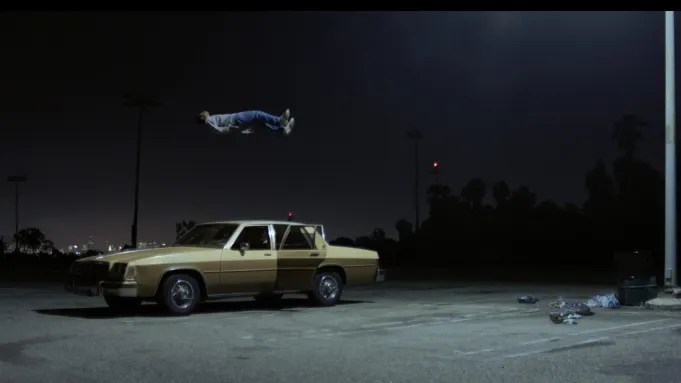
In light of the mockery of “Black Trauma Porn” in “American Fiction,” it’s hard to see the Simon Steuri drama “How I Learned to Fly” as anything but that.

A downbeat story of two parentless, soon-to-be homeless siblings struggling to stay alive and together long enough to get a break, it’s a movie with flashes of heart, humanity and magical realism.

But the white director serves that up with bloody domestic violence, racism, dire poverty and entirely too many tropes from the “struggling siblings” grabbag. The most generous interpretation of the film is that it’s a “What’s Eating Gilbert Grape” set in Greater, Blacker Los Angeles — glum and grim, with a cloying, imitative edge.

Marcus Scribner is Daniel, a high school senior with barely the time to think about college, which his guidance counselor urges him to pursue. He’s struggling with a job, a stammering, bullied younger brother (Lonnie Chavis) to look out for, remembering the trauma of their lives through voice over reveries.

“Once you change the way you look at things, the things you look at change.”

They loved their on-task mother (Crystal Bush), but she’s gone. They feared their ogre of a father (Method Man). But he’s out of the picture.

So they’re soldiering on, trying to keep up with school, an after school job washing dishes, and appearances by hiding from debt collectors, social workers and their sympathetic neighbor (Cedric the Entertainer), who asks questions until he stops because he’s guessed the answers.

Daniel props them up with purloined leftovers from the restaurant and the long list of commandments from Mom’s creed, amended by Daniel, which they’ve written on the ceiling of their bedroom.

“We wash our clothes…We pay our bills on time. We don’t drink. We don’t lie. We talk to each other.”

But for all that, they are doomed to a downward spiral. Fourteen year-old Eli is troubled, haunted by their father’s lingering taunts, a kid smart enough to resesarch car repair on Youtube, but a born victim Daniel isn’t able to keep out of harm’s way. And Daniel’s work and assorted cover stories aren’t keeping the wolves at bay.

The script has hints of that tin-eared “writerly” quality that some movies possess if their writer-director (Simon Steuri) hasn’t spent enough time listening to and transcribing real people speaking.

“Virtue never dwells alone,” neighbor Louis (Cedric) quotes, “It always has a neighbor.”

A cop checks on them after they’ve lost the house and live in a car.

“By no means are you in trouble,” he says, in a way no police officer ever has.

The performances are affecting, with Michele Selene Ang making a great impression as a sympathetic laundromat owner, Method Man at his most menacing and Cedric getting across arms-length concern for what’s going on next door and the simple decency in in his character’s response to it.

The dreamy, downbeat tone is engaging even when the story takes us exactly where we expect it to. “How I Learned to Fly” is undeniably sympathetic, thanks to its underdog story and the good people who intervene in it. It just isn’t an original, surprising or moving take on Black trauma, and another example of the narrow selection of Black stories filmmakers are addicted to, like porn.

Rating: unrated, violence, alcohol abuse, sexual situations, profanity

Cast: Marcus Scribner, Lonnie Chavis, Cedric the Entertainer, Michelle Selene Ang and Method Man.

Credits: Scripted and directed by Simon Steuri. A Film Movement release on Film Movement+.

Running time: 1:42

Posted in Reviews, previews, profiles and movie news | Comments Off on Movie Review: Homeless, parentless siblings remember “How I Learned to Fly”

Book Review: Memoir of a Movie (TV mostly) Mensch, “Being Henry: The Fonz…and Beyond”

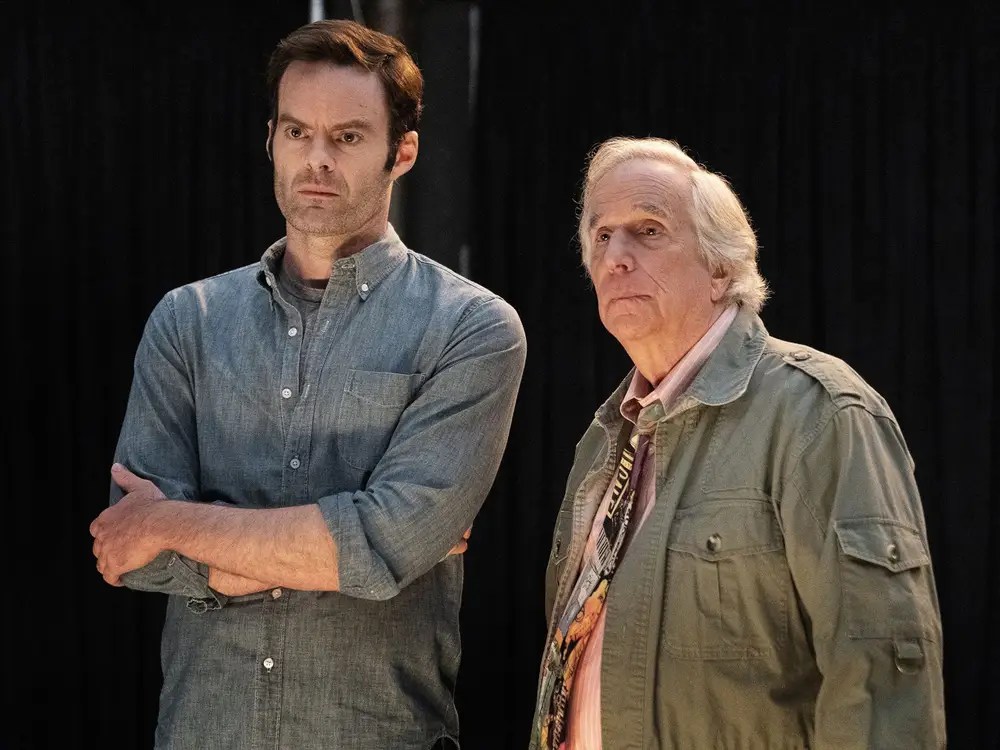
Multiple generations celebrated Henry Winkler’s late life Emmy Award for his performance as a bad actor turned bad acting teacher in Bill Hader’s hitman dramedy “Barry” on HBO.

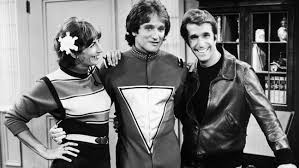
The guy had been a short, strutting TV icon in the ’70s, “trapped” in the “Happy Days” role that made him a Smithsonian-recognized global phenomenon, a faux tough guy with a nurturing heart of gold beneath that leather jacket.

The fallow years that followed The Fonz included some acting (“Night Shift”), a bit of directing (“Memories of Me”) and some successful producing (“MacGuyver,” “Sightings”). But he never got the respect that an Emmy conferred. As he always came off as a good guy, very human and empathetic and sensitive, a “mensch,” we smiled and maybe shed a tear with him at his moment of affirmation.

Winkler talks with some candor about the long arc of his life and career pointing towards that moment in a new memoir. “Being Henry: The Fonz…and Beyond” lets him relate an unhappy (but fortunate and privileged) childhood, his early call to performance, and his lifelong struggles with dyslexia, something a surprising number of actors confess to having to overcome.

He was, he admits, a “terrible reader” because he “couldn’t read.” Memorizing lines was a career-long ordeal, forcing him to perform the gist, the “essence” of this or that piece of dialogue. Improvising around the lines became his crutch. It was only when he landed “Barry” that he’d put in the work to get those Hader and Alec Berg-written lines exactly right.

Winkler also talks about the decades it took him to abandon being too “self-conscious” to be much of an actor, all but lamenting some of his performances and admitting he only “broke through that concrete” that kept him from being “in the moment” and truly transformed into this or that character.

But all that was what made that his big bgreak such lightning-strikes moment. Mere days after arriving in Hollywood, he summoned up “that voice” that he’d never heard before when auditioning for the beloved TV producer Garry Marshall for the role of cool, tough, working class “big brother” figure to Richie Cunningham and the “Happy Days” gang.

“Ayyyyyy?” It just came out.

There’s a lot here about the impact of that fame, bumping into Beatles and Rolling Stones and DeNiro, meeting and marrying his wife (Stacey’s voice is here in those chapters), his efforts to keep Ron Howard from being too hurt at the character ABC and Paramount decided the show was all about even though “Happy Days” was set up as a Ron Howard star vehicle.

That bond never broke, as Howard directed Winkler’s comedy hit “Night Shift,” which introduced the world to the wonder that was Michael Keaton, and summoned Winkler for a great role on TV’s “Arrested Development.”

That connection might be the most apt to focus on here, as both Winkler and Howard are widely recognized as two of the nicest, most down to Earth people in show business.

But the memoirist, often writing in choppy sentence fragments, pulls a lot of punches in his book, naming only the dead unpleasant people he’s dealt with in his career, and even leaving some of them out. We can guess the origins of his “feud” with Tom Hanks. We have to guess who this actor who stole lines and “bits of business” from him might have been, which co-stars, teachers, directors, etc. he didn’t get on with.

He claims to have recognized “genius” in Meryl Streep, brought in to read for a TV movie Winkler did during his “Happy Days” fame, and in Robin Williams, a comic hired off the street (so the legend goes) for a “Happy Days” guest spot that landed him a series and made the future Oscar winner famous.

It takes a while for the book to get around to what made Winkler’s wealthy Holocaust-fleeing parents — dad owned a successful lumber business, even though there were hints of money problems (not enough to keep Henry out of private schools in the US and Switzerland) — such a negative force in his life.

But Winkler did all right despite that belated parental approval, despite the weight those imposing, unlikable grumps were on his psyche, his marriage and general well-being. And whatever his claims about “breaking through,” the things that held him back and made him a justifiably self-critical middling actor, one can see “Night Shift” Henry in everything he does, especially “Barry.”

He may embrace his wife’s “mensch” label, and who wouldn’t? But “nebbish” seems to be the real sweet spot in his acting wheelhouse.

He’s also become a best-selling “celebrity” children’s author, brainstorming books about a kid hiding and fighting through his dyslexia with a career celebrity kids’ book editor who’d transform his memories and ideas into print. That might be the most illuminating chapter in “Being Henry,” that whole “celebrity kids’ lit” sausage factory laid bare, in case you wonder why so many famous folks are pursued by publishers and how they actually (whether they actually) do the hard work of writing.

“Being Henry” is an easy read, a “breezy” memoir in the parlance of the genre. But it’s not deep, the memories summoned up aren’t detailed and its insights aren’t novel. It reads the way one can infer from the kid lit publishing revelations, that it was “processed” more than written.

The chapters are a near uniform 27 or so pages each. A little tidbit of the past is visited in each, some interesting and illuminating, some less so. His talk-show chatted-up passion for fly fishing is glimpsed. His wife’s cancer scare is an occasion to break down his narcissism and struggle to be the husband he knows he’s supposed to be.

And in the end we remember why he earned that lingering affection Winkler we have for him, why we celebrated that late-in-coming Emmy, but also why we might have discounted the “lucky” self-important actor and the roles he’s most famous for.

“Being Henry: The Fonz…and Beyond. By Henry Winkler. 244 pages, including acknowledgements. Cleadon Books. $30.

Posted in Reviews, previews, profiles and movie news | Comments Off on Book Review: Memoir of a Movie (TV mostly) Mensch, “Being Henry: The Fonz…and Beyond”

Netflixable? A tale so convoluted and infuriating that “I Don’t Expect Anyone to Believe Me”

What a maddening, convoluted and bizarrely complex comic thriller “I Don’t Expect Anyone to Believe Me” is.

Maybe it’s the passive “hero,” the muddled morass this Mexican college student in Barcelona finds himself trapped in, the holes in the narrative that don’t satisfyingly take the tale from A-to-Z, but I found this as frustrating as any Spanish-language thriller or satire or darkly comic mystery I’ve seen.

Reading the Juan Pablo Villalobos source novel might help, as one suspects at least a couple of the reviewers endorsing the film might have as their rationale. But what’s on the screen is all that matters in a movie, and this plot has lots of holes, blundered motivations and in A-to-Z narrative terms, half a dozen letters in the alphabet are skipped.

Award winning director Fernando Frias (“I’m No Longer Here”) shows real amibition in tackling “No voy a pedirle a nadie que me crea.” But the leaden pacing, leaps in logic and long static passages where the plot doesn’t advance and the entertainment value flatlines overwhelm any New World vs Old World, Latin America vs. Spain satiric touches and (intended) dark laughs.

We meet JuanPa, aka Juan Pablo as a teen, sneaking off to watch grainy (and explicit) porn with his sketchy cousin Lorenzo and a pal, and committing the title of the porno — “I Don’t Expect Anyone to Believe Me” — to memory.

A few years later, Guadalajara doctor’s son Juan Pablo (Dario Yazbek Bernal) has won a scholarship to study Latin American lit in Barcelona. He’s thrilled that girlfriend Valentina (Natalia Solián) can come along.

But his going away party is interrupted by an insistent call from Lorenzo (Darío Rocas), who has a new hustle going and a “project” he wants to talk over, and it just won’t wait.

That’s when Juan Pablo finds himself kidnapped from a store, stuffed into a van and hustled into the garage where Lorenzo is bound and gagged. That’s when he gets a call from the menacing man who only goes by “The Lawyer.” And aspiring writer Juan Pablo witnesses his first murder when his fast-talking cousin is silenced for good.

For me, “I Don’t Expect Anyone to Believe Me” starts to go wrong right here. Juan Pablo’s passive reaction to this horror is what I don’t believe. His refusal to tell anyone — parents, girlfriend or police — about this isn’t rational, even considering the shock and the expectation that every cop in Mexico is dirty.

Add to that his presence of mind to try and protect Valentina and you’ve lapsed into melodrama. Juan Pablo is hustled off the plane by a dirty cop so that the The Lawyer can call him, make him make up with the dumped-to-save-her-from-this “Vale” so that they can both participate in this Barcelona “project,” threatening Juan Pablo’s parents and Vale in the process.

The film needs a performance and editing that let us see wheels turning, panic, shock, scheming, all of which young Bernal fails to get across.

“The Project” demands absolute obedience, changing the focus of his academic research and his advisor, plopping the Mexican lad who breaks out with excema under stress as the only male in the middle of a lesbian-dominated feminist “Gender Studies” curriculum, forced to fake his way to expertise in it to approach a coed (Anna Castillo) The Lawyer has targeted for courting and seduction.

The central thread of the plot, that “Project,” is forgotten for long stretches as we see the toll this “secret” is taking on Valentina, whom Juan Pablo mistreats and ignores and throws over, a lengthy detour that probably works much better in print than on the screen. We dive into her entire life outside of Juan Pablo, long phone chats with her sister, losing herself in alcohol, hit on by their landlord, lured into a threesome.

Continue reading
Posted in Reviews, previews, profiles and movie news | Comments Off on Netflixable? A tale so convoluted and infuriating that “I Don’t Expect Anyone to Believe Me”