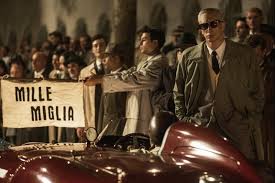
Adam Driver isn’t miscast in the title role of “Ferrari,” Michael Mann’s trek through a month or so of 1957, a make-or-break year for the racing institution supported by a bespoke Italian performance sports car company.
Driver is tall enough to be Enzo, wears a pair of Raybans and a white-hair dye job well and has the necessary arrogance and droll elan in this, his second shot at playing an Italian-accented icon. He was in “House of Gucci,” remember.
But it’s a joyless turn in a script that misses any opportunity to attach heart, wit or higher meaning to the the “commandatore’s” pursuit of auto racing excellence.
“Jaguar,” the cold-blooded racer-turned-builder and tycoon purrs of one rival, “races only to sell cars. I sell cars only to RACE.”
You should hear what he says about Maserati.
“Racing,” he intones, is “our deadly passion, our terrible joy.” Ferrari had seen a lot of death when he races, and more as he guided his still-young (founded 1947) company through various racing seasons. In 1957, blood would cover the Ferrari badge.
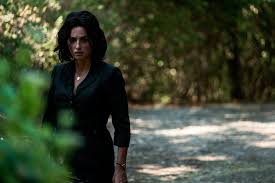
In 1957, Enzo was facing bankruptcy, desperate for a white knight “partner” to invest in the company and allow him to remain in complete control. He was hiding a very open affair with Lina Lardi (Shailene Woodley), with whom he has a ten year-old son who doesn’t bear his surname, with only his wife and corporate partner Laura, giving a brooding, woman-wronged fury by Oscar winner Penélope Cruz, in the dark about this betrayal.
His accounting books being what they are, with Ferrari’s race teams prepping for LeMans and every other competition he could get them in — Formula 1 included — it’s down to one big make-or-break dash across Italy, the epic Mille Miglia — to boost the brand image for that pitch to Ford, Fiat or whoever might want to “partner” with Ferrari.
The racing sequences here are next-level intimate, putting us in the car better than most any film that preceded this one. The crashes in that no-rollbar, pre-seatbelt era are horrific. The open wheel racecars were death traps, even the open-top two-seater road racing cars were nobody’s idea of forgiving and “safe.”
We follow the young Spanish driver Alfonso de Portago (Gabriel Leone) as he tries to get Ferrari’s attention, then lands a driving job at the very moment another driver has a fatal accident. Enzo is that cold-blooded.
After de Portago lands the gig, he has to contend with Ferrari’s fury that “When I win, I can’t see my cars (in the newsreel and photo coverage) for starlet’s asses.”
That’s largely because de Portago was dating Mexican actress Linda Christian at the time.
Mann, the action icon who made “Miami Vice” a cultural phenomenon and “Heat” the benchmark of modern heist pictures, finds himself pinned-in by history with this “true story” film. He’s competing not just with the far more fun and dazzling “Ford v. Ferrari,” but with Steve McQueen’s “LeMans” and the movie against which the entire motorracing movie genre is measured against, 1966’s very similar “Grand Prix.”
One thing the best films on motorsport have in common is a great score, and there’s no sugar-coating the fact that Daniel Pemberton’s music isn’t on a par with the music of “Ford v. Ferrari” and can’t hold a candle or a quarter note to Maurice Jarre’s glorious march in John Frankenheimer’s “Grand Prix.”
The stand-out in the supporting cast is “McDreamy” actor-turned-sports-car-racer Patrick Dempsey, going white-haired as veteran Ferrari driver Piero Taruffi (51 at the time), one of the drivers Enzo respected most. But even he suffers from the plot’s narrow attention on Enzo’s affair, potential heir and the financial troubles we hear about but don’t really see.
The man is still sparing no expense to campaign his racing teams.
I have to say, this characterization, this soap operatic (infidelity, etc.) story, has too much in common with Ridley Scott’s period-perfect but empty Adam Driver star vehicle “House of Gucci.” There’s a lot of well-turned-out style, a bit of intimate bickering, and pasta is served.
But here, that comes between heart-stopping crashes, all of which really happened.
Danville, a small Virginia city on the state line with North Carolina, is a place I’m very familiar with as it is near where I grew up. And one thing I’ve noticed about it, returning from Alaska, Florida, and everywhere in between that I’ve lived since, is how it has been mighty slow to let go of that “Last Capital of the Confederacy” label.
The gigantic Confederate battle flags you’d see at the first stoplight entering town are mostly gone, their “defiant” but angry and often openly racist small business owners dying off, although some normal sized stars and bars are still displayed, next to the Trump ones.
I think about that as my girlfriend and I are only white folks who chose to catch the afternoon showing of the best of the Christmas Day releases, “The ColorPurple” musical. The Danville GCC Cinema is packed.
As I say, this “Purple” matinee the day after Christmas in Danville, Va. is packed. It’s appealing to a wide age range, nationwide. I saw great grandmothers and great grandkids in the showing I attended. “Packed,” but not with local white folks.
You move away for decades, and you figure the One Big Confederate Monument notion of a city has changed as old industries –textiles — close and more backward generations die off. Maybe their more enlightened children move away, to college and greener pastures..
It’s a lovely old city, with a river running through it. Eventually new folks move in with new ideas in tech, re-configuring ancient buildings as housing. Newcomers and struggling Danville native-born voted for a Caesar’s Casino, of all things, which is now open and bringing jobs and reopened motels, presumably accompanied by the gambling problems that always follow such detours into vice.
But I must say Danville, this is disappointingly narrow-minded movie-going. Maybe you want the sort of history Alice Walker was summarizing and referencing in her fiction, a much-honored best-selling novel, erased. It isn’t.
Broaden your horizons. And grow up.
All this does is explain your gullible desire to follow any rich con man in an adult diaper or slick hustler in a down vest who makes you afraid of people who don’t look, think or vote like you.
Oh not, not ANOTHER “pretend we’re getting married” rom-com, tricking the relatives so that somebody can fake his way to an inheritance.
A “bet” is sure to be involved. The lies will pile on top of lies, as more and more people are either drawn into the deceit, or are fooled by it. And of course, the liars will eventually find themselves falling in love “for reals.”
“Miles and Lies,” the clumsy retitling of the Mexican comedy “Tangos, Tequilas y algunas metiras, (Tangos, Tequilas and some lies)” is a remake of “Spanish Affair (“Ocho apellidos vascos,” “Eight Basque Surnames”).
But this formula — with assorted variations — crosses many borders and turns up in many films. A lot of them starred Kate Hudson and/or Matthew McConaughey, back in the day.
It begins with a pathological liar who lies her way into a fake relationship with a rich, spoiled grumpy drunk. The narrative slowly passes through the digestive system already pre-digested. It overstays its welcome because the poor director doesn’t know how to grab that “drop the mike” moment.
And then…Espera por ello, amigos. Just wait for it. Damned if this ungainly, lumbering Mexican-Argentinian rom-com romp doesn’t almost romp. And play.
There’s a buy-in with rom-coms, a “give yourself over to it” that kicks in when enough ingredients gell. For me, that begins to happen when our mismatched couple — played by Cassandra Sanchez Navarro and David Chocarro — lean into cultural stereotypes.
The story’s about a scrambling, lie-on-the-fly bartender named Lu (Navarro) who bets her business “partners” in the bar which she never ponied up her third of the cash for that she can make a tipsy hunk (Chocarro) “fall in love with me.”
Tati (Pilar Santacruz) and Fer (Ximena Sariñana) will forget about what Lu-short-for-Guadalupe owes them if she succeeds. If she fails, well… As Lu is an old hand at “faking it until you make it,’ as the gringos say” (in Spanish with subtitles, or dubbed into Englosh), staging shots for a social media life that in no way resembles reality, how hard can it be? No, the ensuing “one night stand” doesn’t count.
Most importantly, they’re all Mexican, and their bar is in Mexico. And the dude is Argentine. Uh oh.
You don’t have to know the tsunami of stereotypes that Latin Americans hold about each other’s cultures — what the Chileans think of Colombians, why everybody hates Cubans, etc. — to be tickled by where “Miles and Lies” goes. But knowing a few common digs at Argentines is a help.
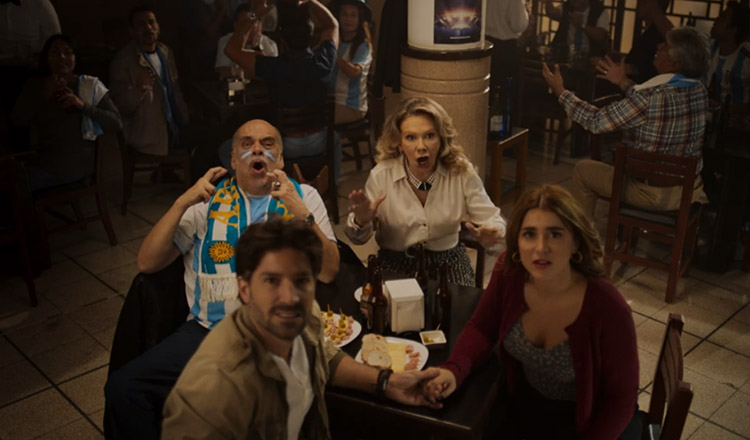
When Lu desperately cheap-flights her way to Buenos Aires to stalk this stranger she only slept with, she is confronted by the “arrogant,” “argumentative,” futbol-obsessed, carnivorous tango-dancing vermouth drinkers that the rest of Latin America recognizes as Argentinian.
Diego — Lu learns — is a a spoiled, ill-tempered trust fund 30something wandering from business to business and passion to passion. He’s in a mood at the moment because his fiance bailed on their planned nuptials. As Diego was “rushing” to the altar to placate his rich mom, who expects him to grow up, you can see his problem. And when the chips are down, so can Lu.
The guy needs a pretty, agreeable woman with mad lie-on-the-fly skills. If only Lu could do something about her “accent.”
When we meet the mom (Soledad Silveyra), we get it. She’s a steamrolling bully who inherited a meat-packing business and who had to butcher and gut her way to credibility. God forbid poor vegetarian Lu has to eat out with this woman.
Fortunately, she has one confederate in her side of this hastily-tossed-together scheme with Diego. Tona (Emilio Guerrero) is a relative of one of her partners, an elderly Mexican actor in Argentina.
Can he do the accent, put on the haughty air, discuss Argentine futbol and the finer points of the tango in polite conversation with his future “in-laws?” Of course he’ll play Lu’s dad.
Characters stumble into Mexican slang and Argentines break into their favorite stadium songs, and nobody is wholly fooled-by or wholly accepting of anybody else.
The “buy in” here is the great chemistry between Navarro and Chocarro. We believe her as a poseur and him as an unfocused, dreamy trust fund bro. Sileveyra and Guerrero are largely the icing on the cake.
Director Celso Garcia and screenwriters by Marco Lagarde and Patricio Vega, adapting the 2014 comedy this is based on, leave entirely too many laughs on the table for my taste. You’ve got a theatrical old Mexican actor “playing” Argentine. You’ve got a Mexican woman trying to “pass.”
And you’ve got Argentine arrogance, ready-made to go on display.
Playing this all more broadly, loudly and briskly would have been a BIG help. This is a 95 minute comedy trapped in a 115 minute movie. There aren’t really enough gags to make the 95 minute version pay off, either.
But a couple of scenes just kill. The eating-out gag reminded me of every Argentinian restaurant I’ve ever eaten in — meat, meat, meat. The only thing in the joints not dripping with blood was your napkin, and that was a temporary state.
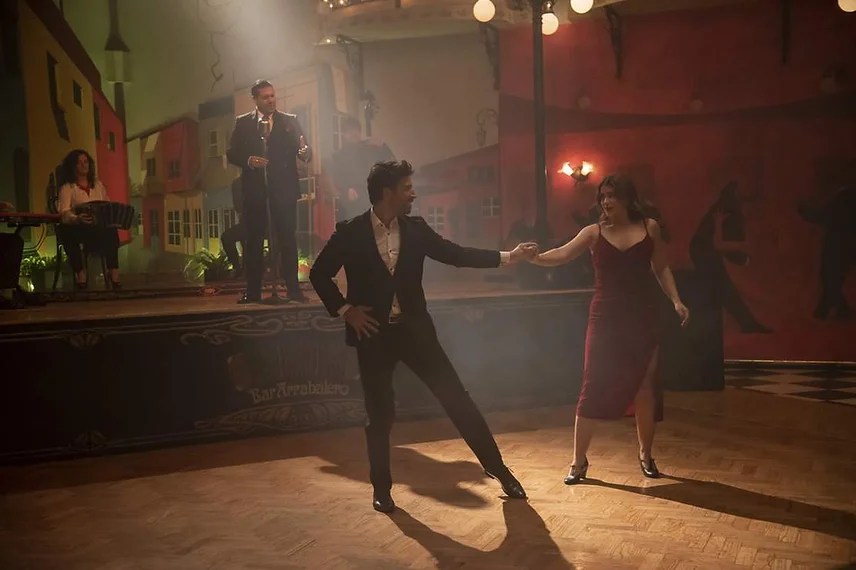
A touristy “history of the tango” stage show sets up a lovely bit of camp, and a Big Romantic Moment. There are a couple of those, with maybe one of them working.
This almost comes off. If Garcia had the sense to end “Miles” on a lovely mariachi moment, and made that moment come 15 minutes sooner and hit his big jokes harder, all involved would have had a winner on their hands.
Rating: TV-16, sexual situations, near nudity, profanity
Cast: Cassandra Sanchez Navarro, David Chocarro, Soledad Silveyra, Emilio Guerrero, Ximena Sariñana and Paulina Patterson
Credits: Directed by Celso Garcia, scripted by Marco Lagarde and Patricio Vega, based on the film “Spanish Affair/”Ocho apellidos vascos.” A Sony International release on Amazon Prime.
Ernest Hemingway was famously grumpy about film adaptations of his novels, and the mere brevity of the first screen version of “A Farewell to Arms” must have raised his ire.
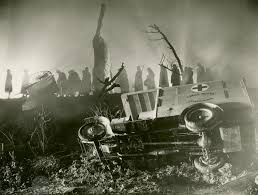
But Frank Borzage, the first two-time Best Director Oscar winner, gives us an Expressionist montage for the ages in the film’s third act, five solid minutes of Lt. Frederic Henry’s AWOL escape through the northern Italian combat zone.
The newly-restored film serves up smoke and fog, wounded men in close-up and silhouette stumbling towards through the dark towards the rear, armored cars and wrecked ambulances and bodies and stylized horrors, air raids and the like. This black and white nightmare has a chilling immediacy and it adds credibility and an artistic touch to what feels, from the very start, like one of the most adult, uncluttered and spare Hemingway adaptations.
Borzage, an actor’s director who did “Bad Girl,” “Seventh Heaven,” the terrific anti-Nazi thriller “The Mortal Storm” and the jolly stars entertaining the troops “Stage Door Canteen,” doesn’t do much to keep the incongruous pairing of the towering Gary Cooper with the petite, 15 inches shorter Helen Hayes from looking like a sight gag in a couple of walking and talking scenes.
But we don’t mind because Borzage and the screenwriters give us a streamlined plot that zeroes in on the characters. The film was also based on an uncredited 1930 stage adaptation that narrowed the tale’s focus. Building on that, Borzage lets the cast give this romance set against the epic tableaux of war an intimacy that allows Cooper and Hayes to just break your heart.
The story has a pre-Production Code edge to it, with pregnancy out of wedlock, an English nurse (Hayes) who “gets in trouble” thanks to a handsome young American ambulance officer (Cooper) who impulsively seduces her, impulsively tells her he loves her, impulsively turns his ambulance around on the way to the Front to come back to reassure her it wasn’t just a “conquest,” and impulsively goes AWOL from a combat zone to track her down after she’s gone to Switzerland to have their baby.
There’s a live-for-the-moment immediacy and resignation to the story and the performances that gets at the fatalism of life and love in a war, where promises that “I’ll never get hurt” ring hollow, where Catherine’s jaded friend Fergy (Mary Philips) has a better grasp of what’s happening here, this nurse’s creed that “we must bring solace to the men who fight” that’s perhaps gotten out of hand.
“You’ll never get married. Fight or die, that’s what people do” in places like this.
Taking its inspiration from Hemingway’s own experiences driving ambulances in the Italian/Austrian campaign, the film gives us just enough combat sequences — barrages and bombardments, hospitals, advances and retreats — to be credible. The story’s really about a young man’s first real love and a (slightly) older woman’s touching, reluctant acceptance of that at face value, because of the combat crucible this romance comes to life in.
Hayes makes us believe Catherine’s leeriness of Lt. Henry, her sad love-in-wartime recognition of what’s happening and her grim embrace of this man and this affair, because losing a fiance at the Somme taught her that life is as impermanent as it gets in war.
Cooper, very young (just a year younger than Hayes) and not yet settled into his relaxed, folky persona or the stoic hero he became in his 40s, was never more vulnerable than he comes off here. The smitten earnestness feels real, the irresponsibility that has him abandon his duty seems almost heroice.
Adolphe Menjou, who’d make his greatest mark on screen in another World War I film, Kubrick’s “Paths of Glory” twenty-five years later, plays Capitano Rinaldo, a rakish Italian surgeon who loves having the American along as his wingman, comically calling himself “your best friend and your war brother” right up to the moment Henry steals the fetching Catherine away from him.
Rinaldi’s reaction to their love affair is masked in nobility, looking out for his cannot-afford-to-be-distracted “war brother,” but has a sinister romantic sabotage feel.
The film’s simplified plot and cast of characters, coupled with all the information, symbolism and emotion Borzage gets across in that epic combat zone montage allowed the director to manage something few other filmmakers did — make a movie as spare, stark and moving as Hemingway’s prose, not so much the definitive “A Farewell to Arms” as a movie that “gets” the novel and delivers it without a single minute of screen clutter getting in the way.
Rating: unrated, fairly adult for its time
Cast: Gary Cooper, Helen Hayes, Mary Philips, Jack La Rue and Adolfe Menjou
Credits: Directed by Frank Borzage, scripted by Benjamin Glazer and Oliver H.P. Garrett, based on the novel by Ernest Hemingway. A Paramount release on Roku, Tubi, Plex, etc.
I’m not sure when the Big Holiday Movie Event became a thing, although “To Kill a Mockingbird” made its bow on today’s date, and “The Godfather” certainly claimed that Christmas Day opening “event” in its time.
“Les Miserables,” the Downey/Jude Law “Sherlock Holmes,” “Dream Girls,” “Django Unchained,” “Ali” and “Catch Me If You Can” were some recent blockbusters or would-be hits that hit screens on the holiday.
This year, I’m planning on catching “Ferrari,” as Neon wasn’t so confident in another Adam Driver slinging-an-Italian-accent drama that they screened it for critics everywhere.
The girlfriend would love to see “The Color Purple,” and I heartily endorse that. So we’ll be immersing ourselves in the wonder that is Taraji, And Fantasia. And Jon Batiste, Colman Domingo and David Alan Grier, by golly.
Are you going out to see one of those, or “The Boys in the Boat” (ugh), or are you staying home to stream “Maestro” with Bradley Cooper as Leonard Bernstein?
The holidays are about a lot of things. After you’ve over-eaten at the table, be sure to drag the kids to “Wonka,” if they haven’t seen it. And if “the kids” are adults, you can’t go far wrong with a Christmas musical version of “The Color Purple.”
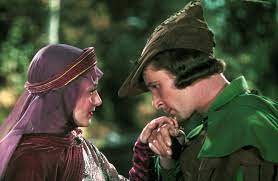
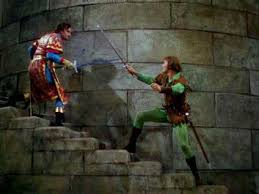
What a wonder “The Adventures of Robin Hood” must have been to the Depression Era moviegoers who first saw it.
A jaunty Errol Flynn swashbuckler splashed across the screen in the still-new and rare Technicolor, capturing glorious locatations, with Oscar winning art direction, editing and an Erich Wolfgang Korngold score that just sings, it must have been every bit as overwhelming as “Gone With the Wind” and “The Wizard of Oz” were a year and a half later.
It’s a touchstone film for any cinephile, and I’ve seen it on TV, video, and at university film societies over the years. But the most recent Museum of Modern Art restoration of this National Film Registry classic really takes one back to what it must have been like to bowled-over by this masterpiece, directed by Michael Curtiz and William Keighley but nursed to life by producer Hal B. Wallis.
The English folk legend has been committed to film more times than one can count, but this is the version with that ineffable something that makes every other take on the tale pale in comparison.
It’s more fun, sure. There are comic moments in the Kevin Costner “Hood,” even fewer that come to mind in the Russell Crowe version. It’s gorgeous, built around an impressive, soon-to-be-regarded as “all star” cast, and epic in scale. But other renditions of the story have been just as big. Yet nothing else over the decades come even as close as those two recent “Hoods” to matching this 1938 classic.
Watching Flynn in it, we can see the Aussie expat chisel his screen reputation in stone, the true heir to the jolly, grinning Douglas Fairbanks action hero throne. The athletic, charismatic Fairbanks filmed the definitive silent “Robin Hood” 15 years before. That film’s plot has been more of a template for all the “Robin Hoods” to follow. Like the Costner and Crowe versions, Fairbanks & Co. went for something more drawn out, and all those versions of the story were over two hours and 20 minutes long.
The Flynn film zips by in 100 breathless, endlessly-quotable minutes.
“Ho, varlets, bring Sir Robin food! Such insolence must support a healthy appetite!”
Pairing Flynn with Olivia de Havilland, his “Captain Blood” co-star, and reconnecting him with his “Prince and the Pauper” sidekick Alan Hale, Sr., as the iconic rendition of “Little John,” giving the film two delicious villains — not just the delicious “Captain Blood” alumnus Basil Rathbone as Guy of Gisbourne, but Claude Rains at his snootiest as the scheming Prince John, it seems as if every move producer Wallis made paid off.
The story’s waypoints had been long codified before the first scene was shot. A young member of the landed gentry is radicalized by the tyranny that sets in whilst “Good King Richard” the Lionheart was off crusading and getting himself held for ransom by the crown princes of Europe.
Robin Hood is a rabid royalist, of a rank that he has access to confront Guy of Gisbourne, the cowardly Terry Jones look-alike Sheriff of Nottingham (Melville Cooper, hilarious) and cruel, scheming Prince John.
“By my faith, but you’re a bold rascal!”
He instantly gets under the skin of Lady Marian Fitzwalter (de Havilland).
“Why, you speak treason?”
“FLUENTLY!”
The script firmly sets the story in 1191 — just over 100 years after the Norman Conquest, and sets up the conflict between plucky, industrious Saxon Britons and the effete Norman French who rule them at the point of a sword, with a compliant high Catholic clergy (Montagu Love) assisting.
But the French haven’t reckoned on English revulsion at taxation, English notions of liberty or English longbows, made of yew wood and lethal in battle for 250 years.
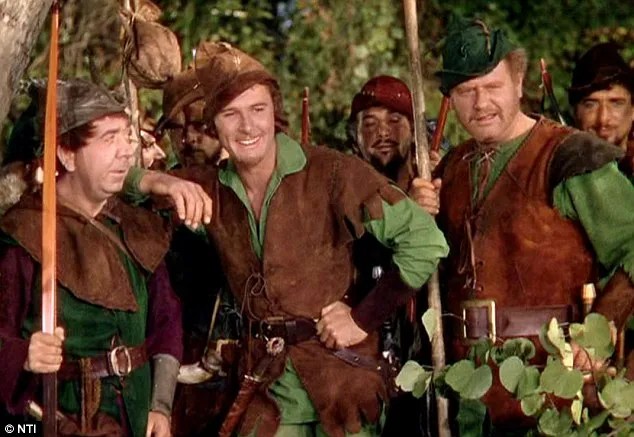
Robin of Locksley evades capture, and starting with his dandy, lute-playing make Will Scarlett (Patric Knowles) and then Little John and later Friar Tuck (Eugene Pallette), he gets the merry band together and takes over Sherwood Forest. They’ll rob from the Norman rich and give to the English poor.
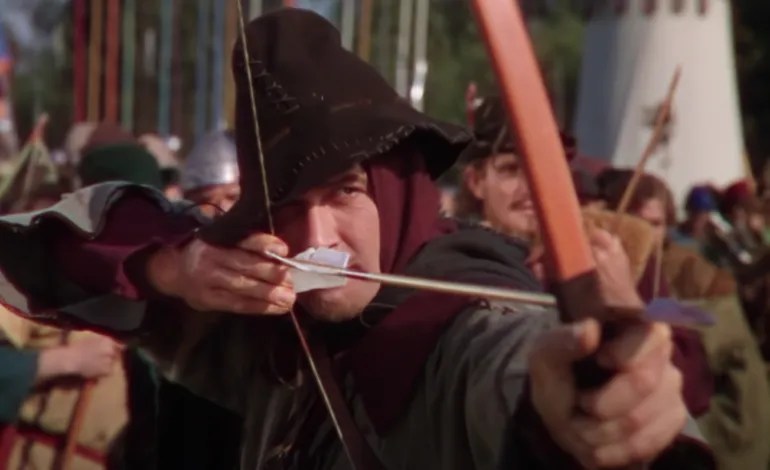
And Robin, a sporting chap, will not only eschew several chances to kill the venal Sir Guy. He’ll risk his neck to compete in an archery competition, in disguise, just to impress Lady Marian.
So many happy accidents led to this film that they themselves became the stuff of legend. James Cagney was slated to play the Prince of Thieves, but he sued to get out of his contract with the stingy brothers Warner.
That went on for years. And that delay didn’t just allow Flynn to emerge as a star, but made the production’s last minute decision to film in Technicolor possible. Every three-strip color camera in Hollywood was brought to Warners’ soundstages and to Chico and Pasadena and Calabasas for location shooting.
Those years also allowed Wallis to convince Viennese composer Erich Wolfgang Korngold to come to Hollywood and compose his “opera without singing” score and change the way films sounded from that moment on.
Without that playful score, we wouldn’t have that lovely moment where Robin confronts Little John with quarterstaffs on a log bridge, Scarlett strums along on his lute as entertainment, and Little John barks at him to pick up the tempo to something more suited to a fight scene. Will obliges.
The archery stunts involve a real archer shooting real arrows into assorted extras, stunt doubles and cast members. Howard Hill was that archer entrusted with that dangerous task, and you can see him playing Elwyn the Welshman in the archery contest scenes.
“The Adventures of Robin Hood” is quite old fashioned, simplistic morality and politics, corny speeches and trash talk, rear-projection chases on horseback, cuts between Robin swinging from a forest tree to land on a fat tree branch on a soundstage for his signature line, “Welcome to Sherwood, milady!”
Edits like that are a lot less jarring and more seamless in this latest restoration.
Critics back then and the still-young Academy of Motion Picture Aats & Sciences had an easier time acknowledging what they knew to be a classic the moment they saw it. It might not have won any acting honors, and Best Picture went to the stage adaptation of the Pultizer Prize-winning Kaufman and Hart play, “You Can’t Take It With You.” Even then, the “academy” liked to be seen as honoring “art.”
But “Robin Hood,” a dazzling smash when it came out, has endured, aging better than any of its contemporaries, a classic worth restoring and worth revisiting any time you crave a little escape to a legendary time, iconic characters and a sporting cast more than perfect at playing them.
Rating: “approved,” PG
Cast: Errol Flynn, Olivia de Havilland, Claude Rains, Basil Rathbone, Alan Hale, Patric Knowles, Eugene Pallette, Herbert Mundi, Montagu Love, Una O’Conner, Melville Cooper and Ian Hunter
Credits: Directed by Michael Curtiz and William Keighley, scripted by Norman Reilly Raine and Steon I. Miller. A Warner Bros. release on Tubi, Amazon, etc.
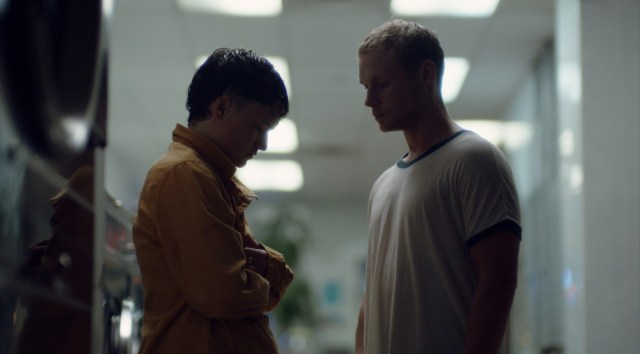
The transitioning transgender man has a moment at the pharmacy. He’s finished up his purchase with a request for “Plan B,” the “morning after” birth control pills.
And the pharmacist is a bit confused, which the still-female Feña disarms with a flippant fib.
“I’m gay,” Feña says. He’s just being a good friend, buying this for somebody else. So he says.
“Before more careful, young man,” the unseen pharmacist scolds.
If there’s a moment that sums up the “confused” 2023 state of sexuality and most confused people’s response to it better than this single scene in “Mutt,” I haven’t seen it.
Writer-director Vuk Lungulov-Klotz packs a lot into his 87 minute primer on Being Transgender Now in mostly-tolerant New York City.
“Confused” comes up, and often. “It’s complicated” is trotted out a time or two. Or three. The phrase “a phase” turns up and is addressed, head-on at a personal if not a cultural, teens-trying-something-on-for-size level.
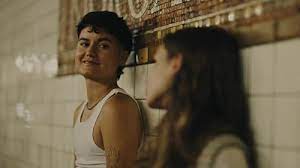
But any way you look at it, Feña, played by transgender actor Lio Mehiel, goes through a soap opera season’s worth of drama, trauma, romance and pain in this “single day in the life” character sketch.
Feña doesn’t go by Fernanda any more. The adjustment, like her transition to “him,” is ongoing.
Consider, he needs to borrow a car to pick up his semi-estranged Chilean dad at the airport. He’s still dealing with hassles at the bank as his boss keeps writing his birth name on his paychecks.
He may have a supportive group of friends and a sympathetic transgender roommate (Jari Jones). But today of all days, he sees his ex, John (Cole Dolman) in the city, and then in their favorite bar. Today of all days, old feelings and urges pop up.
Even though, as Feña’s kid sister Zoe (MiMi Ryder) notes, he’s had the “top” surgery (breast reduction), when “old feelings and urges pop up,” one sometimes has to have an awkward conversation with a pharmacist.
And “today of all days” is the day Feña’s 14 year-old sister has chosen to skip school, flee the “broken” and raging mother who kicked Feña out of the house, and that sister proceeds to carelessly make everything just a little worse.
But the kid’s hip enough to snap at the explanation Feña and every Feña out there feels the need to use with those who don’t “get it.”
“I’m still me.” As if saying that’s necessary.
But the kid and the ex-boyfriend and later the long-absent father (Alejandro Goic) serve a vital function in Lungulov-Klotz’s film. They’re the surrogates for the less hip, asking for clarification, explanation, asking to “see” the scars.
“Mutt” overreaches in the ways it folds all this drama into a single day. And maybe you can’t “have it both ways” in a movie on this touchiest of current hot-button subjects.
Feña is vocally adamant about being way past the point where anybody can use the word “phase” in his presence. But to the uninitiated, those struggling to walk a mile in “their” shoes, sleeping with a guy and having to go buy Plan B muddies the waters and fuzzies up that “phase” argument.
There’s a pause, and something like a raised-eyebrow from Feña when his mouthy sister insists she’s down with all this because “I have a trans friend.” Maybe Feña, like the casual viewer, wonders how anybody a 14 year-old would call a “friend” could be emotionally and intellectually prepared to realize that about themselves, or make that “choice.”
The best thing about “Mutt” is its implicit plea for “sit this one out” if you don’t know what the hell you’re talking about. And there’s also a plea for patience and sympathy for parents, family and friends wrestling with what appears to most to be a “new” thing, an utterly “modern” problem and concern, and for those actually going through this “confusion” and determined to wrestle it into something that resembles a stable, balanced and happy life.
Rating: TV-MA, sexual situations, smoking, profanity
Cast: Lio Mehiel, Cole Doman, MiMi Ryder, Jari Jones and Alejandro Goic
Credits: Scripted and directed by Vuk Lungulov-Klotz. A Strand Releasing film on Netflix.

















 Movie Nation