Classic Film Review: A Twee Love Letter to Paris returns for Valentine’s Day — “Amélie” (2001)

It is a dreadful oversight on someone’s part that the picture of Audrey Tatou as “Amélie” doesn’t adorn the Wikipedia page for the word “coquette.”

Wide-eyed and adorable, with a pixie haircut emphasizing her youth and that dimpled smile evoking a sunny, sweet and sexy innocence, she embodied her career-defining role in a quirky Parisian romance that merits re-release this Valentine’s Day.

Because it’s not like the cinema — Hollywood or elsewhere — is cranking out anything as light and sweet and romantic as this to compete with its memory.

Nominated for five Oscars, this 2001 classic was a peak moment for the whimsy of French filmmaker Jean-Pierre Jeunet, whose wildly-eccentric “Delicatessen” announced him to the world (co-directing with Marc Caro) and who was fresh off the dark wonders of “Alien: Resurrection” when he and co-writer Guillaume Laurent concocted this confection.

“Le fabuleux destin d’Amélie Poulain” as it is titled in French, is a Parisian romance set just after the death of Princess Diana, a quirky story of a waitress who has given up on love who decides to start interfering in the “messy lives” of others — mostly the lovelorn.

Continue reading
Posted in Reviews, previews, profiles and movie news | Comments Off on Classic Film Review: A Twee Love Letter to Paris returns for Valentine’s Day — “Amélie” (2001)

Movie Review: The Perfect Western for Black History Month — “Surrounded”

There’s a stranger in this dusty, 1870 New Mexican town. But as it’s just after the Civil War, this stranger, packing a Remington six-shooter, is Black.

Rail thin, served, but “barely,” in the log-cabin excuse for a saloon, asked for “papers” just to board the stagecoach, even though “I’m free,” glared at and hounded, Mo Washington is inclined to cynicism in voice-over narration form.

“We were free, but we had no place to be free.

This stagecoach ride to Colorado will test Mo’s mettle and underscore Mo’s worth. Road agents will attack, kill and wound and crash the coach. Commanche will pick over the wreckage. And Mo —“Surrounded” — ” will need that Remington, that Civil War experience, to get out of this fix alive and make it to Colorado.

This sturdy and nervy Western punches through a checklist of tropes and conventions of the genre, and throws in a cross-dressing twist. Because while the hard men and harrumping women Mo runs into might think little of Mo’s thin frame and that more Michael Jackson than Chris Tucker high voice, we recognize Letitia Wright from “Black Panther,” “Black Mirror” and “Death on the Nile.”

Mo has passed herself off as a man to fight in a war, get good with a gun and get her hands on a deed to a piece of property in Colorado “for my people.” And damned if desperados, Indians and garden variety Old West racists are going to keep her from her destination.

Jeffrey Donovan plays the one man on that coach willing to look past race and the “Is that a man or a boy?” questions others have about Mo. When the infamous Tommy Walsh (Jamie Bell) and his gang attack and the attack goes wrong — Guess where the stagecoach winds up? — the survivors tie him up, Wheeler (Donovan) will go for help and guess who is left behind to watch the prisoner?

Bell is in fine form here, an outlaw given to violent, spitting rages and sweet-talking negotiations.

“I fought for your kind in the war,” holds no truck with his guard, whose “secret” Walsh is the first to figure out.

With the threat of the rest of Walsh’s gang coming to fetch him in “Commanche country,” the possibility that nobody will return to take him off her hands and the extent of her plight becoming plain, Mo isn’t hearing it. “You the one in chains,” “white boy.” Don’t try to make that “We’re a lot alike” speech in a country where they “hang a Black man from a tree cuz he’s in the wrong place at the wrong time.”

The middle acts of “Surrounded” see less pounding through Western tropes and more grinding through two-hander “debates,” with the occasional escape attempt and encounter with the natives to break up the monotony.

Michael Kenneth Williams made his last performance memorable as a stranger who comes in the dead of night “to help,” but whom Mo and especially Walsh regard with suspicion crossing over into malice.

The action sequences are well-shot and edited, as Wright handles pistols and fight choreography almost well enough for us to discount her model-thin throw-weight’s impact on the physics of a punch.

But her performance has a simmering inner fire that balances nicely with Bell’s over-the-top panic and fury.

Donovan and Williams give the picture gravitas and instant credibility as entirely convincing Western “types” — men of violence with a hint of humanity.

Although some discount this thriller for its simplicity and middle act shortcomings, genre fans will relish its grit, grim dilemmas and period-perfect detail, all in service of an entertaining and believable yarn that honors both the history and the erased history of the American West.

Rating: R, violence, profanity

Cast: Letitia Wright, Jamie Bell, Augusta Allen-Jones, Brett Gelman
Michael Kenneth Williams and Jeffrey Donovan.

Credits: Directed by Anthony Mandler, scripted by Justin Thomas and Michael Pagana. An MGM release on Amazon Prime.

Running time: 1:41

Posted in Reviews, previews, profiles and movie news | Comments Off on Movie Review: The Perfect Western for Black History Month — “Surrounded”

Movie Preview — “A Quiet Place: Day One”

Got to get Krasinski back into the story, if only briefly.

So…prequel time, back to the days when the sound-sensitive alien beasties first dropped in.

Krasinski didn’t direct. He just gets a story credit, a brief appearance and a fat check as The Franchise rolls on.

Good replacement cast, though — Lupita Nyong’o, Joseph Quinn, Alex Wolff and Djimon Hounsou

June 28.

Posted in Reviews, previews, profiles and movie news | Comments Off on Movie Preview — “A Quiet Place: Day One”

Movie Review: A Southwestern Thelma & Lupe try to save “The Stolen Valley”

You can see the seeds of a decent modern day Western in “The Stolen Valley,” a thriller about Native American land theft, vanishing heritage, blood ties and the Old West delusions of Southwestern gun culture.

First-time writer-director Jesse Edwards’ script needed workshopping to clear up all the “Why the hell would anybody do THAT?” moments. The pacing is tentative and sluggish.

But the leads click, the shootouts are well-staged and a stand-out scene that blends action with comedy suggests the sort of “Thelma & Louise” variation this might have been.

Lupe (Briza Covarrubias) and Maddy (Allee Sutten Hethcoat) first cross paths at the payout for the Cedar City (Arizona) Rodeo. They just don’t know it.

Lupe is an honest mechanic, helping her mother (Paula Miranda) save up cash to get them “a place of our own.” They’re of Mexican/Navajo heritage, and work in their extended family’s taco truck for extra money.

Maddy is a rodeo rider, not even scraping by, in hock up to her eyeballs and living in her ancient pickup. Maddy’s debts are held by the gangster Antonio (Ricardo Herranz), who has his fingers in a lot of pies locally, including the pawn shop where Lupe goes to sell her Navajo jewelry to pay for medical care for her mother.

As Maddy shares the cowboy cosplaying fetish so many locals are into, she shows up to pay off her debt with Ricardo with a six-shooter strapped to her big-buckle belt. All heck breaks loose, Lupe gets roped into it, and next thing we and they know they’re on the lam together to see Lupe’s long-lost-now-rich Dad to beg for money.

“He owns half of Alta Valley” is Carl’s calling card. Maybe he’ll be warm and compassionate and reasonable and generous. Sure he will.

We get one look at this ornery, pistol-packing cuss and his band of armed ATV-riding hired-hands and we know better. This SOB (Micah Fitzgerald) is just here to make matters worse.

The pop-out scene in “Stolen Valley” comes during Lupe and Maddy’s getaway from Ricardo’s henchman. They barge into the weathered Buckskin Tavern biker bar on “Mexican Heritage” night. OK, afternoon.

Hey, it’s July 4. Why not?

Lupe yanks Maddy into the proceedings as they pose as “folklorico” dancers. Everything about this scene works — the way Lupe “Oye, hermanas” their way into an ensemble, her practiced ability to “fit in” with the dancing to the rude way the patrons treat bar owner and MC Bill (David Ogle, a hoot).

It’s like a piece of “Pee Wee’s Big Adventure” tucked into a grimly self-serious B action picture, and it works.

Some of what follows does, too. But he performances are uneven in skill and effectiveness. Attempts at the occasional one-liner hit-or-miss.

“Can we shoot our way out of this now?”

Still, the racism is palpable and time-proven, the greed realistic and the threats mortal.

It’s just that the coincidences and unlikely resolutions to this or that fix the ladies find themselves, the slippery grasp of the law, real-estate transactions and corporate alarm at people they’re doing business with turning trigge- happy and mass-slaughter tolerant make this potential B-picture slide down the scale towards C and D.

“Stolen Valley” drifts into “lost potential” and never recovers.

Rating: PG-13, violence, profanity

Cast: Briza Covarrubias, Allee Sutton Hethcoat, Micah Fitzgerald, Ricardo Herranz, Paulette Lamori and Paula Miranda.

Credits: Scripted and directed by Jesse Edwards. A Blue Fox release.

Running time: 1:44

Posted in Reviews, previews, profiles and movie news | 1 Comment

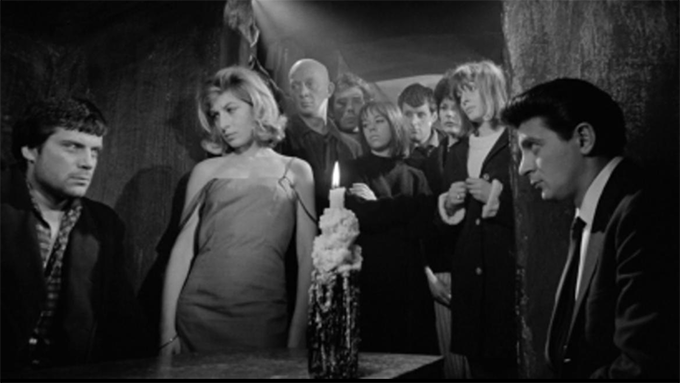
Classic Film Review: The Beatniks are the last to realize “The Party’s Over” (1965)

With its long pre-production process and almost as long release schedule, cinema has never been the most deft medium at surfing the tides of pop culture. Trends bubble up or explode, and like a time-delayed bomb, movies get hold of it, often after it has crested.

The British drama “The Party’s Over” plays like a World War II generation (adults) take on the self-absorption and nihilism of a post-war generation that was already moving beyond the poetry, art, cool jazz and “getting high” obsessions of The Beatniks and paddling out to catch the Mod wave that heralded London’s Swinging ’60s.

Here’s a curiosity of a film that plays a little square, a tad raw, and cautionary without quite curdling into “Reefer Madness” camp.

As our voice-over narrator tries to assure us under the opening credits, “The Party’s Over” isn’t “an attack on Beatniks.” It’s merely a reminder that growing up will teach you that sometimes “kicks aren’t enough.”

A pre-stardom Oliver Reed stars as Moise, centerpiece of a communal pack of hep cats who live in the same apartment building, create art or idle away the day and haunt the same clubs every night. He’s a cocksure, smirking predator who beds every woman in sight, save for “the American,” Melina (Louise Sorel), an innocent who preserved her chastity even as she grew jaded with the folkways of this wearying scene.

“I wonder, if I’ll ever have a daughter,” she ponders, drowning in resignation. “Will she get high, too? And will some hobo maul her with his thick hands?”

Melina may be ready to get out, but she’s not in the mood for rescue. That comes in the form of her fiancé “from the land of the brave and the square,” Carson (Clifford David). A young executive intent on marrying “the boss’s daughter,” he shows up, all business, and gives everybody a serious case of “Yank Go Home.”

He’s to fetch Melina, and neither she nor her new crew are having it. They prank Carson from one apartment to the next, one club or cafe or another — “She was just here…You just missed her.”

“Try Buck House, ask any cabbie and they’ll take you.”

Carson figures out the “game” with that last one. It’s slang for Buckingham Palace.

But Melina won’t be caught, won’t even be met. And over the course of a day or two, Carson figures out maybe she isn’t the one for him, that the attentions of the beguiling and more mature Nina (Katherine Woodville) are something he might want to reciprocate.

He can’t hear Melina call him “just another ghoul in my nightmare,” but he gets it.

But being a stand-up Yank from Athens, Minnesota, he’s not about to abandon his mission. Not with the boss, her Dad (“Green Acres” era Eddie Albert) on the way. That means Carson can remain our tour guide to this scene, where too many of the lads swoon over the exotic American girl they help hide, with cynical, predatory Moise as smitten as any of them.

“I’m just a dead fly in the soup of pomposity.”

With all this substance abuse (alcohol is all we see), all this live-for-the-next-“kick” impulse control, tragedy is sure to strike. That’s what “cautionary tales” are for.
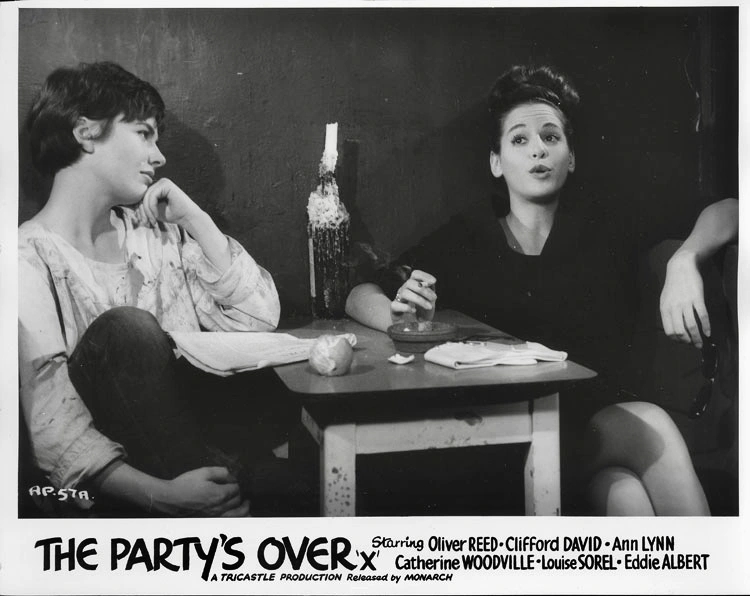
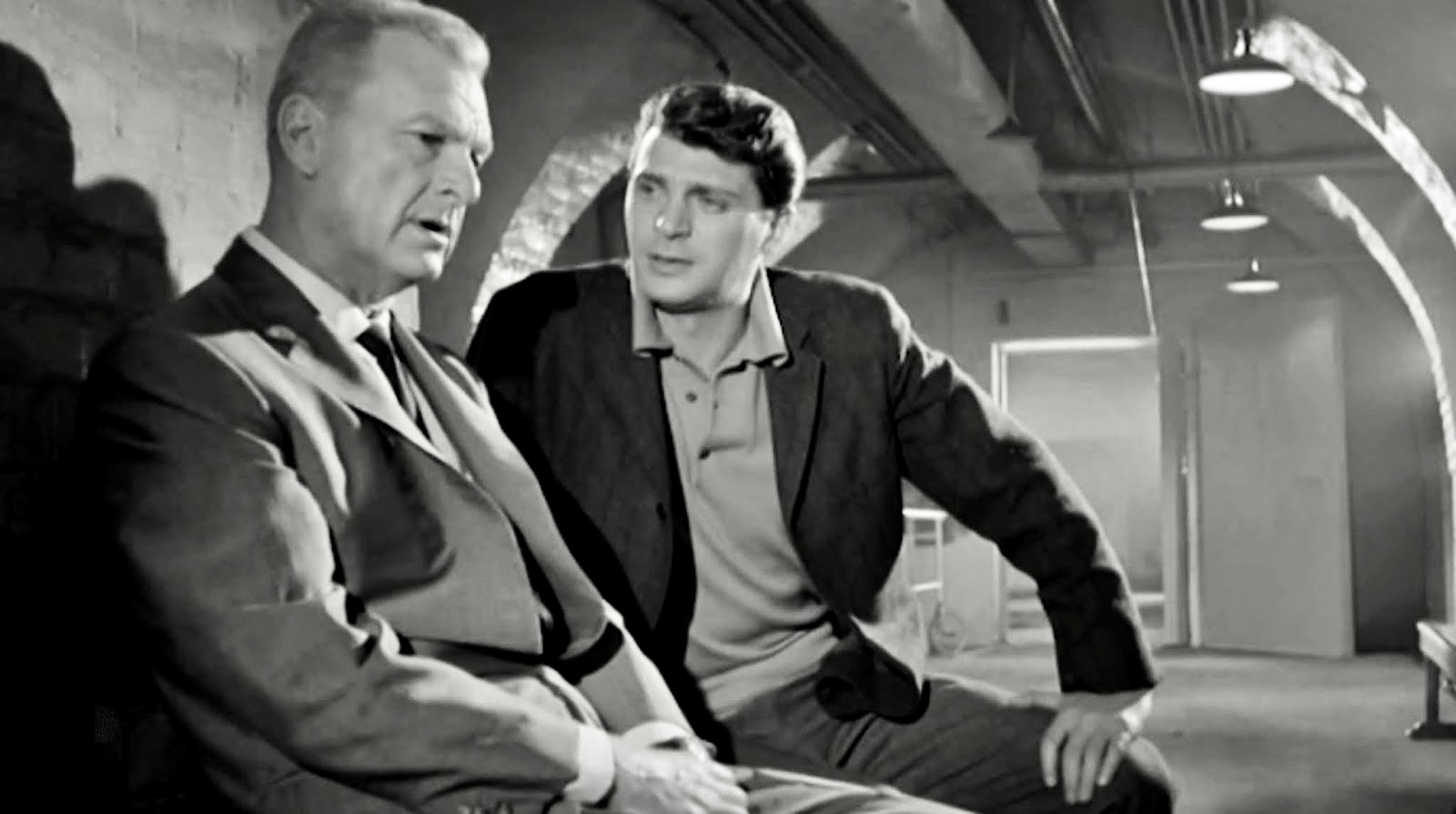
The main reason “The Party’s Over” seemed instantly-dated the moment it came out is that it was filmed in 1962 and had its release delayed over some of the darker elements it portrayed.

Reed’s stardom wouldn’t arrive until “The Trap,” which came out later in 1966. Sturdy journeyman director Guy Hamilton and composer John Barry filmed this before “Goldfinger” made them both James Bond icons.

But the film that sat on the shelf for those years remains a tantilizing artifact, an older generation warning a younger one of its self-destructive tendencies with a story that features differing accounts of what goes wrong, different ways of viewing the seeming sadism or at least indifference of “the party.”

Sometimes the dancers and the jazz they’re dancing to don’t sync up, and we puzzle over the under and over-reactions of Carson to affronts and challenges that delay his “mission” and might even endanger his fiancé. His parents’ generation would have thrown a punch or two to get the Beatniks’ attention.

“Nobody here asked for American aid!”

Woodville is the embodiment of push, stylish genteel upper class slumming in the ’60s, with Ann Lynn standing out as the singer who can’t let go of the Melina-smitten Moise, even though he’s dismissed her because “She always says ‘yes.'”

Mike Pratt plays a manic artist/drummer/club-owner, “Geronimo,” and Maurice Browning is quite good as that Beat Generation “type,” the older WWII combat vet taking in how the younger crowd is testing itself far removed from fighting fascism.

But the vulpine Reed is all magnetic menace and playful accent-slinging charm, the life of “The Party” and the heart of the picture. He can see the damage he’s done and the damage others are doing, and simply will not intervene as it’s against his beliefs, or his short-term interests.

Moise and the others cannot see “The Party’s Over,” but they have to sense the end is coming. Kids even further removed from “The War” were about to upend London and world popular culture, changing the music, embracing fashion and reaching for “kicks” beyond wine and jazz and promiscuity.

“The Party’s Over,” as it turns out, is eyewitness to the moment when the new party is just getting started.

Rating: TV-14, violence, alcohol abuse, smoking, profanity

Cast: Oliver Reed, Katherine Woodville, Louise Sorel, Ann Lynn, Clifford David, Maurice Browning, Mike Pratt, Roddy Maude-Roxby and Eddie Albert.

Credits: Directed by Guy Hamilton, scripted by Marc Behm. A Tricastle Film on Tubi, Amazon, et. al.

Running time: 1:31

Posted in Reviews, previews, profiles and movie news | Comments Off on Classic Film Review: The Beatniks are the last to realize “The Party’s Over” (1965)

Movie Preview: A “teaser” for a Super Bowl movie commercial — “If”

Cute enough, I guess.

No, I don’t refer to The Super Bowl as “The Big Game.” The National Concussion League can go suck it.

Ryan Reynolds and Randall Park promote the preview showing during the final game of the endless football season.

Posted in Reviews, previews, profiles and movie news | Comments Off on Movie Preview: A “teaser” for a Super Bowl movie commercial — “If”

Netflixable? Down and Out in Bangkok — “RedLife”

“RedLife” is a grimly immersive, relentlessly downbeat Thai melodrama that stumbles among the down-and-out crowd of Bangkok’s underbelly.

Sex workers and thieves dream small — starting a life as a couple, getting a “real job,” a single mom simply hoping her child finishes school, a daughter hoping for something “normal,” friendship and affection. That’s all they can allow themselves in lives this close to the margin.

It’s more interesting as a character portrait than a story with a coherent plot, more focused on putting us there than giving us insights into getting there and getting out. But it’s worth a look if you’re interested in that sex-work capital’s struggling masses yearning to breathe free, and make the rent.

Ter (Thiti Mahayotaruk) is the new guy in the gang, the one Kiang (Ukrit Willi Brod Don Gabriel) runs, attacking solitary victims, pitlessly beating them and stealing their wallets and backpacks.

They’re all around 20, but this new lookout is about as green as they get. He fails to intervene in a mugging that goes wrong, and ends up being the only one caught when the cops finally come. Only the intervention of his girlfriend, the sex worker Mind (Karnpicha Pongpanit) gets him out.

What she has to do to free him is just another reminder of how useless he is. He is frustrated, furious, cowardly and lost. He can’t even get himself out of this impoverished jam, much less dream up a better life for them both.

Som (Supitcha Sungkajinda) is a teen trying to keep a low profile at her girls school. She is months behind on her tuition and too broke to do anything extra-curricular. Her mother Aoi (Krongthong Rachatawan) won’t face these problems head on, as she’s deep in denial about her own financial affairs. Aoi still treats her teen as a child, another form of avoiding reality.

Aoi is a cranky 50ish sex-worker, staring at the end of the only means of making a bad living she ever had. As Som can’t talk with her about anything, the girl confides instead in a sympathetic 50ish drag queen.

Writer-director Ekalak Klunson and his co-writers don’t do much to tie these stories together even as we suspect they’re on a collision course. This tediously slow narrative merely reveals how unprepared for the “real world” that they live in Som and Ter turn out to be.

Continue reading
Posted in Reviews, previews, profiles and movie news | Comments Off on Netflixable? Down and Out in Bangkok — “RedLife”

Movie Review: High School horror? Let’s wish the best for “Departing Seniors”

As horror movies that weave “Scream” and “Dead Zone” plot points and gimmicks with high school homophobia and staring it down go, “Departing Seniors” parks itself squarely in “I’ve seen worse.”

Grace notes about sexuality, blunt treatments of bullying and a plot that at least has a certain character-driven logic to it give this derivative, self-conscious thriller a chance. The filmmakers take a number of ingredients, none of them novel or new, and make something less than awful out of them.

Javier, played by Ignacio Diaz-Silverio (TV’s “Primo”), is a smarty-pants/smart aleck senior at Springhurst High, a photographer for the school paper vying for valedictorian of the Class of 2019, with only his flip and funny ride-or-die bestie Bianca (Ireon Roach of “Candyman”) to share this peak moment with.

Because Javier is bullied. Because Javier is gay.

At least he has his antipathy for the other candidate for valedictorian, popular, rich and pretty Ginny (Maisie Merlock) to cling to. The fact that she’s dating Top Jock and Javier’s chief formentor Trevor (Cameron Scott Roberts) makes them Javier’s Couple to Hate.

But mere days before the end of the school year, students start dying of “suicide.” That’s what they and the authorities think is happening. But wrists can be slashed by others, deaths in the pool, in the locker room or on the hard pavement beneath the school’s roof can be “arranged.”

The viewer knows that some nut-with-a-knife and a “Scream” hoodie with a “V for Vendetta” mask has offed them.

It’s only when bullies brutally shove Javier down the stairs that he starts to pull it all together. A nurse’s touch, an inanimate object-gift that he reaches for, lots of things give him “visions” of who all these people really are, and what will happen to some of them if he doesn’t act, if he can’t figure out who might be the monster behind the mask.

Continue reading
Posted in Reviews, previews, profiles and movie news | Comments Off on Movie Review: High School horror? Let’s wish the best for “Departing Seniors”

Movie Preview: A Hitchiker with Cash, a Murder and Moral Quandary — “The Bad Shepherd”

One doesn’t get a sense that enough was spent on hiring a tasty mob-connected villain for this Feb. 23 release. But the setting and the set-up have time-proven potential. The tone of “The Bad Shepherd” seems just right.

Money’s power to instantly corrupt is as timeless a theme as you could want for your thriller.

Posted in Reviews, previews, profiles and movie news | Comments Off on Movie Preview: A Hitchiker with Cash, a Murder and Moral Quandary — “The Bad Shepherd”

Classic Film Review: “Chinatown” turns 50, Jake

There are a lot of reasons seasoned critics and cinephiles still hold onto the 1970s as Hollywood’s true “Golden Age.” They’re the touchstone decade built on a string of benchmark classics which we rightly measure all the films that followed and most of those that came before against, when filmmakers’ personal visions ruled even as the modern blockbuster was born.

“Chinatown” is a keystone movie of that era, one of the pictures that let the world see the transformation that was taking place, as it was happening. It is auteurist, with the screenwriter as the true auteur here, as was the case with “Network.” It was and is epic, but intimate.

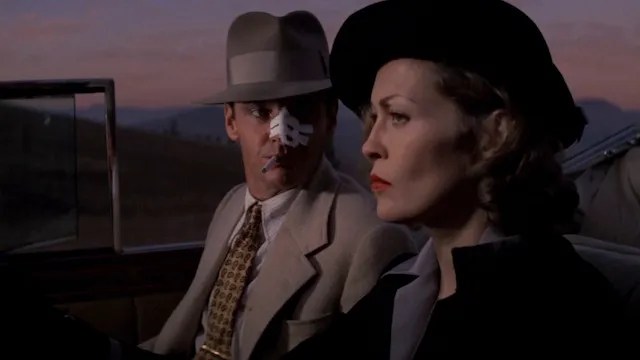
It’s also a star vehicle with Jack Nicholson‘s coming out as a major star. Taken in context, it was yet another period piece anchored in a previous Golden Age — the 1930s. But it was and remains something startling and new, a film noir that transcended the genre and slapped a modern, post Manson Family, mid-Watergate exclamation point on it.

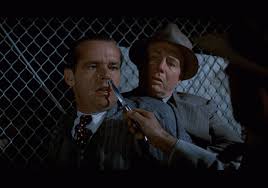
The violence Roman Polanski put on screen still makes you grimace. The performances have an effortless reality about them, even at their most operatic.

And Robert Towne’s genre script, which made most of those that preceded it and everything that came after seem lazy and undercooked by comparison, still unsettles, challenges, surprises and thrills.

A story that taps into the corruption the Nixon era, the large scale scheming that remade Los Angeles in the ’30s and the perversions of the rich and unrestrained, seemingly tailor-made for the not-yet-exposed pedophile Polanski, it’s no wonder that “Chinatown” became shorthand in the movie and the culture for pervasive and systemic rot and injustice.

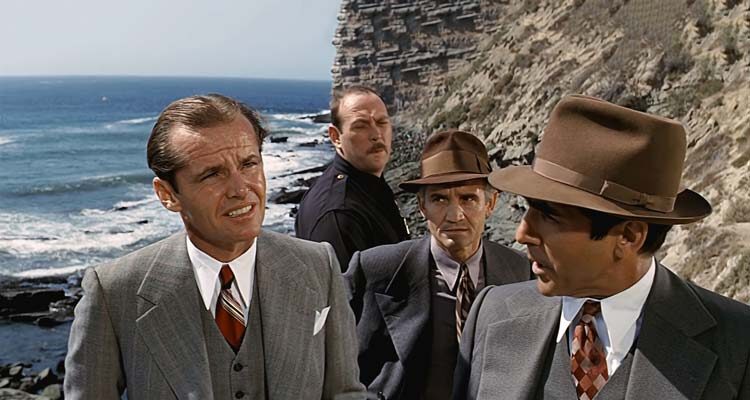
Nicholson is J.J. “Jake” Gittes, a dapper private eye who presides over an office with two seasoned “associates” (Joe Mantell and Crispin Glover’s dad, Bruce Glover) and a secretary (Nandu Hinds) he’s genteel enough to send out of the room when he wants to repeat an off-color joke.

A society dame (Diane Ladd) shows up and asks him to check on her husband, whom she thinks is having an affair. Jake advises her to “let sleeping dogs lie,” but it’s to no avail. When she tells him her husband’s name, “Mulwray,” Jake recognizes it.

And after he and his associates have “tailed” their quarry from water board public meetings to mid-drought water reservoirs to the sea, snapping shots of Mulwray rowing a possible paramour around Echo Lake, he smells a little publicity that might boost his business.

The “scandal” that explodes in the papers happens with or without Jake’s machinations. But the ruthlessly rich femme fatale (Faye Dunaway) who shows up at his office with her lawyer upends all of that. She’s the “real” Mrs. Mulwray. She’s ready to sue.

Jake’s efforts to head that off send him in search of Mulwray, as the city’s water czar goes missing. And right after he’s found drowned, Jake’s real problems begin. Mrs. Mulwray, her obscenely-rich father (John Huston) and a whole lot of people who either know better than to keep asking questions about that “accident” or water “theft” or land buyouts seem hellbent on keeping Jake from getting to the bottom of things, and by any means necessary.

Continue reading
Posted in Reviews, previews, profiles and movie news | Comments Off on Classic Film Review: “Chinatown” turns 50, Jake