
This comic thriller about a gullible little old lady who gets mixed up in things way beyond her experience of the world co-stars Richard Roundtree, Parker Posey, Clark Gregg and Fred Hechinger and opens June 21.
This comic thriller about a gullible little old lady who gets mixed up in things way beyond her experience of the world co-stars Richard Roundtree, Parker Posey, Clark Gregg and Fred Hechinger and opens June 21.
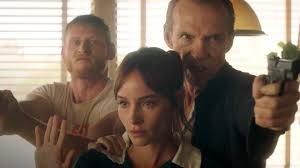
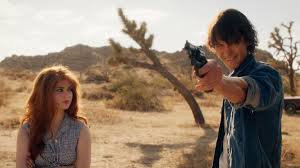
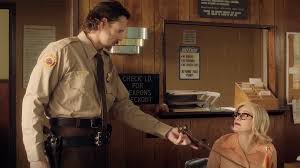
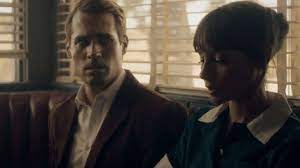
It is one of the hoariest conventions in screen thrillers. Round up a bunch of people, some of them armed and dangerous. Park them in a roadside diner, and see what happens.
The classic “The Petrified Forest,” based on a hit Robert Sherwood play of the ’30s, did it first and best. But Tarantino paid homage to that set up in “Pulp Fiction,” and there are shades of it in “A History of Violence” and legions of stand-off, hostage situation and crooks-on-the-lam thrillers.
“The Last Stop in Yuma County” is a darkly funny variation on a well-worn plot and theme, cleverly-cast and sufficiently-twisty to be worth your trouble.
It’s the mid-70s, and a Joshua Tree region “last gas for 100 miles” filling station is gassed out. That’s what parks the traveling knife salesman (Jim Cummings) in that no-AC diner next door. Charlotte, the sheriff’s wife (Jocelin Donahue) is the waitress, cook (apparently) and rhubarb pie-pusher in charge.
They’re both a little leery of two toughs (Richard Brake and Nicholas Logan) who roll up in a green Ford Pinto. Say, wasn’t that the color of the car used in a bank robbery in Tuscon or somewheres?
They can’t warn the sheriff (Michael Abbott, Jr.) or his green deputy (Connor Paolo). At least others show up in the diner — an elderly couple (Robin Bartlett, Gene Jones), the 20ish lovers who figure out whose Pinto that is and what it has in it (Sierra McCormick and Ryan Masson), and the big guy who runs the empty gas station (Faizon Love).
It takes a while for everybody to get on the same page about what’s going down. And when they do, you can be sure that they and anybody else who rolls in, looking for gas or rhubarb pie, will be armed in one fashion or another.
The villains go from “Ain’t nobody gonna recognize us here” to “Drop it!” “No YOU drop it!” in a flash. And that’s where things turn interesting.
Writer-director Francis Galluppi’s feature debut is self-consciously, self-mockingly self-referential in where he borrows ideas, scenes and set ups. A character quotes “Badlands.” Roy Orbison is on the jukebox. Everybody is both a “type” and a seriously unpredictable “type.” And everybody in the cast gets just enough scenes to make an impression, and does.
The violence is visceral but realistic. About the only “over the top” things about the picture are the myriad misdirections that kick in just as things turn interesting, and just afterward. Didn’t see THAT coming. Not really.
It’s not the most ambitious, original thriller or dazzling writing-directing debut. But Galluppi makes his covenant with the genre and the audience, and fulfills his obligations in a solid and satisfying roadside diner drama with moments of suspense, blasts of violence and enough dark dry laughs to remind us it’s supposed to be fun.

Rating: R, violence, profanity
Cast: Jim Cummings, Jocelin Donahue, Richard Brake, Nicholas Logan, Michael Abbott Jr., Robin Bartlett, Sierra McCormick, Gene Jones, Connor Paolo, Ryan Masson and Faizon Love.
Credits: Scripted and directed by Francis Galluppi. A Well Go USA release.
Running time: 1:30

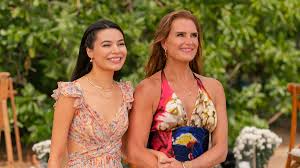
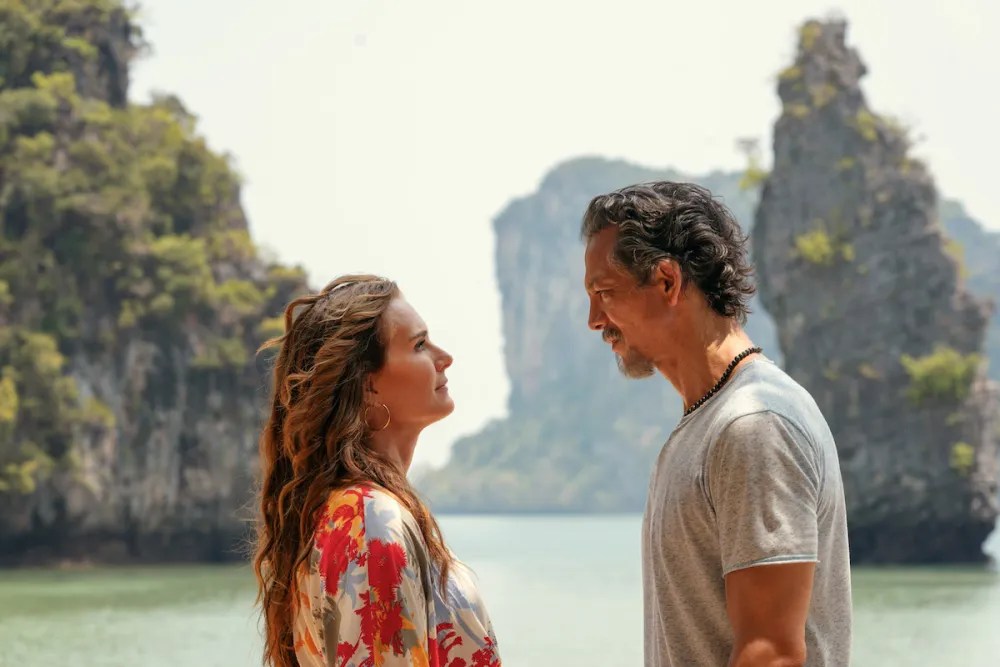
“Innocuous, predictable and well-cast” is about all the praise “Mother of the Bride” warrants, unless you consider another movie featuring the lovely scenery of Phuket, Thailand a deal-maker.
Looking for laughs in this Brooke Shields comedy is like panning for gold on a sunny beach in paradise — not the best use of your time or the location.
Shields stars as a driven, highly-strung single-mom geneticist whose daughter (“School of Rock” alumna Miranda Cosgrove) is terrified of telling her she’s just gotten engaged. Why? Mom’s not that bad.
She’s pretty cool about “the fact that you’re marrying a guy with initials” — RJ (Sean Teale) — “and not a name.” The wedding’s in Thailand because of daughter Emma’s new “brand ambaddasor” gig for a resort? In a month? OK. Fine. Whatever.
But about the father of the groom…
Benjamin Bratt classes up the joint as that dad, a fellow Mom had a long romance with back at Stanford. No problem, once we’ve gotten the “If RJ is my half-brother, the wedding’s off” joke out of the way. Sure, it’ll be “awkward.” But “awkward funny,” right?
Nope. Pratfalls, the “pickle ball incident,” Mom and Dad thrown together with romantic possibilities, a younger doctor nicknamed “sexy Doogie Howser” (Chad Michael Murray) might spice things up, but doesn’t. Aunt of the bride Janice (Rachael Harris) should sass things up, but doesn’t. The pushy corporate “brand” protecting wedding planner (Tasneem Roc) isn’t as hateable as is necessary. And so on.
Shields’ sitcom-polished mugging and reaction shots can’t wring giggles out of a tepid screenplay. And director Mark Waters is a long way from his “Mean Girls” glory and “Bad Santa 2” “edge.”
So there it is, a blase wedding with little romance and almost no laughs takes place in Thailand. I guess you had to be there — on set, a working vacation — to get anything out of it.

Rating: TV-14
Cast: Brooke Shields, Benjamin Bratt, Miranda Cosgrove, Rachael Harris and Sean Teale.
Credits: Directed by Mark Waters, scripted by Robin Bernheim. A Netflix release.
Running time: 1:30


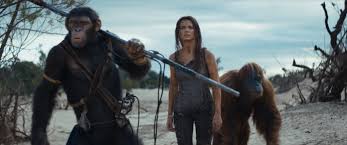
The phrase “spectacularly pointless” hangs over the tenth “Planet of the Apes” movie, a stand-alone sequel to “War for the Planet of the Apes,” which came out seven years ago.
Granted, I was thinking “umpteenth” in terms of the actual number of these films just as it began. And “What is the point of that?” cropped into my head watching the trailer to “Alien: Romulus” preceding the latest 20th Century Studios apes outing. That question lingered all the way through this 143 minute meander through CGI.
“Kingdom of the Planet of the Apes” features a lesser known cast, unfamiliar voices and motion-captured actors acting characters in a generic “hero’s journey” with a vague if not downright inane destination. Just figuring out who is whom and what their purpose in the saga is can be a struggle. Thankfully, the wearily predictable story beats solve those problems, if not the ones presented by “Who should we root for?” and “Why should we care?”
Visual, verbal and character references to earlier “Apes” films as well as “Water World” and assorted other sci-fi spectacles abound.
But little of it makes a lick of sense in a film that might be akin to the “last” “Apes” movie of the first 1970s run of the franchise, “Battle for the Planet of the Apes” — something of a placeholder film for any “Apes” ideas — films or series — to follow, should anybody believe that’s a good idea.
“Some generations” have passed since the death of the viral ape who led the planet’s simian takeover, Caesar. Apes have bent their society towards hunter-gatherers, with horses, tools, multi-story huts, and for the Eagle Clan, birds they’ve somehow trained in falconry.
Their separation from the human race seems complete, as mankind is almost extinct. But that doesn’t mean that conflict has ended. The strong prey on the weak, which is how the Eagle Clan village is sacked and most of its inhabitants taken hostage by the monkey minions of King Proximus Caesar (Kevin Durand).
Son of a falconer Noa (Owen Teague of the “It” movies) promises his dying dad that he will find the tribe and “bring them home.”
Encounters with a wayward human (Freya Allen of TV’s “The Witcher”) may have led the raiders to their village. As Noa tracks the captors, she tracks him. And along the way, he meets the sage orangutan Raka (Peter Macon, the standout in the cast), a member of the ancient Order of Caesar, scholars, worshipers of Caesar doing “the work” of maintaining their oral history until they can figure out how this “storing” knowledge in these things called “books” works.
Raka laments the loss of “herds” of humans, their fate as mute “scavengers” who once walked with apes as equals (there’s a lot of history he wouldn’t know), and preaches “compassion” when the starving, silent but still-dressed human woman falls in with them.
“We will name her ‘Nova.’ We name them all ‘Nova.’ I know not why.”
That’s the lone bit of humor in VFX-guy turned directorWes Ball’s movie (he did some “Maze Runner” pics). His film takes pains — too many pains — to reintroduce us and immerse us in Apeworld, where ruined high-rises are covered in foiliage and the one recognizable landwork is that space age LAX “theme building,” also covered in greenery.
The landscapes, forest and CGI apes are next level realistic, and cost so much to get just right that we get scene after scene slowly setting up the rituals of this “new” society before the movie starts as that society is burned and kidnapped out of existence.
The “kingdom” that Proximus has founded from all these slaves is seaside, in a graveyard for ships and close to something the humans buried that he might might useful for world conquest.
The film’s “placeholder” label doesn’t just refer to the status quo ante that the story attempts to circle back to. Conflicts are arbitrary, and the brawls are perfunctory, “action beats” as defined in third year screenwriting classes. This Nova isn’t mute. And when she meets a human aide to Proximus (William H. Macy needed the money), they have a lot to talk about.
But the overarching gripe here is that initial one I brought up. What is the point? Pierre Boulle’s 1960s source novel touched on race and colonialism in a metaphorical sense. More recent films has grasped ecology and planetary degradation as driving themes behind humanity’s careless collapse and the rise of the apes and “Caesar’s Law.” Guns are introduced, but not politicized. Conflict is imposed, but the non-violence one half expects to see advocated is given a thought and abandoned.
There’s little hint of anything “deep” or “thoughtful” here. This is a dystopia whose origins we might remember, but whose teachable moments and “hope for a better tomorrow” elements are abandoned as we watch the apes climb for eagle eggs, and for their liberty, and chase and fight the enormous gorillas for some unclear notion of “freedom.”
It’s lovely to look at. But that leaden, endless time-suck of an opening act is a fatal flaw that “Kingdom” never overcomes. And two and a half hours is a helluva long time to take to get to a point, not that they ever do.

Rating: PG-13, violence
Cast: The voices of Owen Teague, Kevin Durand, Lydia Peckham, Peter Macon, Travis Jefferey, with Freya Allen and William H. Macy
Credits: Directed by Wes Ball, scripted by Josh Freedman. A 20th Century release.
Running time: 2:23
Sienna Miller, Danny Huston, Giovani Ribisi, Sam Worthington, Luke Wilson, Michael Rooker, JEna Malone, Abbey Lee, Isabelle Furhman, Owen Crow She, Will Patton and Tatanka Means join Costner in his take on “How the West was Won.”
Looks a tad retrograde, as did the teaser trailer. But it’s big and sweeping.
June 28, Aug 16, the film will be released in two parts.
This one’s all country music and “try that in a small town” vs. “city girl” and “yer fancy tech” “You don’t face your fears, you ride’em” swagger.
Yeah, they rednecked up and dumbed “Twister” down for “Twisters.” Oklahoma “never had a chance.”
Glen Powell, fresh off “Anyone But You,” heads a lesser known cast (Katy O’Brian, Daisy Edgar-Jones, Kiernan Shipka, Maura Tierney) in this July release.
Oh yeah. That’s the ticket.
Gladstone (“Killers of the Flower Moon”) plays a hustler whose sister goes missing, even though she’d be the last one “to miss a pow-wow.”
The Feds and the State keep kicking the case back and forth. Shea Whigham plays the creepy father who raised them.
A niece’s future is at stake. Nothing for it but to kidnap that niece and take her to a pow-wow.
“Fancy Dance” opens theatrically June 21, and moves to Apple TV+ a week later.

One hesitates to label the latest thriller from Nicholas Tomnay (“The Perfect Host”) “yummy” or “delicious.”
Sure, it’s a culinary tale on the order of “The Menu.” But this most certainly isn’t “The Bear.”
“What You Wish” is a thriller with life or death on the line, with the super rich behaving badly and the people who “serve” them behaving even worse. This is fine dining with a taboo main course. Yeah, “that,” and without the “Twilight Zone” twist of being named for a cookbook.
The movie is about a desperate, broke chef who reconnects with rich culinary school classmate who jets around the world serving the swellest of the swells that which only he can prepare, and at prices that would make even a real billionaire swoon.
Who would’t be jealous of this lifestyle? But whatever Jack’s got going for him — fat bank account, endless upscale travel, free stays at swanky homes in exotic locales — he doesn’t seem all that happy about it. Old pal Ryan should get a clue.
But Ryan, played by Nick Stahl (of the TV version of “Let the Right One In”) with a calculated desperation, accepted this gift trip to an unnamed Latin American “paradise” (it was filmed in Colombia) with creditors on his tail — the kind of guys you deal with when you have a gambling problem.
Whatever it is that has successful chef Jack’s (Brian Groh) top-knot in a twist, serving “a lotta rich people” who “just want an extreme experience” at table, Ryan can only imagine. I mean, loan sharks are a REAL problem, right?
Jack’s “It’s not all glamor” and “the reward always matches the atrocity” warnings fall on deaf ears. When events conspire to put Ryan in Jeff’s chef jacket, in his rented, remote mansion, he figures he can handle impersonating his friend. And he has no qualms at all about trying.
But when “the agency” people show up, Imogen (Tamsin Topolski, giving off Brit-accented Elizabeth Holmes vibes) warns him “a bad dish will completely destroy the agency’s reputation.” That’s not nearly as scary as “a bad dish from you and your life will end.”
Ryan, posing as Jeff, must fool Imogen and her armed-and-dangerous fixer, the callous Maurice (Juan Carlos Messier, scary), and later the clients and still later the federal cop (Randy Vasquez, properly unflappable, up to a point) who shows up. It’s going to take more than Ryan’s grab-my-big-chance culinary skills to save his bacon.
The screenplay and Stahl let us see the calculations going on, the alarming problems back home and the horrific turn of events that makes Ryan’s abrupt and heartless decision to “take over” Jack’s gig and life logical. Or logical enough.
There’s a callous disconnect that I found less convincing as Maurice takes Ryan out to procure “produce” for this beyond-exclusive meal. You’d think Ryan would at least start to flip out at the monstrous turn of events, the lines he must instantly cross, the horrors he must tolerate and participate in. Stahl gives us little of that.
The second and third acts are about bloody meal prep, the barely-sketched-in rich diners, seeming bystanders and police who may not be as backward or as easily thrown off the scent as “the agency” expects.
Sometimes the suspense pays off and the movie’s twisted internal logic works, and sometimes it doesn’t. Stahl doesn’t always allow the character human reactions to what he’s gotten himself into and what others may be dragged into with him.
But there’s suspense in more than one situation, and a darkly humorous seasoning to the later acts.
Sure, it’s easy to see this as a companion film from the guy who gave us “The Perfect Host.” But Tomnay throws in a couple of twists that pay off and puts us in Ryan’s shoes and chef jacket, trying to work out how in the hell he will get out of this meal-of-his-life alive
Will he skip out before dessert?
Rating: unrated, bloody violence
Cast: Nick Stahl, Tamsin Topolski,
Juan Carlos Messier, RandyVasquez, Penelope Mitchell and Brian Groh.
Credits: Scripted and directed by Nicholas Tomnay. A Magnolia/Magnet release.
Running time: 1:41


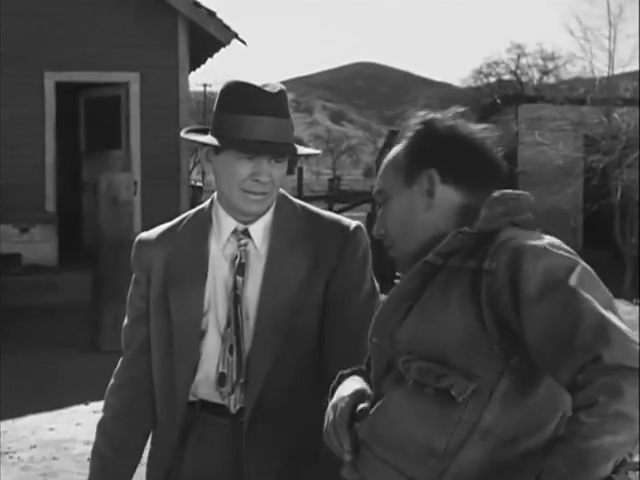
Historically, “Machine Gun Kelly” is about as accurate as the proverbial “two dollar watch.”
The movie about the infamous 1930s Memphis gangster was shot on the cheap in Southern California, with nothing that looks like Tennessee, not a trace of any Southern accent and a lot more violence than was ever attributed to the real George Kelly Barnes.
But 1958’s “Machine Gun Kelly” captures filmmaker and “indie” icon Roger Corman at his breakthrough moment, a screen story told — at least in the early scenes — in brisk brush strokes, ominous shadows and bursts of violence, a film acted with real heat and a screenplay — by R. Wright Campbell (“Man of a Thousand Faces,” “The Night Fighters”) — that plays up the cowardly sadism of its hero and features some of the flintiest dialogue of its day.
“I’m gonna carve a map of Hell right across your kisser!”
“You know, Kitten. I’m gonna get you a nice little white mouse for you to play with.”
“He’s awfully cocky for a man who can’t even crack a hick town bank.”
“Tell your old lady to keep her wise cracks behind her teeth or she’s gonna be wearing false ones!”
“I already do, smart aleck!”
The jazz score by Gerald Fried (“Killer’s Kiss,” “The Killing,” TV’s “Roots”) swings and sizzles so insistently that it carries the picture right up to the point the movie bogs down with a fictionalized version of the kidnapping that put Kelly behind bars.
Charles Bronson pops off the screen in the title role, a star-to-be playing up the sadism and woman-slapping bullying of this character, built up in history thanks to the “machine gun” moniker he wore and F.B.I. chief hypeman J. Edgar Hoover’s exaggerations, a mobster turned in the movie into a craven coward who fears anything to do with death — coffins, floral arrangements, etc.
If there’s anything this “Untouchables” era gangster picture has to say to the modern viewer, it might be that it takes a special kind of warped fraidy cat to covet the no-skills “power” of a machine gun.
But I have to say the picture promises more than it delivers. A bravura dialogue-free five minute opening shows us an early heist in quick, sure strokes. The robberies here are perfunctory, but beautifully framed and shot — shadows of gunplay, etc. It is the getaways that are elaborate, with Kelly and gang (Wally Campo, Jack Lambert, etc.) breaking down his Thompson Submachine Gun, tossing clothes and pistols, handing off the loot, splitting up and swapping cars.
Susan Cabot is the sexy, malevolent manipulator Flo, who shames her beau’s phobias, nags him into jobs, builds his myth and can take a punch or slap herself, because she has to.
Frank DeKova plays Harry, a “big game hunter” accomplice who keeps a menagerie of dangerous critters at his gas station, including a mountain lion he’s trapped. The comic Morey Amsterdam, later to gain fame via “The Dick Van Dyke Show,” is the treacherous weasel Fandango, aka “Fanny,” a weakling Kelly pushes around, tortures and costs an arm.
But Bronson and Cabot set off the real sparks, and even as the story shifts from bank robbing to kidnapping, our anti-hero’s undoing, they keep it watchable as the action subsides and the settings become various interior hideouts, with cops and the parents of a kidnapped little girl (never happened) working with the Feds (Michael Fox) to ensure that the world closes in around Machine Gun Kelly & Co.
The future mentor to generations of film folk, Nicholson and Coppola among them, Corman was supposedly fascinated by the gutless way Kelly went down, and built this film’s psychological portrait around that. He learned that timeless lesson from “Destry Rides Again,” that bullying monsters look awfully small when trapped, stuck in court, trying to stay awake, lying and lying about their exploits until no one believes they’re anything but what they really are — cowards without an audience, a gang or a machine gun to compensate for all the toughness they lack.

Rating: “approved,” violence
Cast: Charles Bronson, Susan Cabot, Morey Amsterdam, Connie Gilchrist, Richard Devon, Frank DeKova, Jack Lambert. Wally Campo and Michael Fox.
Credits: Directed by Roger Corman, scripted by R. Wright Campbell. An American International Pictures release on Tubi, Youtube, Amazon, etc.
Running time: 1:23


