
This June 21 Netflix release puts our actress-turned-entrepreneur back in a familiar guise, a beautiful woman underestimated in a fight.
Anthony Michael Hall is among her co-stars.
This June 21 Netflix release puts our actress-turned-entrepreneur back in a familiar guise, a beautiful woman underestimated in a fight.
Anthony Michael Hall is among her co-stars.



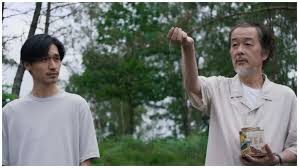
He bears the gutted look of the grieving, even as he keeps some semblance of routine — visiting the fish market, haunting his favorite sushi bar.
But there’s an absence we feel before it is announced, tipped by the second glass he asks for when he gets a beer. The wife he met at this very diner is no longer with him.
He endures the funeral, partakes in its rituals. And when he reads her note with “my last wish” on it, he doggedly sets out to fulfill it.
“Please scatter my ashes on Lake Windermere,” his wife of many decades asked. They lived all their lives in Tokyo, but never got to take a trip as a family reprising a treasured visit of her childhood. Now, he must travel to Britain and make his way to the lake country, popularized and preserved by the books and bequest of Beatrix Potter.
“Cottontail” could have been a simple sentimental journey, a fish-out-of-water quest by a widower to a faraway place meeting eccetric locals who aid him on his journey to the most special place in his late wife’s heart. But writer-director Patrick Dickinson’s film transcends those nostalgic trappings to make sublime, understated points about the way grief empties you out and doesn’t always bring surviving families close together.
Sometimes, bitterness and guilt get in the way.
Lily Franky, star of the Oscar-nominated “Shoplifters,” is Kenzaburo, our solemn, morose tour guide through the Japanese way of death. A struggling novelist, he finds plenty of reasons to flash back to memories of how he met his beloved Akiko (Tae Kimura), treasuring the shy allure that drew him in, regretting the ways he let her down and not wanting to share this last request from the son (Ryô Nishikido) and daughter-in-law (Rin Takanashi) he kept at arm’s length during Akiko’s long decline.
He smokes and he drinks and he recalls their first meeting and courtship — Yuri Tsunematsu and Kosei Kudo play them as young lovers. And then he drinks some more.
Son Toshi brings his wife and child to fulfill the “trip we never got to make together as a family” part of his mother’s wish. But that doesn’t go well.
Kenzaburo is hellbent on undertaking this on his own. He speaks just enough English to understand the rowdy, trainride bridesmaid’s party’s “Oh luv, you’re on the wrong train/going the wrong way.” And swiping a bike and trekking on foot will only get him so far.
But “the kindness of strangers” includes meeting an aged farmer (the great Ciarán Hinds) and his daughter (Aoife Hinds), people who, it turns out, have a special understanding of this quest.
Dickinson, a British documentarian who made a short film some years ago about an expat Japanese couple facing terminal illness (“Mr. Rabbit”), shows Western audiences Japanese funeral and cremation rituals, but also gets at a cultural fear of “being a burden” to others, the embarassment that comes with end-of-life’s many indignitites and humiliations.
The road trip part of “Cottontail” carries its charm, its romance and its “closure.” The flashbacks convey the bitterness of regret as we see reasons for the chain-smoking Kenzaburo’s standoffishness. He’d rather ask strangers for help than face his son.
And the entire sweet and sober enterprise — a British filmmaker writing and directing a very Japanese film about loss, much of it in Japanese with English subtitles — captures not just the differences in cultural approaches to death and dying, but the universal nature of grief, the essense of a great absence and our helplessness in grappling with it, no matter where we are or how we grew up.

Rating: unrated, end of life subject matter, smoking
Cast: Lily Franky, Tae Kimura, Ryô Nishikido, Rin Takanashi, Kosei Kudo, Aoife Hinds and Ciarán Hinds.
Credits: Scripted and directed by Patrick Dickinson. A Level 33 release (June 7).
Running time:1:34

An aspiring actress, formerly an aspiring dancer, considers mortality and the end of human existence — but not who will be keeping records once the human race itself has ended. It’s the early days of the COVID-19 pandemic, when people were frightened and the disease was running rampant and “the system” itself seemed to be crashing. A lot of us were having these not-wholly-reasoned-out thoughts.
“If the world ended tomorrow, I wouldn’t even be a footnote.”
Just as someday, if the cinema survives, the run of “COVID” romances, dramas and comedies that people made during and after lockdown — limited cast, a couple of sets, “COVID protocols,” the works — will be but a footnote.
Writer-director-star Chris Leary‘s “Footnotes” is about two late 20somethings thrown together in big, impersonal Greater LA just as the worst pandemic explodes. He’s living at reduced rent in the small complex, because he’s sort of the “super” there. Will (Leary) gives Apurna (Sharayu Mahale) her keys when she moves in.
He takes care not to flirt. No sense giving her a “creeper” vibe. She goes out of her way not to flirt back.
Then comes COVID, and a simple “Do you have any toilet paper?” plants the seeds of a “platonic” “Hey,” Im not gonna SLEEP with you” relationship.
As their friends-by-necessity conversations, dinners, drinking and drug consumption (played for comic effect) go on, the topics turn intimate, the “platonic” thing is accepted, grudgingly, then tested. By the time the lockdown ends, they’re both right to wonder if what they experienced with each other merited a “footnote,” or something more.
A couple of moments turn on the charm, a couple of scenes carry the weight of reality, expectations and longing. And then this lockdown dramedy drifts away from “just us two.” As it does, it becomes more complicated and progressively less interesting than the “almost interesting” it once was.
Their connection, the banter, a couple of outside characters and situations, none of it lingers in the memory beyond the closing credits or in my case, was clever enough to merit being added to my notes.
Critics “grade” the many COVID romances like this on the COVID curve, or we did as the pandemic was fresher in the mind. It took some doing even to make a simple “two-hander” like this, and everyone gets an A for effort for trying.
But even as I run quick searches to refresh my memory about “memorable” COVID comedies like this (“Getting to Know You,” “The End of Us,” etc.) there’s no escaping the sad reality that they all ran together pretty much the minute the third, fourth and twenty-fourth one came out.
And most of them, unfortunately, barely merit a footnote.

Rating: unrated, drug use, profanity
Cast: Chris Leary, Sharayu Mahale
Credits: Scripted and directed by Chris Leary. A Buffalo 8 release.
Running time: 1:32
Well, isn’t this a lovely, fish-out-of-water tle soaked in melancholy.
Lily Franky, Ryo Nishikido, Tae Kimora and Ciaran Hinds’ daughter Aoife Hinds star in this Man with a Mission, but dependent upon the kindness of British strangers story.
June 7.
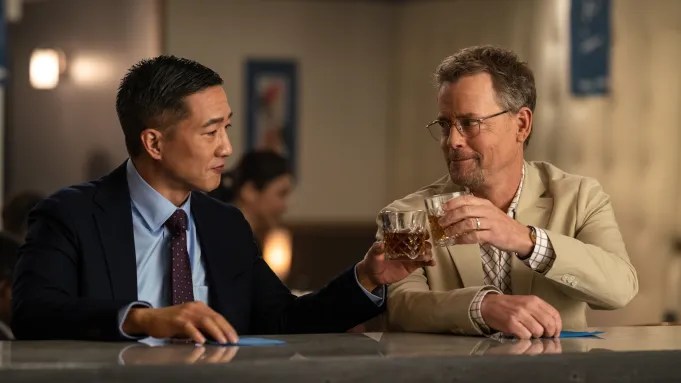
“Sight” is a pleasantly bland bio-pic about the Chinese-born surgeon who came up with a treatment that has restored the sight of millions around the world.
Dr. Ming Wang’s story, growing up during the unrest in the last years of China’s Cultural Revolution, battling anti-education/anti-intellectualism at home, prejudice and limited resources in college in the United States, only to become one of the most celebrated people in his field, is the stuff of many an uplifting biography or autobiography.
It’s rather blandly-handled in this somewhat old-fashioned bio-pic, with the big twist in the story having to do with not just what drives someone, but how one takes inspiration from failure.
Director and co-writer Andrew Hyatt did “Paul, Apostle of Christ” and that “Duck Dynasty” biopic “The Blind.” He’s not out of is element, but not having a hard “faith-based” message to anchor the picture causes his movie to drift by, never unpleasant, but not particularly compelling either.
Ming Wang (Terry Chen) is a press-conference-after-surgery-famous Nashville eye surgeon known for restoring sight to “impossible” cases, and noted for his worldwide philanthropy — accepting cases from the young and the blind, or their advocates, from all over the world.
An Indian child (Mia Swamination) becomes a great test for him. Blinded by her mother to give her an edge begging in her corner of Calcutta, Dr. Wang’s skills, invention, and that of his colleague, Dr. Mischa Bartnovsky (Greg Kinnear) are pushed to their limits with this case.
That causes the obsessed surgeon to hallucinate a tween girl from China back into his life. That leads to flashbacks, a crisis in confidence and confiding in a pretty Chinese-American bartender (Danni Wang) as he struggles to remember why he’s driven to do this, and to find a way around the damage this little girl suffered to her eyes.
We see Ming’s 1970s Chinese childhood — Jayden Zhang and Ben Wang play younger versions of him — a doctor’s son growing up in Mao’s People’s Republic, facing assaults on his school, his person and his adored childhood friend, Lili (Sara Ye), whose grandfather happens to be blind.
Bits of Wang’s back story are filtered into his present day dilemma as we learn the trauma of his youth, the fate of those who knew him and his roundabout path to America, college and success.
Hewing to what we can assume is pretty close to the truth doesn’t rob the film of its drama. But the lack of highs and lows become a real issue as tiny conflicts are blown out of proportion and the big one — dealing with the anti-education “uprising” of the Cultural Revolution — is watered-down to a frustrating degree.
The “true” story seems more compelling than how it is presented on screen. The picture’s old-fashioned nature suggest we’d get more conventionally “Hollywood” triumphs and turnabouts than are served up here.
Chen is stoic in the lead role, and Kinnear — “faith-based” is kind of his brand now — is reliably supportive in a co-starring role.
But there’s little sizzle to any of this. The performances are flat, top to bottom and the script struggles to wrong pathos out of even the saddest plot elements.
We’re all heroes of our own story, and Dr. Wang’s took a more trying journey than most, or so the film suggests. Overfamiliarity with this sort of immigrant’s journey and the tentative nature of the storytelling — even keeping the “faith-based” elements at arm’s length (Fionnula Flanagan plays the nun who brings the Indian child to America) — mute the impact of “Sight,” which is a shame.
Even the Chinese sequences (in Chinese with English subtitles) have their edges rubbed-off as the script goes to some pains to avoid criticizing the government there, past or present. Lacking that edge, any “miracle of faith” or a story arc with obvious ups and downs, “Sight” fails to move, with only the closing credits — showing the real Wang’s achievements — coming anywhere near to living up to what we’re assured, in the opening credits, is “an incredible true story.”
Rating: PG-13, violence
Cast: Terry Chen, Greg Kinnear, Ben Wang, Danni Wang and Fionnula Flanagan,
Credits: Directed by Andrew Hyatt, scripted by Andrew Hyatt, John Duigan and Buzz McLaughlin, based on the autobiography of Dr. Ming Wang. An Angel Studios release.
Running time: 1:42

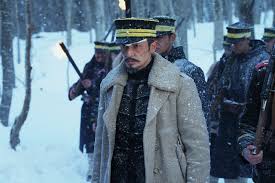


Based on a manga that has led to several anime treatments in recent years, “Golden Kamuy” struggles onto the screen in live action feature film form as a cartoonish curiosity.
A post Russo-Japanese War period piece about a treasure hunt involving tattooed ex-convicts, with soldiers, an ex-soldier, an aged ex-samurai, mobsters and an Ainu huntress, it features action and supernaturalism and enough exposition and characters to fill three two hour movies.
Ainu mores and customs are glimpsed in the midst of a lot of chasing and fighting in pursuit of 24 convicts, each of whom has clues from a puzzle tattooed on their torsos by an inmate who hid a cache of “cursed” gold after that 1904-1905 war.
It’s very “manga” in look and feel, more steam punk than period-perfect. Despite efforts to recreate the battlefields of northeastern China, near the Russian-held city of Port Arthur, and the wilds of wintry, primitive Hokkaido, this Shigeaki Kubo film never shakes the feeling of “fan service” in its plotting and a not-quite-whimsical enough “anime rendered into live action” tone.
Being ever so Japanese, there are pauses for food and discussions of food at the damnedest times — minced squirrel here, skewered dumplings there, otter served the traditional Ainu (a hunter-gatherer subculture) way, and miso which the main Ainu character amusingly describes as having the texture and smell of “feces.”
We get a taste of the origin story of our hero, the battle-scarred Saichi (Kento Yamazaki) who labeled himself “Immortal Sugimito” after his supernatural survival of battle wounds in the war.
“I just can’t seem to die!”
He hears tell of this gold treasure from a traveling companion as he pans for gold in Hokkaido. That’s when he realizes that 24 escaped prison inmates collectively carry the map to this treasure horde.
Saved from a brown bear attack by the young Ainu huntress Aspira (Anna Yamada), she becomes his new traveling companion guide to all things Ainu on this quest to track down the various inmates — brutes, escape artists, etc.
Meanwhile, The Seventh Division, led by Toshizô Hijikata (Hiroshi Tashu) has turned its post-war mission into one of finding those inmates and that treasure. And he’s not alone.
The story is relatively straightforward, or would be if we weren’t pausing for the inclusion of every supporting character, some of them quite minor, who must be introduced and identified by (inter-titles) name.
That’s “fan service” that does the movie no service.
Still, it’s an interesting peek into a part of Japan, Japanese history and culture — especially the forcibly “assimilated” Ainu — that the movies seldom visit even if the story is pieced together between chases, fights and standoffs.
Rating: TV-MA, violence, off-color humor
Cast: Kento Yamazaki, Anna Yamada, Hiroshi Tashi, many others.
Credits: Directed by Shigeaki Kubo, scripted by Tsutomu Kuroiwa, based ont he manga by Satoru Noda. A Netflix release.
Running time: 2:07
A true story about a tropical isle beachcomber who rescues an oil soaked Antarctican in the surf, whose friend “Dimdim” returns, year after year, and whose saga “goes viral.”
That “professional” “cleaner” and “Ronin” Jean R. looks damned adorable paired up with a penguin, I must say.
Jack McBrayer and Celia Weston also star in this big-cast farce about somebody’s “sister is getting married this weekend.” And “somebody’s daughter is getting married.”
Whoopsie, “double booked your weddings” hilarity ensues.
They’re making us wait until January to see Will Ferrel wrestle a gator?
This baby, which also stars Chace Crawford, Jamie Chung and Billy Magnussen, is going direct to streaming — June 28.


As pointless as it is pitiless, “The Strangers: Chapter 1” is one of the most cynical horror reboots in recent memory.
But it’s outperforming the far more entertaining “Abigail” and far better crafted “The First Omen,” and even puts Sydney Sweeney’s “Immaculate” out to pasture at the box office. Just underlines what every new “Planet of the Apes” and “King Kong” and “Fast and Furious” picture says about today’s cinema audience.
They only want to see what they’re already familiar with. So let’s serve up another helping of comfort food.
Two East Coasters (Madelaine Petsch, Froy Gutierrez) are crossing Oregon for a job interview in Portland, when their car breaks down in tiny Venus, a one diner, one drive-in, one garage village in “the literal middle of nowhere.”
The judgmental way the folks in the diner (Janis Ahern and Ema Horvath play the staff) treat Maya’s “vegetarian” menu questions, the supremely sketchy mechanic (Ben Cartwright, there’s a name out of Western lore) who just happens to be grinning at the window when their car won’t start should tip them off that this place is nowhere you want to “spend the night,” especially at “one them them Internet houses (AirBnB).”
Once in that remote, rustic rental, things go from bad to worse, but so slowly you almost forget this is a horror film.
Not really. Of all the ways this Renny Harlin (“Cutthroat Island”) thriller lets down the genre, maintaining a feeling of dread isn’t one of them.
The jolts — three masked intruders glimpsed in silhouette, INSIDE the house, in the dark outside, asking “IS Tamara here?” or cutting to the chase and waving an axe/machete/butcher knife — are a bust.
There’s a little suspense, but one can’t help but feel these two, slow to respond to the real threat, slow to put on pants or shoes, slow to “We should find a weapon” and start working the problem, are a lost cause.
Maybe a knife, or sticking together instead of splitting up, or stumbling across a shotgun or a trusty Jeep Cherokee will help. You think?
I remember liking the original “motiveless torturers/murderers” “Strangers” movie, but probably not a lot. The first sequel wasn’t much. But it was better than this.
Sometimes the over-the-top violence can be a saving grace in such genre films. Sometimes the villain makes them worth watching. Occasionally, the suspense atones for a world of shortcomings.
Not here. By the time “Chapter 1” offers up “To Be Continued,” we can’t say we weren’t warned. About the next one, any way.

Rating: R, graphic violence, profanity
Cast: Madelaine Petsch, Froy Gutierrez, Ema Horvath, Janis Ahern and Ben Cartwright
Credits: Directed by Renny Harlin, scripted by Alan R. Cohen and Alan Freedland. A release.
Running time: 1:31

 Movie Nation