
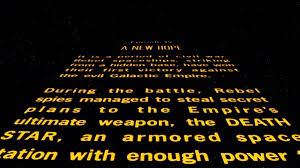
If you’re not old enough to remember the original, unadulterated opening credits crawl to “Star Wars,” I envy you your youth, and pity you not growing up in a cinematic era where the value inherent in the Latin phrase “In Media Res” was lost.
It’s the term we use for joining a “story” that’s already in progress.
In “Star Wars,” we’re told in that opening, that we’re joining a story already in progress, as in the old movie serials George Lucas was paying homage to, and that radio’s Firesign Theatre sent up with its contemporaneous audio cartoon, “Flash Bazbo, SPACE Explorer,” we’re picking things up “When we last left Flash…”
We’re hurled into action and ordered to make sense of it via dialogue with snippets of exposition, semiotics — villains clad in black, storm trooper minions in menacing sneering helmets, heroine and heroine dressed in white — and the instinct to root for the underdogs, those under attack.
The crawl tells us this is “Episode IV: A New Hope.” So we’ve missed three installments of this tale that would have gotten us to this point. And we were FINE with that.
George Lucas’s original script included lots of world-building and what became, in essence, backstories for Luke, the Skywalker clan, Ben Kenobi, Han Solo, Jabba and Gredo. Jump-starting the tale in the middle was one of the luckiest strokes of “We’ve gotta cut this” in the history of cinema.
A big lesson was learned with that blockbuster, one Spielberg and Lucas ran with for “Raiders of the Lost Ark.” We don’t need to see a child, wrapped in swaddling clothes, born on Krypton. Hurl us into the action, take our breath away, and put Indie on the run from Nazis, Natives and “Snakes. I HATE Snakes!”
Fangirl and fanboy mania for “origin stories” took over the movies in the ’90s and really hasn’t let go in the decades since. So we’ve been treated to “Young Indiana Jones Chronicles,” inane “Star Wars” prequels — “Rogue One” being the only one that works — and now a prequel that’s a sequel and a genuine box office bomb in the bargain, “Furiosa.”
We saw Mel Gibson become “Mad Max.” But only AFTER “The Road Warrior” blew up, a stand-alone thriller that didn’t need the no-budget origin story most of us missed in limited release, a tale of Mel’s highway patrolman losing his family and his civilization, but not his police pursuit vehicle, when The World Ended.
The dazzling “Fury Road” was set later in the saga, in this George Miller post “oil wars” “universe.” We didn’t need to see Charlize Theron’s character’s origin story, didn’t need to see how she lost her arm. “Unecessary” was a word that turned up in a lot of reviews, even the laudatory ones.
J.J. Abrams started his “Star Trek” saga with an origin story, and that’s been the rule for most of the big franchise pictures to come along since the ’90s. “Superman Returns” and the entire “Mission: Impossible” franchise were against the grain in starting their stories in media res.
Maybe “Furiosa” is a moment when one and all should remembering that Tolkien wrote a lot of backstory, back history and world building before starting “The Hobbit” in media res, that Lucas basically stumbled into the idea of joining that “galaxy far away,” and that Coppola got away with “Godfather Part 2,” and if you’re not Coppola, maybe asking yourself “Is this prequel really necessary?”should be your first order of business.
What “the studio suits” and accountants want isn’t always the easy money they think it will be. Let’s remember that prequels are “no brainers” just because fans say they want them, but that expecting fans to keep their word when you give them what the fickle dears claim they crave is not just a creative dead end. It can be a financial one, too.



