The first important and well known Maori filmmaker, Lee Tamahori (“Once Were Warriors”) gives us this period piece about an outsider, a preacher, out of his depth in an alien land which Europe is set on conquering and colonizing.
Pearce, a quixotic figure in the acting world, listening to his own drummer, seems the perfect choice to play a conflicted Man of Peace, a mere mortal among Maori warrior tribes.
July 12, we find if both actor and director recapture some of their former glory.
Posted inReviews, previews, profiles and movie news|Comments Off on Movie Preview: Guy Pearce is thrust into the middle of Maori Wars in pre colonial New Zealand — “The Convert”
Pixar’s “Inside Out” was an Oscar-winning “return to form” for the pioneering CGI animation house back in 2015, a film that found heart in attempting to visualize the emotions that guide us through childhood and make us the adults we become.
And while there are changes in the cast and changes in directors for the sequel, “Inside Out 2,” there’s no change in direction of emphasis.
It’s even more about sentiment and emotions, finding, embracing and exposing our shared humanity as we experience “Joy,” “Sadness,” Anger” and now “Anxiety,” “Envy” and oh “Ennui.” And it’s about finding ways to send those emotions up that will resonate with most any adult watching it, and perhaps amuse and inform kids young enough to let their classmates know they’re still into “cartoons.”
Laughs are few and far between here, but a movie about the emotional RED ALERT that heralds puberty is bound to produce a few.
And a film about the age when your core values start to solidify who you are, the tests that come when friendships are pulled-apart and the emotional roller-coaster that could be in animated form ensure it’ll produce a tear or two. Or three.
Our little gal Riley, expressively-animated in all the shades of teen angst, with Kensington Tallman’s perfectly pitched to that, has just turned 13. The “simple” emotions — Sadness (Phyllis Smith of “The Office”), Fear (Tony Hale of “Veep”), Anger (stand-up comic Lewis Black), and lead-“childhood” emotion Joy (Amy Poehler) might not be enough to get her through high school.
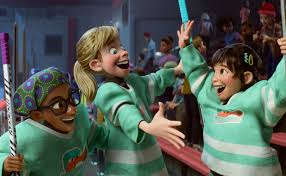
They don’t figure this out until running up against what Riley feels as she’s peaking as a tween hockey player, thrilled and confident winning The Big Game with her Middle School besties, but suddenly getting the attention of older teens she’d love to impress on the high school squad, and their coach (Yvette Nicole Brown).
Mom (Diane Lane) and Dad (Kyle MacLachlan) might be proud. But Riley’s mood changes, crying jags, sarcastic eye rolls and snappishness tell those “old” emotions that there are new players in town.
Enter Anxiety (Maya Hawke), Embarassment (Paul Walter Hauser) and too-cool-for-all-this Ennui (Adèle Exarchopoulos). With high school star Valentina (Lilimar) and Riley’s possible high school Firehawks teammates to hang with at summer hockey camp, Anxiety figures she has the answers.
Out with the old friends, middle school ways, tastes and tried and true emotions. Before the ebbulient, impuslive Joy can blurt “Jiminy mother-loving toaster strudel!” Anxiety has taken control, exiled Joy and her team and put Riley on a path that might alter which memories she leans on that make up her core beliefs, changing who she is and how she thinks of herself.
Joy & Co. figure this coup cannot stand.
The visual genius of “Inside Out” and the similar “Soul” was in the animated ways the screenwriters and the animators visualize memories as tiny orbs, either kept where they can form a musical string that makes up Riley’s character, or pushed to “the back of the mind,” with the least helpful memories buried and best forgetten.
The old emotions must travel the Stream of Conciousness, cross the Sar-Chasm, transit Imagination Land, dodge The Rumor Mill, take part in the Parade of Future Careers and the like on their quest.
As suspense builds, with Riley facing tests of character with competing emotions pulling her in fraught “entire future depends on it” directions, we see the “Inside” struggle in her head and heart, and the ways Riley, “Out” there, acts on this psychic tug-of-war.
The best gags here might be a send-up of Riley’s former favorite singing educational kiddie TV character (goofily voiced by Ron Funches), a riff on “Blue’s Clues” and “Dora the Explorer,” and the flawed and embarassed about it but still haplessly “selfless” video game character (Young Yea) Riley used to crush on.
The lack of humor is felt.
I felt a bit let down by the indistinct voice-casting. Losing Bill Hader and Mindy Kaling takes a bit of edge off the soundtrack, and Hawke, given the plum part of Anxiety, is competent but colorless voicing the role. Ayo Edebiri doesn’t give us enough “Envy” to stand out, nor does Exarchopoulos take Ennui over the top, where she’d register as funny.
That’s the one give-away that writer turned diretor Kelsey Mann is making her feature debut. The voice performances don’t pop. Even Poehler seems a tad winded playing Miss Upbeat All the Time, Joy. That’s the director’s job, to get line-readings that sing.
Some of that can be traced to a script which treats the hunt for sentiment and emotional resonance on an equal level with cute ways of visualizing mental processes, and forgets the laughs.
But most of these “entertainment value” quibbles can be attributed to the original film that spawned it. That means a perfectly fine film suffers just enough when set side-by-side with the modern classic “Inside Out” to be worth mentioning.
Coming in second to one of Pixar’s very best is nothing to, you know, get all emotional about.
Rating: PG
Cast: The voices of Amy Poehler, Lewis Black, Maya Hawke, Liza Lapira, Kensington Tallman, Tony Hale, Ayo Edebiri, Lilimar, Phyllis Smith, Yvette Nicole Brown, Kyle MacLachlan and Diane Lane.
Credits: Directed by Kelsey Mann, scripted by Meg LeFauve and Dave Holstein. A Disney/Pixar release.
Ving Rhames as a cop, Ron Perlman as the mayor of beantown, with Alfred Molina, Michael Stuhlbarg, Jack Harlow and Paul Walter Hauser.
Two desperate guys too old to be leading “a criminal conspiracy” like this, one of them in therapy (Hong Chau goes deadpan), try to rob a mayoral fundraiser.
This 1950s period piece looks chilling, heartbreaking and uplifting.
I can’t easily find any reference to the history this film may be remembering. Maori reform school? Something broader that took in “problem” girls from any race and class? And “cured” them?
Release dates in North America TBD.
Posted inReviews, previews, profiles and movie news|Comments Off on Movie Preview: Erana James is one of the New Zealand misfit girls exiled to an island “reformatory” — “We Were Dangerous”
The debut feature of Spanish filmmaker Estibaliz Urresola Solaguren is an evocative immersion in a place, avocations of that place, in family and trying to figure out how one fits in all that.
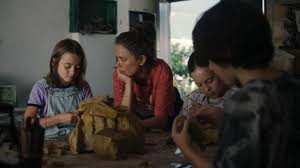
“20,000 Species of Bees” grabs you on several levels, starting with the arresting Basque Country locations. We pick up the rituals of beekeepers, but also explore how one of the fruits of the hive — beeswax — is vital in casting bronze sculptures.
It’s a traditional world, with a very Catholic martiarch, widow of a locally famous sculptor, and the return of her daughter with her three kids. Ave and her brood show up on the eve of St. John the Baptist’s Day, celebrated with a festival and bonfire, allowing them to take a vacation from a struggling marriage and lifestyle just across the border in France.
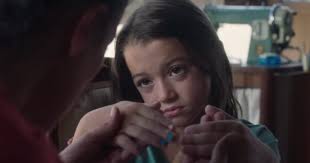
Whatever else is going on in their lives — husband Gorka is skipping this visit — it is their youngest, Aitor, who seems clingiest and neediest. Aitor prefers to be called “Coco.” Aitor likes having his nails painted, playing dressup and waring his hair long.
Aitor acts-out and is indulged, frets and is comforted, and asks questions — of his slightly older brother Eneko, sister Nerea, and when he’s with them, older family members. And for Aitor, or Coco, answers are always forthcoming.
“Will I be like Dad when I grow up?” (in Spanish with English subtitles). “What’s faith?” “Did you always know you were a boy?”
Aitor is eight years old.
Let’s steer clear of the label “coming of age story” for this sympathetic drama about adults bending over backwards to accomodate what we tend to label what children go through at that age — “phases.”
“He’s eight,” more than one adult shrugs.
Even in this corner of Basque country, there’s tolerance — with limits.
“20,000 Species of Bees” is about a family forcing itself to listen to a kid and a child struggling to find the words and blundering about in confusion and the schisms this causes within the family.
Mother Ane (Patricia López Arnaiz) isn’t hearing the relatives gripe about what’s OK “back home” in France. As supportive as she is, she is distracted, with three kids, an absent husband, a possible teaching job in Bayonne. She relishes the chance to dive into her late father’s workshop to see if she still has the skills and the talent to land that job.
And then what?
“Are you separated,” her mother (Ane Gabarain) wants to know?
Grandmother Lourdes sees the kid’s “girlish” hair and affectations and ponders ways to get Catholicism involved. But Aunt Lita (Itziar Lazkano), granny’s sister, is more worried that Coco’s parents haven’t taken the time to “see” the kid and hear the child out. If Aitor/Coco is asking questions of siblings, insisting on using the women’s toilet and dressing room at the pool with Mom and other little girls, Ane needs to shed some distractions.
Bits of the beekeeper’s work, rituals and traditions meet sculpture casting basics in this sublime drama. But “20,000 Species of Bees” lives on its performancs, and the open-faced/open-hearted turn by little Sofia Otero closes the sale.
It’s a childish, unaffected portrait of impulse, shame and anger. A child gets labeled, and wants to correct that label. But to what? At eight, who would know?
Aitor’s reluctant to wholly embrace the gender-neutral name Coco, with his parents shrugging off every bit of acting-out, accepting their indulgence as a way of getting everyone to school/the train/etc. on time.
That’s how lip service is paid to the push-back in a lot of cultures about the seeming explosion in trans identifying children. But “20,000 Species” has somebody from many points of view for the viewer to identify with.
There is no “media” or pop culture “pressure” behind Aitor’s confusion. Aitor takes it on “faith,” in his heart, that something’s not connecting him to the sex he was born with.
Arnaiz stands out as the mother, and there’s great contrast between grandma and great aunt — one obsessed with finding a stolen statue of St. John, a prank that precedes their festival some years, and baptisms, the other hearing the kid and seeing the seeing Coco and wondering how blunt she has to be with Ane to get her to do the same.
Even on the remote edge of the Pyrnees, what much of the world recognizes as “gender fluidity” on a sexuality spectrum, their people grew up as knowing that there’s more than one species of bee.
Rating: unrated, adult themes
Cast: Sofía Otero, Patricia López Arnaiz, Ane Gabarain, Itziar Lazkano, Unax Hayden and Andere Garabieta
Credits: Scripted and directed by Estibaliz Urresola Solaguren. A Film Movement release.
There’s something very attractive about this idea that we go “when it’s your time to go,” and that maybe the hereafter is a bureaucracy we can litigate our way into more time on Earth through.
As fodder for fantasy, that “Heaven Can Wait” plot point was most popular during World War II, when death visited many a family and cinematic comfort food for the grieving and those who know someone who’s grieving resonated with audiences near and far.
It began with playwright and screenwriter Harry Segall’s idea for 1941’s “Here Comes Mr. Jordan,” remade with Warren Beatty and Julie Christie as “Heaven Can Wait” in the ’70s and remade again as a Chris Rock star vehicle, “Down to Earth,” in the early 2000s. There was also “A Guy Named Joe” (remade by Spielberg as “Always”), and of course, that holiday hereafter staple “It’s a Wonderful Life” broadly fits in this same conversation.
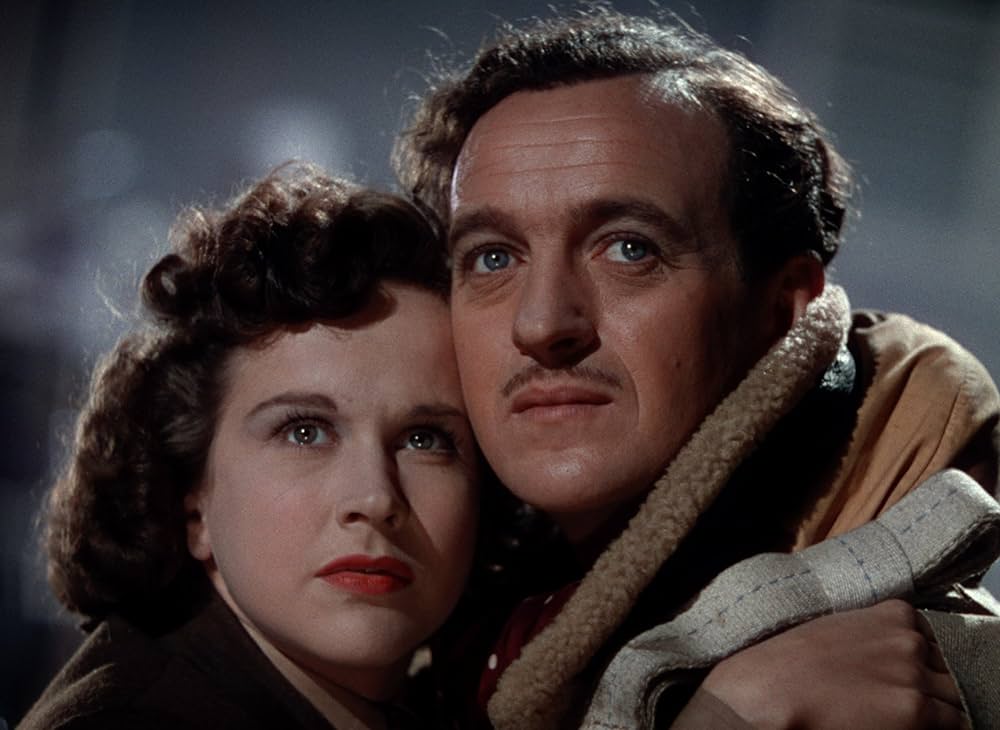
But the best version of this “taking heaven to court because it’s ‘not my time'” is British, an aching wartime/casualty-of-war romance starring David Niven, Kim Hunter and Roger Livesey, and written and directed by Michael Powell and Emeric Pressburger — “A Matter fo Life and Death.”
This 1946 film blends the tragic with the screwball, with daft banter and goofy, ever-so-British stereotypes of Brits, the French and Yanks to boot. It is dazzling in realization, a stunning Technicolor production that made the afterlife and pale imitation of life on Earth — the ultimate “British” bureacracy, finger-pointing within it, and a world that’s monochromatic to boot.
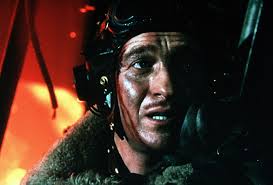
It leaps to a start with an opening scene of a Lancaster bomber pilot (Niven), on flames and “going down” in the fog, his only lifeline a compassionate American Women’s Army Corp (WAC) radio operator (Hunter).
The Brit is antic, almost flippant about death — “Don’t be upset about the parachute, I’ll have my wings soon anyway, big white ones. I hope it hasn’t gone all modern, I’d hate to have a prop instead of wings!”
“June” can’t help but fall in love with such bravado, and Peter the pilot is smitten by her voice. And her reassurances.
“June, are you pretty?” “Not bad.”
Peter wakes up in his flight suit in the surf on the beach near the base where June works. They stumble into each other, instantly recognize their soul mate, and kiss.
During “the war,” they didn’t mess around.
But that romance has a catch. Up in heaven, Conductor 71 (Marius Goring) has noticed paperwork issues. One soul is missing. Tracking it down becomes his mission. “Reasoning” with Peter is his strategy, one arrived at by consulting a dead member of Peter’s crew.
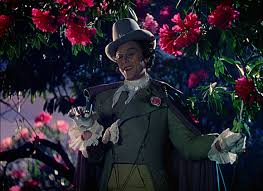
Goring, who’d turn up in Powell & Pressburger’s “The Red Shoes,” plays this “Conductor” as a pre-revolutionary French fop of the first order, not so much a buck passer as a chap who relishes the chance to make his case “down there” for why Peter should come quietly and accept his fate.
“One ees STARVED for Technicolor, up there,” he swans as he swoons over flowers, perhaps the best one-liner in any Pressburger script.
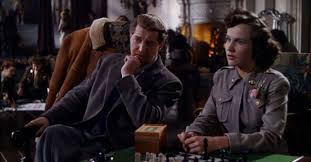
Peter’s in love, and he’s not going quietly. June figures Peter’s communication with this Frenchman is a hallucination, and enlists her pal, Dr. Reeves (Powell & Pressburger mainstay Roger Livesey) to treat him. Dr. Reeves kind of believes the guy, which worries him.
“A weak mind isn’t strong enough to hurt itself. Stupidity has saved many a man from going mad.”
Heaven’s bureaucracy will not be denied, but Peter’s insistence wins him the reprieve of a court hearing in the afterlife. The film’s third act is a somewhat drawn-out “Defending Your Life” court case, another film that draws its inspiration from the idea that heaven is a place where you can take the powers that be to court.
There aren’t many actors who could give Cary Grant a run for his banter like Niven, and Pressburger’s script is decorated with ways for him to show it off — reciting a poem, for instance.
“Give me my scallop-shell of quiet, My staff of faith to walk upon, My scrip of joy, immortal diet, My bottle of salvation, My gown of glory, hope’s true gage; And thus I’ll take my pilgrimage.” Sir Walter Raleigh wrote that. I’d rather have written that than flown through Hitler’s legs!”
Hunter, years before her “Streetcar Named Desire” immortality, is all compassion and emotion as June, buying into Peter’s hallucination, but still hoping Dr. Reeves can “cure” it.
The third act court case is taken over by heavenly protocols, and two powerful performances — Raymond Massey, of Powell & Pressburger’s “The 49th Parallel,” plays an embittered casualty of the American Revolution prosecuting this smarmy Brit, facing off against the man whom Peter gets to defend him. We wonder if Peter has a chance.
“Your smile is not unattractive, sir. Did you use it to enamor this young American lady?”
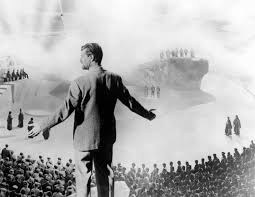
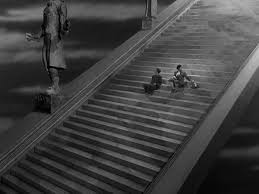
Alfred Junge’s production design is most impressive in the hereafter, with a giant, Busby Berkley-inspired staircase taking our characters on their long walk “up” to eternity. A diverse sea of faces attends the trial — Indians, South Africans, African Americans and Chinese — reminding us it wasn’t just white guys fighting against fascism.
The overlong trial kind of stops the movie in its tracks, but the speechifying fireworks as Massey and his foe make their cases for “The Law” and “Love” in front of judges, bureaucrats and interested (dead) parties, including Puritans, carry it.
The screenplay makes its “love story” sale right in that first scene, just Niven in a mock-up of a burning plane and Hunter trying to keep it together with only the voice of a doomed man to reassure her that it’s going to be all right.
“A Matter of Life and Death” is one of the most timeless classics of its era, a bucket list film for any true film fanatic.
And if you haven’t seen this lovely, funny and moving film, why not let Martin Scorsese make the case for it? He does that, and more, in the new documentary “Made in England: The Films of Powell and Pressburger,” reminding us that much of what was great about the cinema of the ’40s came from the writer/director/producers who called themselves “The Archers” and who rarely missed their target.
Rating: TV-PG, combat deaths, discussion of suicide
Cast: David Niven, Kim Hunter, Roger Livesey, Marius Goring, Joan Maude, Robert Coote and Raymond Massey.
Credits: Scripted and directed by Michael Powell and Emeric Pressburger. A Rank Org/Archers release on Tubi,etc.
Running time: 1:41
Posted inReviews, previews, profiles and movie news|Comments Off on Classic Film Review: The British “Heaven Can Wait,” Powell & Pressburger’s “A Matter of Life and Death” (1945)
Leaning into the logic that “parents are still taking the tykes to “Garfield” at the cinema — at least until “Inside/Out 2” opens — let’s see what this latest iteration of “The Garfield Movie” is all about.
Years of TV shows and other movies about the fat-and-proud-of-it lasagna-addict tabby meant that they’d ave to do something new, something more than just another “Garfield” in his element tale, much more than another “origin story” about how he wound up with put-upon nebbishy “owner” Jon.
So they went for a caper comedy, having Garfield and friends — and relatives — try to hijack a milk tanker from big, impersonal Lactose Farms. It’s a slapstick heist that isn’t a shadow of what Aardman animation did with “Chicken Run” or “Sean the Sheep.” But if you’re going to “borrow” plot points, borrow from the best.
Two members of the cast of “Ted Lasso” turn up. Hannah Waddingham sings, as does Chris Pratt in the title role, an actor who has been in demand in animation ever since “The Lego Movie.” Not that he ever adds anything to these roles.
Samuel L. Jackson voices Garfield’s long lost alley cat dad, Ving Rhames is a bull wanting some satisfaction from that diabolical dairy, and Snoop Dogg and Bowen Yang pitch in, with Nicholas Hoult as Jon and “Lasso” grump Brett Goldstein as a sharpei enforcer for cat diva villain Jinx (Waddingham).
The action is slapstick heavy, aimed at little kids who maybe grew up deprived of the physics-bending violence of “Looney Tunes.”
But this script — three writers, not a one-liner that works — barely a line that inspires so much as a smirk.
“Can I just say, you will NOT be disappointed” the cat narrates in the opening scene. Cats are such liars.
“Have you ever jumped a train?” papa Vic wants to know of his portly progeny.
“I’ve never JUMPED.” “Cheese is my love language.”
At least Jinx, sipping her “Meow-mosas,” watching “Catflix” (Netflix with cat videos) and plotting her revenge on an America that robbed her of the chance to be “America’s Top Feline,” registers.
Garfield still loves his lasagna, still underestimates Odie the dog and grumbles about “Mondays.” But slapstick and decent CGI animation aside, and even grading on that “aimed at very young children” curve, this “Garfield Movie” is slim pickings.
Did they save anything for the sequel?
Rating: PG, slapstick
Cast: The voices of Chris Pratt, Samuel L. Jackson, Ving Rhames, Bowen Yang, Snoop Dogg, Brett Goldstein, Nicholas Hoult and Hannah Waddington.
Credits: Directed by Mark Dindal, scripted by Paul A. Kaplan, Mark Torgrove and David Reynolds, based on the comic strip by Jim Davis. A Sony/Columbia release.
It isn’t scary, with even the best-engineered “gotchas” landing flat.Kind of a big deal when you’re making a horror film.
It’s joyless and humorless to boot, with slick production design that imagines a creature-inhabited “forest” on an island generally forest-free (but not around Wicklow) — Ireland.
“The Watchers,” adapted from a novel by Irish writer A.M. Shine, stumbles onto the screen under a “nepo baby” cloud, with miss-or-hit horror impressario M. Night Shyamalan’s daughter Ishana Shyamalan as writer-director. The best one can say for her hand here is that she’s competent and utterly uninspired.
M. Night, long one of our more delightfully egomaniacal cinematic self-promoters, must have figured that he could turn his “brand” into a filmmaking dynasty.
Nope.
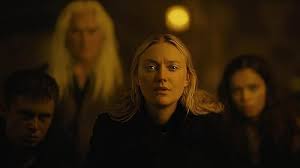
But at least that spares poor Dakota Fanning much of the beating this derivative drivel richly deserves. One of the least expressive actresses of her generation, she plays an American pet shop clerk ordered to deliver a talking yellow parrot (Perhaps a Golden Conure?) from Galway to Belfast, only to break down in a vast forest from which “there is no escape.”
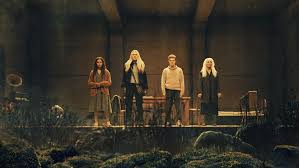
Our clerk, Mina, stumbles into this sage older woman, Madeleine (Olwen Fouéré) who lets her into “The Coop,” a bunker-like structure where Madeleine, Ciara (Georgina Campbell) and young Daniel of (Oliver Finnegan) are holed up.
They have been here for varying lengths of time. Those who tried to escape were never heard from again. So they have to trap and kill their own food, they tell her — ravens or crows, mostly. They cannot be out after sunset. They must “never” look into the burrows that honeycomb the forest. And despite a lot of “Point of No Return” signs that ostensibly could guide someone out, they can’t make it all the way out before darkness comes.
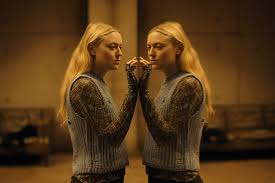
Thus the trap. And every night, “The Watchers” insist they stand up in front of the mirror facing a window and be displayed to their captors.
“It is not wise to keep them waiting.”
The dialogue is a collection of mytho-poetic rubbish of the “It is said that they once walked among us” explanations. The set decorations include an ancient CRT TV and DVD player and an even more ancient Victrola.
We and Mina hear the rules. We and Mina see flashes of children — hallucinations — in the forest. We pick up on Mina’s past, why she’s exiled herself to Ireland.
And not a word of it, not a single fact forced-in, not an attempted “escape” or breach of “The Rules” can do a damned thing to interrupt the tedium.
Bringing in John Lynch for further third act explanations has a “too little, too late” and “Too much” explaining about it.
I’m inclined to think the clumsy and cumbersome material itself, being M. Night “adjacent” in themes and set-up (“Knock at the Cabin”), is just not worth the trouble of adapting.
But Ms. Shyamalan and Ms. Fanning seal its fate, each in her own way — one for having no “gift” or flair for directing, and for casting Fanning and the other for not knowing better — at 30 — than to accept a part that required more of her than she’s got in her repertoire.
Rating: PG-13, some nudity, bloody violence, profanity
Cast: Dakota Fanning, Georgina Campbell, Olwen Fouéré, Oliver Finnegan and John Lynch.
Credits: Scripted and directed by Ishana Shyamalan, based on the novel by A.M. Shine. A New Line release.















 Movie Nation