Movie Review: So, what’s the big deal with “Longlegs?”

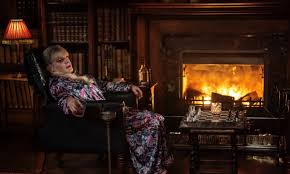
The comparisons with “Silence of the Lambs” litter the reviewing landscape of the wintry Oregon-set thriller “Longlegs.” It’s a horror movie with higher ambitions, or at least pretensions, thanks to its casting of Nicolas Cage as an aged, high-voiced, Satan-worshipping glam rock fan of “on the spectrum” gender and Marc Bolan T.Rex attire.

But the more obvious reference is revealed in make-up that accentuates Cage’s plastic surgery fillers over the years. Apply enough pancake and he looks like the marionette Jigsaw “spoke” through in the “Saw” franchise. A little lipstick, a bit of rouge, and the impersonation is complete.

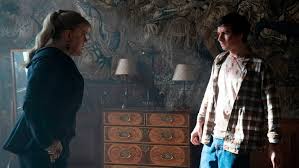
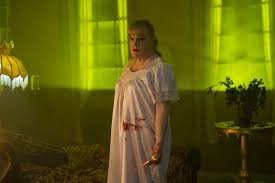
This somber hunt for a decades-at-work serial killer who seems to kill by proxy in the Pacific Northwest of the 1970s through the ’90s parks Maika Monroe in what some are calling the Clarice Starling role. As horror queen Monroe has cleared 30 and still not developed a credibly  adult woman’s voice or the technique to show interior turmoil underneath her blank-faced deadpan, this seems a stretch.

The “It Follows” star is a new FBI agent assigned to 1990s door-knock her way to leads in an open case where families with a particular composition are slaughtered in a ritualistic, systemic fashion every few years under grey, overcast skies.

A “hunch” leads her straight to a suspect on another case, and her boss (Blair Underwood) is inclined take that as a sign. Sort of. He’d like to label her a “psychic,” but “highly intuitive” is what he settles for. She’ll be of help in his long hunt for the mysterious, doll-delivering ogre “Longlegs.”

Longlegs (Cage) is a “Hail Satan!” head case who targets families, and gains access to them just long enough to ensure they’re slaughtered, but not by his hand.

He works through others, guiding their mania. And he writes messages in unrecognizable lettering in indecipherable code. Agent Harker (Monroe), an obsessive loner, cracks it. Longlegs celebrates by sending her a birthday card — in code  — which she cracks.

There’s our connection, serial killer to serial killer hunter. But there’s little cat and mouse to this thriller, little urgency to the quest and little volume to Monroe’s mousy voice as she tries to contend with a killer who may have her number, and an aged mother (Alicia Witt, remember her?) who can’t seem to remember she’s her only daughter.

Our killer quotes from Tommy James of Tommy James and the Shondells (“Crimson…and CLOVER!”) and T. Rex. The film is a period piece largely to accommodate this glam rock/gender-bending fixation in the mind of actor turned writer-director Oz Perkins (“The Blackcoat’s Daughter,” “Gretel & Hansel”).

It’s jarring to see Bill Clinton’s face in every office shot of the F.B.I. agent who believes in psychics (Underwood) office. But at least that’s something. The film is a somber, somnambulant drift for long stretches, interrupted by cheap jolts and the occasional grim “legitimate” one.

As the picture has its share of Easter Eggs — Cage’s “Jigsaw” look, the presence of an “Up With People” song, featuring annual Oscar also-ran Glenn Close (per the closing credits) on the soundtrack, the “It Follows” star rather dully doing the “following” here — I was inclined to wonder if the film’s “Bang a Gong” obsession wasn’t just gender-culture commentary, but a shot at a notorious Hollywood blogger and T. Rex cultist.

Probably not.

But I also didn’t find much else to recommend “Longlegs.” Cage’s shrill, singing Satanic fop (think a slightly less feminine James Corden) amuses in tiny doses. Monroe’s monochromatic turn isn’t a step up from her other horror work, and while Underwood, Michelle Choi-Lee (as a fellow FBI agent) and Witt are interesting, their characters’ and actions don’t really pass the logic-within-this-movie-world test.

Self-seriousness is an interesting angle to pursue in horror, and some boutique studios have made that their brand. But while Perkins may have convinced some of his sleep-inducing thriller’s sophistication and gravitas, I didn’t buy in, any more than I forgot the distributor is hit-or-miss Neon, the “Dollar General A24” in film studio shorthand.

Love Cage, Monroe has impressed in the past, even if one wonders if that Jennifer Tilly voice will serve her well in the long run. And I’m not buying the Quantum Leap in Oz Perkins’ filmmaking some are calling this. In the case of “Longlegs,” the hype is the picture.

Rating: R for bloody violence, disturbing images, smoking and profanity.

Cast: Maika Monroe, Nicolas Cage, Alicia Witt, Michelle Choi-Lee and Blair Underwood.

Credits: Scripted and directed by Oz Perkins. A Neon release.

Running time: 1:41

Posted in Reviews, previews, profiles and movie news | 1 Comment

Movie Review: An Englishman among the Maori, but who is “The Convert?”

The image is so iconic, so striking, and occurs so early in the immaculately realized period piece “The Convert” that you can’t miss its meaning.

Guy Pearce, at his most dashing and playing a lay preacher new to a tiny English colony in New Zealand, trots his white horse down a long, empty and visually striking beach. He is “the white savior” incarnate, a “civilized” man come to bring The Word, righteousness and peace to the locals and the natives.

But as the latest film from New Zealand’s greatest Maori movie-maker, Lee Tamahori (“Once Were Warriors,” “The Patriarch,” “The Devil’s Double”) makes clear, that’s the opposite of the interpretation that this tale of the First Contact years of that island nation intends. This rider on a white horse is a man out of his element and out of place, but one who knows what is coming, what has come to every place Europeans have moved in among the more primitive indigenous peoples.

And even though “The Convert” will have its righteous man among the unrighteous moments and turn towards nn homage to Conrad’s “Lord Jim” in a breathtaking and bloody climax, the messaging never deviates from the opening titles, which tell us how native Maori life, tribal conflict and culture changed with the arrival of two things the Europeans brought with them — firearms and “Christianity.”

Our preacher may try to intervene and change the violent course of events. But he is no savior. He is merely a bystander trying to stop the bleeding.

Pearce plays Thomas Munro, a man summoned by the tiny outpost of Epworth to be their lay preacher. He arrives, by coastal schooner, with his horse, deposited in the Edenic land of stunning cliffs over pristine beaches and glorious primeval forests. His captain (Dean O’Gorman, subtly guarded) is a pragmatic opportunist, a trader who has learned to speak Maori and “mentored” a chief’s son (Ariki Salvation-Turner) in the ways of the sea and the world as a way of easing the path to doing business here.

But on landing, the boy reunites with his father (Lawrence Makoare) as they slaughter members of another tribe Munro has tried to befriend. The only “mercy” the man of God is able to wring out of the hulking, brutish Akatarewa is trading his horse for a newly-widowed and injured survivor, Rangimai, played by Tioreore Ngatai-Melbourne in an outstanding performance that ranges from fierce and cunning to gutted and distraught.

And arriving in Epworth, he may find a new church with stained-glass windows and a populace eager for a preacher. But the doctor refuses to treat Rangimai, the locals barely tolerate her and keep an eyebrow raised as long as she is the “ward” of their new pastor.

Only the near-outcast Mrs. Haggerty (Jacqueline McKenzie, terrific), who has lived among the Maori and speaks their language, will help.

With a tenuous hold on the coast in an unfortified settlement, rented from Rangimai’s accomodating chief (the imposing and regal Antonio Te Maioha) and a marauding warlord slaughtering his way towards them, life is tenuous for settlers who should know better than to hold their “hosts” in such racist contempt. Munro, at least sees this.

“Even when you can’t see them, they’re there,” he’s been warned.

The tattooed, haka-chanting tribesmen and women are fierce enough with their ornate war clubs and carved knives. How dangerous will they be to the English and to each other once they’ve got their hands on a supply of Brown Bess muskets?

The script traffics in the tropes of such tales of a Pākehā among the natives — “forbidden love,” a “civilized” culture of violence meeting an alien culture of ritualized violence, and the inevitable escalation introduced by firearms.

English is picked-up quickly enough to be convenient to the plot, as are the intricacies of a tall rigged ship and its artillery.

But Tamahori is a filmmaker in both his elements here, a Maori who never allows this Maori story to turn patronizing, an action auteur (he counts a Bond film, a “XXX” thriller and “The Edge” among his credits) who knows how to make violence visceral, and in combat scenes, an epic experience.

And Pearce, who has aged from a matinee idol into an actor with a weathered, world-weary presence, lets Munro walk the line, never letting go of the idealism he’s tried to embrace, never forgetting the cynicism that knows better than to expect much out of humanity, no matter where that humanity lives or what traditions it comes from.

Rating:

Cast: Guy Pearce, Tioreore Ngatai-Melbourne, Antonio Te Maioha, Lawrence Makoare, Dean O’Gorman, Ariki Salvation-Turner and Jacqueline McKenzie.

Credits: Directed by Lee Tamahori, Michael Bennett, Shane Danielsen and Lee Tamahori. A Magnet release.

Running time: 1:58

Posted in Reviews, previews, profiles and movie news | Comments Off on Movie Review: An Englishman among the Maori, but who is “The Convert?”

Classic Film Review: “Thirty Seconds Over Tokyo,” (1944) Van Johnson’s finest hour?

I’ve read a few books on the subject, including the most recent scholarship about “Doolittle’s Raid” on Tokyo, one of the more daring American air exploits of World War II. And I distinctly recall the chill that went through my fellow sailors when we stood up, awed, as the surviving members of those air crews passed us to gather at a park adjoining the Sarasota city marina, on their way to celebrate their achievement and remember those who no longer in their ranks some years back.

But a lot of things kept me from taking a look at the big screen version of the World War II memoir “Thirty Seconds Over Tokyo.”

“Accuracy” was a big selling point of this mid-war (1944) WWII film. The brilliant Dalton Trumbo scripted it based on one of the raider’s memoirs.

But how sober and accurate could it be, passing patriotic U.S. censors, coming from the biggest and most sentimental studio, MGM, and starring Van Johnson, for Pete’s sake, the Robert Taylor of Randolph Scotts?

And if there’s a characteristic that unifies the films of director and producer Mervyn LeRoy, it’s that he made a lot of them (“Quo Vadis,” “Waterloo Bridge,” “Mister Roberts”) and that there’s nothing distinct about the direction of any of them. The ones with the best source material that attracted the best cast (“Mister Roberts,””Little Women”) were pretty good. The rest? Competent but colorless.

But remembering the decent job Roland Emmerich and a cast that included Aaron Eckhart did when recreating the raid as the forward to 2019’s “Midway” made me finally knuckle under for the two hours and 18 minutes that LeRoy and MGM devoted to the training, bombing and aftermath that faced those 16 B-25 crews in April of 1942, some of the darkest days of the war.

I knew this picture would be a bit stiff and entirely too gee-whiz-you-guys cheerful, and it is. But this is a smart, sometimes tense and bluntly accurate — if myopic — recreation of a pivotal moment in the Pacific war, when U.S. Army Air Force pilots disabused the Japanese aggressors of the alleged safety of their remote island home in just “Thirty Seconds Over Toyko.”

Spencer Tracy makes Lt. Col. James Doolittle a blunt, just-aloof-enough taskmaster, the guy who dreamed up this scheme of putting medium range land-based bombers on an aircraft carrier’s flight deck and zipping over Japan for a broad scattering of bombings that would startle and rattle millions of Japanese, no matter how their fascist government might try to spin the attack.

“It’ll work out, general,” he reassures a superior. To the 24 crews he brings to Florida for training, to be winnowed down to sixteen, he’s no nonsense. No mistakes, no mechanical problems with your “ship,” no attacks of conscience or fear in any of your crew or you’re out.

“That Doolittle’s a cheerful one, isn’t he?”

Lt. Ted Lawson (Van Johnson) skippers the four men of the B-25 they’ve named “Ruptured Duck,” getting them as ready as the other pilots (Robert Mitchum plays one, and singing, smiling and drawling John R. Reilly plays another) compete to see who can be the first to master taking off at half the speed and with one third the runway that they usually use.

Tracy’s Doolittle is a leader, and pretty unsentimental. The Trumbo script and MGM lineage ensure that pretty much everybody else in the picture makes up for that stoicism — sentimental Southern Cal dad-to-be to Virginia card sharp who gets hustled to Shorty (Reilly), always leading the boys in “Eyes of Texas” or any other Texas song he knows in sing-alongs.

The grinning actors playing cheerful, patriotic character “types” and the light tone are only interrupted by Mitchum’s sober, cynical visage. The man knew how to smoke a cigarette (the movie’s practically an “Enjoy smoking” ad) and size-up a worst-case scenario.

That’s kind of what transpires as their task force is spotted half a day and hundreds of miles short of its planned launch point, forcing the crews to take-off without the cover of darkness, or the guarantee of having enough fuel to reach the safe (unoccupied) part of China.

LeRoy integrates declassified documentary footage of the U.S.S. Hornet’s launch of the planes with soundstage close-ups, planes on a recreated flightdeck (with carrier tower) and footage of a B-25 actually taking off from the famed Santa Monica pier, dressed up to pass for an aircraft carrier deck.

Scenes in China are a marvel of rear and front projection, soundstage sets and painted glass backgrounds, putting Chinese-looking mountains behind a Chinese junk and village across the bay and the like.

A favorite shot? The “Hornet” public address system announces “the smoking lamp is lit,” and air crew, on the deck in the dark, shot from the bridge above, all lighting up in response.

The sentimental stuff grates a bit — hearing Phyllis Thaxter, as Lt. Lawson’s pregnant wife, chirp to fellow pilots’ wives that “If anything should happen, I’d have the baby, a little bit of Ted still living.”

The ordeal of those who survive the raid is over-simplified, partly because only those the Japanese didn’t capture (and in some cases, execute) were available to tell their story. But Lawson’s is particularly harrowing, allowing for scenes of Chinese aid and fluffing the alliance of China and the U.S. during the war with “You people are all right by me” sentiments.

And the low altitude flying footage and in-the-cockpit fakery is first rate, helping the suspense build during the raid itself and dramatically, can’t be topped. They had no idea they’d take the enemy by surprise, and their shock had to be akin to that of the first fliers of Japanese bombers sweeping over Oahu.

Johnson acquits himself quite well in the suffering airman scenes, and one could tell MGM was prepping Robert Walker and Mitchum for stardom with their spotlight supporting roles.

New facts and accounts of the show trials the Japanese staged for some captured airmen would flesh out any more modern account of this pivotal piece of World War II history, and new technology might render the raid itself more immersive and thrilling.

But give it to Mervyn LeRoy, MGM and the U.S. War Dept. of the 1940s. They got a solid, linear, tense and moving script, some famous and not-yet-famous faces from the backlot and a whole lot of combat-ready B-25s together. They put viewers, then and now, right there on that flight deck, crawling down that fuselage tunnel from the B-25 tail to the bow and down there “on the deck” flying at near treetop level through hostile territory on a daring top secret quest that no one back then would describe the way we would today — “a suicide mission.”

And they made a historical drama so close to the truth and polished that it holds up to this very day.

Rating: “approved,” TV-PG today

Cast: Spencer Tracy, Van Johnson, Phyllis Thaxter, Don DeFore, Robert Walker, Stephen McNally, John R. Reilly and Robert Mitchum.

Credits: Directed by Mervyn LeRoy, scripted by Dalton Trumbo, based on the book by Ted W. Lawson. An MGM release on Tubi.

Running time: 2:18

Posted in Reviews, previews, profiles and movie news | Comments Off on Classic Film Review: “Thirty Seconds Over Tokyo,” (1944) Van Johnson’s finest hour?

Series Preview: A Waititi take on “Time Bandits”

Lisa Kudrow and Jemaine Clement’s presence notwithstanding, I’m going to take a wild guess and say this summer’s Taika Waititi Version of Terry Gilliam’s fantasy classic “Time Bandits” could be the 2024 equivalent of George Clooney’s attempted “Catch-22.”

The delirious mayhem, the diminutive cast of trouble-makers, the visionary surrealism, the darkness of it all, the texture of the history visited, the lack of whimsical Sean Connery, Shelley Duvall, Ian Holm, Ralph Richardson, David Warner, Katherine Helmond, John Cleese and Michael Palin and lots of funny little people, all are missing in what looks like a cheap knock-off with a trailer set to the B-52s’ upbeat “Roam.”

It’s “Voyagers!” in other words, a little-remembered ’82-83 NBC series that borrowed plot elements from “Time Bandits.” As fondly as some fanboys might remember that, I’d suggest…watching it anew, if you can find it, and repent.

Posted in Reviews, previews, profiles and movie news | Comments Off on Series Preview: A Waititi take on “Time Bandits”

Netflixable? Can an introverted academic save “The Champion” soccer player from himself?

“The Champion” is a formulaic Spanish sports melodrama about an athlete with “issues” finding his way back to public favor and his place within “the beautiful game.”

It’s not subtle, featuring a rageaholic soccer star whose tantrums are over the top and can be triggered by just about anything. It’s clumsy, suggesting an introverted academic expert on “genius” and not a therapist is the best person to “help” Atletico Madrid superstar Diego grow up.

But it has a moment, here and there. There’s an insight or two that slips in around the edges. And the Big Game finale even manages a surprise that summons a tiny lump in the throat.

Screen newcomer Marcel Serrano is Diego, the small-town boy whose drive — and pushy father (Pablo Chiapella) have taken him to soccer stardom in his teens. Now pushing 20, he’s rich, with 20 people on the payroll, a mansion filled with hangers-on, and his beautiful childhood sweetheart (Cintia García) on his arm.

But we meet Diego in crisis. Losing a match sets off a tantrum that ends with him cursing one and all and head-butting the team captain, all captured on TV.

A lot of threats about how he should “represent the club’s values” and “There’s no room on the team for a hooligan (in Spanish, or dubbed into English) lead to a press conference and a stumbling attempt at reading an apology.

Diego doesn’t realize it, but his agent Juanma (Luis Fernández) has bribed his on-the-spectrum academic brother (Dani Rovira) to come, observe, coach and “help” the star improve his behavior during a multi-game suspension leading up to the season-ending match for the league title.

Academic Alex is a loner, about to lose the house he inherited, a guy with issues traceable back to his and Juanma’s emotionally unavailable, soccer-obsessed father. He’s not a therapist, licensed or otherwise. But he can be bought and perhaps manipulated. And as an observer, he picks up on Diego’s first big problem at that press conference.

“I’m not an idiot, you know,” the kid hisses.

“You have dyslexia.”

With Diego impulsive, mercurial and prone to “do whatever I want,” and with social media and mass media publicity to do about this “intensive education” session to help Diego “tackle” his problems, Alex is instantly in over his head and neither man seems all that keen to get on with much of anything, much less grappling with the issues at hand.

A simple “add words to your vocabulary” regimen, praising Diego’s native “genius” at recognizing patterns in space — on the soccer pitch or on a Rubik’s Cube — and getting away from the paparazzi in Alex’s hometown, and Diego’s own, should be enough to “fix” him. Right?

The film’s simplistic cause and effect won’t be to many tastes, nor will its tried-and-trite march-to-the-big-game/remember-why-you-love-it plot.

But it a few moments. Serrano blows up with conviction, and Rovira’s not bad at a sort of “Monk” soccer whisperer. Chiapella is very convincing as the bullying, success-at-all-costs control freak father, and García makes the most of a tiny supporting role which, considering her character’s love and concern for Diego, should have been larger and more integral to the story.

“The Champion” isn’t a winner, but formulaic or not, it’s never quite a total write-off either.

Rating: TV-MA, some violence, profanity

Cast: Marcel Serrano, Dani Rovira, Pablo Chiapella, Cintia García and Luis Fernández

Credits: Directed by Carlos Therón, scripted by Joan Gual and Joaquín Oristrell. A Netflix release.

Running time: 1:46

Posted in Reviews, previews, profiles and movie news | Comments Off on Netflixable? Can an introverted academic save “The Champion” soccer player from himself?

BOX OFFICE: “Longlegs” brings back the horror audience…or is it the Nic Cage audience? “Fly Me to the Moon” aborts on takeoff

Yes, it’s another weekend of animation domination of the summer box office, with a mediocre “Despicable Me” sequel — “Despicable Me 4” — clearing another $44 6 million, according to Deadline.com.

But the year-long absent horror film audience is the story of the weekend, delivering another hit to workaholic Nicolas Cage’s long resume and giving tony distributor Neon (the poor man’s A24) its biggest opening weekend ever.

“Longlegs” opened at $22.4 million. That’s good enough to come in second place,  with “Inside Out 2” third,  clearing $20 million itself.

“A Quiet Place 3,” aka “A Quiet Place: Day One,” is still bringing home the bacon, pulling in another $11 million as it marches beyond the $100 million domestic take mark ($200 million worldwide).

Apple/Sony’s ill-considered “Fly Me to the Moon” wasn’t the best reviewed new release of the weekend, but that isn’t keeping it from making a not-quite-respectable $10 million or so and a top five finish. Apple spent $100 million on it, filming some sequences at Kennedy Space Center. So…it’ll be streaming soon enough.

“Bad Boys: Ride or Die” ($4+) plunging “MaXXXine,”($2.9) “Horizon” and “The Story of Possum Trot” and other hangers-on will finish the week in the bottom half of the top ten, if in it at all. “The Bikeriders,” “Kinds of Kindness” and “The Fall Guy” are the likely candidates for tumbling out of contention, with older releases losing screens and “Kinds of Kindness” never quite catching on.

Posted in Reviews, previews, profiles and movie news | Comments Off on BOX OFFICE: “Longlegs” brings back the horror audience…or is it the Nic Cage audience? “Fly Me to the Moon” aborts on takeoff

Classic Film Review: David Lean’s “The Passionate Friends”

The later films of David Lean are works of such visual ambition and scale that they can let the viewer lose track of the connective thread, the relationships and characters that make “Bridge on the River Kwai,” “Lawrence of Arabia” and “A Passage to India” so compelling.

We see the editor-turned director, the craftsman and painter of grand cinematic landscapes, but forget the emotional triangles that are the building blocks of even his literary adaptations or biographical epics.

“The Passionate Friends” (1949) is a simple love triangle, another “Brief Encounter” (1945) melodrama about infidelity that here isn’t just considered, but consummated. This time, the third party in the love triangle is much more present.

It’s not “wartime rationing” prosaic, sad and drably middle class like “Encounter,” but posh, even if it feels very much hemmed-in and soundstage-bound until it opens up in an extravagant, lavishly-photographed (in black and white) third act, set and shot largely in the French Alps.

Following Lean’s classic Dickens adaptations “Great Expectations” and “Oliver Twist,” this return to melodrama was a box office flop and tempted Lean into imitating Hitchcock (“Madeleine”), even trying his hand at period piece domestic comedy (“Hobson’s Choice”) as he slowly re-acquired the prestige and box office success that allowed him to make motion picture “events” from “Kwai” until the end of his days.

“Passionate Friends,” based on a novel by “free love” sci-fi pioneer H.G. Wells, is a post-war tale consumed by a long flashback to how our lovers were connected before World War II, and otherwise barely mentions the conflict, loss and privation that Britain was still crawling out of in the late ’40s.

Ann Todd is our heroine and narrator, Mary, a great beauty with an idea of “the sort of life” she wants — rich and privileged. When we meet her, she’s narrating her way on her first post-war holiday, flying to Switzerland (Haute-Savoie, France, actually) to the lakeside Hotel Splendide for a little pampering.

Her husband is stuck in London on business, but his secretary (Betty Ann Davies) accompanies her and makes everything go effortlessly as she awaits the man who pays for all this comfort and high-fashion.

But an old flame checks into the room next door. And speaking from the fictive present — after she’s realized who is staying there — she recalls her great pre-war love affair with academic biologist Steven (Trevor Howard of “Brief Encounter”), the man she told “I shall never love anyone as much as I love you.”

The lengthy flashback isn’t the most graceful one Lean ever offered, but basically Mary and Steven stumble into each other on New Year’s Eve, 1939, after they’d broken up and she’d gone on to marry money. They begin to see each other as “friends,” which her older husband, Howard, tolerates. Howard is played by forever-cuckolded Claude Raines, who made more than one film where he’s the rich, older spouse whose wife is tempted away.

The “passionate friends” revert to being more than friends over the course of this long flashback, and even decide to tell Howard and make a go out of being together. But that didn’t work out, and now nine years later, they’re spouse-free in Switzerland and about to renew their acquaintance in one of the most striking settings on Earth.

Todd is the heart and soul of the picture, and her performance lets us see the inner turmoil of a woman who wants to have her Chanel and Switzerland, and her great love, too. She is at her best in scenes where Mary recognizes the dilemma she’s put all involved in and grows frantic — in that reserved and ever-so-English way — about what to do.

Rains makes Howard dashing, deliberate and distracted enough to let all this play out, but determined to bring down the wrath of Howard when it all blows up.

Trevor Howard is as passive here as he seemed in “Brief Encounter,” a near innocent who can’t quite resist whatever Mary is pulling him back into or see the risks of following one’s heart…or impulses.

The picture’s three-hander structure limits its scope, with much of its running time consumed with drawing room conversations, close-ups of each character in her or his emotional distress, and the clumsy way Mary and Steven handle their indiscretion and keeping it secret.

A rich man, humiliated, can be a dangerous thing.

Lean gets things moving and scenic in the third act, seamlessly blending location exteriors with Pinewood Studios sets, rear-projections and the like.

And the finale manages some suspense, even if it feels like the cop-out many a melodrama of that era leaned into for its ressolution.

But Lean completists will take pleasure in the connective tissue that binds “The Passionate Friends,” a lesser Lean film, with his other work, get a sense of his first serious dalliance into an epic setting and enjoy one last passive romantic turn by Trevor Howard, before a career of grumpy authority figures and military men would all but erase the romantic Lean first saw in him.

Rating: TV-PG, infidelity, smoking

Cast: Ann Todd, Trevor Howard and Claude Rains, with Betty Ann Davies, Isabel Dean and Wilfred Hyde-White.

Credits: Directed by David Lean, scripted by Eric Ambler and David Lean, based on the novel by H.G. Wells. A Univeral/General Film Distributors release, a J. Arthur Rank production restored and now on Tubi, Amazon, etc.

Running time: 1:35

Posted in Reviews, previews, profiles and movie news | Comments Off on Classic Film Review: David Lean’s “The Passionate Friends”

Movie Preview: Naomie Harris and Natalie Dormer are old classmates in “The Wasp”

Oh no, not a superheroine movie. A cheated, abused woman tracks down her most violent childhood friend for…an offer.

“We need a proper plan.” “Are you sure you want him actually dead?”

Aug 30. UK and US?

Posted in Reviews, previews, profiles and movie news | Comments Off on Movie Preview: Naomie Harris and Natalie Dormer are old classmates in “The Wasp”

Movie Preview: At what point does “Deadpool & Wolverine” promotion reach “oversaturation”

Asking for a friend.

Endless variations on these adorable teasers, tie-ins and trailers. Too many? Getting there.

Posted in Reviews, previews, profiles and movie news | Comments Off on Movie Preview: At what point does “Deadpool & Wolverine” promotion reach “oversaturation”

Movie Preview: Crikey! Can Stop Motion Animation, Surfer Voices and live-action surf footage make “The Greatest Surf Movie in the Universe?”

Takes a pair of plastic unicorn testicles to make a movie like this, title it like that, and release it Aug. 16.

Just saying…mate.

Kelly Slater and some surfer dudes and Luke Hemsworth provide the voices.

Posted in Reviews, previews, profiles and movie news | Comments Off on Movie Preview: Crikey! Can Stop Motion Animation, Surfer Voices and live-action surf footage make “The Greatest Surf Movie in the Universe?”