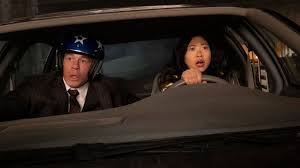
Movie Review: M. Night falls into the Parent “Trap”

An expertly shot and edited thriller built around a cringey/creepy performance by Josh Hartnett is undone by an indulgent father trying to make a pop starlet/actress out of his daughter in “Trap,” the latest from M. Night Shyamalan.

Mr. Suspense-with-a-Twist Hitchcock for the fanboy era takes another shot at passing on the family business to his offspring. And as this tale of serial killer dad possibly undone by indulging his daughter’s fervent desire to see her favorite pop diva in concert goes utterly off the rails in the third act, one cannot help but smirk at the irony of it all.

Because that’s how Daddy Shyamalan’s film is undone, indulging singer/songwriter/actress Saleka Shyamalan to the point where she’s not just the remote performer whose big Philly show “The Butcher” is trapped in, but a key player in the drama that will decide the fate of this monster.

Screen veteran Hartnett plays Cooper, rewarding his tween Riley (Ariel Donghue) for her latest report card by taking her to the big arena concert by Lady Raven (Saleka S.). She’ll sing along with the rest of the crowd, dance with her fellow fans and capture a bit of the spectacle on her cell phone.

But whatever everybody else thinks of the massive police presence at the show, ol’Dad is put on edge. His dark (shadowed in many shots) eyes dart about the venue, not exactly alarmed, but warily and instinctively searching for a cop-free exit.

Some officious Brit, played by Hayley Mills (a LONG way from “The Parent Trap”), seems to be in charge.

As the good-time vibes of the PG-Gaga stage show get underway, Dad makes it his business to avoid the mother (Marnie McPhail) of a child who’s gone mean girl on his daughter. And he turns on his toothiest grin to get answers from a too-helpful shirt vendor (Jonathan Langdon) who might know what’s up.

“You know that serial killer, ‘The Butcher?'” Twelve grisly dismemberment murders and all? The cops know he’s here, and they’re going over everyone the profiler (Mills) thinks could be their suspect.

“Trap” thus becomes a puzzle, an escape room exercise, with the city fireman Cooper refusing to panic, pilfering a security pass and police radio and plotting his getaway.

That “working the problem” is well-handled, with the camera letting us see much of what Cooper might view as a means of slipping through the dragnet. Shyamalan’s shot strategy was to film Hartnett in close-ups and extreme close-ups, highlighting his sinister guise and efforts to mask it for bystanders, police and his daughter, who can’t help but ask “Is something WRONG Dad?” more than once.

Sometimes we see just a portion of Hartnett’s face — one eye only in the frame, or just eyes and mouth — underscoring a situation closing in on a cool-headed killer.

Cooper considers this option and that one, and being the Best Dad Ever, lies to a talent handler (M. Night Shyamalan himself) to help his kid get selected to be the “Dream Dancer” who shares the stage with Lady Raven in one of her numbers. He has ulterior motives.

And every so often, he checks his phone where he has a camera on his latest imprisoned and doomed victim.

Some touches here pay off nicely, such as the fact that the more we see and hear of Mean Girl Mom, the more we let ourselves smirk at her possible fate. But as the plot unfolds, Shyamalan’s work-the-problem steps become more and more far-fetched. And the more he involves his daughter in those machinations, to more of an eye-roller this thriller becomes.

The character’s place in all this we might buy. Her performance of it we won’t.

Young Ms. Shyamalan isn’t wincingly bad, but her inane self-written/self-performed songs are best absorbed in tiny samples, her stage presence as a pop diva is adequate only up to the moment when she stops singing and starts talking with the crowd.

She might “get there” someday, but jumping her to the front of the line does her no favors. All of Daddy’s tricks can’t cover a performance that demands more from her than merely dressing and play-acting “famous.”

Kid Cudi has a fun cameo as The Thinker, a singer/rapper who helped Raven get her start and as Cooper and Riley note backstage, is bitter about it. The Thinker “notices” hunky Cooper, too.

Mills was an odd, gimmicky choice for the all-seeing, all-predicting profiler, who might as well be a psychic.

“Trap” still succeeds in wrong-footing the viewer more than once, but at least some of that comes from Shyamalan’s third-act contortions to bring this thing across some sort of finish line — or finish lines.

As events take their turn in that direction, plot points and narrow escapes become a series of more and more absurd twists.

In other words, if any of us are ever on the lam, maybe traveling north to the City of Brotherly Love to lay low is our best option. Shyamalan’s version of Philly’s finest couldn’t find Rupaul in a rodeo.

Rating: PG-13, violence

Cast: Josh Hartnett, Ariel Donaghue, Saleka Shyamalan, Kid Cudi, Marnie McPhail, Jonathan Langdon, Hayley Mills and Alison Pill.

Credits: Scripted and directed by M. Night Shyamalan. A Warner Bros. release.

Running time: 1:45

Posted in Reviews, previews, profiles and movie news | Comments Off on Movie Review: M. Night falls into the Parent “Trap”

Movie Review: Red Marks for “Harold and the Purple Crayon”

The diplomatic thing to do would be to say the new film of “Harold and the Purple Crayon” is misguided, dull and mostly humorless and leave it at that.

It’s harmless enough, which is the bare minimum parents expect from a kids movie.

And it’s no easy thing, taking a slight but warm children’s picture book and making a feature film out of it. A short film, sure. But that came out in 1959, four years after Crockett Johnson’s book about a child inventing adventures for himself by drawing his way into odd situations with strange creatures thanks to his “magical” purple crayon. There was also an animated TV series aimed at the very young back in the early 2000s.

But almost from the moment the story of Harold stops being animated in the prologue, his life narrated (by Alfred Molina), this children’s entertainment goes wrong.

It parks our now adult hero (Zachary Levy) and his besties Moose (Lil Rel Howery) and Porcupine (Tanya Reynolds) in the “real world,” and that fish-out-of-water joke wears out before the punchline.

With an “imaginary friend” element, it’s similar enough to the early summer blockbuster “IF” to beg comparison, but this puts the problematic star of “Shazam” and other childish adults from a book — they don’t realize that, at first — in an adult world instead dragging imaginary friends into adult life with “Deadpool”/Ryan Reynolds.

While “Harold” never ceases to be childish, “entertainment” almost never enters the picture.

Harold tires of the simple lines and scenarios of the printed page and draws himself into reality and pops up in Providence, Rhode Island in an adult-sized onesie. The “kind and wise old man” is no longer narrating his story and telling him what to do, so he’s at a loss.

The fact that Moose tumbles into the real world with him is no help. Porcupine makes the transition later, showing up with a British accent and Goth girly wardrobe, sniffing around for Moose and Harold and getting into trouble for it. .

After drawing them a purple tandem bicycle to explore their new world with, Harold and Moose are hit by a Subaru driven by a widowed mom (Zooey Deschanel), with her imaginary-friend-obsessed pre-tween Mel (Benjamin Bottani).

Mel learns of Harold’s crayon super power when the dorky adult magically repaints Mom’s house, draws a kitchen full of berry pies and draws a purple plane to fly off in as they search for “The Old Man” narrator.

Harold, Moose and Mel run afoul of Gary the Librarian (Jemaine Clement), a frustrated fantasy novelist who figures out that “Harold” and his “Purple Crayon” come from a book published during the Eisenhower administration.

Gary covets that crayon, making him the villain.

Mel has enough “pure imagination” to be gifted with half his crayon by Harold. That just adds to all the trouble bullied Mel gets into while not lessening Harold’s capacity for blundering mischief.

The almost-funny bit of the movie has Harold and Moose fill in on Mom’s job, in the stockroom of the discount chain Ollie’s. Anybody who’s ever been in an Ollie’s will feel cheated that their Ollie’s — typically an oversized and even more cluttered Dollar Tree — doesn’t look more like the swank down-market Macy’s depicted here.

Deschanel has nothing to play, save for the purple piano Harold draws her to get her back into music.

Clement is in rare form, unable to land a single laugh thanks to this David Guion/Michael Handelman script. They count a “Night at the Museum” sequel and the far more inventive but just as clunky “Slumberland” among their duo-credits.

Howery puts in a lot of effort in pursuit of laughs, to little avail.

And Levy, while relieved to get the work and still willing to tap into his inner child, adds nothing light, insightful or amusing to a children’s movie that was stillborn from the start.

Maybe if he’d kept wearing that onesie.

Rating: PG

Cast: Zachary Levy, Zooey Deschanel, Lil Rel Howery, Benjamin Bottani, Tanya Reynolds and Jemaine Clement, narrated by Alfred Molina

Credits: Directed by Carlos Saldanha, scripted by David Guion and Michael Handelman, based on the children’s picture by Crockett Johnson. A Columbia/Sony release.

Running time: 1:32

Posted in Reviews, previews, profiles and movie news | 2 Comments

Netflixable? A caper comedy about undoing the caper — “Breaking and Re-Entering”

I laughed more than once at the jaunty Taiwanese action farce “Breaking and Re-Entering.”

It’s a jokey, violent and lighthearted collection of heist movie cliches rendered in caper comedy form.

Certainly it’s an overreach when a character in this tale of robbers, hired to rob a shady, crypto-friendly bank’s vaulted “charity” cash, intones, “When a cliche is well executed, it becomes a classic.”

But funny is funny, and the jokes — ranging from “disguise” gags (involving actors swapping voices in their new guise) to a homoerotic riff and slo-mo “take a bullet for you, bro” gag — land about half the time.

“Hey Siri, what does ‘I need him alive’ mean in Chinese?”

That’s almost as funny in subtitles s it probably is in Guoyo, aka Taiwanese Mandarin.

Bo-lin Chen plays Chang Bo-chun, the leader of the gang, an ex-con who took the rap for tech nerd Kao (Kent Tsai), master-of-disguise Uncle Bin (Frederick Ming Zhong Lee) and Mr. Brooding Muscle (J.C. Lin).

They’ve just ripped-off this inherited-a-bank nepo baby Chen Hai-jui (Kang Ren-wu), who’s not the crypto wizard/bank-charity philanthropist he seems. He may be all over TV, pitching suckers with “Do you want to get rich now, or die broke forever?” But he’s taking deadly shortcuts to get there himself.

No sooner have they emptied the vault and timed their tunnel-detonation blast to the arrival of New Year’s Eve fireworks than Bo-chun realizes this was no victimless crime after all. The assistant manager of the bank, Shen Shu-wen (Cecilia Choi) has been set up to take the fall.

Coincidentally, Bo-chun was sweet of Shu-wen, back before he went to jail. There’s nothing for it but for them to sneak the money back in, “breaking and re-entering” as it were.

What’s worse, taking the fall entails silencing Shu-wen. Bo-chun’s got to save her life as well as her reputation. Will the gang go for it? Will she?

It’d be a pretty short action comedy if one and all didn’t.

“Jaunty” here includes stealing that Guy Ritchie “Sherlock Holmes” trick of having Bo-chun wargame out every scenario — from the steps in the heist to simply getting himself or someone else out of a jam — in his head, letting us see how A, B and C would fail, which is why he settled on D.

The fights are violent but jokey, the stunts dangerous but jokey, and writer-director Leo Wang (“Dì jiu fenju”) renders it all in the many shades of “cutesie.”

That works…up to a point. Beyond that point, the action drags and the “cute” in the characters and situations wears off and the jokes and cliches — so many clcihes — wear thin.

Rating: TV-MA, violence, profanity

Cast: Bo-lin Chen, Cecilia Choi, Kent Tsai, J.C. Lin, Kao Ying-Hsuan, Kang Ren-Wu and Frederick Ming Zhong Lee

Credits: Scripted and directed by Ding lin (Leo) Wang, scropted by A Netflix release.

Running time: 1:48

Posted in Reviews, previews, profiles and movie news | Comments Off on Netflixable? A caper comedy about undoing the caper — “Breaking and Re-Entering”

Movie Preview: A mob term becomes a fresh bogeyman for horror — “Bagman”

Most of us have heard of the “bagman” and what his role is in illicit actitivites — collecting the cash from the people being extorted, the ransom from those paying it, etc.

Here he’s yet another mythic creature grabbing kiddies who don’t toe the straight and narrow? Never heard of this usage.

Sept. 20.

Posted in Reviews, previews, profiles and movie news | Comments Off on Movie Preview: A mob term becomes a fresh bogeyman for horror — “Bagman”

Movie Review – “Twilight of the Warriors: Walled In” is a martial arts epic sure to make new fans for the genre

Here’s a gonzo, pull-out all the stops then TEAR OUT those stops martial arts “Gangs of New York” set in Hong Kong before the People’s Republicans moved in and ended to gang wars and spoiled all that cinematic fun.


Sure they did.

“Twilight of the Warriors: Walled In,” is epic in every sense that matters, with gloriously crowded and claustrophic slum sets by Kwok-Keung Mak — art design by Sai-Hung Chow — with climb-the-walls, tumble down floor after floor fight choroegraphy by Kenji Tanigaki and performances by Raymond Lam, Louis Koo, Chun-Him Lau, Philip Ng, Tony Tsz-Tung Wu, German Cheung and martial arts legend Sammo Hung that are the quintessence of Hong Kong martial arts cool.

It’s historic, set in Kowloon’s long gone but infamous high rise “walled city” slum, and between the over-the-top action, deadpan underreactions and silly supernaturalism, it is laugh-out-loud funny

The plot? Well, just go with it.

Based on a comic book, it’s the sequel to “Twilight of the Warriors: Dragon Throne,” which doesn’t appear to have been released in the West.

This film follows the gang machinations by the Triads as they recognize that the British are about to hand over Hong Kong to mainland China. Doom isn’t exactly in the late ’80s air, but scores are being settled and turf taken over by the survivors of “Dragon Throne,” some of whom figure they’ll get sweetheart real-estate deals when their new government buys them out to destroy the vast Walled City.

That’s the world the loner Chan Lok Kwan (Raymond Lam of “The Sorcerer and the White Snake”) wanders into, broke and in need of a Hong Kong ID card to stay. That’s how he runs afoul of Mr. Big (Hung, of “Ip Man” movies and the ’90s US TV series “Martial Law”). When Big’s minions — chiefly the big-haired giggler King (Philip Ng) — cheat Lok, Lok grabs one of the sacks of drug money those minions have collected, and we’re off.

Fleeing and fighting off certain death and trying to sell what turns out to be a bag of drugs creates “territory” issues that add to Lok’s ass-kickings. But the always-smoking Cyclone (martial arts cinema veteran Koo) who killed an infamously deadly gang leader named “Jim” in the first film, takes pity on the guy his mob lieutenant Shin (Chun-Him Lau) nicknamed “Egghead” because of his haircut.

Cyclone covers Egghead Lok’s theft. He finds a restaurant for the homeless loner to work in. Of course, this is AFTER he’s busted Lok’s shoulder in the barber shop that he runs as a legitimate business. And, you know, AFTER he’s tied him up with a new debt.

“Walled In” is about the rippling effect Lok has on this world, his secret connection to its past and the ticking clock of history winding down around them as one and all see The End coming.

It’s a boy’s world of blood and abuse and drugs and working poverty, all of it hemmed in by the gloriously-recreated Kowloon Walled City.

Half-ruined apartments, food stalls, stolen-goods vendor shops and the like close in around us as director Soi Cheang (“Limbo”) leads us into Kwok-Keung Mak’s “Gangs of Hong Kong” sets. Floors are half-gutted, and the space between makeshift buildings is a tangle of busted pipes, planks, cables and wires for characters to tumble through as they plummet to the ground — tossed out of this shop, kicked through the walls of that stall.

The only female character to register is the restaurant child worker they call “Fishball Girl” (little Wan Ching Wong). She’s here to weep over the beatings psychotic Johns deliver to hapless hookers.

“Why doesn’t anyone care,” Lok wonders( in Cantonese and Mandarin with subtitles)?

“The Walled City’s stench will drive anway any normal (feeling) person,” Cyclone sighs.

Lok, of course, will not let this stand. That’s how he falls in with Shin, Twelfth Master (Tony Tsz-Tung Wu), a lieutenant for mob leader Tiger (Tak-Bun Wong), and with the scarred-and-masked AV
(German Cheung), the two-fisted “doctor” for this corner of the Walled City.

The first act has a dazzling chase through Kowloon, a brawl on a bus and our introduction to the Walled City. The second act adds more furious fracases as more characters are introduced and flashbacks to the “Dragon Throne” bloodbath explain how we got here.

And the third act stacks fight upon fight as one and all must face the consequences for their actions and figure out how to stop King, the power-mad Joker-giggler with “spirit power” kung fu, seemingly impervious to pain or injuries and perhaps unkillable.

This is all good, clean, unsurvivably brutal fun, with flying feet and fists and knives wielded with brutal precision. By the time firearms turn up in the third act, the viewer can’t help but wonder what manner of sissy needs one in this world?

You don’t need to have seen the first film, and even being a genre fan isn’t a must. Within ten minutes of the opening credits of “Walled In,” even non-fans are almost sure to become converts, wholly invested in this lost world and these warriors in their twilight.

Rating: R, graphic violence and lots of it

Cast: Louis Koo, Raymond Lam, Chun-Him Lau, Richie Jen, German Cheung, Tony Tsz-Tung Wu, Philiup Ng, Tak-Bun Wong and Sammo Kam-Bo Hung

Credits: Directed by Soi Cheang, scripted by Kin-Yee Au, Tai-Lee Chan, Li Jun and Kwan-Sin Shum, based on the comic book by Yi Yu. A Well Go USA Release.

Running time: 2:05

Posted in Reviews, previews, profiles and movie news | Comments Off on Movie Review – “Twilight of the Warriors: Walled In” is a martial arts epic sure to make new fans for the genre

Movie Review: Viggo Writes, Directs and Saddles Up for “The Dead Don’t Hurt”

“The Dead Don’t Hurt” is a simple revenge Western slowly teased out into rambling, meandering 129 minute saga by writer, director and star Viggo Mortensen.

He and Kevin Costner must shop at the same saddlery.

It can be cute, playful and romantic, then turn dishearteningly violent as it serves up a generous sampling of what life on the untamed frontier could be like. It’s also frustrating in its lapses in logic, its cumbersome, shuffled and dream-infused structure.

And it doesn’t so much give us a villain as serve up a sadistic, monstrous cartoon, conveniently clothed in black, as if we’d have any trouble figuring out he’s the heavy.

“Dead Don’t Hurt” opens with a death, a beloved wife Vivienne (Vicky Krieps of “Corsage,” M. Night’s “Surprise” and the recent French pair of “Three Musketeers” films) passes, leaving stoic Olsen (Mortensen) to bury her and take care of their little boy.

Their story is told in multiple timelines. We see Vivienne’s childhood (played as a girl by Eliana Michaud), growing up the tough and survival-savvy daughter of a French Canadian trapper, with her mother reading the story of Joan of Arc to her at night. We’re taken back to 1850s San Francisco, where the cute flower seller catches the eye of rich men and the dashing Danish immigrant with the pretty horse, Olsen.

“Just Olsen?”

“Just Olsen.”

And in the fictive present we witness a mass murder by our psychotic villain in tiny Elk Flats, where the banker/mayor (Danny Huston, just seen in Costner’s “Horizon”) and the killer’s rich rancher father (Garret Dillahunt of “Red Right Hand”) railroad a simpleton into a noose, taking the fall as his horse is yanked from under him in Western justice administered by a fire-and-brimstone but easily buffalo’d judge (Ray McKinnon of “Ford v Ferrari”).

The courtship scenes are adorable as we see Vivienne brusquely brush off an art dealing member of San Fran’s nouveau riche to take up with the twinkling, rough-hewn Olsen. There’s no marriage, just a “handy” romance and an “understanding.”

When he takes her to dusty, brown Elk Flats (a nearly barren canyon outside of Durango, Mexico), she mutters and sputters.

“THIS is the place you chose out of all the places you’ve seen?”

But they set up housekeeping, her with gardens and trees she has him plant, him doing carpentry for every business in town, and the rich rancher.

Things don’t really go wrong until the ex-Danish soldier Olsen resolves to take part in the American Civil War because “it’s the right thing to do.”

Her “You’re too old” and we just got together arguments falls on deaf ears, as does her “not your fight, not your country” point.

A beautiful woman who takes up bartending in rough frontier town to support herself while her man is away is all we need to know to see what’s coming.

Meanwhile, in the present, we learn that Holger Olsen was named town sheriff at some point. And with his wife buried and the wrong man already hanged, he sits his French-speaking tyke (Atlas Green) in the saddle in front of him and sets out to track the real killer down.

It’s the arid Old West. Tracks and trails don’t get washed away in the rain because it doesn’t rain. Apparently.

There are head-scratching plot elements aplenty here — a “farm” with raised gardens and nothing else done with the land, because it’s sand and rocks, the sheriff’s lack of involvement in the mass murder case (he’s in mourning) and railroading, the abrupt decision for a plainly 50something soldier to join a war with a new common law wife at home on the lawless frontier.

But Mortensen’s steady, stoic presence holds it all together. He is utterly credible in this world, perhaps the finest horsemen to saddle-up since stuntmen/actors Ben Johnson and Harry Carrey Jr. hung up their spurs.

Krieps adds a playful, sexy edge to a character she makes hard-nosed, independent and practical.

Huston just oozes fat cat corruption, and Dillahunt underplays his man of means and influence who must have once been at least somewhat as violent as his out-of-control, bullying, beating, trigger-happy son (McLeod).

The villain is as broadly-drawn as the pursuit of him is illogical.

Mortensen’s script takes a novelist Charles Portis (“True Grit”)approach to dialogue, with lots of characters showing off their vocabularies as a florid way of asserting their superiority over their fellows and the primitive world they inhabit. Drinks are “libations.” Hookers are “sporting ladies,” a bluff way of talking is “coming off full chisel” and the poor stuttering man isn’t just railroaded, he is the victim of “calumny,” an accusation the killer’s father will not countenance.

But “The Dead Don’t Hurt” turns out to be a film that’s easier to appreciate and like than it is to defend. It’s slow. The flashbacks are uneven, with Vivienne’s childhood and the fictive present choppily mixed in with them.

Nobody looks better on a Palomino than our man Viggo. But what kind of veteran-of-two-wars sheriff loads his kid into the saddle IN FRONT OF HIM as he rides off to gunfight an experienced shot and mad dog killer?

Rating: R, violence

Cast: Viggo Mortensen, Vicky Krieps, Solly McLeod, Garret Dillahunt, Ray McKinnon and Danny Huston

Credits: Scripted and directed by Viggo Mortensen. A HanWay Films/Shout! Studios release on Amazon.

Running time: 2:09

Posted in Reviews, previews, profiles and movie news | Comments Off on Movie Review: Viggo Writes, Directs and Saddles Up for “The Dead Don’t Hurt”

Movie Preview: Patel, Lily James and Joseph Gordon Levitt are “Greedy People?”

A murder mystery in The Islands? With a lot of cash in play?

Traci Lords and Tim Black Nelson are in the ensemble.

Don’t get your hopes up. 

This one comes out on the dead zone dumping ground late August — Aug. 23.

Posted in Reviews, previews, profiles and movie news | Comments Off on Movie Preview: Patel, Lily James and Joseph Gordon Levitt are “Greedy People?”

Movie Review: Rough Sex turns Deadly when there’s a “Strange Darling” involved

It’s a reflex reaction.

You see an actress “putting it all out there” for a role — skin, simulated sex, violence and drug abuse. You remember how Hollywood burns through starlets, uses and misuses young actresses until many are “used up,” most often long before having a shot at becoming a Leading Lady.

And you think of the film’s premiere or that first time that young woman’s parents see the film and fret over what they must think of her choices, this often unsavory, reflexively sexist “business” that their precious child has gotten into.

Then you see a movie like “Strange Darling,” with Willa Fitzgerald talking the kinky talk and sprinting, bloodied, out of a motel room into the broad light of day in nothing more than her unmentionables, and you have to say, as a parent or in words of reassurance to the parents — “That’s a gamble that was totally worth it.”

Most of Fitzgerald’s “breaks” up to now have been on episodic TV — “Scream: The Series,” “Reacher,””The Fall of the House of Usher.” I remember the name from if not her supporting performance from “The Goldfinch” and “Desperation Road,” a recent Mel Gibson thriller which, as everyone knows, isn’t going to warrant a gold star on any resume.

If she’s going to make it happen, a big showy part in an edgy, nervy thriller like “Strange Darling” is a safer bet than it looks.

It’s an “unsafe sex” play thriller about a hook-up gone wrong, a motel encounter involving choking, handcuffs, “safe words” and worse. And writer-director JT Mollner, telling this “true” story in “six chapters,” shown out of order, is all about twists, the dark and darker turns, the shocking violence and the upended expectations.

Kyle Gallner of “Smile” is the unnamed hook-up, a stereotype with the mustache, pick-em-up truck with beer in the back and a gun under the seat.

“The Lady” seems to figure he fits the profile, and not just a voting “weirdo” one.

“Are you a serial killer?”

Pretty, sexy in a magenta wig, boots and prone to a lot of eye contact, she’s well-read on “the kind of risks a woman like me takes to have a little fun.”

Recreational sex with a stranger is on both their minds. But she’s out to lay down her concerns and set up some ground rules.

As the film opens with her, in red scrubs and red boots, blonde hair mussed and weepy and running for her life, we can guess that somebody didn’t respect the “safe word.”

The “chapters” jump about as we meet a couple of “old hippies” (Barbara Hershey and Ed Begley Jr.) whose help she seeks, and learn how she came to be chased down a deserted Oregon road by a stereotype in a pick-up with her trapped in a “’78 Ford Pinto.”

“Seriously?”

Mollner is unsparing in the torture and violence and unblinking in the gender politics he puts in play. And Fitzgerald and Gallner just flat out bring it — the suspicions, the sketchy boundaries crossed, the role reversals, the blood that tells us things have gotten out of hand.

I didn’t love everything about this. Scenes have characters lose the logic of the moment and do the one stupid thing that would put them in the most jeopardy — repeatedly.

And a long opening title crawl tries to convince us this is a “true story” for some reason is READ in voice-over for the benefit of the reading-impaired (apparently) by Jason Patric.

But writer-director Mollner (“Outlaws & Angels”) doesn’t take many other missteps, and actor-turned-cinematographer Giovanni Ribisi (he has a cameo here) keeps his lens close even as he’s and his crew are sprinting ahead of the gasping Fitzgerald in hand-held chases.

It matters that the story’s told out of order. It’s great that they landed Hershey and Begley for small but chewy supporting roles. And Fitzgerald’s gamble on her most daring, naked (not quite literally) performance pays off in what could be her break-out role, even if she had a bit of explaining to do to mom and dad when the credits rolled.

Rating: R, graphic violence, drug abuse, sexual situations, profanity

Cast: Willa Fitzgerald, Kyle Gallner, Barbara Hershey and Ed Begley Jr.

Credits: Scripted and directed by JT Mollner. A Miramax release.

Running time: 1:36

Posted in Reviews, previews, profiles and movie news | Comments Off on Movie Review: Rough Sex turns Deadly when there’s a “Strange Darling” involved

Movie Review: Abbie Cornish is “Detained,” but by Cops?

“Detained” is a bloody-minded thriller of “The Usual Suspects” variety. There’s a crime scene with a lot of bodies, and somebody is going to need to explain how they got there, preferably in a series of long flashbacks.

That’s the aim, anyway. But think of this Felipe Mucci (“Two Deaths of Henry Baker”) film, with limited sets and a fixed number of characters, as a play — a play that needed further workshopping.

Abbie Cornish stars in a woman who wakes up in police custody. She blacked out, the cops (Moon Bloodgood, Laz Alonzo) tell her. Somebody’s blood is on her car bumper. She can claim the bar pick-up she met (John Patrick Amedori) “roofied” her, but bad cop/worse cop aren’t buying it, even if they’re up to hearing it.

“Why don’t you walk me through it?”

She’s a woman of means, so she wants a lawyer. But who IS this green kid (Justin H, Min) who shows, unbidden, up in a suit with a briefcase?

What’s the deal with this “precinct,” the fresh paint she touched in the bathroom, the dangerous, unsupervised drunk tank with the deranged “Sully” (Silas Weir Mitchell)?

And that opening “crime scene” aftermath?

Actually, that unnecessary opening simply establishes how clumsy the structure of this script is. The film’s true beginning that is “flashback,” with Rebecca Kamen trying to figure out how she got here, what’s going on and what cards she has to play in this mouse and two-cats interrogation.

Cornish plays our “heroine” as puzzled but cagey, wary and curious. “How did I get here?” is just the first question.

When her besty (Breeda Wool) shows up, she takes a hasty bite of what looks like a Nestle’s CRUNCH Bar. Sarah then covers the letters on the wrapping as a warning to Rebecca.

“RUN.”

That’s clever.

And there’s enough going on here to hold one’s interest…up to a point. The ensemble is believable enough in their respective roles and the violence ranges from depressing to jolting to furious.

It’s the “what’s going on here” that becomes too convoluted to invest in, killing the pacing and robbing the suspense of any sense of urgency. The escalations and rising violence and body count utterly botch any sense of mystery about each “usual suspect,” and that shred of promise Cornish & Co. give the picture in her opening moments is lost.

Rating: unrated, graphic violence

Cast: Abbie Cornish, Laz Alonzo, Moon Bloodgood, Justin H. Min, Breeda Wool, Silas Weir Mitchell, John Patrick Amedori and Josefine Lindegaard

Credits: Directed by Felipe Mucci, scripted by Felipe Mucci and Jeremy Palmer. A Quiver release.

Running time: 1:37

Posted in Reviews, previews, profiles and movie news | Comments Off on Movie Review: Abbie Cornish is “Detained,” but by Cops?

Movie Review: Byrne is Beckett, Grappling with Guilt, Remembering to “Dance First”

The full title of “Dance First” includes the phrase “A Life of Samuel Beckett.” They left out the word “abridged.”

Because while one simply could not do better than have the great Irish actor Gabriel Byrne playing Beckett as a reluctant Nobel laureate, wracked by guilt and having a film-long debate with an alter ego about what to do with “the prize money” from that unwanted honor, it was never going to be easy to fit all that Beckett was, with generous samples of his work, into a 100 minute movie.

The Irish playwright, novelist, poet and short story writer was one the most celebrated and influencial authors of the 20th century. Beckett spent most of his working life in Paris, and composed many of his most famous works first in French, which is how the world first encountered Vladimir and Estragon, Pozzo and the unlucky Lucky, standing around talking, “Waiting for Godot.”

In the film that British director James Marsh (“The Theory of Everything”) and Scottish TV writer Neil Forsyth conjure up, Beckett is basically reduced to that guilt as he considers the women in his life, and men, that he figures he let down over the years.

While that reductivism seems a valid, servicable approach and provides the frame to the black and white flashbacks of Beckett’s brooding past, it proves a bit of a slog as the script serves up few highs and lows, almost no “work in progress” scenes or “Eureka!” moments. It’s as sentimental as a “Maestro,” but lacks the spark, the thrills of more entertaining biopics.

I’d blame some of that on Beckett himself. When the BBC editor Barbara (Maxine Peake of “The Theory of Everything”) who falls for him gushes over “Waiting for Godot,” she calls it a masterpiece and then states the obvious.

“But nothing happens.”

“Nothing happens twice,” the wily absurdist Beckett corrects her.

Aside from the time a Paris pimp stabbed him in the chest, a brief interlude in which the not-yet-famous Irish expat joins the French Resistance during World War II and a few testy exchanges over the autobiographical nature of his work with the women in his life protesting their treatment in the fiction, that goes for the film as well. Not a lot happens. And what does happen is treated too matter-of-factly to be of great dramatic interest.

Beckett hears his name called out in Oslo at the December, 1969 Nobel Prize ceremony, and turns to his (secret) wife and longtime collaborator and “companion” Suzanne (Sandrine Bonnaire) and mutters “What a catastrophe” (in French). He stomps up on stage, snatches the award and then climbs the lighting rig in the wings, leaving the theater. He emerges in what looks like a decomissioned salt mine, the perfect empty space/wasteland for Samuel Beckett to debate himself (Byrne x 2) over what this means.

He and his alter ego decide that the only way to make amends for this “undeserved” glory is to consider what to do with the cash, and rehash all the people the imperious, brilliant Beckett wronged over the course of his life — starting with his demanding, hated mother (Lisa Dwyer Hoff, brittle, bitter and toxic) — and how he might somehow “honor” or “repay” them with the money.

With her and his more-doting dad (Barry O’Connor) raising him in the privilege of private school and kite-flying reveries, May Beckett simply cannot understand or countenance the portrait she sees of herself in his earliest fiction.

“You could only imagine it as you because the whole world is you,” young Beckett (Fionn O’Shea) hisses back, drawing blood.

After graduating from Trinity College in Dublin, Beckett moved to Paris and sought out James Joyce as a mentor. “Game of Thrones” and “Peaky Blinders” alumnus Aiden Gillen plays Joyce as a 1930s burnout, still famous for “Ulyssees,” but no longer “that James Joyce.”

The script gives Gillen an edge to play in his world wearinness, setting the tone for their connection when he dismisses the fanboy’s first approach.

“I’m deep in THOUGHT.”

Beckett eventually befriends Joyce, and we meet the second source of his lifelong guilt. Joyce and his wife (the great Bronagh Gallagher) allow him to stay for dinner, to hang around and rudely pick the great writer’s brain while ignoring the women of the house only so long as Beckett takes their mercurial, impulsive “mad” daughter Lucia (Gráinne Good, terrific) out dancing.

Beckett cannot let that go any further, and Joyce cannot commit his daughter because once they’ve done that, she can’t come back and “Where else can she go?”

Joyce still had “Finnegan’s Wake” in his future, but he pushes Beckett to either write the truth, challenge himself and the literary status quo, or settle for a lifetime of pondering “consideration”great works, rather than actually writing them. “Stay there, it’s safe there.” And when it comes to translating Joyce’s works, he and his wife have their revenge on Beckett when he undertakes that.

Paris is where Beckett met the smart and beautiful Suzanne (Léonie Lojkine), who could see greatness in the young man, if he has the right “companion.” They live in Occupied Paris, flee when their Resistance cell is blown, and survive.

“Dance First” spends little to no time in the creative fervor that drove Beckett’s writing after the war, suggesting guilt over a murdered comrade was the impulse to write “Godot,” “Krapp’s Last Tape” and “Endgame,” revolutionizing the theater, fitting a trio of novels and made-for-BBC radio dramas in between these landmark plays.

We glimpse only one show — “Play” (1962) — which features its three characters acting with their heads sticking out of gigantic urns.

The relationship dramas of his life, with the long-suffering Suzanne the only one canny enough to insist he keep composing his works in French so that they could be paid twice “for the translation,” and BBC Barbara (Bray) is both the classic “other woman” soap opera and key to his rising reputation because Bray was sleeping with him while also reviewing his works for various British media.

There is a lot more to Beckett than this melodramatic side of his life, and Marsh and Forsyth’s chief blunder is in showing us so little by way of introduction to why he’s still the exemplar of theatrical minimalism, a key figure in the Theatre of the Absurd, why her merits having bridge shaped like an Irish harp named for him in Dublin, and a whole class of Irish patrol boats (named for the first vessel in its class) as well.

Those with little acquaintance with his novels, poems, plays or film won’t have that “Why Beckett matters?” question answered. And those who do are sure to find this meditation frustrating in its lack of explanation and celebration.

Byrne is “right” and quite good at showing us the artist reluctant to accept the late-life accolades. O’Shea gets across the conflicted, emotionally stunted egoist consumed by his art and Gillen auditions for a Great Joyce biopic to come.

But Byrne will only get one crack at Beckett, and it isn’t great. With Joyce, as well as Beckett, we’re unlikely to ever get more than one film telling that life story. “Dance First” isn’t exactly bad. It’s just too narrow in focus, too incomplete, a biopic that leaves us “waiting” for an elusive, mythic “author” to truly make his entrance.

Rating: unrated, adult themes

Cast: Gabriel Byrne, Sandrine Bonnaire, Aiden Gillen, Bronagh Gallagher, Gráinne Good, Lisa Dwyer Hoff, Maxine Peak and Finn O’Shea.

Credits: Directed by James Marsh, scripted by Neil Forsyth, based on the . A Magnolia release.

Running time: 1:40

Posted in Reviews, previews, profiles and movie news | Comments Off on Movie Review: Byrne is Beckett, Grappling with Guilt, Remembering to “Dance First”