Movie Review: Swedes endure the “Stockholm Bloodbath,” and a dark comedy about it

It’s revealing that “Stockholm Bloodbath,” the latest film retelling of a grim moment in history that led to Sweden’s independence, premiered in Denmark. The film’s about Swedish suffering, persistence and pluck, and the Danes are the ones who perpetrated the infamous 16th century massacre that the film is about.

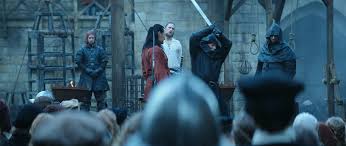
“Bloodbath” is a wildly uneven burlesque of a mass beheading, a jokey, jaunty slaughter with bits of derring-do that aren’t necessarily historical and aren’t particularly satisfying.

It’s the stort of movie you get when the Swedish director of “1408” and “Escape Plan” casts an important piece of Scandinavian history with a lot of Brits in leading roles, films it in English and shoots it in Hungary.

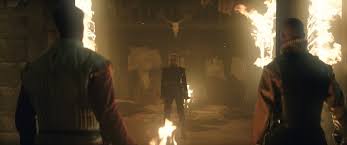
Villains trash-talk, taunt and peacock about, sometimes bathed in blood.

“You really hate the Swedes, don’t you? So...annoying. So full of themselves!”

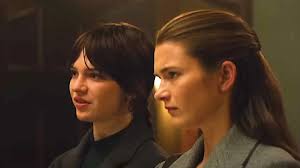
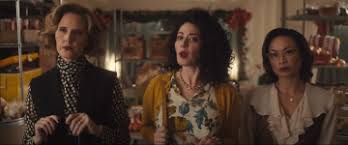
Our heroine, Anne, played by Sophie Cookson of the cartoonish “Kingsman” espionage actioners, loses her entire family in a pre-massacre massacre, and shows up at the Swedish court in Stockholm where she greets the wife (Emily Beacham) of the head of state (Adam Pålsson) with comical informality.

“My mother and father said to send you their best. But they’re um, dead.”

And if it has a “message,” it’s a backhanded swiped at famed Swedish neutrality — “It you don’t pick sides, you’re sure to come out a winner.”

Well-acted, beautifully designed, costumed, edited and set, with good stunts and effects, it’s an action comedy that fails its subject even as it fitfully entertains.

It’s 1520, and the Swedes have been successfully fending off the Danish domination of the Kalmar Union thanks to the exploits of Sten Sture (Pålsson). But Danish King Christian II, played by Danish star Claes Bang (“The Northman,” “The Square,” “The Burnt Orange Heresey”) is prepared to sack, murder and pillage his way overland until the Swedes in Stockholm surrender.

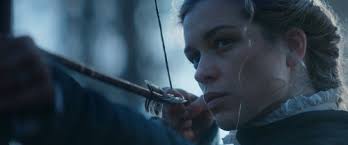
That’s how Anna’s family is slaughtered and her fiance (Wilf Scolding) is kidnapped. If not for the help of her mute archer friend Freja (Danish nepo baby Alba August, daughter of director Bille), Anna would have been taken, too.

But she’s been paying attention to the comic book cartoonish credits identifying the bad guys. The villains are ID’d as “The Big Danish Guy” (Roland Kollárszky) the sadistic “Sylvestre” (Thomas Chaanhing), “The Evil Guy” (Mikkel Boe Følsgaard), etc.

Anna survives her wounds, nursed by her bridesmaid Freja. She’ll practice her archery and have her revenge, keeping an “In Order of Disappearance” checklist as she hunts them down.

There’s also “The Spy” (Ulrich Thomsen), a member of the Swedish court determined to help himself and “negotiate” Sweden back into the union via treachery. And an anti-independence bishop (Jakob Oftebro) has been freed by the Danes, ready to have his own revenge by advising Christian on the flexible meaning of “heresy.”

The villains are deliciously vile and dominate the screen, and the Swedes, soon led by the wife of the head of state Kristina (Beecham), might be over-matched. But as we follow the exploits of Anna and Freja in this frigid war zone, we have no doubt that right will triumph. Eventually.

The performers are all spot-on, registering a convincing pluck or hammy sadism with revenge on everybody’s mind. They get across the filmmakers’ vision.

But it’s that vision that always feels off here. Perhaps the story’s been told so often up there amongst the beautiful blondes that a bloody action send-up of it is the only “fresh” approach to a sad story of mass murder.

“Stockholm Bloodbath” has fine action beats and furious avenging, but collapses into a sort of resignation about the parts of the tale that must be rendered faithfully.

There’s hope, peeking in around the edges, thanks to the action comedy tone. Bang, Følsgaard, Thomsen and others have license to lampoon. But scenes take on a cringey quality as passive people are being led to the chopping block.

It’s as if the dissonance of the over-the-top horror title label history gave this tragedy threw one and all off, and they didn’t realize the blunder until they premiered their version of the “Stockholm Bloodbath” somewhere other than Denmark.

Rating: R, bloody violence, profanity

Cast: Sophie Cookson, Alba August, Emily Beecham, Jakob Oftebro, Mikkel Boe Følsgaard, Adam Pålsson, Wilf Scolding, Ulrich Thomsen and Claes Bang.

Credits: Directed by Mikael Håfström, scripted by Erlend Loe and Nora Landsrød. A Brainstorm Media release.

Running Time: 1:58
Posted in Reviews, previews, profiles and movie news | Tagged , , | Comments Off on Movie Review: Swedes endure the “Stockholm Bloodbath,” and a dark comedy about it

Classic Film Review: Kinski and Herzog make each other film immortals — “Aguirre, the Wrath of God” (1972)

A legend from history was speculated upon and two legends were made when Werner Herzog and Klaus Kinski shot their breakout film, “Aguirre, the Wrath of God” in the jungles of South America with a stolen camera.

This low-budget 90-minute epic was a slow-motion sensation when it rolled out on screens in the mid-70s, winning awards and giving reputations to the two larger-than-life eccentrics who conjured it up.

Herzog established himself as a filmmaking genius with an appetite for the impossible, and a great teller of tall tales not just on the screen, but about his films, with this career-making jewel. And Kinski, close-to stardom in Europe (he’d done German films, had chewy bit roles in “For a Few Dollars More” and “Doctor Zhivago”) became a bug-eyed screen icon, going on to make such future classics as “Nosteratu, the Vampyre” and “Fitzcarraldo” with Herzog, even dipping his toe in Hollywood for a few films before raging to an early death.

Among Herzog’s many acclaimed documentaries is the deliciously dangerous “My Best Fiend,” about his on-set working relationship and friendship with the crazed Kinski.

The film that made them took up the story of an infamous “madman” among Spain’s 16th centurty conquistadors, Lope de Aguirre. Herzog cast Kinski as the murderous megalomaniac and took a skeleton crew of eight, with a dozen actors and a large ensemble of extras, into the jungle and down the Amazon in a recreation of his expedition to find the mythic city of gold, “El Dorado,” that Incans and others passed on to get the Spanish to stop looting, raping, murdering and pillaging in Peru.

Herzog’s script, allegedly whipped-up in a couple of days, partially lost and then largely improvised on location, sketches in the full measure of the man — a lifelong striver, schemer, coup plotter and adventurer.

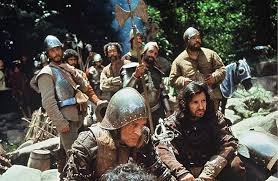
The cinematography of Thomas Mauch is rightly one of the most-acclaimed features of this classic — a broad, brown river, untouched jungles and a motley crew of Spaniards and a freed slave (Edward Roland) struggling with roaring rapids, starvation and attacks by natives (some of them cannibals) on a fool’s errand in search of a mythic city.

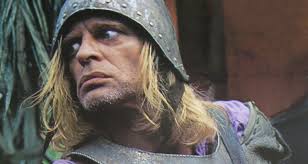
But it is Kinski’s deranged, bug-eyed glare that became the defining image of the film, the face of a man possessed with ambition — he’d arrived in New Spain a mere horse handler — who is third in command of this ill-advised side-expedition, but not “third” for long.

“My men measure riches in gold. But it’s more. It’s power and fame!”

There is a priest (Del Negro) on the trek, our diarist and narrator (the film was shot in English, later dubbed into German for “local” consumption) who tells the tale.

“God’s word must be brought to the heathen.”

Pedro de Ursúa (Ruy Guerra) is the leader, foolishly bringing his wife (Helena Rojo) down river with him through their month or so of hell on the upper Amazon. Peter Berling plays a creature-comforts-craving nobleman who is second in command.

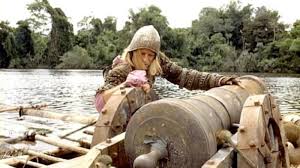
Aguirre, quick to give the orders, discharge the cannon and abandon raftloads of their compatriots when they’re separated, brought his daughter (Cecilia Rivera), perhaps as eyewitness to his rise to glory.

“It won’t be much longer! El Dorado could be only a few days away. No more rust on the cannon. We shall shoot our enemies with golden bullets. And you, Okello, will serve food on golden platters!”

 “I am the wrath of God. Who else is with me?”

“Aguirre, the Wrath of God” unfolds as the quintessential “man’s descent into madness” tale, a saga that echoes Joseph Conrad’s “Heart of Darkness.” “Aguirre” became such an art film sensation that it inspired Francis Ford Coppola to finally tackle his “Heart of Darkness” Vietnam epic, “Apocalypse Now.”

Herzog became known, in an instant, for tackling projects with an insane degree of difficulty. Documentaries or features, the tougher the challenge, the more he seed engaged.

“Aguirre” set the bar so high for Herzog that he and Kinski were compelled to make the ultimate overcoming-all-odds epic, “Fitzcarraldo,” under even more formidable South American jungle river conditions.

Today, “Aguirre” remains essential cinema, hand-held footage so vivid it feels like a 16th century documentary, save for the women’s makeup, which is flawless in defiance of heat, weather and hardship.

It was never overcome by its lore and legend, from that stolen camera, to cast and crew living for weeks on those period-perfect DIY rafts and the tale of how Herzog acquired the collection of monkeys who animate its final images. Having interviewed Herzog a few times over the years, I can say that few filmmakers relish relating the challenges they overcame in their past films and how those related to difficulties making “Grizzly Man,” “Rescue Dawn” and other works in his career’s grand third act more than Herzog.

That “camera that I stole” but which he needed to fulfill his dream and make art story never gets old.

“Aguirre” still feels “outlaw” after all these years for all those reasons, and for the uneasy feeling that the phrase “no animal was harmed making this picture” was left off the titles with cause. It’s a classic that could not be repeated and could never be made today.

Not just because of the difficulties, the primitive conditions no cast or crew would stand for now. The movie’s most “special” effect has no peer among today’s batch of cinema stars and character actors. Klaus Kinski died in 1991, but Herzog made him a screen immortal, one of the great faces in cinema history, in this one disturbing adventure that devolved into misadventure back in 1972.

star

Rating: unrated, violence

Cast: Klaus Kinski, Del Negro, Helena Rojo, Ruy Guerra, Peter Berling and Edward Roland.

Credits:Scripted and directed by Werner Herzog. on Tubi.

Running time: 1:34

Posted in Reviews, previews, profiles and movie news | Tagged , , , , | Comments Off on Classic Film Review: Kinski and Herzog make each other film immortals — “Aguirre, the Wrath of God” (1972)

Netflixable? Argentine half-siblings are “(Un) Lucky Sisters”

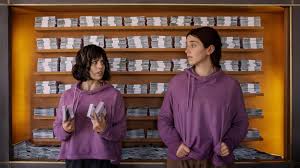
They blow the “meet cute” in the Argentine action comedy “(Un) Lucky Sisters,” and its pretty much all downhill from there in this short but not remotely brisk tale of two disconnected half-sisters who stumble into their late father’s secret stash of (Euro) cash.

Screenwriter Mariano Vera has “flat broke” Jésica (Sofia Morandi) and Ángela (Leticia Siciliani) sort-of acquainted and aware of each other’s existence when they meet in the morgue where their father’s body lies.

Somebody reached out to somebody else on social media once, but somebody was too stuck-up to be bothered with that. So there’s no comical “shock” in meeting to ID a dead-man’s body.

Ángela had something of a childhood with him, but “hasn’t seen Dad in 15 years.” Jesse, whose mom keeps their packed apartment in their name by giving Lamaze classes, was more of a one-night thing with the womanizer his daughter never knew.

As Dad was a “doctor” and a politically connected “facilitator,” broke fast-food trainee Jesse is quick with a “Do we get anything (in Spanish, subtitled, or dubbed into English)?”Ángela and her father’s secretary make Jesse the odd woman out in their discussions of the dead man’s one real asset — his swank “smart apartment.”

As Jesse doesn’t intend to be cut out, she insists on visiting the place, and then staying there. Ángela, struggling to get out of a relationship with a “ets settle down” security guard, reluctantly agrees.

That’s when they find a control setting in the apartment that reveals a hide-away wall covering “a buttload of Euros.” One half-sister is cautious, fearful and reluctant to touch it.

“It must belong to SOMEbody!”

Jesse is ready to stuff her pockets, start dining out and dive into a shopping spree.

There are references to endemic corruption and bureaucratic inefficiency in “this country” in a film that suggests bribery — in Euros — is a way of life and the courts swallow up any inheritance by taking “years” to settle estates, especially ones engulfed in scandal.

The story is framed within an unexciting moment of the two on the run from “cops and mobsters” with a backpack and suitcase full of cash, so SOMEbody wasn’t careful enough.

Director Fabiana Tiscornia does a decent job of setting up the threats — two mayors who are a little too familiar at the funeral, a sketchy TV “journalist” and highrise penthouse neighbor with two over-decorated Pomeranians who seems to know there’s “something” in that penthouse with his while.

The leads are well-cast, with their bickering making the “sisters by different mothers” sale.

“This isn’t OUR life!”

“Then whose is it?”

But there’s nothing original, funny or exciting in any of this. Even the tense moments are undercut by “she’s just imagining making a break for it” scripted missteps.

The pacing is slow-footed, the comical “problem solving” their way out of this windfall dilemma wholly unsatisfying.

Theses sisters may be “lucky” to have each other to go through this with, but they were pretty unlucky in the drab story they’re trapped in.

Rating: TV-14, pretty tame

Cast: Sofia Morandi and Leticia Siciliani.

Credits: Directed by Fabiana Tiscornia, scripted by Mariano Vera. A Netflix release.

Running time: 1:23

Posted in Reviews, previews, profiles and movie news | Tagged , , | Comments Off on Netflixable? Argentine half-siblings are “(Un) Lucky Sisters”

Movie Review: Ukraine’s long-shot hope for an Oscar — “La Palisiada”

Obscure to the point of exasperation, “comic” in ways only its director truly “gets,” “La Palisiada” is one of the more unapproachable films of recent memory.

Even accepting that the challenge of making a period piece movie in the middle of Ukraine’s devastating war(s) is impressive in its own right, “grading on the curve,” as we say, “Palisiada” still isn’t worth endorsing.

I wonder what the old American joke “A ‘film’ is a ‘movie’ we don’t quite understand” sounds like in Ukrainian. That might help explain this indulgent and often incoherent exercise in dark Slavic humor’s selection by a national cinema committee in the embattled country as its entry in the Best International Feature competition for this year’s Oscars.

Director and co-writer Philip Sotnychenko challenges the viewer with a meandering story of the last murderer to be given the death penalty before Ukraine abolished it. He struggles to tie violence back then to violence today with a long prologue set in the present day that connects to the film’s celebratory finale set in that “last execution” year, 1996.

It says something about where the filmmaker’s head is that so little effort is made to separate the two eras (radio news and Soviet vintage cars give it away), or properly identify the characters on the two timelines. The title itself is nonsense, “a figure of speech,” one character explains to another near the end. It might be an Italian or Ukrainian pun. Or it might not.

The prologue wanders about the social whirl of artist Aiesel (Sana Shakhmuradova) and her husband Kiril (No idea who plays him, and the distributor and IMDB are no help). We hear one half of an innocuous phone coversation, visit a party where the inane chatter overlaps (in Ukrainian with English subtitles), and a dinner with her parents, including her “dictatorial” cop-father is followed by an after dinner bedroom argument which ends badly.

We’ve invested 20 minutes trying to figure out what the movie will be about, a film whose prologue adds nothing to understanding what follows. What follows skips back to 1996.

A police colonel has been murdered, and we track through a brusque roundup of what might be called “the usual suspects.” But these un-uniformed scenes could just as easily be Ukrainian “civil war” depictions of “kidnap every male you can get your hands on” reprisals.

Sacha (Novruz Himet) is the dogged cop on the case, participating in the roundups, attending the many “crime reenactments” Ukrainian cops put a lot of store in as they try to solve the case.

We don’t really “get” why they settle on one suspect or see that moment. Did he confess? Is that him taking part in the “reenactments?”

When we meet the forensics doc Vlodymyr (Andrii Zhurba) and two alleged “mental health” experts who interrogate him, we note the young perpetrator’s uncertain memory and his unconcern, which suggests “mental problems” that should figure in the case.

Naturally, he’s railroaded in a “fit to stand trial” farce.

Sotnychenko borrows stylistic and storytelling touches from the Lars von Trier “Dogme 95” Danish filmmaking movement that emphasized naturalism in performance, technique and in immersing the viewer in that which is under-explained.

Our Ukrainian filmmaker takes all of that too far. His movie is dull, and dares to be demandingly so. The “routines” recreated here are blase, even the “comical” trips to a (quarry, I think) for the murder recreations.

The one comic touch that translates is taking us to an open air Odessa flea market, where vendors set up tables and the masses crowd in, prowling for bargains.

Every so often, a train shows up and everybody has to pick up her or his wares or simply move their feet to avoid getting run over. The flea market is in a railyard covered with tracks, with the tracks covered by sellers and buyers.

That’s wacky. Or could be.

As it is, you’d like to think there’s a message in here, about turning away from violence only to be violated by Putin’s “Rebuild My Empire” minions. But I can’t honestly say that there is.

Rating: unrated, violence

Cast: Novruz Himet, Andrii Zhurba and Sana Shakhmuradova

Credits: Directed by Philip Sotnychenko, scripted by Alina Panasenko and
Philip Sotnychenko. A Film Movment release.

Running time: 1:40

Posted in Reviews, previews, profiles and movie news | 1 Comment

Movie Preview: Gere and Uma Thurman star on Paul Schrader’s timely “Oh, Canada!”

An old man remembers fleeing to Canada to avoid the Vietnam War draft in this Dec. 6 release from the director of “First Reformed,” “Affliction” and “American Gigolo.”

A film of protest and American mythology directed by the author of “Taxi Driver” and auteur of “Light Sleeper?”

Posted in Reviews, previews, profiles and movie news | Comments Off on Movie Preview: Gere and Uma Thurman star on Paul Schrader’s timely “Oh, Canada!”

Movie Preview: Commando Eva Green, queen of the “Dirty Angels”

Veteran director Martin Campbell knows how to shoot and cut action, so perhaps this Jan. 3 release will grab a bit of attention.

Green, Maria Bakalova and Ruby Rose headline, with Jojo T. Gibbs, Rona-Lee Shimon and
Laëtitia Eïdo also taking care of business.

Posted in Reviews, previews, profiles and movie news | Comments Off on Movie Preview: Commando Eva Green, queen of the “Dirty Angels”

BOX OFFICE: “Venom” endures, “Heretic” wins converts, “Best Little Christmas Pageant” passes the collection plate

“Venom: The Last Dance” is going out in style, as this critically-dismissed Marvel movie is rolling up perhaps $14 million on its third weekend at the top of the box office heap. That would put it over $112 million, Deadline.com notes.

And that would be enough to keep Hugh Grant — THAT Hugh Grant — from unseating it in the top spot. Grant and his very smart and sinister turn in “Heretic” did $1.2 million Thursday night and outdrew “Venom” Friday, which Deadline somehow figures will spin into an $10.5 million opening for A24’s religion-ripping horror tale.

Good reviews and very good reviews won’t hurt that one, with $10.5 million seeming more like its floor than its opening weekend ceiling.

Not quite upbeat notices and indifferent reviews won’t hurt the faith-based family dramedy “Best Christmas Pageant Ever,” which rushes the holiday season into theaters along with the better-reviewed indie “Christmas Eve in Miller’s Point,” although not everybody got in the holiday spirit thanks to that diffuse and downbeat “comedy” either.

“Best Christmas Pageant,” which came to life in a ’70s novel and became a treacly feature of community theaters across the land thanks to an ’80s stage version, is on track to earn $10 million, over the Veteran’s Day weekend. That’s a very good take for a film starring Judy Greer and a bunch of kids.

“The Wild Robot” is still all alone in the major studio family-film animated releases of the fall (“Hitpig” bombed) and will pull in another $5 million or so. It’ll be over $130 million by the end of the holiday weekend, but it took seven weeks to get there — not a Dreamworks blockbuster by any measure.

“Smile 2” could actually finish ahead of it this weekend, as it is on track to pull in another $4.7 million. It’s over $60 million at this point, probably clearing close to $80 million by the end of its run.

The few theaters still showing the charming Pharell Williams animated biography-documentary “Piece by Piece” could push it over $10 million this weekend, but it looks as if it will fall just short. Fun idea, turning a music doc into a Lego animated pic. If you missed it, you’re missing out.

“Conclave” finishes sixth this weekend, pulling in another $4 million.

Sean Baker’s sex worker tricks her way to Russia tale “Anora” opens wider this weekend and cracked the top ten, clearing the $2.5 million mark.

“Here” opened meekly and is heading to a meek $2.5 million second weekend.

“We Live in Time” is adding $2.3.

And “Terrifier 3” is finally out of gas, pulling in $1.3. But it’s managed to clear $53 million and will finish its run in the $57-60 million ballpark.

The mid-fall/Halloween releases will surrender a lot of screens next weekend, when “Red One” starts the holiday season onslaught, followed by “Wicked,” “Gladiator 2” and “Moana” 2.

Posted in Reviews, previews, profiles and movie news | Tagged , , , , , , , | Comments Off on BOX OFFICE: “Venom” endures, “Heretic” wins converts, “Best Little Christmas Pageant” passes the collection plate

Movie Review: “Heretic,” or “Hugh Grant’s Theology Lesson”

“Heretic” is a simple but smart thriller about faith, a horror movie of ideas that is as sinister as it is cerebral.

The writers of “A Quiet Place” and writer-directors of “65” keep our focus on two young women, Mormon missionaries in peril, and on the twisted, Satanic figure who imperils them.

Sophie Thatcher (TV’s “Yellowjackets”) and Chloe East (“The Fabelmans” and TV’s “Generation”), filmed in revealing closeups, register innocence and optimism, naivete and rising unease closing in on terror as they figure out — at different times — the depth of difficulties their last door-knock of the evening has brought them to.

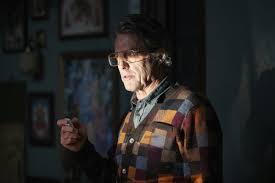
And Hugh Grant, all twinkling curiosity, charm and contempt that turns towards menace, puts on a tour de force of understated villainy as that one older gentleman in the curiously shaped, bigger-on-the-inside house on the edge of town who could be their undoing. You almost forget the “forelock” years of romances like “Four Weddings and a Funeral.” This is a career-redefining post-“Paddington” turn that reminds us he was always more than big blue eyes, unruly hair and a stammer.

Sister Barnes (Thatcher) is the more experienced of the two 20ish young women on Schwinns, handing out pamphlets, approaching often curt and dismissive strangers in town in this corner of the Rockies. Sister Paxton is eager to save her first soul by sharing “all the ways God reveals his plan.”

It’s raining and getting dark when they come to Mr. Reed’s house. He’s someone who earlier expressed an interest in learning more about their faith. He charms at the door, expressing delight at their arrival. And when Sister Barnes notes that they can’t come in without a woman present, assures them his “wife” is in the kitchen, finishing up a pie.

They chat as they wait on the wife and the pie, and as the camera closes in, the supposedly unknowing and curious potential convert reveals that he already has a worn copy of The Book of Mormon, filled with notes and page-tags. And his questions become a lot more pointed than much of what the missionaries have heard about that Mormon-bashing “‘Southpark’ musical (“‘The Book of Mormon’).”

He starts with queries about one woman’s dead father and “signs” that she’s felt his presence after his death. They all have thoughts on the afterlife. And then he drops the big one.

“How do you feel about polygamy?” Their response to his “misogynistic practice” and prophet Joseph Smith’s rationale for womanizing is rote Latter Day Saints dogma about the “practicality” of it in a female-dominated (in its early years) faith.

The digging goes deeper as Mr. Reed trots out props to make his points about “iterations” of ritual and belief through the ages, which must — in his mind — point back to what could have been “the One True Faith.” The young women haven’t his years of research or experience of the world, but try to hold their own even as they concede points about this or that Mormon rationalization or reversal of practice and preaching or even that Smith himself was pretty “sketch.”

But where IS that wife? Where is that blueberry pie they’re smelling that she’s making? Why WOULD this guy have all the versions of the board game Monopoly, including the one that pre-dated it by decades and was stolen by the credited inventor, just to make his point?

Why did he make note of the fact that the “walls and ceilings have metal in them. I hope you don’t mind,” as regards the cell phones that won’t work.

One thing’s for sure, as the debate shifts to fast food, his “I’ve never had a Wendy” is a Freudian slip for the ages. The Sisters — first one, then the other — grasp just how much danger they’re in. They must hide their panic, insist again on seeing the wife and reason (in a panic) and work-the-problem their way out of this peril.

“Heretic” leans on horror and serial killer thriller conventions for its plot and rising suspense. The foreshadowing is obvious, but the ways it is deployed always surprise and chill.

Grant’s villain is deeply considered but still only vaguely defined — supernatural menace, or all-too-recognizably human monster?

The second act somewhat pointlessly shifts in point of view as we see the church Elder (Topher Grace) they speak of as “expecting us back” start to fret about their absence and the darker and darker turns in the weather. And the third act’s grim and gruesome violence and “tests” don’t entirely obscure the struggle for clarity as the writers-directors try to wrap things up in a “What it all means” moment.

But this is top drawer horror, a smart movie that dissects faith and belief and religions in search of their purpose as it trots through the tropes of all the ways the world and the creeps in it are a threat to young women, especially the religious ones.

And Grant’s outing joins the ranks of the great horror villains with an erudite and evil turn for the ages, a “Heretic” who cannot be heard or experienced without sending a chill up the spine of the faithful and the faithless alike.

Rating: R, graphic violence

Cast: Hugh Grant, Sophie Thatcher, Chloe East and Topher Grace

Credits: Scripted and directed by Scott Beck and Bryan Woods. An A24 release.

Running time: 1:50

Posted in Reviews, previews, profiles and movie news | Tagged , , , , | Comments Off on Movie Review: “Heretic,” or “Hugh Grant’s Theology Lesson”

Movie Review: “The Best Christmas Pageant Ever,” not the worst holiday movie ever

“The Best Christmas Pageant Ever,” the latest film of the based on the early ’70s Barbara Robinson novel, comes to the screen with all the charms and shortcomings of a thousand Little Theatre stage productions over the decades.

Uplifting in the right spots, touching near the end, cute and yet cloying, maudlin and manipulative everywhere else, it punches a lot of familiar buttons when it comes to faith-based films for the holidays.

The director of “The Chosen” TV series finds some of the laughs but struggles to keep it moving at a pace that would make this story of a looming disaster comically pay off. Dallas Jenkins goes for slow and easy sentiment when a hint of knockabout farce would do the picture a world of good.

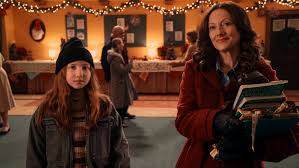
Judy Greer is well-cast as the plucky late 1970s mom who takes on a church Nativity pageant only to have the Emmanuel church annual event taken over by a gang of poor, ill-mannered child bullies.

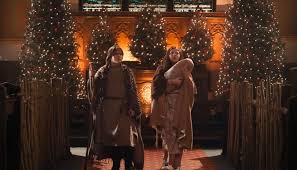
Sure, there are a lot of moving if somewhat static parts to the pageant — children singing carols as a narrator tells the story of the birth of Jesus and other children pose as Mary, Joseph, an Angel of the Lord, shepherds, wise men, the innkeeper, and others who take up all the rooms at “the inn.” And kids are involved, with their own herding-cats challenges.

But the town of Emmanuel has been putting this show on for 75 years, so it’s become less of a challenge than a “tradition” running on auto-pilot. This pretty little girl has played Mary a couple of times, a tall boy from the church has been Joseph, and the lady running it has been on the job for decades.

An accident takes out the regular director, and under-estimated “just bring the (store bought) cookies” Grace (Greer) volunteers to tackle the gig. And when her son (Sebastian Billingsley-Rodriguez) blurts to a school snack-stealing bully that he can get plenty more sweets at his church’s pageant and potluck, all of a sudden Grace has six new kids not just vying for roles, but demanding them.

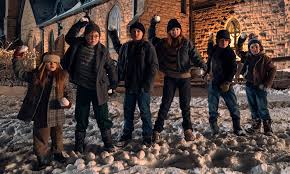
The Herdmans are tiny terrors, bullying hellions who are “the worst kids in the history of the world.” And when they show up, looking for sweets and looking for roles, they basically hijack the show.

But they have questions. Lots of them.

What’s a ‘play’? What’s an “‘inn?” “What’s a ‘manger?'”

Mary’s “great with child?” What’s that mean?

The sextet may be feared by all their peers, with adults labeling many a town incident “another Herdman fire.” But they don’t know this story, its religious significance or even this form of live “entertainment.”

Beatrice Schneider impresses as Imogene, the oldest Herman, the toughest and the ringleader. She insists on playing Mary, and makes the necessary threats to the town Miss Prissy, Alice (Lorelei Olivia Mote) to ensure that happens. Kynlee Heiman plays Imogene’s younger sister, an almost aboriginal fury who bites and screams and terrifies all who encounter her.

And no other kid in this town and that church can stand up to the four Herdman boys. That goes for Grace too, despite pressure from the church busybodies to ditch the Godless heathen Herdmans and do the pageant “the way we’e always done it.”

But Grace sees the children having something like a religious awakening (as if) and potentially changed by their experience learning about, playing and understanding these iconic figures from “The Greatest Story Ever Told.”

The viewer can be forgiven for noting, “Lady, you’re encouraging bullying by letting bullies win,” a bone I’ve picked with every version of this I’ve seen — stage or screen. And even the best adaptations of this “changed by learning about the virgin birth” kiddy show are too sappy for anybody with a family history of diabetes.

The screenplay hits the compassionate moments tear-jerker hard, and the comic moments not nearly hard enough.

But Greer holds down the fort, and keeps the picture on message if not on task. Lauren Graham ably narrates (over-narrates, truth be told) the story as Grace’s now-adult daughter Beth, who experienced this “Christmas miracle” as an elementary schooler (played by Molly Belle-Wright).

And Pete Holmes is OK as Grace’s skeptical husband, a doubter who can’t see these unruly kids as “wise men” or Joseph or Mary or anybody else.

But even Dad has a soft spot for children whose hard upbringing is surely scarring them. And as the faithful like to say, holiday miracles come in all shapes and sizes, even if they don’t necessarily know what frankincense and myrrh are.

Rating: PG

Cast: Judy Greer, Beatrice Schneider, Pete Holmes, Molly Belle-Wright, Sebastian Billingsley-Rodriguez, Kynlee Heiman and Lauren Graham.

Credits: Directed by Dallas Jenkins, scripted by Platte F. Clarke, Darin McDaniel and Ryan Swanson, based on the Barbara Robinson novel. A Lionsgate release.

Running time: 1:39

Posted in Reviews, previews, profiles and movie news | Tagged , , , , , | Comments Off on Movie Review: “The Best Christmas Pageant Ever,” not the worst holiday movie ever

Cinematic Whiplash: “Best Xmas Pageant Ever” chased by “Heretic”

Perhaps the best way to experience these two movies, back to back, maudlin to menacing, treacle to brimstone, Judy Greer to Hugh Grant.

Posted in Reviews, previews, profiles and movie news | Comments Off on Cinematic Whiplash: “Best Xmas Pageant Ever” chased by “Heretic”