Movie Review: “Gone Girl” is good, but not one of Fincher’s best

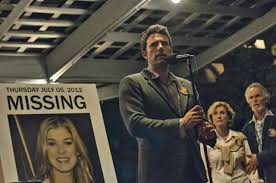
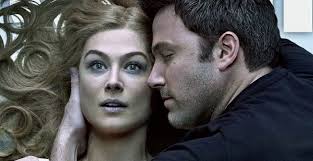
gome1gone2“Gone Girl” is David “Zodiac” Fincher’s seriously twisted, twisty-turny adaptation of Gillian Flynn’s novel about a husband accused of killing his wife, first by the outrage engine known as cable news, and then by the cops.
But that’s only ostensibly what it’s about. As Nick Dunn’s famous criminal attorney (Tyler Perry) counsels him, “This case is about what people think of you.” Casting Missi Pyle as a shrill, rush-to-judgment shrew in the Nancy Grace mold kind of underlines that Big Message.
But this absurdly long, occasionally miscast mystery thriller lacks much mystery. Its big reveal comes at the halfway mark. The further twists and competing narratives about what might have really happened unravel rather than unfold. And that Big Message masks something decidedly more cynical.
Entertaining enough. But one of Fincher’s finest? Not by a Missouri mile.
Ben Affleck plays Dunn, a guy who drops into his small town Missouri bar, has a flirty chat with the cute barmaid (Carrie Coon) and comes home to discover his rich, beautiful wife is missing. Nick is confused, concerned. Scared witless? Desperate? Not in the least. The rumpled detective on his case (Kim Dickens) picks up on this. So do we.
There are blood stains. There was an affair. As the missing wife, Amy (Rosamund Pike) narrates, theirs was a marriage in trouble. Amy, reading from her diary, says “I feel like I’m something to be jettisoned, if necessary.”
But all is not what it seems. Nick’s barmaid pal turns out to be his twin sister. He tries to act guileless, is slow to hire an attorney. The couple treated each anniversary as a puzzle, a treasure hunt with clues. Amy left those “Clue” couplets, in envelopes all around their world, and Nick is frantic to recover them before the cops do. Why?
His in-laws (Lisa Banes, David Clennon), quick to mobilize search parties and media coverage for the girl they named “Amazing Amy” in a series of kid-lit best sellers, wonder about his behavior. He’s just not distraught enough.
And in flashbacks, we see the flirtation that led to a relationship, the adorable date at the bakery taking its sugar delivery (clouds of sugary powder fill the night air around them), the male wish fulfillment fantasy sex they have in bookstores and the like. But hints of trouble are there, and those might explain Nick’s disconnect from the kidnapping.
Pike, unutterably gorgeous, is just brittle enough in the flashbacks to make us fuzzy on what may have led to whatever has befallen her. Affleck looks…guilty. Which is all that’s required.
Neil Patrick Harris is miscast as a cliched rich beau from long ago, Perry plays a version of a lawyer who might appear in one of his own films — a perfectly-coiffed, sing-my-own-praises showboat.
“Elvis is IN Missouri,” he announces, a celebrity lawyer taking a case that’s become a national sensation.
The actors don’t sell the rift that pulled at this couple, and in giving up his revelations so willingly, Fincher suggests he’s making a commentary on modern relationships and marriage. By the time he pulls out all the stops for the never-ending finale, he’s flirting with misogyny.
It’s good, but we’ve come to expect more from the guy who gave us “Fight Club” and “The Social Network.” This is more on a par with “Girl with the Dragon Tattoo.” The calculated shocks feel like a movie we’ve seen before, though at least in this case, that’s not true.
3stars2

MPAA Rating: R for a scene of bloody violence, some strong sexual content/nudity, and language
Cast: Ben Affleck, Rosamund Pike, Carrie Coon, Kim Dickens, Neil Patrick Harris, Tyler Perry
Credits: Directed by David Fincher written by Gillian Flynn, based on her novel. A 20th Century Fox release.
Running time: 2:29
Posted in Reviews, previews, profiles and movie news | Comments Off on Movie Review: “Gone Girl” is good, but not one of Fincher’s best

Movie Review: Reese steps in the background to make “The Good Lie” work

goodlie23stars2

The saga of Sudan’s “Lost Boys,” refugees who wound up in America after fleeing the civil war there, earns an engaging, tear-jerking retelling in “The Good Lie,” a fictionalized account of what faced them.
Sudanese children, often orphaned, fled the country in the ’80s and spent much of the ’90s in refugee camps in neighboring countries. About 3,600 of them were allowed to emigrate to America pre-9/11. “Good Lie” follows a handful of them, from the brutal assault on their village to their thousand-mile trek to safety.
But “safety” is just the first long leg of their journey. Safety means, in the case of Mamere, Jeremiah, Paul and their sister Abital, merely escape from the free fire zone, where Islamic rebels burn, shoot or kidnap anything in sight. These children have seen death, buried friends and comrades and crossed rivers and deserts just to grow up in a Kenyan refugee camp.
goodliekidsThey are young adults — played by Arnold Oceng, Ger Duany, Emmanuel Jal and Kuoth Wiel — by the time the United States agrees to take them in.
Canadian director Philippe Falardeau (“Monsieur Lazhar”), working from a script by Margaret Nagle (“Warm Springs”) then finds the lighter side of this tragic tale of survival. And he does it with such a deft touch that the weight of that long prologue never leaves the movie — even after that pixie Reese Witherspoon shows up.
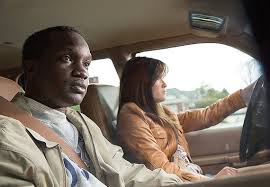
She plays Callie, a Kansas City employment counselor, entirely too provincial to know what she’s getting into when she picks up the three boys (Abital, their sister, has been sent to Boston) at the airport. Their preparations for America consisted mainly of being handed a piece of ice to show how much colder it is in the Midwest than it is in Africa.
“The Good Lie” — the titles come from Huckleberry Finn’s lesson in lies that serve a moral purpose — shifts from survival epic to fish-out-of-water comedy as “Stone Age” Sudanese villagers are exposed to electricity, telephones, modern appliances and American humor for the first time. Cute.
They’ve all learned their English from the Bible, and Mamere (Oceng) expresses himself in the most delightfully dated and genteel way.
“You make our hearts throb with your many kindnesses…May you find a husband to fill your empty house.”
Witherspoon plays the straight man to these “lost” lads. But this formulaic feel-good film succeeds or fails on their performances, and the guys are winners. Oceng makes the responsible, guilt-ridden Mamere charming, Jal brings a bitter confusion to Paul, who gets more “lost” as he starts to hang out with the stoners at the factory where he finds a job. And Ger Duany has a lanky soulfulness as Jeremiah, the moral center of their group, a would-be preacher who narrates the story even as he serves as a tall, thin sight gag.
Witherspoon’s appearance got the movie made and there was early talk of a “Blind Side” sort of Oscar nomination for it. But Callie’s earthy, working class common sense is more the icing on this cake than a central part of it. It’s a performance by a performer with the grace to know it’s not about her, and she surrenders the spotlight.
“Good Lie” rambles a bit and telegraphs its ending. But its earnestness in reminding us of this story and just what America represents to the world’s rising tide of refugees, and why, makes it a winner, a valuable history lesson wrapped in a feel-good bow.

MPAA Rating: PG-13 for thematic elements, some violence, brief strong language and drug use
Cast: Reese Witherspoon, Arnold Oceng, Kuoth Wiel, Ger Duany, Emmanuel Jal, Corey Stoll
Credits: Directed by Philippe Falardeau , written by Margaret Nagle. A Warner Brothers release.
Running time: 1:50

Posted in Reviews, previews, profiles and movie news | Comments Off on Movie Review: Reese steps in the background to make “The Good Lie” work

Movie Review: Cusack Meets Jane in Oz in “Drive Hard”

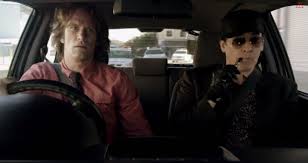
drivehardshot2stars1Here’s the sort of scruffy action comedy that suits the post-box office-draw careers of one-time hipster John Cusack and fading action star Thomas Jane. It covers the costs of a fun few weeks of working vacation in Australia and provides a few on-screen laughs along the way.
The pairing of these two is kind of a lark. Make Cusack some sort of hitman/crook, a variation on his “Grosse Pointe Blank” hitman, and Jane a semi-retired and over-extended race car driver abducted to be the crook’s getaway car driver.
All that can come from that is “Drive Hard.”
Jane is Peter Roberts, married to an Aussie attorney, father of a smart-mouthed tween. No, we’ve never seen “The Punisher” like this. He can’t get sponsorship to drive Down Under, so he runs a driving school. That’s where Keller (Cusack) finds him.
The American never takes off his gloves, black baseball cap or shades and only slowly lets on that, aside from sitting on the wrong side of the car and driving on the wrong side of the road, he doesn’t need lessons. As they hurtle up and down Australia’s Gold Coast, the banter comes fast and furious. Especially when Keller gets Roberts to wait for him outside a bank, which gloved man promptly robs. It’s handy to have a race car driver when you’re in a tiny driving school econo-box trying to outrun the cops.
“You see why I hired you?”
“You DIDN’T hire me, you KIDNAPPED me!”
“SeMANtics.”
Cusack is an old hand at this sort of fast, flippant repartee. So Jane is the real surprise. They need to swap cars, so they dash into a vineyard hotel where a wedding’s supposed to take place.
“Turn yourself in,” Roberts hisses, so loudly the elderly clerk can hear him.
“We WILL…turn in, once it’s BEDTIME…sweetheart,” Cusack purrs, raising the old lady’s eyebrow at how gay couples argue.
Before they’re done, they will brawl with that foul-mouthed old biddy (Carol Burns) and try to evade the police and the mobsters whom Keller has crossed as Roberts’ wife (Yesse Spence) yanks their kid out of school and breaks the news about dad to the media-savvy child.
“Is Daddy dead?”
No no he’s not dead.
“Terrorist?”
Rebecca, no. Your father’s no terrorist.
“Daddy’s robbed a baaaaa-aank, Daddy’s robbed a baa-ank.”
The “Hard” driving isn’t very impressive, despite being a film from the land of “The Road Warrior.” It never rises above the simple formula that got it made. But a couple of dozen random laughs suggest that if “Drive Hard” is these two leading men’s lot in life, they could do a lot worse.
MPAA Rating: unrated, with gun violence and some profanity
Cast: John Cusack, Thomas Jane
Credits: Directed by Brian Trenchard-Smith, written by Brigitte Jean Allen, Chad Law, Evan Law. An RLJ Entertainment release.
Running time: 1:32

Posted in Reviews, previews, profiles and movie news | Comments Off on Movie Review: Cusack Meets Jane in Oz in “Drive Hard”

Movie Review: “The Hero of Color City”

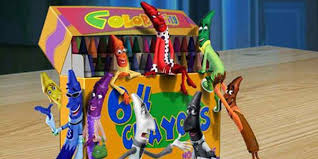
color“The Hero of Color City” is a computer-animated cartoon that looked good enough on paper to attract the voice talents of Owen Wilson, Craig Ferguson, Christina Ricci, Rosie Perez and Sean Astin among others.
Five credited screenwriters later, it comes out as a colorless affair, a crayon box version of “Toy Story” suitable only for the littlest tykes.
After six-year-old Ben goes to bed, his crayons pick themselves up and skip off through a magic door in the crayon box into Color City, an alternate universe where they renew their colors and pointy caps in the spa, and get to relax and be themselves.
Their personalities match their colors. Black is always in a dark mood, grizzled old man Grey goes on about “in MY day,” White is bland, Tutti Fruity giggles, Refried Beans Brown breaks wind. Seriously.
But cowardly Yellow (Ricci) misses roll call and stumbles into King Scrawl and his buggy sidekick Nat (Craig Ferguson). They’re unfinished drawings, desperate for a little color, fearing the day when they’re tossed in the waste basket. They follow Yellow into Color City and create havoc once they arrive.
The crayons have to work together to solve their problems — and stop for a song, here and there.
The story may be Pixar-simple, and the jokes carry a faint hint of Dreamworks wit.
“Colors are runnin’ faster’n a red sock in a washin’ machine!”
“You really saved my wrapper!”
But “Color City” is thin gruel, even by recent, weaker Pixar standards.
Ferguson, cutting loose from the small voice role he’s had in the “How to Train Your Dragon” films, is all puns and pronouncements. They’re all just “pigments of Ben’s imagination,” and he has scores of titular nicknames for King Scrawl, “The Crown Prince of Chiaroscuro, the Head of the Color Wealth.
A couple of lesser known voice actors imitate Woody Allen and Jerry “Hey LAY-deee” Lewis.
Nothing the target audience here will pick up on. Adults will relish those incredibly rare moments of wit, and the 76 minute running time.

1half-star
MPAA Rating: unrated, suitable for general audiences
Cast: The voices of Christina Ricci, Owen Wilson, Craig Ferguson, Rosie Perez
Credits: Directed by Frank Gladstone, screenplay by Jess Kedward, J.P. McCormick, Kirsty Peart, Rich Raczelowski and Evan Spiliotopoulos. A Magnolia release.
Running time: 1:16

Posted in Reviews, previews, profiles and movie news | Comments Off on Movie Review: “The Hero of Color City”

“Good Lie” cast and director talk about America’s need to understand refugees

goodliekids

Those who made the new movie “The Good Lie,” screenwriter Margaret Nagle’s fictionalized account of what many Sudanese “Lost Boys” went through to get to America, figure there’s a timeliness to its history. It’s not just about 1980s East Africa and America just after 9/11.

“Look at what’s happening along the Mexican border, more than 50,000 children fleeing violence in Central America crossing that border, by themselves,” says Nagle. Just as her script depicts unarmed Sudanese children, many of them orphaned, fleeing a war zone, “these kids are on their own, desperate. And some of us getting very upset that this is happening, at the kids!”

nagleNagle’s script — telling the story of “Lost Boys” who made it to America just before 9/11 — took eleven years to find a name star (Reese Witherspoon) and financing that allowed it to be filmed. Nagle sees that as fate.

“After 11 years, with the refugee camps overflowing again, and kids fleeing violence on our borders, maybe the time is right for this movie,” she says. “We are a country built by immigrants fleeing intolerance, violence and poverty. That’s how this country began. Plainly, the schools are not teaching history very well if so many people have a hard time remembering that.”

Kuoth Wiel, who plays a lost girl who makes it out of Sudan with the lost boys of “The Good Lie,” is the daughter of Sudanese refugees, a young actress lucky enough to grow up in Minnesota rather than war-torn Sudan.

sudan1“If you don’t know what it’s like to be a refugee,” she says, “maybe our movie can tell you. We’re just misunderstood, and I think that’s the case with the unaccompanied minors coming in from the border with Mexico. You have to wonder why they’re here. They have nothing left. For their parents to give them up to send them north wasn’t easy. Desperation.”

Nagle adds that “if CNN and other networks would take the time to interview some of these kids, we’d all feel differently about them, just as we did about the ‘Lost Boys’ after ’60 Minutes’ started doing stories on them.”

Actor Arnold Oceng was born in Uganda, the child of refugees who fled Sudan. But the war spilled over the border, as they often do. Growing up in London, he heard the stories of a harrowing childhood he was too young to remember.

“My mom tells me of running away from the war with me tied on her back, through the jungles of Uganda. Hiding from soldiers, just as she had in Sudan. My mom did that. I am totally connected with that war, through her. But I did not understand the desperation she felt, the desperation of all refugees from war feel, until we made the film.”

In “The Good Lie,” Oceng plays Mamere, a refugee who feels the weight of responsibility for the others in his “family,” and survivor’s guilt for those he had to leave behind.

Critics are saying “The Good Lie” is “overly earnest” (Variety) but “bighearted” (New York Post) thanks to its story and its timely message about welcoming refugees. Nagle hopes filmgoers get the bigger picture, “that this is what we do best. When we do something like this, we feel good about ourselves and the country. We’ve been so divided, lacking that higher purpose that makes us great. It’s nice to remember we do this.”

Posted in Reviews, previews, profiles and movie news | 6 Comments

Movie Review: Bolivar gets a glossy if superficial biography in “The Liberator”

liberSimon Bolivar had traits from George Washington and Thomas Jefferson, Jean-Jacques Rousseau and Napoleon, all in one titanic personality.
Born to wealth, he came to champion equal rights for all South Americans. A military dilettante, he fought in over 100 battles and had a hand in liberating much of Latin America.
Statesman, warrior, “Enlightenment Man” and lover, that’s a lot of Bolivar to squeeze into one movie.
So “The Liberator” is an ambitious overreach, a Latin epic with Spanish court intrigues and battles, epiphanies and seductions, at two hours barely sketching in the mythic man for whom Bolivia is named and much of South America owes its independence to.
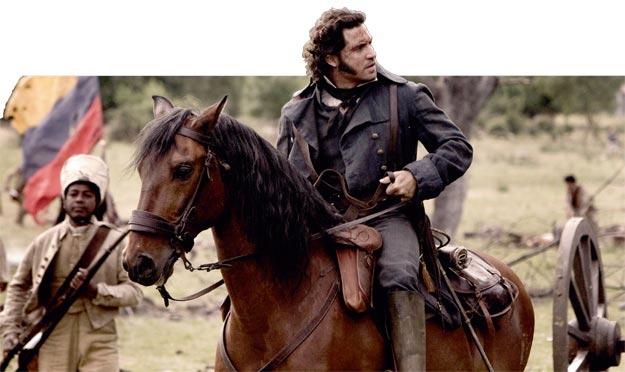
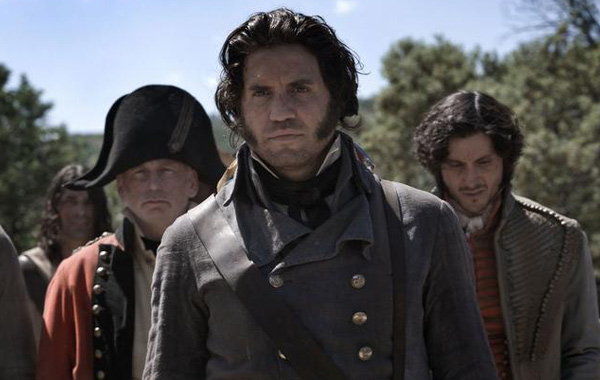
Edgar Ramirez (“Zero Dark Thirty”) makes an earthy, muscular impression as Bolivar, a man we meet as he comes home to his last lover (Juana Acosta), Manuela, who only wants to liberate him from his uniform. This is the night, late in his career, when his enemies came closest to seizing him, but first things first.
In a long flashback, we see the life and career that brought him to that defining moment. A member of Venezuela’s late 18th/ early 19th century landed gentry, Bolivar was raised by a black slave woman, educated and yet slow to see the need to reform a system which placed him at the top, from birth. But an outspoken teacher who has embraced The Enlightenment principles that fired the American and French Revolutions has his ear. And young Simon is moved to action.
“The noble savage has finally awakened!” teacher Simon Rodriguez (Francisco Denis) declares. And so he has. Bolivar first commissions an experienced but aged General Montverde (Imanol Arias) whose motives he questions, and then takes on the mantle of leadership himself, first enduring a sojourn in the wilderness where he comes to realize who this revolution is really for.
Danny Huston is deliciously duplicitous as a British backer of the revolutionaries.
“It’s not every day that an entire continent comes into play,” his Torkington (a fictional figure) purrs, hoping Bolivar won’t dig too deep to consider why the Brits want the Spanish colonies independent.
“The Liberator” may be a Cliff Notes version of South American history, but Ramirez breathes life into it and makes us care, even as we dash from this bloody struggle on the field to that debate and compromise in the legislature.
But Ramirez hauls this entire truncated Timothy Sexton script (he wrote the recent Cesar Chavez bio-pic) through the Andes, into decades of battles, into Spain and across the finish line, giving a charismatic, impassioned performance in Spanish and English. He suggests an impulsive, frustrated man straining to achieve the impossible, to be both a liberator and leader, a visionary and pragmatic soldier.
So even though “The Liberator” is no more successful in achieving its goals than Bolivar was — he wanted a United States of South America — Ramirez lets us appreciate a film, like its subject, whose reach exceeds its grasp.
3stars2

MPAA Rating: unrated, with violence, sexual situations
Cast: Edgar Ramirez, María Valverde, Danny Huston, Gary Lewis, Imanol Arias, Juana Acosta
Credits: Directed by Alberto Arvelo, written by Timothy J. Sexton. A Cohen Media release.
Running time: 1:58

Posted in Reviews, previews, profiles and movie news | Comments Off on Movie Review: Bolivar gets a glossy if superficial biography in “The Liberator”

Movie Review: Reitman’s losing streak continues with “Men, Women & Children”

2stars1It says something about us as a culture that the moment that provokes gasps of shock in “Men, Women & Children” comes when a media-paranoid mother deletes text messages from her teenage daughter’s phone.
We’re shocked at this parental betrayal, the invasion of privacy. It’s only later that we remember, “Oh yeah, Mom PAID for the phone” and that everything else in this ensemble social media soap opera underlines how that shrill mother (Jennifer Garner) is right to be scared to death of how children, women and men are abusing this new hand-held god we worship.
It’s too bad this broad, heavy-handed tragi-comedy undercuts many of its most though provoking moments, further evidence that after this, “Young Adult” and “Labor Day,” director Jason Reitman may never come close to “Up in the Air” again.
The opening blunder of this social media sermon is the ironic, dry and sometimes jokey-profane narration that begins the film and deflates it throughout. Emma Thompson voices that miscalculation, connecting events in and around East Vista Texas High School with Carl Sagan’s “Cosmos” view of the “pale blue dot” planet that we live on and the Voyager spacecraft.
Rosemarie DeWitt and Adam Sandler are drifting through a marriage that has him obsessed with online porn and her bored enough to visit a “have an affair” dating site. Their teen son (Travis Tope) is so deep into web porn that his adolescent desires may be permanently warped.
Judy Greer plays a single mom whose failed acting career means she’s willing to exploit her aspiring-floozy of a daughter (Olivia Crocicchia) on a website filled with provocative poses. The kid, Hannah, is a cheerleader anxious to come off as a tramp. Both she and mom call her web devotees “fans” when “perverts” is closer to the mark.
Allison (Elena Kampouris) is also a cheerleader, one who spent the previous summer tapping into the online eating-disorder underground, starving herself into a stick figure. Somehow, her parents (J.K. Simmons is the dad) fail to notice her emaciated state and the walls covered with photos of rail-thin models, egging on her anorexia.
Brandy (Kaitlyn Dever of TV’s “Justified”) is the bookish girl whose mother (Garner) oversees her social media activities and organizes other parents to do the same. That could put a damper on the attentions of sensitive, sweet football dropout Tim (Ansel Elgort of “The Fault in Our Stars”).

menwomen
This is the “normal” relationship here. They actually talk, try to connect. They touch, in a nonsexual way. Everybody else is constantly staring down at their phone or tablet, cutesy thought-bubbles showing what they’re typing pop up over their heads.
Tim’s quitting the team in football-obsessed Texas is a sign of crisis. He’s deep into Sagan’s “pale blue dot,” and figures football is pointless and “doesn’t matter.” Blasphemy.
“Something about sitting down and talking with Brandy DID matter, and this was enough,” the narrator drones.
That’s as quotable and as deep as “Men, Women & Children” gets. There are a TV season’s worth of soap opera betrayals, melodramatic traumas and blundering efforts to learn from and escape this media miasma.
And standing, tearful and fearful, in judgement is Garner’s mother figure, ridiculed and mockable and proof positive that Reitman just doesn’t get his own point.
“Before you go, I’m going to give you a pamphlet on the dangers of selfies!”
MPAA Rating: R for strong sexual content including graphic dialogue throughout-some involving teens, and for language
Cast: Kaitlyn Dever, Rosemarie DeWitt, Judy Greer, Ansel Elgort, Adam Sandler, Jennifer Garner
Credits: Directed by Jason Reitman, written by Erin Cressida Wilson and Jason Reitman, based on the Chad Kultgen novel. A Paramount release.
Running time: 1:54

Posted in Reviews, previews, profiles and movie news | Comments Off on Movie Review: Reitman’s losing streak continues with “Men, Women & Children”

Today’s first screening: “Birdman”

Seeing this one in prep for an interview with the title character. I remember interviews with Michael Keaton in the ’90s as being singularly unpleasant. He made people cry. Not me, but other journalists.

It was all because of where he was, how far he had fallen from what he had been. That’s why “Birdman” has everybody so worked up. He takes on this has-been/used-to-be “Batman” thing pretty much head on.

Or was given a vehicle to do just that by Alejandro Gonzalez Inarritu.

An all-star supporting cast (Naomi Watts, Edward Norton, Zach Galifianakis, Emma Stone) helps realize this take on hasbeendom, subtitled “The Unexpected Virtue of Ignorance”).

“Birdman” opens in a gradual rollout in a couple of weeks.

Posted in Reviews, previews, profiles and movie news | 1 Comment

Box Office: “Equalizer” $35, “Boxtrolls” $17

boxtrollsAs I have said several places and at several times, Laika’s animated offerings are, to a one — hard sells. Let’s hope so, because the very fine “Boxtrolls” will need a healthy month long run to overcome a weak ($17.2 million) opening in order to ensure Laika gets to make another “ParaNorman,” “Coraline” or “Boxtrolls.” It’ll be lucky to hit $50, not nearly enough to keep the lights on.
“The Equalizer” could become a Denzel Washington franchise, seeing as how it’s based on the TV series and make a whopping $35 million, the best Denzel opening in ages. If he’s in it for the money these days, we should see a sequel or two.

“The Maze Runner” had a healthy second weekend, but “This is Where I Leave You” held a very high portion of its opening weekend audience and should linger in the top ten until November.

Nothing else opened wide, though “Pride” shows signs of being a seniors-oriented sleeper.

Posted in Reviews, previews, profiles and movie news | Comments Off on Box Office: “Equalizer” $35, “Boxtrolls” $17

EXCLUSIVE: Edgar Ramirez talks about the secret to playing Latin hero Simon Bolivar

ramirezReviews for “The Liberator,” or “Libertador,” the ambitious Latin American film that tries to tell the story of Simon Bolivar, the general and statesman often called the “George Washington of South America,” have been more respectful than enthusiastic.
“The man himself remains elusive,” Variety said of the two hour epic. Bolivar is perhaps too much “an icon” to be easily rendered “a flesh and blood human being.”
Fortunately, as the Hollywood Reporter counters, “The Liberator” has “the charismatic and capable Edgar Ramirez” in the title role. The star of the acclaimed terrorist biography “Carlos” and “Zero Dark Thirty” is Venezuelan, as was the 19th century president and military genius.
We caught up with Ramirez, 37, in New York.
Q: Unlike most people in the United States, you learned much about Bolivar in school, growing up in Venezuela. What surprised you in researching him for the film?
Ramirez: “Even in South America, when we were taught about Bolivar, we were never told how intertwined American independence, the French Revolution and Latin American independence were. They came from the same Enlightenment ideas and values. Those ideas traveled from the birth of the United States to the French Revolution to Latin America — Washington and Jefferson to Napoleon to Bolivar.
“We all learn our history, on both sides of the border, in isolation. And they were connected!”
“Bolivar’s ideas were similar to Jefferson’s, and by extension Lincoln’s ideas about freedom were similar to Bolivar’s. Bolivar was the first Western head of state to set out to abolish slavery.”
Q: What sort of pressure did you feel having to portray an icon, a man who has a country named for him (Bolivia), who was so important to the independence of so many countries in South America?
Ramirez: “He was a brilliant statesman and a brilliant strategist. Being Venezuelan, it was a great privilege to portray a character so complex, with so many contradictions — the fighter, the thinker, the lover. We’ve made an action film with great social debates and two interesting love stories.”
Q: The film shows him as a son of wealth who spent much time in Europe, and a little slow to embrace the idea of abolishing slavery, despite being raised by Hippolyta, a black slave he called his mother. A contradiction in the man?
Ramirez: “Bolivar’s ideas, some of them, would seem transgressive, even today. He was a product of his time, but a black woman raised him and that had to impact his views on slavery. As he says in the film, ‘We want this project to free all men — not just landowners, but brown men, black men and white men.’ He was a very special figure in history
“A biopic is not a photograph. It’s a painting. It’s an approximation. Who knows how he sounded? Who knows what was deep in his heart? We were inspired by the size of his personality, the scope of his saga. And we wanted to include his flaws, his impulsiveness, and show him changing.”
Q: Historians often fault him for having Napoleonic tendencies, for staying in power and on the stage too long, unlike George Washington, who stepped aside. Does that explain Latin America’s slow movement to stable, representative democracies?
Ramirez: “The ways independence came to North and South America were entirely different. The British colonies already had been allowed to participate in continental politics. They paid taxes to Britain, but their political life was run by Americans. You were prepared to govern.
“In Latin America, everything ran out of Spain. No Spanish subject born in the Indies could hold any significant political post. Only Spaniards from Spain could be appointed, not elected, to those jobs. We did not know how to govern. We only knew how to obey a strongman.
“Bolivar and the revolutionaries were trying to bring The Enlightenment to a system straight out of the Middle Ages.”
“We have been dealing with that for 200 years, now.”

Posted in Reviews, previews, profiles and movie news | Comments Off on EXCLUSIVE: Edgar Ramirez talks about the secret to playing Latin hero Simon Bolivar