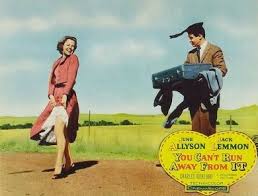
Classic Film Review: Lemmon and Allyson remake “It Happened One Night” — as a musical — “You Can’t Run Away from It” (1956)

“You Can’t Run Away from It” is a comic curiosity from the early career of Jack Lemmon, a musical filmed when studios were scrambling to lure filmgoers away from TV and when musicals were so overexposed — “The King and I,” “High Society” and “Carousel” came out the same year — they almost instantly went out of fashion.

“West Side Story” reset musicals a few years later, returning them to the ranks of rare “event” pictures where the genre remains to this day. And the cinema would find other ways to retain its “date night” place in life — eventually.

But it’s hard to imagine audiences not smelling the desperation and the old fashioned fustiness of this remake of the Frank Capra classic “It Happened One Night” when “You Can’t Run Away from It” hit theaters in 1956.

Leading man turned producer/director Dick Powell had transitioned from musicals to a terrific film noir cynic on one side of the camera. Here, he directs his wife June Allyson in a musical that Columbia Pictures cobbled together from a movie and short story it owned the rights to, with new songs by Johnny Mercer.

Filmed in Technicolor and presented in widescreen Cinemascope, “Run Away” was meant as a song-and-dance star vehicle for Allyson, pushing 40 and years removed from the lesser musicals (“Till the Clouds Roll By,” “Good News,” “Two Girls and a Sailor,””Best Foot Forward”) that made her name.

It didn’t pay off.

The sexy, sassy, downmarket Depression Era edge of “It Happened One Night” was lost in the well-scrubbed, conservative 1950s. A parade of forgettable Johnny Mercer songs, many of them crooned by the not-quite-forgotten Four Aces (pre-doo-wop) quartet, a dopey “Scarecrow Dance” sequence that showcases why Robert Sidney was best known for middling 1960s TV variety show choreography and a bus trip premise that had to seem out of date in the age of “See the USA in your Chevrolet” America had to provoke eyerolls in many a Baby Boomer, dragged to see this by their Liberace/Lawrence-Welk-loving parents.

And no amount of makeup could hide the obvious, that the smokey-voiced Allyson was entirely too old to be playing the gamine whose controlling rich daddy (Charles Bickford from “A Star is Born”) keeps getting her impulsive marriages to gold-digging rakes anulled.

But here’s Jack Lemmon as a fast-talking, hard-drinking, short-tempered and oft-fired newspaper reporter/smart-ass, the Clark Gable role in “It Happened One Night.” He sings, and not just the little bits of humming/crooning he did in many a comedy, but full on solos and duets.

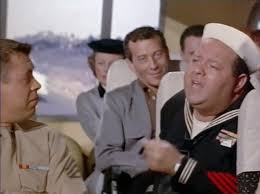
Stubby Kaye (“Guys & Dolls,” “Cat Ballou”) leads a Greyhound busload of extras — and bus driver Henny Youngman (!) in a cornpone “Howdy Friends and Neighbors” tune from Mercer.

And funny folks like Jim Backus pop up, steal a scene, and exit. So it’s not a total waste of time.

Allyson is Ellie Andrews, whom we meet confined-to-quarters on her father’s 60 foot schooner in San Diego harbor. She’s just run off and married somebody new, not her first time.

And considering how much she repeats the phrase “never been alone with a man,” we have to wonder how she manages the meeting, courtship and falling-in-love business, even with ne’er do well playboys like Jacques Ballarino (Jacques Scott, entirely too colorless to register), her latest.

But rather than accept Daddy’s latest anullment, Ellie leaps overboard and swims past the anchored aircraft carriers to freedom. She’ll get back to Texas and “save” this scandalous, newspaper-headline “marriage.”

With Daddy’s minions (Dub Taylor among them) watching the train station and airports, Ellie opts for the bus. That’s how she and we run into Peter Warne (Lemmon), a reporter who just finished a bender/send-off with his colleagues. He’s been fired, and they serenade him with “Old reporters never die. They gradually decline.”

Newspapering. Nothing like it.

The “meet cute” is that she’s in his seat. Peter will shoo her out of it with a boorish “Scoot, scoot, scoot scoot,” but before they’ve crossed one time zone, he’ll have to save her from a “bop talking” hepcat and try to save her bag, with all her money in it, from a snatch-and-grab thief.

Peter figures out who she is, pitches the “scoop” to his old boss in Houston, keeping her out of Daddy’s grasp for this cross-country trek.

“You’re just a headline to me,” he tells the “spoiled brat.”

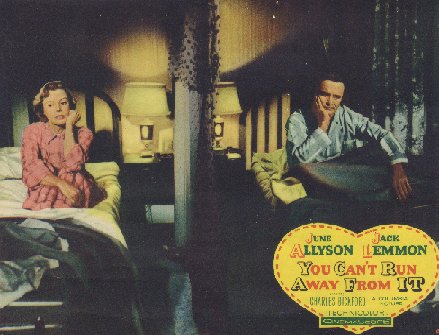
Scenes from “It Happened One Night” are repeated, verbatim — the “walls of Jericho” shared motel rooms (twin beds were all the rage), the hitchhiking, skirt-hiking bit Claudette Colbert pulled off in the original film now has a song to go with it.

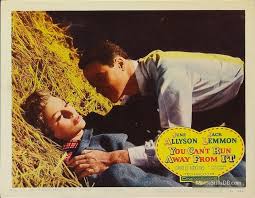
Streams are crossed, wires are crossed and between the location-shot stream-fording and soundstage haystacks and “motor court” lodgings, love is bound to blossom.

Powell makes the best of all that he’s been given, but the script lacks almost anything in the way of snappy dialogue and the wide screen process pretty much swallows character comedies like this one.

Backus had one of the funniest voices in film, and the future Thurston Howell, III and Mister Magoo milks that for all it’s worth in a single scene. Youngman squeezes in a one-liner as both Ellie and Peter insist that he hold the bus and “wait” for them at a dinner stop.

“Sure lady…” “They don’t know, but they’ll never see me again. I just quit!

“You Can’t Run Away from It” wasn’t a hit in 1956. And its relative obscurity is underscored by the lack of color still shots of it floating around the Internet. It was lightly regarded, then and now.

But Lemmon made every role memorable and every leading lady likeable just by his presence. His manic patter early years were made for “screwball,” or its nearest equivalent in square 1950s and early ’60s America cinema.

Check out his “She’s my wife” exchange with sniggering “swingin’ safari” bus riding “daddio” on-the-make George Shapely, played by Paul Gilbert.

“Swing it over’t the other seat, boy. Blow, dad!”

He’d find his “Everynebbish” guise a few years later, in “The Apartment.” But the callous kid/blowhard of “Mister Roberts” grows up and grows an edge in “You Can’t Run Away from It,” a movie that figured out Lemmon was at his funniest when he was at his testiest.

Rating: approved, TV-PG

Cast: June Allyson, Jack Lemmon, Stubby Kaye, Jim Backus, Henny Youngman, Jack Albertson, Howard McNear, Elvia Allman, Dub Taylor and Charles Bickford

Credits: Directed by Dick Powell, scripted by Robert Riskin and Claude Binyon, based on a short story by Samuel Hopkins Adams and the movie “It Happened One Night,” songs by Johnny Mercer. A Columbia Pictures release on Tubi.

Running time: 1:35
Posted in Reviews, previews, profiles and movie news | Tagged , , , , , | Comments Off on Classic Film Review: Lemmon and Allyson remake “It Happened One Night” — as a musical — “You Can’t Run Away from It” (1956)

Movie Review: A Brave anti-fascist theologian is clumsily remembered in “Bonhoeffer”

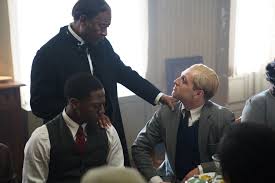
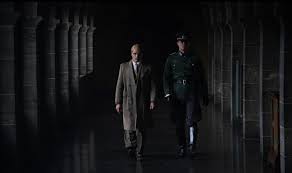
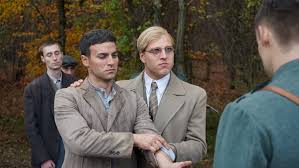
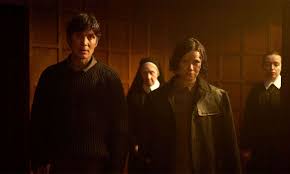
I highly recommend you pay a quick visit to the Wikipedia page dedicated to German theologian and resistance martyr Dietrch Bonhoeffer before taking on writer-director Todd Komarnicki’s film “Bonhoeffer.”

Otherwise, you might be as lost as I was thanks to the botched chronology acted-out by a little-known cast in a screen biography that does not live up to its over-reaching subtitle — “Pastor. Spy. Assassin.”

Komarnicki, who scripted “Sully” and “The Professor and the Madman,” and who wrote and directed a long forgotten Bill Paxton/Julia Ormond WWII misfire, “Resistance,” struggles to get this celebrated figure’s sprawling but short life into 132 minutes. All along the way, as he jumps from the formative events of Bonhoeffer’s theology and anti-Nazi beliefs to the end of his imprisonment in a concentration camp at the end of the war, Komarnicki too often leaves the viewer adrift.

Wait, this character talks about clergy being sent to the “Eastern Front” (with Russia)? Didn’t we just see the aftermath of “Kristallnacht?” The war hasn’t started yet, has it? Is Churchill the one the resistance would be begging for help at this juncture? Is his reason for not helping German resistors really that he fears “invasion” in (just guessing here) 1942-43?

The narrative gets lost and drags us along with it as it does. I’ve seen a documentary about Bonhoeffer and read a bit about him over the years, and I found it impossible to place most undated sequences in the film in any definite time frame.

“Bonhoeffer” captures stirring sermons denouncing the cult of fascism and dwells, at length, on his formative months in America before Hitler came to power — renewing his faith through the sermons he hears in 1930s Black New York churches, discovering jazz.

We’ve already tasted his childhood, the pacifism that might have been born when he saw a beloved older brother march off “a hero” only to have his life wasted in The Great War (WWI).

Jonas Dassler (“Never Look Away”) is a dead-ringer for the preacher acting out a script that tries to celebrate a major figure who was a whirlwind of activity unafraid of pursuing what he saw as a greater cause and a higher calling. We see him helping found the “Confessing Church” in reaction to the Christian Nationalist bent of mainline German Protestantism under the Nazis. And we follow Bonhoeffer into the “underground seminary” where he tries to raise young pastors like himself — on the move and out of reach of the Gestapo — who see the Almighty as the head of the church, not Adolf Hitler.

But we get little notion of the vast collection writings which made Bonhoeffer famous and which immortalized him after his death. In a time of moral crisis and fascist intolerance, the “devout pacifist” speaks, declaring that “Not to speak” in such a crisis “IS to speak.” Silence is compliance and compliance is collusion.

“God will not forgive us for this” criticism of persecution of the Jews, he is warned buy his peers. “He will not forgive us if we don’t!

And when he’s asked by old friends and relatives “Can you give more than your voice to this cause?” Dietrich Bonhoeffer became a spy, joining the Abwehr (military intelligence) where plots were afoot to assassinate Hitler. He will risk “dirty hands” and go where churches and pastors rarely go in his efforts to combat a great corporeal evil that others are content to pray over.

The scheming is given short shrift, and Komarnicki choses to depict a different bomb plot than the one Bonhoeffer was charged with participating in recreating that sequence of events. That adds to the historical murk that this movie lives in.

There’s enough of the man and his words to make us wish the screenplay had been better organized, and good enough to attract a more star-studded supporting cast (August Diehl plays the heroic Bishop Martin Niemoller). Unfamiliar faces, unidentified by on-screen graphics, leave the viewer in the dark about who is related to whom and what their place in all of this might be. Casting familiar faces often fix such shortcomings.

Bonhoeffer spoke, in life and in the film, of putting “a stick in the very wheel of the (fascist, immoral) state until it stops.” That’s a message this Angel Studios (“Sound of Freedom,” and “Cabrini”) production would have been well-served getting out weeks before the last American election instead of weeks after Christian Nationalism and fascism triumphed at the polls.

The movie also strains to narrow its message to Anti-Semitism, when Bonhoeffer himself saw fascism as a broader evil and an immoral threat on many fronts, with many scapegoated victims.

Both that and this gutless “NOW you warn us about ‘fascism'” release date are acts of cowardice that Bonhoeffer himself would have condemned.

Rating: PG-13, violence, mild profanity

Cast: Jonas Dassler, August Diehl, David Jonsson, Flula Borg, Nadine Heidenreich, Lisa Hofer and
Moritz Bleibtreu

Credits: Scripted and directed by Todd Komarnicki. An Angel Studios release.

Running time: 2:12

Posted in Reviews, previews, profiles and movie news | Tagged , , , , | Comments Off on Movie Review: A Brave anti-fascist theologian is clumsily remembered in “Bonhoeffer”

Movie Preview: The Perfect title for a Horror Film? “The Man in the White Van”

Dec. 13, we figure out if this title tells us everything that we need to know about this one.

Posted in Reviews, previews, profiles and movie news | Comments Off on Movie Preview: The Perfect title for a Horror Film? “The Man in the White Van”

Netflixable? “Hot Frosty” serves up a Snowman Who’s “Cut”

When it comes to holiday films, American tastes long ago moved into HallmarkLand.

Christmas princes, princesses, holiday get-aways that turn into second chance romances, holiday movies these days are all about Dolly Parton, Nicolas Sparks and sentiments — and plots — that can be boiled down to a Hallmark Card, or its cheaper Dollar Tree equivalent.

Netflix learned this lesson a couple of holidays back. Jeff Bezos and Amazon/MGM figured it out the hard way last weekend, when their idiotically-expensive “Red One” won the box office race in what could only be described as an underwhelming Pyrrhic Victory.

The most-watched holiday movie in America isn’t about Santa’s security detail (“Red One”), a new version of “The Best Christmas Pageant Ever” or the edgier/off-key “Chrismas Eve at Miller’s Point.” It’s “Hot Frosty,” a “Frosty the Snowman” tale where the snowman stepped off a fashion show runway in between trips to the gym.

Streaming holiday films are where stars of yore from Lindsay Lohan to lesser lights from “Sex and the City” show up and remind us they’re still here, still working and always employable as long as there’s a Hallmark Channel, Netflix or Amazon willing to write a check to park them in a winter wonderland.

“Party of Five” and “Mean Girls” alumna Lacey Chabert is our widowed, lovelorn heroine ready to meet “Hot Frosty.” Lauren Holly (“Dumb and Dumber”), Katy Mixon Greer (“Four Christmases”) and Craig Robinson (“Hot Tub Time Machine”) head the supporting cast of “Whatever happened to’s?”

It’s about cafe owner Kathy (Chabert) draping a magical scarf on a snowman in postcard-perfect Hope Springs, only to have it turn into a naked and seriously buff dude (Dustin Milligan) who might be new to this whole humanity thing, but “If it’s on TV, I can learn it.”

Widowed Kathy has let her house go, as she no longer has a “honey” for her “honey do” list. As our naked snowman swiped used coveralls with the name “Jack” on them, Jack is here to rescue her from her leaky roof (Shirtless shingling in the snow!) and her broken heart.

Because you can learn to fix anything on Youtube. And you can learn to dance and romance from TV.

Holly plays the busybody neighbor who needs Jack’s um, assistance. Mixon Greer’s the town doctor, who’s as baffled as Kathy about this buff new hunk in town’s lower-than-low body temperature.

And Robinson is the local sheriff, determined to get to the bottom of things as regards a “crime” Jack committed, and Jack’s lack of a markable finger print.

There’s maybe one laugh in this — at a gathering of ladies who lunch who gawk at an (unseen) shot of Jack just after his transformation, naked as the day he was born.

The story and the characters who inhabit it never quite surpass “cute” or measure up to “sweet.” But Netflix or screenwriter Russell Hainline have done their research on small town America. The store “Jack” swipes boots and those coveralls from, the same place where Kathy received the “magical” scarf as a gift, is a friend’s unclaimed luggage store. That’s something every Southern Living/RFTV subscriber in Flyover America knows all about.

A lot of people are watching “Hot Frosty.” Some may even like it. But even many of them might admit — with the threat of “No eggnog for you” hanging over them — that it’s pretty but pretty bland and pretty bad (mostly heartless and humorless), to boot.

But ’tis the season for “Give the people what they want,” and what they want is treacle, not The Rock.

Rating: TV-PG, near nudity, lots of shirtlessness

Cast: Lacey Chabert, Dustin Milligan, Lauren Holly, Katy Mixon Greer, Joe Lo Truglio and Craig Robinson

Credits: Directed by Jerry Ciccoritti, scripted by Russell Hainline. A Netflix release.

Running time: 1:30

Posted in Reviews, previews, profiles and movie news | Tagged , , , , | Comments Off on Netflixable? “Hot Frosty” serves up a Snowman Who’s “Cut”

Movie Review: Sex Worker “Anora” marries her “Whale”

Full disclosure, I ducked into “Anora” a couple of times, waiting for other movies to start, before finally setting aside the time to watch Sean Baker’s latest, start to finish.

The tale of an American sex worker of Eastern European descent who catches the fancy of a “whale,” a rich Russian oligarch’s son, who then marries her, it’s about transactional relationships — sexual and otherwise.

I couldn’t decide if this was really my thing. “Anora” lacks the raw emotion, street energy and urgency of Baker’s transgender romp “Tangerine” — and the pathos of his acclaimed peek at childhood homelessness in the “paradise” of “The Florida Project.” Catching thirty or forty minutes of this here and there had me shaking my head at its many explicit sex scenes, which have the whiff of polished, titillating “filler” in the narrative.

It’s easy enough to guess where all this is going. But how is this acclaimed filmmaker going to get 140 minutes of engaging, provocative “movie” out of all this carnality folded into gauche, bourgeois cliches?

The answer is that he doesn’t. “Anora” is an 85 minute movie in a 139 minute package. Lots of skin, lots of sex, plenty of calculated predation — he’s using her, she’s using him. Can a trip to Vegas be in their future?

There are only a couple of ways “Anora” could turn out, and Baker choses one. But only after he’s gotten his fill of athletic pole dances, lap dances, transactional sex and nudity.

The biggest shock in Mikey Madison’s performance in the title role is realizing she’s an actress with other credits. Baker’s MO as a filmmaker is finding “unknowns,” even people with no acting experience (“Tangerine”) but with a knowledge of the sort of characters they’re playing and the world they’re immersed in.

Madison is no stripper enlisted to portray someone she “knows” thanks to her life. She’s a career actress who mastered not just the dancing — laps, and poles — and the working class Bronx accent. She utterly inhabits this part, that of a 20something who does lucrative work but is smart enough to realize there are “no benefits” and “no 401K” attached to her “career.”

Landing “a whale” (rich client) as a husband feels a lot like a “Where do you see yourself in five years?” answer to a human resources dept. questionaire.

Anora isn’t shy about poaching co-workers’ regular clients and is a born saleswoman when it comes to “Wanna get a private room?” and “Let’s get you to the ATM.

She shares an El-side flat with another woman, sleeping all day and working all night in a job sure to age her and wear her out in a flash. Not that she acknowledges that reality.

Then this kid shows up with an entourage, a “boy” who wants a dancer who speaks Russian. Anora’s Russian “grandma never learned English,” so she’s his girl. She figures the kid is loaded, but she has no idea of how loaded until he suggests that she “google” his father’s name. He’s an oligarch, rich and connected.

But Dad and Mom are in Russia, and young Ivan, “Vanya” (Mark Eydelshteyn) is in New York, living in a seaside modernist mansion, playing video games, throwing parties and blowing through blow, hookers and cash.

Anora can’t hide the calculating she’s doing when she side-eyes his New Year’s Eve party invitation, when she’s negotiating his “exclusive” financial relationship with her.

One trip to Vegas later and they’re hitched. He’s 21 and learning what “better” sex is like from a pro. But “Anora” is about what happens when Ivan’s family and his family’s fixers do when they discover this unapproved-of marriage, and what she’ll do to save her whale.

Continue reading
Posted in Reviews, previews, profiles and movie news | Tagged , , , , | Comments Off on Movie Review: Sex Worker “Anora” marries her “Whale”

Movie Review: Mismatched Cousins Find their Pilgrimage to the Motherland “A Real Pain”

It’s true that the funniest bits in Jesse Eisenberg’s “A Real Pain” turn up in the movie’s trailers.

A lot of over-reactions and under-reactions, infectiously exhuberant changes of mood that can be exhaustingly manic, a big personality overhwelming a reserved one, blasts of setting-inappropriate profanity and a big, well-deserved slap for effect pretty much sum it up.

It’s a funny film, but never actually hilarious. It has its touching scenes, its mild jolts of surprise. And there’s the odd “teachable moment” wrapped in the comical personality clashes about Jewish history in Poland, about family history and taking responsibility for those close to you.

A couple of Jewish cousins — a nebbishy/nervous NYC worrywart and his laid-back-to-manic-in-a-flash “free spirit” country kin (Binghamton, N.Y.)  — fly to Poland to see where their grandmother grew up and fled the Holocaust to ensure they’d be born.

Dave (Eisenberg) is frantic about “schedules” and keeping up with their tour group, whom they constantly inconvenience and insincerely apologize “Sorry, so sorry” to every time they’re late. Benjy (Kieran Culkin) doesn’t sweat deadlines, missed trains or “schedules,” and mails himself some primo weed to their first hotel so that they can chill, rub the rough edges off each day and “feel” together as they take a high-end tour through trauma they will never truly know.

We pick up on unemployed Benjy’s general lack of urgency and his unfiltered, dominate-a-room energy right off. He’s constantly asking “You don’t mind the middle (seat on the airplane),” “Mind if I shower first?” passive aggressions.

He is prone to F-bomb tirades about “the corporatization of travel” and the like, which puts more polite people on their heels.

We take in the ways Dave absorbs this, indulges it, apologizes to the others in their half-dozen-member tour group and their pedantic British guide (Will Sharpe of “White Lotus”) when Benjy goes off on their bougie tour and first class train accomodations when their ancestors eighty years ago “would have been herded (into cattle cars) in the BACK of this f—–g train!”

Dave and Benjy are “types.” Dave’s persona is obvious, and Benjy’s secret pain is as well. But we’re invited to a 90 minute ride-along through Dave’s barely-controlled irritation at Benjy’s hypocritical lectures about “feeling” where they are and what is meant by visiting this cemetery, that “Jewish” gate to Lublin, Poland’s old city and the like. Benjy’s also awfully quick to talk out of turn, to take inappropriate camera poses standing in a Warsaw Uprising monument because they’re “funny,” and just as quick to enlist the rest of their group (Liza Sadovy, Kurt Egyiawan, Daniel Oreskes and Jennifer Grey) in his shenanigans.

Benjy plainly is good at reading people, and relating to them, his fondness for the f-bomb notwithstanding. Dave? He wishes he was more like Benjy even as he’s apologizing for his boorishness.

Continue reading
Posted in Reviews, previews, profiles and movie news | Tagged , , , | Comments Off on Movie Review: Mismatched Cousins Find their Pilgrimage to the Motherland “A Real Pain”

Movie Review: Cillian Murphy’s an Irishman Haunted by the Cruelty of the Magdalene Laundries — “Small Things Like These”

There have been more emotional films about the great shame of modern Ireland, the state’s complicity with the Catholic church’s infamous “Magdalene Laundries, which imprisoned pregnant young women in convents, forced them to work for convent for-profit laundry services and made them to give up their children for adoption. “Philomena,” is merely the most celebrated screen account of this crime.

But no film has picked at the scab of cultural complicity as well as “Small Things Like These,” an adaptation of an awared-winning Claire Keegan novel. It takes aim at the conspiracy of silence that most Irish rationalized when confronted with this cruel horror in their midst perpetrated by the shadow state that was, for decades, the Catholic Church in Ireland.

Tim Mielants’ film is a showcase for brooding Oscar winner Cillian Murphy, perfectly cast as a father and coal deliveryman forced to face a great wrong he sees being perpetrated by the convent in his town, Wexford, in the 1980s.

Bill Furlong (“Oppenheimer’s” Murphy) runs a coal, firewood, propane and turf-as-fuel delivery business in the early ’80s, a father of four girls who finishes each day vigorously scrubbing the coal off his fingers so that he can enjoy the pleasures of family life without bringing “work” home with him.

Wife Eileen (Eileen Walsh) is the one doing most of the raising of this elementary school to high school quartet, with the oldest daughter sharp enough to balance Da’s books at the business. Sad-faced Bill always has a smile for his girls, but keeps his wants and needs small, and keeps his own counsel about what’s going on in his heart.

Flashbacks tell us of a few magical moments from his childhood, and that one life-altering trauma that haunts him to this day.

Then he stumbles into a girl locked in the coal shed at the local convent, one of the legions of young women “in trouble” and thus judged and sentenced — by tradition and by their families — to laboring in a convent laundry while waiting to deliver a baby most will never see.

Bill sees this as a “There but for the grace of God” connection to his own past, and his own present. He’s got four daughters, a couple of whom are getting noticed by the local boys in the golden age of “Come on Eileen” on the radio and MTV. Bill wears his unmarried mother’s surname, and sees no shame in that.

But a conspiracy of silence extends from the convent, whose Mother Superior (Emily Watson, chilling) maintains authority via threats and bribes, something the Church could manage as it controlled not just unwed mothers and out-of-wedlock working class children, but the only functioning sector of the educational system — convent schools.

Locals warn Bill to “keep on the right side of people,” to “keep the bad dog witcha so the good dog don’t bite” and the like.

His wife, Eileen, with two girls yet to be accepted by the Catholic school, is more sanguine.

 “If you want to get on in this life, there are things you have to ignore.”

If there’s a clearer “go along to get along” acquiesence to immoral rule, I’ve yet to ear it.

Bill struggles with his childhood (Louis Kirwan is Young Bill) memories. And the sight of a teen girl, shocked and shattered and ill-used, is almost too much to bear. Guilt, duty and compliance go to war for his mortal soul.

Continue reading
Posted in Reviews, previews, profiles and movie news | Tagged , , , , , , | Comments Off on Movie Review: Cillian Murphy’s an Irishman Haunted by the Cruelty of the Magdalene Laundries — “Small Things Like These”

Movie Review: Eastwood’s made a creaky court case built around “Juror #2”

Maybe the answer to “Why did Warner Brothers barely release Clint Eastwood’s ‘final film?” was that it’s just not very good.

“Juror # 2” is competently cast, acted, shot and put together. But the script is melodramatic to the point of “hackneyed,” with a couple of unintentional laughs thrown in for good measure. I caught at least one continuity error, and that is about the only thing that really held my attention the rest of the way through this eye-roller of a Clint curtain call.

Others can grade great grandpa on the curve, but about the best you can say about this “Matlock” melodrama is that it’s not “Cry Macho,” even if it’s not any better than that the worst of the “final films” that preceded it.

Nicholas Hoult stars as a recovering alcoholic and expectant father who finds himself on a Savannah murder trial jury in which he has a very important piece of evidence about the crime which the accused is seemingly certain to have commited.

Juror number two is pretty sure he himself did it.

Seeing as how another juror turns out to be a retired cop, you have to wonder if the “real” killer will get away with it. And you ponder the competence of the prosecuting attorney, running for DA (Toni Collette) and the public defender (Chris Messina) during voir dire (jury questioning and selection).

But that’s kind of the point. Eastwood’s conjured-up a condemnation of America’s justice system, and in his most Clint touch of all, leaves the rush-to-judgement “their only suspect” cops out of the equation altogether. Yeah Clint, prosecutorial misconduct along the Georgia coast always has a local policing element. Or didn’t you hear?

Jurors bicker over a verdict with the two Black jurors (Cedric Yarbrough and Adienne C. Moore) the quickest to vote “guilty” to get out of there and go home. The others, urged on by Justin (Hoult), start teasing-out other possible solutions to the mystery, and break the judge’s strict orders to not attempt their “own investigation.”

The most tainted juror of all consults his AA sponsor (Kiefer Sutherland) who conveniently turns out to be another attorney. And the advice that counselor counsels is jaw-dropping, more dramatically convenient than real world ethical.

Coincidences like that abound as our guilty juror flashes back to that fateful night and tries to head off A) sending an innocent man to prison and B) to avoid letting suspicion fall on him as he attempts that.

Eastwood serves up a politically correct jury — white, Black, Asian, female, male, young, old, etc. — passing judgment on a case so convoluted and a screenplay so contorted that even the aspiring DA starts doing her own investigating. Because again, the COPS are left out of this altogether.

The strangers in the jury room leap into instant “old man” and “stoner” insults, this coming after the second or third reference to “this flawed process” and how “imperfect it may be” to have untrained, distracted and resentful jurors forced to do the work of the court.

The worst thing anyone calls the DA is “a politician.” That’s the depth of the messaging here.

Further complicating our suspect juror’s attack of conscience and rationalizations about the other suspect being “a bad dude” is his “problem pregnancy” wife (Zoey Deutch) who needs him by her side once he’s saved the innocent man and covered his own tracks from within the jury room.

Continue reading
Posted in Reviews, previews, profiles and movie news | Tagged , , , , | 1 Comment

Movie Review: Dumb action gets dumber, “Get Fast”

“Stupid is as stupid does,” and stupid’s entirely the point of “Get Fast,” a dumber-than-dumb action pic that sets out to prove how much movie you can make with pretty much no script at all.

Catch-phrases and stock characters, a film where every heist or attempt to recover the loot from a heist “always ends with a shootout,” it’s a short, stupid sprint of a low-budget action comedy, the sort of picture you get when you have to digitally add muzzle flashes to those “shoot outs” because you blew through way too much money renting a plane, a helicopter and a pricy “cowboy” outfit for the biggest name in your cast, Lou Diamond Phillips.

But take your ten gallon hats off to Valerie Biggin, who arranged the generic ’80s action pop soundtrack. That sets the cheesy tone they were going for here, and if they had fun doing car and truck chases, shoot-outs and the like on a teensy budget, well at least that’s something.

Director and co-writer James Clayton, who directed, co-wrote and co-starred in the Vinnie Jones thriller “Bullet Proof,” drops us right in the middle of the action, the climax to a chase where “partner” Vic (Philip Granger) isn’t able to fly his vintage plane to the rescue of “The Thief” (Clayton), who has robbed the drug gang run by Nushi (Fei Ren).

As Nushi’s minions Sly and Tank (Lee Majdoub and Simon Chin) and others show up to foil their getaway, partner Vic mutters “Get fast, get gone.” And the thief steals fresh wheels to make a getaway that never quite gets away.

There are dirty cops (Alisha-Marie Ahamed and James Hutson) and mob minions to overcome, an anxiety-ridden ice cream truck driver (Suleiman Abutu) to hijack and enlist and Nushi’s murderous “enforcer,” Mr. “If she’s sending who I THINK she’s sending” to be faced.

That would be “The Cowboy” (Phillips,) dolled up like New Mexican pimp ready to strut his stuff and wave his over-sized six-shooters at the Waco rodeo.

Continue reading
Posted in Reviews, previews, profiles and movie news | Tagged , , , , | Comments Off on Movie Review: Dumb action gets dumber, “Get Fast”

Netflixable? Elliot Page stars in a Transgender Homecoming — “Close to You”

The Canadian drama “Close to You” is a quiet, contemplative and yet deflatingly unsurprising homecoming story about an unhappy, maladjusted daughter who returns to his former home and former life after gender reassignment treatment.

It stars the transgender actor Elliot Page, who helped create the story for a largely improvised screenplay that touches most of the bases you’d expect, but with a frankness that’s disarming and sometimes refreshing.

Sam has made a new life for himself in Toronto, enduring years of gender changing treatment to become a better-adjusted person even if he’s not exactly thriving financially.

But his father’s birthday has Sam packing for a weekend back in tiny, lakeside Cobourg, where Sam’s sisters, brother and brothers-in-law are gathering in the family home to celebrate. Sam hasn’t been there in four years.

Most will welcome him. Some will stumble over pronouns and one will fume over the “new rules” and lash out in the most predictable ways.

“We shared a f—–g bedroom, and I didn’t know you!” one sister cries in what we take to be despair and guilt.

And then there’s that high school crush (Hilary Baack) Sam stumbles into on the train. Katherine isn’t shocked at seeing him. But she’s shaken, and we can see the old feelings that she, at least, is struggling to fight off.

“I can’t, I can’t I can’t” is all she can say after all these years. She and Sam will take the time to say more, we feel. Because that’s the way melodramas with gay characters too often unfold.

Married? Loving husband? Kids? Is that just compromising her “true” self? Shouldn’t she, in her 30s, throw that all away just to see a “first love” high school flirtation through?

Writer-director Dominic Savage (“The Escape,” “Love + Hate”) treats every moment, every image with such somber gravitas that “Close to You” is practically smothered in seriousness and good intentions. Sam’s journey home is tracked in long hand-held camera treks through Toronto to the train, and a long walk home in Cobourg, with every step freighted with dread.

After a while, that gets old. And as the largely improvised conversations develop in directions that only rarely move or even surprise, the picture’s slack pacing starts to wear on you.

Wendy Crewson and Peter Outerbridge play the welcoming parents, with each having an idealized “You’re still my child” scene that moves and is a model for “how to speak to your trans kid.”

Continue reading
Posted in Reviews, previews, profiles and movie news | Tagged , , , | 2 Comments