
Movie Review: “Ex Machina” puts the Fear of God into us, about machines

machina

“Ex Machina” is an “Island of Dr. Moreau” for the singularity era. It’s a cerebral, chilling and austere thriller that stokes our fears about digital privacy and artificial intelligence, a film that works largely thanks to a breakout mechanically empathetic turn by Alicia Vikander (“A Royal Affair,””Seventh Son”).
Domhnall Gleeson (“Frank”) is Caleb, a top-notch computer coder who has been summoned to the remote Norwegian retreat of his reclusive search engine mogul boss.
Nathan (Oscar Isaac, “Inside Llewyn Davis”) is a little eccentric, a genius who lives alone, save for a silent Japanese servant (Sonoya Mizuno) in a bunker of a house in a sylvan, mountain setting. He’s approachable, calls Caleb “bro” and likes his beer and his workout routine.
Caleb has won a contest that singled him out for a special job. Nathan’s latest breakthrough is a sentient robot, artificial intelligence that could be “the greatest event in the history of man.” “History of gods,” Caleb corrects. “It’s Promethean, man.” The film’s title has told us that much, taken from the Greek “Deus ex machina,” “god in the machine.”
Nathan needs Caleb to administer a week-long series of questions, a “Turing Test” to determine if this machine has a conscience, thinks for itself, etc.
Ava (Vikander) is a wonder. We can see the metallic components that make up her innards, hear the servos whirr with every movement. But the little skin that is there covers an expressive face, her head twitching like a curious bird, her voice nuanced to create empathy as she picks up on Caleb’s social signals.
She is complicated, fascinating, and as Caleb notes, “non-autistic.” She has empathy and flirts.
“Are you attracted to me?”
Caleb can talk tech with Nathan and talk about life with Ava and that takes him “through the looking glass,” wondering just who is manipulating him, and to what end.
Nathan has callously ignored Asimov’s laws of robotics that might protect humanity from the grave threat that everyone from Arthur C. Clarke to Stephen Hawking has warned us about. Context is key, as a film about this subject with another in a long line of shapely robots comes after “Her” and the Euro thriller “Eva” (a robotic child). Is Ava a mechanical cure for loneliness among the technorati, or an agent of our doom?
No actor is making more consistently interesting choices than Isaac, these days. Nathan is menacing and charming, condescending and encouraging. The Irish Gleeson unleashes an impeccable American techie accent here and lets us see the wheels turn as Caleb tries to reason out where his sympathies should lie and who the greater threat is.
But Vikander and the effects that erase a big chunk of her body make “Ex Machina” work. Thanks to her, the directing debut of writer-producer Alex Garland (“28 Days Later”) is a movie that’s another emphatic flag of caution about digitally surrendered privacy and digital submission to a fate Big Tech seems pre-ordained to sentence us to.

3stars2
MPAA Rating: R for graphic nudity, language, sexual references and some violence |

Cast: Domhnall Gleeson, Alicia Vikander, Oscar Isaac, Sonoya Mizuno
Credits: Written and directed by Alex Garland. An A24 release.

Running time: 1:45

Posted in Reviews, previews, profiles and movie news | Comments Off on Movie Review: “Ex Machina” puts the Fear of God into us, about machines

Movie Review: “Kill Me Three Times” is a clever “Blood Simple Lite,” never quite outsmarting itself

peg“Kill Me Three Times” is a grimly amusing Australian thriller in the “Blood Simple” mold, for those who know their early Coen Brothers history.
And if your memories of that film noir classic aren’t the sharpest, “Three Times” is so similar — in structure, situations and characters — that it serves as a refresher course on that film and the genre it revived.
We meet Charlie as he’s putting the finishing touches on a job. He’s killing someone, so if his ostentatious “car with character” (1960s Olds Toronado) black on black wardrobe and Fu Manchu mustache don’t give him away, that act does. He’s a hit man.
He takes a call. It might be his next job.
The story then flips back and forth in time in between three threads of plot. There’s the bartender-wife (Alice Braga) of a bar owner (Callan Mulvey) trying to run away from an abusive marriage. And there’s the dentist (Sullivan Stapleton) being nagged into faking a death by his receptionist-wife (Teresa Palmer) for reasons that will become clear later.
Somebody wants Charlie to rub out somebody else, but since everybody seems intent on knocking somebody else off, sometimes Charlie sits back, watches and takes credit.
“Quality always costs,” he purrs. Which is why the film is titled “Kill Me Three Times.” Chapters break it into “Kill Me Once” and then “Kill Me Twice.” Because sometimes, the “killed” aren’t actually dead. Premium prices would ensure that the job only has to be done once.
Bryan Brown, little seen in the decades since the “FX” movies, shows up as a tough, aged and corrupt cop.
Pegg, the comic star of “Hot Fuzz” and “Shaun of the Dead,” by default makes Charlie a fun and funny figure — not as sharp as he seems to think. He swears a lot, shakes his head at the shenanigans of others and figures he’ll clean up and collect a nice payday for all the work he may not even have to do.
Unless the flashbacks and flashforwards — most of which have “spoiler alert” built into them — stop him. The James McFarland script and Kriv Stenders direction of it give away the big revelations too easily.
Thus, “Kill Me Three Times” is enjoyable mainly for its performances — Pegg’s comic venality, Palmer’s nagging ruthlessness, Brown’s quiet cruelty — and the creative ways it kills its way toward an ending that we’ve seen pretty close to the beginning.

2half-star6

MPAA Rating: R for bloody violence, language and some sexuality/nudity

Cast: Alice Braga, Luke Hemsworth, Simon Pegg, Teresa Palmer,Callan Mulvey, Bryan Brown
Credits: Directed by Kriv Stenders, written by James McFarland. A Magnolia release.

Running time: 1:30

Posted in Reviews, previews, profiles and movie news | Comments Off on Movie Review: “Kill Me Three Times” is a clever “Blood Simple Lite,” never quite outsmarting itself

Movie Review: “Dial a Prayer” cleverly hedges its bets

prayer

No leap of faith or sudden spiritual conversion brought Cora to the dial-a-prayer call center in suburban Detroit. A judge made that her community service sentence. Because Cora made a big mistake, one with religious implications.
She doesn’t “believe.” Her “How may I pray for you today?” isn’t sincere. She’s reading from a corporate playbook designed to nudge callers into subscribing or donating.
She watches the clock. And when it’s quitting time, she’s gotten her last pep talk from the preacher/boss (William H. Macy), her last coaching from the zealous author of the playbook (Aral Gribble). She can light a joint in the privacy of her car, maybe hit the liquor store on her way home, where her sad, wit’s-end mother (Glenne Headly) half-heartedly nags the 26 year-old, knowing it won’t do any good.
“Dial a Prayer” isn’t your preach-to-the-choir variety faith-based film. It’s cynical enough to suggest the futility of prayer, snarky enough to point out the bottom line, even at such a call center. But Cora, played with a guilt-ridden wince by Brittany Snow (“Pitch Perfect”), is headed toward some sort of, for want of a better phrase, “Come to Jesus moment.” We can feel it, with every flashback that tells her sordid back story, with every contrived (or imagined) prayer she offers, by phone, to a stranger.
Snow’s Cora never reveals herself to be “a natural” at this. But results turn up — she becomes “a rock star” operator, piling up the call log results, and a seemingly upright young man (Tom Lipinski) who was touched by her call and came to meet her.
Writer-director Maggie Kiley wrote, shoots and edits this in such a way that we wonder, given Cora’s mental state, if she’s imagining things like laying her hands on heart attack or traffic accident victims.
Cora resists the religious entreaties of her convincingly zealous boss (Macy), but not his threats about the judge who gave her this last chance at redemption. She lashes out at an absentee dad, a weak mother and at religion itself.
“Dial a Prayer” doesn’t tread the straight and narrow and reaches few predictable conclusions about Cora’s journey. But Kiley has created a pretty engrossing and somewhat moving story of a selfish, self-destructive drunk who finds, if not faith, at least the willingness to look outside of herself to try and help others and the chance to actually join the human race.

2half-star6
MPAA Rating: PG-13 for thematic elements, brief strong language, some drug use and suggestive material

Cast: Brittany Snow, William H. Macy, Glenne Headly, Tom Lipinski
Credits: Written and directed by Maggie Kiley. A Vertical release.

Running time: 1:37

Posted in Reviews, previews, profiles and movie news | Comments Off on Movie Review: “Dial a Prayer” cleverly hedges its bets

Movie Review: “Dior & I”

2stars1

dii

What happens when a self-described “menswear specialist” and “minimalist” champion of the “skinny black suit” takes over one of the most fabled fashion houses of Paris?
Read no further if you’re not a fashion maven, as “Dior and I” is not the movie for you. And even if it is, this undramatic and flat peek “inside” the sewing rooms of Christian Dior holds little in the way of entertainment.
Director Frédéric Tcheng had a hand in such fashion documentaries as “Valentino: The Last Emperor” and “Diana Vreeland: The Eye Has to Travel,” but he has neither the characters nor the potential conflict to make this one anything more than a 90 minute drift up to Belgian Raf Simons’ first show as creative director of the house that maintains founder Christian Dior’s “sublime legacy,” 55 years after the master’s death.
Tcheng touches on that history all too briefly before introducing us to the bland Simons, an artist who confesses, here and there, that he’s more “ready-to-wear than couture.”
Simons scores points for making it his business to meet the seamstresses who will be sewing his designs, straight off. These jolly women in white lab coats insist “the spirit” of the founder is still alive in the house he started, and dive into the designs that Simons comes up with or approves.
But the film, mostly in French with English subtitles — subtitles in white on a sea of white coats, white walls and white bolts and swatches of cloth (epic fail) — conveys little tension or sense of urgency in the eight weeks Simons had to make his mark. Oscar winners Marion Cotillard and Jennifer Lawrence, actress Sharon Stone and fashion arbiter Anna Wintour are glimpsed. But the behind-the-scenes, scenes-overheard nature of the filmmaking means there’s no one to explain to us the situation, no interviews questioning this guy’s selection and little, other than what we can sense just from body language, that suggests the tension and the stakes.
“Dior and I” belongs to a new sub-genre of documentary, films like “Ballet 422,” that give us great access “behind the scenes,” but zero insights as they do.

MPAA Rating: unrated, limited nudity

Cast: Raf Simons, Anna Wintour
Credits: Written and directed by Frédéric Tcheng , written by. An Orchard release.

Running time: 1:29

Posted in Reviews, previews, profiles and movie news | Comments Off on Movie Review: “Dior & I”

Movie Review: “Freetown”

freeThe early days of Liberia’s long civil war provide the backdrop to “Freetown,” a modestly-budgeted odyssey about Mormon missionaries fleeing the country for neighboring Sierra Leone.
It’s 1989, and rebels are hunting anyone from the Krahn tribe, carrying up summary executions of the ruling class tribe members wherever they find them. That’s made it impossible for the nascent Mormon community of missionaries to do their work.
Abubakar (Henry Adofo) is charged with getting these young “Elders” out, to neighboring Sierra Leone. He has a car, but little gas. And just rounding up six young men out spreading the Latter Day Saints word is a nightmare in a country overrun with armed, trigger-happy teenagers.
Garrett Batty’s “inspired by a true story” film is most at home capturing a country descending into chaos — the myopia of seeing a war up close. Locals and missionaries flee to the sanctuary of a church, randomly hunted by disorganized thugs piling out of pickup trucks, enforcing their reign of terror at the barrel of an AK-47.
The Elders are idealistic, Abubakar (also a Mormon) is pragmatic. He’s trying to get them out and they’re handing out tracts, recruiting kids, women and those not involved in the fighting.
“Revelation doesn’t come when we are hiding in the shadows,” one complains. Still, six of the young men in white shirts and ties tumble into Abubaker’s hatchback and they’re off.
Batty’s film has the Elders see this deliverance from a checkpoint or that traverse of a vast mud puddle as a “miracle.” A nearly-empty tank of gas that covers scores of miles? Another miracle. They’re chased toward the border by zealots determined to bring them to revolutionary justice.
The executions and worst of the violence is kept off camera. The acting varies from passable to rote, wooden recitation. And there’s a hint of humor.
“I wouldn’t be opposed to a shower.”
“I wouldn’t be opposed to you having a shower.”
But the film takes over an hour to get underway, and dawdles even after it’s hit the road. The impending peril is feebly handled, the Biblical allegories (one Elder denies his tribe) a trifle heavy-handed.
Inter-African “racism” (tribalism, actually) is discussed, but not the then-current racist reputation of the church these young African men had joined. Perhaps they weren’t told.
So as odysseys go, “Freetown” is a short trip, and the incidents during it hardly seem the stuff of great drama, with or without “miracles.”

1half-star

MPAA Rating: unrated, violence”

Cast: Henry Adofo, Phillip Adekunle Michael, Michael Attram, Alphonse Menyo
Credits: Directed by Garrett Batty , written by Melissa Leilani Larson and Garrett Batty. A Purdie Distribution release.

Running time: 1:53

Posted in Reviews, previews, profiles and movie news | 4 Comments

Movie Review: “Lambert & Stamp” were the Men Behind The Who, the geniuses who made them famous

lam

There have been better, more thorough documentaries about the seminal rock band The Who. “The Kids are Alright” set the standard back in ’79, and “Amazing Journey: The Story of The Who” seemed to fill in the gaps of that earlier film.
But “Lambert & Stamp,” an alternative history of the band as chaotically organized as The Who itself, is still an eye opener.
James D. Cooper’s film, built around two British filmmakers who took over management of the band and led them to the top, posits that they were basically a cinema experiment that went right, a sort of reality TV show that became a self-manufactured success.
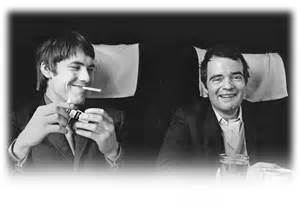
Chris Stamp, brother of the famed British actor Terence Stamp (also seen here) and Kit Lambert were assistant directors in early ’60s British film who longed to direct, and sought out a band that would be suitable for their film exploration of the age of Mods and Rockers, of Swinging London just as it started to swing.
The rough-hewn skirt-chasing Stamp and the closeted, multi-lingual Oxford grad Lambert (seen in vintage interviews with British, German and French TV) were “a whirlwind of ideas about how to get noticed,” lead singer Roger Daltrey remembers. And that’s exactly what started to happen when the quartet formally called The High Numbers started smashing their instruments on stage and discovering theatricality, when their new, novice managers started casting their audience the way one casts a film. The sharpest dressed mid-60s Mods were let in, The Who were even more dapper than their scooter-riding, sharp-dressed listeners. And the contrast between the anarchic band and their Mod image and Mod audience caught fire.
Thus, the band co-opted a movement and became a phenomenon.
The revelation here is how short-lived the garrulous Stamp (interviewed here) and some in the band (composer-guitarist Pete Townshend) thought this would be. Lambert & Stamp saw this as a two year blip on the radar of disposable pop culture, a two year project to prep a film. Art school student Townshend was sure the fame thing wouldn’t last.
And they were pretty much done, until “Tommy” arrived and The Who did what The Beatles, Stones and none of the rest ever managed. They created an opera.
The chronology isn’t neat, and for all the interviews and performance snippets, this isn’t a stand-alone history. You have to know The Who for this alternate take on their rise to glory to resonate.
But Brown has delivered a fun film, a fine tribute to Stamp and the  late Lambert that gives them their due, even if The Who were a little slow to do that themselves.

2half-star6
MPAA Rating:  R for language, some drug content and brief nudity

Cast: Chris Stamp, Kit Lambert, Pete Townshend, Roger Daltrey, Heather Daltrey, Terence Stamp

Credits: Directed by James D. Cooper. A Sony Pictures Classics release.

Running time: 1:57

Posted in Reviews, previews, profiles and movie news | Comments Off on Movie Review: “Lambert & Stamp” were the Men Behind The Who, the geniuses who made them famous

Box Office: A “Furious” start to…summer? “7” heads for a $145 million+ weekend

boxofficeThat famous crack that “Nobody ever went broke UNDER-estimating the tastes of the American public has been true in spades at the box office this year.

“Fifty Shades”? Bad. Big hit. “Home.” Weak. Robust box office numbers.

And now the stunningly stupid “Furious 7” has a $65-68 million Friday that sets this probably not last and not quite least of the “Fast & Furious” movies up for a $140 million weekend. If the numbers hold.

Reviews have been respectful, pandering to the fact that Paul Walker’s dead, ignoring the bigger fact that Vin Diesel was always the stiff here.

And Universal, which makes consistently crappy movies and on rare occasions persuades the rube-oisie to buy a lot of tickets to them, has another hit.

Boo yah. Happy Easter.

“Home” added theaters, and having no competition, is holding onto a decent chunk of its opening weekend audience. A 45% drop, well over $28 million and a chance to top $100 million by say, Tuesday.

“Insurgent” limped over the $100 million mark, or will have by Easter Monday. “Get Hard” and gone limp and looks to top out at $70-75, when it finishes its run.

Other new openings? “It Follows,” the best horror picture since “Insidious,” opens wide and well within the top ten at $8 million.

“Woman in Gold” opens in far fewer theaters and will not quite crack $2 million.

Box office this spring has been so anemic, despite the occasional hit, that “Kingsman” is still in the top ten even though it has made most of its money, and “Do You Believe?”, a weak faith-based outing is ranked despite never having one big weekend. “Second Best Exotic Marigold Hotel” is in the top ten despite earning only $1 million this weekend — $30 million, thus far.

Posted in Reviews, previews, profiles and movie news | Comments Off on Box Office: A “Furious” start to…summer? “7” heads for a $145 million+ weekend

Noah Baumbach and Ad-Rock Horovitz reminisce “While We’re Young”

nb

Adam “Ad-Rock” Horovitz remembers his first “whippersnapper moment.” The once-and-future Beastie boy, 48, was at an outdoor concert in Brooklyn a while back.
“There were these kids hanging out next to us,” Horovitz recalls. “One guy next to us was going on about all these shows he’d done, all these bands he’d played in. For years. ‘Blah blah blah.’ Then he turned to me, ‘What was the first show that YOU played?’
“I said, ‘That was in 1982.’
“And he goes, ‘Oh man. I wasn’t even BORN yet!'”
Horovitz, whose band’s blew up with the chart-topping, generation-defining hip hop/punk mashup “(You Gotta) Fight for Your Right (To Party!)” back in 1986, laughs.
“It didn’t necessarily make me feel old. I just felt…EXPERIENCED.”
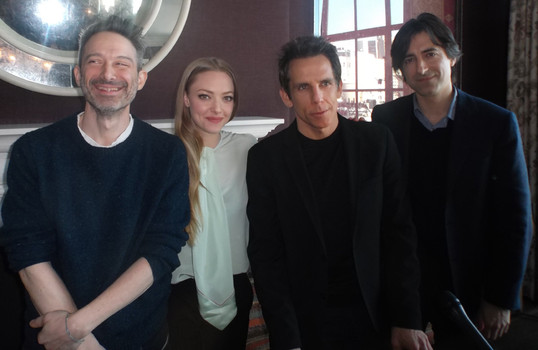
His filmmaker friend Noah Baumbach shares that “experienced” feeling. The director of “Greenberg” and “Frances Ha” cast Horovitz, and their mutual friend Ben Stiller, along with Naomi Watts, Adam Driver and Amanda Seyfried in “While We’re Young,” a gently mocking comedy about the new generation gap amongst the culturally hip, a film earning comparisons to Woody Allen.
Baumbach can walk down any street in Lower Manhattan and see the guys in their skinny jeans and retro Hombergs, resuscitating fashions, music and trash culture that the 45-year-old Baumbach though his generation had buried.
“I keep having the experience of hearing music that I resisted as a kid because it wasn’t cool…being played now by Millennials ‘rediscovering’ it and feeling different about it. I even use some of that music in the movie. I mean, Lionel Ritchie? ‘All Night Long’? Come on. Didn’t like it as a kid, and having kids play it back to me and realizing how good it is was a little humbling.”
“While We’re Young” serves up Stiller and Watts as a 40ish childless couple bored by their baby-centric peers, enamored of a younger, hipper couple (Driver and Seyfried) who seem to be everything they never were.
Horovitz, who has dabbled in acting over the years, is paired up with Maria Dizzia as the peers Watts and Stiller’s couple wants to avoid becoming.
“A moment where I felt old?” Baumbach laughs. “Seeing Ad-Rock, in character with a baby strapped to his chest. Funny. But poignant, too.”

hor
Baumbach “has something of an evil genius for casting” critic Ty Burr noted in The Boston Globe, with Stiller and Watts ably capturing the desperation of the no-longer-young/not-really-old with skill, never more so than in a scene when Watts joins the 20something Seyfried in a hip hop dance exercise class. Horovitz is “grumpy and marvelous” Burr says, in a film Anne Hornaday of The Washington Post called “a thoughtful and resonant depiction of midlife anxiety.”
Mid-life anxiety may be more on Baumbach’s mind than Horovitz’s. Like the characters, all caught up in the world of low-stakes intellectual documentary filmmaking, Horovitz was in the middle of a years-long non-fiction film which he abandoned just as the offer to act in “While We’re Young” came along. He might like to act a bit more, seeing as how his sister Rachael is a pretty famous producer and his father, Israel (“My Old Lady,””Author Author”) a noted writer and director. But first, he has another obligation.
“I am looking back on my legacy, at this point. Mike (Michael “Mike D” Diamond) and I are writing a book on the band.”
And unlike the documentary, which was to be about legendary New Yorker arts critic Peter Schjeldahl’s passion for putting on “very dangerous, and very cool” amateur fireworks displays, Horovitz won’t be able to abandon the book. “We have a contract and all.”
And about “While We’re Young,” hipsters — don’t take it personally, he says.
“I myself don’t wear skinny jeans,” says the hippest member of the relaxed fit generation. “But that’s just me.”

Posted in Reviews | Comments Off on Noah Baumbach and Ad-Rock Horovitz reminisce “While We’re Young”

Movie Review: Faith-based “Beyond the Mask” takes a stab at swashbuckling

maskThe novelty alone makes “Beyond the Mask,” a rare faith-based film pitched as a swashbuckling action picture set during the American Revolution, worth a look.
It’s got piracy, revolution and ordinary men battling against the original “Too Big too Fail” megalopoly, the British East India Company.
There’s also a cameo by the most whimsically secular of the Founding Fathers, Ben Franklin.
An utterly conventional and old fashioned swashbuckler, “Mask: takes a mercenary agent hired by the East India Company, then set up to take a fall for its sins, to America where William Reynolds (Andrew Cheyney) takes on a new identity and a new profession. He’s a pastor in the colonies, and not that good in the pulpit. Even his congregants, especially the fetching Charlotte (Kara Killmer of “Chicago Fire”), raise an eyebrow at that. But she doesn’t suspect him of being “the notorious” Reynolds, wanted by the law and a force greater than the law — the East India Company.
“Only God can give us new lives,” she opines.
But the swashbuckling vicar’s secret is safe only until the arch-villain Charles Kemp (John Rhys-Davies) can find him. And with the East India Company cooking up a teapot full of trouble for the colonies, that won’t be long.
Reynolds feels to Philly, where publisher Ben Franklin finds work for him. Reynolds is soon in the thick of it, as is the lady the vicar once loved.
The divisive politics of 1776 play out on the streets, and in the pubs, because where you chose to drink betrayed where you stood on independence. Picking the King & Crown for a pint isn’t a wise choice for Reynolds.
“It seems I spoke out for liberty,” he tells Franklin (Alan Madlane, who lacks the presence to play the man), “and was thrown out…on my convictions!”
Progressive casting means there are color-blind roles for actors of color.
It’s a decent plot that doesn’t have the light writerly or directorial touch or proper budget to come off. When you’re relying on Franklin’s new toy, “electricity,” to set off bombs, you’d better have convincing effects and there simply wasn’t money for much other than the occasional digital rendering of an 18th century sailing ship.
Cheney, a veteran of Christian films, has nice presence, and Rhys-Davies (“Raiders of the Lost Ark”) makes a formidable villain.
But on the whole, “Beyond the Mask” lacks the wit or excitement to truly come off, though it is intriguing enough to make you hope this team gets to make more films, perhaps spending more money on screenwriting as they do.

2stars1

MPAA Rating: PG for action, violence and some thematic elements

Cast: Andrew Cheney, Kara Killmer, John Rhys Davies
Credits: Directed by Chad Burns , script by Paul McCusker.      Chad Burns . A Burns Family Studio release.

Running time: 1:43

Posted in Reviews, previews, profiles and movie news | 2 Comments

Movie Review: “Woman in Gold”

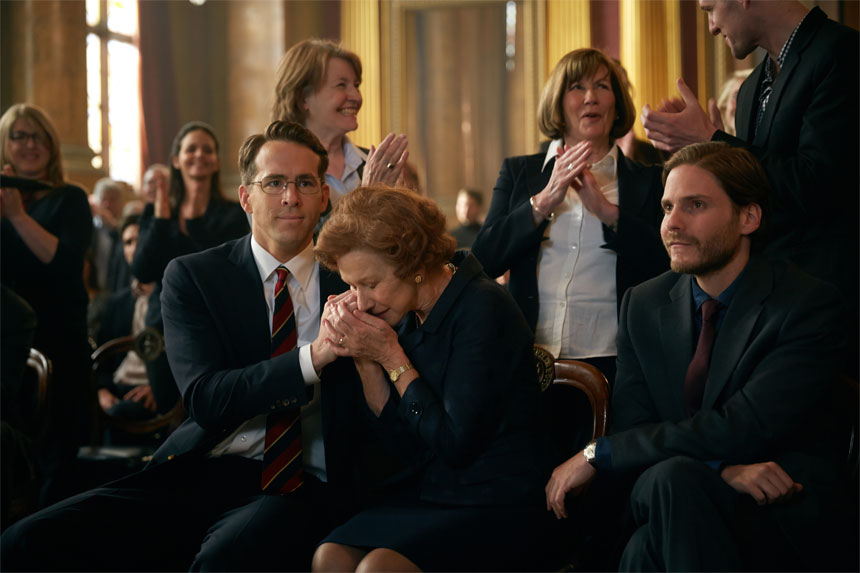
klimt“Woman  in Gold” is a very good story meekly told. It’s a dramatization of one woman’s to recover the art looted from one Jewish family by the Nazis, rendered here in mostly flat tones and trite dialogue. A good rule of thumb for any screenwriter, in this case character actor turned writer Alexi Kaye Campbell, is never give a regal, Oscar-winning actress like Helen Mirren trifling lines like this.(L-R) RYAN REYNOLDS, HELEN MIRREN, and DANIEL BRUHL star in WOMAN IN GOLD

“Ach, come, have some strudel,” her character, Maria Altmann says to a young lawyer (Ryan Reynolds). “I made it especially for you.”
Mirren, the once and future “Queen,” is saddled with pages of this stuff in a screenplay that doesn’t sound like its author has listened to real people, only old movies with hackneyed, Old World-accented dialogue.
Altmann was an Beverly Hills dress shop owner who went to court and to the mat with the Austrian government and people, who had lived comfortably with half-a-century of denial over their complicity in the German crimes of World War II. Reynolds underplays Randol Schoenberg, an over-matched and green LA attorney, grandson of the great Austrian-Jewish composer Arnold Schoenberg. Family connections sent her to him, and a growing sense of grief, outrage and responsibility drove him to sue a Vienna museum and Austria itself over five stolen masterpieces by Austria’s own Gustav Klimt.
The jewel among them was the gold leaf-embossed portrait of the “Woman in Gold.” To Maria, she was her Aunt Adele, a woman she knew in person and a painting she’d seen in the family home up until the day it was confiscated, moved to a museum — stolen.
Director Simon Curtis can’t do much to animate the first hour of this script, with its arcane discussion of “art restitution” and Maria’s dithering over having to return to “that place” and fight with unscrupulous Austrians who consider Klimt’s paintings their national patrimony. Flashbacks illustrate the rich, comfortable life as arts patrons her family enjoyed before Austria’s “annexation” by Germany.
Then, we see the breathless escape of young Maria (Tatiana Maslany) and her husband.
“Unlike Lot’s wife,” Maria muses, “I never looked back.”
We ignore the cloying dialogue as we get our fill of Austrians hiding evidence, stacking the deck on “review panels” of the case, and we get outraged even if Maria seems to have wearied of the fight and Randol wonders if he’s abandoned his career for naught.
Better late than never, “Woman in Gold” starts to grip us. We begin to appreciate the process of “freeing” these “last prisoners of World War II” from a present that is happily ignoring that past.
Like the similarly-themed “Monuments Men,” “Woman in Gold” is burdened by being about what’s at stake — objects, history, heritage — and less about lives.
It’s a labored film thanks to trite dialogue, to interesting characters like a “good Austrian” journalist (Daniel Bruhl) who wants his country held accountable who are given short shrift, and to the many court scenes have a hint of humor, but no spark. This is passable as history, but the climax is so anti-climactic  that this “Woman in Gold” never merits more than a bronze medal.
2stars1

MPAA Rating: PG-13 for some thematic elements and brief strong language.

Cast: Helen Mirren, Ryan Reynolds, Daniel Bruhl
Credits: Directed by Simon Curtis, screenplay by Alexi Kaye Campbell. A Weinstein Co. release.

Running time: 1:49

Posted in Reviews | Comments Off on Movie Review: “Woman in Gold”