
It snows on the people-and-advertising choked streets of Los Angeles. San Diego has been reduced to “Waste Management District” for greater LA. Drone strikes are directed by smart glasses targeting systems, you’re never alone so long as you can afford a hologram, the cops drive flying Peugeots and things still go better with Coca-Cola.
But what are we to take from the chilly magnificence of “Blade Runner 2049?” Can we develop empathy for characters we know, entirely too soon, either don’t exist or do not have the “child of woman born” bonafides?
Thirty-five years after his death, and we’re still pondering sci-fi genius Philip K. Dick’s ultimate question — “Do Androids Dream of Electric Sheep?”
This long-promised, long-gestating sequel to Ridley Scott’s flawed masterpiece of the ’80s moves humanity no further down the rabbit hole of the murky nature of existence even as it deepens the dystopia that our polluted, violent, over-populated planet might be hurtling towards.
Denis Villeneuve, of “Arrival” and “Sicario,” takes the reins from Scott for the return to the brownscape of Future LA, which looks entirely too much like present-day Hengshui, China, or any mature, built-up smog-covered megacity in what used to be the developing world. Villeneuve has constructed the most-anticipated science fiction film of the year on conventional bones, with surprises that aren’t terribly surprising if you’re paying attention or if you’ve seen the trailers and TV ads.
Ryan Gosling, playing yet another detective, is the LAPD’s “K,” a Blade Runner chasing down replicants 30 years after Deckard (Harrison Ford) tracked down Roy Batty (Rutger Hauer) and fell for the feminine perfection of Rachel (Sean Young).
Tyrell Corp. is no more, but a visionary industrialist named Wallace (Jared Leto) has made replicant “slaves” safe for humanity.
“We make angels in service of civilization,” he purrs behind milky-white eyes.
There are just a few outdated rogue models left to get rid of, and it’s when K is disposing of one (Dave Bautista of “Guardians of the Galaxy”) that he learns of a new wrinkle in the human/replicant continuum.
“You’ve never seen a miracle,” the dying clone tells him.
This news is so big that Madam, K’s boss (Robin Wright) considers the new hunt a threat to civilization, and news that would terrify humanity.
Which is why she leaves just one cop on the case. ALMOST makes sense, right?
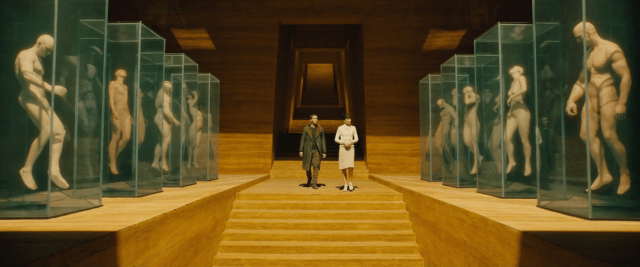
K must sift through clues, visit retirees from the Blade Runner ranks, check eyeballs for serial numbers and deal with Wallace’s most fanatical minion (Sylvia Hoeks) in order to solve and survive this case.
“Blade Runner” presented a Los Angeles logically transposed into its demographic future, with overwhelming Asian and Latino influence. Villeneuve couldn’t resist making his Future LA more pan national — from the “little lady” waiting at home for K (Cuban starlet Ana De Armas) to assorted Euro and Middle Eastern bit players to the comically French product placement of Peugeot futurecars.
The Earth of 2049 is a crowded yet seemingly depopulated world — vast swaths of the empty, the deforested (eco-system collapses) and the abandoned. Visits to the San Diego junkyard are reminiscent of “Wall-E,” “Hardware” and assorted other dystopias featuring a crashed consumer culture.
It’s a largely humorless picture, with Gosling doing the hard-boiled thing in a mechanical minor key, such as when K runs into a hooker (Mackenzie Davis of “The Martian”).
“You’re not going to kill me, are you?”
“Depends. What’s your model number?”
It’s also, start to finish, pretty much heartless. The best acting moments are shared by Gosling and Ford, and by a visit to a professional “dream implant” scientist (Carla Juri).
But for all its stunning visuals and legitimate intellectual and moral heft, the picture has all the emotion of last year’s cell phone commercials.
Wait for one scene that matches the heartfelt intensity of Rutger Hauer’s demonstration of what it means to be human to Ford’s Deckard, in the rain-soaked climax of the original film. You’ll wait in vain.
Hope against hope that the director of “Arrival” will give one actor an “Amy Adams in ‘Arrival'” moment of genuine pathos. Doesn’t happen.
That leaves “Blade Runner 2049” as more impressive than moving, more thought-provoking than heartfelt — chilling in its magnificence.

MPAA Rating: R for violence, some sexuality, nudity and language
Cast: Ryan Gosling, Harrison Ford, Robin Wright, Jared Leto, Ana de Armas, Mackenzie Davis
Credits:Directed by Denis Villeneuve, script by Hampton Fancher and Dennis Green, based on Philip K. Dick’s “Do Androids Dream of Electric Sheep?”
A Warner Brothers/Son-Columbia release.
Running time: 2:40




 So we won’t know — for sure, until the “actuals” are cooked (ahem) up by the studios, who actually won the last weekend of September box office sweepstakes, some time Monday afternoon.


 Movie Nation