Movie Review: Teen Temptress, Femme Fatale, or Victim? “Nahir”

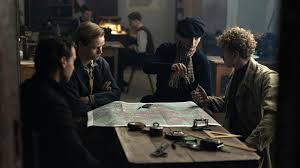
“Nahir,” a brooding, glamourized and sexed-up account of a notorious Argentine murder case, is a mystery thriller that aims for engrossing and immersive that never falls short of quite watchable along the way.

Screenwriter Sofia Wilhelmi and director Hernán Gu

erschuny take great pains — with flashbacks and flashbacks within flashbacks — to show us several versions of the title character’s account of what happened the fateful night in which she allegedly killed her allegedly abusive lover.

We’re treated to backstory which dissects the aloof and mysterious teen beauty who either planned a crime of lover’s revenge, carried it out and took some pains to cover up her involvement, or didn’t. Not in the ways the earliest versions of her account of that fateful night played out, anyway.

Valentina Zenera plays Nahir as a vain beauty confident in her allure, even at her (seen in a flashback) quinceañera. Nahir dreams of riding the premiere float at Gualeguaychú’s famed carnival parade and riding that to fame as a model.

Not that she says much of this out loud. Nahir is depicted as inscrutable, controlled and controlling. All the boys fancy her and no one gets more of her attention, and manipulation, than 20 year-old Federico (Simon Hempe).

Nahir says they’re broken up. Then they’re together. As the narrative jumps back and forth from “before the crime” (in Spanish with English subtitles) to “after the crime,” we see both their torrid affair — “torrid” at least in his eyes — and her “No, we weren’t dating” way of describing it to her friends and eventually to the cops.

Because one night, Federico rides his motorbike to his doom.

We see how Nahir takes the “news” of his death. “Poker-faced” barely does that reaction justice. We watch the early questioning, the tear she tries to summon up or fake with a tissue.

And we learn that Nahir’s adored and adoring Dad (César Bordón) is a pistol-packing police officer. If there’s one thing that’s become accepted wisdom the world over in recent years, it’s the idea that police in most any country all consider themselves experts in one thing — knowing what they can get away with, and how.

When Dad says “I’ll get you out of here…I’m working on it. You’ll be home by New Year’s,” Nahir believes it. Is it because of what she knows, or what she knows that he knows?

As we see Nahir’s (perhaps) ex-beauty queen mother (Mónica Antonópulos) primp and prep her for a pageant and for a TV prison interview, we pick up on the dynamic of the household and the narcissism of our heroine.

“No crying,” Mom insists before her interrogation. Or did she? Federico’s come-ons are punctuated with a macho “I get anything I want.” Dad wasn’t shy about showing his pistol to would-be stalkers who stare at Nahir in crowds. His icy “princesa” never betrays any emotion at any of this.

The court case reveals more than just the lovers’ exchanged “love of my life” texts. Protesters demand “justice” for Federico, but witnesses paint a more complicated picture of their on-and-off romance. And as her situation isn’t quickly resolved — one way or the other — and her “story” changes, we wonder what really happened.

I like the way the story’s jumps backwards and forwards in time to wrongfoot the viewer. We’re given just enough information to decide on guilt or innocence, and then new information is brought to light. Think again.

Now on Amazon Prime, “Nahir” was longer when it played in Argentina, and reviews of this “true” story there weren’t the best. Perhaps it’s tighter, as the Prime cut of the film is 14 minutes shorter. Or perhaps Argentines are more invested in the story and uninterested in the doubts “Nahir” suggests.

Zenere, underplaying in ways that hint at the character’s similarities to Amanda Knox — accused because she underreacts to news of a murder — makes her character believably guilty or possibly innocent. And whatever verdict, she ensures the narcissistic Nahir is never seen with a hair out of place or eye shadow and earrings that aren’t perfectly matched, even behind bars.

Rating: TV-16, violence, sex, profanity

Cast: Valentina Zenere, Simon Hempe, Mónica Antonópulos and César Bordón

Credits: Directed by Hernán Guerschuny, scripted by Sofia Wilhelmi. An MGM release on Amazon Prime.

Running time: 1:48

Posted in Reviews, previews, profiles and movie news | Tagged , , , , | Comments Off on Movie Review: Teen Temptress, Femme Fatale, or Victim? “Nahir”

Classic Film Review: Accept no Substititute for this Suspsense Masterpiece — “The Wages of Fear” (1953)

Stanley Kubrick was among the most famous filmmakers to assert that if you can’t tell what’s happening in a film — the emotions and motivations of the characters and the point of it all — with the sound turned off, that film and filmmaker have failed.

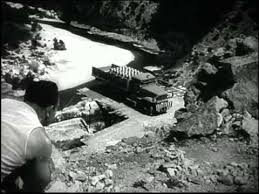
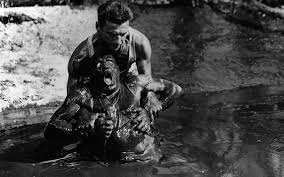
“The Wages of Fear,” Henri-Georges Clouzot’s masterful thriller about desperate men taking on a desperate job, is a case in point.

A tale from the edge of civilization about the sort of men trapped there, of Big Oil (American) imperialism and how cheap life is to them, it remains a study in nail-biting suspense over 70 years since its mid-1950s release.

The fact that it’s in French, Spanish, Italian, a little German and English suggests it is the images, the archetypes and cinematic semiotics that will tell this story. With or without subtitles — a restored print that the streamer Tubi is offering now has none — the archetypal casting, washed-out and desolate black and white cinematography (by Armand Thiraud) and pulse-pounding editing by Madeleine Gug, Etiennette Muse and Henri Rust underscore the international image language that cinema was always meant to be.

Yves Montand stars as Mario, a French dead-ender in remote Las Piedras (The Stones), South America, a dusty, dry and mountainous land we assume is Venezuela. Or Bolivia or Peru. Las Piedras is a two-street/one airstrip village that was changed when an oil refinery was built at the end of the pipeline there.

“Wherever there’s oil, there’s Americans.” Mario growls.

None of the many men from many nations trapped there has the money to fly out, but Mario clings to his Old World dash, no matter how soiled his suit, and his memories of Paris and fierce desire to return. He keeps his “lucky” Metro (subway) ticket as a talisman, hoping he’ll get to ride that again.

The arrival of a bribing tough, Jo (Charles Vanel, who first appeared on screen in 1912) gives Mario somebody new to hang with among the Brits, Americans, locals, and the Nazi salt mines survivor Bimba (Peter van Eyck) and the jolly Italian baker Luigi (Folco Lulli) who lounge aroung Pepito’s store and cantina.

Linda (Véra Clouzot, the director’s wife) is the star attraction there. The beautiful waitress and scullery maid only has eyes for Mario.

A deadly blowout and fire at a Southern Oil Co. well 300 miles away kills many, but as the cynical local SOC rep (William Tubbs) sees it, it creates opporunity for the locals, especially the Euro-drifters. O’Brien promises to “manage” the locals and the press with a “blame the victims” strategy. And he’ll get that well fire out on the cheap, loading two trucks with unstable nitroglycerin and paying $2000 a man to the four men who will slowly drive it cross country 300 miles in 24 hours.

A cursory driver’s test/contest puts Jo and Mario and Bimba and Luigi behind the wheels of two hulking five ton trucks. As they putter along at 6, 7, 10 or recklessly as much as 40 miles per hour, facing engine trouble, extreme terrain, road blockages and the like, we’ll soon find out who’s really tough, really clever at working problems out on the fly, and who isn’t.

Like “Sorcerer,” its most famous remake (Netflix attempted a more modern one last year), the original film, based on a novel by Georges Arnaud, takes its sweet time establishing the “Treasure of Sierra Madre” milieu and the rough, characters trapped there. William Friedkin went to all the trouble to showing us “how” his drivers ended up at the (jungle) ass-end of the world, with “Sorcerer” backstories showing crimes that put the lot of them on the lam.

Clouzot lets his casting — the dashing singer just-then-turning-actor Montand, crusty Vanel, van Eyck suggesting to 1950s audiences that there were “good Germans” and Lulli’s sad, equally desperate gregariousness — do that for him.

I loved the jungle quest nature of “Sorcerer,” with that locale setting up its iconic rope-bridge-in-the-rain sequence. But Clouzot’s dusty, sunbleached South America (the South of France, actually) could be just as challenging. Rear projection shots of the driving aside, the actors make us feel the tension, the seething resentments and the greed they experience behind the wheel, or fleeing from the truck when their nerves get the better of them.

Mario freaks out over Jo’s temerity behind the wheel and puts his own foot on the gas pedal. Luigi seems like an Italian pushover until we see him in a tight spot. And there are plenty of those, with frequent reminders that nitroglycerin was never something you wanted to shake in liquid form.

This film’s lore includes the leading men getting very sick from the work conditions of the set, and American censorhip when “Wages” was released in the U.S. Nobody in official Eisenhower Era 1950s America wanted union-busting, life-wasting greed in the form of Big Oil and its most devoted minions depicted on screen.

But we’d miss that today if Clouzot hadn’t gone out and told us what’s now accepted fact. There are companies that will do anything for a buck, including figuring out how many people they can afford to kill before it impacts their stock price. It isn’t just oil companies operating that cynically.

“The Wages of Fear” feels both quaintly “period” and bluntly modern, which is one reason it’s THE bucket list film for action cinema fans. This is a classic that reminds us of the compromises we all make, and the math we’re all capable of when we’re desperate enough.

That’s universal, something anybody speaking any language can see and understand, with or without subtitles, with or without admitting it to themselves.

star

Rating: TV-14, violence, nudity, profanity, smoking

Cast: Yves Montand, Charles Vanel, Folco Lulli, William Tubbs, Véra Clouzot, Dario Moreno and Peter van Eyck.

Credits: Directed by Henri-Georges Clouzot, scripted by Henri-Georges Clouzot and Jérôme Géronimi, based on a novel by Georges Arnaud. A Cinédis releasee on Tubi.

Running time: 2:29 or 2:35

Posted in Reviews, previews, profiles and movie news | Tagged , , , , | Comments Off on Classic Film Review: Accept no Substititute for this Suspsense Masterpiece — “The Wages of Fear” (1953)

Movie Review: Wild West Dinklage chases Juliette Lewis into “The Thicket”

“The Thicket” is a Western built on archetyepal characters pursuing one another through a forbidding and unforgiving archetypal Western landscape.

It’s a wintry fin de siècle “manhunt” for a young woman, and another woman gang-leader named Cut Throat Bill who kidnapped her. “Thicket” is a new, modest-budget indie film version of “The Searchers,” “Big Jake,” “The Missing,” and any other saga about men (and women) on horseback hunting others who have taken hostages.

The violence, the beautifully forbidding Alberta winterscapes and the presence of Peter Dinklage, Juliette Lewis, Leslie Grace and Arliss Howard recommend this generic horse opera. But archetypes clanging up against the cornball indulgences — missteps taken in dozens of similar films — kind of undo it.

We’re treated to a bloody inciting incident at a ferry across an icy river, a fight in a brothel to rescue a woman (Grace) sex-trafficked into working there, a stand-off at a fur trading post/saloon and a shootout at a snowbound cabin in the woods. But we roll our eyes over coincidences, worn out tropes of the genre and the way characters — even unschooled ones — quote the Bible, Shakespeare and Latin to each other for effect.

It’s the early 20th century, and a remote farm has lost its parents to “the smallpox.” Young Lula (Esme Creed-Mills) and older brother Jack (Levon Hawke) bury them, and wait for grandpa (Guy Sprung) to show up, burn the place down to disinfect it and take them to another relative.

They never make it. A motorbiking madwoman in leather helmet, goggles and furs has rounded up her gang. Scarred, “ugly” and quick to anger, Cut Throat Bill (Lewis) threatens one and all at that ferry with “You afraid of me?”

Taking a shot at her doesn’t help. Grandpa’s entirely too old to save his “We don’t want no trouble” for AFTER taking that shot and adding a scar to Bill’s collection.

The wipeout that follows leaves Jack staggering back to consciousness only to realize Lula’s been taken.

At a nearly lawless nearby town, “Jones” (Dinklage) and Eustace (Gbenga Akinnagbe) are scraping together a living by burying shooting victims. Not paying them is just the start of the trouble for the alderman (Ryan Robbins) who taunts and threatens the diminutive Jones.

“Ain’t exactly a fair fight there, stubs!”

Jones and Eustace are soon on the run themselves when Jack talks them into tracking down Bill for the bounty on her head so that he can free his sister. “Searchers” style warnings that Lula is already “probably not the sister you remember” suggest her fate — raped, kept as Bill’s lover for a bit, etc. — don’t deter Jack.

So the hunt is on.

But alderman Bailey (Robbins) deputizing sibling goons (James Hetfield of Metallica plays one) to hunt down Jones and Eustace for what they did to him when he thought he’d get away with a few “midget” jokes and cheating them out of their money. The hunters are themselves hunted.

Chris Kelley’s script, based on a novel by Joe R. Lansdale, serves up a few “End of the West” touches — the motorbike we see the masked Bill ride in on, the motorized wagon Jones and Eustace cross the Northern West in, without a Sheetz or other filling station in sight.

But the idea here, as in “Big Jake” and in the “Yellowstone” prequel series “1923,” is to remind us how lawless and violent the region could still be, even after it was settled, tamed and Henry Ford, Thomas Edison and Alexander Graham Bell “modernized” it.

This picture seems a bit out of its time. The weather-worn churches and villages too tiny for the railroad to bother with are terrific details. But the “smallpox” could have been later-arriving Spanish Flu, and certain other touches might have made all this tie together better and seem more firmly of its day.

Characters behave rashly, often in ways that defy their self-interest. Jones turns out to be a man with a colorful past and “particular skills.”

Lewis leans into the scars and the life that gave them to her character, making her a worthy foe.

“Yewww thank I’m purty, don’t ye?”

The charismatic Dinklage ably plays a new version of the cynical, cool and confident rider of the range.

At one point, these two antagonists meet and drink and compare notes on how society treats the “ugly” and the “short.” That scene has solid acting and a little emotional heft. But like more than a few other turns, it makes little sense logically and narratively.

Like Tarantino’s “The Hateful Eight,” director Elliott Lester, cast and crew have some stunning snowbound settings, a smattering of hard-boiled Western prose, some tough guy/tougher broad stand-offs and a lot of shooting.

Nice try and all that. But there’s just too much that hobbles this horse opera to let it gracefully unfold and canter off into the snowy sunset.

Rating: R, graphic violence, rape, profanity

Cast: Peter Dinklage, Juliette Lewis, Levon Hawke, Esme Creed-Mills,
Gbenga Akinnagbe, Leslie Grace, James Hetfield and Arliss Howard.

Credits: Directed by Elliott Lester, scripted by Chris Kelley, based on a book by Joe. R. Lansdale. A Tubi release.

Running time: 1:45

Posted in Reviews, previews, profiles and movie news | Tagged , , , , , , | Comments Off on Movie Review: Wild West Dinklage chases Juliette Lewis into “The Thicket”

Movie Preview: A “Cupid Killer” thriller for Valentine’s Day — “Heart Eyes”

Producers associated with the “Scream” franchise are behind this surviving Valentine’s Day/surviving a serial killer thriller.

Jordana Brewster stars. Olivia Holt is another “name” in it. Devon Sawa and Mason Gooding also star.

Those “producers,” the screenwriters and actor turned director Josh Ruben (“Werewolves Within” are going for frights, grisly murders and laughs with it.

Seeing as how Hollywood has all but given up on romantic comedies — Sydney Sweeney excepted — this must have been a very cunning pitch.

Let’s get those young horror couples out and into seats with a masked murderer stalking young lovers around V-Day.

They’re releasing it Feb. 7, but Feb. 14 is DATE NIGHT AT THE MOVIES, Y’ALL!

Posted in Reviews, previews, profiles and movie news | Comments Off on Movie Preview: A “Cupid Killer” thriller for Valentine’s Day — “Heart Eyes”

A Snow Day is always a movie day, but not to a Cocker Spaniel

A Cocker never forgets her first snowfall.

“Tell me more about this ‘Iditarod’ of your Alaska days, Dad. Where do I sign up?”

Posted in Reviews, previews, profiles and movie news | Comments Off on A Snow Day is always a movie day, but not to a Cocker Spaniel

Netflixable? WWII Underground Agent “Number 24 (Nr. 24)” tells kids what’s called for when you Fight Fascism

One of the smartest places Netflix has put its international production money is Scandivanian World War II films. A collection of true or “inspired by” true stories have shown us forgotten heroics, sacrifice, treachery and air raids that went wrong. And these movies travel well, playing to WWII buffs the world over, especially in North America.

The soberest of the lot might be “Nr. 24,” titled “Number 24” for the U.S./Canadian market. It’s an account of the exploits of Norway’s most decorated resistance fighter, Gunnar Sønsteby. And it focuses on the terrible choices one has to make in a war when fascism has not just invaded your country and taken over the power structure, it has rooted itself in the culture so that real patriots can’t know who their countrymen they can trust.

Director John Andreas Andersen’s film is framed within a blunt, unglamorous lecture Sønsteby (Eric Hijvu) gives very late in his life. With fascism bubbling up all over Europe, even in Norway, Sønsteby gives school kidsin his hometown of Rjukan a history lesson.

The Germans didn’t need many troops to sieze Oslo. There were Nazi-sympathizing traitors in the government and all over the country, led by fascist military officer Vidkun Quisling. Choosing to join the resistance in 1940 — when the war’s outcome was very much in doubt — may have been noble but might not be popular, and could very well be suicidal.

The old Hero of Telemark tells a rapt audience of teens in his hometown, “Let’s talk about values” (in Norwegian with subtitles, or dubbed), and launches into his life story — carefree days years before the war when the warning signs about fascism’s rise were popping up, even in Norway, shifting into his “futile” joining with partisan fighters resisting the initial invasion and his recruitment to the an anti-Nazi espionage organization, supplied by the Brits, which he’d eventually come to lead.

Sjur Vatne Brean plays the young Gunnar, a mild-mannered accountant with skiing and camping skills, who journeys from naivete to seasoned fighter determined to make the hard decisions resistance leaders must make.

The older Sønsteby emphasizes how “careful” he was as he built his “network” of comrades in arms and sympathetic helpers. He eschewed any idea of “family” — his own would be imperiled — and romance for the duration of the war. He avoided alcohol, and planned out each day in advance. “Five pockets” he nicknamed himself, one on his jacket for each fake identity and “papers” to be shown to Germans and Norwegian Nazi police, depending on the situation and setting.

The film details some suspenseful exploits and grapples with the moral choices involved in taking action against murderous Norwegian traitors who rounded up the country’s Jews to be shipped to concentration camps, summarily executed resistance fighters or anyone who helped them and the like.

The narrative takes Sønsteby to and from Norway, trekking to neutral but Nazi-sympathizing Sweden, flying to Britain for “training” (not seen) and even a meeting with Norway’s king-in-exile (Kristian Halken). We see records offices bombed when the Germans and their Norwegian puppets prep to draft Norwegians for combat duty on the Eastern Front. An arms factory is attacked, and Germans are killed in ambushes.

But there’s also the grimmer work of accepting that a childhood friend is trying to rat you out and having him killed. Old Sønsteby hears out fresh-faced student questions about “Did you try non-violence?” and gives them a wake-up call.

“Gandhi never had to resist (dehumanizing) Nazis.”

He bluntly speaks of sacrifice as flashbacks show comrades killed, family members, comrades in arms and confidantes arrested and tortured.

Under fascism, he warns, “don’t trust the” media and the rich men who own newspapers and the like. The police? They’re working for those who have seized power and taken away your freedoms. They’ll torture you and shrug “just following orders.”

“Number 24,” scripted by Erlend Loe and Espen Lauritzen von Ibenfeldt, skims over details like Sønsteby’s training and how all this dynamite and these pistols and Bren guns were acquired. The logistics of resistance is limited to arranging apartments and the like.

The focus here is on “values,” the moral choices that underline the actions of the people who took those actions. There’s a famous French documentary about just how insidious fascism was in France. But “The Sorrow and the Pity” could have been made about any country in Occupied Europe. Violent nationalist bigots were often in a majority in a populace, no matter how much France, Belgium, Denmark or Norway celebrate their resistors.

Fighting that, risking your life to simply approach a countryman or countrywoman to see if they’ll help or turn you in when you ask their assistance in stealing printing plates to counterfeit Norwegian money or let you sit in their apartment to stake-out a target, is a more fraught experience than anybody — young or old — mouthing off on Twitter or Bluesky has ever experienced.

Director Andersen (he did the disaster movie “The Quake”) keeps this slick, polished production moving even as he and the screenwriters avoid many of the tried-and-true devices — training-for-the-mission montages, etc. — of the genre.

Most characters don’t explain their actions, and the risks of approaching strangers scenes require at least some lip service to that.

Sjur Vatne Brean and Erik Hijvu play Sønsteby as unemotional and poker-faced. That may be how the real hero survived his heroics, but it’s dramatically flat on film.

Everybody’s neat and well-dressed in this occupied, rationing-enforced country. And the vintage cars shine even under the grey, snowy skies and muddy roads of winter. “Realism” has its limits.

But “Number 24” is a tough-minded reminder that, as the late historian David McCullough emphasized, “These (historic heroic) people don’t know how this is going to turn out.” Living circumscribed, secretive lives for years, committing deadly acts without months or years of military training and indoctrination, these are extraordinary acts committed by the brave outliers among us, who will always be few in number.

We may admire or judge them today, but if we weren’t there, how can we?

Rating: TV-MA, violence

Cast: Sjur Vatne Brean, Erik Hijvu, Ines Høysæter Asserson, Mark Noble and Per Kjerstad

Credits: Directed by John Andreas Andersen, scripted by Erlend Loe and Espen Lauritzen von Ibenfeldt. A Netflix release.

Running time: 1:52

Posted in Reviews, previews, profiles and movie news | Tagged , , , , , , | Comments Off on Netflixable? WWII Underground Agent “Number 24 (Nr. 24)” tells kids what’s called for when you Fight Fascism

BOX OFFICE: “Den of Thieves 2” capers off, Audiences Ask, “Robbie Who?” as “Better Man” bombs

Gerard Butler, O’Shea Jackson, Jr. and Lionsgate are pulling off a wintry heist this weekend as “Den of Thieves 2: Pantera” may eek out a narrow box office win over “Mufasa,” not quite “The Lion King.”

Thursday night and Friday numbers point to a $15+ million weekend for the sequel to the 2018 hit which was released by start-up distributor STX. Lionsgate has the franchise, now, and as Deadline.com sees it, the film may give the studio its first weekend win since the “Hunger Games” reboot of a couple of years back.

But SoCal is burning. And a big storm has blanketed much of the country (five inches where I live in SoVa). Theater attendance will be dampened by both of those factors. And then there’s the fact that whatever the relatively few critics who reviewed “Thieves 2” say, it’s not “nicer, much nicer in Nice (France).” Slack, slow, underwhelming in most action ways — with streaming movie pacing — it kind of sucks.

“Mufasa” — a middling and pointless CGI back-story to a prized Disney IP, a cash grab release — is chugging along, slated to pull in another $11-12 million.

With “Thieves” and “Plane” and whatever other titles I’m forgetting, Gerard Butler has pretty much taken over the “Mr. January” title from action rival Mark Wahlberg, who had a run of early Jan. hits a few years back. But Marketing Mark has “Flight Risk” coming up, and that’s sure to draw.

“Sonic the Hedgehog 3” will rack up another $9 million or so, pushing this latest video game adaptation/sequel over the $200 million mark, domestically. It’s still leading “Mufasa,” but that $14 million gap between the two may close by month’s end.

The gorgeous “Nosferatu” won’t need Oscar nominations to cement its status as an A24 horror blockbuster. It is on track to add $7 million or so to A24’s coffers by weekend’s end, pushing it over the $80 million mark. Not bad for a gorily-updated 1922 silent film remake. It should win nominations for production design, if nothing else.

And Disney’s REAL smash of the season “Moana 2” winds up its run in the top five with another $4-5 million. It’s earned over double what “Mufasa” did, which sends Disney a message.

“Wicked” is rounding up another $4.5 million, which may allow it to edge its Oscar-bait rival “A Complete Unknown,” also slated to earn $4.5 million.

“Babygirl” hasn’t done much business, but another $2.9 million keeps it in the top ten.

The Indian thriller “Game Changer” has $1.5 million in its sights.

The Pamela Anderson “comeback” “The Last Showgirl” is riding decent reviews and a reasonably wide release to a $1.35 million opening, putting it in the Top Ten.

As my significant other and I sat in an empty cinema Thursday, watching the Robbie Williams/Ape as Pop Star biopic “Better Man,” the writing was on the wall. The humbling vanity project — a $110 million CGI pop biography/extravaganza — may break even abroad. But audiences here aren’t saying “Remember him?” They’re wondering “Robbie who?” On over 1200 North American screens, and the damned dirty ape won’t take in much more than $1 million. It won’t crack the top ten. Let’s hope he’s crying all the way to the Euro bank, as this gimmick pic isn’t making a dime in the New World.

When you need to imagine yourself as a homely, out-of-control simian to hide the fact that your bio pic is nothing but a collection of cliches — Daddy didn’t love me, I love drugs, let’s leave out most of my romances and avoid the word “bisexual” — you need a Tina/Elton/James Brown/Queen status song catalog to put butts in the seats. Williams doesn’t.

Trent-on-Stoke Robert might be big abroad, but he moved to LA and promptly sailed back to Britain because “Nobody cares” is a pretty hard thing to hide on the pop charts, or the box office.

As always, I’ll update these numbers as Saturday’s later day data and Sunday’s tallies are reported.

Posted in Reviews, previews, profiles and movie news | Tagged , , , , , , , , , , , | Comments Off on BOX OFFICE: “Den of Thieves 2” capers off, Audiences Ask, “Robbie Who?” as “Better Man” bombs

Movie Review: Make Yourself Famous, try to be a “Better Man” and not a Pop Star Cliché

Whatever he means to other parts of the world — his UK homeland in particular — the pop star Robbie Williams falls somewhere on the “Remember him?” to “Who?” sliding scale here in the U.S.

So maybe the idea of a boy band member turned early 2000s solo act, a crooning, dancing and lyrics-writing “entertainer” in the Justin Timberlake/Michael Jackson mold being worthy of a bio pic seemed like a no brainer across the pond. It might be a film that “travels” as they say.

But I saw “Better Man,” with my fiance on opening night in the United States. We were an audience of two.

And while the occasionally familiar if not exactly immortal or even “memorable” song wafts off the soundtrack of “Better Man,” this isn’t “A Complete Unknown,” “Rocketman” or even “Get On Up” in terms of a portrait of a fascinating, complex and major artist who remade the (English language mostly) pop world.

“Rick Rolled: The Rick Astley Story” has more appeal, if not more cachet. “Adele: Having the Last Laugh” would seem more worthy.

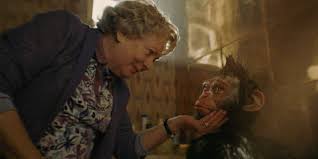
But Williams’ clever-not-“brilliant” conceit for conceiving his hardscrabble (ish) life story is that he’d be played “as I see myself,” a not-particularly attractive CGI monkey extra from “Planet of the Apes.” We can infer that his idea that he’s a “trained monkey” or that he sees himself as just not-that-attractive, a maddeningly insecure pop singer who ventured from boy band background singer/dancer to pop-charts-dominating superstar. It’s a humbling way for this “The Ego Has Landed” icon to approach his life story.

Yes, it’s a gimmick but a clever one, a singer singing to massive crowds, but always as a simian singer, always seeing a version of his chimp self out in the mob, doubting and causing him to question his worthiness of the fame he always sought and the talent he never really doubted.

But what does working class Robert “Robbie” Williams of Stoke-on-Trent do with this CGI version of himself (dancing actor Jonno Davies does the motion capture “acting” for the ape), narrating his $110 million version of his life story? Why, he tells us of his desire to be “famous,” his descent into drugs, cheating with every English-speaking pop starlet on the planet, the “nan” (granny) who always believed in him, the aspiring singing-joking-emceeing “entertainer” dad who abandoned him and the boy band (Take That) that kicked him out before he “showed them” his true value to the masses.

Talk about tried and true and trite.

After the first blush of how cute this conceit is, this called-to-perform, fame-craving, spotlight-hogging Robert “Robbie” is wracked by insecurites even as he’s playing the British inspiration for Coachella — Knebworth — talking up audience sizes like an insecure, crooning Trump. “Better Man” becomes a simple catalog of pop stardom clichés

James Bond Aston Martin parked in front of the mansion he trashes in stoned, insecure rages? Check. “Nan” (Alison Steadman) who supported his dream, but whose dying moments he missed? Check. Involved with a girl group (Raechelle Banno) star from All Saints? Check…and mate.

The movie is a gloss of a life, not an in-depth portrait. If you sit through this slick, long, grim and utterly predictable bio-pic and ask yourself “And this ‘wanker’ is worthy of a bio-pic why?” you won’t be alone.

Steve Pemberton plays the Sinatra-worshipping, Music-Hall-missing emcee, the comic/”singer” dad who instilled in young Robert the need to “be famous,” to matter, to “have it” and “light-em-up (show off, onstage and off).”

It’s not enough to love what you do.

“What matters is other people loving you doing it!”

Kate Mulvany plays the long-suffering mother who indulges her soon-fatherless son’s dreams of trying out for a boy band, and becoming famous and all the downside that fame offers for her and him.

Damon Harriman plays that always-hated/mocked first manager, casting director for Take That who appreciates Robert’s “cheeky” attitude enough to cast him in a band where he’s just sung an audition song so far removed from the pop charts as to make one question what century the 15 year-old boy lives in.

We glimpse boy band rivals who hold Robert (renamed Robbie for Take That) back, the gay clubs touring to teen-girl shift in appeal, manufactured by that first manager. And we get Williams’ rock star version of earning the right to be kicked out of that “band.”

What we don’t get is anything particularly revealing. Bisexual? Seriously involved with a couple of Spice Girls? Copulating his way to fame/telling tales in interviews, etc? Skipped or skimmed-over.

This is very much the Robbie Williams-narrated and “officially approved” version of his life story. And for all the terrific dance numbers, the scenes of the chimp alter-ego version of “Robbie” behaving badly, this is never the least bit revealing, never a movie that reinvents the musical bio-pic genre.

They hired visual effects specialist and music video director (and co-writer) Michael Gracey and spent all this money to simian-ize their “star.” And they voice-over-narrate it to death and censor/embellish/omit/”shine” it into an unsurprising genre pic more worthy of Justin Bieber than the British Justin Timberlake.

Rating: R, drug abuse, self-harm, near nudity, profanity, constant smoking

Cast: Robbie Williams, Jonno Davies, Steve Pemberton, Raechelle Banno, Tom Budge, Damon Harriman, Kate Mulvany, Alison Steadman.

Credits: Directed by Michael Gracey, scripted by Simon Gleeson, Oliver Cole and Michael Gracey. A Paramount release.

Running time: 2:14

Posted in Reviews, previews, profiles and movie news | Tagged , , , , | 2 Comments

Movie Review: More heists, more Butler and Jackson — “Den of Thieves 2: Pantera”

One hesitates to ever use the phrase “lazy” in describing the epic enterprise that is the making of any major motion picture. But the temptation is there in describing writer-director Christian Gudegast’s reunion with Gerard Butler and O’Shea Jackson, Jr. for “Den of Thieves 2: Pantera.”

They had all those years between films — “Den of Thieves” came out seven Januarys ago — and this lumbering, indulgent and nonsensical sequel is what they came up with?

There’s a hint of “French Connection 2” in the thought processes here. Let’s take our cop from the first film, send him to the South of France and have him “turn” and join the high-stakes heist artist he was chasing in the original.

But that resemblence is a fraud. If you’re going to get Butler back on board, you’d better promise him a working vacation in Nice and the Riviera, not the grit of Marseilles. You want Jackson, Jr. around, you’d better promise the same, plus a better wardrobe and a flashier character who tries his hand at speaking French.

Every situation is trite, under-motivated and perfunctory. Many a scene is drawn out for “acting” moments where our two antagonists swap pointless back-story anecdotes about their upbringing.

It opens with a tepid jet transport (in the hangar) heist and finishes with a derivative diamond district robbery. These underwhelming action beats come almost two hours apart in the movie’s dawdling narrative. Slapping a mountainside Nice to Northern Italy car chase onto the ending doesn’t do much for that “lifeless” feeling

Gudegast makes the distinction between his two characters clear in the most cartoonish ways. One’s a slovenly, just-divorced cop who drinks too much. The other’s a driven, team-assembling super-thief who dresses better and “can’t stop” his craving for bigger and bigger robberies.

Oh, and one smokes and the other vapes. I’ll leave that mystery for you to solve if you watch this two and a half hour bore.

Butler’s burnout-case Nick is freshly divorced when he hears of this Antwerp airport robbery that sounds…almost nothing like the one in “Den of Thieves.” Living in his truck (“I LOVE my car!”), he bullies his superiors into sending him abroad, faking Federal Marshal credentials so he can talk the French into letting him help catch his elusive mastermind, Donnie (Jackson).

There’s attempted humor in the cop to cop banter with Nick’s French counterpart (Yasen Zates Atour) about the pronunciation of “croissant,” “you Americans” and the like. It doesn’t take.

The only joke that works is Nick’s drunken, enthusiastic quotation of the title of the most famous song by Jackson’s rapper/actor Dad (Ice Cube), earning a double-take from criminal mastermind Donnie.

It takes literally nothing (that we see) for Nick to track Donnie down on the Riviera. He’s just abruptly in the apartment Donnie has rented to scope out the scene of his next caper, a “diamond district” bank heist.

Evin Ahmed plays the “overwatch” “honey trap” member of Donnie’s “Panther” team of colorless Serbians.

The Sicilian mafia has a problem with what they’re doing, leading to threats, more complications and some members of their crew backing out.

It’s going to take a lot of product-placement Audis to chase down that electric Porsche they use for their attempted getaway.

Our writer-director indulges his star by giving him quirks, speeches and put-downs, but little that amounts to “character” in any realistic sense. Nick’s “reason” for threatening his way into this cop-to-criminal career change?

“You got over on me, fraulien. No one gets over on me.”

The heists are derivative, un-rehearsed and unexciting, with curious gadgetry and half-assed problem solving.

But as the old song goes, “It’s nicer, much nicer, in Nice.” So at least one and all got a nice Nice visit to the South of France for their trouble.

Rating: R, violence, profanity, drug abuse, smoking

Cast: Gerard Butler, O’Shea Jackson Jr, Evin Ahmad, Salvatore Esposito, Dino Kelly and
Fortunato Cerlino

Credits: Scripted and directed by Christian Gudegast. A Lionsgate release.

Running time: 2:24

Posted in Reviews, previews, profiles and movie news | Tagged , , , , , , | Comments Off on Movie Review: More heists, more Butler and Jackson — “Den of Thieves 2: Pantera”

Movie Preview: Sophie Thatcher is a robotic AI “Companion” to die for

The people who brought us “Barbarian” are behind this twisted and bloody thriller, co-starring Jack Quaid and
Harvey Guillén. Jan 31

Posted in Reviews, previews, profiles and movie news | Comments Off on Movie Preview: Sophie Thatcher is a robotic AI “Companion” to die for