
April 18.
A lot of punch for a mere “teaser.*
April 18.
A lot of punch for a mere “teaser.*


“Didi” is a gentle but sharp-edged tale of a California teen coming to terms with who he is, a movie that invites grimaces of recognition even as it advertises its “different culture” status.
Writer-director Sean Wang’s debut feature fits neatly within the coming-of-age genre, but benefits from a few novel touches.
First of all, the kid’s Chinese American and has to live with stereotypes — the mother and nagging granny who speak Mandarin at home — and cope with stereotypes, the nickname “Wang Wang” and the “You’re so ASIAN” remarks of his middle school peers.
Secondly, he’s a social misfit in the most benign sense. “Wang Wang,” called “Didi” at home and named “Chris” on his birth certificate, is a screwup in the most cringeworthy, recognizable sense. He’s 13, with no clue about girls despite the fact that he has an older sister whom he torments and steals from when he should be getting style, behavior and work ethic tips from her. Didi says the wrong — often vulgar — thing to her, and that tactlessness/cluelessness extends to friends and classmates, all of whom are in a hurry to grow up, most of whom are managing it better than Didi.
The third novel touch in Wang’s film is the cliches it dodges, even if it does that more bluntly than deftly. If this is about “finding your tribe,” it’s also a story of rejecting and then accepting the one you’re born into. Those Sk8tRbois who let you hang because you pass yourself off as a “skateboard filmer” might not be the right hang, any more than the girl you crush on or the gauche pals you’ve held yourself back with since elementary school.
Alienated? Not naturally “talented” as a filmmaker? Maybe the AV Club is for you.
Wang’s period piece is set in 2008, where Didi (Izaac Wang, no relation) is living and learning from his Internet/social media addiction. MySpace is peaking, and there’s nothing that a Youtube tutorial can’t teach you.
“How to kiss” might come up. Especially if he finds a way to seem appealing to the fetching Madi (Mahaela Park) at a “Superbad” watching party at her house.
“How to film skateboarding” would be handy to watch, once he’s stumbled into Donovan (Chiron Cillia Denk) and his older crew of skaters/graffiti-vandalizers. He’s been videoing and posting stupid things he and his friends do online for some time. Delete those and maybe he can bluff his way into something cool.
But for now, he’s got pal Soup (Aaron Chang) and cool poseur Fahad (Raul Dial) as besties, willing and perhaps even able to steer him through the rough waters of early puberty. If they can stop pranking each other and others and get past that tween-to-teen “gross” boy phase, that is.
Mom (Joan Chen) is a frustrated artist raising Didi and college-bound older sister Vivian (Shirley Chen, no relation) and coping with non-stop nagging (in Mandarin, with English subtitles) from her aged mother-in-law (Zhang Li Hua). She’s doing this alone, as the breadwinner/husband is still earning a good living back in Taiwan.
“Didi” is a digital age baby, not the best student, ill-mannered in the extreme, disrespectul of his mother and using the Internet in every way he can think of to connect with Madi, skateboard culture, the vast trove of movies he’s never seen and the like.
But can all that digital stalking and “research” smooth out his rough social edges and help him fit in?
Our young star is just open-faced enough to let us see every stumble, social miscalculation and embarassment Didi experiences, open-hearted enough to make us feel bad for him in the most sincere “been there/messed that up” sense.
Chen gives a soulful fury to mother Chungsing, leaning into cultural peer pressure, but Americanizing in ways that make her tolerant of her son’s many missteps and her rebellious daughter’s disappointing UC-San Diego admission.
Writer-director Wang isn’t splitting the atom or reinventing the wheel here, and the film’s variations from the tropes for this genre aren’t unique or all that revelatory. But “Didi” makes a most relatable tour guide in helping us remember what running straight into a wall as you hit your teens was like.

Rating: R, drug and alcohol use involving teens, profanity, sexual references
Cast: Izaac Wang, Mahaela Park, Raul Dial, Chiron Cillia Denk, Shirley Chen and Joan Chen.
Credits: Scripted and directed by Sean Wang. A Focus Features release on Apple, Youtube and Amazon.
Running time: 1:33
First, he’s your pal, welcoming you into his circle, his “hang.”
And then he’s not.
We knew Paul Rudd couldn’t be that nice. And ageless.
“Saturday Night Live” alumnus Tim Robinson stars as a man comically, cruelly upended by his brief “Friendship” with his neighbor (Rudd). Kate Mara plays the wife who urges her husband to get out of the house and make a few “pals.”
This A24 release from first time feature writer-director Andrew DeYoung rolls out in May.

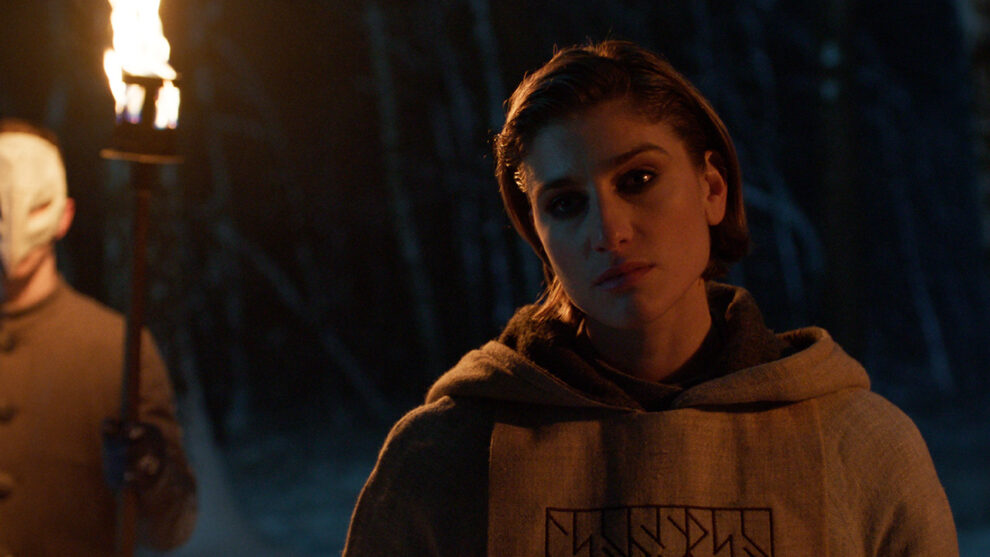
Kazakh filmmaker Serik Beyeu, an editor turned director, demonstrates one clear talent in his latest film. He’s very good at persuading actresses and extras to take their shirts off.
“Succubus,” a supernatural thriller re-titled “The Demoness” for video distribution, is a show reel of nudity and horror sex, of looped, disembodied voices reading lines from a “doesn’t really understand English” translation of a screenplay that was already bad at plot, suspense, action, character and dialogue.
“Find your partner. Only together you’ll be able to get out.”
It’s all rather apalling, with or without shirts.
There’s this island with a fir tree plantation and an exclusive “retreat” where monied couples go to face their truth and heal their relationships.
Well, they call it a “retreat.” It’s run by a staff of martinets in robes and masks, with a disembodied voice/leader and note cards handed out to the couples in “exercises” designed to make them deal with each other and their “truths.”
Characters helicopter in and after encounter group “truth” sessions find themselves in a forest labyrinth hallucinating scenarios — usually sexual — in a mirror that reveals their “true” passions.
Monstrous forest creatures with arms like limbs of trees grasp them as they switch partners, cheat and refuse to acknowledge the peril they’re obviously in because they’re too busy stripping and getting busy, visiting topless dancer clubs and the like.
“Take me to the MANAGER!”
An ethnographer (Angelina Pahomova, although who knows who dubbed her lines) is there to hunt for a missing sister, and perhaps “discover” the source of this island’s demon myths.
The demoness (Nino Ninidze) reveals herself in a ritual sacrifice scene where her incantations sound scripted by Eastern European AI.
“Kissy, killy, cull-eee ah kay!”
Only “Babylon’s Water of Death” can save them. Because stripping off their tops and having sex isn’t doing the job.

Rating: violence, sex, nudity
Cast: Angelina Pahomova, Polina Davydova, Pierre Bourel, Polina Vorobyova, Artur Beschastnyy, Anton Rival, Victor Mikhailov and Nino Ninidze
Credits: Directed by
Serik Beyseu, scripted by Oleg Kurochkin and Dmitriy Zhigalov. A Well Go USA release.
Running time: 1:36


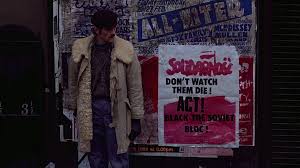
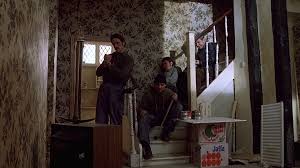

A cut-rate Polish work crew slips into wintry 1981 London to do an off-the-books home renovation in “Moonlighting,” Jerzy Skolimowski’s droll and intimate comment on capitalism, the collapse of communism and the horrors of cut-rate home repair.
It’s one of the great snapshots in time of the early 1980s. Released over ten years before the “one Europe” Maastricht Treaty, it shows us how the East exploited Western loopholes, and xenophobic Londoners turned a blind eye — well, the shopkeepers and better-off homeowners did, anyway.
And the film made a grand star vehicle for Jeremy Irons, fresh on the heels of his “Brideshead Revisited” TV breakout. He plays the one Pole who speaks English in a quartet slipped into Britain by an unseen Polish plutocrat to restore the rich Pole’s three story townhouse in Hammersmith.
Irons may be the most dashing home renovator this side of HGTV, a Pole with the poshest English accent ever. And one can tell from the way Nowak, his character, takes a swipe at demolition and mishandles a saw that here’s one actor who never helped build or strike a stage set.
But as he narrates this misadventure, jotting down details in the ledger book “the boss” insists he keep, we learn exactly why this “master electrician” is here and in charge. He speaks English and will do all the lying to customs, negotiating with vendors and placating neighbors.
“I can speak their language, this is why the boss chose for me for the job,” he narrates. “But I don’t know what they really mean.”
Being the lone English speaker and reader gives Nowak “control,” like “The State,” back home. He keeps the three men — Eugene Lipinski, Jiri Stanlislav and Eugeniusz Haczkiewicz — on a rigid schedule, feeds them on a tight budget and allows them one visit to a phone box on the corner per week to hear from home. But with Poland roiled by the Solidarity movement that would bring about the fall of the Soviet Empire, Nowak’s “control” over these “stupid” men may have limits.
How will they maintain their subterfuge, rush through their one month “no work/no employment” visas project and stay on task when there’s a coup in The Motherland? Will he tell them?
Manual labor notwithstanding, a better title for “Moonlighting” might have been “Shoplifting.” Local Brits take advantage of the Poles, who are in the country under false pretenses, “stealing” jobs from working class Brits and undercutting their prices. They’re able to do that because communist country currencies were nearly worthless as they had no “consumer economy” back home.
Nowak’s “control” of his work crew really starts to slip as the money runs low and he has to start stealing to feed them. They’ve already been ripped off by an Indo-Pakistani used TV dealer. Nowak has the team’s bicycle stolen. So he steals another and repaints it. He can’t get “news” from home, and keep it from the others, without stealing the neighbor’s newspaper.
And if anybody back home expects gifts on this crew’s return, more pilfering may be in order.
The Brits sell them some inferior goods, try to catch Nowak in the act of shoplifting and sneak their own rubbish into the rented “skip” they hire for the demolition. Everybody cheats everybody.
When “Moonlighting” came out, Skolimowski made a big deal out of the fact that his own expat home in London’s Kensington was being renovated while the movie was being shot. That sharpened his script’s sense of the not-exactly-victimless crimes being committed in those lean, hard anti-union Thatcher years.
The movie breaks one of screenwriting guru Robert McKee’s fundamental laws of “story.” Nowak, being the only English speaker, has exchanges with neighbors irate over the noise and mess they’re making, shopkeepers and shopgirls. But the entire “narrative” is related in voice-over.
That emphasizes Nowak’s isolation, his ignorance of how capitalism “works” and his paranoia that the men he manipulates a dozen ways, including resetting his watch to reduce their sleep time, will find him out and either go on strike or have their revenge in more direct means. Nowak’s paranoia extends to his girlfriend “Anna” back home. Who is keeping her company while he is away?
Irons has the right voice to carry this narrative, soft and somber and weary. Nowak carries the resignation of all of Eastern Europe in that voice, trapped in a life that won’t get better, uninvolved and thus hapless with regards to the changes that were beginning as this film was being shot and during its release.
Skolimowski never made another film remotely as good as “Moonlighting.” But with this movie at this moment in history he conjured up a parable for its time that stands the test of time.
East or West, working people who surrender “control” of their work and their lives to others are victims of the limitations and agenda of the State or The Boss. Back then, millions upon millions recognized that as the ultimate restriction on their liberty.

Rating: PG
Cast: Jeremy Irons, Eugene Lipinski, Jiri Stanlislav, Denis Holmes and Eugeniusz Haczkiewicz.
Credits: Scripted and directed by Jerzy Skolimowski. A Universal Classics release on Tubi, other streamers.
Running time: 1:37
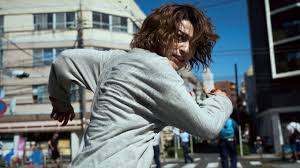

“Faceless” is “I Am a Fugitive from a Chain Gang” or just “The Fugitive” for Japan’s current “Seijin no Hi” generation. The conceit is so clever that the clock is probably already ticking on a Hollywood version of this.
A young man of about 21 violently lunges and lashes and bashes his way out of prison, faking bloody vomit so that he can bust out of the guarded ambulance on the ride to the hospital.
Kaburagi (Ryûsei Yokohama) was convicted of an “In Cold Blood” mass killing as a teen. And now this “monster” is on the loose. A nationwide manhunt is underway. Only the intrepid police detective Matanuki (Takayuki Yamada) can bring him in, but the days and weeks tick by with this menace still on the loose.
There are these witnesses — a couple of young women (Riho Yoshioka, Anna Yamada), a bleached blond young man (Shintarô Morimoto) and others — who talk about the kid’s considerate side, his sensitivity.
When it turns out they’re being interviewed later in the narrative, expressing doubts about Kaburagi — whom they knew as Benzo, Nasu, etc. — and his guilt in a crime and punishment, when we’ve heard a police chief suggest “make an example of him,” we and they wonder if the guy’s been railroaded by a “system” too lazy to “fully investigate.”
Those being interviewed about their encounters with Kaburagi question “what justice is.”
Because the blond, orphaned construction worker Jump (Morimoto) got hurt on the job, and the mop-topped loner known to him as Benzo was the only one who stood up to their bullying boss, insisting a workman’s comp claim be filed.
“I just call out injustice when I see it,” Benzo tells him, in Japanese with English subtitles.
Online editor Ando (Yoshioka) notes the writer/reporter Nasu has a gift for writing and a talent for generating clicks on her company’s news website. She takes note of his inexperience of the world, his haunted look and his tears at watching a TV melodrama and suggests “You never know what somebody’s going through.” That goes for her, too. Her father is a lawyer entangled in a possible legal injustice himself.
Each confesses they figured out their new acquaintance wasn’t really right handed — bad with chopsticks — or didn’t really glasses. But they’re convinced he could not be capable of such a crime.
The viewer, however, is allowed to doubt their judgement. We sense what he’s capable of and wonder if he’s the avenging sort. When trapped, he’s like a mad dog — wrenching and writhing, wild-eyed with terror, breathlessly fleeing.
The intrigues are fairly superficial, as are the snap “He didn’t do it!” judgements from his sometimes smitten but always impressed peers.
But director and co-writer Michito Fujii keeps “Faceless” (“Shoutai” in Japanese) moving just fast (not that fast at all) enough so that we don’t mind the soap opera melodrama and swooning over a skinny hunk in assorted haircuts — many of them stylishly floppy.
And Yokohama gives us just enough of the damaged kid underneath that boy band veneer to keep the kid a mystery. For a while, anyway.

Rating: TV-14, violence
Cast: Ryûsei Yokohama, Riho Yoshioka, Shintarô Morimoto, Anna Yamada and Takayuki Yamada
Credits: Directed by Michihito Fujii, scripted by Michihito Fujii and Kazuhisa Kotera. A Neflix release.
Running time: 1:59




A mother and father contemplate sending their oldest daughter to London to study.
It’s 1970 and the family lives in Rio de Janeiro. Brazil has been under a military dictatorship for years. the daughter is college age, rebellious, and the country is enduring a crackdown brought on by the kidnappings of foreign ambassadors. The kidnappers want political prisoners, who are many, freed in exchange for these diplomats.
But the father, Rubens (Selton Mello) wonders if Veroca needs to be abroad, just “until this phase is over.”
Is he discussing Veroca’s (Valentina Herszage) latest “phase?” Pot-smoking, music-obsessed and outspoken? Or are he and wife Eunice (Fernanda Torres) pondering the latest “phase” of an oppresive, arrest-everyone/interrogate thousands/detain hundreds government run by an unaccountable army and pistol-packing plainclothes secret police?
“I’m Still Here,” the latest film from Walter Salles (“Central Station”), is a chilling history lesson where what’s being taught here in Portuguese (with English subtitles) speaks to the universal concern of what happens to civil liberties in a time of oppression, when an authoritarian government controls the military, the courts and the media and can brand anyone it wants a “terrorist,” “murderer” or undesirable.
Salles folds a portrait of a comfortable life, albeit with armed soldiers everywhere, into this story of one family’s trial by secret arrest.
Rubens is an engineer — a designer who has planned a new house for them that he’s laying out on a gorgeous piece of land with a view of the Christ the Redeemer statue overlooking Rio. The family has a car, the leisure for trips to the beach, and has a live-in housekeeper to help clean up after and feed four girls and a little boy.
But Rubens used to be a legislator. And he’s not totally muzzled his “Death to the Dictatorship!” sensibilities. He takes mysterious calls and deliveries. And early one weekend morning, the dead-eyed goons with pistols stuffed down their pants show up and take him away.
“Your husband will be home soon,” they lie. Three of them stay behind to search the house, monitor the phone and intimidate one and all. The others hustle Rubens into a VW Beetle — the cop car of choice — and off he goes.
He wasn’t the first. Veroca faced an alarmingly aggressive gunpoint stop and search on the drive home from the movies with friends. Soon, the ever-questioning and pleading Eunice will have her moment — with a younger daughter — stuffed into a VW, handcuffed and hooded and hauled off for questioning.
Salles builds his film on fear — when the police arrest everybody, they have mug shots of everyone, which they show Eunice to see if she sees “anyone you recognize” — and the aching uncertainty of not knowing.
Unaccountable to anyone, authoritarians don’t even admit they’ve arrested someone, much less the “charges,” their status and location.
Eunice has one daughter in Europe and other kids to keep safe at home, a house to keep with a sexist banker who won’t let her access their accounts without her absent husband (she can’t say he’s been arrested) and a lie to maintain for those kids even as friends and others struggle to question and plead for “justice” that they have to know won’t be coming. Not for years, decades even.
Salles’ film takes place in 1970, 1996 and close to the present day as brief epilogues update on what everyone has done or become and the status of their “case.” “Closure” always hangs out there, in the distance, where no justice can be found. But Mom hung on, and son Marcello (Antonio Saoia) grew up to tell their tale in print.
What’s most chilling here is what we don’t see, the distant screams in the prison, the one young guard who won’t say where her husband is, but who tells her “I just want you to know that I don’t approve.“
We hear the drilled dehumanization chants of soldiers in training, an army that exists to control, suppress and oppress the people. We rattle through city streets in tiny cop cars with sirens blaring, remembering the days when VW stood for “the Very Worst car” to have an accident in.
I found the final chapters less moving than intended, and the epilogues anticlimactic — one more than the other.
But Torres is so subtle at portraying a mother unable to show panic or righteous rage that when Eunice finally does let her guard down it’s almost shocking. It’s a great performance and worthy of the Oscar nomination she earned.
The film is also up for Best Picture and Best International Feature at the upcoming Academy Awards. It’s good enough to contend, even if we know that the film’s cautionary message about enduring the democratically unendurable, is what got it nominated. A lot of filmmakers in a lot of countries are thinking about that these days.

Rating: PG-13, violence, marijuana, smoking, nudity, profanity
Cast: Fernanda Torres, Selton Mello, Valentina Herszage, Bárbara Luz, Cora Mora, Guilherme Silveira, Antonio Saboia, Luiza Kosovski and Fernanda Montenegro,
Credits: Directed by Walter Salles, scripted by Murilo Hauser and Heitor Lorega, based on a book by Marcelo Rubens Paiva. A Sony Pictures Classics release.
Running time: 2: 17
June 25.


Not going to sugar-coat this.
“Bring Them Down” is rough, a movie of wrenching, insensate cruelty, much of it directed at animals.
Writer-director Chris Andrews has made a debut feature that is as hard to watch as any recent film, and an intentionally frustrating experience that mimics real life in a world where “the law” doesn’t figure into things, least of all a search for justice.
Andrews tells the story out of order, showing us horrible things that happen as tensions rise in a feud between neighboring sheep farms in hilly, rocky central Ireland (Connemara is the setting, Athenry is mentioned, the Wicklow Mountains were the filming location). And then he flips back to show us how and why things happen, letting us dread the ugliness that we’ve already seen and know we may have to see again.
The story weaves random encounters and bad blood and vague rumors of “rustling” into specific grievances, causes and effects as it does.
A car accident years ago shows us a tearful mother pleading with her son to take the news of her leaving his father well, and Mikey’s mother and girlfriend in the back seat shouting at him to slow down as he road rages into an accident that kills, and disfigures and emotionally scars those who survive.
Grown up, Mikey (Christopher Abbott, just seen in “Wolf Man”) still lives on the farm with his “waiting for new knees” Da (Colm Meaney, of course), still communicates with the old bully in Gaelic, still tends the the that the O’Sheas graze on a hill they share with a neighbor who doesn’t have their “500 years” of experience, reputation and financial security.
Paul Ready of TV’s “The Terror” is Gary, the burly, bearded and bullying neighbor who has raised his son (Barry Keoghan) in his image. His wife (Nora-Jane Noone) was in the back seat of that car with Mikey, decades before. She bears the scar of that wreck, and Gary isn’t shy about using that to bait Mikey every chance he gets.
We’ve seen Mikey’s temper. We’re allowed to wonder if he’s mellowed, and wonder how wise that approach to a neighbor might be.
Because young Jack (Keoghan) called Mikey to alert him to a couple of dead O’Shea rams on the hill.
“Where there’s livestock, there’s dead stock,” he cracks.
But Jack is evasive and won’t let Mikey see the corpses. and when two re-branded (with spray paint) rams turn up at the local auction, the game is up. Jack stole them. Mikey’s fury is barely contained as Gary does what bullies do — dares him to do something about it.
As there have been stories of rustlers mutilating sheep, lopping off their legs, the threats to the O’Shea’s way of life are concrete and palpable. What does Old Man O’Shea want Mikey to do about it? Bring back the sheep by force?
Nooo. He wants his son to “Bring me their f–ckin’ HEADS!”
Callous cruelty and self-serving behavior permeates this world, where peer pressure — nobody will buy from shifty, crooked Gary — is almost the only recourse available when one family steps completely out of line. There’s no friendly uniformed Garda to keep the peace and see that wrong is made right.
And with no law, escalations can only end in horror.
Shoving and threatening leads to road rage and other escalations. And as the story folds back into itself, we see the desperation and amorality of the malefactors, the cowardice of bullies, the consequences of being a bad neighbor and the burden of being trapped with that bad neighbor — for life.
If you’re easily triggered on pretty much any subject listed above, I’d advise you to steer clear of this brutish Irish saga. It’s too bloody, too depressing and infuriating, and Andrews makes it his business to not give the viewer much relief or satisfaction with any of it.
But it’s also quite good, even if it denies us much that would give the viewer some sense of relief or justice.

Rating: R, graphic violence, animal abuse, drug abuse, smoking, profanity
Cast: Christopher Abbott, Barry Keoghan, Nora-Jane Noone, Paul Ready and Colm Meaney.
Credits: Scripted and directed by Chris Andrews. A Mubi release.
Running time: 1:47
Asian Americans gays cook up work arounds for their “traditional” relatives who don’t understand their sexuality, going so far as to fake relationships and a marriage.
Ang Lee’s “The Wedding Banquet” rode the crest of a wave of what we’d come to call queer cinema when it played to enthusiastic reviews in art houses back in 1993, earning an Oscar nomination and a rich afterlife on home video and cable as well.
But for all its repressed emotions and dry humor, the picture has to play as more than a tad quaint thirty years later. So much has changed, even with reactionary efforts to turn back the clock on LGBTQIA visibilitiy and rights.
If anybody can make this fun, it’s “SNL” star Bowen Yang. Lily Gladstone also stars in a film from the director of “Spa Night” and “Driveway.”
The new take on this tale opens April 18.


