Movie Review: “Bullet Head” is a Chatty Caper Thriller with a Canine Twist

bullet3

Everybody has a dog story in the heist-gone-wrong thriller, “Bullet Head.” Even the dog.

And these stories are told, mostly in smartly-handled, rhapsodic flashbacks, in Paul Solet’s tale of crooks trapped in a warehouse with a bloodied fighting pit bull out for revenge. It’s almost exactly what you want in a crime genre picture — good actors, great dialogue with a tasty, righteous twist to the proceedings.

Oscar winner Adrien Brody and ought-to-have-an-Oscar character actor John Malkovich are grizzled veterans of the safecracking trade. They joined “a soft in, soft out” job set up by a junkie (Rory Culkin) and it went wrong.

Their car shot up with the get-away driver dead, they’re waiting for “a pick-up” at this vast, abandoned warehouse in the outskirts of town. Recriminations? Yeah. The old guys should have known better than to trust “the kid.”

They should have known better than to take on “one last job.”

There are only three kinds of “last scores,” the elder statesman (Malkovich) grouses.

“The kind where you serve life. The kind where you’re served a bullet. The kind where you walk away.”

They didn’t “walk away,” and here they are.

“Here,” we’ve seen in a parallel plot, is an active crime scene itself. A mobster (Antonio Banderas) is running a high stakes dog fighting tournament here. Rottweilers, mastiffs and pit bulls named De Niro, Eastwood, Jackson, Bronson  and Freeman, fight, with the losers promptly dispatched by their heartless trainers.

Only one doesn’t die. His trainer does. I’ll let you imagine how. Now, the safe-crackers are trapped in the building, unarmed, with a killer dog.

Not that a gun would help.

“I’ve done plenty of bad,” Brody’s crook declares, “but I ain’t shootin’ no f——g dog!”

Writer-director Solet, whose “Mars” TV series was a hit for National Geographic, makes this ruined warehouse a labyrinth of breathless chases and near-death experiences, mazes of stacks storing who-knows-what, an abandoned gym, holes in floors, holes in walls and catwalks to escape onto.

But it’s the characters and the dialogue that make this cut-and-dried thriller work. Brody and Malkovich swap “cat person/dog person” put-downs. They make their animal encounters of the past compelling, charming and almost-funny.

Just guessing here, but those monologues are probably the reason this cast signed onto Solet’s picture. Culkin’s is the most heartbreaking. Banderas gets his across with just his Spanish growl, no filmed recreation necessary.

And yeah, we see a lot of “Bullet Head” from the dog’s point of view, not just the blurry, fish-eye lens chases. A dog has to have a hard life to get to where he is, and we see it.

bullet2.jpg

The players give great value, one and all. We stop wondering “Why’d they sign onto this?” (a bit of a parlor game with any Adrien Brody movie) quickly. We empathize with most of the characters, even the killer beast out to get them.

It’s a clever trick for a movie with a predictable story arc and a marvelous fatalism about its characters. It’s the players and their points of view that let “Bullet Head” score something close to a bulls-eye, even if the shot is fired at easy, close range.

2half-star6

MPAA Rating: R for violence, bloody images, language, some drug use and nudity

Cast: Adrien Brody, John Malkovich, Rory Culkin, Antonio Banderas

Credits: Written and directed by Paul Solet A Saban Films/Millennium  release.

Running time: 1:33

Posted in Reviews, previews, profiles and movie news | Comments Off on Movie Review: “Bullet Head” is a Chatty Caper Thriller with a Canine Twist

Netflixable? “Sex and Broadcasting” shows free-form radio’s most famous survivor

sex1

If you’ve ever dial-hopped and stumbled across a poet reading her latest haiku, followed by an ancient cylinder recording of a singer from the very early 1900s, chased by an extended bebop jazz jam and rounded-off by by a live singing harpist, you’ve discovered a broadcast relic of the ’60s, “free form radio.”

It’s a non-corporate, non-network “listener supported” “community” station, as opposed to a member of the NPR network. It’s radio for “people who don’t quite fit in.” And it’s a rare thing.

You can find such typically low-power (limited reach) stations in big cities, in the mountains of Virginia, Tennessee and North Carolina, in college towns such as Madison, Wisconsin or Winter Park, Florida. And perhaps the most famous survivor of the species is WFMU-FM in Orange, New Jersey, just across the river from Manhattan.

“Sex and Broadcasting” is the title of a famous “how to” book by Lorenzo W. Milam about getting such a station licensed, staffed (volunteers) and on the air. It’s also the title of a lively and engaging documentary about WFMU’s history and struggles to stay solvent and relevant in the age of Internet Radio and a million other distractions for this station’s metro-New York audience.

Tim Smith’s movie follows station manager and guiding light Ken Freedman as he pulls his own on-air stunts, doing a “meet up with our listeners” live in the middle of a local lake (from a canoe), leads the camera through the cluttered archives, record and CD stacks and arcane music reproduction gear (the aforementioned Edison cylinder player) and tries to rally the independent thinkers there to fund raise to pay their bills and expand their signal reach into NYC.

WFMU, which started life as an Upsala College FM station (Upsala closed, the station lives on), is captured at a fun, desperate moment in its history. There were popular hosts, popular programs, including “JM, The Jewish Moment,” a daily dose of ethnicity and ardent Zionism, the beehive of studios and stacks filled with comics, musicians, hangers-on and ardent believers in this sort of radio, all there for one of the station’s near-death experiences — drowning in debt.

Considering the history of such stations, it’s hardly surprising that the volunteers are generally older, whiter, more Jewish (in this station’s case). They are aged hippies and assorted other eccentrics. Decades of donated labor hosting shows have made them polished presenters, people capable of genuine novelty on the air. Their personas and programming zaniness have made them frequent subjects of profiles in the other New York media.

The station had one host set the record for one person being continuously on the air, makes live performances of every manner of music (much of it unpolished) and has an internet presence that created a worldwide web audience for its weirdness, which makes fundraising easier.

“Community” stations aren’t just licensed to serve their community, they create their own community — of supporters, volunteers, listeners and call-in show guests. And WFMU, like such stations I’ve appeared on, volunteered for and just listened to — WORT, WUVT, WPRK, WDVX, etc. — excels at this, which Smith’s movie notices but doesn’t dig into.

sex2

While hosts and former hosts talk on camera, a bit broader picture of the station’s whole eco-system would have made a better movie (and a longer one, alas). The only fans who speak on camera are famous — Adam “Ad Roc” Horowitz of The Beastie Boys, comic Patton Oswalt, “Simpsons” creator Matt Groening.

And nothing Smith shows us here can convince the viewer that this brand of broadcasting might stage a comeback, any more than any other terrestrial broadcasting medium. Thus, it’s an exercise in nostalgia.

But “Sex and Broadcasting” is still a fascinating block of broadcasting trapped in amber, a little radio history about passionate people doing something they love, willing to beg for bucks on the air to continue doing it and finding enough kindred spirits, “people who don’t quite fit in” in a shrinking sea of radio listeners to cling to FM life a little longer.

2half-star6

MPAA Rating: unrated, profanity

Cast: Ken Freedman, Matt Groenig, Adam “Ad Roc” Horowitz, Tom Scharpling, Patton Oswalt

Credits:Directed by Tim K. Smith. A Netflix release.

Running time: 1:18

Posted in Reviews, previews, profiles and movie news | Comments Off on Netflixable? “Sex and Broadcasting” shows free-form radio’s most famous survivor

Box Office: Oscar Contenders Bubble up on a Weekend “Coco” Will Win Easily

bill1“Coco” should clear $25-30 million on its second weekend, and will be over $110 million overall by midnight Sunday, winning the box office by a safe margin over “Justice League.” It’s not doing epic business, but glowing reviews and lots of parents with tykes mean this one should cruise to $200 million even if “Ferdinand” sucks away some of the wind in its sails in two weeks.

Not that there’s weeping over at Warner Brothers. “Justice League” will finish second, again, and clear $200 million by late next week.

“Thor: Ragnarok” is closing in on $300 million. Which could cause Warners to weep.

“Wonder” has turned out to be the season’s sleeper, renewing Julia Roberts’ box office currency and warm hearts to the tune of another $14 million this weekend. $75 million already, dashing towards $100.

Yes, “The Star” and “Daddy’s Home 2” and “Bad Moms Christmas” are still making money, and with no new wide releases, they’ll be around for at least another weekend or two.

But this weekend is where the box office starts to reflect the Oscar ambitions of “Awards Season” pictures and the studios backing them.

Pictures like “The Disaster Artist” and “The Shape of Water” are opening in handpicked theaters in NY and LA with an eye toward piling up buzz slowly to begin an awards season push. They need, as Deadline.com points out, big per-screen numbers ($50,000?) to impress and make their case. The reviews are already stellar. 

Woody Allen’s “Wonder Wheel” is trying that limited release tack, and getting pounded. Poor reviews overall. Will anybody see it outside New York? Will anybody want to see it, in light of the highly-credible pedophilia charges renewed by Mia Farrow’s son, Ronan?

“Three Billboards Outside Ebbing, Missouri” expanded last weekend, and cracked the top ten. It’s hitting four hundred more screens this weekend (over 1000 now) and is making a case as an across the board hit packed with nomination-worthy performances (Frances, Sam and Woody?).

“The Florida Project” opened a bit early to make its case this way, and has only earned $4 million in two months. Expect A24 to roll it into more theaters if the Golden Globes are accommodating and honor it with nominations.

New York-centered awards buzz for “The Post” and Willem Dafoe (“Florida Project”) could be prophetic, or as the usual outlier “too early to count” attention. Nobody takes The National Board of Review seriously. Not in this millennium.


Posted in Reviews, previews, profiles and movie news | Comments Off on Box Office: Oscar Contenders Bubble up on a Weekend “Coco” Will Win Easily

One More Trailer: “All the Money in the World” with All the Christopher Plummer You Need

No more Kevin Spacey. An Oscar winner replaced by an Oscar winner in Ridley Scott’s take on the infamous 1970s Getty kidnapping.

Posted in Reviews, previews, profiles and movie news | Comments Off on One More Trailer: “All the Money in the World” with All the Christopher Plummer You Need

A Gay Teen Comes Out, Develops Gaydar in “Love, Simon”

People griping about the glacial pace of change should take a peek at this trailer for a spring teen romance by a major Hollywood movie studio and featuring A-listers in supporting roles.

Twenty years since Matthew Shepard and “Boys Don’t Cry,” less than a decade since the creators of “The Hangover” thought “That’s gay. Don’t be so gay” was the perfect put down, and here’s a romance that isn’t built around gay bashing, bullying, etc.

Or so it would seem.

“Love, Simon” is about a boy hiding his sexuality and finding what it takes to stop hiding it. Love the joke about “everybody” should have to “come out” and inform their loved ones what their sexual preference is.

Nick Robinson has the title role, with Jennifer Garner and Josh Duhamel as his parents, Tony Hale. “Love, Simon” is based on the Becky Albertalli novel “Simon Vs. the Homo Sapiens Agenda,” and opens Mar. 16.

Hollywood has been hard-pressed to manage a decent heterosexual romance in recent years. Let somebody else have a go.

Posted in Reviews, previews, profiles and movie news | Comments Off on A Gay Teen Comes Out, Develops Gaydar in “Love, Simon”

Movie Preview: “Mary Magdalene” gets her Movie Moment

It looks serious-minded, sober. And if it aims for controversy, it’s soft-peddled in the film’s first trailer.

Aside from, oh, Jesus played by Joaquin Phoenix and Chiwetel Ejiofor playing St. Peter.

Rooney Mara has the title role, a “fallen woman” saved and redeemed by Jesus, and in a “Da Vinci Code” spin, picked by him to “lead” his flock/church after his death.

Look for “Mary Magdelene” right around Easter — March 30.

Posted in Reviews, previews, profiles and movie news | Comments Off on Movie Preview: “Mary Magdalene” gets her Movie Moment

Movie Review: A French Chanteuse’s Sad, Sad Life is laid bare in “Dalida”

dal1.jpg

In America, we have been known to eat anything fried, to queue up for the films of Adam Sandler and the endless “Farewell” tours of Cher and KISS.

And in France, they still savor the taste of snails, and never quite lived down a mania for Jerry Lewis and too many atrocious pop stars to count.

“Vive la Difference,” as they would say, and they’re right.

Which is the most diplomatic way I can think of to deliver a backhanded slap at Dalida, a 1950s through disco era French obsession celebrated as much for her tragic life and death, which echoed that of the indisputably great Edith Piaf.

Born into an Italian musician’s family living in Egypt, she became a star in France, and sold millions of records all over the world in French, Italian, Spanish, Arabic and apparently German.

The tunes? French originals, often of the syrupy ballad or novelty tune variety, and a never-ending parade of insipid, thin-voiced covers of English language hits from the likes of Cher, The Moody Blues and whoever made “I Wish You Love” (She dueted with Johnny Mathis once on this one) a pop “standard.”

“Dalida” is an absurdly long, jaw-droppingly tragic and soapy film of her life, which was cursed with the trauma of her father’s arrest during World War II (an Italian in British Egypt, he was accused of Axis sympathies), lovers who took their own lives, an abortion that took away her chance of having children, and her own suicide attempts.

Svelte Sveva Alviti looks enough like the real singer, whose real name was Yolande Christina Gigliotti, to accept the title role. But her colorless, charisma-free  performance matches the underwhelming songs she lip-syncs to. It’s a strained, dull movie that begs the non-French response, “I don’t get it.”

The film is set, mostly, in the aftermath of a suicide attempt. Her young Italian lover– a struggling singer– has taken his own life, and she’s decided to do the same.

Her producer, who took the name “Orlando” (Riccardo Scarmacio), her first manager, the ex-husband who made her a star (Jean-Paul Rouve) and others are kept at a distance, interrogated by a doctor who wants to know how to “rekindle her zest for life.”

Through them, and Dalida’s own sessions on a psychotherapist’s couch, we see the story of her life — her father’s arrest in Cairo, her Egyptian beauty-pageant big break, arrival in France and ensuing stardom, and all the broken love affairs, career challenges and phases her fame went through.

There’s the standard threat from her ex, whom she ditches just as she gets big, in French — “What I make, I can break.”

“You think I need you to exist?” she sneers back.

Her Paris Olympia Theatre triumphs, her efforts to prop up this younger lover or that one (Nicolas Duvauchelle makes a strong impression as “St. Germain,” a particularly weird self-promoting toy boy hustler), many of them are laid out in this survey of her life of sadness.

How sad?

“The hardest thing between life and death is choosing life,” she sighs. “Death is sweet.”

There’s no getting around what a rough time Dalida had, in between the curtain calls. There’s a hint of Judy Garland or Maria Callas in her bad luck and bad taste in men.

dal2.jpg

But the title performance, the awful lip-syncing, the utter lack of stage presence, cripples this movie in ways no mere maudlin cover of “Nights in White Satin” in Italian could.

The flashback structure, a well-worn device long before Marion Cotillard won an Oscar for playing Piaf, gives the picture a lurching forward progress that barely qualifies as “advancing the plot” at all.

Co-writer director Lisa Azuelos is content to serve up snippets of shows, TV appearances in disco wear, love scenes that generate no heat (It’s almost chaste enough to play in her native Egypt.) and inane bickering over her future with her entourage bracketed with montages of her radio, LP, TV, concert and film triumphs.

That may play in France, where Dalida is remembered and, one assumes, loved. But even trolling through youtube videos of the real deal, who had great stage presence and later in life, a darker, more interesting voice, can leave those who are not French, Italian or Egyptian a little lost.

Why did they latch onto this banal beauty in the first place?

1half-star

MPAA Rating: unrated, with violence, suicide, nudity

Cast: Sveva Alviti, Jean-Paul Rouve, Riccardo Scarmacio, Alessandro Borghi, Nicolas Duvauchelle

Credits:Written and directed by Lisa Azuelos, with script assistance from Orlando and Jacques Pessis. A Pathe release.

Running time: 2:04

Posted in Reviews, previews, profiles and movie news | Comments Off on Movie Review: A French Chanteuse’s Sad, Sad Life is laid bare in “Dalida”

Movie Review: Get those Drugs to France via “Fast Convoy”

con1

A good chase thriller isn’t so much scripted as diagrammed, mapped-out.

Characters have to get from Point A to Point B. Make the journey viable and scenic. Create interesting obstacles for them to overcome — a police dragnet, a dangerous cargo, betrayals, double-crosses, etc.

And you want to bring the film to a climax with mayhem in a finale hewn out of some form of rough justice, a criminal’s code of the road as it were.

The lean and immersive French thriller “Fast Convoy” (“Le Convoi,” to the natives) is a compactly mapped out addition to the genre. It packs four cars full of drug smugglers — mostly Muslim — and puts them on the road from Malaga to Paris. Over a day and a night (1100-1200 miles), they’ve got to dodge the cops — Spanish and French — work out internal conflicts, fight paranoia and panic, adapt when things go horribly wrong and survive long enough to collect twenty-thousand Euros.

It’s a chatty ride filled with bickering teams of drivers — scout teams in an Audi A4 and a VW Passat, a chaser/fixer in a Porsche Cayenne, and the cargo car, a Chrysler 300 — on a journey interrupted by explosions of violence.  Genre picture it may be, but it’s not really about the cars or the chase or the quest. Characters are everything in this “thirteenth” delivery, the one that’s sure to be their undoing.

Majid (Foëd Amara) is a grump. In quick snippets of conversation, we figure out he’s got a pregnant woman waiting for him, that they work for “The Mahmoudis,” and that nobody told him that their trunk load of Moroccan hash has been augmented with bundles of cocaine. Young Elyes (Mahdi Belemlih) is behind the wheel and shrugs it off. Majid, who knows the “next level” legal consequences, flips out.

“What’ll you tell the JUDGE? ‘I only had SEVEN kilos! For PERSONAL use!”

Their convoy is built around burner phones, and Majid is quick to burn up his cussing out convoy leader Imad (Tewfik Jallab). That keeps Yacine and Remi (Amir El Kacem and Leon Garel) in the lead car from getting through and warning them all about a Guardia Civil (Spanish police) roadblock. And in Majid’s agitated state, that’s not a good thing.

Will the convoy’s mysterious “fixer,” Alex (Benoît Magimel) be able to tidy this up? Depends on how big a mess he finds when he rolls in with his Cayenne. 

Alex is from a rich tradition in French crime films, a “cleaner” in the “Leon” (“The Professional”) mold. He knows how to dispose of a shot-up vehicle, what to do with a body. But his sunglassed cool is tested when he sees young Elyes has grabbed a hostage (Nadia Kherici).

Layers of intrigue are added as the shaken team dashes north to the Franco-Spanish border, through stunning Pyrenees passes, racing the clock.

But it’s the banter, in French with English subtitles, that titillates. Yacine is every bit as paranoid as Majid, and he’s seething with fury over the Gallic dope, Remi, he’s riding with. Remi wants to go all-in with this profession, changing his name to something Muslim. “Osama” is the fool’s first choice.

Imad tangles with his much-younger driver Reda (Sofian Khammes) over where they store their grenades. For, you know, just in case. 

Alex is the mystery. Cold-hearted killer, cunning calculator, or is there humanity in there? He’s not happy having a hostage mixed in with these bungling, panic-prone chatterboxes.

“Either she comes too, or you kill her.”


conv3

Genre director Frederic Schoendoerffer (“96 Hours,” “Scene of the Crime”) won’t make anyone think of “The Transporter” with his pedestrian handling of the automotive stuff. He co-wrote a script that is more interesting for its run-of-the-mill logistics (gas cans in the scout cars, keeping the cargo car out of CCTV-covered gas stations and rest areas), dialogue and shoot-outs than its oddly-inept escape attempts, lax roadblocks and coincidences.

The players — believable, not particularly sympathetic, with Magimel’s Alex providing the requisite “cool” — make this work, and the violent interludes kick “Fast Convoy” up a notch. When Hollywood remakes it, and they should, they should stick to the diagram worked out here.

It won’t need all that “Fast & Furious” clutter to come off. Just a little more supercharged driving, if you please.

2half-star6


MPAA Rating: Unrated, graphic violence, drug abuse

Cast: Benoit Magimel, Rheem Kherici  Tewfik Jallab, Mahdi Belemlih, Amir El Kacem, Leon Garel

Credits: Frédéric Schoendoerffer, script by Yann Brion and  Frédéric Schoendoerffer. A Paramount release.

Running time: 1:42

Posted in Reviews, previews, profiles and movie news | Comments Off on Movie Review: Get those Drugs to France via “Fast Convoy”

Movie Review: Denzel’s “on the spectrum” as “Roman J. Israel, Esq.”

roman2

Not knowing that Dan Gilroy, writer-director of “Nightcrawler,” brother of Tony Gilroy (“Michael Clayton”) wrote and directed it would help “Roman J. Israel, Esq.,” simply by lowering expectations for the Denzel Washington legal drama.

Strip away any pretense of “Oscar contender” attached to Washington’s turn as an unreformed activist lawyer who never left his Civil Rights Movement past, faced with the moral dilemma of his life’s first, big mistake. Forget that his lumpy, “on the spectrum” character turn is designed to attract Oscar attention, and maybe this overlong but engaging character study in crisis goes down easier.

Sony/Columbia certainly wanted that to be the case, releasing this picture with little fanfare or pre-release attention from critics. They knew it was problematic, from Washington’s inconsistent-with-classic-Aspergers symptoms performance to a meandering, moralistic story that takes forever to get to its moment of crisis, and even longer to resolve it in the way we know it will.

Washington’s title character is “the pillar” behind a famous L.A. activist practice, for 36 years the “man behind the curtain” — doing the research, memorizing California statutes, compiling briefs and never erring in his judgement of the law and the injustices in the ways it is enforced.

“I’m quite confident of my recollections.”

That “savant” thing makes up for his bluntness, Roman’s prickliness, his never-changed hairstyle, unbending racial attitudes and slang — he still calls every black woman he meets “Sister,” ever black man “Brother.” He’s got one suit, and a sort of naive idealism that rarely stepping into court has never forced him to abandon.

And then his unseen partner has a heart attack, the practice is about to close and his one lifeline is from a man who is everything he is not, his partner’s sell-out super-successful protege, played with uncanny canniness by Colin Farrell. George Pierce may want to tidy up this in-the-red law firm run by his law school mentor. He may have an angle he’s playing as he tactfully tries to re-direct Roman’s rude brilliance into something his semi-predatory criminal law firm could use.

That’s the hide-his-hand style Farrell brings to the part. But on the surface, George is a rich, slick, smooth-talker who wants to do right by a man his mentor trusted as the brains of a practice that had social impact far beyond its billable hours.

roman1

Roman, who uses “Esquire” after his name, even though he often has to explain it, has not yet tired of “doing the impossible for the ungrateful.”

“I believe because of my beliefs.”

But he takes the job offer from George, because he cannot help but label the civil rights organization he’d like to work for “nickel and dime reformers” to its young director (Carmen Ejogo) when he’s begging for a job.

At some point, Roman will abandon some piece of himself, lose idealism and look for the easy, unethical way out. It’s just that Gilroy takes his damn sweet time getting us to that point.

Trying to create some sort of romantic interest between Roman and the younger activist played by Ejogo is laughable. We never do get a handle on what motivates George to indulge this square peg so hell-bent on seeking “justice” and so inept at asking for it.

The murder case that gets Roman into hot water isn’t remotely interesting, and his efforts to extract himself from it clumsily handled. Washington’s take on Roman, all-knowing, socially inept, “shy” and yet verbose, clueless and yet self-aware, callous and intensely compassionate, is jarring.

But we do get some fine civil rights lawyer sermonizing, Reverend Al Meets Johnny Cochrane.

“NOT speaking out is ordinary,” Roman preaches. The legally obvious is “an enema of sunshine,” “Freedom is something you can only give yourself.” “Lack of success is self-imposed.”

So what we have with the most honorable “Roman J. Israel, Esq.,” is a lawyer better suited to being a judge, and a character — with all the inconsistencies of Washington’s performance (there are many variations of “on the spectrum”) — deserving of a better movie built around him.

2stars1

MPAA Rating: PG-13 for language and some violence

Cast: Denzel Washington, Colin Farrell, Carmen Ejogo, Tony Plana

Credits: Written and directed by Dan Gilroy. A Sony/Columbia release.

Running time: 2:0

Posted in Reviews, previews, profiles and movie news | Comments Off on Movie Review: Denzel’s “on the spectrum” as “Roman J. Israel, Esq.”

Movie Review: Dickens finds his Scrooge in “The Man Who Invented Christmas”

xmas2

Charles Dickens is pacing his study, muttering loudly enough that the servants can hear. And giggle.

“SCRATCH!” he says. “Scroooou-ples. SCRAMPLE.”

It’s important work, a big part of his process.

“Get the name right,” says Dickens, who delighted in “collecting” unusual names for later use in his fiction, “and if you’re lucky, the character will appear.”

And in any version of “A Christmas Carol,” if you get the right Scrooge, all else falls into place.

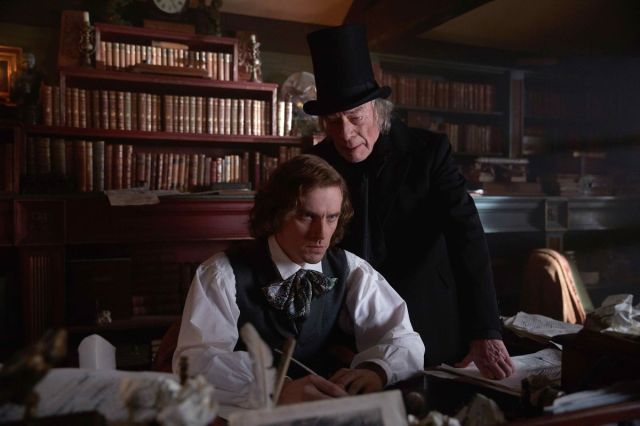
That’s what “The Man Who Invented Christmas” is, a fanciful, semi-historical spin on Dickens’ most famous work, ostensibly about how he came to write it. And while its Dickens, played by Dan Stevens, the oft-employed “Downton Abbey” alumnus, is fine, its Scrooge is one for the ages.

Christopher Plummer, an actor whose career’s third act has been filled with Dickens — it began with a dazzling villainous turn in “Nicholas Nickleby” in 2002 — and assorted other Oscar nominated and Oscar-winning delights, is a perfectly adorable grouse, a towering cadaver of Victorian sarcasm, the muse who haunts Dickens as he frantically searches his past, his acquaintances and his city’s streets in a mad scramble to finish his self-financed masterpiece in a mere six weeks in 1843.

It’s obvious Plummer is perfect from his first scene, a chance encounter where Dickens observes him as the sole mourner of his late “business partner.”

“Hum—-bug.”

And as Dickens leads his the growing cast of this novella (in his head) through London, looking for a Fezziwig, a Ghost of Christmas Present or Bob Cratchit, Plummer’s Scrooge is his droll, bored critic-in-residence, there to comment on anything or any place that gives the manic writer inspiration.

“It’s a market, you idiot.”

xmas1

It’s not the first film or play to use this writer-haunted-by-his-characters device, but that pays dividends in a cute, sentimental holiday film whose ethos is uttered by Dickens’ long-suffering mother (Ger Ryan) when explaining her Christmas pudding recipe to Dickens’ wife (Morfydd Clark).

“The secret is to warm the treacle.”

Dickens’ impoverished, workhouse (child slave labor) past hangs over him, his debts and spendthrift ways remind him too much of his ne’er do well dad (Jonathan Pryce), his publishers skeptical, as he’s produced three flops in a row. Adored by his public, at home and in America, he’s got to get this short “Carol…in prose” done, perfectly illustrated (Simon Callow is Leech, the talented but imperious engraver) and into stores before Christmas.

But bless his soul, there’s inspiration all around him — the unemployed brother-in-law with the consumptive, crippled son, the creaky barrister/lender who keeps padlocks on his safe, the rattling old waiter named “Marley.”

Fans of British character actors will recognize the several, among them the great Scot Bill Paterson as a wealthy fan, a delusional “self-made man” undeterred by his wife’s reminder that her dad left them a factory, who supplies the author with his heartless “decrease the surplus population” quip.

It’s “A Christmas Carol” riff for those who already know the story, and entirely too on-the-nose for its own good. The Irish/Canadian production is handsome, beautifully-costumed if rather clumsily lit — not quite BBC/PBS level polish. And for all the suggestion of impending ruin, the script and Stevens’ performance of it lack urgency and desperation.

The odd boner — having Dickens feted with “Yankee Doodle Dandy” during his American tour of 1842 is about 60 years before the song was written – creeps in. And some plot contrivances, banishing the Irish maid (Anna Murphy) who gives Dickens his ghost story idea, are simple and overly-obvious plot devices.

But one of the greatest tales in the English language gets its moist-eyed due, simply by following the recipe the master laid out 174 Christmases ago.

“The secret is to warm the treacle.”

2half-star6

MPAA Rating: PG for thematic elements and some mild language

Cast: Dan Stevens, Christopher Plummer, Morfyyd Clark, Miriam Margolyes, Jonathan Pryce, Anna Murphy, Simon Callow

Credits: Directed by Bharat Nalluri, script by Susan Coyne, based on the Les Standiford. A Bleecker St. release.

Running time: 1:44

Posted in Reviews, previews, profiles and movie news | Comments Off on Movie Review: Dickens finds his Scrooge in “The Man Who Invented Christmas”