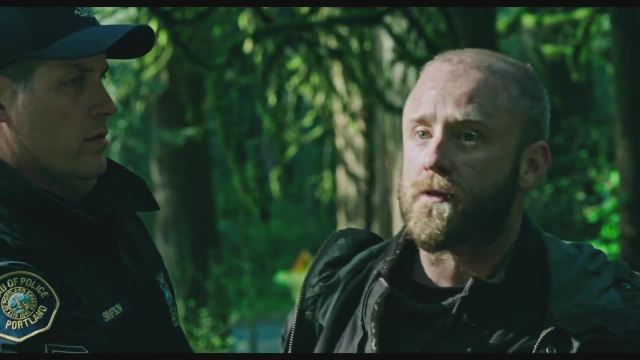
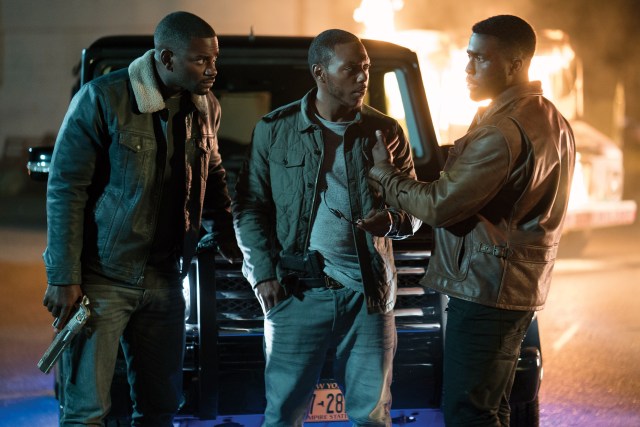
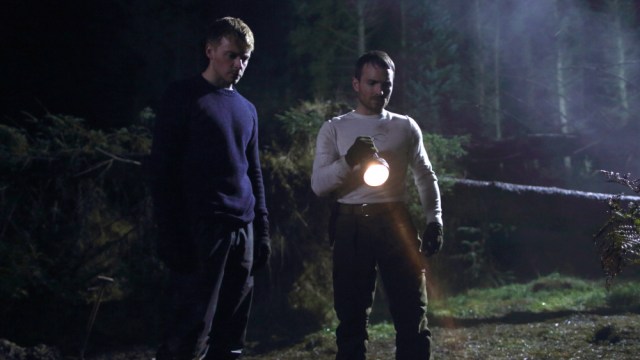
This one opens in March of next year. There’s zero conflict or the possibility of conflict in this first teaser, so something’s missing.
I mean, I don’t expect “Action Point,” heaven forbid. But…something.
This one opens in March of next year. There’s zero conflict or the possibility of conflict in this first teaser, so something’s missing.
I mean, I don’t expect “Action Point,” heaven forbid. But…something.

The short answer to that headline question is “No.”
Even on Netflix, director Kelly Reichardt’s movies are the ultimate acquired taste. Austere to the point where tiny gestures are magnified into moments of enormous consequence, silent save for the most banal blurbs of dialogue, they live in the eyes of her characters, in the sea of words left unspoken.
After flirting with melodrama in her feature debut (“River of Grass”), she quickly found her niche in telling stories where — to quote IMDB user reviews on “Old Joy,” “Wendy and Lucy” etc., “nothing happens.”
She made a Western about a wagon trail lost on the Way West, “Meek’s Cutoff,” and left them wandering to what we assume will be their doom.
Michelle Williams became her muse some years back, and the Montana Oscar winner was probably the magnet who helped draw Laura Dern, Kristen Stewart, James Le Gros, Lily Gladstone and Rene Auberjonois to “Certain Women,” an adaptation of Montana stories by Montanan Maile Meloy.
Loosely connected, they tell of women coping with loneliness, distance, personal and professional frustration in Big Sky country, “Where the men are men and the sheep don’t mind.”
Sorry, old North Dakota joke about “Mont-ah-ah-ah-ah-na.”
It’s a humorless film, too, so you do what you can for it.
Dern plays a lawyer having an affair in Livingston, anything to liven up a life and practice whose highlight is dealing with one increasingly crazy client (Jared Harris). He suffered a head injury in an accident, accepted a hasty settlement, and has spent months refusing to accept her counsel that he screwed himself permanently and the blurred vision and increasingly irrational behavior are not something he can take to court again.
Williams is married to the guy (Le Gros) who is having the affair. With their teenage daughter, they’re living in a tent, struggling to build their own house, angling to talk the elderly Albert (Auberjonois) out of a pile of cut sandstone on his property.
Native American actress Gladstone (“Winter in the Blood,” “Scalped”) is a solitary ranch hand, dealing with livestock and a feisty Corgi out in remote Belfry (population, 218). One night she wanders into “town,” follows the “crowd” into a school, and finds herself in a class on “School Law,” mainly consisting of teachers anxious to question a lawyer about their rights — to compensation, overtime, to expel problem students.
The teacher? Working class, fresh-out-of-law-school Livingston lawyer Beth is played by Kristen Stewart at her most natural, disarmingly unkempt. The Rancher’s gaydar goes off and she’s smitten. But is she reading the girlish but rough-cut Beth right?

Reichardt’s serene, slow style means that even the big incidents in these stories pack no punch. The most dramatic might be the lawyer dealing with the increasingly unhinged client, the most aching is the rancher-lawyer flirtation.
The Williams/Le Gros episode has the expectation of fireworks that never come.
Poignant here, anti-climactic there, Reichardt wrings as much meaning as she can from her players’ eyes — words unspoken, hurt and hope and guilt and disappointment register in just a look.
You hope for more, and you have a right to expect more, but Reichardt has gotten away with less for so long that it’s too much to expect her to deliver it, now.

MPAA Rating: R for some language
Cast: Laura Dern, Michelle Williams, Rene Auberjonois, Lily Gladstone, Jared Harris, James Le Gros, Kristen Stewart
Credits:Written and directed by Kelly Reichardt, based on stories by Melie Malloy. A — release.
Running time: 1:47
The people who made “The Lobster” have opted for “period piece” for their next trick, a dark comedy about the reign of daft Queen Anne of Great Britain.
With Olivia Colman as God Save Me and Rachel Weisz as her lady in waiting/power behind the throne and fellow Oscar winner Emma Stone as the new lady in waiting and thus new one we’d call “The Favourite,” this Nov. 23. release looks to be an awards season hoot.
And perhaps a little easier to take than “The Lobster.”
All of my leisure reading is taken up with non-fiction, with the odd fiction classic thrown in just to clear the palette (Fitzgerald, Steinbeck, Hemingway, Patrick O’Brian).
And as I read this history of Dunkirk or that Life of Lou Reed/Bowie/Dylan/Janis/McCartney/Barry White, my mind wanders into “Is there a movie in this?”
Chewing on the new “Critical Edition” (heavily footnoted) of M. K. Gandhi’s “The Story of My Experiments With Truth,” I see a movie that Richard Attenborough’s stately, epic of Gandhi’s activist years skipped past. That film, which is aging better than the highbrow critics of the day ever expected largely thanks to Ben Kingsley’s timelessly fiery, charismatic, righteous and above all else, wise and kind performance, picked up the Future Mahatma in South Africa, an activist/barrister seeking rights under Apartheid leading into World War I.’
But there’s an altogether different movie, I think, from the early years of the Hindu icon who made the Nobel Peace Prize pointless (He never was awarded it, which makes the Obama/Kissinger and other honors laughable).
Get past the autobiography’s wordy, pedantic forward/introduction by Trilip Suhrud, skim over the more or less Indian middle class childhood, and we find an 18 year old Mohandas Karamchand Gandhi, married at 13, already a father, on his way to Victorian Great Britain, a quintessential “innocent abroad.”
He was a comically shy and naive lad studying to be a lawyer, a profession which rarely rewards the painfully introverted. He hid his marriage from the English, as was the custom of Indian students abroad in the late 19th century, making for awkward “set ups” and one misguided “Let’s take the Indian lad with us to the brothel” incident.
He arrived in the U.K. at the height of a Victorian era vegetarian craze, too shy to ask if what he was being served was free of beef or pork, but able to find whole restaurants devoted to vegetarian dishes in some quarters. And according to his narration, the vegetarians were prone to clubbing up and quarreling over degrees of righteousness, like apostles whose vegan messiah left their company too soon.
He moved in high circles, made a fool of himself in several “Passage to India” incidents, made lifelong friends and sometimes ill-chosen acquaintances. And he studied the law, which eventually served him in good stead as he went into legal battle on behalf of the oppressed in various corners of the British Empire.
He harbored guilt over his lust for his wife, doubled down on that guilt by missing his father’s death by squeezing in a little intimacy during a break from the old man’s deathbed sit, and started forming ideas about “bread labor,” a life of doing no harm to any living thing and the piety of peasant work. Gandhi was shrinking his carbon footprint long before Starbucks belatedly announced plans to ban the cursed plastic straws.
Get Kingsley, whose entire career — even his many memorable villains — was informed by Gandhi, to narrate from the playful early years of the autobiography. I’ve interviewed Sir Ben more times than I can count, and I dare say he’d be down for it. A gentleman, raconteur and a real sweetheart, with a life-affirming laugh and great sense of humor, it’s impossible for anybody born after the early ’80s to not think of him when they think of Gandhi. He’d make a voice-over sing.
A movie that humanizes people history has parked on a pedestal by visiting their awkward years makes for good drama, and often great comedy. Ask Shakespeare.
In terms of exposition, just let the comic misunderstandings that made the boy the man he became tumble by, hilarious, touching, dark and often delightful blunders on the way to global icon for freedom, justice and non-violence.
As someone who loves historical films and any movie that can purport to be “about something,” this is one I’d love to see, a comic Prince Hal prelude to the non-violent Henry V Gandhi was to become.

The most dramatic and damning story about the heedless run-up to the invasion of Iraq has to be the ways a humiliated and enraged America blundered into Iraq, led by a Bush administration hell-bent on getting a war and an experiment in “nation building” out of 9/11.
Anything to change the subject from the arrogance, inattention and rank incompetence they displayed in letting 9/11 happen on “their watch.”
Another promising angle to take would be exploring how a cowed and compliant TV news and print press corps — most infamously the New York Times — followed Mr. “Mission Accomplished” and the nation over that cliff.
Rob Reiner and his “LBJ” screenwriter Joey Hartstone opted to zero in on the less dramatically promising, or at least more difficult to wring a compelling film from. “Shock and Awe” is about the dogged reporters “getting it right,” the lone news operation, in a sea of Bush cheerleaders, to talk truth to power.
The filmmakers went for “All the President’s Men” or “Spotlight,” films of simmering, beneath the surface drama, brilliant performances and gravitas — both underpinned by a long, attention-demanding running time. What Reiner and Hartstone managed is closer to “Lions for Lambs” or “Kill the Messenger,” a movie that like “LBJ,” is more interesting than compelling, more superficial than definitive.
“Shock and Awe” is a meandering but brisk, almost flippant stroll through the 9/11 to Invasion of Iraq era as seen through the eyes of the late, lamented Knight-Ridder News Service, a Washington D.C. newspaper wire service whose journalists were the only ones to say, point blank, that Dick Cheney, Donald Rumsfeld and assorted other Bush officials were lying to America.
Theirs was the only analysis to roll its eyes at the whopper that the secular dictator Saddam Hussein and rich boy religious fanatic Osama bin Laden were in cahoots.
Reporters Warren Strobel and Jonathan Landay, and veteran war correspondent, author (“We Were Soldiers”) and onetime Bush administration insider Joe Galloway were the only ones to track down contrary voices, real experts who laughed at Cheney’s delusional declarations that “We’ll be greeted as liberators.”
They were the solitary journalists to look at this the way the hawkish but pragmatic Calloway did. Played by Tommy Lee Jones, his guiding ethos was, “When the government f—s up, the soldiers pay the price.”
Reiner’s film tracks the Strobel (James Marsden) and Landay (Woody Harrelson) through the months of legwork, “unnamed government sources” and those willing to go on the record — “The Vice President is lying.” They make $20 bets on “Who can get the best quote” that will make a story zing, make its point and stick with the reader.
The threats are familiar to anybody who’s ever seen a newspaper picture. “Tell your boss we’re going with the story whether he comments or not!”
The facts laid-out have been verified by history. “The decision is made (to invade Iraq). Intelligence (briefings) is made to fit it.”
The reporters are profane, skeptical to the point of cynicism, and the outspoken liberal Reiner must relish all the dirty names these people call assorted Bushies. It’s what reporters do, curse people who lie to them. Their “bias” is inherently towards the truth.
And Reiner, who plays the battling and embattled bureau chief, John Walcott, takes acting pleasure getting on his reporters, tearing into the biggest papers of his own chain –Knight-Ridder, later swallowed by McClatchy Newspapers, both of them swallowed by Tribune — for not carrying the stories their own news service was accurately reporting. “Patriotism” cowed one and all, we’re reminded.
A running gag? Explaining to sources and potential girlfriends (Jessica Biel plays Strobel’s fetching accountant/neighbor) what Knight-Ridder is. “Knight RIDER…Is that a magazine?”
They were attacked from all sides (shades of “Kill the Messenger”), threatened by right wing readers, just for being out of step. You can see why Reiner took on Walcott for himself. Walcott is the Ben Bradlee figure here; testy, defiant, circling the wagons as cable TV news took the “anything that helps Israel” New York Times to heart and never followed up on Knight-Ridder’s skeptical, factual stories.
“We are Knight-Ridder,” he sermonizes. “We don’t write for people who send other people’s kids off to war. We write for people whose kids are sent to war!”
If he’d confined his story to just the journalism, just the pressure cooker within that bureau, with the celebrated Galloway leaving government to write columns questioning the “chicken hawks” and “National Guard deferments” and their glib treatment of what was sure to be a grave, blood-stained endeavor, Reiner would have stayed on solid ground.
Alan J. Pakula (“All the President’s Men”) didn’t show up strident, paranoid anti-war wives (Milla Jovovich) or awed-at-what-you-do girlfriends (Biel). Reiner does.
“The Post” took us to Vietnam for a taste of the consequences of governments lying their young men into combat, so Reiner tries that, too, tracking a patriotic young man who enlists, is paralyzed by an IED and testifies before Congress to open the film.
The performances are more solid than inspiring. We don’t get under anybody’s skin in a 90 minute movie that packs in all these story threads and all this exposition (a big chunk of it handled by Biel’s girlfriend who “did my homework” speech, recounting the history of Islam, the Middle East and Iraq in a minute and a half or so).
Jones is the stand-out in the cast, giving the chest-thumping Bronze Star-winning combat reporter that beyond-reproach veneer of a man hardened by battle who just happens to be a reporter. I met Galloway as (depicted in the film) his Vietnam memoir, “We Were Soldiers,” was being turned into a Mel Gibson film, complete with flag-waving AND the reminder that soldiers are always trapped implementing government policy, even ill-conceived ones.
The real Galloway is who Shakespeare had in mind when he scribbled that “St. Crispin’s Day” speech, because if anybody could make you “hold their manhoods cheap” when talking about war, it was Galloway (and Tommy Lee Jones).
Full disclosure, at one time or other, I worked for every newspaper chain (and a later version of this wire service) mentioned here, and the first person I ever heard recite that print journalist’s credo, that our duty is to “afflict the comfortable, and comfort the afflicted,” was named Tony Ridder.
Maybe I wanted this to be better, or maybe I’m cutting Reiner & Co. a little slack. But if nothing else, the timely “Shock and Awe” is a blunt reminder of how important a skeptical press is in countering a popular government — or even an unpopular one — that is hellbent on lying, misleading, on doing something for nefarious reasons, and has all of cable news, talk radio and a truth-averse internet backing it up.

MPAA Rating: R for language including some sexual references.
Cast: Woody Harrelson, James Marsden, Milla Jovovich, Jessica Biel, Rob Reiner, Richard Schiff, Tommy Lee Jones
Credits:Directed by Rob Reiner, script by Joey Hartstone. A Voltage/Castle Rock release.
Running time: 1:31
Based on the Penelope Fitzgerald novel, directed by the woman who gave us “The Secret Life of Words,” “Elegy” and “Learning to Drive,” “The Bookshop” celebrates reading in the face of ignorance, public good over greed and love. It finally has a US release date, Aug, 24, where it has a week or so to find an audience in between summer and fall.

Josh Brolin joins Danny McBride and his “The Foot-Fist-Way” director Jody Hill for another comic riff on emasculated Southern white manhood with “The Legacy of a Whitetail Deer Hunter.”
It’s a satiric goof on fathers and sons and the decline of “the tradition” that used to be passed, generation to generation — hunting — that allows Brolin to send up his manly man’s man image, playing a divorced dad who loves the woods because that’s the last place he feels in control. Unarmed animals can’t talk back.
Buck Ferguson is the country Carolina star of “Buck Adventures” DVDs, homey little stalk-and-shoot escapades filmed by his trusty, bullied videographer Don (McBride).
“I’ve seen the best and I’ve killed the best,” he drawls in the opening credits to his show, hunting whitetail deer “all over the world.” He sticks John 3:16 in the credits because he knows his audience — white, Southern, hunting happy Protestants who, as an ex-president famously noted, “cling to guns or religion” to deal with their bitterness.
Buck’s bitter about his divorce, with his ex-wife (Carrie Coons) taking up with a richer, slicker more citified fellow (Scoot McNairy) who just might be the new “Daddy” to his son, Jaden (Montana Jordan of TV’s “Young Sheldon”). Not if Buck has his way, though.
His latest “adventure” is taking the phone-game-guitar-and-girl addicted kid out to “catch” his first deer. It’s a bonding experience, “gettin’ blood on your boots,” that makes fast the ties that bind, that helps ensure there will be a next generation of hunters, just like Buck. And Don will be there to video the “emotional” journey, bickering with Buck about camera angles that create an “emotional crescendo,” “B-roll,” coverage and the kill shot.
Buck, who has a sadistic glee about shooting deer, gets all gooey when he insists his shows are about “family.” For Jaden, this will entail “learning to be a man,” taking on his “whitetail legacy,” getting over any phobia about killing something so cute.
“We can honor the deer,” he teaches, “but we can’t love it.”
The kid? “I thought we were gonna be straight-up KILLIN’ stuff.”
Jaden’s a straight-up spoiled punk who seems to have taken the divorce too easily, in spite of being held back a year in school. He’s indulged by his might-be “new daddy,” who gives him a laser-scope/large capacity magazine Bushmaster assault rifle for the trip.
So much for Buck passing on his granddad’s ancient Winchester.
The kid “always thought of myself as a Marriott guy.” But camping it is.
He’s instantly bored, constantly patching up things with his clingy girlfriend by phone.
So much for long, patient deer stand sits for a “non-typical” big 20 point buck that they spied in the Appalachians of N.C., where this three day quest takes place.
They don their camo (no orange visibility vests), “camp” with a state of the art product placement air mattress and horse around, from site to site, on big, fast rented ATVs.
And things don’t go quite according to plan.

McBride, working with Jody Hill again, dials down the over-the-top vulgarity that’s become his “Vice Principals/Pineapple Express” trademark. Just a little. Why isn’t Buck dating again, his kid wonders?
“The only tail your dad is chasin’ is WHITEtail!”
Brolin is the very embodiment of a “type,” here. Buck is a self-described man’s man losing his grip on his life and his world. He drinks, doesn’t acknowledge that guys like him have sissified camping and hunting, with all their lazy redneck Outdoor World toys and has as much self-awareness as the dumb deer he’s stalking.
If he didn’t vote for Trump, it was only because he was holding out for Ted Nugent.
But Brolin doesn’t make Buck some Bubba stereotype. He’s focused, dogmatic, proficient, a blowhard and maybe a bit of as we-say-down-South “chicken-s–t” without the control his firearms give him. Can’t control his kid, isn’t shy about making his cameraman take risks before he parades himself taking them — on camera.
The kid is the standout character, a Southern version of a tiny-attention-span generation that grows up too fast, quits anything that’s “too hard,” utterly uninterested with “tradition” and “legacy,” inured to violence by video games and yet Disney-conditioned to see an animal as a living thing that wouldn’t like to be shot.
Young Jordan makes this kid cocksure, just learning how to “handle” women and how he can bully his needy dad around, but starting to accept the quiet, under-educated horror that could be his future.
Hill and co-screenwriters McBride and John Carcieri deliver minor tweaks to expectations with the plot, making Don the Profane Father Confessor to both father and son, giving the kid a learning arc, suggesting that maybe it’s just too late for Dad to learn.
That renders “Whitetail” only fitfully amusing after a genuine knee-slapper of an opening act. It’s not as slapstick silly and gonzo-paced as “Tag,” but manages a similarly sweet tone.
As comedies go, it’s not a kill shot. But it makes a miss almost as entertaining.

MPAA Rating: TV-14, violence, profanity, sexuality, alcohol abuse (child drinking)
Cast: Josh Brolin, Danny McBride, Montana Jordan
Credits:Directed by Jody Hill , script by . A Netflix release.
Running time: 1:27

The sophomore jinx settles in over “Frank & Lola” director Matthew Ross’s second feature, a violent thriller with a strong undercurrent of sex, Russian intrigues and Keanu Reeves.
“Siberia” is tedium itself, a boring, talkative and nonsensical story that parks Reeves, as a high rolling diamond smuggler, in a remote mining town awaiting a delivery, awaiting deliverance and awaiting his next sexual encounter with the fetching, blunt barmaid Katya.
Lucas Hill (Reeves) would have happily stayed in the swank hotel in St. Petersburg where he was supposed to meet the illusive Pytor and pick up some blue diamonds. Ransacking Pytor’s room doesn’t produce anything, threats over his many burner cell phones (which Hill keeps in a special compartment of his briefcase) get him nowhere.
And a Russian mobster (Pasha D. Lychnikoff of TV’s “Shameless” and “Insomnia”) is breathing down his neck for these stones. He makes threats in that oblique way Russians make threats in the movies, with an aphorism.
“Patience, Mr. Hill, is like air in a sealed room. No matter how much you start with, eventually, you run out.”
Better dash out to the provinces to see what the hold up is. That’s where he gets stranded, and gets mixed up with Katya, played by Romanian actress Ana Ularu of “Muse.” She is worn and weathered and seriously disrespected when Hill meets her. He totally misreads her and her situation, leading to a beating which naturally progresses to an indecent proposal.

“What would you do if I asked you to sleep with me?”
As Hill has a wife at home (Molly Ringwald), a lot on his plate, and it’s a small town and Katya has protective, brutish brothers, that’s a dicey proposition. Which he indulges in, repeatedly. She is smitten, in that Russians-in-the-movies way.
“I do not hate you yet.”
Reeves was cast at least in part because, like his character, we are meant to underestimate him. All these Russians switch from English to Russian to insult and plot their double crosses of him. Of course he speaks Russian.
The yokels drag him out for a chilly (it’s supposed to be winter, but nobody looks cold) bear hunt. Of course he knows how to handle s a gun.
His rival for the stones is a South African (James Gracie) with whom he has one of those loving/loathing relationships.
“You’ve seen too spy movies.”
“And you have seen too few.”
What Ross conjures up here, working from a dull, murky Scott B. Smith script, is a lot of conversation, numerous scenes that seemingly lead nowhere and sex in rooms with Soviet Era color schemes.
It’s all heading toward a reckoning that cannot arrive soon enough, not with groaning zingers like “This is humor? American humor?” and “In Russian, when we don’t want to answer a question, we ask another in return.”
Yeah, we do that in America, too.
“Frank & Lola” was a harrowing psycho-sexual drama about the power dynamics of a tortured relationship, one built upon betrayal and the suspicion of betrayal and the raw menace of Michael Shannon. Whatever promise that picture held that attracted Reeves (He likes to travel for his indie film work, too.), it’s obvious that the director is out of his element here, and that Reeves is unable to add value with his mere presence.
“Siberia” slogs along like the failed pilot for a poorly-thought out cable series, one with Eastern European development incentives but without enough drama, incident, intrigue or plot to justify its running time.

MPAA Rating: R for strong sexual content, nudity, language, some violence and drug use
Cast: Keanu Reeves, Ana Ularu, Pasha D. Lychnikoff, James Gracie, Molly Ringwald
Credits:Directed by Matthew Ross, script by Scott B. Smith. A Saban Films/Global Road release.
Running time: 1:44

Avoiding Adam Sandler films is a lot easier than it used to be. Basically, he’s moved (with his aging fanbase) to Netflix, and the most prominent theatrical releases he’s in have him doing a goof Dracula voice for Sony Animation.
So Thanksgiving came early this year.
But as feeble as his Sony Animation “Hotel Transylvania” comedies can be, a sentient adult can find pleasures in the dazzling design, the occasionally witty sight gag and the ever-shifting state-of-the-art that such films advertise.
Kids? They’re just waiting for the next fart joke.
Starting “Hotel Transylvania: Summer Vacation,” the third film in this Sandler voicing Dracula-as-a-hotelier-and-doting-dad comedy series with a dazzling, photo-real train chugging from Bavaria to Budapest is impressive. The cruise ship featuring in the [plot — a summer cruise –looks like “Titanic” might in a James Cameron-directed Bullwinkle cartoon.
Director Genndy Tartakovsky emphasizes sharp angular lines — characters framing each other and the scene with their bent and lean body shapes — and snap-action, whiplash-quick character jumps and jerks.
The story, which packs the lovelorn Vlad, his daughter (Selena Gomez) and assorted friends from his Hotel Transylvania to a cruise in the Bermuda Triangle for a little flirting and dodging holly stakes to the heart, is almost interesting.
And there’s a commitment to the vocal performances, as if the collect-the-check years are over and Sandler and his cronies realize they’ve got to put the effort in, if only in front of a microphone, from now on.
It’s just the jokes that aren’t funny — not even to the supposedly undemanding (very young) audience these films are tailored to. Well, aside from the farts.
See Vlad have lilting accent issues with a (Sony) phone’s vocal assistant.
“I’m lonely.”
“I understand. I’ve ordered you baloney.”
A prologue on that train established Vlad the Impaler’s long history fending off the Van Helsings, vampire hunters from way back. But today, Vlad’s just a lovelorn widow, happy his daughter has married, but despondent that “you only get one ‘zing’ (love at first sight) in your life.”
His daughter misreads this as “You need a vacation.” But his pals who come along (David Spade as The Invisible Man, Steve Buscemi as Wolf Man, Keegan-Michael Key as Murray the Mummy, Kevin James as Frank (N-Stein), etc., all figure it’s a chance for romance.
“This isn’t The Love Boat.” No, it’s not funny, but it’s a very representative line from this very limp script.
Vlad “zings” for the captain of the Legacy (Just call it Titanic already), voiced by Kathryn Hahn. Unfortunately and unbeknownst to him, she’s just the latest Van Helsing to take a crack at killing Drac. Unfortunately for the film, she’s rather colorless as a voice actress and the character isn’t the least bit funny as a villain.
There’s a little “Nemo” in the scuba diving monsters vacationing scene, a visual pun from “300” in the way they slo-mo topple off the “cliff” of the ship’s stern, and a touch of “Raiders of the Lost Ark” in Van Helsing’s quest for some magical talisman from Atlantis that will give her family the edge in its fight with the supernatural.
What’s closer to funny are the bits floating around the film’s periphery. Joe Jonas voices an amusingly on-key lounge-singing Kraken.

The Mexican monster Chupacabra (Jaime Camill) sidles up to the bar and orders a drink — a goat in a martini glass.
Mel Brooks is back as the grandpa vampire — nothing funny to say, but all the witches on board chase him.
And one and all are “slaves to the rhythm,” little dance interludes that are as catnip to tiny tykes as fart jokes.
Messages in the movie are in sync with the shirtless, cabana boy monster-twinks of the lost continent resort of Atlantis — “We’re here, we’re hairy, and it is our right to be scary.”
All of which is a roundabout admission that there’s not a “zing” in this thing. But it is pretty to look at.

MPAA Rating:PG for some action and rude humor(Jaime Camil
Cast: The voices of Adam Sandler, Selena Gomez, Kathryn Hahn, Molly Shannon, Steve Buscemi, Kevin James, David Spade, Mel Brooks, Jim Gaffigan, Joe Jonas, Fran Drescher
Credits:Directed by Genndy Tartakovsky, script by Genndy Tartakovsky and Michael McCullers. A Sony Animation release.
Running time: 1

The word “opportunist” gets kicked around a lot in “Whitney,” director Kevin Macdonald’s new onstage/backstage, warts and all documentary about Whitney Houston.
This family member tosses it at that family member, or girlfriend, music industry professionals slap it on Houston’s father, her family entourage, so many of them on her payroll treating her like, as one eyewitness puts it, “their ATM.”
Some reviews of the film apply it to director Macdonald, for focusing on the sensational, the sordid and the before-our-eyes tragedy of Houston’s very public decade-long decline and death in 2012.
I found “Whitney” to be shockingly emotional just in the way it presents this once-in-a-lifetime voice, her seemingly effortless talent and the personal cost a life of secrets, disappointments and addiction. She found fame beyond modeling with her gift-from-Mama (Cissy Houston) voice, and drugs long before Bobby Brown.
The most damning revelation in the film is that the girl nicknamed Nippy who grew up to be the greatest pop starlet of her era wasn’t just self-destructive. As in the much-honored Amy Winehouse doc “Amy” of a few years back, our heroine is shown to have had a lot of enablers, chief among them, like Amy, her own father — John Houston.
She lit up rooms, concert stages and “The Bodyguard” with her smile, stormed the pop charts with her talent and stared down accusations from a homophobic African American community that she was gay, or “too white.”
Yes, it’s fun to recall that “opportunist” Rev. Al Sharpton led a boycott, calling her “White-ney,” in the ’80s, and that the shill was the first guy on the phone to be interviewed by CNN when she died. She had to declare she wasn’t gay on chat shows and that she wasn’t an addict to Dianne Sawyer, lying both times.
She was booed at the “Soul Train Awards,” dated footballer Randall Cunningham and was “dogged” by Robert DeNiro. Her first love and longtime protector and most trusted confidante, Robyn Crawford, was eventually chased out of her life by her controlling Dad and ego-bruised, and bruising husband Bobby Brown.
She was, by any objective measure, a fatally disastrous parent.
But her vocal range dazzled, her smile invited all in and if you ever doubted her crossover appeal, there was that Gulf War era Super Bowl appearance where her “Star Spangled Banner” moved all of America to tears.
When she was in trouble, churches held prayer vigils to pray for her recovery, rehab and restoration.
Macdonald, still best-known for “The Last King of Scotland,” but who did the equally thorough Bob Marley bio-documentary “Marley,” sums up this life within its very personal parameters. He interviewed scores of friends, employees, collaborators, relatives and business partners, from the prickly Bobby Brown to record label chief L.A. Reid and “Bodyguard” co-star Kevin Costner.
Personal assistant Mary Jones will break your heart with the tears she still sheds over Houston’s inglorious end.
Whatever pushback this film is getting should be taken with a grain of salt. The denial of this gospel singing daughter of a gospel singer’s problems, flaws and complicated love life within that corner of African America is both dated and delusional. She was “fluid” in her sexuality, negligent as a parent and incapable of “praying away” the addictions that tie themselves to too many of those gifted with the kind of fame she dealt with.
A confidante who recalls her visits with Michael Jackson, because sometimes each tabloid famous famous singer needed just to be in the room with someone facing the lonely world through exactly the same eyes, is terribly touching.
Macdonald uses news footage of her era to illustrate the passage of time, and home videos, “backstage” documentary footage never meant to see the light of day (Janet Jackson/Paula Abdul bashing), grainy home video and movies to tell her story. If the film has a serious shortcoming, it is Poverty Row studio Roadside Attractions’ not digitally cleaning this stuff up. It’s an ugly looking film, and the murky video gives it a seamy “True Crime” TV documentary feel.
I recall talking with Macdonald when “Last King of Scotland” came out, asking him off-handedly what he was doing next and being shocked that the Scotsman was planning an epic look at the life, music and legacy of Jamaican reggae icon Bob Marley. I interviewed him again when the film came out and asked why he’d want to endure the “What could YOU know about Bob Marley?” abuse that was sure to follow.
Oh, he reassured me, he’d only go through THAT for a “singular talent, a huge figure in the culture” like Marley.
With “Whitney,” you appreciate Macdonald’s own talents, his eye and ear for icons and his unflinching way of challenging (we hear pointed questions for Brown and others, off-camera) the people who knew her to give him the straight dope — not just sycophantic, self-serving plaudits.
Houston was a real mess, to be sure — probably abused as a child, certainly abused as a wife, ill-used by her crooked Dad, not saved by friends, family or the industries that made fortunes off her. But she was a “singular talent, a huge figure in the culture.” “Whitney” is a touching naked look at how that American Tragedy played out. 
MPAA Rating: R for language and drug content
Cast: Whitney Houston, Bobby Brown, Gary Houston, Mary Brown, Kevin Costner, L.A. Reid, Lynne Volkman Credits:Directed by Kevin Macdonald. A Roadside Attractions release.
Running time: 2:00