Netflixable? Comfort Food Film is Always in Season, “Goodbye June”

Oscaar winner Kate Winslet directed and stars in “Goodbye June,” a sentimental and sharply-observed dramedy in which terrific performances and a couple of deeply emotional scenes overcome the glum predictability of it all.

Because everybody knows the holidays are a magnet for emotion, family quarrels brought to a head and tragedy.

“Goodbye June” has a lot of “The Family Stone” and more than a bit of “Love, Actually” and other seasonal favorites in its characters, situations and their responses to them. But casting Oscar winner Helen Mirren as the dying matriarch and title character, with BATFA winner Timothy Spall playing her dotty husband, Oscar nominees Toni Collette and Andrea Riseborough joining Winslet as their three daughters and Johnny Flynn (Mr. Knightley in the latest “Emma.”) as their son ensures that every role that counts pops off the screen and every tried-and-true sibling conflict rings true.


The holidays are coming and mother June is losing her struggle with her health. She collapses at the stove, and loving but tuned-out husband Bernie doesn’t hear the kettle boiling over after she does. Live-at-home son Connor, their youngest, is the one who reacts and takes action.

That means calling feuding sisters Jules (Winslet) and Molly (Riseborough). Jules is organized, earning a good living and raising three kids — two in private school, one special needs — pretty much on her own with an overseas-employed husband. Mol is immersed in a more chaotic state of affairs with a less gainfully employed spouse (Stephen Merchant) and kids of their own, including one they’ve named for that British theatrical and cinematic rogue Alfie and another Tibalt, either after the fantasy card game “devil” or trouble-maker from Shakespeare’s “Romeo & Juliet.”

Connor neglected to call oldest sister, crystals-and-sage-burning New Ager Helen, who lives abroad. But wherever she is (US? Germany?), she bolts for home at the news of this latest crisis.

The doctors have reached their “no more treatment we can offer” stage of their efforts to save the cancerous June. Comfort care or paliative care, in hospital or in hospice, she’s not likely to make it to Christmas.

Jules is rattled. Her rival sister Mol is enraged, furious at the mere mention of “hospice,” spitting blame and ripping the doctors — one of whom has the misfortune of being named Simon Cowell.

Mum reflects on the birds she saw out her window and suggests “Why don’t we have goose for Christmas?”

And when Helen gets there — tie-dyed, pregnant and “energy” reading — she’s the one who pushes for “make it Christmas” in the hospital room.

Connor chews his nails and bites his knuckles, Jules juggles, Mol fumes, Helen weeps and tries to keep the peace. Dad? He drinks his ale, watches his football and pretends “It was the pipes” when it turns out he forgot to turn off the sink water when they all scrambled to get June to the hospital, ruining their house.

The script sets up lots of conflicts to resolve, and gives us and the Cheshire family a voice of calm and reason and empathy in Nurse Angel (Fisayo Akinade), who is Mum’s co-conspirator when it comes to making peace between the two warring sisters.

Mirren beautifully captures June’s annoyance at the indignity of the end of life as many experience it in the western world . Privacy, solitude and keeping one’s basic bodily functions to oneself is off the table, adding a touch of humiliation to everything else the aged and infirm are coping with.

Spall gets a redemptive story arc, Riseborough and Collette and Winslet make the most of characters that are little more than “types” with each getting declarative monologues explaining their function in this narrative.

Flynn’s Connor might be the most interesting, mainly because he lets us see who and what he is in all this. We don’t need a speech to understand how rough it was for him growing up under a matriarchy that included three overbearing sisters. But screenwriter Jon Anders lazily takes side in the “nature or nurture” debate by making Connor gay.

And yet predictability has its virtues in comfort food cinema. It’s the very familiarity of these people and these situations that make “Goodbye June” appealing and easy to digest.

Winslet, as actress and director, gets us to the emotional core of the story with skill and compassion even as her movie introduces its emotional buttons, one by one, before punching each in turn with a care and sensitivity that make this “Goodbye” therapeutic as well as over-familiar.

Rating: TV-MA, profanity

Cast: Kate Winslet, Helen Mirren, Toni Collette, Johnny Flynn, Andrea Riseborough,
Fisayo Akinade, Stephen Merchant and Timothy Spall

Credits: Directed by Kate Winslet, scripted by Jon Anders. A Netflix release.

Running time: 1:54

Posted in Reviews, previews, profiles and movie news | Tagged , , , , | Comments Off on Netflixable? Comfort Food Film is Always in Season, “Goodbye June”

Movie Review: “Psycho Therapy: The Shallow Tale of a Writer Who Decided to Write about a Serial Killer”

Sometimes a film title says it all, or at least entirely too much.

Turkish filmmaker Tolga Karaçelik blunders into that truism all too eagerly with his American feature film debut — a comic thriller he deigned to over-label “Psycho Therapy: The Shallow Tale of a Writer Who Decided to Write about a Serial Killer.”

Glib, hackneyed in subject matter (Hollywood makes entirely too many serial killer stories, so indie cinema should steer clear), slow in pace and with “Shallow” doing all the heavy lifting in that ungainly title, one can still see how it might have paid off in defter hands.

There’s an unhappy couple at the center of it all. We meet Keane (John Magaro) and Suzie (Britt Lower) at an NYC dinner party where his talk of his “new book” bores and almost amuses the other guests as he describes a Neanderthal/Homo Sapiens romance in the Slovenia of 40,000 years ago.

As his first novel was Mongolian in subject matter and won some award, Keane figures he’s found a gimmick that will suit perhaps his readership if not his agent (Ward Horton). And certainly not his wife.

Suzie the breadwinner has a severity about her reflected in bangs so sharp you could slice pizza with them and a dead-eyed stare that would break any spouse paying attention. Keane isn’t.

“They were laughing at you,” doesn’t get a rise out of him. “I want a divorce” does.

With a no confidence vote from his agent and a post mortem ultimatum from his wife, maybe Keane should reconsider the suggestions of this “fan” (Steve Buscemi) who approaches him with the suggestion that he write “a sexy story with a serial killer.” The stranger, named Kollmick, approaches him more than once. Because “just Kollmick” would love to “help.”

He’s a “retired serial killer,” he says. “I managed to stop before getting caught,” he explains.

Kollmick knows his craft, or at least knows all the right authors — pathologists and mystery novelists — to quote about that craft. He will lecture Keane, be his “counselor” as he takes him inside the mind of a serial killer and help him write his book.

But Kollmick taking drunken Keane home means he bumps into the soon-to-be-ex-wife. She confuses “counselor” with “couples therapist.” And brittle and bitter as she is, she perceives this as the first time Keane has “taken the initiative” in their relationship.

Kollmick finds himself trapped into faking his way through something he knows nothing about on any level.

Keane cuttingly sums up the totality of marriage counselor expertise needed in a couple of suggested phrases — “safe zone” and the prompt to answer any question with “Is that what you think?” The idea that a serial killer is conducting an “autopsy” of their marriage is cute. But that’s about it as far as “clever” goes here.

The script has Suzie noting Keane’s new routines, habits and research materials — books on toxicology, “How to Get Away with Murder,” etc. — and figures he’s plotting her murder. Soon she’s following him/”them” as they plot a sort of dry run kidnapping as training.

There’s potential for something madcap or at least droll in all of this. Magaro — of “Past Lives” and just seen in “The Mastermind” — is game and iconic character player Buscemi is as credible as the somewhat inane and verbose script allows him to be. Lower, of TV’s “Severance” lets us see Suzie as full of darkly comic potential.

But as it lumbers along, we can’t help but notice the succession of scenes, sequences, plot threads or plot twists that just don’t come off.

Every promising direction is stopped dead in its tracks. And most every fraught yet comical situation is left to wither on the vine.

Turkish cinema isn’t known for its riotous comedies. But perhaps Karaçelik could take this set up and make something funnier out of it in his native land in his native tongue. I’m sure Netflix would swallow that pitch.

Rating: TV-16, violence, profanity

Cast: John Magaro, Steve Buscemi and Britt Lower

Credits: Scripted and directed by
Tolga Karaçelik. A Brainstorm Media release on Amazon, other streamers

Running time: 1:42

Posted in Reviews, previews, profiles and movie news | Tagged , , , , | Comments Off on Movie Review: “Psycho Therapy: The Shallow Tale of a Writer Who Decided to Write about a Serial Killer”

Classic Film Review: Hitchcock “adapts” to Talkies — “East of Shanghai” (aka “Rich and Strange”) (1931)

It came as a surprise for me, and probably shouldn’t have, that Alfred Hitchcock’s transition to sound from silent cinema took more than a film or two and more than a year or two.

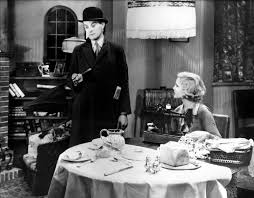
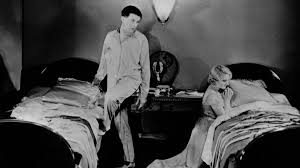
Hitchcock was half a dozen films into the talkies era when he turned the Dale Collins novel “Rich and Strange” into a darkly comic hobnobbing-with-the-swells travelogue back in 1931.

Taking its title from a phrase from the “Full Fathom Five” verse from “Ariel’s Song” in Shakespeare’s “The Tempest,” retitled nonsensically to “East of Shanghai” for American consumption — the entire tale takes place west of Shanghai — it’s “silent” enough to make one think one is sitting down to a late Hitchcock pre-talkie comedy.

The opening scenes of London office job drudgery, sight gags on “the tube” and bowler-hatted proles marching and popping umbrellas open in synchronicity in long takes speed-adjusted to match the jaunty syncopated music, are dialogue free.

Even after the talking starts, the picture is littered with pointless, redundant silent-era intertitles, as if Hitch was anxious to give his title-writer wife Alma Reville the work.

“To Get to Paris You Must Cross the Channel.” “To Get to the Folies Bergère You Must Cross Paris.” “And to Get to Your Room you must Cross the Hotel Lounge.”

Those three knee-slappers are followed by the odd title that serves some function — a passenger liner arrives in “Port Said.” But many others tell us who’s in the scene that we can obviously see for ourselves — “Fred.” “The Princess.” — or other information (“Later.”) we can figure out for ourselves. This goes on ad nauseum.

Those silent cinema touches give the film a stodgy feel and slow what could have been an 80 minute skip to a crawl.

Still, there’s a dash of “pre-code” profanity sprinkled in a plot that sees a working middle class couple stray from one another as they take a first class trip to Europe, the Middle East and the Far East (Singapore). The cheating is sophisticated, genteel and even a tad racy.

And the light tone carries this comedy from London to Paris, Marseilles to shipboard, Port Said and Singapore, with even the Keatonesque third act shipwreck doing Hitchock and his reputation for seeing “funny” in many a situation proud.

Continue reading
Posted in Reviews, previews, profiles and movie news | Tagged , , , , , | Comments Off on Classic Film Review: Hitchcock “adapts” to Talkies — “East of Shanghai” (aka “Rich and Strange”) (1931)

Movie Preview: “Avengers: Been There, Done That,” aka “Avengers: Doomsday”

Dec. 26. Which means youve got a whole year to get worked up over this revival.

Posted in Reviews, previews, profiles and movie news | Comments Off on Movie Preview: “Avengers: Been There, Done That,” aka “Avengers: Doomsday”

Movie Preview: Mandy Moore has to be “The Breadwinner” as she’s married to Nate Bargatz

“Clean” stand-up comic of the moment Bargatz gets top billing (LOL) in this family-friendly and seemingly dated comedy about role-reversal in “provider” terms in one household in an economy shoved into a death spiral.

This could be cute, even if it feels like it’d be more at home in a Reagan Era recession comedy.

March 13.

Posted in Reviews, previews, profiles and movie news | Comments Off on Movie Preview: Mandy Moore has to be “The Breadwinner” as she’s married to Nate Bargatz

Netflixable? Danish Dame goes “Mango” for a Man in Málaga

“Mango” is a tepid Hispano-Danish romance set in and in the hills above the resort city of Málaga on Spain’s celebrated Costa del Sol.

Rigidly formulaic and strictly low-heat as far as romances go, I’m guessing you can guess every turn the plot takes just by my listing the pertinent plot points.

Our heroine, Lærke (Josephine Park) is a workaholic deal-closer and detail-oriented re-designer for a big Danish hotel chain. Her boss (Paprika Steen) insists she go to Málaga, “get close to” the owner of this failed mango farm and get him to sell so that they can build on the property.

The boss’s biggest motivation? “I want a seat on the (corporation’s) board!”

That kills a planned vacation Lærke was to take with her neglected teen daughter Agnes (Josephine Højbjerg). As Agnes just failed to get into architecture school, she might as well come along and get something resembling a vacation out of it.

The owner of the scenic hilltop “mango plantation,” Alex (Dar Salim) is doggedly determined not to sell, debt be damned He has his reasons, and they might include his assistant, Paula (Sara Jiménez), who calls him “Bro” and is “family.”

Can Lærke please everyone? And if she can’t, guess who is destined to get the short end of the stick?

The “meet cute” happens on the jet from Copehagen to Málaga, a not-quite-funny bit of business involving the mother of a toddler who wants Lærke and her daughter to give up their window seats and a stranger who gives up his so that “both children” can be mollified.

The romantic leads are “rude” to each other at every opportunity. But “rude” by Danish standards.

The plantation’s shop and cantina features “mangolade,” “mangonade” and “mango vinegar,” amongst other products featuring their crop. Cute. Ish.

Park does a decent job of making Lærke a trained critic of all things “hospitality,” including “mangonade.” Salim’s Alex character barely registers, and the “girls” bonding scenes are perfunctory.

The funniest role is that of the imperious, vaping and demanding boss, whom we root against instinctively.

The dialogue — in Danish and Spanish with subtitles, or dubbed into English — doesn’t offer much zing.

Our director and screenwriter don’t show any flair for writing or executing comedy.

But the scenery is spectacular, and the fact that Lærke and Agnes — whose dad begs Lærke to “never let her drive” — traverse this landscape is a Mini Cooper had me pricing Mini rentals on the Costa del Sol.

So that’s something, anyway.

Rating: TV-MA, adult situations, profanity, smoking

Cast: Josephine Park, Dar Salim, Josephine Højbjerg, Paprika Steen and Sara Jiménez

Credits:Directed by Mehdi Amaz, scripted by Milad
Schwartz Amaz. A Netflix release.

Running time: 1:36

Posted in Reviews, previews, profiles and movie news | Comments Off on Netflixable? Danish Dame goes “Mango” for a Man in Málaga

Movie Review: Don Johnson REALLY wants what’s in storage “Unit 234”

It’s got a “name” or used to be “name” cast, a compact setting, a twisty plot and the director of “Sweet Home Alabama” behind the camera.

“Unit 234” has the makings of a gritty B-movie that makes the most of its underdog status.

But those twists turn in on themselves as the picture’s plot contorts into a pretzel dunked in one lapse in logic after another. The action passes by in what seems like slow motion.

The location and a pretty good cast giving decent performances are squandered in the process.

The setting is a lonely, potentially claustrophobic 24 hour self-storage facility on the outskirts of Jacksonville in the northeastern corner of the Self-Storage State. And if you don’t think “24 hour” denotes “We rent to sketchy people” you’ve never been to one of those joints after dark.

It isn’t exactly Girl Scout cookies ready for distribution or Aunt Frida’s mid-century modern furniture that has folks come poking around for in the wee hours.

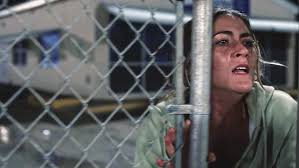
“Orphan” alumna Isabelle Fuhrman plays Laurie, a 20something saddled with the family business after her parents died and ready to learn the hard way that she’s the only dependable Gen Z employee she knows. Her big vacation to see her beau (Anirudh Pisharody) is derailed by an underling who bails on taking her shifts from her.

And wouldn’t you know it, that’s the rainy night in Florida when somebody stashes a body in “Unit 234,” one that might wakeup from the hospital gurney it’s handcuffed to.

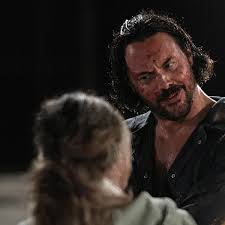
A prologue introduced us to blood-in-his-hanky sick rich guy (Don Johnson) who wants that body or person or what’s in that body or person. He rides around in a chauffeured G-Wagon and has minions who will shoot other minions for him if he doesn’t get what he wants.

Showing up at Schuyler’s Self-Storage after dark without a key runs him afoul of Laurie’s “procedures” and rules. So cold-blooded Jules’ henchmen will have to do this the hard way.

As she opens the unit herself and finds a guy still wired up to med fluids and such, who wakes up blabbering about “organ harvesting,” she has words for her foes when she and Jules cross paths again.

“You people are going straight to HELL!”

Jules? “Yeah, I think I’m OK with that.”

A harrowing night of using what’s in the other units to fight back or get away or at least get out the word about their peril ensues. Yes, “storage units are like a box of chocolates.”

Laurie learns the mistake of waking a sleeping-on-the-job Florida sheriff’s deputy and expecting help.

Director Andy Tennant — “Hitch” and “Fool’s Gold” were also his — isn’t known for thrillers. And that shows in the picture’s slack pacing. A bit of speed might have rushed the viewer past all the “Wait, in what alternate reality does this shooting/reaction/behavior make sense?” moments.

But the cast is game, with Huston properly frantic, Johnson oozing menace and Fuhrman dialing up the pluck and self-preservation savvy in her role.

It’s not their fault “Unit 234” turns out to be a blood-stained episode of “Storage Wars.”

Rating: 16+, bloody violence, profanity

Cast: Isabelle Fuhrman, Don Johnson, Jack Huston, Christopher James Baker and Anirudh Pisharody

Credits: Directed by Andy Tennant, scripted by Derek Steiner. A Brainstorm Media release on Amazon Prime.

Running time: 1:28

Posted in Reviews, previews, profiles and movie news | Tagged , , , , , | Comments Off on Movie Review: Don Johnson REALLY wants what’s in storage “Unit 234”

Movie Preview: Our End Times Savior Might be Tom Cruise? “Digger”

Well, he saved the cinema, almost single-handedly, after the first COVID wave passed.

Riz Ahmed, John Goodman, Emma D’Arcy and Aoife Hinds, daughter of Ciaran Hinds, also star in this Alejandro G. Iñárritu thriller.

“28 Years Later” meets “Tropic Thunder: vibe to the trailer.

Oct. 26?

Posted in Reviews, previews, profiles and movie news | Comments Off on Movie Preview: Our End Times Savior Might be Tom Cruise? “Digger”

Documentary Review: An Environmental/Farm Economy Parable from Macedonia — “The Tale of Silyan”

An ancient parable is remembered and acted-out in modern day Macedonia in “The Tale of Silyan,” the latest documentary from the director of the Oscar-nominated “Honeyland.”

Writer-director Tamara Kotesvka documents the collapse of her country’s small farm economy and sees its parallels to the folk tale of a son, Silyan, who wants to leave his father’s farm and see the world only to be “cursed” by the father and turned into a stork.

Silyan doesn’t really fit in with the migrating storks. And his father no longer recognizes him. So they face their future separated, lonely and mourning what they once had.

Farmer Nikola Conev has been on the family land all of his 60 years. He and wife Jana plant and cultivate melons, potatoes, corn and grapes, and their daughter, her husband and children pitch in to help with the harvest.

But prices collapse and the younger generation migrates to Germany where they can only find low-paying jobs that barely cover the cost of their childcare. So Jana moves there to help.

Nikola and many of his peers meet and console each other, as many are in exactly the same boat. Their entire families have left. All that remains for them is protesting their plight with tractor parades and public crop dumping. “Giving up” could mean selling their land and moving abroad, staying on it until the money runs out, or suicide.

Nikola video calls his wife and tries to maintain ties. He takes a job running bulldozers and tractors at the local dump. He takes in an injured stork there and tries to nurse it to health.

And he broods over a son we never see, one like the son in the parable, a child he hasn’t talked to in years. He could be that injured stork, for all he knows.

As she demonstrated with her quiet, contemplative and mournful story of an old lady beekeeper in the mountains, Kotesvska is the very embodiment of the “patient” documentary filmmaker.

You can use words like “acted-out” and “story” in describing her films as she follows and films and waits and blends into this world, figuring out the narrative as it reveals itself to her.

We stop wondering if this reality we’re seeing is “performed” as we follow the still-playful-together couple into the fields, flirting and teasing, and we join Nikola with an even older and lonelier friend who’s just bought a metal detector which they take to all the empty houses in their village.

Did somebody bury gold in the walls? They’re that desperate and that delusional.

But this family left their house long ago, that farmer hung himself right here, etc.

Kotevska weaves the human story into the extensive footage of Europe’s omnipresent storks. They swoop down on newly-plowed fields for worms and grubs. And when field after field goes fallow, they follow “the sound of the tractors” of Nikola and fellow farmers to the dump where they now work.

Many storks die in the plastic-littered garbage. But one Nikola makes it his business to save.

It’s a beautiful film, equal parts sentimental and bluntly realistic. Like “Honeyland,” what Kotevska is capturing is a vanishing way of it.

If there’s hope to either film, it might very well be futile. But if the parable of the stork son and his father farmer can work out, why can’t modern day Macedonians find a resolution that brings balance, purpose and a future for the farmers and the storks who watch, follow and depend on them?

Rating: TV-PG

Cast: Nikola and Jana Conev

Credits: Scripted and directed by Tamara Kotevska. A National Geographic release premiering on Disney+ and Hulu.

Running time: 1:19

Posted in Reviews, previews, profiles and movie news | Tagged , , , , , , | Comments Off on Documentary Review: An Environmental/Farm Economy Parable from Macedonia — “The Tale of Silyan”

Movie Preview: A South Asian “Hamlet” set in Modern London

Riz Ahmed stars in this new re-imagining of “Hamlet,” with royal Danish intrigues replaced by South Asian familial strife.

We’ve had mob “Macbeths” and Samurai “Lears” and Sydney Sweeney/Glen Powell “Much Ados.” “Tempest” has journeyed to “Forbidden Planet,” and on and on it goes.

That Bard gets around. This looks intriguing.

Posted in Reviews, previews, profiles and movie news | Comments Off on Movie Preview: A South Asian “Hamlet” set in Modern London