
It came as a surprise for me, and probably shouldn’t have, that Alfred Hitchcock’s transition to sound from silent cinema took more than a film or two and more than a year or two.
Hitchcock was half a dozen films into the talkies era when he turned the Dale Collins novel “Rich and Strange” into a darkly comic hobnobbing-with-the-swells travelogue back in 1931.
Taking its title from a phrase from the “Full Fathom Five” verse from “Ariel’s Song” in Shakespeare’s “The Tempest,” retitled nonsensically to “East of Shanghai” for American consumption — the entire tale takes place west of Shanghai — it’s “silent” enough to make one think one is sitting down to a late Hitchcock pre-talkie comedy.
The opening scenes of London office job drudgery, sight gags on “the tube” and bowler-hatted proles marching and popping umbrellas open in synchronicity in long takes speed-adjusted to match the jaunty syncopated music, are dialogue free.
Even after the talking starts, the picture is littered with pointless, redundant silent-era intertitles, as if Hitch was anxious to give his title-writer wife Alma Reville the work.
“To Get to Paris You Must Cross the Channel.” “To Get to the Folies Bergère You Must Cross Paris.” “And to Get to Your Room you must Cross the Hotel Lounge.”
Those three knee-slappers are followed by the odd title that serves some function — a passenger liner arrives in “Port Said.” But many others tell us who’s in the scene that we can obviously see for ourselves — “Fred.” “The Princess.” — or other information (“Later.”) we can figure out for ourselves. This goes on ad nauseum.
Those silent cinema touches give the film a stodgy feel and slow what could have been an 80 minute skip to a crawl.
Still, there’s a dash of “pre-code” profanity sprinkled in a plot that sees a working middle class couple stray from one another as they take a first class trip to Europe, the Middle East and the Far East (Singapore). The cheating is sophisticated, genteel and even a tad racy.
And the light tone carries this comedy from London to Paris, Marseilles to shipboard, Port Said and Singapore, with even the Keatonesque third act shipwreck doing Hitchock and his reputation for seeing “funny” in many a situation proud.
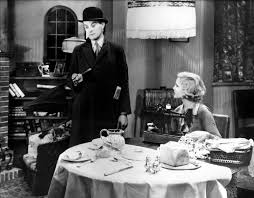
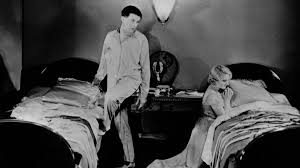
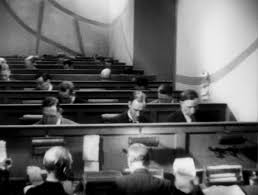
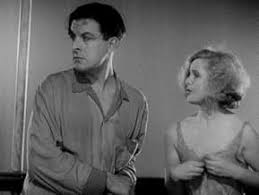
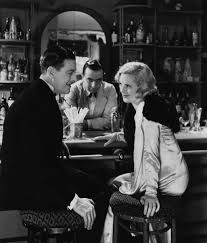
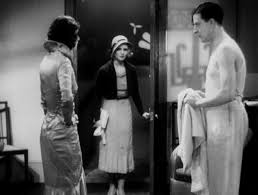
Henry Kendall is Fred, a “cubicle drone” in those long ago days before cubicles. He’s bored by his clock-watching job, dulled to the experience of the trek home and given to the odd “Damn” over “the pictures, the wireless (radio entertainment) and the office” and the limitations of their lives.
They have a housekeeper, because they aren’t farmers, after all. But wife Emily (Joan Barry) has to sew her own dresses, dammit.
“I want some life,” Fred whines, “some of the GOD things in life — money,” and the travel and comfort that comes with it.
A perfectly-timed letter from a rich uncle is their salvation, or so they think. They’ll have money to quit their London lives and travel the world, hitting the most famous nightspots, seeing glimpses of France, the Middle East and Asia in the bargain.
It’s a tad limited for a “grand tour,” And it takes no time at all for Fred to dismiss Em’s notion of going ashore to see and take snapshots of the Arab world of Port Said as “You don’t want to look like a tourist.“
That’s Fred, spoiling all her fun. Em? She’s shocked SHOCKED at the attire of the dancing girls of the 1930s Folies Bergère.
“Oh my GOD! The curtain’s gone up too soon! They’re NOT DRESSED!”
But on the luxury liner from Marseilles to Singapore, Fred gets seasick and stays seasick. That puts Em in the company of the dashing Commander Gordon (Percy Marmont). And when Fred finally gets over the queasiness, there’s nothing for it but for him to tumble for the exotic charms of The Princess (Betty Amann).
One and all would rather couple-up and sneak off for assignations than endure the company of the chatty bore, the “gossip lady” Miss Emory (Elsie Randolph, a walking, chatting sight gag as comic relief).
The “money can’t buy you happiness/contentment” messaging isn’t subtle, but isn’t hammered home, either. Our heroine and hero aren’t presented as rubes out of their depth but as innocents abroad, tempted to dally in the infidelities of the upper classes.
There’s the odd chuckle from this situation or that bit of Miss Emory shtick — racist gags about shouting at Asian cabin boys and Chinese dining on a kitty cat and the like, too. But knowing Hitchcock’s growing reputation, even then, as a “master of suspense,” one is inclined to see a lot more foreshadowing in the shots of lifeboats, the turbulent water of the ship’s wake and wash and the like than there actually is.
There’ll be no murder/”man overboard” on this voyage “East (not really) of Shanghai.”
Kendall makes a fine fop, helped accidentally by heavy painted-on stage-actor makeup. There’s fun in the mangled English of The Princess and in Miss Emory’s pushy/needy chatter.
Barry, an early example of the classic “Hitchcock blonde,” walks off with the picture as a woman with agency, intellectual and emotional intelligence that Fred’s patronizing “good little women like you” misses.
One of the great screen beauties of her day, Barry showed promise right up to the moment — just two years later — when she married into inherited money and “retired” from the screen. She’d dubbed a Czech actress’s lines for Hitchcock’s “Blackmail” and one could imagine the future Sir Alfred finding other roles for her. But Hitchcock’s most beautiful blondes almost always let him down.
The movie which Barry — not to be confused with the American actress who filed a paternity suit against Charlie Chaplin — is most famous for remains a curio most often sought out by Hitchcock completists, who will see hints of the style, shooting and editing flair and wit that became his trademark in this early work.
It wasn’t until Hitch turned his taste for comedy into an element of his thrillers — the sunny (“North by Northwest”) and the dark (“Vertigo,” “The Birds”) — that The Master of Suspense figured out the best way to have the last laugh.

Rating: “approved,” TV-PG
Cast: Henry Kendall, Joan Barry, Percy Marmont, Betty Amann and Elsie Randolph.
Credits: Directed by Alfred Hitchcock, scripted by Hitchcock, Alma Reville and Val Valentine. A British International release on Tubi, other streamers.
Running time: 1:25


 Movie Nation