
Hogwarts it ain’t. Kind of a giddy trailer, eh wot?
Hogwarts it ain’t. Kind of a giddy trailer, eh wot?

The triumph of “Crazy Rich Asians” is the spectrum of its characters, a broad representation of the global Chinese diaspora.
Granted, these are the Asian “one percent” we’re talking about here, but you have old money nobility, sage elders, gauche goofballs and party animal vulgarians. Pettiness and kindness, enduring marriages and infidelity, class snobbery and academic achievement are represented.
There are cliches and stereotypes, but the film’s broad collection of “types” transcends that.
That’s why you see the words “representation” and “inclusion” in most reviews of this Jon M. Chu (“Jem and the Holograms”) film of Kevin Kwan’s novel, the first of a trilogy.
The movie? Well, you’ve seen the trailer, right? It is exactly as sold, as aspirational and acquisitive as “Keeping Up with the Kardashians,” as surprising as a McDonald’s menu.
They’re utterly Westernized Chinese — British or American educated, speaking American, Australian and British accented English — insanely rich families with ties to Taiwan, Hong Kong, Shanghai, all around the Pacific Rim.
Their clothes are the latest fashions from Milan, Paris and (for the tacky) Vegas, their music consists of Chinese covers of jazz and pop standards and Madonna classics. “Material Girl?” You guessed it.
And the story they’re stuck in? A weary “she’s not good enough for my crazy-rich son” tale of class consciousness, with an all-Chinese cast of characters. It has hints of the high-tone gloss of Tyler Perry’s melodramas among Atlanta’s African American elite and the outsider-looking-in cultural divide of “My Big Fat Greek Wedding” (OK, “Greek Wedding 2,” as in less funny).
Constance Wu stars as Rachel Chu, an economics professor at NYU. She’s dating this hunk, Nick Young (Henry Golding) and he’s invited her to his cousin’s wedding back in Singapore. He’s to be the best man, he tells her.
What he hasn’t told her is that they’re flying first class in one of those trans-Pacific luxury airliners, that his family’s “comfortable,” “which is exactly what somebody super-rich would say!”
OK, so a professor at an elite American university in New York has dated a guy for a year and never “googled” a notoriously “eligible” heir to Singapore’s richest developers. Riiiight.
The world Nick inhabits is insular enough that he’s been noticed, dining out with Rachel, by the diaspora’s speed-of-light social gossip network. Nick’s mother (an imperious, regal Michelle Yeoh) knows he’s bringing this “nobody” home to meet her before Nick can break the news.
Rachel? She has no idea what she’s in for.
“His parents can’t NOT like me, right?” she asks her widowed mom.
The fangs are out and the judgmental gossips span the generations as Singapore’s Chinese rich prep to take on this “golddigger.”
At least Rachel can catch up with her college pal, Peik Lin, played by the always-more-amusing-than-she-was-in-“Ocean’s 8” B-girl, Awkwafina. Meeting her and her new money/tacky “Donald Trump’s bathroom” decor-obsessed family is when “Asians” finally finds some laughs.
Because Peik Lin (Is “Pigpen” her Americanized nickname?) is sassy, slangy, all “banana” jokes — “Yellow on the outside, WHITE on the inside.”
And comic Ken Jeong plays her dad, over-the-top, pretending to only speak Pidgin English, force-feeding his plump family (and their guest) at dinner.
“Eat up! There’s a lot of children starving in America!”
They’re the life of this somewhat leisurely stroll through Asian affluence. They explain this world to Rachel, the rigid hierarchy, the supercars, the absurdly pricey fashions, with Peik Lin putting Rachel through the obligatory “makeover” scenes (“Pretty Woman”), the Young family’s “rainbow-striped” cousin (Nico Santos, a campy stitch) advising her about handling Nick’s Dragon Lady/Tiger Mom and virtually nobody coming right out and saying “She’s not good enough for him,” but a whole series of cliques coming to that very conclusion.

A secondary story, about Nick’s married-below-her-station fashion icon sister (Gemma Chan) has her spending millions on earrings and hiding them from her ex-military “entrepreneur” husband, who is bothered by the money. In the “Crazy Rich” value system projected here, he of course is in the wrong.
The only “crazy” stuff here consists of bachelorrette party shopping sprees — “Nobody likes free stuff more than rich people” — and a bachelor blast that is as excessive as the “Gangnam Style” groomsman (Jimmy O. Yang, funny) who throws it.
But there’s more product placement than laughs. Kwan’s novel presents a too-conventional-to-be-interesting story, one with very limited comic horizons. Netflix Ang Lee’s “The Wedding Banquet,” about a dutiful Chinese son who hides his homosexuality behind a fake “wife” he brings home to Taiwan. I’m not saying that’s the way this should have played out, but “Crazy” could use some edge, some real culture-shaking/culture clash conflict.
The world depicted, and the entire enterprise, despite some warm moments in the third act, is smug and self-satisfied in an off-putting way.
It begins with a get-even moment Nick’s mom had years ago at an exclusive London hotel, which in a racist harrumph refuses to honor her reservation. In 1995? Racism is real and the Brits invented most of the world’s racial slurs, but that grates and feels a decade or two off.
And the “only our kind” snobbery of the rich for the less accomplished Chinese doesn’t completely gloss over the monoculture we’re seeing, a reminder that sociologists place the Chinese (and Japanese) as among the world’s most racially exclusive (“racist”) cultures.
The leads are pleasantly bland, but Yeoh never lets Eleanor, Nick’s mom, descend into cartoon villainy. And the giggles provided by the supporting players help.
But “Crazy Rich Asians” puts its emphasis on “Crazy Rich,” and “Asians,” when a little more “Crazy” would get us through its glitzy two hours with less tedium and more wit.

MPAA Rating: PG-13 for some suggestive content and language
Cast: Constance Wu, Michelle Yeoh, Henry Golding, Awkwafina, Ken Jeong, Gemma Chan, Chris Pang
Credits:Directed by Jon M Chu, script by Peter Chiarelli, Adele Lim, based on the Kevin Kwan novel. A Warner Brothers release.
Running time: 2:00
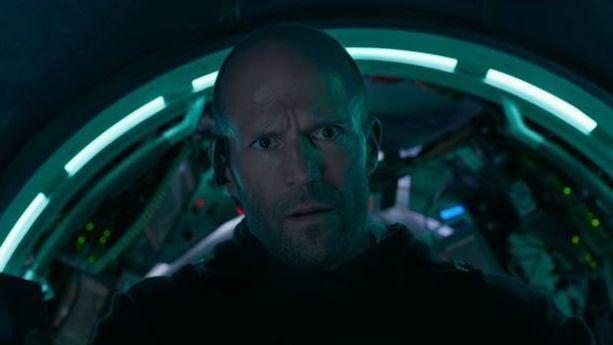
The giant prehistoric shark thriller “The Meg” opens to indifferent reviews, and middling box office expectations.
A $23 million opening for a reported $150 million film won’t please the accountants, but the Chinese investment, co-stars and setting suggest that’s where the box office expectations lie.
Reviews aren’t helping. With popcorn pics, they don’t dampen fan enthusiasm for a picture people are dying to see, but in this case — a 45 at Metacritic and a whopping 50 at the broader sample (less exclusive, greener reviewers allowed in) Rottentomatoes won’t convince an indifferent audience to change its mind.
That will make for a neck and neck race at the box office with “Mission: Impossible–Fallout,” one of the best MI movies and something of a late summer phenomenon. It heads into the weekend closing in on $150, and should end it around $170-175 million 17 days after release.
The best reviewed new film of the weekend is “BlackKklansman,” a return to funny, politically/socially relevant form for Spike Lee (with a producing assist from Jordan Peele). It could catch fire, but nobody sees any evidence of that at this point. An $11 million weekend is projected. It’s good enough to make money on into September, if audiences find it.
“Slender Man” isn’t awful, just an attempt to substitute style for scares in a horror film that doesn’t come off. It’ll still flirt with $10 million this weekend, according to Box Office Mojo.
Will Disney’s “Christopher Robin” overperform an expected 50% drop at the box office on its second weekend and manage over $13 million? Doubtful.

A pre-fabricated urban legend comes to the big screen in “Slender Man,” essentially a random mash-up of horror film tropes and effects that doesn’t amount to much that’s frightening.
Director Sylvain White, of “Stomp the Yard” and a lot of episodic TV in the many years since, hurls fish-eye lenses, hand-held shaky cameras, tracking zooms (in homage to Spike Lee), all sorts of in-camera effects to simulate how crazy teenage girls go after they’ve summoned Slender Man.
The monster, an Internet creation of the child-snatching variety, is a faceless version of Lurch, the butler for The Addams Family — wraith-thin, faceless, inexplicably wearing a white shirt and tie.
He’s the ghost of a Reservoir Dog or one of the Men in Black? In any event, he’s better in fleeting glimpses than in close-up.
The movie mimics what’s allegedly been dominating teen and tween slumber parties the past decade, girls hearing or reading about the legend, finding online help in “summoning” the demon, and (in the movie at least) suffering the consequences.
“Guys, we SO have to do this.”
Four BFFs (Joey King, Julia Goldani Telles, Jaz Sinclair, Annalise Basso) , essentially egged on by a quartet of boys who say this is what they’re trying this weekend, watch the online video (Shades of “The Ring”), hear the bells toll and start having nightmares.
“What did you see?”
What did YOU see?”
The thing is, you SEE the Slender Man — often glimpsed in the background, in foggy woods, glimpsed in “Bigfoot” style online videos — and he’s got you.
“Some are haunted, some go mad and some he takes.”
A week later, one of their number disappears on a school trip.
You can guess the order the girls will have their Slender moment of truth by the stereotypical casting here — brunette, brownette, African American and redhead.
The kids frantically do online “homework” to figure out how to retrieve the missing friend, and that just gets them in deeper. Warn a boyfriend or younger sister “Do NOT watch the video,” and they do what teenagers do.
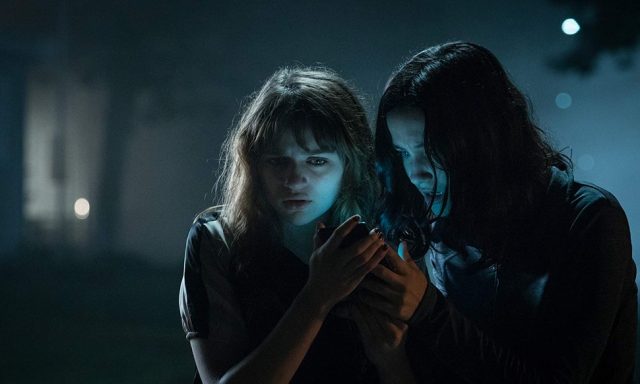
It’s not laughably off, and give White credit for the picture’s fairly eerie tone and look — darkened streets, foggy forests of spindly pines, shadows and more shadows. It’s just not worth more than the occasional hair-raising instant.
But here’s something that “Slender Man” gets right — casting Joey King of “The Conjuring,” Netflix’s “The Kissing Booth” and “White House Down” as Wren, the punk/Goth girl in the quartet. King sells the pants-wetting terror of facing supernatural doom better than anybody else in this movie, or most of the horror movies since A Quiet Place.”
If everybody else had faked being scared as perfectly as Ms. King, maybe we’d be scared, too.

MPAA Rating: PG-13 for disturbing images, sequences of terror, thematic elements and language including some crude sexual references
Cast: Joey King, Julia Goldani Telles, Jaz Sinclair, Annalise Basso
Credits:Directed by Sylvain White, script by David Birke . A Screen Gems release.
Running time: 1:33
Looks as if this one only previewed in NYC, so I guess I’m ducking into my favorite multiplex tonight to see every teenage girl’s nightmare — “Slender Man.”
You see that title, and the name of that star (Gael Garcia Bernal also stars), and you think, “Uh oh. Trouble in Kindergarten.”
Look for “The Kindergarten Teacher” to start streaming Oct. 12.

“Perdida” is sort of an Argentinian Girl with the Mermaid Tattoo,” a human trafficking thriller built around a compelling lead performance by Luisana Lopilato.
It begins promisingly, features striking Patagonian and Canary Islands locations and some brutal brawl for your life fights. But no mystery thriller you can figure out before the midway point can claim total success, no action pic that saves the heroine from certain death with the devices this one uses can cling to believability.
“Perdida” opens with a fruitless search party in the Patagonian snow. A teenage girl has gone missing.
Fourteen years later one of the other girls from that class field trip to a volcano is now the fiercest cop on the human trafficking beat. Pipa is now going by her given name, Manuela (Lopilato). We meet her as she stalks a guy, climbs through a window into his house, saves a newly-trapped teen and beats the living Infierno out of the kidnapper.
“You can’t save them all,” (in Spanish, with English subtitles, or dubbed) her boss (Rafael Spregelburd) grouses. Being a cop who breaks rules, busts heads and gets her man, Manuela doesn’t hear him.
The case that derailed her life and then redirected it comes back into play at the memorial mass for the missing girl. Somebody placed a “How’d they get that?” photo of her as she was back then, in the church. Somebody has been publishing touching obituaries. Manuela is guilted by mother of the “perdida” (lost girl) into reopening the case.
Over her boss’s objections, of course.
There is a third timeline the viewer is privy to, ill-used prostitutes about to be buried in a banana plantation in the Canary Islands. The one with the mermaid tattoo talks herself out of being murdered.
As Manuela starts asking questions, starts employing her junkie/hacker buddy (Oriana Sabatini) and trying to figure out two faces she didn’t know at this memorial (a feral Amaia Salamanca and a brutish Carlos Alcántara).
The friends that were on that trip with her are no help, “Cornelia got lost. A puma ate her. She died.” That’s that. They’ve moved on.
But the mystery couple, given to violence and answering to a monstrous overlord known only as “The Eyptian,” are getting worried. Because The Egyptian (Pedro Casablanc) is starting to sweat about what Manuela knows and what she might find out.
“A woman’s secrets and lies are more important than her own life,” he declares.
Co-writer/director Alejandro Montiel is still best-known for the behind-the-scenes musical “Eight Weeks” in North America, but there are a couple of badly-reviewed thrillers also on his Argentinian resume.
Working from a Florencia Etcheves novel, he juggles first two timelines, then three and then adds a fourth, stripping the mysterious out of this mystery, explaining how Pipa grew up to be Manuela, a fury in cargo pants, and showing all his cards entirely too soon.
Lopilato under-reacts, here and there, but for a slip of a thing, she packs a fierce punch. She’s got her hands on a fascinating character and she gives Manuela pathos, toughness and a temper.
More’s the pity that the mystery she’s struggling to solve is given away, pretty much, by the script and direction that tends toward the melodramatic, long before the closing credits.

MPAA Rating: TV-MA
Cast: Luisana Lopilato, Amaia Salamanca, Carlos Alcántara, Rafael Spregelburd
Credits:Directed by Alejandro Montiel , script by Jorge Maestro, Mili Roque Pitt and Alejandro Montiel, based on the novel by Florencia Etcheves. A Bowfinger/Netflix release.
Running time: 1:43


You may not know the name, but you know the face of Robert Davi, a veteran heavy, a big screen fixture for decades playing mob bosses, made men, Bond villains and the occasional cop, soldier or Fed.
“I’ve had to live with this face,” he shrugs. “I look like, you know, a thug.” And he’s more or less accepted that.
But one of those villains — Jake in “The Goonies” — gives away Davi’s true passion, singing a little opera in between threats and violence. That was the Astoria, Queens native’s first love.
And as the decades of making bad guy money have progressed, he’s been able to buy a nice house, raise a family and finally indulge in that original passion, touring with an orchestra, performing the music of his idol, Frank Sinatra.
“Davi’s Way” is a documentary about Davi’s grandiose plans to celebrate Sinatra’s 100th birthday, to replicate a signature concert in Sinatra’s career, the 1974 “Main Event” at New York’s Madison Square Garden. The Chairman of the Board made history with this defining late-career solo show, singing from a boxing ring, “punching” his way back to prominence, one more time.
And if, like most people, you don’t know the name “Robert Davi,” you can see where this might be a problem. “Davi’s Way” director Tom Donahue (the vet-healthcare expose “Thank You For Your Service” was his) captures the humble character actor’s descent into delusional diva-hood in this warts-and-all, laugh-until-you-cringe documentary.
Davi has this dream, and he approaches a friend “Danny A.” with some concert promotion connections. He hires an aspiring actor “Stevie” as his overwhelmed personal assistant. And away we go — a year of tantrums, shrinking expectations, endless promotion, petty indignities and “tough love” to the daughter, Ariana, who wants to be a singer/actress and wants Dad’s help getting a start in the business.
Davi has the chops and stage presence to manage a more than passable late-career Sinatra, and no less than Quincy Jones sings his praises in the film.
But man, what a tool. At times it’s as if he’s playing a tool, a self-important star who bullies and insults that assistant, the film crew — “I don’t want bad-guy lighting. FILTERS!” — makes his daughter cry and annoys the hell out of promoters, would-be show producers and venue operators.
He doesn’t like being told that doing Sinatra is “not just about putting on a hat.” And he REALLY doesn’t like it if he’s wearing a hat and sunglasses and anybody else in the room is wearing the same. Especially that hapless assistant.
He tosses names around as possible Sinatra-fan “co-stars” on his night. “Busta Rhymes? Know any females? LOR-day?”
The assistant, working his few showbiz connections, chuckles at having to ask if “Jay Z” or Timberlake are available.
That list descends into Gene Simmons and Kid Rock territory quickly — you know, Davi’s “Fox and Friends” fellow guest conservative celebrities (Davi just finished a “Roe vs. Wade” movie that FoxWorld eagerly awaits).
Davi wants Madison Square Garden, but just to reserve a date would cost $50,000. “Nassau Coliseum,” he counters. “How about these twin skating rinks?” the Nassau Coliseum guy offers back.
And on it goes, a year of shrinking horizons and impossible demands. He recreates Sinatra album cover photos (getting out of a chopper), hears from the most famous casting director in Hollywood history (Lynn Stalmaster) where he went wrong in his career, and then gets on with it.

Davi, an Actor’s Studio-trained heavy, tenderly relates the story of how he got a part in a late Sinatra thriller, “Contract on Cherry Street,” his “big break,” and how he got to hang out with his fellow Italian American, known for his generosity as well as his mile-wide mean streak.
Which kind of makes you wonder how much of this meanness is just for the cameras, an act. I mean, he’s nice to Joe Mantegna, Chazz Palmineri, Robin Leach and others he needs favors from. Then we see him in concert and catch improvised stage patter that crosses the line into cruel and we figure “Oh, he learned the bad stuff from Ol’Blue Eyes, too.”
But still we laugh, at the hat thing, at the passable crooner-impersonator who thinks he’s on a par with the real deal and at the endless refusals to compromise even as he’s compromising, right up to a concert that doesn’t go perfectly but closes in on “debacle” thanks to his on-stage blunders and reactions to imperfection.
You’ve got to give a tip of the — you guessed it — “hat” to Donahue for showing the guy pretty much as he is, a big screen tough guy with a hilariously fragile ego, in the end a classic “Hollywood type,” starring Robert Davi as himself.

MPAA Rating: Unrated, profanity
Cast: Robert Davi, Danny A. Abeckaser, Ariana Davi, Quincy Jones, Deana Martin, Joe Mantegna, Chazz Palminteri, Robin Leach, Lynn Stalmaster
Credits:Directed by Tom Donahue. A 2B release.
Running time: 1:22
I cannot tell what role Arielle Kebbel has in this indie romantic fantasy. Sure, she’s the worldly, sympathetic bartender commiserating with the Big Business Go Gettter/Hunk (Justin Hartley) who figures time travel is the best way to “get the girl of his dreams” who is already with somebody else.
I’m assuming the romantic object of desire is Hartley’s actress/wife Chrishell Hartley.
But the billing (“and Arielle Kebbel”) and punch line of the trailer suggests Ms. Right is Winter Park, Florida’s own AK.
There’s no firm release date for “Another Time,” but there’s enough here to gin up curiosity.
A bit English, a little Terry Gilliam, a lot Tim Burton (Lasse Hallestrom and Joe Johnston are credited as co-directors), two Oscar winners in the cast, No Doubt music adapted for a “Nutcracker” updating/revisionist take.
Pretty.
Could be a magical sleeper hit, or a colossal miscalculation. “The Nutcracker and the Four Realms” opens Nov. 2.

 Movie Nation