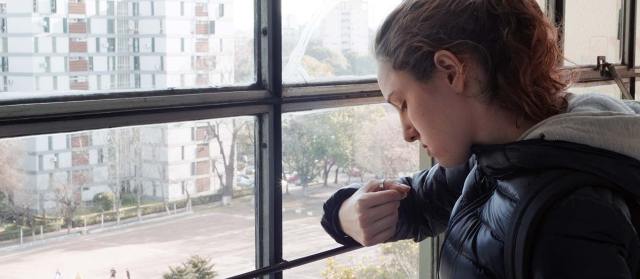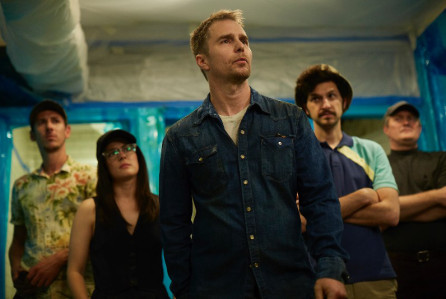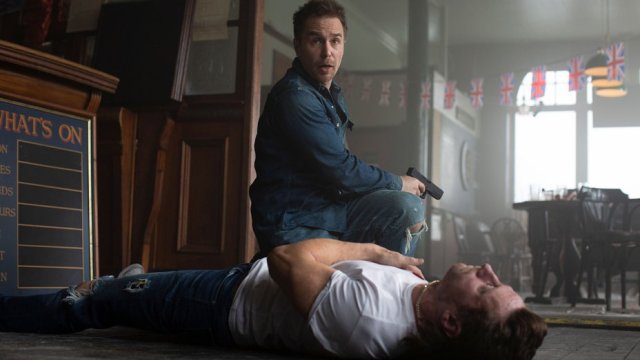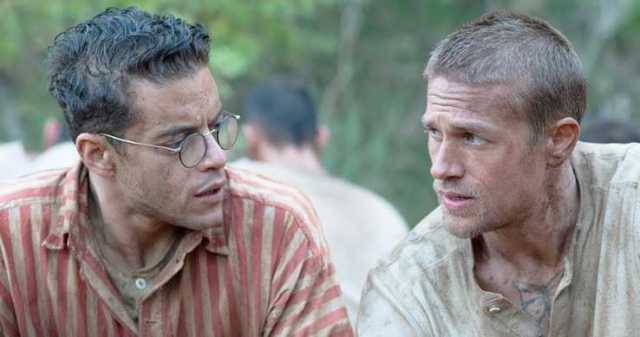
The casting’s a tad unconventional — Steve Coogan and John C. Reilly as Laurel & Hardy?
But OK. Reilly the great dons the padding and Coogan loses a little weight and takes on the light, thin voice of Stan.
The setting — a farewell tour for the legendary and at this time estranged silent comics, with Ollie in failing health and Stan having moved on from their partnership.
Maybe it didn’t live up to the Oscar bait potential Sony Pictures Classics saw in it. I’ve still been dying to see this. “Stan & Ollie” rolls out wide Jan. 25.
Let us descend then, a stranger in a strange land checking in on the anime wonder that is “Dragon Ball Super: Broly.”
I am not a devotee, so I must approach this, the 20th anime film based on “Dragon Ball,” following multiple manga (Japanese comic books, often translated into English, where they sell quite well) iterations and more than one TV series that preceded the movies, as a non cult-member looking to be converted.
But that’s a fair approach, as movies, even those pandering to a very narrow audience, still have to stand alone.
I didn’t find this latest variation on the “Broly” semi-sympathetic villain origin story hard to follow. But what confronts you when talking about movies like “Dragon Ball Super: Broly” is the gap between what hardcore fans expect and thus want from this, and what anybody who loves the medium of film and has an appreciation of narratives told with anime might reasonably expect it to deliver.
That gap’s a chasm with “Broly,” probably the widest release “Dragon Ball” cartoon (in the US), and judging from the two thirds full midday matinee showing I saw, certain to do passable box office no matter what critics might say. And there’s not much to say in its favor.
If, like me, you are a stranger in this corner of the culture, I offer this fine five and a half minute nerdsplanation/crash course from IGN linked below. Wikipedia’s a little help, too.
As a character shouts (Lots of shouting here. The film is, after all, Japanese — with English dubbing.) at one point, “What in the name of the MULTIVERSE is going on?”
The “dragon balls” are magical talismans, briefly releasing a dragon able to grant the owner any wish.
That makes them the sort of thing a universal megalomaniac named Frieza, son of King Cold, might want. He has enslaved much of the universe via his minions, Saiya warriors.
Frieza, a shrimpy mincing pedant (Think “Niles” on the TV show “Frasier”) loves four things — dragon balls, harnessing more power for himself, watching other folks fight and showing off his superior intelligence and vocabulary amongst his inferiors.
“Tell me ONE thing. What’s REPUGNANT mean?”
The film begins with a prologue getting the audience up to speed on that back story, the transfer of power and covetousness from Cold to Frieza, of the intergalactic infancy of Broly, dragged by his father to a planetoid where he can be safe from infanticide and perhaps grow up to become “The Super,” this tale’s version of a Messiah or “Chosen One.”
Frieza is hellbent on turning Saiya against Saiya, and the grown-up Broly can help him stir up the testy Prince Vegeta, the doofus wiseacre Goku and others.
If you drop into any of the online forums or even Youtube samples of “Dragon Ball” tales and comments on them, you get the idea that fans come to this densely charactered/thinly-scripted “multiverse” mainly for the fights.
And the tropes.
“Dragon Ball Super” is both an origin story and a sort of re-boot. Broly has been in earlier tales, but as much as the other characters reference their “history,” his part in it has been excised to hit the never-ending story’s reset button.
The fights are animated in such a way as to be a series of dazzling, colorful pop art action poses — punches thrown that hurl this character through a whole range of mountains or cause that one to plow up an entire glacier. The freeze-frame analogy works because in this corner of anime, the pronounced jerky movement of a Hayao Miyazaki “Spirited Away” or “The Wind Rises” is exaggerated. It’s under-animated.
Visually the stills are fine, but the animation is made-for-TV-pre-HD era quality — junky, cheap, with sparkle and light added, here and there.
The characters are nonsenical, with endless variations of fantasy board, card or video game “new powers.” Nobody ever dies (at least not in this branch of the story).
Women and girls are all but invisible, here. And you think the West is patriarchical.
The jokes consist of drolleries by Frieza (again, Niles of “Frasier”) and little double-takes, familiar characters breaking from the narrow confines of their historical place within this universe. There’s a smidge of edge to the language — mild profanity — a hint of homophobia (mincing stereotypes) and a literal demonstration of that word “homo” and “phobia,” as two characters must engage in an effeminate dance to achieve “fusion” and fight the bad guy. It repulses them. But they do it.
Seeing this without being a veteran member of its devoted audience is like dropping in on any “Never Ending Story” and trying to catch up, or stepping into a cinema in a foreign country and watching the local product without a firm grasp of the language.
Fortunately, for all the detail — characters blurt out reams of exposition and backstory — there’s virtually no “story” here at all. So I started concentrating on this sea of young males (Maybe 1% of the audience was female — the ladies all have day jobs?), mostly white, were getting out of it. Obsession with anything — Scrabble, Rubik’s Cube, orchids (and orchid thieves) and “My Little Pony” can be fascinating to observe and dissect.
The whole pop culture subgenre here — supernaturalism, epic flying “fights,” unkillable heroes, struggles for universal domination with your fists and energy bolts flying out of them, has the whiff of “junk culture” about it. It plays as part of that genre — Marvel movies that are all about the CGI “fights,” “Transformers/Power Rangers/Pacific Rim” piffle.
“Dragon Ball” doesn’t pre-date American comics, but connect it to its Chinese origin novel as inspiration as it feels like the Ur Text of this sort of epic brawls across the cosmos fantasy.
Every now and then, one of those movies takes a stab at being “about something.” Not here. It’s instantly forgettable to anyone who isn’t a fanatic lost in the minutia of their corner of junk culture.
But if it’s what the fans want, take comfort in the fact that at least they’re not “Bronies.”
MPAA Rating: PG for prolonged frenetic sequences of action and violence, and for language
Voice Cast: Vic Mignogna, Sean Schemmel, Erica Lindbeck, Christopher Sabat
Credits: Directed by Tatsuya Nagamine, screenplay by Akira Toriyam. A Funimation/20th Century Fox release.
Today we dip our toes in the subculture of “Dragon Ball,” cult anime films with a supernatural bent that are — judging from Internet forums and Youtube collaters — valued for their drawn-animated “fights.”
I’ve channel surfed into at least one of the TV incarnations more than once, but dismissed it pretty quickly because of the animation quality. Pretty sure I caught an earlier “Dragon Ball Z” movie at one of the newspapers I used to work for.
Broly the blonde villain gets another movie in this manga turned TV shows turned 20 cult film series.
As the vast majority of people “reviewing” these films seem to be in the cult, let’s see if I can bring fresh eyes to the story, characters, dialogue (English dubbed) and animation. And not get death threats for so doing.
On first glance, Michael Franti seems so relentless upbeat he might make your teeth hurt.
But he’s no Pollyanna.
The singer-songwriter, with a battered guitar — Mama Brown — that Willie Nelson would admire, is an activist whose R & B/reggae-flavored songbook that transcends his rap origins, says he wakes up thinking “the world is completely” screwed, just like the rest of us.
“The battle taking place today is between cynicism and optimism…I feel it in myself.”
An Oakland native of German-Irish-African-America/Native-American heritage, adopted as a baby, raised by a Finnish American couple, he could be excused for taking a more morose, Scandinavian pessimism as the posture he shows the world.
But he doesn’t.
As front-man for Michael Franti & Spearhead, he makes “socially conscious politically charged rap, reggae and acoustic music.” And he makes pop you can sing along to, tunes that have turned up in video games, on movie soundtracks. He’s toured with the likes of John Mayer and Stevie Wonder and played at Barak Obama’s inauguration and Bonnaroo.
His biggest hit is the lethally infectious, sing-along “Say Hey I Love You.” ”
Still, with all that success and an eco-resort (Soulshine) in Bali, he has his bad days. He questions his purpose, like any of us.
But he has these touchstones, people he’s found inspiring when his life needed inspiration.
“Stay Human,” which takes its title from one of his albums, is a documentary that has him traveling and interviewing those inspirations, and singing once he gets there. And what feels like a 50something pop star’s vanity project becomes — Dare I say it? — touching, as we meet the Atlanta couple who don’t let the husband’s ALS break their love, the natural childbirth evangelist in Bali, the a bamboo booster in Indonesia and two young South Africans overcoming poverty via education, and making a new future for themselves.
Robin Lim instills Franti with her belief that natural childbirth can reinforce “a child’s capacity to love and trust.” As she pitches in after a Philippine hurricane, a country where a huge portion of the population is pregnant, she declares “I want to live in a planet populated by people who were born gently.”
Franti, in dreadlocks and tattoos, driving a Tesla, is a veritable poster boy for progressive good intentions. He shows us his knee surgery and recovery and introduces us to Steve and Hope Dezember, Atlanta fans he met just as the “ALS Ice Bucket Challenge” was sweeping the land.
But Hope was contacting Franti because “Steve was living the REAL ‘ALS Challenge.'” He wanted to see a Spearheads show before he died.
As Franti gains a “Live your life to the fullest” perspective from them, we see him recording the moving ballad “Nobody Cries Alone.”
Arief Rabik is a surfing environmentalist and bamboo evangelist who is helping communities in his corner of Indonesia battle global deforestation by turning fast-growing bamboo into wood pulp that can be turned into planks and boards.
Rabik preaches that sustainability begins with “socially, having stability, then economic stability. Ecological stability follows.”
South African students Busisiwe Vasi and Sive Asinyo grow up in Port Elizabeth Township so poor that they live in a shantytown where a shared hose is the area’s only available water. But Ubuntu School encourages Busisiwe to avoid desperare shortcuts that trip up her peers and start her own business selling chicken, eventually finding her way to college.
Sive focuses on getting into college, too, and lifting his family out of a shared tiny shack.
Their stories, collectively “remind you of what it means to be your best, as a human being,” Franti says, who pulls out a guitar and sings with kids and adults wherever he goes. “Don’t you give up on me, and I won’t give up on you,” he sings, and you don’t.
He asks good questions, doesn’t overwhelm the film with his own story and just oozes empathy and easygoing charm everywhere he goes.
Because he seems to fit in everywhere he goes.
“I want to make music that reminds me of the importance of the little things…that make us human,” he says. “Maybe our struggles are our greatest gifts. We are what we search for.”
It’s not a challenging documentary, and yes, “Stay Human” does have a touch of “write off my travels on my taxes/self-serving” promotion about it.
But heck, I’d vote for the guy. Or buy his “inspirational thoughts” calendar. I’m checking his tour schedule right after I hit “publish” here.
MPAA Rating: unrated, some profanity
Cast: Michael Franti & Spearhead, Robin Lim, Arief Rabik
Credits: Directed by Michael Franti. A Cinedigm release.
The best action pic you’re going to see this January isn’t on the big screen. Well, depending on the size of your TV, it could be.
It’s “Close,” a Netflix kidnapping thriller starring Noomi Rapace as an utter badass “close protection” operative — a bodyguard — who takes her work seriously and takes down villains by the score.
Rapace has worn a physical competence about her in action roles since the very beginning of her career. Unlike Linda Hamilton, Zoe Saldana or Sigourney Weaver, the one and only “Girl with the Dragon Tattoo” didn’t transform into a convincing kick-you-know-what and take names heroine. It’s been her brand from the get-go.
We meet “Sam,” her character in “Close” in a Middle East combat zone. The reporters she’s escorting are ambushed.
“SCREAM!” she yells at the woman (Olivia Jewson) trapped in the SUV with her.
Whimpering, “I, I, I...can’t!”
Sam smacks her. HARD. She screams. Damn right she does. The fact that the actress playing the reporter is the director’s sister just makes it Freudian and funny.
Sam may be combat competent, canny and cunning, but she chain smokes and drinks to fight off the shakes. She’s still wearing the cuts she got, shooting her way out of that mess, when she’s offered that next job.
“What happened to your face?”
“Work.”
A rich heiress (Sophie Nélisse of “The Book Thief” and “Mean Dreams”) needs protection on a trip from London to Morocco, where her just-died-father raised her. He’s left her his phosphate company, one he took over while married to his second wife (Indira Varma of “Game of Thrones” and “Exodus: Gods and Kings”). As her family started Hassine Mining, she’s not happy about that.
Their Chinese competitor also might have ideas about the new club-hopping majority stockholder. And then there’s the fact that however western Morocco seems, it’s still a country as easily accessible for terrorists and criminals as it was back when Rick was running the Cafe Americain in “Casablanca.”
Sam has just a single outing to prove she’s the world’s toughest wingwoman/c—blocker in a club — “Who do you think you are? My Mom?” — before they’re on a plane bound for the family “castle” in central Morocco (“Close” was filmed in and around Marrakesh and Casablanca).
“Welcome to my prison,” Zoe mutters. And when we see the hi-tech security systems there, we get it. Of course, Sam looks at all those cameras, those armored shutters that doors that seal when a threat is detected, and complains to the guy is charge (Akin Gazi) that there aren’t enough “boots on the ground.”
Later that night, she’s proven right.
Co-writer/director Vicky Jewson (a “Lady Godiva” film and “Born of War” are her major credits) cooks up some splendid precarious situations for Noomi the Badass to fight her way out of — starting with the breeched fortified house but including a dumpy hotel room, a crowded police van and eventually, the water-filled catch-tank of a Moroccan fishing boat.
The bad guys speak French and Arabic, and their plotting and threats are not translated. That’s always a smart play. We experience the unknown threat the way Sam does. Zoe? She grew up here. She speaks the languages.
The Swedish Rapace thrives in roles that call for action, toughness and vulnerability. She’s perfect in this part, where her forward motion and capacity for acting out violence drives the picture.
It’s not a particularly surprising thriller, but it is lean and bowstring-tight. And Rapace absolutely sells it as plausible and herself as just the badass you want in your corner when the villains sneer and the bullets fly.
MPAA Rating: unrated, violence smoking, profanity
Cast: Noomi Rapace, Indira Varma, Sophie Nélisse, Eoin Macken, Akin Gazi
Credits: Directed by Vicky Jewson, script by Vicky Jewson and Rupert Whitaker A Netflix release.
It’s unclear how much forethought M. Night Shyamalan gave to tying his “Unbreakable” anti-heroes to the multi-personality psychopath of “Split.” And asking him is pointless, because filmmakers lie.
But the upshot of “Glass” is that parking James McAvoy‘s “Horde” of characters benign and lethal, young and old, male, female or uncertain, into an “Unbreakable” sequel about men living under “the delusion” that they’re actual superheroes with actual superpower, just lets McAVoy vamp the picture away from everybody else.
Including the director.
Shyamalan abandons the direction his movie “might” have taken — a promising pursuit of the serial kidnapper/killer on the loose in Philly (McAvoy) by clairvoyant and super-strong vigilante in a poncho The Overseer (Bruce Willis) — for the story that comes after that.
“Glass” turns into a semi-serious dissection of comic book tropes, themes, story beats and traditions, and a seriously dull and sometimes silly psychoanalysis thriller set in an insecure insane asylum overseen by touchy-feely optimist Dr. Ellie Staple (Sarah Paulson).
She’s the specialist in the “delusion” that some people apparently have, that they have special powers, that there have always been supernatural people like themselves. She wants to explain that away — logically.
“Comic books are not history,” she reminds one and all.
When the Horde of personalities that began life as Kevin (McAvoy) and the home security expert turned vigilante Dunn (Willis) are nabbed in mid-brawl, she has three subjects to study. Because the troublesome guy with the brittle bones called “First name ‘Mister, last name ‘Glass'”( Samuel L. Jackson) has long been in custody, and seems to be catatonic.
Raven Hill Mental Hospital has given over a wing to these three, and Dr. Staple has just a couple of days to make progress with the trio and her own reseach. No, we don’t know what’ll happen after that. But considering Glass wiped out everybody on a train save for Dunn 19 years ago (when “Unbreakable” came out) and Kevin/The Horde has been kidhapping and mutilating young women — save for Casey (Anya Taylor-Joy) — it won’t be a slap on the wrist and “treatment.
One clever touch — the only thing that keeps Kevin/Hedwig/Patricia et al from turning into the monstrous mass of murderous muscle, able to climb walls and scamper across ceilings is a “hypnosis light.” It’s a strobe whose every flash disconnects whatever guise Kevin is in and prevents The Horde from slaughtering his way to freedom.
McAvoy gets to play an improv game, switching characters every time the strobe goes off — British or redneck, perpetually nine years old or perpetually their “queen bee,” Patricia.
Fans may check into this to see these characters revived, see the return of Dunn’s son (Spencer Treat Clark) or figure out how kidnap victim and sole survivor of a slaughter Casey could be so darned forgiving and sympathetic to at least one or two of Kevin’s less murderous characters.
But for too much of the two hours-plus running time of “Glass” is spent in grim and action-starved simplistic mind-games in the hospital, and a limp noodle of an anti-climax or two that pass for an ending.
The terror, tension, suspense and puzzle-solving of “Split” are abandoned for remedial movie back-engineering two stories into a third.
Willis and Jackson get by on presence and reputation, and Paulson — despite her delightful riffing on comic books and comic book fans who treat them as literature and holy texts — isn’t given enough to play.
Shyamalan compensates for dialogue and situation shortcomings by filming everybody in lots of full-screen close-ups. This is IMPORTANT, those say. Right. Paulson and Taylor-Joy get the best of these.
It all makes for a somber and self-serious (Shyamalan’s Achilles Heel) popcorn pic that is easy enough to sit through even as its pointlessness grows with every act, and its final act underlines and admits it.
MPAA Rating: PG-13 for violence including some bloody images, thematic elements, and language.
Cast: James McAvoy, Sarah Paulson, Samuel L. Jackson, Anya Taylor-Joy and Bruce Willis
Credits: Written and directed by M. Night Shyamalan. A Universal release.
This is the international trailer to Tom Holland’s latest turn as “Your friendly neighbhood Spider-Man.”
A villain returns, Mysterio (Jake Gyllenhaal) arrives, with Zendaya, Marisa, Samuel L. Cobie and Favreau reprising their roles within “The Universe.” Director Jon Watts returns from the first Holland webslinger movie.
“Far from Home,” not to be confused with “Homecoming” or whatever, opens July 5 and will dominate the second half of the summer. Guaranteed.