
Gemma Jones, Richard Madden and Bryce Dallas Howard also star in “Rocketman.”
The “Kingsman” star does his own singing, wears the high heels and oversized glasses. May 19 is when this “inspired by the true fantasy” comes out.
Gemma Jones, Richard Madden and Bryce Dallas Howard also star in “Rocketman.”
The “Kingsman” star does his own singing, wears the high heels and oversized glasses. May 19 is when this “inspired by the true fantasy” comes out.
The trailers have been dark and twisted, the cast impressive as all get out.
And if they’re previewing “Bad Times at the El Royale” two weeks in advance, they have to think they’ve got a winner on their hands, right?
Bridges and Dakota Johnson, Hamm and Hemsworth…It opens Oct. 12.
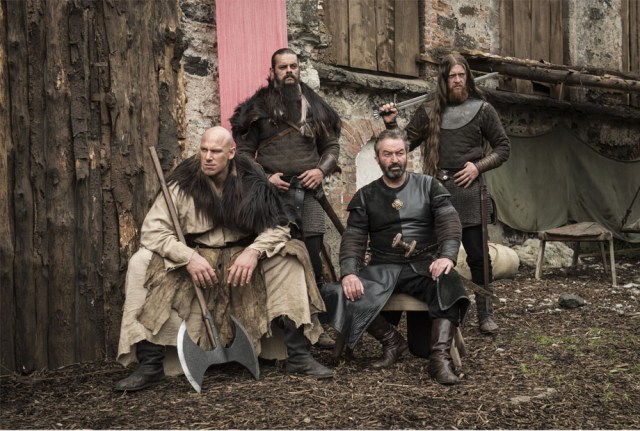
Just my luck, a Viking movie to review and fresh out of Spam. Bloody Vikings.
And while I’ll watch most anything with Vikings in it, “Viking Destiny” gives that brand loyalty a pretty severe test. A flagon of mead could help, even if Python’s Spam theory proves insupportable.
It’s a cut-rate “Excalibur” with the Norse God Odin and trickster Loki dueling for the consciences of assorted Vikings, who were not known to have consciences.
A Viking King (Andrew Whipp) is summoned to battle as his queen struggles with childbirth. “Go,” do the battle thing, save the Kingdom of Volsung.
But, as Odin (the great Terrence Stamp) narrates, it is “a curse for a child to be born with an absent father.” The Queen (Victoria Broom) dies in childbirth, and the king, even though he’s victorious, grieves and gives up his daughter, an unacceptable heir, to his treacherous half-brother (Timo Nieminen).
“Half Prince” Bard is “planting a seed that will take 20 years and one to bear fruit,” Odin intones. Odin tends to do that.
Odin shows up, now and then, to advise the girl who grows up to be Helle (Anna Demetriou), a fiery redhead trained in the martial arts, just like Merida, the princess of “Brave.”
But fair is fair, so Loki (Murray McArthur), his eyes and forehead covered in black, hisses evil ideas into Half Prince Bard’s ear.
Sure enough, Helle turns 21 and the treachery begins. Lured into a cave to kill the Kraken (“It’s not real,” she says, citing the scientific method), surviving assassination attempts, fleeing across the seas in (mostly digital) long ships.
She stumbles into Paul Freeman (“Raiders of the Lost Ark”) who leads a “Traveler” tribe of vegetarian hippies.
“Would you care to join us for turnips? Do not worry. We will not be eating the turnips.”
A drinking joke? This MUST be Ireland.
Odin sidles up and offers pep talks and the odd profundity.
“Rain does not fall on one roof alone…No matter how dark the forest, there is always a path through it.”
That Odin.
If this reads as if I’m not taking “Viking Destiny” seriously, it’s because I’m not.
Screen newcomer Demetriou is a striking presence in metallic red hair and leather, and she and her stunt team (not always obvious) handle fight choreography, including epic brawls with twin giants (Martyn Ford), well enoughl.

The Northern Irish locations are as lovely as they were when “Excalibur” and assorted other Viking and Dark Ages tales (“The Last Kingdom”) were filmed there.
The movie needed more out of its Loki, and as nasty as as Timo Nieminen makes Bard (murdering sex partners in mid-coitus), he’s a tad bland, too.
Stamp gives Odin an aged twinkle.
And writer-director David L.G. Hughes (“Hard Boiled Sweets”) may not be at home in the genre, but the dialogue has a chuckle or two.
“Of course we don’t eat our horses. What kind of monsters do you take us for? We will eat your women.”
“Shouldn’t you be off raping and pillaging?”
“There is no greater mirror than a true friend!”
“Sleep is the cousin of death.”
“Goodbye my brother. Onwards, to Valhalla!”
In the end, “Viking” finds its destiny to be kind of a half-finished, half-financed and half-hearted Viking saga, with only the arrival of the Irish vegetarian hippies led by Indiana Jones’ nemesis, Belloq, to delight us.
Not robust and realistic, not silly enough to include Spam, it finds its own Valhalla to be more like Perdition — a mediocre middle ground it’s stuck in for all eternity.

MPAA Rating: R for bloody violence, and some sexuality/nudity
Cast: Anna Demetriou, Andrew Whipp, Terence Stamp, Paul Freeman, Will Mellor, Martyn Ford, Victoria Broom,
Credits: Written and directed David L.G. Hughes. A Saban release.
Running time: 1:31
Epic shootouts in the movies make you clench up, reflexively duck. They’re visceral and heart-pounding, which is why they’re an integral part of many a best-selling video game.
It’s that famous Churchill quote about being shot at and missed — “There is nothing more exhilarating than to be shot at with no result.”
There’s a doozy or two in “Hold the Dark,” and by “doozy” I mean comically melodramatic in defiance of reason, common sense and any police procedure you ever heard of.
It gives this unfortunately uneven Alaskan thriller by the director of the bloody-minded “Green Room” (based on a William Giraldi novel) a “Wind River Botched” feel, or would if hadn’t wandered off the reservation half an hour earlier.
But it starts so soberly, creating such a bleak, drained-of-emotion mood that makes its lurch into horror movie conventions and blunder into a bloodbath all the more disappointing.
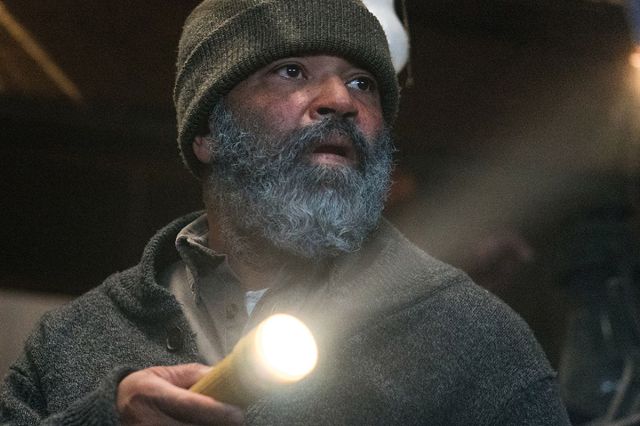
Jeffrey Wright plays Core, a tough-minded wolf behavior expert summoned to the mid-winter wilderness, a town where wolves are taking children. The woman who writes to him read his book. She’s a military wife, Medora Slone (Riley Keough) who wants closure before her husband (Alexander Skarsgård) returns from a tour in the Middle East.
“Come help me, and kill him,” she writes. “I know you feel sympathy for these animals. Please don’t.”
Core is no ivory tower academic. He may be unused to the cold, but he knows his quarry and is willing to pull the trigger if he finds the pack that did this.
Core stays with Mrs Slone, whose grief has gutted her, turned her speech into something metronomic — mechanical. She seems off. An there’s this mask on the mantel, the silliest piece of foreshadowing this side of “Friday the 13th” movies.
Because the wolves? They’re bystanders, metaphors here.
There are father-son flashbacks, and the setting shifts to Afghanistan, where Vern Slone is seen as a murderously efficient machine gunner, coping with news of his son by searching for death.
Core struggles to understand what he’s stumbled into, tries to filter what the white locals and suspicious natives (Julian Black Antelope is scary, tough and cagey Cheeon) and James Badge Dale is the state police officer who suddenly realizes he needs “everyone” in his department in this small town, thanks to the shocking burst of violence that signals the film’s shift from the real world to the surreal.
The point of view drifts, the “hero” we follow drifts and the carnage piles up as director Jeremy Saulnier and his screenwriter/collaborator Macon Blair try to wrestle a savage beasts/savage humans allegory into shape.
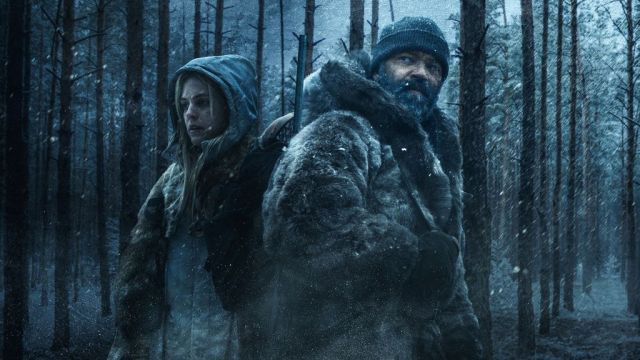
Wright is one of the great character actors working these days, and losing track of him and his character hurts the film.
It’s an almost pitiless thriller, as unforgiving as the wilderness that it is set in, another reason the “Wind River” comparison is apt. But every time it strays from the realm of the realistic, “Hold the Dark” stumbles.
And about that big shootout. It’s hard to believe Alaska’s cops somehow missed out on the Militarization of Policing in America, even if it’s not hard to imagine police being outgunned in the land where spree killings were common many winters before Columbine.
It’s not the only scene in the movie that hobbles it, but it does put an exclamation point on a tale that gets so much right — setting, atmosphere, tone and casting — before it goes so wrong.

MPAA Rating: TV-MA (graphic violence, nudity)
Cast: Jeffrey Wright, Riley Keough, Alexander Skarsgård, James Badge Dale, Julian Black Antelope
Credits:Directed by Jeremy Saulnier , script by Macon Blair , based on the ook. A Netflix release.
Running time: 2:05
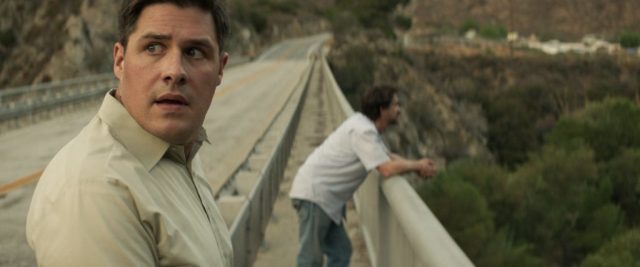
Here’s a knotty little thriller about a “psychic medium” with an eye for the main chance, if not the gift he’d need to take advantage of it. Because if you’re supposed to be able in touch with the spirit world, the one thing you should be able to figure out is when the hustle is up.
Richard Sommer of TV’s “Mad Men” has the title role of “A Crooked Somebody.” He plays Michael, a colorless wannabe with a book out and a gig working the paid seminar circuit, still giving “readings” to small groups when “by this point, John Edward was on TV every night of the week.”
He makes his gripe to his booker and “plant” in these audiences, Chelsea (Joanne Froggatt of “Downton Abbey), a woman he has history with, who now resists his advances.
Michael sees his work as harmless, giving comfort to the bereaved like an AA group leader or a preacher of the laying-on-of-the-hands variety.
His preacher father (Ed Harris) and mother (Amy Madigan, of course) wish he’d find work with more “honor” in it, with Dad seeing his special “gifts of persuasion” — you’ve got to be a fast talker and a faster-thinker to pull this off — as something he should turn towards sales.
But Michael’s birthday party magician years gave him a taste for applause, and the fact that he’s willing to give away his books on occasion, make him feel he’s “helping.”
“Your son loved animals, didn’t he?” he reassures grieving parents. “There’s no more pain, there’s only joy.”
All that changes when he casts the name “Jim” out into an Arizona audience. One guy who won’t own up to knowing a Jim (Clifton Collins Jr.) seems shaken.
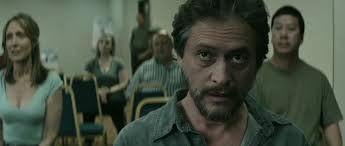
And he’s the fellow who clubs Michael in the parking lot and takes him hostage. Dead “Jim” “showed you what happened.” And that means Michael must die. Michael’s protestations that he’s faking it don’t cut it with Nathan.
“You don’t just stop being psychic, I know the real deal when I see it.”
It takes quick thinking to get that knife away from his throat, and even quicker thinking for Michael to figure out a way to turn this situation — Nathan committed an infamous murder years ago — to his advantage.
Michael has to improvise, wing it, make it up as he goes. “Jim is FURIOUS with you,” gets the killer’s attention. And a road trip at knife-point gives Michael ideas for how he can “solve” this case and get that “Crossing Over” level of success he’s dreamed of.
Sommer plays Michael straight, so there’s no hint of the lovable con artist about this grifter. He’s an “Ace in the Hole” cynic, a “Leap of Faith” hustler not above risking his neck and his manager’s to work this situation to his advantage.
“There are still moves to make here,” he says, repeatedly plotting his course as he goes along.
Collins, an old hand at playing a gullible murderer (“Capote” was his breakthrough film), carries murderous naivete around like baggage. Sommer gives Michael a paper-thin bravado born of desperation.
Director Trevor White is more known as a producer (“Wind River” and “Ingrid Goes West”), and he’s not bad at maintaining suspense in producer/screenwriter Andrew Zilch of Youtube’s “Good Mythical Morning” somewhat predictable script.
One thing good producers have an eye for is casting. The right actors can save directors and make passable scripts something extra. Even when we know where it’s going, really good actors make that stroll down the primrose path an entertaining one.

MPAA Rating: R for language and brief violence
Cast: Richard Sommer, Clifton Collins, Ed Harris, Amy Madigan
Credits:Directed by Trevor White, script by Andrew Zilch. A Vertical release.
Running time: 1:42
Reliably hilarious together, master improvisers, the Kings of One-Upping Each Other, do Will Ferrell and John C. Reilly have another buddy farce hit in them?
Hell, the world’s been WAITING for a Ralph Fiennes version of Professor Moriarty. And in a farce?
Kelly Macdonald, Hugh Laurie and Rebecca Hall are bystanders to the silliness, not a bad sign.
Seems a bit late for the lads to be getting around to re-teaming, but Reilly always delivers fair value and Ferrell has had an amazing run in buddy pictures. Amazing.
Nov. 9, “Holmes & Watson” are on the case.
Put hotheaded, just-quit working class mechanic Jason Mantzoukas (“The Dictator,” “The House”) in a car with child of privilege Tony Revolori (“Grand Budapest Hotel,” “Spider-Man”) and send them into desert Southwest America.
Laughs see sure to follow.
Pamela Reed, Taissa Farmiga (“The Nun”) and Ron Livington are in the supporting case.
“The Long Dumb Road” opens Nov. 16.
I’ve interviewed Peter Jackson a few times over the years, and often as the conversation was winding up, he’d talk of the war movie he wanted to make — a version of WWII’s “The Dam Busters,” about RAF pilots who trained and engineers who engineered a “bouncing bomb” mission that would destroy the dams in Nazi Germany’s Ruhr Valley, crippling the German war effort.
He talked about doing this for years.
What’s he’s gotten to first is “They Shall Not Grow Old,” this British documentary about WWI, a sort of Ted Turner colorization and speed correction, with sound, of footage of The Great War as the soldiers — all dead and gone, now — experienced it.
One night only in the UK, but you can bet it’ll make BBC or Netflix or somebody else. Looks extraordinary.
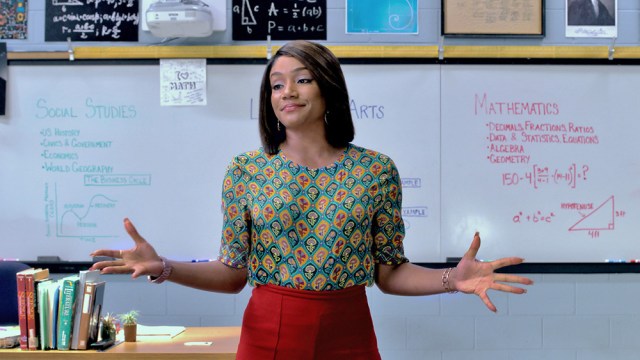
TIFFANY HADDISH stars in “Night School,” the new comedy from director Malcolm D. Lee (“Girls Trip”) that follows a group of misfits who are forced to attend adult classes in the longshot chance they’ll pass the GED exam.
The bar has been set high for Kevin Hart comedies, and adding new star Tiffany Haddish to the mix should prove a boon for “Night School,” an indifferent star-comedy with little to recommend it — a few laughs, widely scattered over two rather leaden hours of running time.
Remember, Kevin got his first decent break on “Freaks and Geeks.” He’s Apatow trained to keep his comedies going and going and going, even when they’re not working.
Box Office Mojo looked at Thursday night’s numbers and hasn’t adjusted its $32 million predicted opening for this one. Average for a Hart comedy, but there’ll be trouble if Thursday’s $1 million and small change doesn’t pan out to a big Friday and bigger Saturday. Reviews overall were a lot like mine — “meh” to “ugh.”
Deadline.com figures $30 million is a safer bet. In any event, this one should win the weekend with ease.
The significant competition will come from the cartoon comedy “Smallfoot,” which I thought was cute, with a science-over-superstition message that’s logically hard to beat. Most critics agreed. Both Deadline and Mojo are predicting a $24-27 million weekend for this one, not being a “brand” name Pixar franchise or anything of the sort. I am guessing it will make a race of it with Mr. Hart’s farce — both of them coming in around $30.
I saw “Hell Fest” with a pretty good sized audience Thursday night, so the horror audience could lift this one out of the hole everybody predicts it will be digging out of ($3.5-4 million). It’s terrible.
Pitiful reviewed greeted the Pure Flix version of “Little Women,” but it could manage as much as $4 million, Deadline.com figures.
“The House with a Clock in its Walls” should finish its second weekend in the $12-15 range,
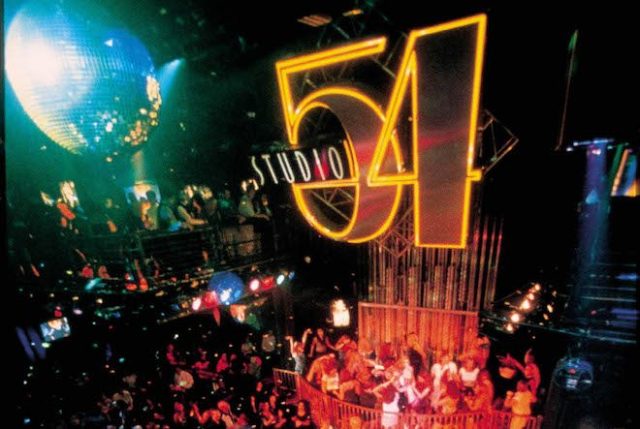
There’s been so much written, said and filmed about New York’s famed disco era icon Studio 54, that filmmaker Matt Tyrnauer was hard-pressed to find anything new for his documentary, “Studio 54” (Oct. 5).
What he settled on was the tactile glitz of the facility, the cultural watershed moment the discotheque represented and the fellows who ran it.
Nobody particularly famous is interviewed for the film, none of the survivors of the Liza/Bianca/Halston/Warhol/Liz/Michael set speak anew, they’re just seen in archival footage or in tiny snippets of vintage TV interviews.
The Fall of Rome hedonism is given its due — sex and sexuality, seeing and being seen — all that. But so is the mad rush to build in the joint, the genius “adult theme park” design, the stunning lighting and sense of “event” created there for $40-65,000 per night — wind machines and balloons, confetti and snow, ballet interludes and high-wire acts and not-quite-stripper performances.
An army of ex-employees, from the manager to the bouncer and on-call makeup and hair stylists, join surviving partner Ian Schrager in laying out the logistics of how the whole mad scene worked.
And it’s fascinating, even if the “revelations” are few and far between, even if the nostalgia seems a little misplaced for a club built on decadence, hedonism, cocaine and the premise of almost-accessible exclusivity.
Young college pals on the make Steve Rubell and Schrager “worked” their way up to the massive facility on 54th and Eighth by scouting the underground gay nightclubs where models would show up on the arms of their gay fashion designers. Rubell (closeted at the time) noticed that straight men wanted to go where the models were.
And after getting a start in Queens with the Palace Garden, they rounded up the cash to get hold of the art deco Gallo Opera House, later an abandoned CBS TV studio that they turned into Studio 54.
Tyrnauer, who did “Valentino: The Last Emperor” about the Italian fashion magnate, is the first filmmaker to lose himself in the glories of the building itself, its ornate, high done ceiling and vaulted entryways, and in the way competing club moguls blackballed Rubell and Schrager and kept club designers from helping them.
So Schrager, a lawyer by training, took on conceptualizing the place, and Tony winning stage and lighting designers came in with Broadway crews and created a permanent spectacle — using the gorgeous bones of the building, tapping into its opera and TV past, filling the place with lights, and pools of darkness, neon and mirror balls and accomplishing this in a mad “get ready for opening night” Broadway sprint
Rubell envisioned a club where gay and straight worlds would meet on equal, non-threatening footing, a club where the pre-AIDS/post-Pill and Vietnam promiscuity had a place, as did the sense of a “show” that the audience — “cast” each night — put on.
Rubell is seen, barking at folks behind “the velvet rope” — “You didn’t shave. Don’t come here if you can’t be bothered to shave.” “Go home and change your shirt.” Couples were broken up (beautiful women allowed in, their dates often refused entrance).
And from the chaotic, front-page news opening night in April of 1977, celebrities were courted, “wrangled” by publicists, giving the place both cachet and a chance for the not famous but good looking to mingle with the glitterati.
“You have to build a nice mousetrap to attract the mice” a glassy-eyed Rubell said in a TV interview at the time. As cub reporter Jane Pauley asks him another question, Michael Jackson strolls into the office in all his high-voiced pre-“Thriller” glory, making another Rubell dream come true.
Celebrities and others felt “free” there, Schrager and others declare. The paparazzi were let in, “but only the ones who played by our rules.” Closeted celebs and bankers could “be themselves” and gay and straight hookups and furtive couplings were the norm.
Schrager, the surviving partner, is here to define the business model — “A club is all about capturing the moment.” Never forget what you’re selling because “you have no discernible product except for the magic you create.”
And Schrager is here to accept his part in the sudden fall of the club and its leadership — tax and drug problems, jail time. He dodges questions if not responsibility. “I don’t remember. All I know is I got the benefit and I was a co-conspirator.”


The flood of photographs and miles of film and video tape exposed in Studio provide ample proof of what made it special. And a lengthy third act gives us the film’s few revelations about that downfall, the greed, arrogance and unsavory practices that ended 54’s run after just 33 months.
The club is long gone — I’ve seen plays at the Roundabout Theatre Company there, and I recall seeing movies in the building (in a once-seedy neighborhood that the club helped bring back to life) in past decades.
But Tyrnauer makes a good case for this disco Parthenon’s place in American history, the role it played in moving gay lifestyles towards more mainstream acceptance and its status as cultural watershed — flaming out in the ’70s, with Reagan. AIDS and “Greed is good” pushing it into the dustbin of history in the ’80s.
Funny, few people have fond things to say about the decade that followed. But Studio 54 they want to remember, or hear about if they were too young to get a gander at it in its glory. “Studio 54” gives them their most thorough look back yet.

MPAA Rating: unrated
Cast: Steve Rubell, Ian Schrager, Jack Dushey,
Credits:Directed by Matt Tyrnauer. A Zeitgeist release.
Running time: 1:39


