Movie Review: Can “Widows” pull off the Big Heist?

widows6

Co-writer/director Steve McQueen doesn’t reinvent the heist picture with “Widows,” his follow-up to “Twelve Years a Slave.” But he does change the focus, the point-of-view, raising the stakes while piling on characters, subtexts and twists.

It’s as complicated as “The Departed,” which wasn’t a heist picture, and in spite of the fact that the phrase “mean and lean” was invented to describe this corner of the crime movie genre, he gets away with it with this well-cast, uncommonly well-acted sometimes pulse-pounding thriller.

A heist goes wrong in a hail of bullets and a torrent of fire in the film’s opening moments. Harry Rawlings (Liam Neeson) and his gang (Jon Bernthal among them) didn’t make it. All that’s left are ashes, and widows.

And a debt. Turns out Harry & Crew were robbing from the well-heeled gang leader Jamal Manning (John Tyree Henry), who just happens to be running for district alderman in this corner of Chicago. Jamal and his ruthless enforcer/brother Jatemme (say it like it’s French) want that money — $2 million — back. They need it to win the election.

As they’re battling Jack Mulligan (Colin Farrell), son of Tom Mulligan (Robert Duvall), whose family has owned that ward seat for decades, that further complicates matters.

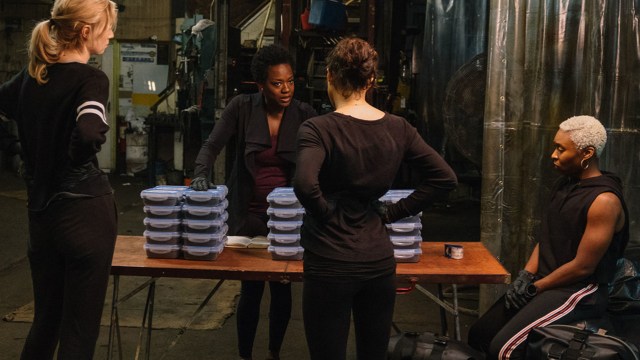
And demanding the money, on pain of death, from the widows of the robbers, could be a non-starter. Just how many assets to the four women have? Even stripping teacher’s union lobbyist Veronica (Viola Davis) of her posh condo, swank furniture and Escalade won’t get them close.

She’s tasked with getting the other widows on board — bridal shop owner Linda (Michelle Rodriguez), blonde beauty with no visible job skills Alice (Elizabeth Debicki) are made aware of the dilemma. New mom Amanda (Carrie Coon) stays out of it. The others are close to broke.

Veronica, queen of looking the other way, has to figure this out with only her punch-drunk driver Bash (Garret Dillahunt), a retired accomplice of Harry’s, and this safe deposit box key.

That’s where her late husband kept his planning journal, research, logistics and scheduling for every job he ever did. And there’s this “next” job, with $5 million on the line, that could save them all.

McQueen never lets “Widows” descend into “Set it Off” or “Going in Style” absurdity, zeroing in on how hard achieving every little step that most heist pictures skim over actually is. Getting a van that can’t be traced? Police auction, fake name. Guns? Visit a gun show, find an overweight gun nut to help hook you up. Finding out where the “safe room” whose blueprints Harry had, the place they’re actually going to rob, actually is? That’s hard.

“How’m I supposed to know this?”

“By being smarter than you are right now!”

One inspired piece of casting — making Daniel Kaluuya of “Get Out” the heavy, Jatemme. McQueen’s camera circles him as he gets right up in the face of those he wants to intimidate, nose-to-nose. Yes, that action has purpose. But sometimes, he’s just getting his sadistic jollies out of somebody he expects to stab or shoot anyway. It’s a monstrous turn which should park Kaluuya on everybody’s “must have” list of actors you want in your thriller.

Davis suffers mightily, lets us believe she’s lost the love of her life (Harry/Neeson is in her dreams and flashbacks) and takes on her burdens with the stoicism that has become her trademark. One thing she doesn’t pull off is acting as if she’s had an adorable lap dog (bearded collie) in her life. She carries him like an ungainly sack of rice, as if she’s never picked up a dog or had one on a leash. Maybe she resents sharing the screen with the pooch, who is a scene stealer (as W.C. Fields warned us).

Rodriguez (“Fast and Furious,” “Girlfight”) has to hide the toughness she carries around as her screen baggage. Debicki, with her model’s looks, makes good work of the “one we’re supposed to underestimate” and Cynthia Erivo makes us forget her in “Bad Times at the El Royale” playing Belle, a late addition to the “gang” who is a walking muscle thanks to the multi-job schedule she keeps as an inner city single mom.

Duvall delivers his usual sound and fury, and Farrell easily suggests the cunning Jack Mulligan uses to get by, the act he puts on as a white politician trying to hold power in an overwhelmingly African American ward.

McQueen includes so many folks in his story (based on a Lynda La Plante novel) that many characters feel underserved and a few story threads lack the fulfilling payoff we want. Jacki Weaver plays Alice’s “use your looks to make money” mom, Lukas Haas is cast against type as a wealthy developer paying for Alice’s company and Kevin J. O’Connor, as a wheelchair bound bowling-alley owner no longer in “the life” so stands out in his couple of scenes that we crave more of his character.

The extra faces make “Widows” feel cluttered, and coincidences and the occasional jarring, illogical scene that comes out of nowhere show us some points on the steep learning curve he was on that he hasn’t mastered.

But he’s still made one of the best thrillers of the year and one of the best heist pictures since David Mamet made “Heist,” the modern benchmark for excellence in violent, complex cinematic capers.

3stars2

MPAA Rating:R for violence, language throughout, and some sexual content/nudity

Cast: Viola Davis, Michelle Rodriguez, Daniel Kaluuya, Colin Farrell, Elizabeth Debecki, Robert Duvall and Liam Neeson

Credits:Directed by Steven McQueen, script by Gillian Flynn and Steve McQueen, based on the novel by Lynda La Plante. A Fox release.

Running time: 2:09

Posted in Reviews, previews, profiles and movie news | Comments Off on Movie Review: Can “Widows” pull off the Big Heist?

Documentary Review: “Under the Wire” lets friends and colleagues tell us about war correspondent Marie Colvin, subject of Rosamund Pike’s “A Private War”

wire1

In 1999, on the war-torn, divided island of Timor north of Australia, some 1500 women and children were trapped and in danger of almost certain slaughter by invading Indonesian forces and their supporters.

American Marie Colvin was the only Western journalist on the ground there, and stubbornly refused to leave or stop reporting — doing interviews with media companies in the U.S., Britain and elsewhere — “bearing witness” to what was about to happen and warning the world of an atrocity in the making.

The Indonesians backed down.

In 2001, at the height of the Sri Lankan Civil War and the humanitarian crisis it spawned, her cries of “Journalist JOURNALIST” could not dissuade government forces from dropping one last mortar round on her, taking out an eye. She filed a 3000 word story, on deadline, while wearing an eye patch, the first of many.

And in February of 2012, she slipped into war-torn Syria and died in an artillery barrage of civilians by the army of genocidal dictator Bashar al-Assad. 

“Bearing Witness” was Marie Colvin’s life’s work, and the title of an earlier documentary about her. “Under the Wire” is a fine new film about her, covering her full career and her death and timed to come out just before “A Private War,” the feature film about Colvin starring Rosamund Pike, hits theaters.

Colvin was a foreign correspondent who specialized in conflicts, showing up wherever fighting broke out — from Chechnya to Zimbabwe, Sierra Leone to country-by-country protests and insurrections of The Arab Spring.

Working first for U.S. wire services, and then for Britain’s “Sunday Times,” and appearing on TV in the process, she became a legend in her business — the first to talk to Gaddafi after U.S. air strikes failed to kill him, frequent interviewer of Arafat and other world leaders, but most importantly — as someone who did not lay back when the shooting started.

When the civilians who always come off the worst in combat zones would cry “Tell the World, TELL THE WORLD,” Colvin was their ally and their microphone.

“Under the Wire” uses archival footage of Colvin and extensive interviews with those who worked with her, including Paul Conroy, the British photographer/videographer who ventured into many a war zone with her over the years.

“But she was a complete and utter one-off,” Conroy says, always focusing on the human tragedy of war, brassy and brave and always “bearing witness.”

“It’s about what people, what people are going through” she said on one TV appearance.

Others echo Conroy’s “legendary” assessment of Colvin, called “one of the greatest war correspondents of our generation” by her Sunday Times editor, Sean Ryan.

Chris Martin’s documentary uses extensive footage shot by Conroy and others, and occasional recreatings, capturing not just Colvin in action but the chaos of any combat zone — jumpy hand-held footage of camera people running from gunfire or to a safer spot to ride out an artillery bombardment.

We meet their guide and translator for that fateful trip into Syria (Assad’s government didn’t want anyone “bearing witness” to the civilians it was slaughtering in the name of putting down an insurrection).

The harrowing nature of the work is the primary focus of this film and many others on this subject. But Colvin never comes off as the classic adrenaline junkie/Hemingway wannabe that too many of these films turn their heroes into.

She turned her lost eye and eyepatch into a trademark, her reputation into armor and a pulpit from which to warn the world about this genocide or that refugee crisis.

The most fascinating part of Martin’s biographical documentary is the detail — from interviews with survivors, found footage and recreations — we get about Colvin and Conroy’s most dangerous mission, which would turn out to be Colvin’s last.

Crossing the Syrian border with Lebanon in darkness on the backs of motorbikes, “a shadow gives you to another shadow” is the way Conroy described their trek.

Filing stories from the besieged towns of Baba Amr and Homs, appearing on TV with Anderson Cooper describing the “worst” slaughter she’d ever witnessed. Conroy and reporter Edith Bouvier remember death — a baby’s and later Colvin’s own, with grim audio of the moments just after the artillery round that fatally wounded her and French correspondent Remi Ochlik.

wire2

Fittingly, the film goes on after Colvin’s death as indeed the dangerous work does. One of the best things this History Channel produced film manages is take away the “They should never have been there” dismissal by the clueless who shrug every time a journalist dies. They have to be there because we need to know.

And the other is to strip much of the glamour off the profession. Nice hotels in places most people would be too frightened to visit aside, war correspondent is a grim, dangerous line of work that seldom allows for the peacocking we see such “characters” do in the movies. Far too often, they end up like Colvin, remembered but rarely living long enough to enjoy being labeled “a legend.”

3stars2

MPAA Rating: R for language and disturbing violent images

Cast: Marie Colvin, Paul Conroy, Sean Ryan, Edith Bouvier, Williams Daniels,Wa’el

Credits: Written and directed by Chris Martin. An Abramorama release.

Running time: 1:40

Posted in Reviews, previews, profiles and movie news | Comments Off on Documentary Review: “Under the Wire” lets friends and colleagues tell us about war correspondent Marie Colvin, subject of Rosamund Pike’s “A Private War”

Next Screening? “Widows”

I’ve been looking forward to this one for much of the year — Viola Davis in an action pic, and Ms. “Girlfight” Michelle Rodriguez, in a role worthy of her talents and not billed behind the cars.

Steve McQueen’s “Widows” opens Nov. 16. 

Posted in Reviews, previews, profiles and movie news | Comments Off on Next Screening? “Widows”

Preview, Travolta plays a real-life boat racer/drug runner in “Speed Kills”

Little late posting this Florida-centric trailer.

John Travolta seems a little long in the tooth to be tackling the role of Ben Aronoff, offshore cigarette boat racing champ, boat builder and supplier of the craft that got the coke into Miami.

Katheryn Winnick, Jennifer Esposito and James Remar also star in this “based on the incredible true story” thriller.

And Matthew Modine plays one of Aronoff’s friends, George Bush Senior.

“Speed Kills” earns limited release Nov. 16 here in the US.


Posted in Reviews, previews, profiles and movie news | Comments Off on Preview, Travolta plays a real-life boat racer/drug runner in “Speed Kills”

Preview, “The Secret Life of Pets 2”

Illumination is doing character-specific trailers for this sequel, and the one for Max, for instance, features a trip to the vet.

Coupla chuckles. Next summer, we’ll see if there are more.


Posted in Reviews, previews, profiles and movie news | Comments Off on Preview, “The Secret Life of Pets 2”

Preview, Vanessa Hudgens takes a step backward with “The Princess Switch” for Netflix.

Look at this wish-fulfillment holiday comedy trailer and tell me this doesn’t look like something Hudgens would have made six years ago.

Posted in Reviews, previews, profiles and movie news | Comments Off on Preview, Vanessa Hudgens takes a step backward with “The Princess Switch” for Netflix.

Movie Review: “The New Romantic” checks in on what Gen-whatever thinks about love

rom1

Maybe every generation puts its unique stamp on “the romantic comedy,” but odds are that each new posse just figures out what Jane Austen knew 200 years ago.

Thus, “The New Romantic,” a thin collegiate romance hung on the “sugar babies” concept. You’ve almost certainly heard of this college-coed-seeks-sugar-daddy phenomenon. “New Romantic” summarizes its appeal and takes the most predictable path to showing our sugar baby the down side.

Blake, played by Brit actress Jessica Barden of “Far from the Madding Crowd,” is 21 and looks 14 — 15 tops. She’s a rising senior with a sex column in the school paper, and the most boring sex life on campus.

She knows that her dad met her mom without Googling her or finding her on Match.com with a “witty bio” attached to her picture. That fact and “an unhealthy binge of Nora Ephron movies” in her youth has her idealistically wondering “What would my love story be?”

Which is why her “Hopeless Romantic” column is about to be canceled.

“It’s time to say goodbye to ‘grand gestures,'” she narrates, presumably from her column. “The grandest it gets these days is swiping right or left.” Cynicism doesn’t sell or lure the lads.

Her “foosball meetups” with college guys “who don’t even know how to go on a date” any more isn’t finding readers. Roommate and best friend Nikki (Hayley Law of “Riverdale” and “Altered Carbon”) sums it up in a sentence.

“You write a sex column with no sex.”

Then a mix-up with driver’s licenses at the liquor store introduces her to Morgan (Camila Mendes, also of “Riverdale”). And Morgan — put together, well-dressed and plainly coddled, is her introduction to this life of well-heeled men looking for young (very young) women, sex and dates without complications.

Why? Have you priced a college degree lately?

Yes, “Young girls are prostituting themselves to pay for college,” but once Blake moves past judging, she gets an earful on the upside. Morgan gets jewelry, fashion and “gifts” to the tune of $67,000 from the man she’s seeing.

And Blake? She’s pretty and Morgan is sure she could handle this, should she want.

“Am I a prostitute? No. Am I a gold digger? Maybe.” Morgan huffs that she’s “having a better time than these girls who get nothing more from a one night stand than the occasional pregnancy scare,” and unlike them, she’s not graduating under “a mountain of debt.”

rom1.jpg

That’s how Blake meets Ian (Tim Sharp), a well-off college professor looking for a student (not in his classes) he can carry on with.

As “Pretty Woman” and Jane Austen references pile up, as the “chivalrous” older man bedazzles Blake’s life, she writes about it and rationalizes.

“Wealthy older people supporting struggling younger ones is nothing revolutionary. Read any Jane Austen novel…Why does our society hate ‘gold diggers?’ Maybe relationships aren’t supposed to be about love, but about survival.”

And maybe she’ll get a college journalism prize for her suddenly edgy and topical column, a prize coveted by the one classmate/school paper colleague (Brett Dier) to show a romantic interest in Blake, “prostituting” herself or not.

There’s wit and the spark of life in the relationships Blake has with her peers in this world, funny little lectures on journalism — “Follow the story, not your feeling.” — from her older classmate/editor (Avan Jogia). “It’s not ‘This American Life,’ but it’s something.

Law handles the laid-back, effortlessly cool BFF role with panache. Blake bicycles to her assignations with Professor Ethics Violation. He gives her alternate transportation.

“A sex moped?” “A HOped!”

Writer-director Carly Stone (she writes for TV’s “Kim’s Convenience”) delivers a few clever turns of phrase, the odd cute joke and a knowing connection to college life’s modern pitfalls, where getting “black-out drunk” leads to “one night stands,” hazards only combated with “study drugs.”

“Big gestures” might be dead, but the attempt is worth a new verb to these kids — “We’re ”Sleepless in Seattling!'”

But I could do without the cliche of older academic explaining why vinyl is better than digital to a coed.

And Ms. Barden, 25 now but still looking like high school freshman year is right around the corner, creates an obstacle at the center of “The New Romantic” that she has little control of. She looks like a child. And putting her in the arms of an over-30 actor is just plain creepy.

Thank heavens they had the good sense to not get the least bit graphic with this, despite the subject matter.

Kudos on the mastering the accent and all, and she and her castmates do all right by the few bits of biting banter they get to play.

But parking a woman who looks like a pixie in on her way to junior high Spanish Club hobbles the marginal film that “New Romantic” was always destined to be.

2stars1

MPAA Rating: unrated, sexual situations, drug references

Cast: Jessica Barden, Hayley Law, Annie Clark, Eva Link, Darren Eisnor, Brett Dier, Greg Hovanessian

Credits: Written and directed by Carly Stone. An Orchard release.

Running time: 1:22

Posted in Reviews, previews, profiles and movie news | Comments Off on Movie Review: “The New Romantic” checks in on what Gen-whatever thinks about love

Movie Review: One more Christmas is stolen by “The Grinch”

grinch4.jpg

I wish to Blitzen Universal would leave “The Grinch” alone.

The 1966 TV special was compact perfection, a minor masterpiece to remember legendary animation director Chuck Jones by. You’re never going to improve on having Boris Karloff as your kindly-spooky-sweet narrator or Thurl Ravenscroft’s bone-tingling crooning of “You’re a Mean One, Mister Grinch,” by composer Eugene Poddany.

But “How the Grinch Stole Christmas” isn’t just a short film (based on a beloved book) American families are tickled and touched to the point of tears by every holiday season. It’s a property, part of a brand. And Universal has every right to try and wring more money and improvements to its theme park Seuss attraction out of the green furball every few years.

They go back to animation for this latest incarnation, a bright and shiny toddler-aimed bauble with slapstick gags, more characters, more “acting” than storytelling, updated rhymes to the songs and no emotional connection whatsoever.

It’s perfectly passable as eye candy and children’s entertainment, so long as you’re sure they have no memory of the Chuck Jones original. This one’s heart is three sizes too small.

Critics can embrace it as that rare chance to chew on Benedict Cumberbatch a bit. Brother Brit took a paycheck here and in a rare bad career move, has nothing to give to the part.

His Grinch has “Garlic in your soul,” but a more-explored connection to Who-Ville. He showers, dashes on a splash of Cold Spice and goes shopping there — even though it’s the holidays, because he’s eaten up all the food in the cave-home he shares with his puppy Max.

“How much emotional eating have I been DOING?”

This Grinch has an alleged friend (not reciprocated) down in Who-Ville. He’s voiced by “Saturday Night Live” mainstay Kenan Thompson.

And the new Grinch has a back story, a little Dickensian motivation for why he hates Christmas. Adults always inferred that in earlier versions, and kids who’d seen “A Christmas Carol” could make the same Scrooge connection that Dr. Seuss did all those decades ago. But here, let’s spell it out for everybody.

Who-Ville is a veritable gingerbread castle of a town, presided over by Mayor Angela Lansbury, who has decreed that this Christmas has to be “Three Times” bigger and better than the last.

And little Cindy Lou Who (Cameron Seely) is a sassy, sledding bundle of rambunctious wonder who needs to get an audience with Santa because she’s worried her single mom/working mother (Rashida Jones), a nurse, needs a break and won’t get one in the gig economy.

You know the rest, the story arc from “a heart, two sizes too small” has to be moved from cynicism over the grinding commercialism of the holidays to embrace “the True Meaning of Christmas,” thanks to the Whos’ devotion and unshaken faith.

Because, you know, he’s stolen everything Xmas related in that mission to “stop Christmas from COMING.”

grinch2

A novel approach — The Grinch’s mathematical and technological way of ripping off every house in Who-Ville (he counts them, counts the hours he has to pull off the heist, etc.), The gadgets he and Max employ are Seussian whimsy incarnate.

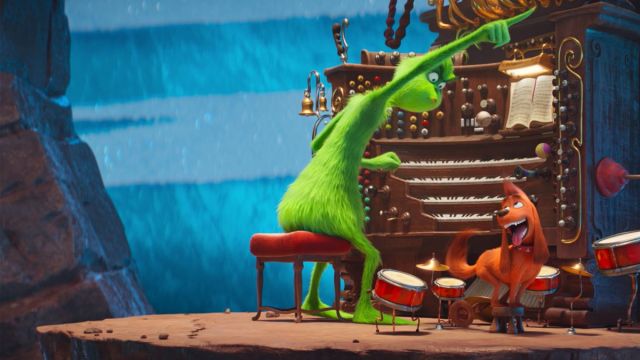
Cute touches — having Thompson’s character introduced as he offhandedly sings “Have a Holly Jolly Christmas” from the “Rudolph the Rednosed Reindeer” Rankin/Bass TV special of the ’60s, letting The Grinch work out his loneliness at a Seussian pipe organ pumping out “All By Myself.”

There’s enough Christian Christmas music in this version to warm an icy Megan Kelly heart.

The Whos have their own expletives when The Grinch knocks over their snowmen or swipes that last jar of Who chutney from the grocery.

“Oh…Sugar plum!”

The updating of the narration works — “Safe in his cave and apart from the fray, he reminded himself ‘It is better this way.” But having Pharrell Williams narrate and sing the beat-boxed update of “You’re a Mean One” won’t warm anybody’s cockles.

It would have improved the film to ignore market research and hire grumbling, bemused and singing (sometimes) baritone Keith David to take over the storytelling narration. Williams is too light and ordinary sounding to make the “storyteller” work.

But this “Grinch” isn’t about aesthetics or shelf-life or making anything memorable, something Universal has managed with recent “Horton Hears a Who” and “Lorax” adaptations.

It’s as forgettable as the torn wrapping paper piled around the tree 15 minutes into Christmas morning.

2stars1

MPAA Rating: PG for brief rude humor

Cast: The voices of Benedict Cumberbatch, Rashida Jones, Kenan Thompson, Cameron Seely and Pharrell Williams

Credits:Directed by Yarrow Cheney, Scott Mosier, script by Michael LeSieur and Tommy Swerdlow, based on the book by Dr. Seuss. A Universal/Illumination release.

Running time: 1:26


Posted in Reviews, previews, profiles and movie news | Comments Off on Movie Review: One more Christmas is stolen by “The Grinch”

Movie Review: Is “Suspiria” worth the bother?

sus1

The safest way to review the new “Suspiria” is to remember the old “Suspiria” (1977) and bow out with an “It’s not really my thing.”

Cryptic, creepy, sexually asexual, gory and grotesque, it’s Reason One to back away — carefully, with an eye towards an exit — any time you’re cornered into a conversation with a Dario Argento cultist. The first film and the entire canon of Argento was and is most disturbing in the sorts of lost souls slavishly drawn to it and him.

The second tack to take is acknowledging that in poker, we call it a “tell.” In coal mines, it’s canaries who give away the game. And in movies, the presence of Dakota Johnson is the surest sign you’re in for something that grates and fails, a tease that renders the sexy off-putting, the potentially compelling dull. She’s uncanny for her knack of turning up in bad movies, made worse (usually) by her presence.

Luca Guadagnino (“Call Me By Your Name,” “I Am Love”) gives us a challenging puzzle  of an indulgence that rattles on and on, like a hearse with blown shocks, well past its point of resolution. Those inclined to treat everything he does as The Italian Cinematic Renaissance will give him the benefit of the doubt — stunt casting, insert shots of eyes-averting gore interrupting the underlit perpetual gloom of Berlin in mid-Cold War.

It’s always raining in horror movies with this much pretense.

I cut no such slack. He’s always needed editing, never more so than in this time-suck.

“Suspiria’s” “Six Acts and an Epilogue” structure begins with an opening act that is more a prologue. Chloe Grace Moretz plays a manic/panicked dancer whose Jungian psychotherapist, Dr, Klemperer, lets her show up unannounced and bounce off his walls —  sharing her mid-freak-out journal, her dreams and her fears that this Markos Dance Company she’s joined in Berlin is killing her and others who come into their clutches.

“There are WITCHES,” she insists, giving the game away in the opening ten minutes. “They’ve been underground since The War!” It’s 1977, and Germany’s Awfulest Generation hasn’t died out yet. There were witches in their ranks.

Patricia leaves the scene. Enter Susie Bannion (Johnson), a naive devotee of Viva Blanc, the genius behind the all-female company. She has no references, but her writhing, arhythmic dance — contortions, leaps and crawls — sells Blanc (Guadagnino muse Tilda Swinton) on her. She will replace Patricia in the company. And then Olga.

No, let’s not talk about “what happened” to them — terrorism, hijackings, bombings and kidnappings are all over the TV. Let’s assume it had something to do with that.

But as Susie half-innocently immerses herself in the womynist culture of the cultish company and Dr. Klemperer tries to get the police interested in what his missing patient said about the corps, the Ohio girl finds herself drawn into intrigues and wrestled to the floor by unseen, gnarled hands reaching up from “below.”

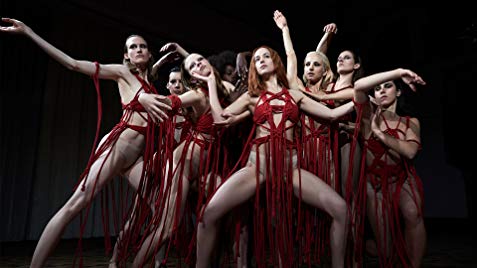
As the choreographer, assistants and matrons of the Markos cackle in their “Last Supper” staged meals that play like an infamous cooking scene in “Macbeth,” as cops are seen helplessly nude and humiliated, under a spell cast by the witchy women, Susie loses herself in the collaboration and the art which — as we’ve seen “The Red Shoes” and “Black Swan” — is what dancers do; lose control of their destinies and lives to The Dance.

sus2

I loved the chilling decay of the production design, calling to mind the great German cinema of the ’70s. The nightmarish fashions aren’t hurt by flashbacks of Susie’s Amish childhood — a brutally repressive farm life where she could only dream of travel and dance. The ’70s Amish here, with their tractors and what not, are more Mennonite, no matter what Susie says to Madame Blanc and her harem of harridans.

The Dance itself is striking, powerful. The rituals of “The Company” are even more fascinating with thi film’s “toil and trouble” subtext. Blanc kisses each dancer in greeting at every rehearsal, her directions to them are vague and yet specific enough.

But as Susie takes over “The Protagonist role” in “Volk,” the show the ensemble is reviving, noting that she memorized it by watching film footage (pre Youtube and pre-VCR) of it “over 100 times,” and the dancer she’s replacing in the role is seen shoved into an empty rehearsal studio where unseen forces drag, hurl, yank and tear her until she’s a bag of broken bones and meat, all carried out in time to Susie’s movements in rehearsal down the hall, as blood spurts and is spat out, as designer meat hooks drag the body away, the viewer is faced with a stark choice.

Stick with this and try to rationalize whatever “Suspiria” is saying about art and dance and witchcraft and feminism to justify two and a half hours of unerotic, opaque ickiness and puzzles we’ve worked out (Don’t look at Dr. Klemperer, listen to the voice).

Or do we join those who decide “This just isn’t worth the trouble?” Because it’s possible to “get it” and enjoy the (brief) challenges of Guadagnino’s vision and wish somebody would challenge him in the scripting, shooting and editing stages, to get to the damned point, and once he’s made it, move on.

1half-star

MPAA Rating: R for disturbing content involving ritualistic violence, bloody images and graphic nudity, and for some language including sexual references

Cast: Dakota Johnson, Tilda Swinton, Chloe Grace Moretz

Credits:Directed by Luca Guadagnino, script by David Kajganich, based on the Dario Argento film’s characters. An Amazon Studios release.

Running time: 2:32

Posted in Reviews, previews, profiles and movie news | Comments Off on Movie Review: Is “Suspiria” worth the bother?

Movie Review: “The Long Dumb Road”


road1

So many road trip comedies and only one lifetime to get through them all.

It’s a conundrum, a dilemma for anybody who cherishes the genre as much as I do.

On a sliding scale, “The Long Dumb Road” is closer to “The Guilt Trip” or “We’re the Millers” than “Midnight Run,” “Nebraska,” “Sideways” or any of the acknowledged recent classics of the genre.

It’s a scruffy road comedy that isn’t quite scruffy enough, even though it co-stars eternally shambolic Jason Mantzoukas, currently not-shaving and appearing on “Brooklyn-Nine-Nine” and “I’m Sorry.”

But a little chemistry always makes the trip bearable, and pairing him with Tony Revolori (“The Grand Budapest Hotel”) pays dividends in this affable amble across the American Southwest.

Affluent suburban Texas teen Nathan (Revolori) is off to art school, vintage Pentax 35mm camera in hand, minivan loaded for life in LA. It being an old minivan, it doesn’t make it out of Texas.

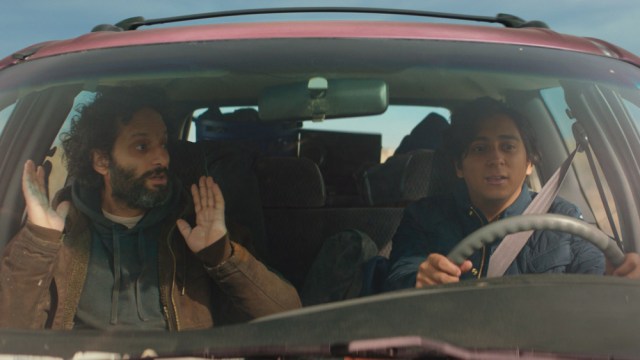
Luckily for the kid, there’s a garage close by. And Richard (Mantzoukas) is just in the process of melting down (LOUDLY) and quitting. The best way to pay him when he gets the van running again is to give him a lift…”just 45 minutes up to road, place called Alpine.”

If you know your road comedies, you’ll know that “45 minutes” is an illusion, that “just drop me off anywhere” will not hold.

And if you know the genre, you’ll know to expect the “Planes, Trains and Automobiles” mismatch.

Nathan is sheltered, uptight and flush with his parents’ cash for the trek. Richard, he of the greasy t-shirt beneath the stained hoodie, a riot of hair, wild eyes and manic patter? He’s the opposite.

He leaps from “Wanna a road brew?” (he keeps a beer bottle in his shirt pocket) to “So what’s your story? You party?” to “Wanna share this pretty rad jazz cigarette?” (coolest name for a joint) to “You’re an artist? So what’s your philosophy? What have you got to say?”

The two make a mid-winter (no snow) journey from Texas in the general direction of LA, with inter-titles signifying stops along the way — Marfa, Texas, Las Cruces, Truth or Consequences, Albuquerque, Gila, Silver City…

And with the stops come mild misadventures straight from the road comedy screenwriting app — bar fight, robbery, tracking down an old love, new romance, car troubles and the kindness of strangers.

When the formula is this tried and true a movie has to get by on chemistry and its banter.

Favorite movie? It’s “The Graduate” vs. “Fast and the Furious: Tokyo Drift.”

Richard somehow doesn’t realize there were MORE “Fast and Furious” movies, that series co-star Paul Walker died.

“Dude, you’re blowing my mind!”

Nathan? He’s never been to Richard’s impromptu choice of next destination — Vegas.

“Dude, all the best hookers are in strip clubs.”

Music? Nathan has this iPod his ex-girlfriend gave him.

“There’s like three Indigo Girls records on here. Is that why you dumped her? ‘Cause I totally get it.”

The meet-up with the long lost flame goes so very wrong that it gets “Long Dumb” off on the right foot. An ill-fated meeting with one of Richard’s old running mates (Ron Livingston, amusingly cast against type) is an unexpected laugh.

Mantzoukas makes Richard a mercurial mess, disarmingly charming one second, self-sabotaging (and Nathan sabotaging) the next. He poses for Nathan’s camera — “This is America at its purest, dude.” His philosophy? “Friends, shelter and a little bit of food in my belly.”

Richard is going to put Nathan’s declared eschewing of his “pretty sheltered life,” planned from SATs to college to marriage to its severest test.

Nathan will be like “my little brother. I’m gonna teach you everything…rip the condom off’a your mind.”

Richard’s lived 35 years just rolling with the punches, adrift, a guy with “We GOT this” answers for everything.

“You need to be more zen about how things happen,” he preaches. But remember, he’s an idiot.

“This is so stupid.”

“I know, right? Let’s do it.”

Director and Hannah Fidell and her co-writer Carson Mell remade their short film “The Road,” and had just promise in that script to get Livingston, Taissa Farmiga, Grace Gummer and Pamela Reed on board.

But it’s hard to see anything at all to this without Mantzoukas. He’s the beating heart of the comedy and the soundtrack to the film, rarely shutting up long enough to take a breath, collect his thoughts or plan ahead.

Whatever everybody else is doing, he sounds like he’s improvising, making this up as he goes along. He’s just the sort of guy you’d pick up hitchhiking — probably harmless, entirely too chatty and just edgy enough to make you plan your next rest stop where you can hopefully ditch him.

Provided the car starts when you’re making your break.

2half-star6


MPAA Rating:R for pervasive language, sexual content and some drug use

Cast: Tony Revolori, Jason Mantzoukas, Grace Gummer, Taissa Farmiga and Pamela Reed

Credits:Directed by Hannah Fidell, script by Hannah Fidell and Carson Mell A Universal release.

Running time: 1:30

Posted in Reviews, previews, profiles and movie news | Comments Off on Movie Review: “The Long Dumb Road”