
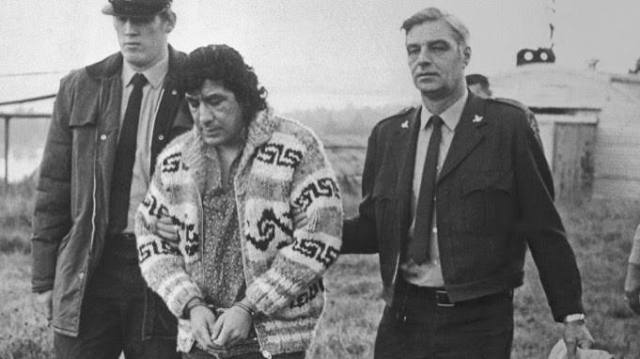
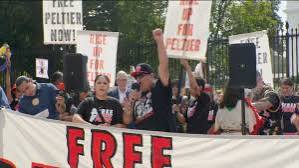
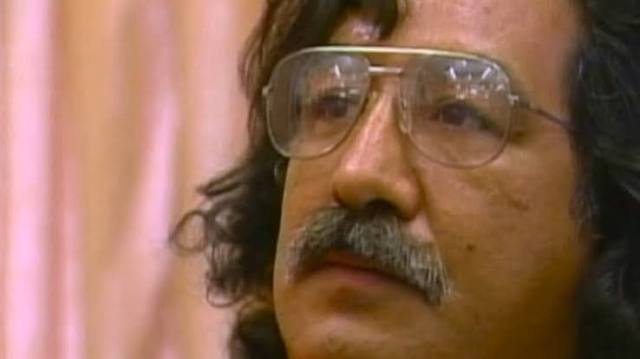
“Free Leonard Peltier” is about the half-century-long struggle to get Native American activist Leonard Peltier out of prison.
Peltier, accused of murdering two F.B.I. agents during the Federal government’s intervention in a Native “civil war” at the Pine Ridge Indian Reservation in June of 1975, was convicted in a trial littered with F.B.I. and prosecutorial “irregularities,” with an avowed racist on the jury and an accused racist — Paul Benson –– as judge.
Peltier’s incarceration became and international cause celebre, with everyone from Marlon Brando to the Dalai Lama, Soviet state media and Amnesty International weighing in. Decades passed, and the torch was passed from one generation of activists trying to get “justice for Leonard” to another.
Leonard Peltier’s name became synonymous with America’s unequal and broken system of justice and a black eye from which the F.B.I. never recovered.
He was imprisoned so long that the first major documentary about the sketchy case the government built against him — “Incident at Oglala: The Leonard Peltier Story,” by the famed British director Michael Apted — came out in 1992, some 34 years ago and came 15 years after his trial.
In “Free Leonard Peltier,” co-directors David France (“Welcome to Chechnya”) and Jesse Short Bull (“Lakota Nation vs. The United States”) use close access to Peltier and lobbying and organizing team and interview his many American Indian Movement contemporaries, including others accused of murder by the F.B.I. and exonerated. The filmmakers also lean on over half a century of archival footage of the conditions of the times and events leading up to the Incident at Oglala.
The result is a film that doesn’t leave much room for counter-arguments — Peltier’s version of where he was when the raid and shootout on the fateful day have changed over the decades — but that lets history catch up to its subject and its point of view.
The viewer can take or leave allegations about the reasons for the “civil war” on Pine Ridge, that it was inspired by “colonized” tribal Chief Dick Wilson and his workings with the government and mining interests that wanted the Oglala Sioux land and its buried uranium deposits.
But before the Nixon administration, when all this went down, few would have believed what one right wing megalomaniac might be capable of while running our government.
And the uneasy feeling that the F.B.I.’s vaunted reputation was built on managed, massaged and blackmailed propoganda existed long before its bestiality-friendly present, or Director “Fingers on the Scale of an Election” James Comey or leaking Director Christopher Wray’s insistence there was “no conspiracy” involved in the Jan. 6, 2021 coup attempt.
A parade of presidents had the chance to pardon Peltier, but the only ones who’d consider it were Democrats, raising the urgency surrounding the end of Bill Clinton’s and then Joe Biden’s presidencies and the hopes for clemency.
Racist Republicans from Reagan to both Bushes and Trump notably pardoned cronies and well off white people, not Native American activists.
Any hope Clinton would release Peltier was dashed when some 500, almost all white, middle-aged and older F.B.I. agents marched to the White House. They wanted this conviction, evidence, cover-ups and injustices be damned.
Peltier’s cause appealed to many, but not all. But much of the U.S. and the world came to see his case as emblematic of America’s mistreatment of Native peoples and stealing of Native land since long before its founding.
I lived in North Dakota, covered Native events in Peltier’s hometown of Belcourt and saw occasional examples of the overt racism there, which looked an awful lot of what you saw in the way white people regarded Black and brown people in my native South.
I interviewed AIM’s Russell Means and Dennis Banks when Michael Mann’s “The Last of the Mohicans” came out, and they’d had roles in the film and had led Native extras on a strike for better living and working conditons. Righteous dudes.
Reading “Bury My Heart at Wounded Knee” is a great way to lose your taste for many a “classic” Western.
And every time after my first interview with filmmaker Apted — when 1992’s “Thunderheart” and “Incident at Oglala” came out — that I reconnected with the director, we’d catch up on what the status of Leonard Peltier’s latest appeals were.
France and Short Bull cover as much of the story as possible in two hours — Native history, Bureau of Indian Affairs mistreatment and land theft giving rise to protests and militancy in a militant era.
And when the prosecutor in charge of the district that tried and convicted Peltier (James Reynolds) removed his name from the case and signed a petition for Peltier’s release based on F.B.I., judicial and prosecutorial misconduct, it’s not like we need to hear fresh fury from the people who railroaded the man.
Short Bull and France didn’t make the first documentary about Peltier, or the first great one. But they may have made the one that matters.

Rating: unrated, depictions of violence
Cast: Leonard Peltier, Russell Means, Charmaine White Face, Dennis Banks, Dino Butler, Madonna Thunder Hawk, Rob Robideau, Kevin McKiernan, and James Reynolds.
Credits: Directed by David France and Jesse Short Bull, scripted by Jamie Deradorian-Delia, Adam Evans and David France. A Magnolia release.
Running time: 1:48



