
“Sundown” is a lightly regarded “all-star” action picture that gets lost in the history of that cinematically storied year, 1941.
When “Citizen Kane,” “The Maltese Falcon,” “How Green Was My Valley,” “Sullivan’s Travels,””High Sierra,” “The 49th Parallel,” “Sergeant York,” “Meet John Doe” and “The Lady Eve” come out the same year, it’d be pretty hard to make anybody’s Top Ten list.
But “Sundown” is an American WWII movie from just before Pearl Harbor, one where “Germans” and “Nazis” are never mentioned, butin which the World War has reached into East Africa and British colonialists must contend with Italians and Nazis arming restless native proxies to tie down British forces.
It collected three Oscar nominations for its score, art direction and cinematography. The settings are just underfilmed enough — New Mexico — to be striking and “alien” looking, passably doubling for East African deserts.
The film was directed by Henry Hathaway, who’d one day earn John Wayne his Oscar (“True Grit”). It doesn’t “erase” Africans from an African story, goes easy on the racist patronizing that was common in American films of the day, and gave work to African American actors like Dorothy Dandridge, Emmett Smith and Jeni Le Gon even if the Islamic African villain role was reserved for veteran heavy Marc Lawrence, appearing in not-quite-blackface.
And “Sundown” is built around a top-flight cast — Gene Tierney, Bruce Cabot and George Sanders, with screen legends Harry Carey and Cedric Hardwicke in key supporting roles and nice showcases for veteran character players Reginald Gardiner and Joseph Calleia.
An independent woman (Tierney) flies into a remote corner of Kenya and “Somaliland” and is welcomed like the local shaker and mover she is. But her place in the story isn’t clear for the first act, which settles in on a remote outpost where the Canadian Crawford (Cabot) is district commissioner, a beneficent and curious do-gooder whose military counterpart (Gardiner) is intent on curbing his plans to explore and make contact with a troublesome tribe, the Senshi.
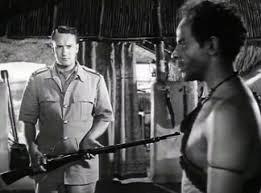
That earns a brusque visit by army Major Coombes (Sanders) whose orders are to “replace you, old boy” and to find out who is arming the Senshi via capturing one of those rifles they’re now using to shoot their neighbors and the Brits with.
An Arab trader (Lawrence) is getting those guns in, and is behind plots to ambush the local British garrison and take over this corner of Somaliland/Kenya. He and whoever is supplying him must be outed and foiled.
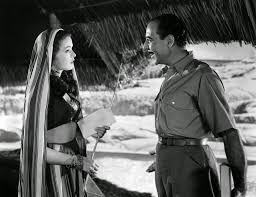
That’s how the region’s queen of trade, Zia (Tierney, immortalized as “Laura”) figures in. Half-French, Western educated, she inherited her father’s trading post empire and now is walking a tightrope between rival factions — Allied and Fascist — hoping to throw in with “the winners.”
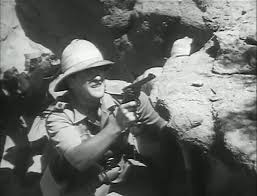
The natives are, um, restless, with the ghostly rumor that one of the “six white men” in this African troop’s outpost will “meet his death” on this night. Will it be Crawford, Lt. “Roddy” (Gardiner), Coombes, the jovial Italian history teacher turned army officer and now “prisoner of war” (Joseph Calleia, terrific) or the Dutch mineralogist (Carl Esmond) whose country fell to the Germans the year before? Or might it be the “White (elephant) Hunter” Dewey, played by veteran Western star Harry Carey?
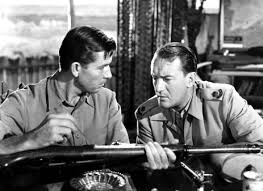
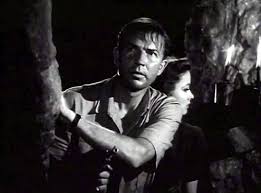
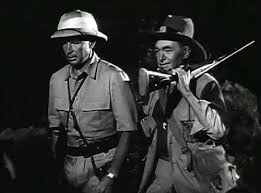
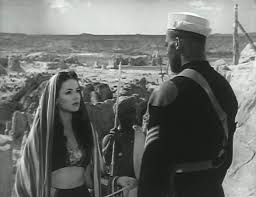
The action is well-handled even if the script struggles to reach for deeper meaning in the existential struggle between fascists, colonialists, the colonized and “Christianity” in all of this.
Tierney is showcased in all manner of belly dancer wear as Zia, who is respected by the Natives, ogled by the Brits and doted over by the Italian who knew her as a child.
“King Kong” veteran Cabot is properly stoic and idealistic, Sanders was well on his way to becoming the droll, bitchy wit famed for acrid put-downs in every movie that followed his turns as “The Saint,” “The Falcon” — “Laura,” “All About Eve” and “A Shot in the Dark” included. The laconic Carey adds credibility to his long in-country “hunter” who has seen it all and anticipated the changes in the wind.
But what remains striking about this aging actioner are the beautiful screen compositions of cinematographer Charles Lang. Principals and supporting players walk from inky darkness into pools of light at Crawford’s high-pitched thatch “hut,” in caverns or skulking about canyons others gather around a campfire.
It’s a lovely looking black and white film, and it demonstrates why Lang thrived during Hollywood’s Golden Age, and went on to light and shoot such classics as “Sabrina,” “Charade” and “Some Like it Hot.”
The deserts, augmented with process shots and fortress sets, show the work of three-time Oscar winning art director/production designer Alexander Goltzen (“Touch of Evil,” “Spartacus,” “The Beguiled,” “Play Misty for Me”).
“Sundown” may not make enough of the idea that fascism must be fought, even in sleepy backwaters like this corner of Africa. An epilogue/sermon by someone (Cedric Hardwicke) recognizing the sacrifices necessary to make every corner of the world safe for decent people doesn’t deliver the punchy pathos of similar moments in “Casablanca,” for instance.
But there’s something to be said for a movie that gives voice to the irony of a war being fought “everywhere,” where even the combatants can’t figure out the import of struggling over a place so out of the way that each day’s gin’n tonic time can’t come soon enough.
“Best part of the day, sundown. Nothing more to do in a place where there’s nothing to do anyway.”
Wait until Gene Tierney shows up.

Rating: TV-PG, violence
Cast: Bruce Cabot, Gene Tierney, George Sanders, Harry Carey,
Joseph Calleia, Reginald Gardiner, Marc Lawrence, Dorothy Dandridge, Jeni Le Gon, Carl Esmond, Emmett Smith and Cedric Hardwicke.
Credits: Directed by Henry Hathaway scripted by Barré Lyndon and Charles G. Booth, based on Lyndon’s novel. A United Artists release streaming on Tubi, et al
Running time:


 Movie Nation