
Which classic film to watch on a chilly Sunday afternoon often comes down to a coin toss for me.
Does the day have a ’40s, ’50s melodrama vibe? That usually means it’s Douglas Sirk or Nicholas Ray time. And if there’s a Ray film I haven’t seen popping up on the usual classic film menus, sometimes I don’t even bother tossing that coin.
“The Lusty Men” has a homoerotic title, Robert Mitchum and Arthur Kennedy and a rodeo setting with Susan Hayward as the woman set up to “come between them.” The possibilities in that are many, considering its bisexual director and the ways he toyed with male relationships and female archetypes in such classics as “Rebel Without a Cause” and “Johnny Guitar.”
Sure enough an overtly “butch” woman or two slips past the censors, even if they aren’t the focus of the movie. Even if the plot of “Lusty” lapses into the predictable, there’s sure to be something interesting to unpack in a Ray picture.
“Lusty Men” is groundbreaking in a much more conventional way. Rodeo had been featured in some of the earliest silent films, which used real life rodeo competitors to show off their roping, riding and cow-punching skills. But it was an alien world to the Wisconsin-born, former Frank Lloyd Wright apprentice, folk-music-connected, Federal Theatre Project trained Ray.
So Ray makes this love triangle melodrama a rodeo “explainer,” using grandstand announcers to detail the rules and traditions and dangers of each event. Real rodeo footage is edited into events that “legendary” bull rider Jeff McCloud (Mitchum) and cowhand/protege Wes Merritt (Kennedy) compete in.
Editing emphasizes the man-vs.-beast violence of the sport, especially in those “safety last” good ol’days when even veteran cattlemen didn’t know diddly about how to evade a goring/stomping by a Brahma bull who doesn’t like to be ridden and just “threw” you.
Safety and rodeo clowning evolved over the decades. But the character “types” and the reasons they do what they do haven’t changed in “The Wildest Show on Earth.”
It’s a way for fellows far from the center of the universe with an archaic professional skill set to change their luck, their fate and their cultural invisibility.
“For a little bit there,” crusty rodeo cowboy Jeff intones, “you’re a lot more than you was.”
But that isn’t what married man Wes will admit to when he talks about his motivations for trying his luck.
“A fella’s bankroll could get fat in a hurry, rodeoin’,” Wes muses. “I wanna toss a rope over my own cow, just once.”
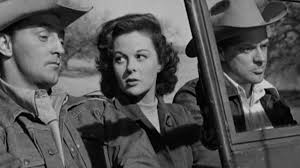
He dreams of owning their own place. Jeff has met Mrs. Merritt (Hayward). And whatever she says about their current state — her keeping a modest cabin that’s not their own, him just a ranch hand with access to a war surplus Jeep — everybody involved knows the stakes.
Jeff has taken one fall too many, “busted my last three ribs” and just limped back “home” to Big Springs, Texas. He ducks into the dusty hovel he grew up in, jaws with the old timer (Burt Mustin) who owns the family “ranch” now, and meets the Merritts, who keep stopping by.
The Merritts need $5,000 to buy the Old McCloud place from old Jeremiah. And they ain’t getting there fast on cowhand cash.
“Wes tells me you once made three thousand dollars in one day, rodeoin,'” Louise asks Jeff.
“That’s right.”
“And threw it all away,” she quizzes.
“Oh, I didn’t throw it away. It just sorta’… floated.”
Mitchum, the quintessence of manly cool in his day, is effortlessly credible as McCloud, a tough guy who rode hard, earned big and partied and frittered it all away on fancy saddles, boots and a cowboy’s idea of high living.
Louise may be tempted by the dollar signs, the shortcut her man might master to get them to their $5k quicker — if he doesn’t get hurt or killed. But most of her reservations are given voice by others.
Crusty Jeremiah describes the McClouds as “the most shiftless family ever to hit these parts.” A lady rodeo performer (“Ain’t no ladies around here,” cracks notwithstanding) wants to know if “Jeff ever made a pass at you,” on meeting Louise. Other women swoon or sulk at hearing Jeff’s name, and about his mentor/”partner” relationship with Wes, once he’s gone behind his wife’s back and started competing.
Wes? He’s dreaming of that yet-to-be-written Garth Brooks tune, “Rodeo,” with lines about “It’s the roar of a Sunday crowd, It’s the white in his knuckles, The gold in his buckle, He’ll win the next go ’round.”
Louise is the only one who envisions the unborn Garth and his song’s dark side — “a broken home and some broken bones, Is all he’ll have to show, For all the years that he spent chasin’ This dream they call rodeo.”
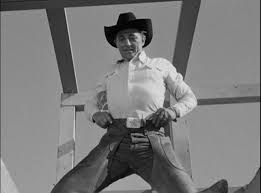
Ray sets all this up with a montage of a “rodeo days” parade, clever quick cuts that put Mitchum straddling that stall, dropping down on that one bull he shouldn’t have ridden and his slow limp through an empty, windswept and litter-strewn arena — his belongings stuffed into small duffle bag — a rodeo rider who hits the end just shy of 40.
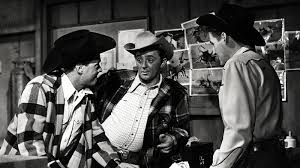
Other scenes of veteran riders chewing the fat and rodeo groupies hanging around, man-hunting and husband-stealing, immerse us in this living-in-a-trailer/always-on-the-road life, which Louise finds herself hurled into without her consent.
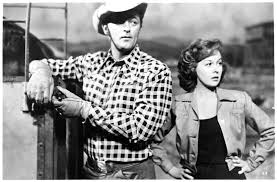
Mitchum’s Jeff has been around the block. He knows the conflict that’s coming. He doesn’t have to lean into any hunch about “chemistry.” Hayward and Mitchum set off the sparks that tell us what could happen. It’s just a question of “Will it?” and “What then?”
The atmosphere and intimacy of this time-tested story, even the squarish “Academy” aspect ratio of it all, lower expectations for this black-and-white-but-not-noir classic. It looks, feels and sounds like a very good B-movie with an A picture’s cast and producer (Jerry Wald), which is what it is.
The film embraces — at arm’s length — the pageantry and romance of rodeo, but never loses its cynicism about this risk-your-neck-for-a buck “sport.” Veteran character actor Arthur Hunnicutt gives voice in many digs at the high-risk/low-returns lifestyle in portraying a busted-up hanger-on whose rodeoing days are long gone. “Booker” shows off his “most busted leg in the world” to newbies who fork over a quarter.
“Twenty years rodeoin’ done that. Leg busted nine times, kneecap five, and the ankle four… Nobody’ll ever beat it unless they jump off one of them New York skyscrapers!”
But nothing will break the fever of a man who catches it, not even the concern of the prettiest hash joint waitress-turned-wife ever.
Guys like “rodeo tramp” Jeff may serve up jaundiced endorsements. But nothing he or anyone else says, poetic or discouraging or both, expresses anything but blind optimism about their “chances” and the bargain they struck to take them.
“There never was a bronc that couldn’t be rode, there never a cowboy that couldn’t be throwed. Guys like me last forever.”

Rating: “approved,” fisticuffs, rodeo violence, alchohol abuse, infidelity — TV-PG today
Cast: Susan Hayward, Robert Mitchum, Arthur Kennedy, Arthur Hunnicutt, Carol Nugent, Frank Faylen, Lorna Thayer, Maria Hart and Burt Mustin.le
Credits: Directed by Nicholas Ray, scripted by Horace McCoy and David Dortort, “suggested by” a magazine story by Claude Stanush. An RKO release streaming on Tubi, et al.
Running time: 1:53



