
Novelist R.L. Palacio’s attempt to turn out a sequel to her best-seller “Wonder,” which became a Julia Roberts weeper on the big screen, seems well-intentioned enough. But tying that story about a precocious child bullied simply because he looks :different” to The Holocaust might seem a stretch, and the film made from that literary sequel “White Bird” can’t escape being cloying and cliched.
Still, bullying is how fascism gets its start, and America and much of the world is coping with the consequences of that in ways the first film could only hint at. Skip past the “let’s cash in on a hit” ethos that hangs over all sequels and there’s a perhaps unintended timeliness to this tale.
The bully who needs to learn the error of his ways is Jewish, a New York child of privilege who doesn’t know his family’s history with that sort of behavior.
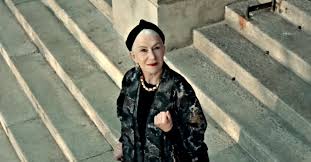
Helen Mirren plays the famous French painter and grandmother to prep school punk Dillon (Teagan Booth) who was expelled from his previous school for bullying little Auggie of “Wonder” a while back. Grand-mère conveniently shows up at the family townhouse after Dillon’s first day at his new school, where he’s witnessed rich boys he’d like to impress bullying the compassionate, human rights activists of the student body.
Dillon did nothing. As he figures the lesson from all that is to “mind my own business, don’t be mean, don’t be nice,” granny is here to state the obvious.
“Always be kind,” she preaches. Stick up for the bullied. And then she tells him the long story of her Holocaust childhood in Vichy France, a time “when it took courage to be kind” to Jews like her, and by extension, Dillon.
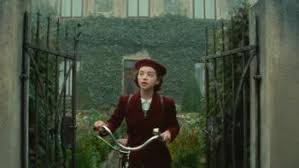
Young Sara (Ariella Glaser) was a fashion-conscious young teen just taking an interest in boys in 1942, when all of a sudden the French government’s Nazi overlords made anti-Semitism not just the law of the land, but fashionable among the French populace.
Sara was already a talented artist, but she doesn’t get how things are changing until the handsome Gaul she’s smitten with (Jem Matthews) takes note of her drawing and says it’s “not bad, for a Jew.”
Her mother (Olivia Ross) counsels that this spreading hatred “is like a bad storm. We just have to let it pass.” But Dad isn’t shy about scaring them all to death with what’s coming. He makes Sara promise to keep her overcoat with her and wear her winter boots at school all day. Naturally, she’d prefer to ditch the coat and don her ruby red shoes the moment she’s in class.That almost costs the child her life.
The Nazis show up, Jewish kids are grabbed and she escapes with her life. And who becomes her savior but the “crippled” boy the school bullies have all nicknamed “crab” because of the way he walks.
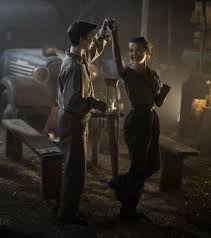
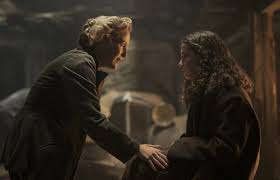
Julien, “my REAL name,” is a boy (Orlando Schwerdt) of resourcefulness and resolve. Mechanically-inclined enough to be the assistant projectionist at the town cinema, he spirits her away and hides Sara in his barn. Her parents were arrested, but Julien’s parents Vivienne (Gillian Anderson) and Jean-Paul (Jo Stone-Fewings) are all-in on saving her from certain death.
Julien must take daily risks of discovery, keeping the secrets of his projectionist/French Resistance fighter boss, his parents’ sympathies, the compassionate teachers and headmaster of the Catholic school and Sara’s survival from not just the Germans, but from French collaborators, including the school bullies.
Here, those teens are given black uniforms, berets and machine guns, with the freedom to harass and shoot neighbors/classmates they suspect of anti-German activity.
The perils are no different from those faced by those in hiding in many other versions of this sort of story — including historically true ones, and not just the fictional accounts. The twists mostly melodramatic. The title? That’s the symbolic version of the “little bird” her parents used to sing to Sara about, now white and appearing at important moments in her struggle to survive.
The life lessons passed on include “They hate us because they can’t see us,” and the way to fight that is to ensure that you’re seen.
With anti-Semitism on the rise and accusations of it being used to silence criticism of Israel and its unquestioning supporters, one might think there’s always a case for telling and retelling these stories, especially to the young.
But after “The Boy in the Striped Pajamas” and “The Book Thief,” there’s something to be said for avoiding bland, treacly melodramas on this subject, holding out for something with more moral, intellectual and aesthetic heft.
Director Marc Forster is a long way from “Monster’s Ball” or even “World War Z.” He still ensures this is a slick, good-looking and professional production. But covering the same ground in an utterly conventional, voice-over-narrated-to-death melodrama gives us a film with no thrills, little suspense and, thanks to generally bland performances, almost no emotional resonance.
That’s doing a disservice to the subject and the tragic history that inspired it.

Rating: PG-13, violence
Cast: Helen Mirren, Ariella Glaser,
Orlando Schwerdt, Teegan Booth, Jem Matthews, Teagan Booth and Gillian Anderson.
Credits: Directed by Marc Forster, scripted by Mark Bombak, basedon a novel by R.J. Palacio. A Lionsgate release.
Running time: 2:00



