Documentary Review: Ambulance Drivers of Mexico City are the “Midnight Family”

midnight1

The sprints, hurtling through the crowded streets of Mexico City, are a matter of life and death.

Sirens wailing, lights flashing, a paramedic bellowing over the megaphone, “Taxi, move MOVE” or “You idiot on the bicycle! GET ON THE SIDEWALK!”

And that’s just the race to get to the accident scene. In Mexico City, there are virtually no “government” ambulances. And the few private ones compete in mad dashes to get to the accident, fight or shooting first. If they don’t, nobody gets paid — not the crew, the cops who might have tipped them about the need for their services, and who expect a bribe even if they didn’t.

The patients? Often they fight over paying up.

“Midnight Family” is a harrowing and cautionary inside look at the Wild West of Mexico City emergency services. “The private sector” has taken so much of “public” care that it’s every beat-up old ambulance for itself, with pricey private hospitals paying kickbacks for deliveries and dirty cops hassling drivers over their licenses, their professionalism and their slowness over paying them bribes to let them do what they came to do.

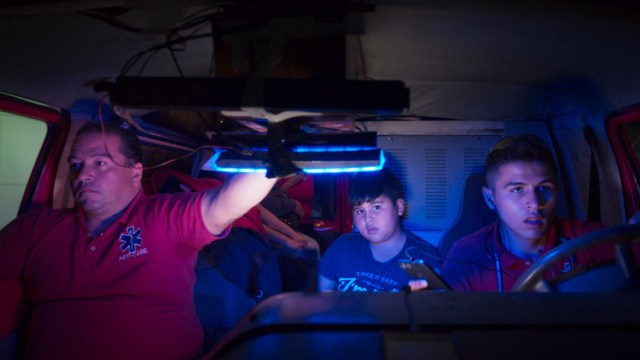
Director Luke Lorentzen (“New York Cuts”) puts us in the front seat of the Med Care van staffed by the men of the Ochoa family, freelance entrepreneurs trying to feed and care for a big family from inside an ambulance. Their story has thrills and compassion, hard luck and grief.

And in them, any North American can see a cautionary tale of what happens to a health care system left up to its libertarian, market-driven devices. People are suffering and dying as money-grubbing corruption slows down the most basic of services — saving those hurt, in bleeding and in pain.

Fernando seems to be the patriarch, and he and (I take it) his brother Manuel are the ones who comfort the teen girl whose boyfriend just broke her nose, who pat and plead with a baby, whose glue-sniffing dad has accidentally injured, to resume breathing.

Juan is the mouthy 17 year-old go-getter. He likes to drive, uses his down time to breathlessly recite his evening’s exploits to his older girlfriend. He chews on Fernando to “take this seriously,” whenever they’re asked for their “papers” by a cop.

“This ambulance FEEDS us,” he pleads (in Spanish, with English subtitles).

Rolypoly Josúe can’t be more than 12. He rattles around the back as the ambulance recklessly races down the street, locking this bit of gear down, for he too has a role here. He’s not just onboard to complain about food and the money it’s going to cost for his next meal.

Lorentzen sees elements of the fictional features “Nightcrawler” and the Nic Cage ambulance driver tragi-comedy “Bringing Out the Dead” here, and plays them up. Ambulance drivers compete like gladiators running the chariot race in “Ben-Hur.” Losing can be life threatening. But they compare notes while sitting around on centrally located street corners, waiting for that next call. Which cops are the biggest pain, what was their toughest ride this week?

midnight2

Accident scenes are chaotic. The cops aren’t there to direct traffic. They’re “investigating” and doing paperwork and hassling ambulance crews, chiding them for not having the right “plate,” the required gear or what have you.

“Midnight Family” lets us be touched by Fernando’s compassion, his inability to strong-arm victims and family members who (off camera, but overheard) haggle over the fees of paramedics who just tended to their loved-one and raced them to the hospital, often of their choice.

But the whole “system” is just appalling, a bare bones service struggling to meet the demand of a largely-uninsured populace and a medical establishment which isn’t just two-tiered, it’s sliding-scale budgeted. “Government hospital,” where you’re lucky if they can squeeze you in, deluxe “private hospital” where you expect the best care, and other private hospitals which sit somewhere in the middle, unless they’re too far away to do anybody any good.

No, you do NOT want to have an accident or need of emergency services in Mexico City. What’s even scarier is how the worst parts of that experience could take over anywhere that tax-supported services are slashed in a “You’re on your on, pal” race to the bottom.

3stars2

MPA Rating: unrated, limited graphic injury footage

Cast: Juan Ochoa, Fernando Ochoa, Manuel Ochoa and Josúe Ochoa.

Credits: Directed, shot, written and edited by Luke Lorentzen. A 1091 Media release.

Running time: 1:20
Posted in Reviews, previews, profiles and movie news | Comments Off on Documentary Review: Ambulance Drivers of Mexico City are the “Midnight Family”

Next screening? “1917”

Looking at the slate of films stretching out to the end of the year, this may be the last one I am dying to see.

Interested in “Bombshell,” intrigued by what Clint will do with “Richard Jewell,” indifferent to “Cats” and pretty much everything else.

But a “Great War” drama that isn’t about a “War Horse?” I’m there.  “1917” opens Christmas Day. 

Posted in Reviews, previews, profiles and movie news | Comments Off on Next screening? “1917”

Movie Review: “Anya” is different, all the way down to the genetic level

anya1

“Anya” begins with a love story, and we don’t believe it for a second.

Its moments of whimsy have a forced, static quality, and never feel anything but scripted, contrived and stiff.

But taken as science fiction, which is what this is, “Anya” is a provocative tale of human genetics, cultural isolation and ethnic necessity grafted onto an unlikely coupling and what that couple wants out of this relationship.

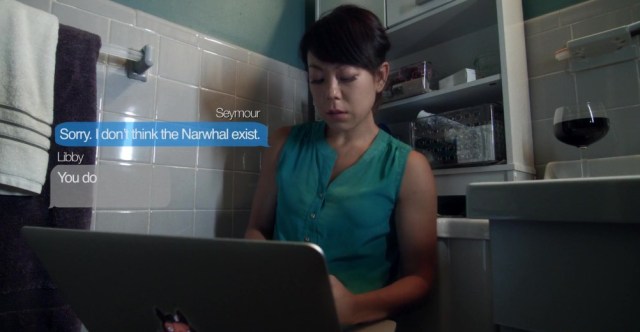
Libby (Ali Ahn of “The Landline” and TV’s “Billions”) has dragged Marco (Gil Perez-Abraham) to the ramshackle boat a former beau (Motell Gyn Foster) lives on. She and Marco have married, and want to have children.

But something isn’t working, and Marco’s answer about the cause isn’t likely to pass muster with evolutionary geneticist Seymour (Foster).

“He’s cursed,” Libby declares. Marco was warned that “anyone who left the community could never have kids.”

“The community?” That would be a corner of the South Bronx called “Little Narwhal.” Marco’s “people” speak something like Spanish, and are from an island in the Caribbean given the unlikely appelation, “Narwhal Island.”

Narwhals, for those not familiar with the way the London knife attacker was subdued, are tusked whales who live in the Arctic. Not the Caribbean.

Seymour is intrigued enough to have Libby fill him in on her unlikely courtship, marriage and attempts at procreating with Marco. Emails prompt flashbacks.

She is older and more “experienced,” something she figured out when she (a reporter) met him. Marco was wearing exotic garb which, apparently, he’d sewn himself. He is gorgeous, so we get the sexual attraction.

But they met the day he was kicked out of his community. He has no experience of New York outside his tiny corner of it, no profession.

“How old are you?” she wants to know. “The right age” is his only answer.

Even given Libby’s intense desire to have a child, this isn’t much to build a relationship on, real or fictional.

Flashbacks skip through the tentative (and wholly illogical) courtship, and Libby’s organized, calendar-tracking attempts at procreation. Early misscarriages abound.

That’s where Seymour comes in. He takes a swab from Marco and Libby’s mouthes, and analyzes the DNA these show them. An expert on Neanderthal DNA turns out to be the perfect one to confront what he finds. Marco’s people are a whole new subset of humanity, one unable to procreate with cute Korean-American reporters.

The most interesting potential element of co-writers/directors Carylanna Taylor and Jacob Akira Okada’s film is its depiction of a tiny subculture, tucked away in plain sight in a New York neighborhood. They gather at a hidden (not really open to the public) bookstore, sing and dance in their native tongue, and shun anyone who leaves their “family.”

There’s a hint of Orthodox Judaism to this sectarian world of what one can only describe as “ethnic purity,” where genetics limit the dating pool so severely that arranged marriages are the rule and group intimidation of those who try to “leave” is the norm.

Foster’s Seymour is the focus of the film as we visit him in his lab, where he discusses the ethics of this research with colleagues and assistants. But for a guy so obsessed with discovering and “publishing,” he can’t seem to even locate this “unicorn” island where these people came from. Isn’t there a geographer on the faculty?

It’s a sci-fi “fairytale,” a I guess. And as such, it’s sorely lacking.

That points to “Anya’s” overarching shortcoming. You can have an interesting milieu and subject, but the lack of evidence of a “love story” driving the narrative leaves it kind of heartless. Libby’s “ticking biological clock” is never addressed as a motive. We simply see a pregnancy magazine. And brooding Marco is pretty to look at, and temperamental.

But what could they possibly TALK about? I mean, meeting somebody in New York is supposedly nigh on impossible, but seriously. The blasé dialogue is a reflection of that.

And lacking the charm or warmth the story should hang on in order to work, we’re just left with a quirky scientist and the unhappy mismatched folks who want to bring a child into the world because…they just want to, OK?

It’s interesting, all right. That’s just not enough.

2stars1

MPA Rating: unrated, sexual situations

Cast: Ali Ahn, Gil Perez-Abraham, Motell Gyn Foster

Credits: Written and directed by Jacob Akira Okada, Carylanna Taylor. A First Encounter release.

Running time: 1:20
Posted in Reviews, previews, profiles and movie news | Comments Off on Movie Review: “Anya” is different, all the way down to the genetic level

Movie Review: Let’s head down the rabbit hole of “The Mandela Effect”

Imagine a low-budget movie whose characters take “The Matrix” a little too seriously. They think we’re all living in “The Matrix,” a vast computer program that has just enough glitches in it to give us clues about what’s going on.

Our memories tell us that the comic Sinbad played a genie in a movie called “Shazaam,” we were sure that Nelson Mandela died in a South African prison in the ’80s, “Jif” peanut butter used to have a different name.

And who the heck changed the “Looney Toons” series of cartoons to “Looney Tunes?”

Imagine a REALITY where Internet conspiracy buffs see all this as “proof” that it isn’t our memories that are tricking us, it’s the Master Programmer, or whoever.

Concede this point to the makers of “The Mandela Effect.” They’ve hit on a fascinating hook. Their trip down the rabbit hole isn’t as compelling or suspenseful as one might hope, but for subject matter, they’ve picked a doozy.

“Mandela Effect” is about a couple (Charlie Hofheimer, Aleksa Palladino) grieving for their lost daughter. Claire is struggling to get back to a routine. But Brendan? He’s talking to their preacher (Tim Ransom), asking the big question.

“If there is a God, why’d he take Sam (Madeleine McGraw)?”

When Brendan and Claire have conflicting memories of where a photograph of the entire family was taken, he takes his search for existential reality to that font of all that’s wise, good and factually-vetted for our protection — the Internet.

Before you know it, he’s wondering who the hell stole Curious George’s tail, what happened to the monocle on “The Monopoly Man” and just who or what is causing this mass mis-remembering that he sees people on the WWweb sharing.

mandela1

Co-writers David Guy Levy and Steffen Schlachtenhaufen weave voices and clips of people of science like Neil DeGrasse Tyson and Abhishek Kothari debating reality, string theory and the like, and “Mandela Effect” guru Fiona Broome speculating on what might be going on. It’s very “JFK,” and almost convincing in positing that this is something serious people talk about, even if the most serious are only doing it as a thought experiment.

Once you grab onto the date of the Cern Supercollider going online and an infamous George W. Bush faux pas about Nelson Mandela being dead, you’re “into the multiverse,” without scores of (blurry) Spider-Men to guide you through it.

Look at all the links I’ve posted in this review. This is fascinating speculative science, even if it is science fiction.

The movie can’t quite wrestle the pathos it needs out of this search for a reality where their daughter DIDN’T die. Palladino (“Halt and Catch Fire,” “Boardwalk Empire”) is better at giving the couple’s loss the emotions it warrants. Hofheimer’s Brendan, like the viewer, is hunting for “alternate facts” to explain the “unreal” nature of the death of their daughter, too wrapped up in coding and research to let go.

I needed a little more paranoid prophet out of the scientist (Clarke Peters) Brendan consults. A bit more heat to the debates with the brother-in-law (Robin Lord Taylor) was in order, too.

The effects, because you know there are going to be effects simulating the breakdown of the “simulation,” are first rate — “Matrix” and “Tron” touches.

But the best one can say about “The Mandela Effect” is that it’s a fascinating, if heartless, failure, skimming the surface of the conspiracy, not doing justice to the tragedy even if it ensures that we never, ever watch “Looney Toons (Tunes)” the same way again.

2stars1

MPA Rating: unrated, fisticuffs, sexual situations

Cast: Charlie Hofheimer Aleksa Palladino, Robin Lord Taylor and Clarke Peters

Credits: Directed by David Guy Levy, script by David Guy Levy, Steffen Schlachtenhaufen. A Gravitas Ventures release.

Running time 1:20

Posted in Reviews, previews, profiles and movie news | Comments Off on Movie Review: Let’s head down the rabbit hole of “The Mandela Effect”

Questlove from The Roots and “The Tonight Show” to direct a documentary — “Black Woodstock”

Variety has the news that a 1969 Harlem music festival, contemporaneous to Woodstock, will be the subject of this compilation doc and history lesson.

Fresh live footage of Nina Simone and Sly and the Family Stone? I’m down.

https://t.co/XZxuROwRIc https://twitter.com/Variety/status/1201516548692873216?s=20

Posted in Reviews, previews, profiles and movie news | Comments Off on Questlove from The Roots and “The Tonight Show” to direct a documentary — “Black Woodstock”

BOX OFFICE: Give ‘Frozen 2’ $124M Holiday Record, ‘Knives’ carved up $42M

It’s not the overall all time Thanksgiving weekend record, which came from the tens of millions tallied by last year’s offerings.

But “Frozen 2” iced the single film holiday weekend record, with “Knives Out” pulling in a not-too-shabby $42 million over the five day “weekend.”

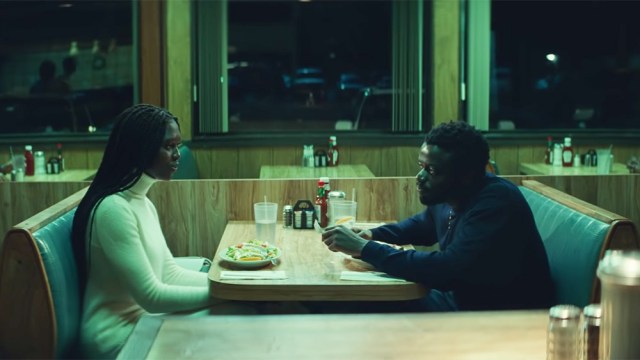
“Queen & Slim” took in $15, “Beautiful Day in the Neighborhood” just under that, “Ford v Ferrari” just over $19.

https://www.hollywoodreporter.com/news/frozen-2-box-office-scores-124m-holiday-record-knives-hits-42m-1258559

Posted in Reviews, previews, profiles and movie news | Comments Off on BOX OFFICE: Give ‘Frozen 2’ $124M Holiday Record, ‘Knives’ carved up $42M

Movie preview: Might “THE TURKEY BOWL” be NEXT year’s holiday hit?

Rhetorical question, of course.

Posted in Reviews, previews, profiles and movie news | Comments Off on Movie preview: Might “THE TURKEY BOWL” be NEXT year’s holiday hit?

Netflixable? “I Lost My Body” is a dark animated fantasia of an immigrant’s life in Paris

body1-1.jpeg

I’m not quite satisfied with that headline for this review. Remind me to return to that and have another go encapsulating “I Lost My Body,” the strangest animated offering you’ll see on Netflix this year.

It’s a memory play, a romance and a twisted fantasia on one clumsy dreamer’s youth, his “accidents” and the “fate” that brought him to Paris, to work and within the orbit of the fair librarian, Gabrielle.

Blood pooling on the floor, a busted pair of glasses and a face introduce us to Naoufel (voiced by Hakim Faris). But in a life-passing-before-his-eyes reverie straight out of Camus, his mind drifts to a (black and white) past, his childhood — palm trees and flies, everyone speaking French, and piano lessons.

My best guess (not having read the Guillaume Laurent novel this is based on) is that Naoufel grew up in Beirut.

He remembers the sounds he gathered as a boy with his cassette recorder, his father telling him how to catch a fly. “Aim for the side,” his father counsels (in French, with English subtitles, should you choose that default language setting).

The story takes us to Naoufel’s fictive present, a 20ish lad sharing a crowded apartment with other Arab world emigres, blundering through pizza deliveries on his scooter, bullied by many, indulged by few.

And then there’s the third story thread, The Great Escape. A disembodied hand breaks out of a fridge in a morgue, spilling eyeballs as it does, and makes its way out a window into the unaccomodating (for a hand with no body attached to it) world outside. Mortal combat with a pigeon and rats, near-“death” experiences with a dumpster and trains, groping along a gutter, floating on an umbrella — a hand’s eye-view of the City of Light.

body2.jpeg

Nauofel’s life-changing moment, the story’s driving incident, happens on yet another botched delivery. He, his scooter and his pizza hid and damaged by an unrepentent motorist.

The voice on the intercom of the high-rise where he makes this belated drop off is feminine and rude.

“You should get a new job,” she says, over-explaining how the name on the buzzer isn’t her, how he’s getting no tip, how she’s not coming all the way to the lobby to pick up this very late (and it turns out, ruined) pizza.

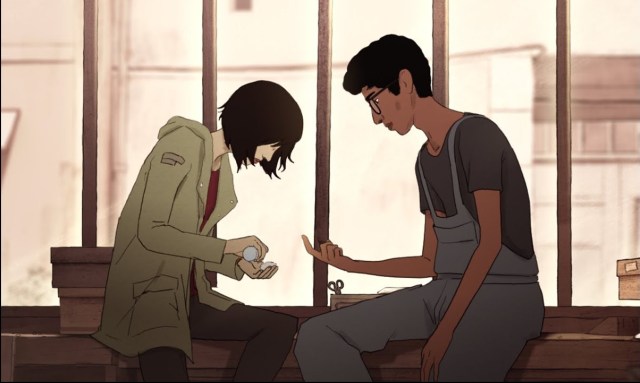
But saying he had an accident brings out the unexpected — empathy. The chat turns almost flirtatious. No, she’s not coming down. But Naoufel has a goal, now. He must meet this Gabrielle (the voice of Victoire Du Bois). If that means taking a job with her woodworking uncle, so be it.

“I Lost My Body” weaves these three story threads into a resolution, connecting the past with the present, the real with the fantastical.

And it manages all this connection and mysteries resolved in just 81 minutes.

That brevity works against the film, at times. Just when the potential romance, a meeting of the minds, is flowering, we cut away to the cut-off hand. Just when we’re getting to where the hand came from, we’re shown Naoufel’s childhood again, folding in how he was then to the young man he grew into — dreamy to the point of clumsy.

The animation is understated and under-animated. It has the jerky motion of using a lower frame rate (anime speed). But first-time feature-director Jérémy Clapin and Laurent, a French cop turned screenwriter and award-winning novelist, have conjured up a lovely, surreal odyssey as animated memory play, and an engaging and ambitious film that cannot be adequately summed up in a headline.

It almost (but not quite) defies description.

3stars2

MPA Rating: TV-MA, violence

Cast: The voices of Hakim Faris, Victoire Du Bois, Patrick d’Assumçao

Credits: Directed by Jérémy Clapin, script by Guillaume Laurant and Jérémy Clapin, based on Guillaume Laurant’s novel. A Netflix release.

Running time: 1:21

Posted in Reviews, previews, profiles and movie news | Comments Off on Netflixable? “I Lost My Body” is a dark animated fantasia of an immigrant’s life in Paris

Netflixable? “The Body Remembers when The World Broke Open”

body1

I said, in my very first review of a “Netflix Original,” back when the DVD turned streaming service was getting into acquiring and distributing its own movies, that intimate indie films should be their bread and butter.

They don’t cost much, they’re almost always worthier of a bigger audience than they ever find, and they lose nothing in translation to smaller screens.

There’s nothing epic about “The Body Remembers when the World Broke Open,” save for its title. It has no Oscar pretentions, again, save for that pretentious title.

But this compact, intimate story was well worth telling and is worth seeing, a drama told in real-time about two women of Native American heritage stumbling into one another and struggling to find common ground to solve a real world problem in big, impersonal Vancouver.

Co-writer/directors Kathleen Hepburn and Elle-Máijá Tailfeathers wrap this story, set in an almost never-filmed culture’s diaspora, in rain and trauma, mistrust and the common ground of gender and race. A hyper-realistic character study in crisis is what emerges.

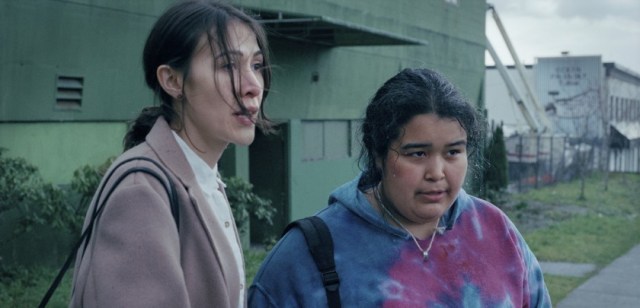
We meet Rosie (Violet Nelson) on the bus, followed by a long walk home to the apartment she shares with her grandparents. She is almost 19 and very pregnant, but seemingly happy about her state.

Aila, played by co-writer/director Tailfeathers, is meanwhile getting a pap smear at her OB-GYN, a young professional in a long-term relationship thinking about having a baby. She had an abortion, she tells her doctor, probably when she was about Rosie’s age.

We don’t see the brawl that sends Rosie running into the cold, rainy streets. We just hear the livid screams of her “lover.” She’s bruised, wet and shoeless. That’s how Aila finds her at the bus stop.

Aila hears the still bellowing boyfriend, sizes Rosie up and talks her into coming home with her. That’s where the questions start.

“Grew up on the Rez?” “Got anybody looking out for you, Rosie?” “So, what d’you think you want to do, then?”

No, she didn’t up on The Reservation. And “some people feel like they’ve gotta talk all the time.” Rosie is evasive, mistrusting of anyone or anything that would put her in “the system.” No cops. What is this half-Blackfoot/half Sami (Scandinavian indigenous) woman who is drying her clothes up to?

Aila: “You’ve got a mouth on you, hey? You think I’m trying to save your soul, or something?”

Rosie: “You sound like my case worker!”

They talk, tentatively, feeling each other out. Aila wants to get Rosie into an abused women shelter. Rosie wants her clothes out of the dryer, maybe the loan of a pair of shoes. We’re treated to a soft-sell sales job, trying to convince a battered, pregnant woman to remove herself from her bad situation, a defiant young woman determined not to be pushed into anything she doesn’t want.

When they’re not quietly bickering, they find amusement in the fact “everybody’s Native these days.” When they get into a taxi together, Rosie invents a hilarious story of how she is taking “my sister” to rehab. Hey, anything to give a taxi driver to talk about how long he’s been “a friend of Bill” (in AA) is good for a laugh.

And wait, Canadians don’t say “Ey” any more? It’s “Hey” here.

The lack of dramatic fireworks mute the film’s impact somewhat. And young Ms. Nelson has an unfortunate tendency to mumble, swallow her lines.

That’s OK. Watch it with headphones or earbuds, or rewind it a bit. Movies like “The Body Remembers when the World Broke Open” were what Netflix was made for.

2half-star6

MPAA Rating: TV-MA, adult subject matter, profanity

Cast:Violet Nelson, Elle-Máijá Tailfeathers, Charlie Hannah, Barbara Eve Harris

Credits: Written and directed by Kathleen Hepburn and Elle-Máijá Tailfeathers. A Netflix release.

Running time: 1:45

Posted in Reviews, previews, profiles and movie news | Comments Off on Netflixable? “The Body Remembers when The World Broke Open”

Movie Preview: Psychologist Gere probes the minds of Dinklage, Goggins and Whitford — “Three Christs”

A group therapy period piece with an all-star cast, including Julianna Margulies and Jane Alexander, “Three Christs” follows an early attempt at “understanding the delusions” of three men in a mental hospital in 1950s Michigan.

Peter Dinklage, Bradley Whitford and Walton Goggins play men who are sure that they’re Jesus Christ.

Veteran producer and director Jon Avnet (“Fried Green Tomatoes”) filmed “Three Christs” in 2017, but it finally reaches screens, via IFC, on Jan. 3.

Posted in Reviews, previews, profiles and movie news | Comments Off on Movie Preview: Psychologist Gere probes the minds of Dinklage, Goggins and Whitford — “Three Christs”