
Partly because he drives the most collectible Aston Martin on Earth.
Looks pretty cool for an April thriller, launched to get an early jump on summer.
Partly because he drives the most collectible Aston Martin on Earth.
Looks pretty cool for an April thriller, launched to get an early jump on summer.
An accomplished cast, including William Hurt, Christopher Plummer, Ed Harris, Samuel L. Jackson and Sebastian Stan, impressive combat footage, a potentially compelling story?
Too bad “Roadside Attractions” has“The Last Full Measure.”Nobody’ll see it when it comes out Jan. 24.
I’ve seen a couple of Ned Kelly biopics over the years.
He’s generally portrayed as Australia’s Billy the Kid. A rebel, cunning, ruthless, celebrated, infamous.
Here he’s starting “a revolution.”
George MacKay is Kelly, with Russell Crowe, Charlie Hunnam and Nicholas Hoult in the cast. Let’s hope it gets decent U.S. distribution.
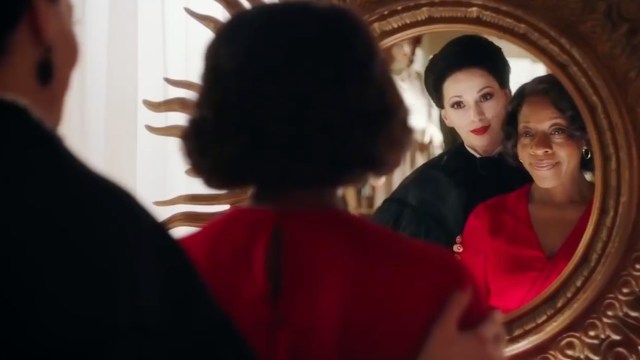
Here’s a devilish dose of macabre, masochistic guilt for everything you bought on Black Friday, and just in time for Christmas!
With “In Fabric,” horror auteur Peter Strickland (“The Duke of Burgundy,” “Berberian Sound Studio”) takes on consumerism, wage slavery and the global curse that is fashion, viewing them all through the prism of the lurid, kinky ’70s horror films of Dario Argento and his ilk.
It’s a tale of a dress possessed, giving everyone who wears it a rash. As if that’s not enough, this stylish 1970s “Ambassadorial Function Dress” has a mind of its own. If the rash and the dreams it provokes don’t drive the wearer mad, the damned thing will slide its metal hanger down the metal rack of your closet — screech screech — and try to suffocate you, or worse.
Returns? Even harder in Britain than they are in America. Especially when you’re dealing with a staff that just checked out of the Hotel Transylvania.
A dark comedy awash in style that creeps you out and pins the “ick” meter won’t be to every taste. Violence isn’t the half of it. Menstruation to masturbation, this one covers a lot of bases, none of them pleasant. But with each passing minute that “In Fabric” weaves its chillingly comic spell, it wraps the viewer in a shroud we can’t escape without tripping as we do.
Marianne Jean-Baptiste of “Secrets & Lies” and TV’s “Without a Trace” is Sheila, a newly-separated bank teller with only her rebellious teen painter son (Jaygann Ayeh) for company. She could do with a little companionship, and this being the age of landlines, rotary phones, answering machines and personal ads in the local weekly, she’s starting to date.
Montages of still photographs and bursts of retro TV ads for “The Sales” reinforce the idea that this is Britain in the ’70s, and that January — the big post-Christmas shopping frenzy — awaits. That’s when Sheila sets out to buy the dress.
The store she chooses is the most peculiar clothier this side of “Seinfeld’s” version of J. Peterman. And the Slavic-accented sales clerk (Fatma Mohamed) promises her “a panoply of temptation,” a dress that will flatter her and fill “the crevices of clarity” in her date’s mind.
Damn. That’s some sales pitch. Miss Luckmoore (Mohamed, a mainstay of Strickland’s films) is pale as death, dressed in black and given to the plummy locutions of an exotic Mistress of English as a Second Language.
“Your dressing room awaits…your dress to coalesce into a simple union of wonders!”
Thus begins Sheila’s dark night of the retail fashion soul — a rash, nightmares, a dress that literally does battle with her washing machine and might just smother the insufferable and insulting artist’s model (Gwendoline Christie) who has taken up with her son.
Better keep the receipt, honey.
Sheila’s battle with the scarlet dress — what to do about it, with it — is but the opening salvo of a war. Others will be helpless in its thrall. And with the perverse rituals Miss Luckmoore, her boss (Richard Bremmer) and staff perform on store manikins after hours, it’s no wonder. That dress is ready-to-wear Satanic possession.
The British emigree Strickland makes his home, if not his movies, in Budapest, Hungary. His obsession with Transylvanian Gothic reaches full flower with “In Fabric,” from its blood-red dress-of-death to the Daughters of Dracula sales staff in the women’s wear department at Dentley & Soper’s.
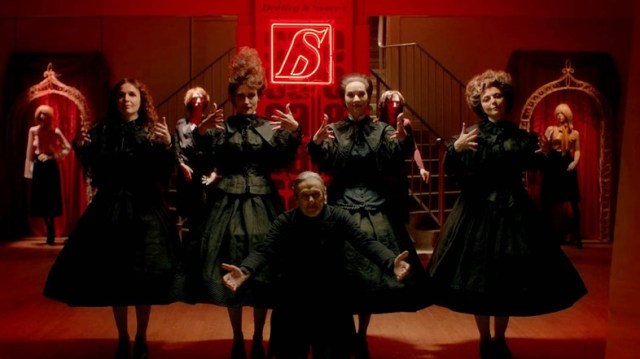
He finds humor in sex scenes, with one or two partners. He scores his satiric points not just in caveat emptor, or let the covetous beware. Through Sheila’s two weirdo (gay, nosy and invasive) bank bosses (Julian Barratt and Steve Oram) Strickland scores points on the rising imbalance in the employer/employee relationship.
Their clucking voices have a touch of passive aggression and threat, their eyes close in almost orgasmic delight at noting every imagined shortcoming, every psychological issue extrapolated from some idiotic invented transgression that they lay on Sheila in their best human resources-speak. An “insolent salutation” could be a black mark on her record.
Mohamed is the break-out in this fine cast, her deft way with the florid, Slavic-accented poetry of retail scripted by Strickland is a thing of rare beauty.
The score, by Cavern of Anti-Matter, smacks of electronic harpsichords swirling into power chords — a Walter Carlos before Wendy Carlos came to be evocation of the ’70s. The montages of still photographs — people shopping, street scenes, etc. — have a “Night of the Living Dead/Zapruder Film” tint.
“In Fabric” takes a while to settle in, and that goes for the viewing experience, too. It takes a few minutes for us to surf the wave Strickland wants us on, to get in sync with the vibe he’s going for.
But rare is the horror movie that finds off-the-rack laughs in everything from ’70s fashions and consumerism to ’70s British sex and slang, and does it with haute couture style.

MPAA Rating: R for strong sexual content including a scene of aberrant behavior, and some bloody images
Cast: Marianne Jean-Baptiste, Fatma Mohamed, Hayley Squires, Leo Bill, Julian Barratt and Steve Oram
Credits: Written and directed by Peter Strickland. An A24 release.
Running time: 1:58

You want to get your indie comedy financed and distributed? Sign some “names” for the cast. Advertise them as the “stars.”
So sure, Val Kilmer’s only in a single scene, as “President Biden, nightmare in chief.” Put his name above the title.
Get Billy, pardon me, WILLIAM Baldwin to play a hard-nosed campaign guru who’d like to help Tom Berenger get into the White House.
Denise Richards? Make her a hard-hitting TV journalist. Drag Dominique Swain (“Lolita”) in to play a trashy neighbor.
That was enough to get me to review “1st Born,” so I guess it worked, right?
But the film stars Reza Sixo Safai and Taylor Cole as an LA couple desperate to have a baby. Well, you can see why the producers played up the others.
The wannabe-parents get the bad news that their unborn baby has prenatal health issues thusly.
“We have to abort this baby!”
That’s from the doctor (Greg Grunberg), who mugs and hums and hams his way through just enough scenes to call himself a standout in this Cast of Infamy.
The baby needs bone marrow from its two grandfathers. So Kate (Cole) has to convince her politico dad, Tucker Jefferson (Berenger) to pitch in. And Ben (Safai) much reach out to his estranged father back in Tehran. That would be infamous anti-American activist Hamid (Jay Abdo), whom we meet as he flips off reporter Christine (Richards) in a TV interview conducted in Iran.
Kate and Ben have lied to their parents’ about who and what their fathers are. Hamid is a “pistachio grower,” so far as Tucker knows. Hamid thinks his new daughter-in-law’s dad owns a push cart hamburger stand.
The illusion disappears just in time for a “You ARE the Axis of Evil!” and “YOU are the GREAT SATAN!” shout off.
These bitter enemies somehow have to find a way to take one (a long needle) for the team and donate bone marrow before they cause an international incident.
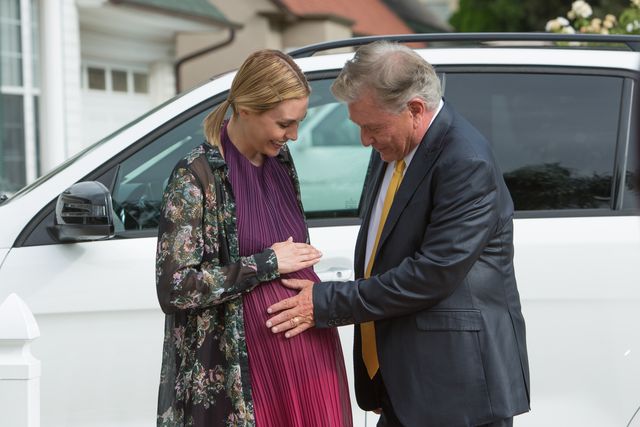
Random characters and bit players pass by the camera and fail to find anything funny to say or do. The veteran players don’t humiliate themselves. Embarrass themselves? Almost. Abdo takes the right “Soup Nazi” approach to the material. Baldwin has aged into a growling clone of older brother Alec, Kilmer doesn’t look anything like Biden — and makes so little effort that we see a mustache in the offing — Berenger sputters a bit and Richards can’t make this reporter’s “funny” lines funny.
That’s because “1st Born” is built on a script so awful you kind of wonder why they didn’t follow up on that abortion joke and abort the works. The film’s only laughs are in the blown lines — by American actors reciting that butchered English.
“Are these all your luggages?” “He first entered into American soil…” “Allow me to the be the first to call you Mister Grandfather!”
Veteran character player Robert Knepper, playing a demented Desert Storm veteran, gets off the best one-line review of the picture.
“In this country, we say the word ‘bomb’ quietly!”
Yes. Yes we do. Unless we’re talking about a cross-cultural comedy that fails on pretty much every level — music, direction script and the cast that performs it.

MPAA Rating: unrated, crude language, sex jokes
Cast: Reza Sixo Safai, Taylor Cole, Val Kilmer, Denise Richards, Jay Abdo, Tom Berenger and Billy Baldwin
Credits: Directed by Ali Atshani, script by Sam Khoze, Tarek Zohdy and Mahdi Alimirzaee. An LA Independent release.
Running time: 1:20

Sam Mendes’ “1917” is a gripping and quite entertaining Tommy’s-eye-view of The Great War” as seen from the trenches of France.
Mendes (“Jarhead,” “Skyfall”) didn’t get his tribute to the men and their sacrifice in World War I out in time to coincide with commemorations for the end of that conflict. But he’s cooked up an immersive, heroic tale that humanizes a conflict canonized for its faceless slaughter and waste, a “Lost Generation” grimly depleted on the Fields of Flanders.
The story could not be simpler — two British soldiers (nicknamed “Tommies”) are sent across nine miles of No Man’s Land and enemy occupied territory to halt an attack that will only get their fellow soldiers slaughtered. The attack’s at dawn tomorrow, so you’d better get cracking, lads (George MacKay, Dean-Charles Chapman).
Lance Corporal Black (Chapman, of “Game of Thrones”) is determined to save the “Second Devons” (Devonshire Regiment), at least partly because his own brother is a lieutenant serving with them. The general (Colin Firth) picked him for this mission because he’s good with maps, and he’ll be extra motivated.
Lance Corporal Schofield (MacKay, of “Pride” and “Captain Fantastic”) was just unlucky enough to be Blake’s chum, the one he picked to accompany him. Schofield didn’t survive the bloody horrors of The Somme to get killed on some suicidal sprint to hand deliver a note. Medals, ribbons and “a mention in the dispatches” are no enticement to him.
But radios were not yet in common use on the field, and “Gerry’s cut our telephone lines,” so there’s nothing for it.
Thus begins a grim odyssey through the World War I experience — the green flowering of spring unfolding under the rotting corpses of men, horses and dogs beset by the flies of April. Mud and snipers, a wrecked tank, miles upon miles of barbed wire, ruined towns, the fascinating over-engineering of German trenches (abandoned in “a planned withdrawal”), booby-traps, dogfighting biplanes rat-a-tatting above — Blake and Schofield are solitary souls on a quest in the middle of the maelstrom of war.
The camera clings to these two as they stumble and grope, under overcast skies or in the dark of dugouts and tunnels, through the quiet hell of a battlefield half-abandoned but sure to be full of sound and fury again, any minute now. Mendes uses “the long take,” a nearly seamless series of scenes unfolding in (for the most part) real time to build suspense and empathy for our two over-matched heroes.
Because this script is hellbent on throwing every peril The Great War was infamous for at them over the course of two hours.
Mendes and his “Penny Dreadful” co-writer hurl the duo into corpse-covered shell-craters and spooky tunnels. Death comes from afar — artillery and snipers — and very close. Rifles and bayonets and bare hands are what it takes to stay alive. Death comes from above — airplanes — and below (a raging river).
Of course there’s a mademoiselle in distress (Claire Duburcq) to be stumbled over, amid the cream of British character actors who play sergeants and commissioned officers (Benedict Cumberbatch, Daniel Mays, Adrian Scarborough, Mark Strong) who pass by.
Of course the foreshadowing is obvious, but not heavy-handed.
It’s meant to be immersive, a “Dunkirk” of the first World War. And if it isn’t on a par with that modern classic, you can blame the slack pacing, the heaping helpings of melodrama in the tale Mendes and Krysty Wilson-Cairns cooked up. All these obstacles to overcome, and yet so many longueurs — pauses while the soldiers on this desperate, dangerous time-sensitive mission stop to shake their heads at the waste or consider the Last Milk Cow on the Western Front. Our heroes listen to a soldier singing “When I Cross Over Jordan” and take time to recite a poem — Edward Lear’s “The Jumbles” (“In a Sieve they went to sea; In spite of all their friends could say…”).
“1917” loses its urgency just enough to make you notice and wonder “What are these two doing? Get BACK to the MISSION!”
Mendes gets the blasted landscape of No Man’s Land, the trenches, the kit each soldier carries with him right. The rapidly shifting shadows created by a descending flare make for a striking scene.
But he fritters away some of the tension and the drive of the narrative when he loses the crouching/ducking fear and paranoia that had to become instinct if you were to have any hope of surviving the war.
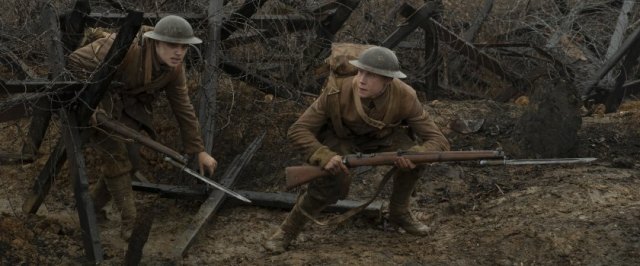
The “long take” has long been enshrined as a sort of cinematic rite of passage, something filmmakers indulge in mainly, one suspects, to impress the faithful — hardcore film buffs.
Orson Welles had a hand in elevating these long unedited shots that rely on camera blocking, staging, pre-planning and actors who can remember a lot of choreography to go with their lines. “Touch of Evil” opens with the most famous “long take” in cinema history.
Properly applied, long stretches without a perspective-changing interruption (edit) can build tension, when you’re not distracted and impressed by how many characters and how much ground Robert Altman’s opening to “The Player” has squeezed in. We are conditioned to cuts, and the mind misses them when they’re not there. Suspense builds as we expect something momentous coming at the end of the build-up a long take entails.
Hitchcock took this to its logical extreme with “Rope,” a 1948 thriller whose stagebound origins allowed him to “indulge” in making a film of ten long takes — with only the limitations of a reel of celluloid loaded into the camera determining how many edits the picture would have.
But Hitchcock admitted that “Rope” was just “a stunt.” Editing is the essence of cinema, “the lynchpin of worthwhile filmmaking,” as Sir Alfred put it. Cuts quicken the pace and raise the heart-rate, refocus our attention, zooming in, heightening suspense and connecting us with the characters with emotional close-ups.
You want to see a movie with “no cuts” and nothing but long takes? Hunt down “Russian Ark.” Yes, like “Rope,” that was a stunt. Like “Rope,” it’s “cool” but dull.
So no, the long takes don’t transform “1917” into the cinema event of 2019.
It’s still entertaining, a polished period piece and solid combat film, even if its story leans entirely too heavily on the hoary conventions of the Victorian/Edwardian melodramas that every Briton fighting in it would have recognized, way back then.

MPAA Rating: Rated R for violence, some disturbing images, and language
Cast: George MacKay, Dean-Charles Chapman, Daniel Mays, Mark Strong, Richard Madden, Claire Duburcq, Colin Firth and Benedict Cumberbatch
Credits: Directed by Sam Mendes, script by Sam Mendes and Krysty Wilson-Cairns. A Universal/Dreamworks release.
Running time: 1:59
Fans of the Brit car series “Top Gear” can tell you when that show hit its stride, and list a string of memorable moments from it that generally correspond with that.
The show took off when the erudite and whimsical polymath James May became the third wheel, joining Jeremy Clarkson and Richard Hammond.
And while their bits involving vintage cars and their shortcomings in “challenges” could be a delight, “Top Gear” only hit top gear when they put these three on the road where there were no roads — epic, breakdown and accident filled misadventures across Africa, Asia, Australia, the Arctic and the Americas.
When Clarkson was fired — more for lying about an international incident he ginned up in Argentina than for reasons given by the CYA BBC — and the other two joined him in taking Amazon’s blank check, the trips were what their titled sequel, “The Grand Tour,” promised.
The show they delivered wasn’t that, not nearly to the extent many of us wold have wanted. Car reviews, gag “tests” and fast laps? Meh. A live audience in a traveling tent? Whatever.
Give us three aging Anglo Saxons coping with the wilds of the world in various vehicles of unreliable vintage, always British and often failing in their special xenophobic ways.
So now they have finally figured that out, before the cast is too old to risk malaria, mauling and other maladies as three flummoxed funnymen abroad.
Here’s an interview with former “Top Gear” producer Andy Wilman that acknowledges that.
https://deadline.com/2019/12/the-grand-tour-showrunner-andy-wilman-interview-1202794405/
A Marvel movie for sisters everywhere.
A bit Russian for my taste, but then again, I’m not Tucker Carlson. Summer release.
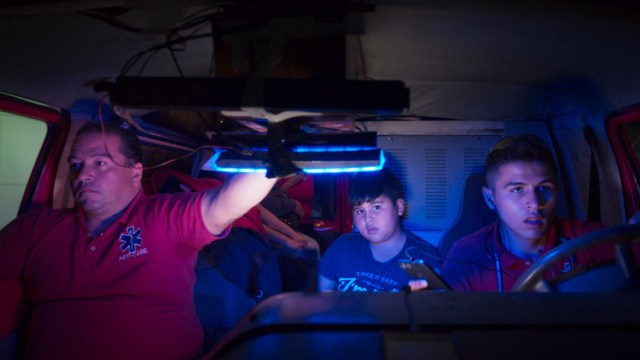
The sprints, hurtling through the crowded streets of Mexico City, are a matter of life and death.
Sirens wailing, lights flashing, a paramedic bellowing over the megaphone, “Taxi, move MOVE” or “You idiot on the bicycle! GET ON THE SIDEWALK!”
And that’s just the race to get to the accident scene. In Mexico City, there are virtually no “government” ambulances. And the few private ones compete in mad dashes to get to the accident, fight or shooting first. If they don’t, nobody gets paid — not the crew, the cops who might have tipped them about the need for their services, and who expect a bribe even if they didn’t.
The patients? Often they fight over paying up.
“Midnight Family” is a harrowing and cautionary inside look at the Wild West of Mexico City emergency services. “The private sector” has taken so much of “public” care that it’s every beat-up old ambulance for itself, with pricey private hospitals paying kickbacks for deliveries and dirty cops hassling drivers over their licenses, their professionalism and their slowness over paying them bribes to let them do what they came to do.
Director Luke Lorentzen (“New York Cuts”) puts us in the front seat of the Med Care van staffed by the men of the Ochoa family, freelance entrepreneurs trying to feed and care for a big family from inside an ambulance. Their story has thrills and compassion, hard luck and grief.
And in them, any North American can see a cautionary tale of what happens to a health care system left up to its libertarian, market-driven devices. People are suffering and dying as money-grubbing corruption slows down the most basic of services — saving those hurt, in bleeding and in pain.
Fernando seems to be the patriarch, and he and (I take it) his brother Manuel are the ones who comfort the teen girl whose boyfriend just broke her nose, who pat and plead with a baby, whose glue-sniffing dad has accidentally injured, to resume breathing.
Juan is the mouthy 17 year-old go-getter. He likes to drive, uses his down time to breathlessly recite his evening’s exploits to his older girlfriend. He chews on Fernando to “take this seriously,” whenever they’re asked for their “papers” by a cop.
“This ambulance FEEDS us,” he pleads (in Spanish, with English subtitles).
Rolypoly Josúe can’t be more than 12. He rattles around the back as the ambulance recklessly races down the street, locking this bit of gear down, for he too has a role here. He’s not just onboard to complain about food and the money it’s going to cost for his next meal.
Lorentzen sees elements of the fictional features “Nightcrawler” and the Nic Cage ambulance driver tragi-comedy “Bringing Out the Dead” here, and plays them up. Ambulance drivers compete like gladiators running the chariot race in “Ben-Hur.” Losing can be life threatening. But they compare notes while sitting around on centrally located street corners, waiting for that next call. Which cops are the biggest pain, what was their toughest ride this week?

Accident scenes are chaotic. The cops aren’t there to direct traffic. They’re “investigating” and doing paperwork and hassling ambulance crews, chiding them for not having the right “plate,” the required gear or what have you.
“Midnight Family” lets us be touched by Fernando’s compassion, his inability to strong-arm victims and family members who (off camera, but overheard) haggle over the fees of paramedics who just tended to their loved-one and raced them to the hospital, often of their choice.
But the whole “system” is just appalling, a bare bones service struggling to meet the demand of a largely-uninsured populace and a medical establishment which isn’t just two-tiered, it’s sliding-scale budgeted. “Government hospital,” where you’re lucky if they can squeeze you in, deluxe “private hospital” where you expect the best care, and other private hospitals which sit somewhere in the middle, unless they’re too far away to do anybody any good.
No, you do NOT want to have an accident or need of emergency services in Mexico City. What’s even scarier is how the worst parts of that experience could take over anywhere that tax-supported services are slashed in a “You’re on your on, pal” race to the bottom.
MPA Rating: unrated, limited graphic injury footage
Cast: Juan Ochoa, Fernando Ochoa, Manuel Ochoa and Josúe Ochoa.
Credits: Directed, shot, written and edited by Luke Lorentzen. A 1091 Media release.
Running time: 1:20
Looking at the slate of films stretching out to the end of the year, this may be the last one I am dying to see.
Interested in “Bombshell,” intrigued by what Clint will do with “Richard Jewell,” indifferent to “Cats” and pretty much everything else.
But a “Great War” drama that isn’t about a “War Horse?” I’m there. “1917” opens Christmas Day.

 Movie Nation