
Yeah. “In the Loop” and “Veep” creator Armando Ianucci gives Hugh Laurie a sci Fi comedy star vehicle.
Yeah. “In the Loop” and “Veep” creator Armando Ianucci gives Hugh Laurie a sci Fi comedy star vehicle.

Netflix, it would seem, has decided to take on The Hallmark Channel when it comes to seeing who can produce the most cheesy, inconsequential Christmas movies.
But really, dumping them all on us just in time for Halloween isn’t fair.
“The Knight Before Christmas” is a Vanessa Hudgens romance that turns her into a suburban Ohio science teacher visited by her literal “knight in shining armor,” literally, right before Christmas.
Josh Whitehouse of TV’s “Poldark” is Sir Cole Christopher Frederick Lyons of Norwich, a 14th century night who stumbles into an old crone (Ella Kenion) in the snowy forest during a falconry contest. We know she’s an “old crone” because she answers to that.
She promises the young knight “the quest you’ve dreamed of.” Thanks to a magical medallion, she’s sending him to “your destiny,” a place where there are “flying steel dragons” and “a magic box that makes merry.”
That’s what hurls him, in chain mail, broadsword in hand, to The Christmas Castle that dominates the center of Braceburg, Ohio every holiday season. He thinks he sees a way out. But Mrs. Claus is not the “old crone” he’s looking for.
Science teacher Brooke (Hudgens) is more his speed, taking him in, with her “trusty steel steed” and carols-upon-command Alexa. And that “magic box?” It’s loaded with Netflix, showing “Holiday in the Wild,” a somewhat better holiday stocking stuffer from the streamer.
Because as cute as Hudgens and Whitehouse are as a couple, as game as Whitehouse is to throw himself into this nonsense, there’s precious little nonsense to get into. Screenwriter Cara. J. Russell finds a laugh or two, but leaves an AWFUL lot of funny potential at the poker table, here.
Sir Cole is quite taken with this “mead” they serve during long Ohio winters. Hot chocolate, is it?
“Delicious! WENCH! Another round!”


Brooke has an ex who left behind clothes she offers to Cole.
“SIR Cole!”
The ex? “He turned out to be, as the kids say, ‘a real douche.'”
“I should THANK the douche for the garments!” And later, “Your dalliance with the douche” questions come up.
“Douche” is a funny word that keeps on giving. Perhaps something might have been made of the fact that a knight of the realm of the early 14th century would be fluent in French, and is confused by this simple French word that’s taken on a whole new meaning in America. More “douche” jokes, I say!
Or hearing this or that carol via Alexa could have inspired a witticism. “Good King Wenceslas? I knew his daughter!”
Brooke’s “You’re really a Renaissance Man, aren’t you?” could have set up a quizzical look from the man from the Medieval, not (later) Renaissance, era.
And so on.
As it is, the playt\ers wring what little life there is out of “Medieval enthusiast” explanations for Sir Cole’s behavior, just one of “the cosplay knights at the Christmas castle.”
“Must be one of those ‘Method’ actors.”
Hudgens’ science teacher Brooke seems rather blasé about all this unscientific “time travel,” not particularly swept off her feet by the Knight in Shining Armor who is staying in her guest house (Teachers in Ohio are rich!).
Whitehouse has the fun part, but he can’t make mead out of powdered hot chocolate. The “quest” is remembered, here and there — rescuing this or that damsel in distress. Emmanuelle Chriqui is wasted in a bit part as the teacher’s sister.
But on the whole, “The Knight Before Christmas” is one to skip, a sweet nothing that’s a lot more “nothing” than sweet.

MPAA Rating: TV-14.
Cast: Vanessa Hudgens, Josh Whitehouse, Emmanuelle Chriqui and Ella Kenion.
Credits: Directed by Monica Mitchell, script by Cara J. Russell. An MPCA/Netflix release.
Running time: 1:32
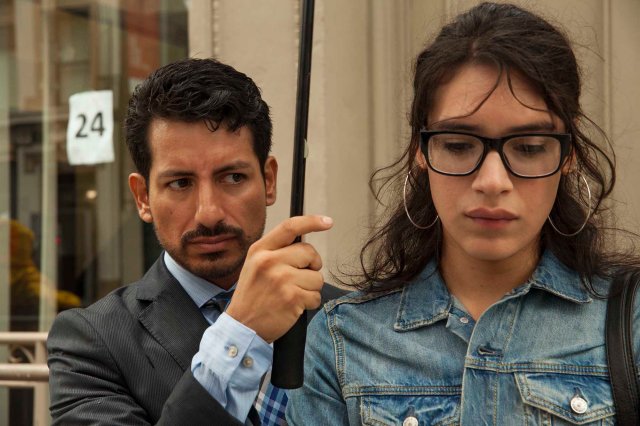
“The Garden Left Behind” is a queer cinema throwback, a simple slice-of-life/what-we-deal-with portrait reminiscent of the early “Here’s who we are” melodramas of the “Lianna” (1983) to “Go Fish” (1994) era.
It’s introductory by nature, polished yet primitive, just like the films that dominated gay big screen storytelling long before the alphabetic expansion to “LGBTQ.”
Director Flavio Alves’ film — John Rotondo co-wrote it — is a “transition” primer, what one person coping with “gender dysphoria” has to go through to be happy in her own skin.
Tina (Carlie Guevera) drives a licensed Town Car around her corner of New York, supporting herself and her abuela (granny), her last surviving relative (Miram Cruz). She’s the only person in her life who still calls her “Antonio,” only speaks Spanish and longs for the day they might “return to Mexico.”
Tina’s got a support system of transgender women of color like herself, with Carol (Tamara M. Williams) her spirit guide through medical officialdom’s “process” of transitioning.
“It’s just so much,” Tina complains. “I have to go to the doctor to see the psychologist to get the letter to get the approval…”
The doctor (Ed Asner) is sympathetic, but serious-minded and very, very old. His probing questions make Tina cry. And no, you do NOT get to compare this to “getting a tattoo.”
She is not happy that she has to “convince some old-ass man” of her sincerity. But she’s undocumented. And the back-alley alternative isn’t something her ladies-who-lunch crowd will let her consider.
Tina also has a long-term boyfriend. But while Wall Street Jason (Alex Kruz) may finally get around to taking her out, he’s more interested in sex on the down low.
And then there’s the bodega clerk (Anthony Abdo) she flirts with. Chris is young, easily bullied and runs with a rough, homo/transphobic crowd. Fitting in with them means letting them shoplift, listening to a LOT of hate speech, playing baseball and keeping his sexual proclivities secret.

“The Garden Left Behind” weaves these threads together and resolves these stories in quite conventional — for the genre and subject matter — ways. We see the steps in Tina’s transition laid out. Tina is radicalized by violence against a trans woman she and her friends know. Chris and Jason will fight their true natures and reveal who they are.
And another “name” actor will show support and help get the film made by playing a sympathetic, tolerant bartender (Michael Madsen).
The transgender actors aren’t nearly as polished as the established “names” in the cast — line readings that have a stiff theatricality, etc. That and the care-worn and over-familiar “my struggle” story are what I mean by “primitive.” If you don’t know where this is going early on, you’re not getting out enough. And haven’t been getting out enough for years.
By and large, though, “Garden” is shot, lit and edited as well as most studio pictures.
Its value in its topicality — transgender people are still facing violence, and not just in “Boys Don’t Cry” America — and in representation, putting people on the screen who still aren’t often depicted in screen dramas, treating them sympathetically and “explaining” their lives to those of us in need of a primer.
But “Garden Left Behind” is not “Tangerine” or “The Danish Girl” or “Boys Don’t Cry” or “Transamerica.” That it comes after all those “introductory” and groundbreaking films is why, as sympathetic as it might be, it’s just as forgettable as it is watchable.

MPAA Rating: unrated, violence, sex
Cast: Carlie Guevara, Miriam Cruz, Anthony Abdo, Tamara M. Williams, Alex Kruz, Ed Asner and Michael Madsen.
Credits: Directed by Flavio Alves, script by Flavio Alves and John Rotondo. An Autonomous release.
Running time: 1:28

“House Arrest” is a 22 minute sitcom pilot lost inside a 104 minute romantic comedy.
It’s got a cute couple with chemistry, a couple of wacky supporting characters, a daft dilemma and a couple of funny pratfalls. That’s not even close enough to sustain a rom-com of this length.
The premise — Karan (Ali Fazal of “Victoria & Abdul”) is holed up in his roomy New Dehli condo, and has been for 279 days. He cleans obsessively, keeps a car that he has a hired man come and wash, run the engine, etc., and absolutely refuses to cross the threshhold of his flat. Even when a delivery lady drops an eggplant that’s barely out of his reach.
He’s got a few friends who stay in touch — the womanizer J.D. (Jim Sarbh) phones him from whatever bed he’s waking up in, whatever toilet he happens to find himself needing, and the irrepressible Pinky (Barkha Singh), the daughter of a “don” (a mobster) who never hesitates to drop in and impose herself on hapless Karan.
He has his plants, his Roomba, his cleaning rituals and a daily parade of delivery folk (most of whom simply get his address wrong). Pinky? She’s always ready to offer sex for a favor, even if it means having her Lurch-sized body guard Rambo (Sunil Kumar) turn his back while she makes her move.
Not interested, Karan insists. But the favor she needs is an offer he can’t refuse. Because she won’t allow it. He needs to keep “this package” she’s having delivered. Just for a bit.
Figuring out that she’s stuffed a bubble-wrapped body in the trunk dropped at his door comes later.
J.D. professes concern for the shut-in (nobody calls him “Agoraphobic”). Karan is on the spectrum, some sort of spectrum, anyway. One picture is tilted, that means he’s tilting every picture on his wall. But there’s this reporter J.D. wants Karan to meet.
Saira (Shriya Pilgaonkar) is working on a story about the Japanese fad, “hikikormori,” young men locking themselves in their homes with only social media, electronics and food deliveries for company. Is this catching on in India? Karan could be a test case.

The comedy here comes from the bubble wrapped body, mostly. And Pinky. And to a lesser degree, Rambo and J.D. When the body “wakes up” there’s an amusing wrestling match to contain him, and a ditzy phone call to Pinky who tries to talk Karan through finishing the job on the phone. “Stick the knife just below the shoulder blades…or maybe slitting the throat (in a blend of Hindi — with subtitles — and English) would be easier!”
The romance comes from this pushy, pretty reporter and talks Karan into saying “I just needed a break” from his life as a banker, with its “responsibilities, promotions, ambitions.” She’s not convinced. Neither are we.
A day long visit to his immaculate, well-appointed and roomy home convinces her that “You’re loaded. You have it all! You can do anything you want!”
Anything except go outside. And he might have to do that if he wants to “get the girl,” in rom-com speak.
The film is meant to feel claustrophobic, with the limited settings — interiors that comprise Karan’s world. The colors, the light and the balconies undercut that design goal.
A clever sitcom effect — everybody Karan talks to on the phone materializes in the room with him — J.D. on the toilet, Pinky getting her hair done, Saira riding in an “auto” (three wheeled motorized rickshaw).
If you ignore my warnings and dive into this, I will give screenwriter and co-director Samit Bansu this credit. There’s a very sweet twist or two, right at the end. It’s the bulk of what comes before that finale that handcuff “House Arrest.”
MPAA Rating: TV-14
Cast: Ali Fazal, Shriya Pilgaonkar, Jim Sarbh, Barkha Singh, Sunil Kumar
Credits: Directed by Samit Basu and Shashanka Ghosh, script by Samit Bansu. An India Stories/Netflix release.
Running time: 1:44
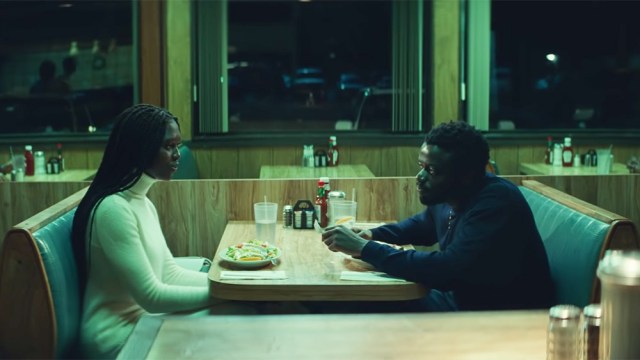
It’s messy, random, funny and poignant, violent and surreal, politically-charged and romantic.
“Queen & Slim” is an African American art film channeling a 1970s blaxploitation, on-the-lam-from-the-law road picture vibe. As its riveting, rambling, geographically-inept two hours roll by, lurid visions of the blaxploitation cinema of that era bubble through an indie spin on “Dirty Mary and Crazy Larry,” “Sugarland Express” and “Vanishing Point.”
Does Tarantino know director Melina Matsoukas (TV’s “Insecure” and “Master of None”)? It’ll be love at first viewing once he takes a gander at this.
The odyssey begins with a date, enabled by Tinder, consummated at a suburban Ohio diner. There are no names, just banter. He (Daniel Kaluuya of “Get Out”) is a noisy, uncouth eater. She (Jodie Turner-Smith of TV’s “The Last Ship”) is regal, long hair expensively braided, put together — a lawyer. She’s out of his league but she’s trying not to let it bother her.
“I know good grammar!”
“DO you?”
She picked him because “You had this sad look on your face. I felt sorry for you.”
He takes that about as well as you could hope, talks about his family lovingly, sports a crucifix, prays over his meal as we learn that A) she’s a lawyer, B) she’s not close to her family and C) she’s an atheist.
So that ride home in his Accord, with his “TrustGod” vanity plates doesn’t hold a lot of promise. But when she takes his phone to stop him texting and driving, and starts poking through his business on it, he reaches over to get it back. That little swerve on an empty road in a black part of town, with no traffic, is their undoing.
And telling the testy cop who pulls them over “My bad” isn’t going to cut it. “Get out of the car” is next. “May I ask why, officer?” isn’t going to cool him down, either. “No, you may not.”
Having a lawyer in the car is no help. The “officer’s prerogative” means impertinent, accusatory questions, a rummage through the trunk. Nothing He says can descalate the situation. Everything She says does just the opposite, and that’s how the trigger-happy cop pulls the trigger, there’s a life-or-death wrestle over the gun, she’s grazed on the leg, the cop winds up dead.
The lawyer is the one who demands that they leave the scene. “We are going to keep running until we come up with a better plan!”
He may protest, want to call his family, want to get her to a hospital. Overruled. No phones (out the window). No hospital. Just flee.
Matsoukas and her “Master of None” screenwriter/collaborator Lena Waithe put our anti-heroes on the road, with tension at every fill-up, suspense in every encounter, and fear that the policeman’s cruiser had a camera that will ID them, but not clearly demonstrate how out-of-line the dead cop was.
They’re going to be infamous in an Internet instant.
And yet somehow a fraught transaction with a convenience store clerk — they left their wallets in the car they abandoned, but took the dead cop’s gun — dissolves into laughs.
“Izzat a Glock,” impressed white boy clerk wants to know? Others treat them as folk heroes — “Cop killas, cop killas!”
And the destination she has decided on, New Orleans, taking refuge with her pimp Uncle Earl, lets veteran character actor Bokeem Woodbine (“Dead Presidents” to “Overlord”) hilariously take over the movie. No “get away” for “the black Bonnie and Clyde” would be complete without a wholly pimped turquoise 1972 Pontiac Catalina dressed in appropriate pimpwear.


Matsoukas and Waithe gift their stars with little reveries, romantic conversations that this mismatched pair share in the shock of their flight. Confessions and longings are handled in voice-over rather than straight filmed dialogue, a poetic touch that works.
Her “ideal” man? “I want him to show me scars I never knew I had.”
Amid the grace notes, there’s bickering — over control, big decisions about their route, and music — “Skinny Luther (Vandross) or Fat Luther?”
Kaluuya makes a marvelously sleepy-eyed reactor, in over his head from the start. “You look guilty? “I AM guilty.” Turner-Smith announces her arrival as a star, fiery and sexy, worldwise but vulnerable.
“Queen & Slim” hits familiar waypoints (a juke joint) along it’s alternately grim-or-merry way, making comments about police racism and militarization, Black Lives Matter reviving African American activism, and folk hero myths born of violence.
The departure stings and the destination burns. But as with any trip that embeds itself in memory, it’s the journey and those you take it with that “Queen & Slim” leaves you with.

MPAA Rating: R for violence, some strong sexuality, nudity, pervasive language, and brief drug use.
Cast: Daniel Kaluuya, Jodie Turner-Smith, Benito Martinez, Chloe Sevigny, Flea and Bokeem Woodbine
Credits: Directed by Melina Matsoukas, script by Lena Waithe. An eOne/Universal release.
Running time: 2:12
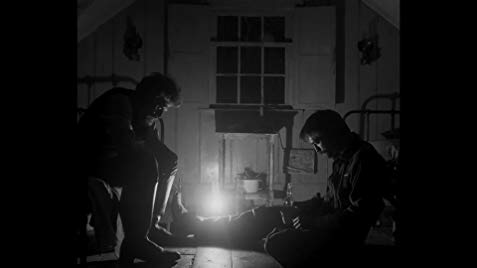
It would be odder than odd to see Adam Sandler walk away with Indie Spirit honors, but that’s what “Uncut Gems” could do for the critically derided comic’s career. An A24 film parked in awards season, and we have to talk about the self-described King of “moron comedy” for the past 25 years seriously.
Renee Zellweger, Elisabeth Moss, Mathias Schoenarts and everything an everyone to do with “The Lighthouse” are also on the ballot.

It isn’t just the title that gives away the “reveal” in the documentary “Bikram: Yogi, Guru, Predator.” We don’t have to remember the news coverage of this “hot yoga” popularizer, the franchised kingpin of yoga in America who made a fortune by first convincing the “in the know” in Beverly Hills to stretch, bend and sweat their way to good health — starting in the 1970s.
We know his game from the Brahman BS that pours out of Bikram Choudhoury’s pie-hole. All these credulous TV profiles, decades of chat shows and the like, from “The Dinah Shore Show” and “Merv Griffin” in the ’70s and ’80s, to “60 Minutes” and assorted other puff-piece purveyors.
He “cured” (Richard Nixon) with yoga, and Nixon gave him a Green Card for his trouble.
He “taught” Elvis. He takes credit for everything within reach, credit he doesn’t deserve.
His followers show the slavish devotion of cultists. Accusations of rape and abuse won’t sway them.
His sexism is monstrous, out in the open, “p—y” bragging, raging at the very idea of being contradicted by a woman in videotaped court depositions.
And for years, high ranking people in the court system have avoided going after him, not wanting the hassle of fighting somebody with a lot of money, a lot of Bentleys, thousands of followers and an Indian passport, which he eventually used to flee the country and the justice of civil judgements against his profane, Speedo-wearing old man arse.
Eva Ora’s film doesn’t have to underline it, put members of the State Department under oath before the U.S. House of Representatives to make the parallels clear.
“Dangerous clown” as one of those interviewed for her film describes him. You couldn’t make it any clearer if you took away the Indian passport and give him a gold plated toilet, instead.
We know this guy. Millions of Americans voted for him. And they didn’t even get flexible and fit in their bargain with a buffoon.


Ora’s cut-and-dried film uses those decades of gullible TV profiles (all journalists get taken now and again, TV ones most of all) to let Bikram tell his rags to riches story, spin his own creation myth.
And we watch him in action, decades of footage from his drill sergeant on a Speedo classes, where legions of devotees come to find fitness, good health and a guru — something/someone to believe in.
They get cursed, are deprived of food, sleep and bathroom breaks.
And with every fresh crop of “teacher school” recruits, those chosen as “talented” enough to fork over big bucks for a nine-week isolation course of intense training to be “certified” by Bikram, legions of nubile young women have been brought into his presence, encouraged and taught, and after hours, harassed, taken advantage of and even raped.
Even some of them, and many are profiled here, won’t write everything they’ve been through off to experience. He is someone who “based a lot of truth on a whole lot of lies.”
And as it was in the beginning, when only Hollywood’s hippest were tuned in to his classes, they’re slow to let go.
“You’ve never really done yoga until you’ve done a Bikram class!”
The court cases won’t change their minds, we fear. And like the other famous current example of the mercurial, dimwitted bullying, sexually abusive misogynist/narcissist, we know the True Believers’ epiphany won’t be something they welcome.

MPAA Rating: TV-MA
Cast:Bikram Choudhury, Larissa Anderson, Sarah Baughn, Micki Jafa-Bodden
Credits: Directed by Eva Ora. A Netflix release.
Running time: 1:26

The sheer number of Holocaust dramas in the film canon means that the bar for the genre has been raised, perhaps unfairly high. If the movie isn’t great, considering the epic horror of the subject, it can and should be dismissed, or so the thinking seems to be.
But what if the tale’s a decent yarn with interesting characters, a mystery or two and the rich subtexts of classical music, an arrogant prodigy, World War II childhood, famously valuable violins, and Judaism? With those ingredients, “The Song of Names” would be at least watchable with or without the vast tragedy that hangs over it.
French Canadian director François Girard is at home in this milieu, with “The Red Violin” and “32 Short Films About Glenn Gould” on his resume. He and screenwriter Jeffrey Caine serve up a quiet, atmospheric period piece in adapting Norman Lebrecht novel.
It’s about two friends who grew up together in London “during The War,” who broke from each other suddenly. And in the narrative present, 35 years after that break, one of the two is still doggedly searching for the other, seeking closure and answers about whatever happened to the fellow with “music from the gods” talent.
In 1951, a London concert debut, that of a Warsaw-born prodigy raised and schooled in Britain, is canceled. The man promoting it, played by Stanley Townsend, is gutted by his discovery’s no-show. His son Martin (Gerran Howell) is a tad put out as well.
In 1986, Martin — now played by Tim Roth — is a music educator and concert promoter who, when judging a competition in Tyneside, sees a Newcastle boy conduct an odd ritual. He kisses the precious lump of resin he uses on his bow before playing.
Martin has seen that before, decades ago. Thus begins his latest hunt for his long lost “brother.” His wife (Catherine McCormick) will just have to understand.
“The Song of Names” tucks Martin’s 1986 search, updated in Tyneside, Warsaw and on to New York, with long flashbacks telling the story of how the two boys met and much of what led up to that infamous no-show Big Show in 1951.
Luke Doyle plays little Dovidl Rapaport, son of lower middle class Jews from Warsaw, a “genius” in his father’s eyes. That’s made him arrogant beyond measure, even as he seeks mentorship in pre-war London.
“He’s not (Fritz) Kreisler,” his would-be teacher tells Martin’s father.
“Kreisler is NOT Rapaport,” the precocious brat spits back.
But Mr. Morrison (Townsend) decides that the child must be taught and must stay in London. He will stay with his family, and room with his son Martin, which doesn’t sit well with the kid (Misha Handley).
Intimidating Dovidl speaks several languages, is more serious about music than Martin (who plays piano) and can even best him in a tussle. Might as well learn to put up with him. They grow up, thick as thieves.
Flashbacks quickly sum up the war years, Dovidl’s insistence on standing outside and watching The London Bliz because “It would have been like this” for his family in Warsaw, Dovidl acquiring a young musical rival and the two of them having a “Devil Went Down to Georgia” fiddle face-off in a crowded air raid shelter. Later, there’s the futile search for Dovidl’s family after the war.


Martin’s connection to the slightly younger boy is almost worshipful. Dovidl’s looming teenage crisis of faith can be tossed off in an aphorism.
“Ethnicity is the skin you were born with and will have until the day you die. Religion is a coat. When it gets too hot, you can take it off.”
The teaching, the piano-violin duets and the sibling-level friendship all end the night Dovidl stands up an audience, an orchestra and Martin’s father in 1951. Martin’s wife Helen was there. So she understands the renewed search, even as she dismisses it as futile.
“If he wanted to be found, don’t you think he would have found you?”
The cold trail leads from that Newcastle boy to the street performer who taught him, to Warsaw, a woman (Magdalena Cielecka), the Treblinka concentration camp, and onward.
Saul Rubinek has a warm on-screen moment, playing a luthier and violin broker, and Eddie Izzard a nice cameo as the radio announcer for that infamous concert-that-never-was broadcast.
“The Song of Names” has a gloomy pallor about it, overcast out-of-doors, the dimly-lit wooden interiors of the life of privilege the boys grew up in, concert halls and nightclubs — all shaded with the hazy glow of memory.
The violin playing fakery is top notch, from the boy “prodigy” to the late-arriving big name you’ll see listed on the credits below. And the acting has a lived-in reality, even if the emotional punch any story with “Holocaust” attached to it is mostly missing.
That only turns up in “the reveal,” the moment that gives the film its title.
But that payoff is as rich musically as it is dramatically. One problem with movies of the “Mister Holland’s Opus/Mo’Better Blues” bent, films building towards some signal moment in music that is what the film is based on, is what letdowns those “grand musical statements” always are. Not here. It’s musically poignant and moving.
Still, “The Song of Names” is a more interesting than fascinating mystery than it is a profound statement on memory, loss, tragedy and faith — which was plainly its aim. The conflict is more talked about than keenly felt, the climax something of an over-the-top anti-climax.
But its shortcomings shouldn’t deprive you of the pleasure of immersing yourself in this world, this time, these lives and this story. It’s as watchable as its opening credits promise it will be.
MPAA Rating: PG-13 for some strong language, brief sexual material, thematic elements, and smoking
Cast: Tim Roth, Clive Owen, Catherine McCormick, Jonah Hauer-King, Gerran Howell, Magdalena Cielecka, Stanley Townsend, Saul Rubinek and Eddie Izzard.
Credits: Directed by François Girard, script by Jeffrey Caine, based on the Norman Lebrecht novel. A Sony Pictures Classics release.
Running time: 1:53
Jack London’s classic earns another adaptation.

Sometimes, you can pinpoint with smart-bomb accuracy the moment a movie goes wrong. In the manhunt thriller “21 Bridges,” it concerns a mass murderer/”double tap” cop killer, an underworld “banker” he’s just held a gun on, and an Alcoholics Anonymous token.
Trigger happy Ray (Taylor Kitsch) has just been persuaded to drop the murderous threat, to work with Adi (Alexander Siddig), the quick-service money launderer, by Ray’s partner in crime, the guy (Stephan James) who helped him swipe “50 keys” of mob cocaine, starting the body count which is already nine, according to the news reports on the TV behind them.
Mercurial Ray whips out that AA token, lays in on the bar in Adi’s loft, and asks for whisky. All that slaughering (“double-tap,” remember) have given him a thirst that Red Bull won’t slake. With that token, screenwriters Matthew Michael Carnahan (“Lions for Lambs”) and Adam Mervis misguidedly try to not just humanize Ray, they soften him up so that we can sympathize with him. It comes out (in the police efforts to profile him) he was a vet, too.
Gosh, all that stress, the horrors he’s seen. It’s no WONDER he’s in AA. It’s no wonder that he latched onto a life as gun-for-hire. And it’s no wonder that he killed a bar full of cops as he and Michael (James) stumbled over a LOT more cocaine and a lot more complexity in what they’d thought would be a simple hold-up of a mob restaurant/drug storage waypoint.
“21 Bridges” goes steadily more wrong after that. And more’s the pity, because there was promise in what was supposed to be a taut tale of a detective (Chadwick Boseman) whose specialty is bringing cop killers to justice. He’s the one who orders the tunnels, ferries and “21 bridges” that connect Manhattan to the world closed down overnight to catch the guys who killed seven cops, left another mortally wounded, and murdered the restaurant manager in the bargain.
Det. Andre Davis is the son of a slain cop. We see the grim pageant of an NYPD funeral (sans bagpipes, this time) in the opening scene. And we hear Davis declare that “being a cop is not really a choice for me…it’s in my DNA,” and pontificate that “justice comes at a cost” at an Internal Affairs shooting review board hearing where his latest on-the-job killing is investigated.
“Justified shootings” have become a habit for this guy. And if Davis was played by anybody other than Black Panther, maybe his history would be more of a grey area, less righteous. So that when the F.B.I. shows up at the murder scene and refers to him as a “trigger” it would sting more. Davis has been called in by his chief (Keith David) and a precinct captain (J.K. Simmons) who have very specific requirements in mind for this manhunt.
Simmons’ Capt. McKenna lists, from memory, the officers slain. And “just so you know, they leave behind four wives, one fiancee. Six kids.”
Don’t put them through the ordeal of arrest and the public spectacle of a trial. Be the guy the F.B.I. just dismissed as an executioner, a “trigger.”
But Davis has questions about the first police on the scene. No alarm, no shots fired. No sign of forced entry. ”
“Why were they there?”
British TV director Brian Kirk (“Luther,” “Game of Thrones”) pumps up the pulse-rate in the early scenes, showing the two crooks arriving to find ten times as much cocaine as they were hired to steal, the heist going wrong, the hail of machine gun fire they use to shoot their way out.
We follow their pursuit through Det. Davis and his “all hands on deck…flood the island with Blue” strategy. Traffic control delivers the first clue, vehicle registration a second, a woman in “the life” looking at a red light camera photo and speculating on who these two might be a third.
The logistics of getting off Manhattan with millions in drugs, or payment for those drugs, and doing it while the clock is ticking, is fascinating too. You sell drugs to a mid-level dealer, he’s not paying you by check. Cash on hand? Bags and bags of $20 bills aren’t inconspicuous, thus the need for this banker. Adi? “He’s SWITZERLAND, man!”
Michael, the junior partner among the robbers, turns out to be the brains, reluctant to spill blood and thus more sympathetic.
Davis has a sidekick for the night, a narcotics cop Frankie Miller (Sienna Miller) who has no more qualms about shooting the bad guys than her captain. There are cops AWFULLY eager to “put those two down.” Davis? We reflexively expect higher mindedness, a nose for “justice” and a suspicion from him because of Boseman’s casting.
Look at the elegant, cool and super-heroish way he flashes his badge in scene after scene.


Giving Davis more of an edge would have made the pursuit more of a moral dilemma for him, that “Black and Blue” quandary of a cop who senses bad cops all around him even though he’s been avenging his father’s murder with every “righteous kill” he carries out.
But the manhunt, complete with shootouts, chases on foot through Manhattan’s meatpacking underbelly, could have gotten by without that little extra nuance of doubt had Kirk not repeatedly pumped the brakes — stopping the picture cold as Davis repeatedly confronts and negotiates with the killers.
The film’s flow is also interrupted by that second line of pursuit, the one we’re not privy to. For all the split second timing of tips, clues and sightings, the sprinting Davis and Burns are often the second police to arrive at this dark street, that salsa bar.
Too little is made of the actual closure of the bridges, of the tightening net closing in on the pursued.
Maybe “21 Bridges” could withstand sops to the stars (“Let’s make the murderous bad guy sympathetic.” “Let’s make the hero righteous, not sketchy.”). But as any fan of police procedurals knows, nothing kills a tense “ticking clock thriller” quicker than stopping that clock.
MPAA Rating: R for violence and language throughout
Cast: Chadwick Boseman, Sienna Miller, J.K. Simmons, Stephan James, Taylor Kitsch, Alexandder Siddig and Keith David
Credits: Directed by Brian Kirk, script by Mattheww Michael Carnahan and Adam Mervis An STX release.
Running time: 1:39


