Documentary Review: Depeche Mode gathers the faithful for “Spirits of the Forest”


forest6

Well, isn’t this the most adorable damned concert doc you ever saw?

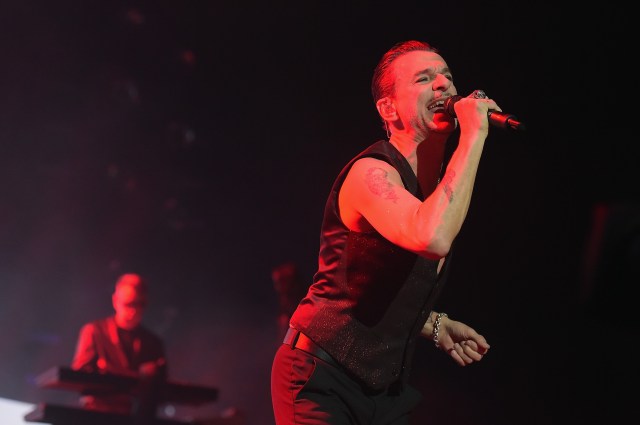
“Spirits of the Forest” captures Depeche Mode at the finale to their 2017-18 “Global Spirit” in Berlin. It’s a multi-media spectacle in the modern concert style, with the fellows showing their years and miles, but still tight and lead singer David Gahan still in fine voice.

But it’s a show basically as seen by a chosen half-dozen of their most devoted fans, people mostly in their 30s and 40s who relate what the music has meant to them, music they’re passing on to their children or in one case, have passed down by their Internet concert-watching dad in Outer Mongolia.

They are from France and Berlin (by way of Brazil), Colombia, Romania, Los Angeles and Mongolia.

One had grueling bouts of depression and even amnesia. Another had a breast cancer scare, after growing up as the only black kid in her school who listened to Depeche Mode.

One had to leave his homeland to find the courage to come out. Another group up under totalitarianism. One divorced and saw his kids move far away.

And did I mention on is in Mongolia, for Pete’s Sake?

The thing that connects them, got them through, is the music of the band whose dark, electronic-flavored tunes range from cute (“Just Can’t Get Enough”) to droll and edgy (“Personal Jesus”).

A Depeche Mode show “is like going to the best church you’ve never been to,” one of our narrators declares.

Colombian Dicken bonded with his kids over their cute Youtube covers or the band’s songs done on toy instruments, which gave them a global following.

LA Liz endured her chemo with the New Wave faves of her youth.

Concert doc vet turned feature director (“Control,” “The American”) Anton Corbijn captures the drama of a show in Berlin, “the Depeche Mode capital of the world,” epic sing alongs to “Never Let Me Down Again,” “All I Ever Wanted” or “People are People.”

The concert footage is very much of a piece with all the other New Wave bands still touring, with Gahan’s theatricality making up for bandmates who were never all that animated when they were young rock stars.

I was never much of a fan of that whole synth-drenched era, to be honest. But their songs stand out enough to make them worth revisiting for their sophistication, dark sexuality, depth and occasional political relevance. Gahan singing their recent single, “Where’s the Revolution, come on people you’re letting me down” stings.

The tunes hold up and these fans, in Corbijn’s brisk, short and sweet film, give you a hint as to why they’re still a big deal and what they get out of a band that makes them relevent enough to keep them coming back, and to want to pass that passion on to their kids.

3stars2

MPAA Rating: unrated, some profanity

Cast: Indra Amarjargal, Daniel Cassus, Cristian Flueraru,Carine Puzena, Dicken Schrader and Depeche Mode

Credits: Directed by Anton Corbijn, with John Merizalde and Pasqual Gutierrez. A 1091 release.

Running time: 1:20


Posted in Reviews, previews, profiles and movie news | Comments Off on Documentary Review: Depeche Mode gathers the faithful for “Spirits of the Forest”

The “Edison” of biography vs the Edison of “The Current War”

current

I’ve just finished the last biography written by the historian Edmund Morris, a Pulitzer Prize winner and the world’s foremost expert on Teddy Roosevelt, and among those foiled by “There’s no THERE there” in trying to write a biography of Ronald Reagan.

“Edison” paints a gloriously detailed and most human portrait of “The Wizard of Menlo Park” (Edison hated that label), one that flies in the face of much of what recent revisionism has attached to his reputation.

He’s remembered as a fanatical credit hog, even though he generously acknowledged when he was building on the work of others working on the same project, even contemporaries.

He fought to protect what was his, and indeed impede those competitors pushing the envelope when it came to infringing on his patents. In film histories, he is depicted as single-handedly holding back the cinema, and inspiring much of the newly-born business to flee to California thanks to his stranglehold on film camera and projection patents, which his lawyers defended through the Motion Picture Trust. Some of that is true, but he freely acknowledged whose work – Edward Muybridge, for starters, who asked him to look into pictures that mimic movement — he was building on in his revolutionary leap forward in film. Whatever claims the French, Brits et al have to the invention of the cinema, Edison is the one who made it work and created standards in terms of screen shape, the width of the film and projection speed that endured a century.

And he was on the whole “sound film” thing decades before “The Jazz Singer.” He was older and less interested in Kinetoscope and its children, pulled away to do war work, etc., otherwise he’d have surely licked the synchronization problem he was attempting to solve at about 1900.

He was alternately rich and broke — constantly spending money on that next big nut he was sure he’d crack — automated magnetic iron mining, for one thing, synthetic rubber for another.

He considered the phonograph his greatest achievement, not the light bulb, even though he had been almost wholly deaf since age 12. He stuck with pre-electric “acoustic” recording (no wired microphone, etc) too long, and judged musicians — singers especially — by the smoothness of the grooves they created when singing into his disc cutters. Everybody’s a critic.

“The Current War” had its film festival premiere before Morris died, but there’s no word he saw the film, which is built on the battle between Edison’s first-to-market Direct Current (DC) system and the Westinghouse/Tesla Alternating Current (AC) system. There’s a lot in the movie that’s accurate, although making Edison a wily villain (Benedict Cumberbatch) who —the myth endures — HATED Tesla is inaccurate.

That lightbulb presentation scene depicted above? It really happened. But Edison, publicity hound though he was, hated public speaking and let others do the group pitches on such occasions. Remember, DEAF.

He and Tesla (played by Nicolas Hoult) had a very good relationship, each singing the other’s praises, with Edison even understanding that the brilliant younger man had to go off on his own after only short employment with Edison’s first-in-the-world research and development lab.

They were close enough to pay tribute to each other on many public occasions, close enough for Edison to jab Tesla’s diet (Steak. Just steak. Apparently.)

Westinghouse, played by Michael Shannon? He stole Edison’s light bulb patents, and the very idea that the whimsical, unassuming and unkempt Edison would socially snub the guy (a motivating factor in the film) doesn’t jibe with the portrait of the man Morris paints.

“The Current War” was perhaps the best rescue-edit in recent film history, a film trapped in an inferior, studio-dictated cut by Harvey Weinstein during his last gasp of TWC power. It’s damned entertaining and worth tracking down.

Morris’s “Edison” would make a glorious historical mini-series, a story he tells in reverse order — the chapters are ten year (or so) increments in Edison’s life, beginning with his last days, working towards his birth, with a shockingly touching epilogue to close it.

Whatever PBS and others have done in documentary form, this is a life of drama, pluck, “on the spectrum” genius and conflict and begs for recreation with actors. He spent as much time defending his patents as he did bringing the world light, a power grid, recorded sound (an outgrowth of his efforts to make Bell’s “telephone” work), cinema and (in inventions that he refused to patent but left to humanity) making X-rays practical.

He was a joker from an early age, a wry yarn spinner in one-on-one company, with a natural wit. One of the most accomplished telegraphers during his days as a Western Union man, he was pranked by new colleagues when he showed up to take a new posting in Boston. They had him transcribing a long news story sent via the manic telegraphy of a super-fast Washington operator. None of the pranksters realized that nobody was faster than the very-young Edison at transcribing Morse code.

The sender got flustered and frustrated, telegraph key fingers cramping up at being unable to rattle Edison into begging him to slow down. The man who would invent the microphone thus had his first “drop the mike” moment, a punchline delivered via dots and dashes to a punk who thought he had him punked.

“Suppose you send a little while with your other foot?”

His legend was burnished into myth for so long it was only natural that generations would follow and try to take some of the polish off that reputation. I remember getting into arguments at cinema museums in Britain and France about whose work on the cinema deserved priority (The Brits, then and now, looked down their noses at him even as they were jumping in and claiming credit for ideas he’d already patented. The French did less technologically than aesthetically, even if they were the first to do real cinema — not peephole — projections.)
“Edison” the book details all the discoveries he and his peers lacked the language to describe or figure out a use for. Radio, for one thing. Nobody knew sound could be carried on waves he’d observed in his pre-oscilloscope lab.
As for the elderly wizard, on the night he died in 1931, America and much of the world paused, turned off its lights, and remembered just what life was life before Thomas Alva Edison came along.

edison1.jpeg

Posted in Reviews, previews, profiles and movie news | Comments Off on The “Edison” of biography vs the Edison of “The Current War”

Movie Preview: “THE WAVE” continues the great Justin Long comeback

A thriller with good buzz, and an annoying voice over narration?

Corporate attorney ingests the wrong drug, and his paranoid world flips upside down.

Posted in Reviews, previews, profiles and movie news | Comments Off on Movie Preview: “THE WAVE” continues the great Justin Long comeback

Movie Preview: Daniel Radfliffe is “the white Mandela” ready to “ESCAPE FROM PRETORIA”

This Spring release (in the UK) stars Radcliffe as Tim Jenkin, and Ian Hart ad is the true (ish) story of white South Africans working with the African National Congress during Apartheid, and imprisoned for it

“Escape from Pretoria” is prison break drama from a somewhat problematic “Mississippi Burning” point of view — white characters telling an African story from a white point of view.

But it could be good.

Posted in Reviews, previews, profiles and movie news | Comments Off on Movie Preview: Daniel Radfliffe is “the white Mandela” ready to “ESCAPE FROM PRETORIA”

Movie Review: Alfre Woodard’s turn in “Clemency” is Oscar-worthy

clemency.jpg

In her forty years on the screen, nobody has been better at “making it real” than Alfre Woodard. 

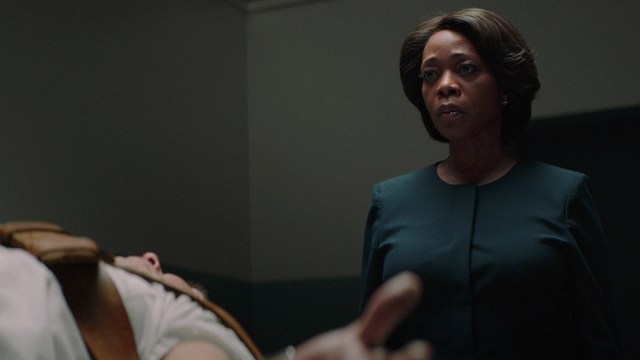
So don’t drop in on “Clemency” expecting histrionics. She plays a prison warden at a penitentiary with a crowded Death Row, and a busy execution schedule. And Bernadine Williams knows she’s got to keep her game face on.

Bernadine is sublimating the media and protesters outside her gate stress, the agonizing moral dilemma of this work and the politics of her job. Woodard gets everything we need to know about her across in just her gaze, her eyes.

In Woodard’s stillness is a singularly great performance from a career decorated with them.

We meet her on one of those execution days, maintaining professionalism, not giving away much in the way of bother at the “What do we want?” “RESPECT FOR LIFE!” “When do we want it?” “Here and NOW!” shouts outside. Bernadine maintains her decorum with the mother of the condemned.

“Did they stop it? Have you heard anything?”

She’s in the death chamber for the lethal injection. And she never lets those with the grim task of witnessing the execution see her sweat — even when the procedure goes wrong.

“I could try his foot,” the tech says, searching for a vein that will take the needle. “We could try his femoral artery.”

“Do it.” 

She keeps the media at bay, is rigid about protocol and process. She may be a functionary, a cog in the machine following orders, always professional, never offering an opinion or showing signs of conscience.

But Bernadine can’t sleep. She’s drifted away from her still-trying husband (Wendell Pierce). She’s drinking at a local bar, right to the edge of sloppy drunk.

And there is no break in sight. Here comes the next condemned man. There were problems with Tony’s (Aldis Hodge) conviction, appeals worth hearing. If ever there was a case for clemency, his activist lawyer (Richard Schiff, perfectly cast) says this is it.

But the lawyer has little hope. The politics of the death penalty in red state America make it as untouchable as Social Security. The idea, he grouses, is to “kill them as under the radar as you can.” 

Writer-director Chinonye Chukwu (“alaskaLand” is her other feature credit) doesn’t have an emotionally wrenching story of the “Dead Man Walking” variety to tell here. She may not even have the most emotional Death Row story of this winter (“Just Mercy” is due out shortly).

But she loses herself on the details and lets her Best Actress to Never Win an Oscar star walk us through them.  Woodard’s Bernadine knows her lines, her “when it’s time for the procedure” interview with the condemned. She has the long names of the drug combo that is supposed to numb and then kill the inmate memorized.

The fireworks at home are muted, insensate. She cannot lose her temper. Not any more. Her debate with the retiring activist lawyer is measured, political and self-preserving.

“You want to play this ‘good guys/bad guys.'” She knows, to him, “I’m one of the bad guys.”

“Clemency” has just enough debate about the morality of the death penalty, just enough compassion for the condemned and pays enough notice to the family of the crime victim to fit within the genre whose conventions it leans on. It won’t change anybody’s mind, and probably won’t play at all in the states where revenge killing by the state is most popular.

But Woodard lifts it, suggests the human cost, the humanity one has to dull to endure this process, time and again. Her performance is reason enough to seek out “Clemency,” and make you realize that it’s not just the condemned who need it.

3stars2

MPAA Rating:  R for some disturbing material, and language.

Cast: Alfre Woodard, Aldis Hodge, Wendell Pierce, and Stephen Schiff

Credits: Written and directed by Chinonye Chukwu. A Neon release.

Running time: 1:53

Posted in Reviews, previews, profiles and movie news | Comments Off on Movie Review: Alfre Woodard’s turn in “Clemency” is Oscar-worthy

Next screening? “Spies in Disguise”

Saturday mornings are the most popular time to preview upcoming kid films. Studios like to pack a theater with kids, their parents and film reviewers so that those of us writing about movie get a taste of how it plays with its intended audience.

So today it’s Blue Sky animation’s “Spies in Disguise,” a Fox release.

All star voice cast, an action comedy staring Will Smith, Rashida Jones, Reba McIntyre, Tom Holland and Karen Gillan from “Jumanji.”

Not sure how long Disney, which now owns Fox, will keep this animation arrangement intact. Blue Sky has made some fun films, but rarely on a par with Disney Animation or Pixar’s best. Rarely blockbusters.

“Spies” looks as if it could work and opens Christmas Day.

Posted in Reviews, previews, profiles and movie news | Comments Off on Next screening? “Spies in Disguise”

The other “Real” hero in the “Richard Jewell” story

The newspaper treated as the villain in Clint Eastwood and screenwriter Billy Ray’s warped, wingnut friendly movie, was no such thing. They were the first to report the fact that he could not have done it.

Go to the link if you want to see how.

https://www.ajc.com/news/local/torpy-large-ajc-wronged-richard-jewell-wow-what-you-don-know/ucwRJ1RSxzBDwA6gNV7pQK/

Posted in Reviews, previews, profiles and movie news | Comments Off on The other “Real” hero in the “Richard Jewell” story

Netflixable? “6 Underground,” let’em stay there

under1.jpeg

Quick show of hands, who among you got through “6 Underground,” I mean ALL the way through it?

Because I was ready to give up, ten minutes in. I may be a big Ryan Reynolds fan, but even I have my limits.

‘Absolute s–tshow,” as one wag in the cast declares.

And everybody knows, NOBODY stages a s—tshow like Michael Bay.

Bay goes so over-the-top for this $150 million action extravaganza, it’s like he’s making a parody of his entire career — mercifully “Transformer” free.

The opening gambit lays it all out here for us, the Bay trademarks stuffed into a car chase that goes on and on and on and…

It’s Alfas and Rollers, Ferraris and Beemers, Minis and megayachts, thousand dollar sunglasses and 20-grand suits, exotic locales and exotic underwear, supermodel hookers and Cover Girl secret agents in male wish-fulfillment fantasy sex scenes.

All of it cut into a blur of explosions, crashes, blood-bursts, heads exploding, bullets raining and all of it set to pop and rock music — a montage of mayhem and Muzak.

One-liners, some whispered, most shouted – “Never underestimate the power of a really nice suit.” “This is where you ask me if I’m afraid!” “Evil goes unpunished.”

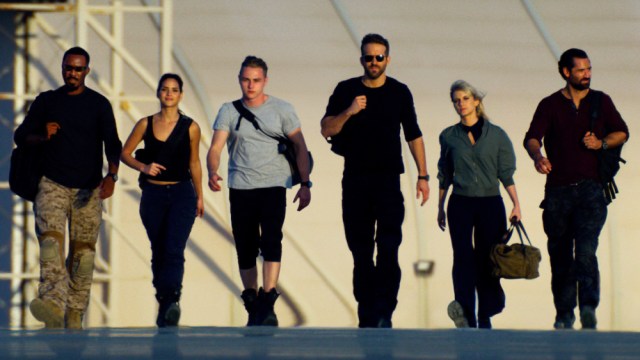
That’s the premise, Reynolds as a billionaire inventor and adrenalin junky who pulls  together this “team” to see to it that the world’s a bit nicer without certain villainous humans in it. His “family” is a group of specialists with numbers, not names — “2 — C.I.A. Spook,” “3 — The Hitman.”

They fake their deaths (elaborately) and become “ghosts,” because “ghosts have one power above all others — to haunt the living, for what they’ve done.”

Dave Franco’s the driver in that excessive, glib and gory opening chase. Melanie Laurent is the “spook” having a bullet taken out of her by Adria Arjona in the backseat.  I forget her number.

Ben Hardy is “The Skywalker,” a parkour-practicing thief, Manuel Garcia-Rulfo is the hitman, Corey Hawkins is the ex-military sniper recruited for The Big Mission.

That would be taking out a Middle Eastern dictator and yadda yadda yadda, who cares?

If you’re into Michael Bay, this is on a par with his lesser action comedies, even though Reynolds brought his “Deadpool” writers with him to the party.

He owes them. And you know what? That favor’s been REPAID, with a really crappy not-that-flip-and-funny screenplay.

“There is NOTHING else I’d rather be doing with my life!”

If you’re not into Bay, fast forward to the BIG STUNT/EFFECT in the final act if you’re not going to sit through the whole thing. It’s a doozy, more impressive than anything I can remember in a Michael Bay movie.

It took a lot to get through this, because I re-HEEEL-ly hated that stupid, talky, bloody and endless opening chase. I’ll cut it a teensy bit of slack for A) Ryan Reynolds and B) that really cool effect at the end.

But that’s it. Done with this. Unless it becomes a damned franchise.

1half-star

Rating: R for strong violence and language throughout, bloody images and some sexual content.

Cast: Ryan Reynolds, Melanie Laurent, Dave Franco

Credits: Directed by Michael Bay, script by Paul Wernick, Rhett Reese. A Netflix Original.

Running time: 2:08


Posted in Reviews, previews, profiles and movie news | Comments Off on Netflixable? “6 Underground,” let’em stay there

Movie Review: “A Hidden Life” ponders how one confronts evil in Hitler’s Reich

life1.jpeg

Breathtakingly beautiful, poetic, soulful and chillingly topical, Terrence Malick’s “A Hidden Place” searches for righteousness in a time when cruelty and evil are the popular will.

This dream fugue of a movie is three hour meditation on the bravery of conscientously objecting to the actions of one’s government and refusing to swear fealty to a leader when to do so would be a betrayal of yourself and your morality.

It’s a World War II allegory for our times, a lone Austrian refusing to “go along,” to “Heil Hitler” even though every Austrian around him insists on it. And it’s a love story, an all-consuming romance that cannot withstand the test that this moral choice forces Franz Jägerstätter to make.

Franz, played by August Diehl of “The Command” and “Allied” and “Inglourious Basterds,” is an Alpine farmer who, with his wife Fani (Valerie Pachner) has made a life in in their village, Radegund. It’s a gorgeous place, a world peopled by those content with lives of physical labor ruled only by the demands of each changing season.

They plow and plant, care for the cows, chickens and pigs, scythe the wheat in late summer and haul it to the waterwheel grist mill with their donkey.

Malick presents Radegund as a quiet pastoral idyll, living in harmony with nature, all but untouched by the modern world.

But it’s 1939. Hitler, we remember, has annexed his native Austria into the German Reich. And Austrians, especially the village mayor (Karl Markovics), are thrilled. He’s “broken our chains” “lifted the people” and made Austria great again.

Franz and Fani pay little mind to the beer-swilling pundits of village green. They’re too consumed with each other, their little girls and their work to pay it much mind. Then, the Reich invades Poland. And then Franz is drafted.

He details the training at a nearby ancient fortress in long, loving letters home. But as the recruits are indoctrinated by triumphalist documentary footage of the senseless, dehumanizing slaughter their cruel, amoral state and its twisted leader impose on Europe, Franz has attacks of conscience.

Fortunately, he’s sent home after training. But he’s made up his mind. He will not swear loyalty to this monster. He will not take part in this amoral horror. As France collapses, Fani, Franz and others in the village hope that the war is over and he won’t face the choice he’s already made his mind up about.

We know better.

I shrugged off Malick after the swooning, indulgent sentimentality of “Tree of Life.” His recent films “Song of Songs,” “Knight of Cups” and “To the Wonder” left me cold. But “A Hidden Place” is closer to the mark, a film that marries his style — dreamy, immersive images of nature and natural beauty — to a subject that suits it.

This is his most beautiful film since “A New World,” his most poetic since “The Thin Red Line.” “A Hidden Place” is a reminder that nobody’s movies are as pretty to look at as Malick’s. And that beauty is a vivid underpinning to the picture’s over-arching message.

How could anyone this attuned to this world possibly go along with the unnatural destruction, inhuman cruelty and slaughter of a state that has gone mad, led by hate-mongering demagogue?

The camera roams and hovers, hanging on the shoulders of characters — on a farm field, on a country lane, in a training facility or later, in a prison — as we hear and see snippets of conversation. Too much of it is in voice over, a Malick crutch. A lot of is couched in the language of soul-searching profundity.

“Don’t they know evil when they see it?”

“The whole world’s sick.”

“Conscience makes cowards of us all.”

“You can’t change the world. The world’s stronger.”

“No evil can happen to a good man.”

Fani is the more devout of the two, not puzzling over Franz’s choice, having the faith that God will intervene on the side of the righteous, trying to be resolute in the face of the awful consequences everybody involved knows are coming.

life2.jpeg

An interesting stylistic touch — voices are never raised as Franz and Fani debate and discuss this, and then involve a few neighbors of the same mind, and even the village priest. Faith is extolled and tested, but even The Catholic Church wants him to do what it does — just go along to get along, ride this whole Hitler thing out.

Once Franz’s decision becomes public, though, tempers flare, voices rise, shunning sets in and threats begin.

Dealing with military authority and The State has an altogether different tone. Most of the dialogue, save for the odd unsympathetic villager, is performed in English. German, in this film, is the language of authority, hate and cruelty.

We need only that moment Franz declines, in uniform, to swear an oath to Adolf to know what’s coming. If we’ve learned nothing else from World War II movies, it’s that sadism and savagery are best delivered in German.

And if America’s current political plight has taught us nothing else, it’s that resorting to violence is easier after we’ve become numb to the language of violence.

The performances are sympathetic, but for all the close-ups and efforts at absorbing us into these lives in this world, the characters remain remote, removed. There’s warmth but nothing that approached emotionally wrenching.

Malick, of course, takes his time getting us to this point. He’s an indulgent filmmaker, and as much as I appreciate the meditative rhythms of story, inner conflict, setting and consequences here, “A Hidden Life” is slow to the point of slack.

The picture’s so long it buries nice cameos by Matthias Schoenaerts, as a lawyer who calls this protest “madness” that “no one outside of this prison” will ever hear of, and the great German actor Bruno Ganz, famed for “Downfall” and a million Internet “Hitler” speech memes. Ganz plays an aged officer who sits in judgment of Franz’s “treason” to The Leader and his regime.

Still, it’s a lovely, immersive experience, a movie that invites the viewer to ponder the nature of conscience, the bravery of conscientous objecting and the realization of how what happened there could happen anywhere that people embrace ignorance and hate, and others either go along with them, or do nothing.

3stars2

MPAA Rating: PG-13 for thematic material including violent images.

Cast: August Diehl, Valerie Pachner, Maria Simon, Matthias Schoenaerts and Bruno Ganz.

Credits: Written and directed by Terrance Malick. A Fox Searchlight release.’

Running time: 2:54

 

Posted in Reviews, previews, profiles and movie news | Comments Off on Movie Review: “A Hidden Life” ponders how one confronts evil in Hitler’s Reich

Movie Review: Let’s keep “Black Christmas” in the dark

black1

Love just LOVE that Imogen Poots. Even if there is no way that line will ever NOT be funny.

An actress who has made interesting choices ever since “V for Vendetta,” “Me and Orson Welles” and “28 Weeks Later” put her on the cinematic radar, the Great Brit uses her one last turn as a college coed to do a “statement” movie on horror and its incurable, genre-old desire to slaughter pretty young things like herself.

“Black Christmas” has a female empowerment “woke/revenge” subtext, making it a slap in the face to the “torture porn” decade of horror. Sorority girls, hunted on a college campus where this sort of thing may have been going on through time immemorial, turn the tables on their tormentors.

Great.

If only they’d get around to that a tad earlier. But no, we’ve got to have an hour of summary slaughter, a collection of the dullest, least sympathetic and most poorly set-up murders in the history of Dead Teenager Movies.

There’s time for a little cheesecake, the ladies of “Moo Kappa” dressing in Santa’s Little Helper mini-dresses to tease, taunt and blast a little truth-to-power to the jerks at “Deek,” Delta Kappa Epsilon. One suspects student activist Kris (Aleyse Shannon) is behind it. But Riley (Poots) is shoved into the skirt and into service as well.

Riley has history with the bro-iest of the frat bro fraternities. Riley accused the former president of the frat of attempting to roofie and rape her. Riley reported this and “nobody believed you.”

And now that she’s dissed them to their smug faces, that frat is going to be out for revenge.

And then there’s this professor and Hawthorne U. alumnus who teaches “the classics” to the student body, and “there’s a petition circulating to have me fired” for it. He’s played by “Princess Bride” and “Saw” vet Cary Elwes.

SOMEbody is already sending out boringly-threatening text messages supposedly from the “founder” of the college and its most infamous fraternity. As the school is 200 years old, you could see why the kids wouldn’t take that seriously.

But this texter or texters is stalking women while wearing a Grim Reaper cowl and mask, making text jokes about what a ham and a sorority girl have in common — “They both SQUEAL before they die!” Take heed, ladies. Something horrific is going down.

Or would be if “Black Christmas” wasn’t the worst-directed horror movie in recent memory. There is no suspense, no time allowed to summon up terror, no novelty to the killings. And those elements I mentioned that “set up” the story? They make for the most excruciatingly dull first hour, and nothing that follows can atone for that.

An icicle? Christmas tree lights? Seems to me those might have turned up in the seven earlier incarnations of this horror title.

black2.jpeg

Poots gamely tries to bring a little acting polish to a genre where perfect hair, smiles and cleavage have always been the priorities.
But actress-turned-director Sophia Takal, who co-wrote the script, cannot for the life of her figure out what’s scary and what isn’t. There isn’t a second of suspense in this, not one sorority bonding or sorority sisters bickering moment is believable.

The picture begins badly, attempting a tone-setting menstrual pad gag scene early on, a “diva cup” moment that falls so wincingly flat that you hope the actress who performs it doesn’t let her parents see it.

Yes, date rape is horrific. Not the worst idea to motivate a vengeance fantasy with. But somebody somewhere should have had a clue, early on, that there’s more to a horror film than saying how “woke” you’re being. Somebody should have seen this wasn’t scary and was never going to be scary without rewrites and a director with a feel for the medium, who realizes how to make murders chilling, horrific and empathetic.

When things go this wrong, even having Imogen Poots can’t save it.

Still funny, BTW.

1star6
MPAA Rating: PG-13 for violence, terror, thematic content involving sexual assault, language, sexual material and drinking
Cast: Imogen Poots, Aleyse Shannon, Lily Donoghue and Cary Elwes.

Credits: Directed by Sophia Takal, script by Sophia Takal and April Wolfe. A Universal release.

Running time: 1:32

Posted in Reviews, previews, profiles and movie news | Comments Off on Movie Review: Let’s keep “Black Christmas” in the dark