
Warners has been showing this one for a week or two, but reviews are embargoed until noon today I think
My market isn’t seeing it until tonight. As Margot/Harley Q was the only viable element of “Suicide Squad,” we have cause for guarded optimism.
Warners has been showing this one for a week or two, but reviews are embargoed until noon today I think
My market isn’t seeing it until tonight. As Margot/Harley Q was the only viable element of “Suicide Squad,” we have cause for guarded optimism.
See? This is what happens when we don’t give Amy Adams tje Oscar she’s deserved for YEARS.
Julianne Moore and Gary Oldman have been there. Hope they commiserated with her, because Amy pulls out all the stops on this dressing down turn, based on the hit novel.
It’s like “Queen & Slim” with LAUGHS
Issa and Kumail, a real action comedy love match? Works for me. April
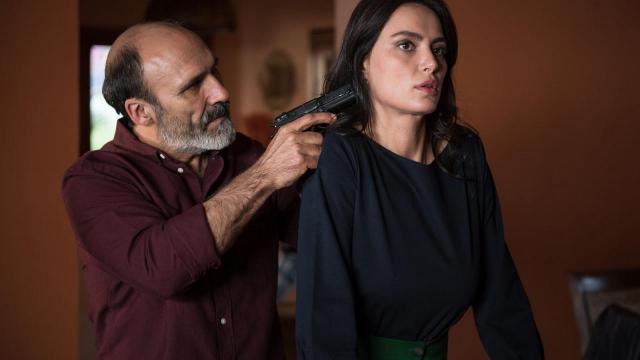
Just who are we meant to root for in Corneliu Porumboiu’s “The Whistlers?”
Is it Cristi (Vlad Ivanov), the deadpan, corrupt Romanian cop yanked hither and yon — from Bucharest to La Gomera, in the Spanish Canary Islands — by the demands of his job and the mobsters he’s mixed up with?
Might it be Gilda (Catrinel Marlon), the perfectly-named femme fatale. Money and a man might be on her mind, but she’s a little too knowing and too quick to take on the guise of a “high class prostitute” to trust.
Perhaps Magda (Rodica Lazar), the head of Bucharest narcotics? She at least seems incorruptible. But we all have a price.
We can’t root for Paco (Agustí Villaronga), the mob boss who sets this convoluted caper in motion, all to get back “my right arm,” Zsolt (Sabin Tambrea), who has been nabbed for money laundering.
Damn. We could pull for Kiko (Antonio Buíl), the mobster and Canary Islands native who undertakes teaching not-that-hapless Cristi “the whistling language,” a within-earshot code allowing you to spell out words and pass messages without a police-traceable cell phone.
“Poot your finger like-a-thees,” he starts, demonstrating how to get the right whistle. He doesn’t speak Romanian, Cristi doesn’t speak Spanish, and his Eeeengleesh if very Chico Marx. “Like eet ees a gun you poot in your mouth!”
That’s almost the only overtly comical thing in this bloody-minded “Blood Simple” style dark “comedy. That, and the guy (István Teglas) who runs the mob-friendly motel called “Opera.”
You can hear everything from Offenbach to “O Fortuna” once you walk in the door. “Doesn’t that chase off customers?”
No, it “educates them,” as if that needed explaining.
The creator of “12:08 East of Bucharest” serves up a convoluted caper-with-killings tale about a prison break, payoffs and double-crosses upon double-crosses.


Cristi is brought to La Gomera, told to “forget about what happened in Bucharest” and learn this tricky, intricate language as if his life depended on it.
Because it does. We see him punched and held under water, threatened and pursued by his mob connection and his cop colleagues.
“How did you end up like this?” his devout mother wants to know.
So do we. But as the chapters — named for various characters and “The Whistling Language” unfold, we get a load of Gilda and we sort of understand.
“Sort of” because the movie is a lot murkier than it should be, losing itself in traveling scenes through lovely Canary and seedy Romanian scenery, in lots and lots of rooms “under surveillance” and relationships that bend so out of shape that some are not who they seem.
And through it all, through near-drownings and near-riches, money lost and a duplicitous woman found, Ivanov never lets us guess how hapless and helpless or cunning and competent Cristi might be.
“The Whistlers” is that rare cops-and-criminals picture that gives us a little to chew on and a new skill to practice — whistling.
“Poot your finger like-a-thees, like eet ees a gun you poot in your mouth!”

MPAA Rating: unrated, graphic violence, bloodshed, explicit sex
Cast: Vlad Ivanov, Catrinel Marlon, Rodica Lazar, Sabin Tambrea, Antonio Buíl, Agustí Villaronga and István Teglas
Credits: Written and directed by Corneliu Porumboiu. A Magnolia release.
Running time: 1:37
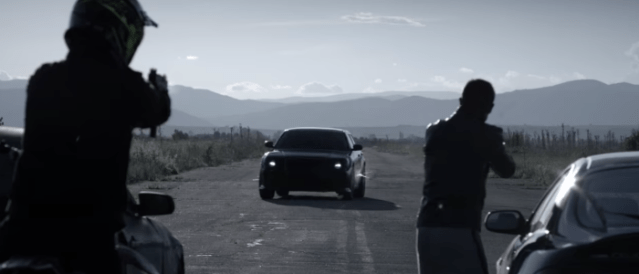
What kind of man parks a piece of evidence — the car whose owner died when he was dropped 20 stories onto its roof — in the police impound lot, sees that car turn its lights and ignition on, engine revving, and stands right IN FRONT of said car peering through the headlights in the gloom as that engine revs?
A DEAD man.
The 1977 horror tale “The Car,” about a possessed auto, which Stephen King ripped off for “Christine” (1983), is back for “The Car: Road to Revenge.”
Different killer car, a modified Chrysler 300 with gullwing doors badged as “Lazarus” for this futurescape. Gearhead horror fans may spy a metallic connection to the original film, but anyway…
In a hellish cyberpunk future hell — Bulgaria. Bulgaria is hell — an arrogant, crusading DA (Jamie Bamber) gets his hands on some evidence on a microchip, and is murdered by “Road Warrior” extras — tossed out of a Bulgarian high rise.
His ex (Kathleen Munroe) becomes the object of the gang’s murderous search, who call her “Little Miss Needs-to-Die.”
The stubbly, tough-guy cop on the case (Grant Bowler) wonders if she had something to do with the DA’s death. Or maybe the murders that the damned car starts carrying out.
“Look man, am I a WITNESS, or a suspect?”
“Depends on who’s driving that car!”
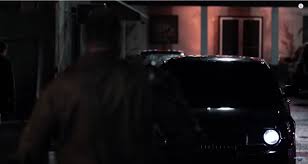
There’s a lot of bloodshed in this lawless land — again, Bulgaria today, the rest of the world tomorrow. A lot of chasing, tires squawling, engines racing, good guys and bad guys trash-talking in cage match bars and strip-club cage bars.
Some lip service is paid to “self-driving cars” and a CPU that could decide to maybe avenge its owner (Is that in the warranty?), but only lip service. As always, this car is haunted.
The violence is sudden and gruesome — blow torch torture, power drill torture. The bad guys are awfully quick to dispatch people they allegedly need to “question” to get that plot device “chip.” No wonder they’re not getting anywhere.
It’s as dreadful as it sounds, although I’ve seen worse. The car chases are second rate and the car itself — black or not — isn’t remotely as sinister as the Lincoln of “The Car” or the Plymouth Belvedere of “Christine.” That’s a function of how it is filmed and edited.
John Carpenter filmed “Christine.” John Carpenter was the master at making something menacing.
This? See it if you’re contemplating a cyberpunk tour of Bulgaria.

MPAA Rating: TV-MA, graphic violence
Cast: Grant Bowler, Kathleen Munroe, Nina Bergman, Micah Balfour, Jamie Bamber, Martin Hancock and
Credits: Directed by G.J. Echternkamp, script by Michael Tabb. A Universal/Netflix release.
Running time: 1:29
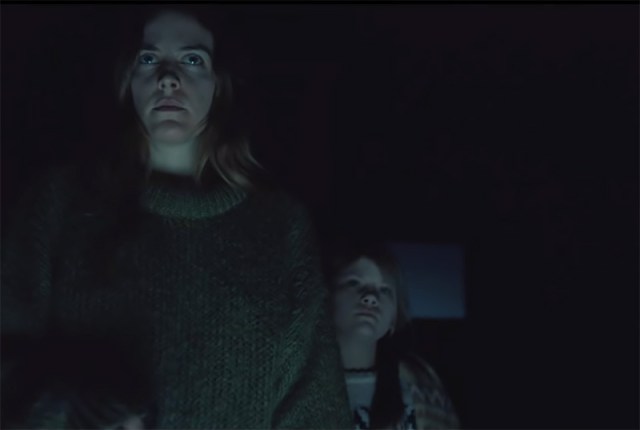
Is “The Lodge” the most disturbing thriller of the year? Judas Priest, I hope so.
Dark and despairing, grim and gripping, it’s not necessarily shocking. It doesn’t live or die on its “big twists.”
But it gets in your head and messes around there. Just as it was designed to do.
I can’t remember a horror movie that left me as gutted as this one.
A family has been broken. Dad (Richard Armitage) has moved out. Mom (Alicia Silverstone) weeps and struggles to put a brave face on.
But the kids (Jaeden Martell, Lia McHugh) can tell. And then “broken” becomes “shattered.”
She raised the kids Catholic, and Dad faces down the avalanche of blame he’s due with utter denial. Pack your stuff, we’re going to “the lodge,” the family’s place in the frigid mountains. Grace, “the other woman” is coming.
They’ll “have some fun, get to know her a little better.”
Is he nuts? “You left Mom for a PSYCHOPATH!” Kids and their “Googling” of Dad’s paramours.
Aidan (Martell, of “Knives Out”) subjects little sister Mia (McHugh) to Internet footage of Grace’s past — “found footage” of a cult she was in.
And what do cults do? Aside from swoon over extremist political candidates?
So it isn’t just the fact that Grace is played by Riley Keough, who could be Mom’s younger, less-blonde sister, that wrecks this weekend.
It isn’t just journalist Dad’s insane abandonment of the three of them, and Grace’s little Maltese, Grady, “for work” in the dead of a very snowy winter.
It’s the kids-hate-Dad’s-new-love/kids-research-her and conflicting dogmas that drive the strife and the action — Catholic kids vs charismatic Christian cultist, children clinging to their lost mother vs Dad’s ready replacement for her.
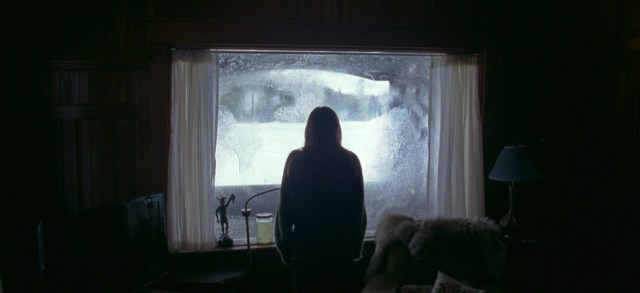
Silence is something that’s rare in modern life, but not in the most chilling horror movies. Music-free car rides, a TV that’s rarely on (except to watch “The Thing” or “Jack Frost,” equally creepy), a big, echoey wooden two-storey surrounded by sound-muffling snow.
Things go bump, crucifixes and icons tumble and things turn chilling and…interesting.
Keough carries the weight, here, as the story is from her point of view. Is she losing it? Is her past catching up with her in a supernatural way?
Mia has a dollhouse version of “The Lodge” back home, but the existence of that doesn’t give away where this is going. Much. Martell doesn’t have to try hard to suggest pale-sullen-stalker OR withdrawn, brokenhearted son.
Like him, the movie could go either way.
Austrian co-directors Severin Fiala and Veronika Franz (“Goodnight, Mommy”) keep the light low and the camera lower — emphasizing the ceilings closing in, the lodge dollhouse’s unerring mimicry of the real lodge’s construction.
But isn’t production design or great narrative artifice that gives “The Lodge” its wrenching effect. It’s the sense of loss, the idea that it’s not shared at the same intensity, that “life goes on” can be the cruelest response of all.

MPAA Rating: R for disturbing violence, some bloody images, language and brief nudity
Cast: Riley Keough, Jaeden Martell, Lia McHugh, Richard Armitage and Alicia Silverstone
Credits: Directed by Severin Fiala and Veronika Franz, script by Sergio Casci, Severin Fiala and Veronika Franz. A Neon release.
Running time: 1:48
Behn Zeitlin, Mr.”Beasts of the Southern Wild,” directed this latest take on free range children who refuse to grow up.
“Wendy” opens Feb. 28.

We figure out “The Silent War” is Western long before the Spanish captain has dismounted and shown off his El Tigre, a Spanish knockoff of that cowboy cannon, a Winchester (’92). It’s obvious when the hero steals the horse and the leather “duster” riding coat from the gentleman/hunter.
That captain (Aitor Luna) is relentlessly hunting, on horseback, that horse thief (Asier Etxeandia) through the remote, under-populated borderlands in the North of Spain.
It doesn’t matter that the year is 1944 and the hunted man is a die-hard Spanish Republican hoping to re-start the Spanish Civil War — this time, with the help of the Allies who are nearly done defeating Germany and Italy. The Spanish uniforms and machine guns of the irregulars returning to Spain don’t hide the fact that this is a tale of pitiless murder and revenge.
And you don’t have to show cattle for your story to be a Western.
This bloody-minded last-man-standing thriller, based on a comic book, puts the viewer through a ringer. There’s a little Spanish history, a lot of stunning scenery and lots of gruesome violence and drawn out savagery.
First-time feature director Alfonso Cortés-Cavanillas shows a flare for building suspense, an unblinking eye for violence and a kind of relentlessness that wears by the film’s third act. But the man has an eye and an ear for period piece action.
The “ear” part comes from the Spanish title to “The Silent War.” “Sordo” (“Deaf,” in English) is the state Anselmo (Etxeandia, of the Oscar-nominated “Pain & Glory”) finds himself in right off.
He’s part of a group of Spanish Republican freedom fighters, returning to the country to re-start their Civil War. It’s October of 1944 and they are part of a thousand man force of infiltrators, coming in before (they’re sure) the Allies join them to “finish up” — the last fascist dictatorship in Europe.
But their “For Whom the Bell Tolls” sabotage — blowing a bridge — goes up prematurely. Their unit is all but wiped out. Vicente (Hugo Silva) is injured and captured. Anselmo is on the run, with only a little ringing to remind him of what ears used to be for.
Dogged, murderous Capitán Bosch (Luna) isn’t much on prisoners.
“The dumbest part about prisoners,” he lectures his men (in Spanish with English subtitles), “is refusing yourself the joy in killing an enemy!”
But deaf or not, Anselmo is hard to catch. Torturing Vicente in the village where he used to live isn’t helping. Perhaps his lady love (Marian Álvarez) can be persuaded to help?
And failing that, there’s always the Russian mercenary-sniper (Olimpia Melinte) who lost one eye at Stalingrad and isn’t particular about who she hurts or kills.
The mercenary’s arrival is the first sign that this WWII era thriller was born in a comic book. Spain’s Franco sent Spanish troops to fight in Russia –– against the Russians.
Everything up until then has been a collection of repurposed elements from classic Westerns. There’s a stand-off in a remote cabin, a lot of horses, a shoot-out and chase on horseback, random acts of brutality and a bit of honor among foes.
A sergeant that the insurgents capture in the opening scene is freed, and given a bullet to keep in his pocket for the next time he runs into them or people like them.
To “remember (the bullet) is in your pocket and not your head!”
The setting is striking, and the violence comes right up against the edge of “repellent.” And there’s a sense that we’re slow-walking our way towards the final showdown and whatever sadism it promises.
But Cortés-Cavanillas and his co-writer wonderfully transfer the comic’s gimmick — that Anselmo cannot hear, and thus cannot hear enemies catching up to him on horseback, cannot understand what people he’s pointing a gun at are saying and cannot logically sneak up on anybody else as he tries to survive this month-long ordeal.
It’s too grim to be for every taste. But that “deaf man hunted” hook, the novel setting and the Western archetypes parked on the edge of the 1944 Pyrenees make “The Silent War” a winner, and suggest the start to a promising feature film career.

MPAA Rating: TV-MA, graphic bloody violence, sexual assault
Cast: Asier Etxeandia, Marian Álvarez, Hugo Silva, Aitor Luna, Imanol Arias and Olimpia Melinte
Credits: Directed by Alfonso Cortés-Cavanillas, script by Alfonso Cortés-Cavanillas, Juan Carlos Díaz Martín, based on the comic book by David Muñoz and Rayco Pulido. A Netflix release.
Running time: 2:02
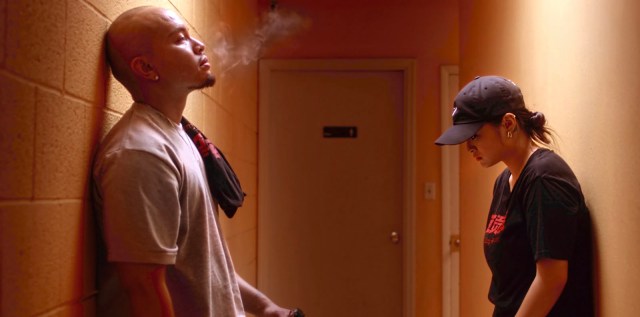
Tera keeps her black cap pulled down over her eyes and keeps those eyes in a permanent glower.
The hat is armor, her posture sullen, defensive. You grow up Chinese and female in South Central Los Angeles, it comes naturally.
She’s in school, studying business, when we meet her. But her side hustles tell us that she’s out of these kids’ league, a 21 year-old who’d already an MBA — matriculating bad ass.
She can tell the family business — her mom’s Chinese restaurant — is a dead end. Her broken down mother knows it, too. It takes her cousin to articulate it.
“This neighborhood don’t do anything but keep you where you’re at.”
But that one delivery to a back-room drug “lab” will change the arc of Tera’s career and her family’s fortunes.
“Take Out Girl” is a gritty, promising but somewhat flat-footed first feature from cinematographer (“Prodigy”) turned director Hisonni Johnson.
It has a feel for its setting — the cultures thrown together, inter-marrying, absorbing from each other — the street argot that hints at African American, Latino, Chinese, Korean, Filipino as a first-gen melting pot. And it has a compelling leading lady. Hedy Wong, who co-wrote the sometimes-melodramatic script, seems too streetwise, fearless and tough to be 21. This world, it is suggested, made her that way.
She can look this drug dealer, Lalo (Ski Carr, spot-on) –hulking menace and gold grill masked by a hint of Latino gentility — square in the eye and give him the business consultant’s rap about his “problem.”
“No disrespect, but your people? They’re not really functional. They noisy.” As in, they’re sloppy and unmotivated. And their scowls, stubble, tattoos and chains make them walking drug world stereotypes to the cops.
Somebody like her, “Little Asian Girl” making Chinese food deliveries? They’d never give her a second thought. What’s your name, Chinese girl?
“Call me what you call me.”
“Take Out Girl” it is.
The family’s in hock, and Tera’s school hustles aren’t fixing that. But Tera’s supposed to be “the brains” in her family, with her short-tempered brother Saren (Lorin Alond Ly) the one most likely to get mixed up dealing drugs, hanging with gangsters. Which he is.
Tera is the one who takes things to the next level.
Lynna Yee sympathetically plays their mother, crippled by back pain from a lifetime of single-mom labor in a restaurant she is afraid to close, even for a few hours, just to get a break. Dijon Talton plays Nate, the custodian/handyman at their strip shopping center, the one sweet on Tera.
And veteran screen heavy J. Teddy Garces is Hector, aide de camp to Lalo, the one “watching” their unnamed new delivery queen because — as the cliche goes, “I don’t trust you.”
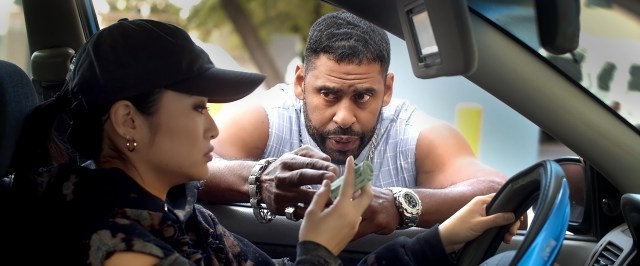
The film’s leisurely opening sets up Tera as a smart cookie, Saren as a hothead and Mom as a martyr to her kids and her business. Learning her new business is handled with some sharply cut montages, set to drug dealing hop hop.
Too little is done with Tera’s business acumen, there’s no spark to the would-be romance and too many one-on-one scenes play as static as still-lifes. Characters strike a pose, take a beat and ask for a date or make an introduction by insisting you “Check out the white shoes. White shoes!” or share some confidence.
These scenes slow down the early acts.
Odd moments of drug dealer generosity and “little Chinese girl” bravery ring false. All these violent people with guns and she never flinches? Several shifts in tone and the nature of Tera’s work seem abrupt, and the third act’s twists are pure melodrama.
But the milieu, similar to 2017’s “Gook” with far more conventional plot complications, is a winner and Wong is utterly convincing as a clever hood rat, if not quite as convincing as a coed. Suspense isn’t maintained throughout, but several scenes manage a wonderful tension.
That adds up to an indie thriller with promise, if not quite the pace and polish it needs to deliver the drama, excitement and heartbreak.

MPAA Rating: unrated, bloody violence, drug content, profanity
Cast: Hedy Wong, Ski Carr, Lynna Yee, Lorin Alond Ly, Dijon Talton
Credits: Directed by Hisonni Johnson, script by Hedy Wong and Hisonni Johnson. A The Label release.
Running time: 1:39
I liked the “Groundhog Day” Jeep commercial. And the Boston Hyundai “pahk the cah” ad. But those and this James Bond short spot were the only items from “The Big Game” that I sampled.
This adds a little to the stunt bonafides for this April’s Bond film. Nothing else.


