Bingeworthy? Ryan Murphy’s gloss on “Hollywood”

holly5

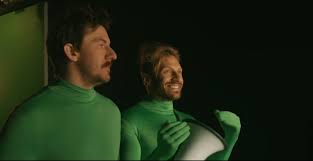
Don’t let the phrase “Jim Parsons almost walks away with Ryan Murphy’s ‘Hollywood‘” scare you off, “Big Bang” haters. Because it’s “almost,” for starters. And Parsons, playing real-life “eye for the beefcake” predator/agent Henry Willson, is villainously vile, and a hoot.

The man who bedded the handsomest Hollywood wannabes of his generation, and made some of them — Rock Hudson, most famously — movie stars, is one of the standout figures in this gay fantasia on Hollywood “as it could have been.”

It’s exactly what you’d expect a limited series from the guys who came up with “Glee” (Murphy and Ian Brennan) and one who went on to take on the Bette Davis/Joan Crawford “Feud” — a soapy, dishy gloss on inclusion, race, sex and sexuality in a history of Hollywood as it never really was.

As the gay black screenwriter Archie Coleman (Jeremy Pope) enthuses, they “take the story of Hollywood,” with its racism, sexism and closet-closing homophobia, “and give it a rewrite.”

The seven episodes aren’t uneven in quality or gloriously-detailed production values, but they vary entirely too much in impact. There are moments — just moments — of giddy fun. Yeah, they could have made this a romp. And then there are a couple of emotional highs, remembering the doors closed and dreams deferred. It could have been a straight melodrama, too.

Its take-off point is “Scotty’s Secret History of Hollywood,”the book and documentary it inspired about a service station run by gigolos, “servicing” the men and women of the film colony. Ernie (Dylan McDermott) runs this version of that real story, a dapper “gigolo” stereotype, right down to the pencil-thin mustache.

Ernie’s greying, and he’s got that “first act cough.” Uh oh.

Ernie “head hunts” broke wannabe Jack Castello (David Corenswet, earnest but merely OK in the part), married and with a baby on the way — too “straight” to be a “full service” employee. But handsome Jack, a freshly-discharged WWII vet, becomes the favorite of regular client Avis (Patti Lupone), an aged starlet who was told she was “too Jewy” (ethnic) to make it as an actress. And Avis is married to the “Ace” (Rob Reiner, a fine vulgarian) “Ace Pictures,” the fictional studio all these fictional (and non-fictional) characters circle around.

Maybe Jack can get that big screen test.

And Jack recruits Archie, a gay cruiser he tracks down in a gay porno theater. Archie’s (Pope) an aspiring screenwriter at a time when the only movies black screenwriters could get paid for were “race” pictures by the Oscar Micheaux of the day.

Archie’s got this script — “Peg” — about Peg Entwistle, a failed-actress who famously jumped off the Hollywoodland sign to her death in the 1930s. EVERYbody wants a piece of “Peg.”

Except Raymond Ainsley, a pal and fellow screenwriter sleeping with Archie’s sister. Ray (“Glee” veteran Darren Criss) has his own script and dream. He has a Chinese story he wants to film that will give Anna May Wong (Michelle Krusiec), a silent star who lost the lead in “The Good Earth” to a non-Chinese actress (Luise Rainer) who won an Oscar playing it.

Anna May, “the first Chinese-American movie star,” is another real person, an actress who crawled into a bottle after being typecast as “exotic Asians” and “dragon ladies.” Look at her credits on IMDb and see what Murphy and Brennan want to “save her from” in this alternative history.

Laura Harrier plays Ray’s “woman of color” girlfriend, Camille, a great beauty condemned to playing maids, unless these crazy, optimistic outsiders can “make our own rules by breaking some of’em!”

Fictional characters like production chief Dick Samuels (stage director/actor Joe Mantello, cynical and when he needs to be, sentimental) and real-life “players” like Willson (Parsons) relate real-life Hollywood anecdotes with the usual “Let me tell you a little story” moments dished to the newcomers.

Legends from John Wayne and Irving Thalberg take it on the chin in the those legendary bits of gossip.

On screen? Rock Hudson is eviscerated. Eleanor Roosevelt (Harriet Sansom Harris, terrific) is nominated for sainthood.

Others are shown at their glossiest, with their human weaknesses included — storied director George Cukor’s (Daniel London) famed gay pool parties, Vivien Leigh’s (Kate McGuiness) fragile “Scarlett O’Hara” vanity, Tallulah Bankhead’s (Paget Brewster) bawdy wit.

Here’s Oscar winner Hattie McDaniel (Queen Latifah) and playwright/wit and gay swain Noël Coward (former hobbit Billy Boyd, not really anybody’s idea of Coward).

Holland Taylor plays a talent scout and acting and locution coach, the one who teaches would-be actors like Jack and Rock Hudson (Jake Picking, so bland he might be the real Rock) and prophesies “There’s a movement, a whole new style of acting, coming. NATURALISM!”

In a cynical story about how Hollywood “hypocrisy,” the way the town has ALWAYS run — the sexual barter system (“screwing your way into the movies”) — Taylor’s Ellen Kincaid is the series’ conscience. An old timer who recognizes that the prejudice in this town colonized by Jewish outsiders is mostly fear of what “they” — Middle American moviegoers — will “accept,” she has the best and campiest line of all, when Ellen meets the screenwriter of “Peg.”

“You’re colored...I LOVE it!”

Hollywood history fans will lose themselves in this vamp of “actual” history. Keep your smart phone IMDb page open and and look up the figures to see who’s real and who isn’t.

Oscar winner Mira Sorvino has a small but sweet and showy role, Samara Weaving plays a cutthroat starlet, and nearly-forgotten names and faces like “Tab” and “Rory” and “Guy” may have you doing homework between episodes.

“Peg” was never a movie, but one called “Peggy” played a big part in making Rock Hudson’s career. Look it up.

It’s the zingers that will keep you watching. Ernie berates Jack for not “servicing” a regular client in the behind-the-station trailer, a client who is anything but “regular.”

“It’s COLE PORTER! Yesterday, I heard you humming, ‘Don’t Fence Me In.’ If I can’t count on you to lend a helping hand to a National Treasure like Cole Porter…”

Yes, it’s a mixed bag, but unlike TOO many streaming series to name (Mindy Kaling are your ears burning?), this one gets right down to business, delivering right from the start of the opening episode. There’s heart in the “Hollywood can change the world, let’s try it” ethos. And there are laughs, none bigger than Jim Parsons, letting his contemptuous, foul-mouthed freak flag fly at every gorgeous “Greek god” who comes to his office for a “meeting,” a signing and a sexual transaction.

“You f—–g hayseed!”

Wait’ll you see him do the Dance of the Seven Veils.

stars2

MPAA Rating: TV-MA, sex, nudity, profanity, smoking, alcohol abuse

Cast: David Corenswet, Darren Criss, Laura Harrier, Dylan McDermott, Jeremy Pope, Jake Picking, Holland Taylor, Patti Lupone, Joe Mantello, and Jim Parsons

Credits: Created by Ian Brennan and Ryan Murphy. A Netflix release.

Running time: 7 episodes @:44-60 minutes each.

Posted in Reviews, previews, profiles and movie news | Comments Off on Bingeworthy? Ryan Murphy’s gloss on “Hollywood”

Movie Preview: Another thriller titled “Driven”

This one stars Richard Speight and comes from small/edgy distributor Uncork’d.

A cabbie racing the clock with a client. A race against…evil.

June 12.

Posted in Reviews, previews, profiles and movie news | Comments Off on Movie Preview: Another thriller titled “Driven”

Movie Review: Family from the Caucasus tries to maintain “Closeness” after a kidnapping

close4

“Closeness” is a drama set in the Kabardino-Balkaria Republic of the Russian North Caucasus. It is depicted as a place of limited options, an uneasy “tribal” ethnic mix of populations and a grim, grey beauty that mirrors the hard people living through hard times there.

Writer-director Kantemir Balagov identifies himself as Kabardian (Muslim) in an opening voice-over, and tells us this story happened in the city of Nalchik, dumpy model of Soviet planning and architecture just north of the Georgian border. The story he tells happens to poor working class Jews living there in 1998.

Ilana, “Ila” (Darya Zhovner) is 24, and works on cars in her dad’s garage. She seems to treasure the connection, but Avi (Atrem Cipin) is OK with it, even if he’s always bringing up folks he knows suggesting other jobs for her.

“Do you want to spend all your life fixing cars?” he grumps (in Russian, with English subtitles).

Her mother (Olga Dragunova) puts up with it, because their lean finances demand it. Besides, their son David (Veniamin Kac) is getting married. He’s younger, doesn’t seem to have a job himself. But he’s their darling, something made clear by the big engagement dinner they throw him.

There’s a guy her parents have in mind for Ilana, but Rafa is a bit of a shrimp. We figure out he’s not “man enough” for her when we see who she steps out with. Zalim (Nazir Zhukov) is a bear-sized truck driver and Kabardian. He’s rough company and she’s down with that.

But returning home after the party, she realizes tragedy has struck. David and his fiance have been kidnapped. “Don’t tell the police,” they’re warned. And the ransom? It’s well beyond their reach.

The family and community’s “Closeness” are tested, as the rabbi rounds everybody up for a meeting to pool resources. Some bristle at pitching in, others are most interested in helping fiance Lea’s widowed mom recover her daughter.

Ilana’s family will lose everything they have getting David back, and even though we’ve seen how close the siblings are, she fumes at this final confirmation that she has less value. They’re even willing to marry her off for the cash to get David back. She’s not going to accept this, Zalim is more her speed.

“He’s not from our tribe.”

“I don’t BELONG to that tribe,” she hisses.

But going to stay with Zalim is more harrowing than she could know. The Chechen wars— Russians attacking Islamic separatists — weren’t some remote “overseas news” in 1998 Nalchik. And sitting with Zalim’s radicalized pals, hearing them bring up ancient grievances (“Remember 1763!”) and watching snuff videos of Chechens torturing and executing Russian prisoners (the real deal) is too horrific even for Zalim to watch.

A friend’s crack that “Jews are good to make soap from” should close the deal for Ila. That it doesn’t speaks volumes about how much she resents the family that’s using her to raise cash for her brother.

close5

Balagov shoves our faces into the this, tight shots in a 4-3 aspect ratio creating a claustrophobia that isn’t lessened by the natural lighting outdoors and dimly lit interiors.

It’s a very rough and rough-hewn film. He shoves our faces into the ethnic turmoil. But the violence, gratuitous as it seems, serves a purpose. Ila’s connection to this other “tribe” is a non-starter.

“Jews are good to make soap from,” one Muslim cracks.

And if the prisoner-murdering footage (far more than necessary to make the point) wasn’t bad enough, we’re treated to a rape as well. Be warned, there are “triggers” woven into this picture that make it not for everyone.

Balagov has already shown us an ugly vision of Jewish “types” from the region, self-interested, stingy. One elder who offers to “help” just wants to get Avi’s garage at fire-sale (desperation) prices.

“Don’t PREY on us!” Ila shouts, to no avail.

Ila is the heart and soul of “Closeness,” and Zhovner breathes an impulsive fury into her. She’s more at home in overalls than a dress, and her whispered dismissal of a marriage proposal — “It’s not going to happen” — is but a prelude to the film’s third shock, the way she ends that talk, in the middle of a marriage negotiation dinner, will be the one scene from “Closeness” that don’t think I’ll ever forget.

stars2

MPAA Rating: unrated, graphic violence depicted in actual terrorist footage, rape, profanity, drinking and smoking

Cast: Darya Zhovner, Atrem Cipin, Olga Dragunova, Nazir Zhukov and   Veniamin Kac

Credits: Directed by Kantemir Balagov, script by Kantemir Balagov, Anton Yarush. A Kino Lorber release.

Running time: 1:58

Posted in Reviews, previews, profiles and movie news | Comments Off on Movie Review: Family from the Caucasus tries to maintain “Closeness” after a kidnapping

Netflixable? Diamonds and cash, a will and a marriage tested by “Dangerous Lies”


lies3

“Dangerous Lies” isn’t the dumbest whodunit to come along. There’s enough here to make you guess, second guess and maybe third-guess who is doing what to whom.

Maybe the situations seem a little prime-time soapy and the acting a little underwhelming, considering the bodies that start piling up around it.

It stars Camila Mendes from TV’s “Riverdale,” so make what you will of that soap-thriller casting.

But it’s mostly undone by its need to explain and over-explain, to have characters speculate (right on the money) about motives, what’s REALLY going on, rather than leave it to us to figure out.

Enough of what’s going on is obvious that we don’t need the remedial help.

But director Michael Scott is most at home making Hallmark-ready Christmas movies (“Hitched for the Holidays,” “Christmas on Holly Lane,” “Christmas Lost and Found” and that holiday classic, “It’s Christmas, Carol!”). So not having a handle on how much to explain or how to build suspense and pace your picture to rope the viewer in is to be expected.

At least he stages a decent shootout.

Mendes is Katie, a waitress when when meet her, slipping out of her Chicago diner for a makeout session with her studious student husband Adam (Jessie T. Usher, the littlest “Shaft”). But a robbery begins while they’re outside, and coming back in, Adam intervenes — violently.

That event upends their lives…WE’RE TOLD (not shown). Months later, he’s dropped out of school, cannot find a job and the bills are piling up. She’s become an in-home caregiver to a kindly old gent (Elliott Gould, bless him).

And when Katie lets slip to Leonard how hard times are, he wants to help. He takes on Adam as a gardener, off the books. It’s against the caregiver company’s policy. So is Leonard writing Katie an excessive check for this month’s services.

Adam’s impulses again rub against Katie’s well-intentioned caution. They cash it, and find Leonard dead the very next day.

If they’re worried about “how this looks,” they still don’t promptly call the authorities. Adam picks this very moment to rummage around Leonard’s attic, where the treasure lies.

And if those two actions aren’t suspicious enough, Katie insists to the cops that Leonard wanted to be cremated. That’s got to set off the detective’s (Sasha Alexander) alarm bells.

That’s BEFORE a lawyer (Jamie Chung) shows up with Leonard’s will, leaving everything to Katie. There’s also this creeper real estate agent (Cam Gigandet) insisting on making an offer on the property.

If it looks suspicious, it IS suspicious, right?

When the most basic description of your plot seems to give away the game, it takes style, performances and cleverness to wriggle out of the corner your picture’s painted into. “Dangerous Lies” lacks all three.

Not enough is made of “This Adam husband fella, how WELL do you know him?” doubts. The trauma of surviving a violent robbery, committing violence to stop it, isn’t developed.

There are ways to misdirect us when the second body shows up, more doubts that can be sewn and aren’t.

Mendes’ Katie under-reacts to almost all of this, partly thanks to the script, which has her hearing Adam’s “why don’t we” angles out at each juncture, partly due to her own limited range.

A beloved employer dies and she finds the body? A tear, maybe two. He left me EVERYTHING? Woohoo!

The script has Usher’s character leap into one dunder-headed move after another. The couple has scripted affection, but little chemistry.

Yeah, I know, “millennials.” But still.

This emotional disconnect only grows as the body count rises. Don’t they see how this looks? Don’t they FEEL anything?

The end result is a thriller that doesn’t race towards a climax we figure out (finally) 20 minutes in advance, it limps there.

1half-star


MPAA Rating: TV-14, violence

Cast: Camila Mendes, Jessie T. Usher, Sasha Alexander, Cam Gigandet, Jamie Chung and Elliott Gould.

Credits: Directed by Michael Scott, script by David Golden.  A Netflix release.

Running time: 1:36

Posted in Reviews, previews, profiles and movie news | Comments Off on Netflixable? Diamonds and cash, a will and a marriage tested by “Dangerous Lies”

Classic Film Review: How is “The Age of Innocence” (1993) aging?

Revisiting “The Age of Innocence” for the first time in many years doesn’t erase first impressions of the film. But it does make you marvel at the many times Martin Scorsese chose to tackle ambitious projects far removed from the American Master’s comfort zone.

Back in 1993, much was made of the movie maker who seemed married to the mob taking on a passions-never-allowed-to-boil Edith Wharton romance, a 19th century period piece of baroque wealth in an emerging New York.

But he’s been breaking out of his pigeon hole all along, as the great ones inevitably do. “Hugo,” “The Aviator,” “Kundun,” “Silence,” “The Last Temptation of Christ, and “Boxcar Bertha” — Scorsese has always reached beyond the cinema he’s known for.

He’s not shied away from “period” even in stories and milieus more in his wheelhouse, either — “Raging Bull,” “Gangs of New York,” “Shutter Island.”

“Innocence” came out in the middle on the ongoing Jane Austen mania, and suffered by comparison. It’s dry and not the least bit witty. The cutting, gossipy dialogue is cruel, not clever. The confessions of passion PBS soap operatic.

“I just want us to be together!”

“I can’t be your wife, Newland! Is it your idea that I should live with you as your mistress?”

That’s Wharton’s take on America’s emerging aristocracy of wealth — bluff, blunt to the point of inelegant.

But the exposition and gossip-heavy exchanges felt dated then and more so now, with characters repeating the phrase that’s just been uttered to them in mock movie melodrama quaintness. Scorsese’s weakest scripts — “Gangs of New York,” “Silence” and “Innocence” — were co-written by his longtime collaborator, critic-turned-screenwriter Jay Cocks.

The 1870s to @1910 story concerns the interlocking circles of high-born attorney Newland Archer (Daniel Day-Lewis) and his beloved, May Welland (Winona Ryder), and how those are interrupted when a beautiful but woebegone relation of the Wellands, Countess Ellen Olenska (Michelle Pfeiffer), returns home from an unhappy marriage to lesser European nobility.

She’s heading for a divorce, and Newland — engaged and eventually married to the dull but charming May — is overcome by the spark, smile, vulnerability and sexual heat of the smouldering Countess.

Ryder, 22 when “Innocence” came out, seemed miscast way back when. But the remove of several decades let you see the inner resources and grit of a character whose surface is studied dullness.

“What are you reading?”

“Oh, it’s a book about Japan.”

“Why?”

As if she can’t think of a reason anyone would be curious about the world beyond their reach.

Ryder was an “old” 20something, one of the greatest actresses of her generation. A bit out of place, here, but not as bothersome.

I was more taken aback by how the great Daniel Day-Lewis comes off, starchy and “proper” which is very much in character, but fey and unmanly. The robber baron classes flattered themselves on their American masculinity (back then, anyway), and he seems off — Dr. Zhivago soft.

The supporting cast has a couple of highlights — Norman Lloyd and Miriam Margolyes were heralded at the time of release. But too many smaller roles were forgettably cast, with few of the caliber of Michael Gough, Richard E. Grant, Mary Beth Hurt (a single scene) or Geraldine Chaplin brought on board, and even that illustrious quartet was left with little to do other than don evening wear, light cigars and decorate the immaculately recreated sets.

Eagle-eyed viewers will spot future Oscar nominee June Squibb (“About Schmidt,” “Nebraska”) as a maid.

The nouveau riche gaucherie is more subtle than you’d like — a J.M.W. Turner reproduction hanging here, a quartet of suited-servants carrying Granny (Margolyes) in a sedan chair there.

Still, Scorsese magnificently captures the provocative allure of removing a lady’s glove before kissing her hand, even if Day-Lewis takes that “sex scene” to an amusingly voracious pitch.

It’s good to remember how marvelous Pfeiffer could be in a period piece and why she attained her status as the sexy dramatic lead of her day.

Some regard “The Age of Innocence” as essential American cinema or essential Scorsese. I don’t. It’s arid when it should have a hint of “droll,” theatrical and stagey when we’re meant to believe these people “live” in this world.

Scorsese never lets us forget he’s an outsider looking in, tiptoeing through the material as if he’s afraid of bumping the porcelain off the lacquered “oriental” end tables and pedestals.

stars2

MPAA Rating: PG, for thematic elements and mild profanity.

Cast: Daniel Day-Lewis, Michelle Pfeiffer, Winona Ryder, Geraldine Chaplin, Richard E. Grant, Stuart Wilson, Mary Beth Hurt, Norman Lloyd and Miriam Margolyes.

Credits: Directed by Martin Scorsese, script by Jay Cocks and Martin Scorsese. A Columbia release.

Running time: 2:19

Posted in Reviews, previews, profiles and movie news | Comments Off on Classic Film Review: How is “The Age of Innocence” (1993) aging?

Bingeworthy? “Never Have I Ever” figured Mindy Kaling had a high school sitcom in her

You’d expect Mindy Kaling’s take on a teens-on-the-make sitcom to be edgy — kids and teachers lobbing profanity back and forth across the net, an Indian-American teen daring to call her mother a “bitch” in mid-tantrum, a 15 year-old brazenly propositioning the hottest guy in school.

And you’d expect it to be more diverse than your typical sitcom. Her (and “Mindy Project” co-creator Lang Fisher) version of Sherman Oaks, California is almost WASP free. It’s a sea of Asian and Hispanic kids, African American authority figures (a principal, a shrink) with a Jewish nemesis and a too-woke-for-words Jewish teacher for good measure.

Today’s history project, “What if Anne Frank had a cell phone?”

With Kaling involved, if you thought it would be funnier than “Never Have I Ever” turns out to be, you wouldn’t be alone. The dollops of “sweet” and rare laughs are especially hard to come by in the first few episodes.

As one character is in the process of coming to terms with her sexuality, the phrase “It gets better” comes to mind. But not much. Not enough.

It’s about 15 year-old Devi (Maitreyi Ramakrishnan), who is set up to be “the smart Asian kid” but one with a terrible temper. If only we saw more of it.

Devi’s got a reason to be cranky. She lost her dad at last year’s spring orchestra concert (she plays the harp), lost her own ability to walk for a couple of months after that, perhaps due to the shock.

And, curse of curses in teen rom-com life, she’s still a virgin.

Starting the new term, she’s no longer “FDR” (wheelchair bound) and she declares “Sophomore year is going to be OUR year” to drama dork pal Eleanor (Ramona Young) and tech-nerd Fabiola (Lee Rodriguez). Ever seen a high school rom-com that DIDN’T use that line?

Devi takes a lot of chewing-out from her dermatologist mom (Poorna Jagannathan), copes with the too-gorgeous college cousin Kamala finishing up her Phd and living with them (Richa Moorjani), and occasionally sees her dead dad, and not just in flashbacks.

At school, she renews her war with smart jerk/rival Ben (Jaren Lewison, amusingly annoying) and crushes on the school dreamboat, the hopelessly cut Paxton Hall-Yoshiba (Darren Barnet). After school is when she sometimes sees her shrink (Niecy Nash).

And narrating her story, for reasons the series gets into, is tantrum-tossing tennis great John McEnroe. Little bursts of profanity don’t change the “Wonder Years” cloying nature of the voice-over. Devi has her moments of temper, which Mr. Mac-Obvious labels, “THAT’s how we hotheads boil over.”

It makes little chronological sense that anybody in that house would have ever been into John McEnroe, whose tennis career wound down in the early ’90s. Her family might have come to America in 2001, with Devi born a few years later. But her dad doesn’t look 60 or even 50, so how’s that McEnroe connection work?

Mac is there when Devi’s full-court-press on Paxton bears fruit in “Never Have I Ever…had sex with Paxton Hall-Yoshida.” That’s how the episodes are titled.

“Well, this was certainly not the walk of shame she was hoping for.”

The jokes are of the “Is that a skirt, or a headband?” “You look like an Asian Kardashian!” variety — tired, horny teenager takes. Those comparing “Never” to the John Hughes classics of the ’80s are missing the mark by several years. This is closer to “American Pie” — some cuteness, a lot of (lite) crude, a little heart here and there — always heavy on the hormones.

All Devi wants to be is a “normal teenager.”

“Normal teenagers wind up in prison, or worse — working at Jersey Mike’s!”

Hilarious.

Cousin Kamala’s story includes efforts to arrange a marriage back in India while hiding a boyfriend in the States (“Big Bang Theory” much?), and there are story lines about a “spirit animal” Devi thinks is her dad and the awakening sexual preferences in one of her friends.

The casting is, frankly, bland. Brag about the talent hunt and seeing thousands of faces if you want, but when your lead is charisma-starved and prone to rushing her lines, that sets the tone for the rest of the cast. She looks her age, which gives an underage jolt to her assertive bursts of brazenness.

The supporting players can’t be so interesting, natural or funny that they show her up, so her BFFs, toy boy and even rival collectively whisper “Not a breakout star in the lot.”

Even Niecy Nash is less interesting than normal, unable to summon up any dudgeon when Devi declares to her shrink that “I’m ready to BONE.”

“If you were ready to bone, you would use the phrase ‘ready to bone.'”

As I say, the show starts to find its sentimental footing by episodes three and four. But there’s little traction with this writing and this cast. Compare “Never Have I Ever” to the sparkling and sometimes raunchy teen comedy movies Netflix makes, “The Kissing Booth,” “To All the Boys I’ve Loved” before, to or other Netflix sitcoms. This falls closer to the formulaic “One Day at a Time” reboot than “Unbreakable Kimmy Schmidt.”

Even the target audience could catch on that this isn’t destination streaming. It’s filler with a hint of spice to it — five hours worth.

Whatever the thin charms of the characters or glories of putting characters on the screen that a lot of different American kids can see and say, “Hey, she/he looks like me,” you’d have to be a pretty undiscriminating kid to not wish “looks like me” was a lot funnier.

2stars1

MPAA Rating: TV-14, teen drinking, sex talk, profanity

Cast: Maitreyi Ramakrishnan, Darren Barnet, Lee Rodriguez, Richa Moorjani, Poorna Jagannathan, Ramona Young, Jaren Lewison, and the voice of John McEnroe.

Credits: Created by Lang Fisher and Mindy Kaling.  A Netflix original series.

Running time:  10 episodes @ :30 each.

Posted in Reviews, previews, profiles and movie news | 5 Comments

Documentary Review: Remembering The Last Poets, Black writers not “Scared of Revolution”


“Scared of Revolution” takes us back to the pre-history of hip-hop, to The Last Poets, young African American slam poets (before that was a thing) who got up on stage, accompanied by a conga player or an ensemble, and spoke their truth.

It’s a profile of Umar Bin Hassan, Akron native, Baltimorean now — who came to fame alongside Abiodun Oyewole, Sulaiman El-Hadi and others in the New York of the late ’60s and early ’70s.They released a seminal, self-titled LP — just poets in performance with a drummer — that became a hit and influenced Gil-Scott Heron (“The Revolution Will Not Be Televised”) and the rap and hip hop that were born at the end of the ’70s, having their works sampled on the records of Biggie Smalls and others.lastThe film takes its title from the most famous poem by Hassan (born Jerome Huling in 1948), a biting and hilarious piece titled “N—–s are Scared of Revolution.”“N—–s are scared of revolution
But n—–s shouldn’t be scared of revolution
Because revolution is nothing but change
And all n—–s do is change”
Daniel Krikke’s intimate portrait captures Hassan on stage, follows him around Baltimore and takes a ride with him west to Akron, Ohio, where he has family but where little remains of the “Little Harlem” where he learned to rhyme as a shoeshine in the 1950s.Fellow Last Poets, musical Bill Laswell, Hassan’s mother, sister, daughters and grandchildren make appearances and make the case for his place as a grandfather of hip hop, his “astonishing and enduring influence.”The arc of the group’s fame is discussed, how their motives were “to be the purest (idealized) revolutionary poets,” and how “their politics became show business.”The pitfalls of celebrity present themselves — a crack addiction that made him a lousy father to the children he had with different women. He was the son of a violent drunk of a father, but he says he performs to this day “to keep my father’s presence alive.”And if you’re looking for that redemptive story arc that the best stories about addiction lean on, we see the doting grandfather this absentee father turned into.What the film lacks is actual faces and voices from hip hop testifying to his influence, snippets of the songs that sampled his poetry.But Krikke isn’t stingy about Hassan’s poetry, giving the poet plenty of time to perform his work (he’s seen writing new pieces as well).It’s a warm portrait, warts and all, if not as critical and definitive as one might like.3stars2 MPAA Rating: unrated, profanity

Cast: Umar Bin Hassan, Bill Laswell, Aziza Hassan, Bobby Jean Culler, Abiodun Oyewole, Bill Adler

Credits: Written and directed by Daniel Krikke. A Film Movent release.

Running time: 1:17

Posted in Reviews, previews, profiles and movie news | Comments Off on Documentary Review: Remembering The Last Poets, Black writers not “Scared of Revolution”

Netflixable? “It’s for Your Own Good (Es por tu Bien)” asks the Spanish question, Does Father know best?

good2

There are two ways and two ways only that the rom-com “It’s for Your Own Good (Es por tu Bien)” can turn out, given the set-up.

It’s about three brothers-in-law, concerned at what they see are poor choices their three daughters are making in who they fall in love with. They resolve to bust these trainwreck relationships up before lives are ruined.

Will they succeed in finding ingenious ways to bust up inappropriate–possibly self-destructive — couplings, and win their daughters’ lasting affection and appreciation for “saving” them?

Or will they fail, see the error in their ways, realize the daughters — teen to 20somethings — have to make their own decisions and perhaps come to see their new loves in a new light?

You know which one’s the more politically-correct and “woke” route. It would take real guts to choose the first path, which seems too old-fashioned for any movie similarly plotted to use as a resolution.

But it’s to the filmmakers’ credit that they at least make the range of fatherly concerns interesting, reasonable and (somewhat) rational. And it’s to the stars’ credit that they make these guys’ angst just a little amusing.

Arturo (Jose Coronado of “The Man with a Thousand Faces”) is a wealthy attorney whose daughter Valentina (Silvia Alonso) leaves the Dad-approved attorney she was going to marry at the altar to take up with an old flame, the leftist/activist/idealist Alex (Miki Esparbé).

“If we don;’t do something,” he fumes in between drinks and binge-eating…everything, “in two days our daughter’s going to be playing the flute in front of the mall!”

Jesus or “Chus” (Javier Cámara of “Living is Easy with Eyes Closed”) dotes on daughter Marta (Georgina Amorós), a star student and promising cellist who has picked this conservatory-admissions interview moment to take up with a pot-smoking, scooter-driving dead-end punk (Miguel Bernardeau), a “NEET” (No employment, education or training) in Spanish parlance.

“You’re going to wind up in a Turkish prison knife-fighting over a scrap of bread!” he pleads, in Spanish with English subtitles.

Hot-tempered construction foreman Hipolito or “Pilo” (Roberto Álamo of “The Skin I Live In”) isn’t close enough to his baker/barrista daughter (Andrea Ros) to know that she’s taken up with a famous painter (Luis Mottola), one who happens to have been a school classmate of Pilo’s. He’s twice her age, in other words. They connected after she posed nude for him, it’s suggested. He finds this out at her coffeeshop, standing in line next to the old classmate who brags about the “younger bon bon” he’s dating.

“You PERVERT! She’s my DAUGHTER!”

The three sisters these brothers-in-law are married to seem resigned to this situation, or at least fine with it. But they’re the ones who joke about “breaking them up.” The guys are the ones who run with the idea.

The script having pre-ordained where this will end weighs on the generally uninventive ways the guys come up with to engineer the break-up. Pilo keeps punching people, Arturo keeps gorging — eating anything in sight — and trying to buy his way out of “his” dilemma, and Chus seems hapless in the face of a boy who is tougher than him, who travels with a Rottweiler who has a sweet tooth.

The starting-point of the “inappropriate” mates makes you root for the fathers to run off uncompromising control-freak idealist Alex, bad-news-and-headed-for-jail Dani or #MeToo creeper/artist Ernesto. The gutsy play for the screenwriters would have been to make at least one dad “right” in all this.

The players make what they can of this material, and the pace picks up enough in the third act to give us a little something for our trouble. On the whole, though, “It’s for Your Own Good” isn’t for anybody’s own good. When you limit yourself to just two possible outcomes, the lack of suspense kills the comic promise of the premise.

1half-star

MPAA Rating: TV-MA, violence, drug content, sexual content

Cast: Javier Cámara, Jose Coronado, Roberto Álamo

Credits: Directed by Carlos Therón, script by Manuel Burque, Josep Gatell. A Qexito release on Netflix

Running time: 1:33

Posted in Reviews, previews, profiles and movie news | Comments Off on Netflixable? “It’s for Your Own Good (Es por tu Bien)” asks the Spanish question, Does Father know best?

Rent “The Lunchbox: and remember Irrfan Khan, 1967-2020

irfan

Do yourself a favor, if you’re stuck at home and craving something to watch.

Netflix of Amazon Prime “The Lunchbox,” the best Western showcase for the soulful Indian actor Irrfan Khan.

He died this week. He was just 53.

His most popular movies in the West were “Jurassic World,” where he played a too-soft villain, and “Life of Pi.” He made a chilling heavy in “Slumdog Millionaire.” But his was his quiet, introspective presence in films such as “The Namesake,” where he was better and the material was better than the finished film, and “The Lunchbox,” that sticks with me.

He had a cancer diagnosis a couple of years back, but a colon infection was what took his life.

His final film, “Angrezi Medium,” just opened in India.

But if you want to see him at his best, rent“The Lunchbox.”Subtle, understated and romantic, it’s the “Brief Encounter” of our time.

lunch

Posted in Reviews, previews, profiles and movie news | Comments Off on Rent “The Lunchbox: and remember Irrfan Khan, 1967-2020

AMC not playing Universal movies?

Universal may have shown a little too much glee in bragging about how well they did by streaming the middling “Trolls World Tour” thanks to cinemas being closed thanks to COVID19.

AMC Theatres has threatened that it will no longer play Universal films in the wake of comments made by about the on-demand success of #TrollsWorldTour.

Universal us walking back their day and date VOD/theatrical enthusiasm. But the damage is done.

https://t.co/p7eh3mjI4G https://twitter.com/THR/status/1255276157509013504?s=20

Posted in Reviews, previews, profiles and movie news | Comments Off on AMC not playing Universal movies?