

Movie Review: K-Stew takes a swing at “Seberg,” and misses

seberg2

The resemblance borders on uncanny. With the right haircut, the proper dose of blonde, Kristen Stewart IS Jean Seberg.

But the Iowa-born Seberg, made famous by “Saint Joan,” made immortal in “Breathless (“À bout de souffle”), had a spark that the always-underplaying Stewart never manages, even as she’s capturing the star-crossed starlet in the most traumatic period of her life.

And “Seberg,” a semi-historical account of Seberg’s radical 1960s political dilettantism and her pursuit and persecution by J. Edgar Hoover’s F.B.I., never quite jells into the tragic jeremiad and Oscar bait it was intended to be.

After Truffaut’s groundbreaking “Breathless,” Seberg pursued a career, half in Hollywood, half in France — married French novelist, filmmaker and diplomat Romain Gary (Yvan Atal) and had a son with him.

“Seberg” captures the star at 30, fretting over whether to take a lucrative, high-profile role in a Hollywood picture.

“It’s a Western…a Western musical. It’s irrelevant,” she complains to her agent (Stephen Root). “I want to make a difference.”

As the musical was “Paint Your Wagon,” a debacle like few others, she was right in the first regard. Flying Pan Am to Hollywood she impulsively dives into achieving the second. A Muslim militant, Hakim Jamal (Anthony Mackie) creates a “class” incident on her flight, and in an opportunistic instant, she throws in with his group for a photo op on the tarmac.

That gets the attention of the F.B.I., which is dedicated to undermining “elements in society who don’t like the way we do things here in America.”
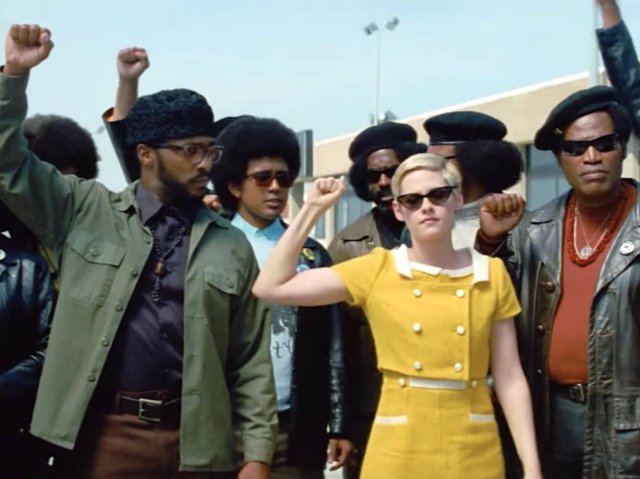
segberg1

Seberg is no dummy. She figures she was being baited on that flight, probably for money and public support. And she doesn’t know Jamal is an ex-con, an unstable womanizer who has done time in a mental hospital. That we learn from the F.B.I. agents assigned by their station chief (Colm Meany) to wiretap the movie star and track the movements of Jamal.

Jack O’Connell of “Unbroken” plays the agent with a conscience. Vince Vaughn plays the racist rageaholic inclined to top his boss’s “shine revolutionary” description of Jamal with a few choice uses of the N-word.

Mackie turns up the charisma, making Jamal a compelling speaker and master of rhetoric. When Seberg speaks of her “frivolous” work, he reassures her “The Revolution needs movie stars.”

They have an affair, and when the F.B.I. snoops stop making their “dark meat on the bone” cracks, they have what they need — a famous face giving “money and a platform” to radicals. Let the surveillance begin.

She feeds fuel to the fire. It’s 1968, Young Paris is on the streets, youth protests against racism, injustice and the Vietnam War are everywhere. And Seberg, living in France and returning to her native America, is good for a quote on that.

“This country is at war with itself.”

The surveillance scenes feel quaint — guys in white shirts and ties, sitting in a van or in HQ, listening to conversations and sexual encounters. Then you think of what they’re doing, a government agency spying on non-criminals, leaking embarrassing truths and in many cases, noxious lies to ruin “enemies of the state.”

Seberg gets wind of this and grows more paranoid by the hour after realizing that SOMEbody is deep into her business, destroying her marriage and her career.

Jamal, married to a leader in the Movement (Zazie Beetz), is feeling the heat, too.

Agent Jack starts to question the ethics of what he’s doing once his wife (Margaret Qualley) gets wind of it.

Stewart gets across Seberg’s spiking paranoia, but never lets us feel it. She’s a chill actress, and that keeps a barrier up that hurts the movie.

Watch her scenes with Mackie and Beetz. She practically wilts in their presence (especially the fearsome Beetz).

The script veers away from history with its whole “agent with a conscience” balderdash. The crazed partner Vaughn plays is straight out of bad melodrama.

And director Benedict Andrews underscores just how deeply he doesn’t “get it” by finishing the film with a long closeup of Stewart/Seberg, failing to wring emotions out of her, her failing to wring them out of us. Maybe that’s his way of throwing her under the bus, but a guy best known for stage works translated for the screen and “Una” didn’t do his star and her “star vehicle” any favors at any point.

MPAA Rating: R for language, sexual content/nudity and some drug use

Cast: Kristin Stewart, Jack O’Connell, Anthony Mackie, Margaret Qualley, Zazie Beetz, Yvan Atal, Stephen Root, Colm Meany and Vince Vaughn

Credits:Directed by Benedict Andrews, script by Joe Shrapnel, Anna Waterhouse An Amazon original release.

Running time: 1:42

Posted in Reviews, previews, profiles and movie news | Comments Off on Movie Review: K-Stew takes a swing at “Seberg,” and misses

Movie Preview: A “Southerner” (Canadian) gets Inuit kids interested in lacrosse — “The Grizzlies”

It’s a sports dramedy in the traditional “McFarland USA” (and 1900 variations) mold.

But with violence, life or death consequences and traditional native ways of life and mistrust of “Southerners.” When you live above the Arctic circle, even Canadians are Southerners.

Cute. But again, the stakes are a lot higher than even “Crooked Arrows,” which covered the same sport from a Native American point of view. Seeing as how North American tribes invented it, that’s only fair.

“The Grizzlies” growl March 20.


Posted in Reviews, previews, profiles and movie news | Comments Off on Movie Preview: A “Southerner” (Canadian) gets Inuit kids interested in lacrosse — “The Grizzlies”

Movie Preview: Tracee Ellis Ross divas Dakota Johnson to death hitting “The High Note”

You think the daughter of Miss Diana Ross knows how to play the diva?

Yeah. “Black-ish” is where Tracee Ellis Ross has to do the real acting.

Dakota Johnson plays the long-suffering assistant to the diva.

Ice Cube, Eddie Izzard, Zoe Chao and Diplo also feature in the cast of this May 8 release, “The High Note.”


Posted in Reviews, previews, profiles and movie news | 4 Comments

Netflixable? One 9 year-old “System Crasher” tests Germany’s social safety net

crasher1

In this country, we hear about these kids from teachers. The stories of how one disturbed, disruptive child requires constant attention, eats up all the teacher’s time, are legion.

Manic, impulsive, sometimes, untamable rageaholics are stressing educators and social workers the world over. In Germany, they even have a name for them — “System Crasher.”

Here’s an unblinking portrait of such a child, a willful, possibly psychotic nine-year-old girl not old enough to be parked in a mental hospital, not responsive to any kindness, any “last chance” at foster care, disrupting schools, group homes, hospitals and lives with every violent tantrum.

Benni (Helena Zengel) is a blonde, blue-eyed fury — sweet and bubbly one moment, flipped-out and lashing out the next. Some trauma in her childhood contributed to this, but her over-scheduled doctor (Melanie Straub) lets the “s” word out, just once, in suggesting “off label use” of some different drug that might calm her down. It’s worked on “schizophrenia.”

The debut feature film of Nora Fingscheidt lets Benni (short for Bernadette) into our hearts, worthy of our pity. But our real sympathies bend toward the over-matched group home counselors, teachers, social workers and one “school escort” as they try everything to corral this uncontrollable child. There’s a lenience that seems delusional, the more times we see evidence of it play out. But they’re just following protocol. Their efforts always ends with her escaping, acting-out and hurting somebody, and in the hospital under restraint.

Benni is desperate to go home to her mum (Lisa Hagmeister), who shows us just enough of her poor choices to allow a single finger of blame pointed her way. Benni escapes, convinces a stranger to drive her to Helmstedt, where her mother and two siblings live with her latest boyfriend.

Benni bullies her younger brother and sister, but in a benign way. Mom and boyfriend come home, and in seconds a violent outburst has her attacking her mother and punched and locked in a closet until the police arrive.

Every time she’s on the loose, something goes wrong — an ugly confrontation with a dog, schoolyard taunting that turns violent, tantrums that have an entire group home on lockdown while she hurls things about in the playground.

Reasoning with her is pointless. Warning her about every new placement falls on deaf ears — “It’s got to work this time, OK?” (in German with subtitles).

American audiences may bristle at the laxity of her supervision. She is plainly a danger to herself and others. But “the system” dictates what steps they can take. And with other foster kids, group home children and schoolchildren to cope with, Benni is a test “the system” cannot pass. It’s gutsy of the film to show us how there are literally no easy answers in a case like this.

But when her doctor suggests an “intensive therapy abroad,” sending her and a counselor off to Africa, feel free to roll your eyes? Is she just shipping this problem south? Why on Earth would anybody think that would work?

Her school escort, Micha (Albrecht Schuch) figures a “vacation” in the less stimulating woods, a forest cabin on a farm, would help. Letting a male counselor take a little girl into the woods sounds too creepy to ever happen in the States, but the system in Germany is desperate enough to let him try.

Zengel is a balled-up fist of energy in the title role, getting across the sweetness that can convince those who take pity on Benni that “she’s making progress,” but unleashing hell in a flash to remind them she isn’t.

An excellent supporting cast suggests empathy that crosses into pity, which “the system” doesn’t allow.

And that next explosive mood swing is all it takes to remind each and every caring adult put in her path that pity and caring and hugs won’t be enough. Drugs and institutionalization, those last resorts, start to look like a blessed relief long before “System Crasher” checks out.

3stars2

MPAA Rating: TV-MA, violence, profanity

Cast: Helena Zengel, Albrecht Schuch, Gabriela Maria Schmeide, Lisa Hagmeister

Credits: Written and directed by Nora Fingscheidt. A Netflix Original.

Running time: 1:58

Posted in Reviews, previews, profiles and movie news | Comments Off on Netflixable? One 9 year-old “System Crasher” tests Germany’s social safety net

Movie Review: Working and going under in the gig economy, “Sorry We Missed You”

sorry5

Ken Loach is the Scorsese of feature film realism, the Tarantino of naturalistic, lived-in dialogue, the Claire Denis of movies built on characters who show us life, as it happens.

His milieu is typically Britain’s working class, which he celebrates even as he shows its struggle and a system — capitalism — that has increasingly beaten it down since he first broke out with films such as “Poor Cow” and “Kes” in the ’60s, and in the decades since.

Unknown or inexperienced actors speaking thickly-accented working class argot, his movies sometimes come with subtitles — because they need them.

“Sorry We Missed You” is Loach’s intimate, scathing take on life in the “gig economy,” a family not getting ahead or even holding its own, but swimming as frantically as it can even as they spiral down the drain. It’s his best film in years, and with a resume that includes “My Name is Joe” and “The Angel’s Share,” that’s saying something.

Ricky Turner (Kris Kitchen) has worked in manual labor most of his life. Now, he’s ready to “be me own boss.” He’s hiring on as a parcel delivery “contractor” for PDF shipping. He gets the “owner-driver franchisee” from Maloney (Ross Brewster), but he has to flinch at every cost he’s expected to incur. Buy a van, or rent one (at extortionate rates) from PDF.

A hard talk with his home healthcare worker wife Abby (Debbie Honeywood). If they could just sell her car, he could get a van. “Just take the bus,” he pleads. And peacekeeper Abby agrees.

But with her working from 7:30 A.M. to 9 p.m., and him starting earlier and getting home almost as late, “family time” may be the ultimate sacrifice. Not a problem for studious tween Liza (Katie Proctor). Teenage Sebastian, Seb (Rhys Stone) is already lost, smart enough to do the math to see what little life holds to someone his age and refusing to buy in.

He’s cutting school so that he and his friends can tag the city with their graffiti, videoing their deeds as they do. So even as Ricky is being lectured on what everything costs, how his company-issued scanner will be his lifeblood, how “hit your ETAs,” prioritize “your precisors” (items like phones, etc., that have to be delivered at a specific time) and don’t take anything bathroom breaks (Here’s an empty water bottle, mate.), we can see the thin thread between the Turners and ruin stretching, with Seb blithely yanking at it for attention.

Abby’s compassion is captured in home visit after home visit, coping with the inform, the insane (feces flinging, scratching), the embittered and depressed even as her employer exploits her good heart and good nature in its pleading demands.

She’s made this home one where children are indulged and treated as adults, and Seb’s open rebellion seems a consequence. There’s no punishment meted out for disrespect, no corporal punishment for indifference, selfishness and endangering the entire family and not just his future.

Dad’s “Just give yourself some choices, mate” can’t even get the kid to look up from the phone.

Seb isn’t the best-drawn character here. He seems politically astute in sizing up the working class dream that was put on life support under Thatcher and has deteriorated ever sense. But the graffiti he risks all for isn’t political, and his myopic disregard for his family seems somewhat contrived, out of character.

Loach and his longtime screenwriting collaborator Paul Laverty give Darwinian capitalism its speech, coming from the mouth of Maloney, who explains — in the bluntest terms — how he keeps them all employed by working them until they doze off at the wheel. It’s because “the Patron Saint of Nasty Bastards” has to, or their clients will use another service.

Abby might be the first to see the cost their hours and thin finances are having on their lives, but Ricky voices the exhausted complaint against income inequality heard the world over when he mutters, “Everything is out of whack.”

The story’s predictable arc feels real when it is at its bleakest. Families disintegrate under these conditions. Check divorce filings in any town where big employers fail and folks grasp at “gig economy” straws to get by.

Loach and Laverty and their characters thrive when the margin of error is at its thinnest. Conversely, moments that force them appreciate the talent of the boy who is burning the family down in this their darkest hour seem melodramatic and naive.

But that “You never give up on your kid” ethos? That’s as real as rain.

From its pun title (the sticker you leave for a failed delivery) that really means the life the disenfranchised working class family is losing, to the gritty realism of working life in an economy that only “works” for the one-percent, “Sorry We Missed You” sounds an alarm — by turns desperate and simplistic. As Loach & Co. have been sounding it for decades, one wonders if anybody is still listening, as much as we should be.

3stars2

MPAA Rating: unrated, violence, profanity

Cast: Kris Hitchen, Debbie Honeywood, Rhys Stone, Katie Proctor and Ross Brewster

Credits: Directed by Ken Loach, scripted by Paul Laverty. A Zeitgeist release.

Running time: 1:41

Posted in Reviews, previews, profiles and movie news | Comments Off on Movie Review: Working and going under in the gig economy, “Sorry We Missed You”

Netflixable? “All the Bright Places” are where they store the schmaltz

ALL THE BRIGHT PLACES

Elle Fanning and Justice Smith take a walk — and a bike ride — through love and death in “All the Bright Places,” a moon-eyed teen romance that never knows when to drop the mike.

It’s a movie that takes at least some of its prompts from one of the best young romances of the ’70s, “Breaking Away.” Novelist Jennifer Niven, taking her queue from the motto on Indiana’s license plates — “Wander” — throws two star-crossed and mentally struggling teens into each other’s path, and lets the sap flow until everything and everyone is sappy.

It’s not a bad film. Elle Fanning doesn’t make bad movies. But it crosses several “Give me a break” lines, and then goes on and on past its dramatic climax, grabbing you by the shoulders and shaking you until you get the point. As if it has one.

Theodore Finch (Smith), who goes by “Finch,” is jogging the day they meet. Violet Markey is standing on the railing of a bridge, contemplating something rash.

He talks her down. And from that moment on, he takes an interest, becomes a sort of protector even as he’s online stalking her to figure out her story.

Violet lost her older sister. She is off-the-scale depressed. Finch, for all his problems — his meetings with the guidance counselor (Keegan-Michael Key) confirm he’s not coping, either — figures he’s saved her life and he’s responsible.

Violet’s would-be beau, Roamer (Felix Mallard) is running out of patience.

“How much longer are you gonna ACT like this?”

Her BFF Amanda (Virginia Gardner) may warn her off Finch, reminding her that his nickname is “The Freak” for a reason.

And he’s alarmingly persistent. Posting a song he’s written for her online should get him visited by the cops and maybe expelled — “I met you standing on a ledge…Why don’t you come talk to ME instead?”

But he wears her down. Her parents (Nicole Forester, Luke Wilson) are at a loss about what to do to bring her back to the land of the living. Finch figures a lot of attention, a few Virginia Woolf quotes and a “partnered” class project where they visit the Great Attractions of Indiana will do the trick.

There’s a lot of arch, forced banter that writers figure is how writerly kids talk these days — “My young brain is plump with knowledge!” But truth be told, the funniest bit in “All the Bright Places” is the idea that there are “bright places” in the Hoosier state, places these two will visit — on foot, by bike, etc., “the Wonders of Indiana.”

Pancake flat Indiana’s “high point” elevation marker is one of those. “I can see my house from here! Come on, the view is incredible.”

They stand together on a hope chest sized stone marker together. That’s the closest connection “Bright Places” makes with “Breaking Away,” a romance worth renting and swooning over 40+ years later. Indiana is, by rep, boring, a place to escape from.

Bike rides through the flat country, a swim in a quarry (They filmed “Bright Places” in Ohio, which tells you something.), all borrowed from the earlier film.

The romance here is more perfunctory, less heartfelt. And that goes for several big twists in the tepid plot. Events are mandated by script requirements, never organic.

But as Netflix has had great luck with teen rom-coms, and teen romances, spending the money on landing this novel and this cast was a smart gamble.

Who would have guessed “Bright Places” could be this dull?

1half-star

MPAA Rating: TV-MA, suicide, sex, profanity

Cast: Elle Fanning, Justice Smith, Alexandra Shipp, Keegan-Michael Key, Luke Wilson, Nicole Forester and Virginia Gardner

Credits: Directed by Brett Haley, script by Liz Hannah and Jennifer Niven, based on Niven’s novel.  A Netflix original.

Running time: 1:48

Posted in Reviews, previews, profiles and movie news | Comments Off on Netflixable? “All the Bright Places” are where they store the schmaltz

Movie Preview: Scotland remembers “Robert The Bruce” — Do you?

Another trip back to the “Braveheart” era.

Angus MacFadyen has the title role in this April 24 release.

Posted in Reviews, previews, profiles and movie news | Comments Off on Movie Preview: Scotland remembers “Robert The Bruce” — Do you?

Movie Review: Winterbottom and Coogan serve up a modern take on “Greed”

DSC_5362.NEF

If ever there was a time ripe for satirizing, sending up for its open corruption and crass celebrity, all consumed with unquestioning dimwittedness by a public distracted by “bread and circuses,” it is ours.

Idiots idolized for their innate skill at being “famous,” and nothing else, a gullible electorate consuming what they’re told, believing what they’re fed, voting for open expressions of their own ugly “id” in defiance of common sense, common purpose and common decency — these are “fall of Rome” days we’re living through.

For all the angst and despair that manifests, hell, it COULD be funny. Right?

The daring British filmmaker Michael Winterbottom and his muse, Steve Coogan tackle these times with the aptly-titled “Greed,” a tale of excess and cruelty, naked theft and thinly-disguised tax dodges all presided over by an entitled bully who is, every day and in every way, the poster boy for all that is wrong in British and American capitalism and public life.

This skewering likely to be the only punishment the retail hustler, tax dodger and con-artist Sir Philip Green, on whose shenanigans this tale of vulgar excess, naked narcissism and callousness it is based. And more’s the pity, because as angry as it is and as outrageously funny as it wants to be, “Greed” doesn’t quite come off.

Coogan is Sir Richard McReadie, billed as “the Da Vinci of Deal-making, the Monet of Money” as he is introduced at his big fashion retail company party. Let others call him “Sir Shifty” and “Greedy McReadie.” He’s hired a famous TV presenter to sing his praises, and that’s what his minions who make his millions hear.

There’s a double irony in that the vapid, beautiful celebrity doing the introduction — playing herself — is British TV “presenter” Caroline Flack, who just killed herself after a self-induced/tabloid-exploited fall from fame into infamy.

Winterbottom (“Welcome to Sarajevo,” “A Mighty Heart” and “The Trip” movies with Coogan and Rob Brydon) tells us the tale of McReadie’s “Greed” via his plans for an epic 60th birthday celebration. He’s building an amphitheater on a Greek island to stage the ultimate Roman toga party, complete with mock gladiatorial games.

Mixing up ancient Rome for ancient Greece is just the sort of thing gauche, rich dolts do, like confusing “Kansas Cities.”

As McReadie rants at his hapless builders, lion-renters and party organizers (Sara Solemani and Tim Key), he is shadowed by a well-traveled, thinks-he’s-witty hack writer (David Mitchell) who is writing his biography. He’s all “The Lion, the Witch and the Wardrobe” puns, which no one around him gets.

Through Nick the biographer, we meet the “classmates” and “colleagues” and old friends who take us through the “self-made man’s” entitled private school years — hustling, gambling and preying on his peers — to his breakthrough in fashion retail, first marriage (Isla Fisher), cheap foreign labor exploitation and a long Parliamentary inquest into his ruthless, self-enriching, predatory and illegal methods for making himself rich(er) and famous.

“He wasn’t somebody who loved clothing,” his ex and still business partner (she lives tax-free in Monaco, so his “empire” is in her name for that reason) admits. “He loved the deal.”

His “art of the deal?” Lowballing every supplier he meets, storming out of meetings in the expectation that the other side will bail. And then bankrupting the company, displacing thousands of employees, and moving on to the next prey.

James Blackley makes a very convincing Young Richard, polishing his low-rent hustle back in school, taking what he’s gotten away with to Sri Lanka where he can undercut labor costs and undersell his more ethical competition.

“Envy and jealousy are incurable illnesses, my doctor tells me,” the older McReadie, playing the victim, complains to his government inquisitors. “I’ve done nothing wrong.”

Meanwhile, with ex-wife on board, “trophy” wife (Shanina Shaik) in tow, son who loathes him and openly wishes for his death (Asa Butterfield) and daughter (Sophie Cookson) “acting” for her scripted “reality” TV show about her famous life and misplaced love for Mr. Wrong (Ollie Lock), McReadie tries to rant his party into being.

There’s a lion involved. “He’s like a rescue cat who needs to be put down!”

A lifetime of berating underlings bears fruit — “This is not ‘banter.’ This is me ‘bollocking’ you.”

And feelings for the ex pop up, here and there. “Is that a push-up bra, or are ‘those’ new?”

There are Syrian refugees camped on the beach at Mikonos, spoiling the view for his “party.” Celebs left and right are turning him down. Stephen Fry does not. Once upon a time, he hired James Blunt to serenade he and his new wife outside their hotel. Everybody can be bought, we are reminded.

His always-fuming mother (Shirley Henderson) shows us where his “underdog” ethos came from, even though, as classmates complain, “He went to a PRIVATE school!” He was never an “underdog,” and “self-made” seems a stretch.

There’s a lot to chew on in this film, which resembles Winterbottom’s similarly chaotic Coogan vehicle “Tristram Shandy: A Cock and Bull Story” in every way save for the laughs.

There is no bigger Winterbottom fan than me, and Coogan’s long been at the top of my list of British comic actors. I laughed at his obligatory ABBA joke (obsessed with them, he is) and at many of his rants and a few amusing comic set-ups here.

Coogan is game and Fisher strikes the right tone. But there’s no much bad behavior to “expose” and complain about that there’s no room for fun.

Perhaps this plays better to British audiences who know the infamous retail cad it is based on. Or perhaps it is just missing that one ingredient that makes any Coogan/Winterbottom vehicle, satire or not, amusing — Rob Brydon.

2stars1

MPAA Rating: R for pervasive language and brief drug use

Cast: Steve Coogan, Isla Fisher, Shirley Henderson, Asa Butterfield, David Mitchell, Danita Gohill, Sophie Cookson and Stephen Fry.

Credits: Directed by Michael Winterbottom, script by Michael Winterbottom and Sean Gray. A Sony Pictures Classics release.

Running time: 1:44

Posted in Reviews, previews, profiles and movie news | Comments Off on Movie Review: Winterbottom and Coogan serve up a modern take on “Greed”

Movie Preview: Jordan Peele’s take on “Candyman” — The first trailer

Spreading himself pretty thin, but his track record speaks for itself…

Posted in Reviews, previews, profiles and movie news | Comments Off on Movie Preview: Jordan Peele’s take on “Candyman” — The first trailer

Documentary Review: Rare titles are the Holy Grail to “The Booksellers”


book3

We carry around a picture of an antiquarian book dealer or obsessive book collector in our heads.

White. Male. Tweed.

And there isn’t a lot in D.W. Young’s New York-centric “The Booksellers” that tampers with that. There’s tweed, here and there, the odd overly-curled mustache. It’s a very Jewish world, especially when the film digs into the Anglo-American history of this specialty trade.

But there may be a change coming to the business of collectible books, which is a major thesis of Young’s lovely and lush if meandering, bookshelf browse of a movie. Is the sun setting on this esoteric obsession? Or is a big-city hipster-driven revival turning that around?

It starts at the The New York Antiquarian Book Fair at the Park Ave. Armory, wanders into auctions, digs through the history of the hobby, changes in what is “in vogue” with collectors (signed first editions, first editions with perfect dust jackets, etc.), drifts off message with the “ephemera” (posters, toys, things that belonged to authors) and makes its way into the monumental collections of a hand full of America’s most obsessive “women writers” “esoteric occult books” or “Hip Hop History” or “works of imagination” have filled their weighty wall-shelves with.

Fran Lebowitz, that quintessential New Yorker, remembers the famed “Book Row” of Park Ave. bookstores, dozens of them at one time “run by dusty Jewish men who were very irritated if you wanted to buy a book.”

Journalist/author and book-hound Susan Orlean (“The Orchid Thief,” “The Library Book”) talks about books’ meaning, and about cleaning up her notebooks and “ephemera” and passing them on to a college archive.

And book collecting expert Rebecca Romney of TV’s “Pawn Stars” speaks up, after many other older men in the trade lament “the passing of an era” and the “death of the profession” of book-hunting, book selling and book collecting, noting the hipster generation embrace of the printed page and the slow shift away from the “85-15” ratio of males to females in this world.

We see the auction where an anonymous phone bidder bought Leonardo’s “Codex Leicester (Hammer)” book of scientific writings and illustrations for $30 million+ in 1994.

And we scan the covers of leather bound historical volumes, printed on parchment or velum — as well as occult works bound in human skin. The idea of books as “objects” or art, quite aside from their printed pages, has never been presented with more clarity than here.

“The Booksellers” doesn’t take care to ID every talking head we see, and waits until the last half hour to show us the folks who drive this industry — the collectors. It’s still a bibliophile’s delight, a time trip back to bookstores long gone as well as the Argosy and Strand and Imperial, filled with people of the sentiment that “If books disappear, human beings disappear!”

3stars2

MPAA Rating: unrated

Cast: Fran Lebowitz, Susan Orlean, David Bergman, William Reese, Rebecca Romney

Credits: Directed by D.W. Young. A Greenwich Entertainment release.

Running time: 1:39

Posted in Reviews, previews, profiles and movie news | Comments Off on Documentary Review: Rare titles are the Holy Grail to “The Booksellers”