
Got to put that “Onward” outing in the rear view mirror, and quick.
But, as Seinfeld puts it, What is the DEAL with Pixar’s obsession with DEATH?
Got to put that “Onward” outing in the rear view mirror, and quick.
But, as Seinfeld puts it, What is the DEAL with Pixar’s obsession with DEATH?
 There’s an opinion, common in certain film fan communities on the Internet, that carries the belief that kids’ movies are too treacly, inoffensive and mild-mannered for the little darlings’ own good.
I don’t necessarily think they’re wrong. Children are exposed to a lot of words, action tropes and screen violence — via every screen in their lives — before they hit second grade. Maybe they’re more sophisticated consumers of what we used to call “adult content” than we give them credit for.
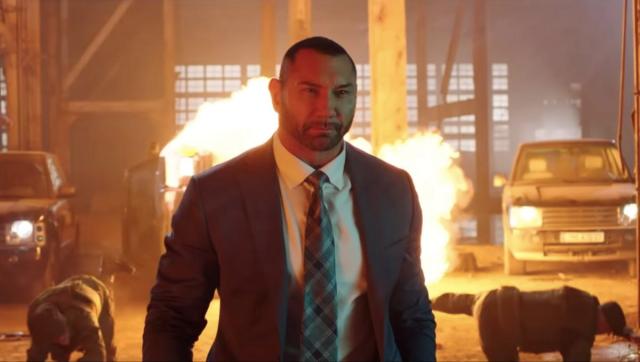
For those folks, who figure “Goonies” and kids-mixed-up-in-foul-mouthed mayhem is a touchstone, we give you “My Spy.” It’s about a child who stumbles into a C.I.A. stakeout, blackmails an embarrassed agent into befriending her and courting her mom, and is exposed to the odd shootout, killing and curse word in the process.
I can’t say it’s very good, because it isn’t. But the magnificent walking, talking, pratfall-taking sight gag that is Dave Bautista? Well cast.
Bautista is an ex-Army Ranger turned C.I.A. spy who blows his big undercover plutonium purchase in Putin-land by slinging the worst “Russian arms dealer” accent in the history of the Cold War.
“Take an ACTING class, for God’s sake!” a villain hisses, in an equally bad accent.
That’s when man-mountain J.J. does what he knows how to do — “Kick ass.”
Those bothered by such things can start the movie’s body count here. Maybe a dozen villains bite the dust. No blood, but explosions can separate one’s head from one’s body.
J.J.’s boss (Dr. Ken Jeong, not given a single funny thing to do.) isn’t happy with this outcome. He sentences J.J. to surveillance duty in Chicago, paired up with tech nerd Bobbie (Kristen Schaal). They’re watching the widow (Parisa Fitz-Henley) of a guy whose brother (Greg Bryk) is mixed up in this bomb building/buying/selling scheme.
Maybe the bad guy will turn up. Or maybe the widow’s curly-haired 9-year-old will figure out their apartment’s bugged and who did the bugging. And maybe Sophie, whose nurse-mom can’t take her to that school ice-skating party, will keep her yap shut and her video of their stakeout apartment off “the cloud” is Agent Shrek will provide “adult supervision.
And maybe the kid will push her luck, blackmailing J.J. into all sorts of kiddie activities.
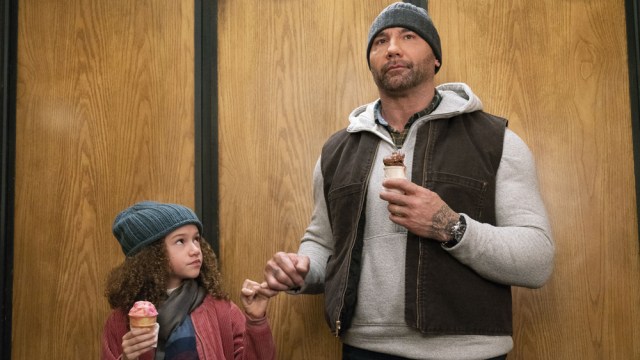
Here’s what made me laugh — every time the Incredible Hulk-ista considers the ruthless, risk-free option for dealing with this three and a half foot tall threat.
“Kill her,” he suggests to google-eyed Bobbie. “Make it look like an accident. The stairs, maybe?”
Other versions of this, told to the kid’s face, end with “and they never find the body.”
J.J.’s other sure-fire laugh elements are his size — no suit fits him — and the violent line of work that’s made him tactless and unfiltered in”war stories” dinner conversation.
“By that time we were drinking our own urine…”
The kid is cute and has a light touch, by insufferable child actor standards.
The gay neighbors, played by Devere Rogers and Noah Dalton Danby? Kids are never too young to learn gay stereotypes.
“Oh my Lord & Taylor!”
But scenes where J.J. gives her spy training and lessons in how to walk slowly away from an explosion like all the cool spies do “in the movies” did nothing for me. Giving all of those away in the TV commercials and trailers doesn’t help.
So, not much here for adults. And if you’re the least bit squeamish about how old your child should be before she or he is ready for an action comedy with a body count, well you’ve been warned.

MPAA Rating: PG-13 for action/violence and language.
Cast: Dave Bautista, Chloe Coleman, Parisa Fitz-Henley, Kristen Schaal, Greg Byrk and Ken Jeong
Credits: Directed by Peter Segal, script by Erich Hoeber, Jon Hoeber. An STX release.
Running time: 1:39
The sky is falling, the virus is spreading and nicknaming the pandemic after the blundering, ignorant dunces mismanaging it doesn’t help.
So, while we still can, let us brave the Trumpdemic and see this comic book release, which the Sony braintrust chose not to preview in most markets.
I have previews lined up for the next two weeks, and I half expect those to change pretty much any minute.
Theaters are run by children, mostly, who cannot be expected to run Clorox wipes over every seat between showings.
As we will not know we’re infectious until some time after we show symptoms, best to keep one’s distance from the folks in the cinema with you.
If last weekend was any indication, with normally jammed multiplexes taking on the appearance of ghost towns, that shouldn’t be a problem.
See you at the movies!
Yeah, they moved it to April.
Might help. Might hurt this kid-and-Dave Bautista action comedy. Probably not too violent, but you never know.
Anyhoo, looks funny. Love that Dave.

There’s something inherently tone-deaf in a gory satire cooked up by Hollywood “elites” mocking liberal “elites” hunting “deplorables” for sport.
Maybe the film schooled screenwriters of “The Hunt” have a firm grasp of liberal tropes — the ones Fox News mocks morning, noon and night. There’s the PC speech.
“Don’t joke about AIDS!”
“Don’t joke about ‘CHOICE!'”
There’s the mincing “foodie” identifiers, group chatting about the “Rat-f—-r-in-chief” and “education-impaired rednecks,” looking down their “liberal Deep State elite” sculpted noses at everybody who ever wore a name tag to work.
Because they’re all about fashion.
“Is that a KIMONO? APPROPRIATION, Richard!”
So sure, “nailed it.” But “THOSE people” walk into a minefield and lose all their nerve when trying to depict those “salt of the Earth” plumbers, hairdressers, waitresses and “gun-clutching homophobes” who provide the heroes — or heroine — of their botched flipping of the “deplorable/elites” script.
The group of super-rich, super-PC “hunters” whose ranks include Amy Madigan, Jennifer Garner, Steve Coulter and Glenn Howerton are sketched in. The assorted bubbas, a veteran, a “big game hunter” and others they’re hunting aren’t so much as outlined.
The joke here is that every paranoid “Q-Anon” Alex Jones/Hannity conspiracy trotted out by the Loony Right smacks of truth when eleven victims are drugged, tossed on a plane and taken off to “The Manor” for a sport-hunt where they are “The Most Dangerous Game.”
“Manorgate” they and their kind have been calling it (“Google it !”) the replacement for “Pizzagate” and assorted other “what’s REALLY going on” schemes that Internet age gullibles buy into.
That’s why podcasting gun-nut Gary (Ethan Suplee) and “Airborne” vet Don (Wayne Duvall) blurt out “I know EXACTLY what’s going on” more than once when they throw in with our heroine “with very particular skills.” That would be Crystal, played by Betty Gilpin of TV’s “GLOW” and “A Dog’s Journey” and “Isn’t It Romantic?”
Crystal’s the one who wakes up, lock-gagged and in the woods but knowing how to make a compass out of her name-tag pin, a little friction and a leaf floating in a pond. (Shown in “The Edge,” and no — it doesn’t work, film school boys).
Most of this “deplorable” group is gruesomely shot, pierced or blown-up before they can get their bearings and figure out they’re being hunted. A couple of famous (ish) faces are in those ranks.
But Crystal is the one defies the odds, and Gilpin has a lot of fun deadpanning this smartest-prey-in-the-woods Amazon. She listens to the “I KNOW what’s happening” trigger-happy dunces like she’s been doing it her whole life. Growing up in Mississippi, that seems like a fair bet.
Don in particular is blown away by her ruthlessness, her mad killing skills and her disinterest in “theories” about what they’re in the middle of. After all, she got the drop of folks with all the weapons and the element of surprise, hunters who’d been told “Just have a little fun with her.”
“Why didn’t they just KILL you?”
“Don’t care.”
Let the others giggle about “blowing the lid off” this “conspiracy” by being “on Hannity, like them two Jew boys who got Nixon!”
Crystal is into figuring out where they are, how to arm herself and using those arms to get out. But none of the escaping “victims” had reckoned on these soft Lindsey Graham-voiced sissies having such a blood lust.
“I thought they were all vegan?”

Director Craig Zobel (“Compliance,” TV’s “One Dollar”) has things skipping past us for about 45 minutes when the script pauses for a long, stupid faux Southern anecdote. The film stops cold while we consider Gilpin’s feeble Mississippi accent, the urgency that just left their “escape” attempt and why the movie only uses “Jew boys” that once, when — thanks to the writers and the director — more “leaning into” that blind spot was in order.
Why have the “liberal elites” mince around “those people” using “the N-word.” Have a hypocrite USE it, right after “Ooo, Ava DuVernay liked my tweet!”
Mocking people who believe in “Crisis actors” is fine. Why pussyfoot around Islamophobia and xenophobia?
Why not say what conservative dog whistlers mean when they say “Hollywood elites” and “liberal elites?” #Hollywood2Jewish.
A whole “those people” debate about African Americans, based on current “NPR” usage is punctuated with a lame, “And WHO’S on NPR?” rejoinder. “WHITE people.”
“Jews” would’ve been funnier and more accurate. In Bubbaland, we’ve been known to call NPR “B’Nai Brith Broadcasting,” where you shouldn’t hold your “Brith” waiting for a non Jewish host or hostess to interview assorted experts named Cohen, Levy or Stein.
Go ahead, Blumhouse Boys — touch the third rail of Hollywood “identity politics.”
But that would’ve given this limp “satire” bite and guts, something it lacks, start to finish. The contempt is supposed to cut both ways/SEVERAL ways. And it never does. Toothless.
Sorry, did I offend? That’s kind of the point of satire. This movie has an echo chamber feel and tone and offends no one.
Pulling this gruesomely violent picture from release after one of many NRA-sponsored mass shootings just gave it a notoriety it doesn’t warrant.
And tipping its plot just gave Fox News and its ilk something to be outraged about so that they don’t have to talk about open corruption, impeachment or the “fake” pandemic.
Gilpin revels in playing tough, smart, cool and pitiless. She doesn’t register pain, fear or worry, but that’s quibbling. And knowing that “Million Dollar Baby” Oscar winner Hilary Swank is in it just sets up a “girl fight” for the ages.
Aside from that, “The Hunt” is like sitting in a deer blind (Look it up, Hollywoodies) on the wrong corner of the pasture. Pointless.

MPAA Rating: R for strong bloody violence, and language throughout.
Cast: Betty Gilpin, Hilary Swank, Ike Barinholtz, Ethan Suplee, Emma Roberts, Amy Madigan
Credits: Directed by Craig Zobel, script by Nick Cuse, Damon Lindelof. A Blumhouse/Universal release.
Running time: 1:29
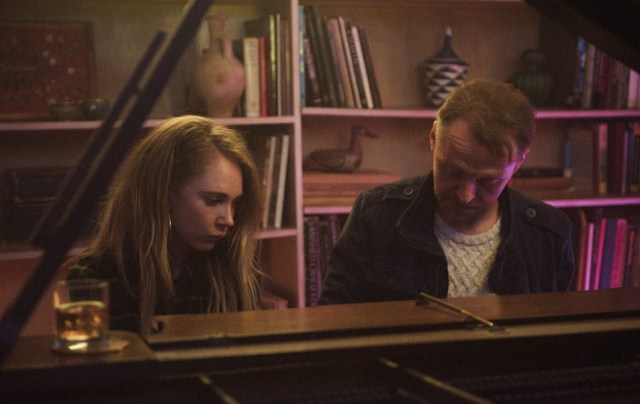
Juno Temple delivers a dazzling turn as an aspiring singer/songwriter struggling to protect and look out for the schizophrenic producer who “discovered” her in “Lost Transmissions.”
As Hannah, she turns manic with fear over what could become of Theo (Simon Pegg), a Brit trapped in his head and lost in America’s byzantine health care system and bizarre mental health Catch-22s. Hannah’s mania spins out of her intimate knowledge of Theo’s predicament. She’s among the medicated mentally ill herself. She understands what he’s going through and what he’s up against.
And like Theo, she is off her meds.
Katharine O’Brien’s “inspired by a true story” debut feature begins with a musical connection that cements a friendship and partnership, and then sets up its fundamental dilemma with just a line, delivered by one of Theo’s circle of friends.
“Don’t let him take you down the rabbit hole with him, Hannah.”
Theo is the life of parties within that circle. A successful record producer who used to belong to a band himself, he lures shy Hannah into a duet with him at the piano. He flirts with talk of initiating her into “a secret society.” He tempts the cubicle-drone Hannah with a trip to his recording studio, filled with instruments, some of which used to belong to legendary producer Phil Spector and Chaka Khan.
In a flash, he’s turned a song or two of hers, “written when I was a kid,” into dreamy synth-pop. In another flash, she’s set up to write tunes for a bleached dance pop bombshell (Alexandra Daddario) based on just that demo.
And then she makes the mistake of giving Theo a lift. He’s antic, and absorbed with the station between stations on her radio. “If you listen really carefully, you can hear the transmissions!”
He’s lost his car — literally misplaced it. He’s twitchy, jumpy and “off.”
“Are you ON something?” No. He’s “OFF” something.
Unlike Hannah, who “keeps everything level” with meds, Theo fears it muffles his brilliance and mutes his gifts.
He shouts “Listen, listen LISTEN” to her over the radio. A call to his friends earns a “Oh God, not AGAIN.” And in spite of all that, Hannah takes responsibility for her mentor and is even tempted to try life without medication as a jolt for her “inspiration.”


O’Brien gives Pegg scenes to show Theo’s laser focus at the mixing board as he works his mixing magic with a band. Theo is stone-faced and in-the-zone. But we can feel what’s coming. We’ve seen the hair-trigger temper, heard the unfiltered “truth” he can blurt out, giving away the crazy.
Temple, a screen veteran (“Atonement,” “Black Mass,” “Wonder Wheel”) who too-rarely lands a lead, is heartbreaking when Hannah is frantically trying to keep Theo out of harm’s way — involuntarily institutionalized for “observation,” confronting police, acting-out on a drive to the mental hospital.
She’s funny when Hannah drops her meds and starts acting out — Theo style — in her “sellout” scenes with Daddario, who is spot on as the gorgeous, nail-biting egomaniac who needs Hannah’s talent to pretend she has some of her own.
Pegg is the very picture of schizophrenia — funny and charming, here and there, lucid when he can get it together to lie to a doctor, bug-eyed and furious when Theo’s independence is threatened and his view that “time” is being controlled…by somebody — isn’t taken seriously.
O’Brien even gives us a homeless “prophet” tirade to show how common this temporal mania is among the mentally ill. Theo wears watches all over his arms and ankles.
O’Brien and her players take a common creative community belief — that “maybe the insanity makes (unusual) neuro-connections in his brain” that renders the brilliantly unbalanced brilliant — and have made a superficial but grimly realistic and thoroughly engrossing movie gloss of that theory.
And Temple has reminded us that she’s better than all those bit parts as tarts, “broads” and the like, a leading lady of formidable empathy and range. Hell, she even sings.

MPAA rating: unrated, drug abuse, profanity, violence.
Cast: Juno Temple, Simon Pegg, Alexandra Daddario
Credits: Written and directed by Katharine O’Brien. A Gravitas Ventures release.
Running time: 1:45


The image is stark and iconic — a lone house, fenced, construction site devastation all around it — a single man resisting the march of “progress.”
But there’s no vast supply of balloons to lift Stacey Ryan’s trailer “Up” and away from this Louisiana industrial Hell. And his hold-out status, surrounded by 14 petrochemical plants in one of the most polluted places in America has us fearing for his health and his life more than the tiny, ruined town of Mossville, which he represents.
“Mossville: When Great Trees Fall” is an infuriating film that captures “environmental racism” at its most obvious, a film shot at a little known but infamous ground zero example in the American South.
Stacey Ryan, a mechanic and lifelong resident of Mossville, is our tour guide and main historian for a town “founded by free slaves” after the Civil War devastated — you could say “targeted” — by a power structure and industries who decide that “not in my backyard” doesn’t apply to working class places populated by mostly powerless Black people.
The few hold outs there, when we meet them, are religious people who remember a “safe” place village, founded by seven families, covered in fruit trees.
They thrived by not being noticed, not living on land the powers that be coveted. But they were invisible, unable to stop the vast processing concerns that Louisiana allowed to buy their way in and make the place unlivable for those who remained.
Ryan shows filmmaker Alexander Glustrom old TV interview footage of his parents, his mother protesting that “The color of my skin doesn’t make a dog — a guinea pig!” But that’s how firms like Axiall and those that preceded and followed it treated them.
Fires and explosions, “shelter in place” accidents, leaks into the water supply, dioxin in the blood. Mossville residents started dying of cancer.
Here’s footage of then-Louisiana Governor Bobby Jindal singing the praises of a South African biochemical and energy concern, SASOL, moving in — thanks to state incentives.
Glustrom then takes us to Secundo, the company’s Apartheid era plant built next to Zamdela Township, “the biggest source of carbon dioxide on the planet.” South African activists speak of companies like SASOL treating poor people as “disposable others,” the ones governments and companies decide “can live in the pollution.”
Because nobody with money or influence would stand for it.
An environmental lawyer laments the uphill battle the few survivors in Mossville are fighting, and the film’s third act lets us see how all this is winding up. Big Petrochemical’s predations and pollution won’t stop at Mossville. More affluent towns are within the reach of wind and water runoff from there.
No wonder nobody talks about Bobby Jindal any more.
“Mossville: When Great Trees Fall” is earning limited release before airing on PBS later this year.
MPAA Rating: unrated.
Cast: Stacey Ryan, Erica Jackson, Van Jackson
Credits: Directed by Alexander Glustrom. A Fire River Films release.
Running time: 1:15

An inspirational Christian music romance runs into the limitations common to the faith-based genre in “I Still Believe,” a bland tear-jerker that lacks the drama or commitment to wholly come off.
This true story of singer-songwriter Jeremy Camp’s “love of my life” ill-fated romance has warmth and moments of charm. It’s more “I Can Only Imagine” than “God’s Not Dead,” a concerted effort at presenting a positive message without anger or political victimhood. All that’s missing are the basics of good drama — conflict — and commitment and chemistry from its stars.
K.J. Apa from TV’s “Riverdale” plays young Camp, an Indiana lad who is smitten on sight when he spies pretty Melissa (Britt Robertson of TV’s “Girlboss” and “For the People”) at a concert when he arrives at Calvary Chapel Bible College in California.
How we get to that “meet cute” — which isn’t “cute” — sets the tone for the movie. It’s 1999 and Jeremy has to calm his special needs brother (Reuben Dodd) who is distraught at his leaving home. His struggling pastor dad (Gary Sinise) keeps a pizza joint delivery sign on top of the family’s ’80s AMC Eagle station wagon, but the parents (Shania Twain plays his mom) have managed to buy the kid a new guitar before he heads off.
That’s Jeremy’s ambition, “making it.” His “struggle” to achieve that consists of talking his way backstage at a concert The Kry are giving on campus, asking for advice from songwriter Jean-Luc (Nathan Parsons), and becoming a roadie for the night.
That gives him instant entre to a musical sounding board, songwriting feedback, recording studio and…fame.
And it’s in between delivering guitars (“guitar tec:”) to Jean-Luc in mid-show that he spies the prettiest girl on campus, beaming in rapture at the music The Kry perform. As Jean-Luc says, “I write love songs to God.” With maybe a girl in mind as he does, he jokes.
Here’s where the conflict is dodged. Hunky Jean-Luc’s “girl in mind” is Melissa. This being a Bible college and Melissa being chaste, that makes for a slow attempted-wooing. And even though Jeremy doesn’t know that attraction when he flirts, he keeps after Melissa after he learns that news, continuing to take Jean-Luc’s advice and help as he goes after his girl. Cold.
The filmmaking Erwin Brothers (“I Can Only Imagine,” “Moms’ Night Out”) make little of this potential friction. The conflict is snuffed out with nary a spark or raised voice.
Seriously?
There’s no struggle for the hero “make it” either.
That leaves the only spark in the movie the tepid romance between the leads, and the only conflict in the movie the cancer that hits Melissa shortly after their almost-cute “date/NOT a date” dating life debate has been settled.

Kapa does his own singing in “I Still Believe,” a big plus as he covers both Camp’s songs and others from the Christian pop canon, such as a beach campfire rendition of “Find Me in the River.”
His acting is a bit soap-opera-ish — constantly running his fingers through his hair in anguish, flirtation or whatever. He and Robertson have an onscreen attraction that is wholly dictated by the script and never believable. It’s more a “non-repulsion” than attraction.
Robertson’s commitment to the part doesn’t include ever, for one second, looking the least bit sick. A bandana covers the scalp she chose not to shave for the part, and fools no one. Still, she is credible as a true believer, sharing her passion for the cosmos in a planetarium scene – “God is so infinitely vast…and he knows MY NAME!”
The message here is soft-peddled, with only “Hasten the day” — Jean-Luc’s devotional motto, an ethos of “hastening Jesus’ return” — and debates of what Melissa meeting Jeremy and later developing cancer means for “our destiny.”
Jeremy is smooth. He works God into his come-on.
“God wants us to run for it, not away from it!”
The title tune has a potent message — maintaining faith when “proof” it pays off isn’t there — and a dull arrangement. The picture itself runs on past its climax, moist-eyed but never quite wrenching, no matter how long this is dragged out.
As with the Erwins’ “I Can Only Imagine,” there’s something to be said for a faith-based film that is soft-hearted and apolitical. But “I Still Believe” the Erwin Brothers aren’t growing as filmmakers, and won’t until they learn how to generate conflict, which is what it takes to create good drama.

MPAA Rating: PG for thematic material
Cast: K. J. Apa, Britt Robertson, Nathan Parsons, Shania Twain and Gary Sinise
Credits: Directed by Andrew Erwin and Jon Erwin, script by Jon Erwin and Jon Gunn. A Lionsgate release.
Running time:1:55
With studios scrambling to move their promising product off the shelves and into later post-Corona virus release dates, one does wonder if Universal isn’t happy just to get “The Hunt,” delayed by its satiric bloody, “liberal gun nut” satire message, off its books.
A hit would be nice, a bomb just a shrug considering the circumstances.
But wetnall curious, right?
This offers two great ones a tour de force. Dern has been dazzlingninbhis


