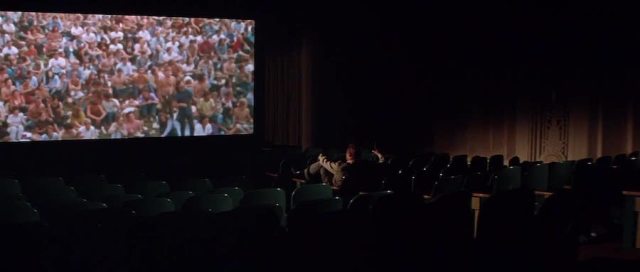
All these replays of sports events of the past filling the network airwaves this last weekend brought this image to mind.
Charlton Heston, sitting alone in an LA movie house, remembering what “crowds” look like.
What was he watching? Michael Wadleigh’s “Woodstock,” an event that celebrated a major anniversary last year, a movie Martin Scorsese helped edit.
Chuck’s got there in style, too. Grabbed himself an American convertible fresh out of the abandoned showroom.
“The Omega Man” was sort of the “rugged American individualist gun nut’s guide to surviving the apocalypse” and shaped a lot of such End Times tales to come. Richard Matheson’s “I Am Legend” is the book it was based on, and Will Smith’s remake was slightly smarter, a tad more progressive and in step with the times.
Anyway, movie going’s gotten a lot like Chuck’s experience in that film. Not sure how long the cinemas will stay open. Cities like NYC and LA have already shuttered theirs. Governors may act because Washington won’t. And even without that, no multiplex can cover expenses with the few paying customers who are showing up.
AMC is facing a debt crisis as it struggles to stay open via a limit of 50 customers per theater.
Let’s hope there are still places to go see a movie when all this shakes out. For now, streaming it is.
Having electricity and internet connection and extra time on your hands, with no sports (Today’s “opiate of the masses.”) to while away any indoor hours you have for social isolating, maybe it’s time you caught up on classic cinema.No, I don’t mean watching “Die Hard” or “Billy Madison” again.Start with Open Culture, where they have titles like Bunuel’s “Robinson Crusoe” streaming for free, over 1100 films listed.There’s still free film content in the inner recesses of YouTube.Assorted museums and archives keep online libraries up for your streaming convenience. The Library of Congress and The British Film Institute are good places to start.Some for profit “free movie” sites jam you with commercials, or are pirate sites. You can tell the difference.Vudu is one of the sources for commercial cut feature films and TV series.You don’t have to pay for Netflix’s limited menu of films or have a Roku to go down a movie rabbit hole online.Got a favorite site you go to (No bloody pirates, please)? Help everybody else with a comment/tip, if you would.http://www.openculture.com/freemoviesonline
The casual film fan might not recognize this, but serious movie buffs can vouch for what a game-changing venture Gore Verbinski’s “Pirates of the Caribbean” blockbusters were.
For half a century before Verbinski and Depp, Keira and Orlando set sail, pirate movies were career-killing box office poison. Robert Shaw died just as the flop “Swashbuckler” was coming out, “Pirates” and “The Pirate Movie” — hell, “Cutthroat Island” torpedoed Geena Davis’s marriage to director Renny Harlin, didn’t it? Didn’t do his career any favors either.
Peter Medak is a Hungarian filmmaker whose career was on the early 1970s rise — “The Ruling Class,” “A Day in the Death of Joe Egg.” Then he let his friend Peter Sellers, “the greatest comic actor in the world,” talk him into directing a film of the novel “Ghost in the Noonday Sun.”
It would be shot in Cypress. They’d buy and refit a ship to film it on. It was 1973. And it was about pirates.
The fact that you’ve probably never heard of “Ghost in the Noonday Sun” says it all. It was a debacle on every level, so bad Columbia Pictures refused to release it. It slipped out on home video a decade later, and nobody heralded it as “a lost masterpiece” when that happened.
To this day, Medak is haunted by the film, the trauma of making it and the price it cost his career. He went on to make “The Krays” and “Romeo is Bleeding” and oh, “Zorro: The Gay Blade.” But he could’ve been a contender, he figures.
“The Ghost of Peter Sellers” is his 90 minute documentary therapy session, an attempt to revisit a fiasco and exorcise the demons it unleashed. Medak is 82 now, and was 80 when he filmed the doc. He breaks down in tears more than once in the film.
“My career was completely destroyed by this movie,” he whines to Norma Farnes, who was Peter Sellers’ agent at one point.
“You’ve got to let it GO,” she says, attempting to console him.
But this cinematic therapy session turns out to be one of the more fascinating dissections of a film that failed.
Here’s a chunk of the black and white prologue to “Ghost of the Noonday Sun” to give you an idea of what we’re talking about here.
The clips from the making of the movie and from the film itself, with Medak revisiting every location, from the London street where Sellers made him the pitch, to the villa they rented for Sellers on Cypress, reveal a movie that became a nonsensical big screen riff on “The Goon Show,” the precursor to Monty Python which Sellers and pal Spike Milligan had co-starred in.
Milligan script doctored the movie, but “Spike didn’t really understand film,” Medak confesses.
Trotting out production memos, company letters, daily shooting schedule and summary reports, and talking with producers, financiers, surviving cast members and those who were there reveals the train-leaving-the-station trap of movie-making. A movie without a coherent script, checks rolling in, a start date, sets and a ship built in Cypress — once this disaster started rolling, all the star tantrums and feuds with director and his co-stars, all the threatening letters from the London production office, all the director’s doubts could not stop it.
That train was leaving the station, had left the station and had damned well better arrive at its destination, twelve screenwriters, star “heart attack” and pirate ship sinking — on the DAY a drunken Greek captain crashed it on delivery in Cypress — be damned.
Stopping production was never an option. They stop, and NOBODY gets paid. Sellers fired producers and tried to fire Medak and tried to cajole him into quitting (with a bribe) so Sellers could get out of a movie he was instantly ready to abandon.
The actor turned up “catatonically depressed” after breaking up with his latest girlfriend, Liza Minnelli. Even Sellers’ “Goon Show” co-conspirator Milligan, on set for a supporting role and depended on for rewrites, couldn’t shake him out of it.
And Medak? “I signed that contract, I desperately needed the money, and I had a responsibility, I thought, to see this through.”
His most revealing line might be this one. “I want to KILL people, but they’re all DEAD.”
So he does the next best thing. “The Ghost of Peter Sellers” turns into a reexamination of a famously “difficult” film star’s behavior, Sellers’ troubled mental state “that was never looked after,” the portrait of a man Medak still says he loves and still calls “a f—–g GENIUS.”
Medak then sits down with Robert Wagner, who had to work with Sellers on “The Pink Panther.” He chats up Rita Franciosa, widow of actor Tony Franciosa, co-star of “Ghost in the Noonday Sun.” And as a coup de grace, Medak brings in Joe McGrath (“Casino Royale”) and Piers Haggard (“The Fiendish Plot of Fu Manchu”), directors who ALSO suffered from working with Sellers on movies that became epic failures.
All this piling on turns “Ghost of Peter Sellers” into a “pathography,” the nickname given biographies that torch the reputations of the dead. And frankly, it’s deserved.
As John Heyman, the late producer of “Ghost in the Noonday Sun” and man who sent letters threatening to fire Medak during filming recalls, “Everybody knew Peter was nuts. Watch out.” They never guessed “HOW nuts.” But they figured it would be worth it.
Medak crosses into self-pity, here and there, invoking a traumatic WWII childhood (Jewish in Occupied Hungary), the loss of a sibling and his father while young, psychoanalyzing why he let this film get the best of him.
It was a movie several people, including Medak, say, “never should have been made.” But by the end of this documentary, you wonder if perhaps Medak’s closer to Heyman’s peace with making a misfire, “just a movie” after all. Not bloody likely, though.
MPAA Rating: unrated, some profanity
Cast: Peter Medak, Peter Sellers, Spike Milligan, Robert Wagner, Rita Franciosa, Norma Farnes, John Heyman, Joe Dunne, Joseph McGrath, Piers Haggard
The most consequential current faith-based movie, a film built on Christian themes of redemption, forgiveness, turning the other cheek and righteousness, is rated R.
“Burden” is not a “family” picture, and a whole lot of faith-based film fans will skip it and opt for the reassuring weepy pablum of “I Still Believe.” Which is a crying shame.
While both films are flawed, with “Burden” winning the “heavy-handed” and “sermonizing” sweepstakes, it’s still a movie of real life conflict and moral heft. It’s a film of good performances and moral consequence.
Garrett Hedlund is Mike Burden, a brawny, working class Laurens, S.C. brute who loves his “biker rock” (Lynyrd Skynyrd, et al) and his band of brothers. Those are Ku Klux Klansmen, in Mike’s case.
He’s a repo man with a soft spot for a single mom (Andrea Riseborough) about to lose her TV. But he’s racist to his very soul. An old high school classmate (Usher Raymond) gets no such “slack.”
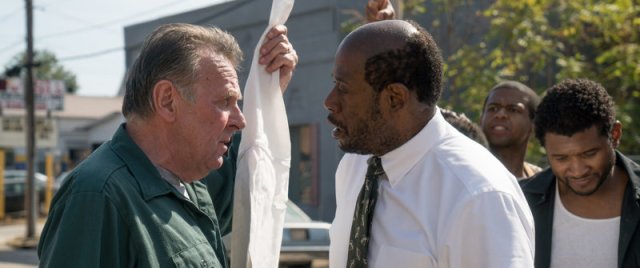
That’s because Mike has all but been adopted by his KKK mentor, local businessman and racist provocateur Tom Griffin (Tom Wilkinson). Mike pit-crews on Tom’s dirt-track racing team, and is expert at winding burlap around the crosses Tom likes to burn at his KKK rallies.
And Mike is on the demo/restoration crew Tom puts to work on Laurens’ long-empty movie theater, the Echo. Tom’s got a surprise for 27% of South Carolina’s population. He’s turning that theater into The Redneck KKK Museum. Just because he can.
“Tell the god—-d NAACP this HERE’s the new capital” of S.C., he drawls.
Activist minister Rev. Kennedy (Oscar winner Forest Whitaker) spends too much of his time mediating racial injustice at the retail level already. We meet him as he’s helping a black woman get a refund at that discount store where the employees wear blue vests and the white ones think nothing of mistreating black customers.
The last thing he needs is that old, once-segregated theater, reopening as a “museum” for the terrorizing of our community.”
This isn’t a piece of ancient history. It happened in 1996, and actor-turned-writer/director Andrew Heckler lays on the hate, the racism and the violence to underscore the schism this community of working poor — black and white — live with.
Mike’s quite to anger, eager to join in on intimidating and assaulting black folks. But he’s sweet on Judy, and in her he and we see the promise of a story of redemption.
Riseborough (“The Grudge” and TV’s “zeroZerozero”), a British actress of almost unmatched range, makes Judy a rawboned, big-haired gum-snapper with earthy sex appeal, instantly attracted to Mike but leery of his KKK connections. She may put up with it, but there’s an implied side-eye in every little hint of racism from him or his Neanderthal Grand Wizard father-figure.
Her little boy is best friends with a little black kid. Mike’s Road to Damascus begins when he offers to take her kid fishing, and little Franklin’s best friend Dwayne gets to tag along.
It’s harder to hate a child, especially a sweet-spirited one.
Rev. Kennedy’s daily protests dent the museum’s business. But stopping that and changing Mike are a long, torturous row to hoe in “Burden.”
Whitaker is perfectly at ease playing a character who is both symbol and flesh-and-blood husband and father, trying to keep his own son from meeting violence with violence.
Wilkinson tears into his businessman bigot, a racist’s racist who may be smart enough to realize his minions are absolute morons, but at least they’re putty in his hands.
“They got the Martin Luther King Museum, they got the Jew Museum,” he roars. Now, he says, “the Chosen People…fighting for God’s Will for racial purity,” will have a place where they can see a Confederate sword and get their picture taken in a white KKK robe.
Exit through the gift shop, y’all.”
Hedlund plays Mike as borderline unhinged, which makes the redemption story something of a hard sell. Even at two hours, Mike’s “gradual” transformation still seems abrupt.
But Riseborough is the film’s Voice of Reason, a struggling, broke white working class Southerner who has done the math. What’s hundreds of years of racism gotten them? Dead-end lives in a one-water-tank town in the armpit of S.C.
“What, you gonna drive all the Blacks outta Laurens? We’ll still be white trash, with no one to step on to make us feel better!”
Writer-director Heckler scripts some good speeches, delivers a doozy of a surprise-twist ending and does a terrific job at hiding the movie’s purpose and Mike and Tom’s actions in the opening scenes.
When we see what The Echo is being turned into, Heckler makes that moment a real slap in the face.
The cross-burning is nicely paralleled with Rev. Kennedy’s bonfire-side sermon about all the black churches burned and bombed throughout the South over the years.
But the movie dawdles, drags and hammers home its points, over-emphasizing the violence. t’s as subtle as the tools Mike uses to demolish walls in the theater they’re turning into a museum. Black people’s mistrust of Mike’s “conversion” makes them the proxies for the audience here. We don’t buy it.
The lump in the throat “see the light” moments aren’t nearly as powerful as they were in the similar period piece “Best of Enemies” from last year.
“Burden” is still a movie of faith with more virtues than failings, more ambition than merely pandering and more topicality than we’d care to admit.
MPAA Rating: R for disturbing violent content, and language throughout including racial epithets
Cast: Forest Whitaker, Garrett Hedlund, Andrea Riseborough, Tom Wilkinson, Usher Raymond
Credits: Written and directed by Andrew Heckler. A 101 Studios release.
I can’t speak for you, but I’m a little numb with shock at this “shelter in place/self-quarantine/lay low y’all” that has dropped on our 21st century civilization’s heads.
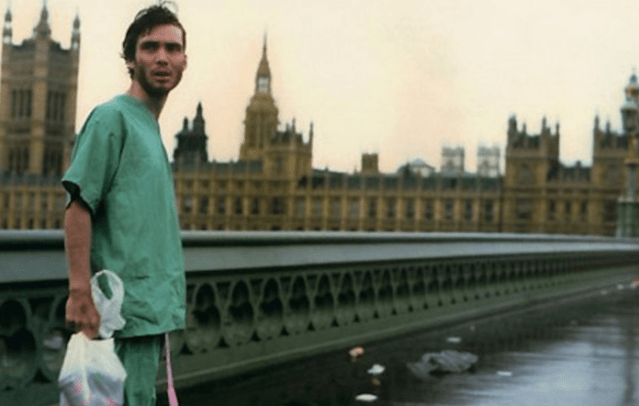
It’s one thing to adore the science fiction allegories of old “Twilight Zone” episodes (“Time Enough at Last”), movies old (“The Omega Man”) and new (“I Am Legend,” “World War Z”), experiences that transport us — briefly — into a situation that makes us wonder how we’d act, what we’d do to save ourselves and what part of our humanity and human civilization would be at the top of our list to save for eternity.
We think “I’d head for the hills” or “hole up in the desert/mountains” or what have you. Anything to get clear of the “Contagion,” at least until it sort of blows over. As if we’re sure that’ll happen.
I have a live-aboard cruising sailboat and half-smirked “I’ll just sail away for a bit. Someplace warm where the Corona beer is cheap and the populace is maybe Corona (virus) free.
These attitudes of “get away” and “We alone will survive” and “self-reliance will save us” are burned into our psyches from movies and TV. From Westerns onward, Americans in particular have absorbed that “I can go it alone” ethos.
Some would say our fate is tied to one American political party’s embrace of Westerns long after they went out of style that has them constantly looking for “cowboys” and “mountain men” like they’ve seen in moving pictures. But I can’t believe any Republican voted for somebody as unmanly and unself reliant as the cowardly oaf in the Oval Office because they thought he was a (movie) cowboy like Reagan.
But maybe.
Here we were, all set to dive into the “last humans standing” story of “The Quiet Place” again, and damned if it isn’t pulled from release. A little too “on the nose,” if you ask me.
Time and again, movies have presented us with an “Outbreak” which it takes pluck and luck and can-do knowhow to survive.
But what I remember from “Outbreak” is the movie theater scene. The film, which turned 25 this month, shows disease spreading from an African monkey to humans, who pass it on in a chilling moment where, in a nearly-quiet movie theater, the movie is interrupted by muffled coughs that slowly spread among the filmgoers.
But plagues have plagued the big screen forever. Monty Python’s Terry Jones (director of “The Holy Grail”) made “Bring out yer dead” a cultural punchline.
Robert Downey and Sam Neill made plague the 17th century comeuppance for decadence in “Restoration.”
There was “The Horseman on the Roof” and a personal guilty pleasure, the Omar Sharif/Michael Caine film, by novelist and one-time director James Clavell, “The Last Valley.” In the same 1600s that “Restoration” was set in, Sharif plays a man on the run who stumbles into a village in “The Last Valley,” that the plague has not reached.
Michael Caine and his band of mercenaries shows up and mucks up primitive paradise.
I don’t recommend any of these titles — or the ON-THE-MONEY “Contagion” (I didn’t love it when it came out. Heartless, as indeed viruses are.) as “escape” while we’re holing up, riding the storm out.
But if we’re out buying up all the toilet paper and bracing for the Apocalypse, that’s how we’ve been trained — by the movies.
Accepting the inevitable, which is what the fatalistic reads on Coronavirus seems to entail, calls to mind the End Days sadness of “On the Beach,” which weighs heavily on the viewer even though the film is over 60 years old, now
Meanwhile, Kevin Costner and I are stocking the boats and getting ready for “Waterworld.” You lubbers let us know when it’s safe to come back.
We don’t need to hear the voice of William Shatner as narrator to know where the screenwriters of “To the Last Death” got their plot.
It’s an animated “Saw” movie built on the bones of “The Gamesters of Triskelion,” an episode of “Star Trek” TOS.
The animation is lurid and limited — sort of a digital bunraku (jerky motion character action in front of static backdrops — and the action is bloody in the extreme in this story of a busty animatrix voiced by Dani Lennon who becomes a pawn in a “game” some aliens are running.
It’s kind of cool, for a movie whose script is more pithy punchline-oriented than clever. And truthfully, there was no reason this story was animated in the first place, but that’s the main reason anybody would think it’s “cool.” Think of “Death” as an “Adult Swim” in a pool of gore and you’re on the right track.
Miriam (Lennon) directs a non-profit acronymed “PANAC” — Peace and Nonviolence Action Committee. You have to wonder if that isn’t because her daddy Cyrus DeKalb (Ray Wise) is a billionaire time arms manufacturer and onetime candidate for vice president.
But Miriam and her siblings rebelled against the old man and torpedoed his candidacy. No hard feelings though, right? Daddy’s invited Miriam, Ethan (Damien C. Haas), Kelsey (Florence Hartigan) and Collin (Benjamin Siemon) to his weapons-bedecked office building for a “reunion.”
Daddy’s a real piece of work, Mr. “Avarice is strength” and full of withering, profane criticism for each and every one of his offspring. Ethan? He was “far busier doing your eight grade math teacher than doing eighth grade math.” And so one.
Daddy doesn’t want hugs over his newly-announced medical condition. He wants “payback.” He has henchmen standing by to help him mete out punishment. “Death!”
Only Miriam escapes. But on her hospital bed, as she tries to recall the events of the night before for a suspicious cop, an alien entity (Morena Baccarin) materializes and offers her “a rematch.” She “warp back” 24 hours, go back into the “reunion” with new information and new purpose and foil her father and save her siblings.
The “gamemaster’s” rules? “You must and will provide amusement” as she fights her way through this predicament. Those entities gambling on the game “can stop” and “demand a replay” if things aren’t entertaining enough.
Thus Miriam must relive, “Edge of Tomorrow” style, the slaughter of the night before — figure out how to best this henchman or warn and rescue that sibling.
And here’s where this “Didn’t need to be animated” spatter film goes wrong. The gambits, “gags” in Old Hollywood terminology that allow her to get the drop on this bad guy or face imminent butchery from that one, are lame.
There’s suspense as hulking thug is about to dispatch this way or that. Yes, a chainsaw is involved at one point. But the resolutions to those predicaments fizzle and disappoint. Every. Damned. Time.
Animation should let the writers’ “reason/fight her way out of this” imaginations run wild. It does nothing of the sort. The “Do Over” moments dictated by the gamblers are just as limp.
So as “cool” as it is to have Wise doing another diabolical villain, as pointless as Shatner’s occasional plummy voice over about “The vast void between stars” is, as buxom as the assorted assertive women in this horror comic book of a movie might be, “To Your Last Death” is a gory gimmick without a decent movie behind it.
MPAA Rating: unrated, graphic bloody violence and animated nudity, profanity
Cast: The voices of Dani Lennon, Morena Baccarin, Ray Wise and William Shatner.



 Having electricity and internet connection and extra time on your hands, with no sports (Today’s “opiate of the masses.”) to while away any indoor hours you have for social isolating, maybe it’s time you caught up on classic cinema.No, I don’t mean watching “Die Hard” or “Billy Madison” again.Start with Open Culture, where they have titles like Bunuel’s “Robinson Crusoe” streaming for free, over 1100 films listed.There’s still free film content in the inner recesses of YouTube.Assorted museums and archives keep online libraries up for your streaming convenience. The Library of Congress and The British Film Institute are good places to start.Some for profit “free movie” sites jam you with commercials, or are pirate sites. You can tell the difference.Vudu is one of the sources for commercial cut feature films and TV series.You don’t have to pay for Netflix’s limited menu of films or have a Roku to go down a movie rabbit hole online.Got a favorite site you go to (No bloody pirates, please)? Help everybody else with a comment/tip, if you would.