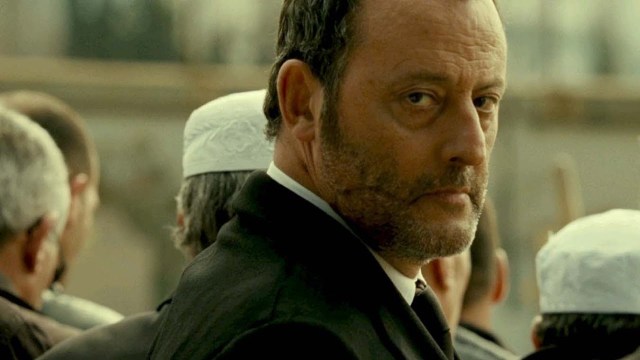
The South African novelist J.M Coetzee adapted his own allegorical novel for Colombian director Ciro Guerra.
Not a bad cast — Robert Pattinson, Johnny Depp, Greta Scacchi, Gana Bayarsaikhan and Mark Rylance.
The South African novelist J.M Coetzee adapted his own allegorical novel for Colombian director Ciro Guerra.
Not a bad cast — Robert Pattinson, Johnny Depp, Greta Scacchi, Gana Bayarsaikhan and Mark Rylance.

Art, love, travel and mourning find their way into “The Sunlit Night,” a star vehicle that gives Jenny Slate her best showcase since “The Obvious Child.”
This indie film, stuffed with a colorful supporting cast that includes Gillian Anderson, Zach Galifianakis, Jessica Hecht, David Paymer and Alex Sharp, gives us Norwegian scenery and mockably earnest Viking Village re-enactors, a family breaking up, the tyranny of modern art’s gatekeepers and a Jewish Russian Viking funeral.
And whatever crucifixion the film was given at a certain film fest a year or two back, chopping over twenty minutes from it lets it skate by, turning it into a flippantly sweet story that benefits from lovely touches that seem delightfully random in this version.
Savaged at Sundance, saved in a re-edit. There’s your headline.
Slate is Frances, a failing artist from a family of frustrated artists. Dad ( Paymer) is a gifted painter reduced to turning out medical illustrations for textbooks. Mom (Hecht) works in fabric. Only sister Gabby (Elise Kibler) had the good sense to pursue a law degree, and a fiance her embittered dad doesn’t approve of.
Frances deals with one critical/faculty beat-down evaluation too many, breaks up with a rich beau who lives in the Hamptons, gets the news of her sister’s nuptials and her parents’ breakup to top that off, and does what any butterfly floating around the arts does. She takes a residency.
“This is NOT a residency,” reclusive Norwegian artist Nils (Fridtjov Såheim of “The Wave”) reminds her on her arrival in the far north. She was warned, after all. She’d be “painting a barn” for him. And while it’s a traditional barn that he’s turning, inside and out, into an “installation” in yellow, “This is just hard work. You’re going to hate it.”
Frosty Nils kind of insures that. Frances chatters away, he just points to the numbered beams in the barn, and the numbered buckets in various shades of yellow and turns a deaf ear to her waxing lyrical about the scenery, how “magical” it is that she’s “buried in the sun.”
Frances’s curiosity sends her next door to the Viking Village, where Cincinnatti’s own Holgar (Galifianakis) plays the “chief,” in the historic recreation itself and in its cheesy amphitheater video. She is intrigued by the local COOP Mix market, where one woman is stationed inside the dairy case, seemingly all day.
And Frances is struck by the oddball stranger (Alex Sharp of “The Hustle” and “To the Bone”), a seemingly distraught and standoffish young man from The States she keeps running into.
There are places where the film’s re-edit shows, and places where you sense a salvage job that in effect, saves the movie. Short shrift is given to Frances’s break-up, and to her family turmoil. GAnderson plays the mother of the stranger, slinging a Russian accent to boot. Her part is chewy but tiny, and Zach G’s isn’t much bigger.
But good actors get across what we need to know and what we’ll be entertained by. Scenes and gags aren’t around long enough to seem labored, and that suffices.
The heavy use of voice-over, with Frances comparing every face and scene she sees to a painting, might be an after-Sundance “patch,” or it might not. But it’s delightful. It works.
The Viking chief is Van Gogh’s “Dutch postman.” The morose young man, Yasha (Sharp) “looked like Caravaggio’s ‘Boy with a Basket of Fruit.'” Her family’s tiny New York apartment has a Mondrian lay out. “His eyes fall somewhere NOT on the blue spectrum,” and so on.
I just adore Slate, and director David Wnendt, who did that German Hitler comedy “Look Who’s Back,” lets her play to her strengths — vulnerable, lost and sarcastic.
“Sarcasm doesn’t suit you,” the grumpy Nils advises. Nils doesn’t know J. Slate.
As much as I agree with the Greatest Editor of them All, David Lean, that pretty much any film can be saved in post production, if the performances are there, I’m not going to go way overboard praising this salvage job. It isn’t “The Current War: Director’s Cut” level rescue. But whatever they edited out of “The Sunlit Night,” they made certain to keep the funny, sweet and sunny parts. And Slate makes the time pass like a late summer Green Flash — an enchanting moment or two or three, and gone.

Cast: Jenny Slate, Alex Sharp, Fridtjov Såheim, Jessica Hecht, David Paymer, Zach Galifianakis and Gillian Anderson
Credits: Directed by David Wnendt, script by Rebecca Dinerstein, based on her novel. A Quiver release.
Running time: 1:22

Perhaps it took a humorless, career-crippling George Clooney TV version of Joseph Heller’s novel to make us better appreciate Mike Nichols’ daring, infamously-expensive version of “Catch-22.”
Released at the height of the Vietnam War, suffering in comparison to Robert Altman’s equally anti-war dramedy “M*A*S*H,” seemingly more on a par with with equally cynical action comedy “Kelly’s Heroes,” which has had the benefit of a lot more TV exposure, “Catch” still plays the way it did way back in 1970 — as a pricey, “difficult” satire with a “difficult” shoot as baggage.
But wipe away the “Catch-22 lore,”the people cast and cast-aside, the fact that Nichols wanted the more age-appropriate Al Pacino as Yossarian, the young bombardier/anti-hero. Grapple with the film’s disordered narrative and come to terms with the nightmarish focus of the story — an active-duty combat airman flying through and ranting through what we now call Post Traumatic Stress Syndrome, coupled with survivor’s guilt.
It’s amazing to see now. And considering how our war movies, from “300” to “Midway,” “Greyhound” to “Flyboys” and even at times, “Dunkirk,” are made now — with digital planes and ships and sometimes tanks — they really don’t make’em like this any more.
Nichols made the most of his coastal Mexican location, showing off all 17 WWII vintage B-25s taking off and landing every chance he got. You couldn’t do that today.
And that cast. Alan Arkin makes a fine, perplexed and outraged Yossarian, a sane man trapped in the insanity of war, an actor who never hits a punchline too hard, never takes the character’s exasperation into parody.
“Let me see if I’ve got this straight. In order to be grounded, I’ve got to be crazy. And I must be crazy to keep flying. But if I ask to be grounded, that means I’m not crazy anymore, and I have to keep flying.”
“You got it,” Doc Daneeka (Jack Gilford) tells him. “That’s Catch-22.
“Whoo… That’s some catch, that Catch-22.”
Orson Welles as a grumpy general, Tony Perkins as a put-upon chaplain, Martin Balsam as the murderously vain commanding Col. Cathcart, Buck Henry as his venal sidekick, Col. Corn (screenwriter Henry was never better as an actor), baby-faced Bob Balaban as the always-crashing, always-tinkering, even-tempered Orr, it’s a dazzling corps.
Bob Newhart half-stammering through Major Major Major, a very young Martin Sheen raging as the pilot Dobbs, Art Garfunkel as the innocent co-pilot Nately who falls for an Italian hooker, Charles Grodin as an upper-class twit navigator, a smarmy, befuddlingly upbeat Richard Benjamin (cast, with his wife Paula Prentiss as a nurse Yossarian chases), the famous French star who fled to Hollywood Marcel Dalio is the wizened old Italian who figures Italy has already won the war, since it has surrendered and Americans are still fighting and dying.
And there’s a sea of actors we’d come to recognize on TV (“The Bob Newhart Show” is over-represented) in the years that followed.
Jon Voight stands out just enough as the grinning opportunist Milo Minderbender, a stand-in for every war profiteer you’ve ever read about, working the angles, an impersonal unpatriotic multinational corporation who wins no matter who loses.
Like its two contemporaries, “M*A*S*H” and “Kelly’s Heroes,” it’s a guy’s movie with a dated leering quality about the opposite sex. It’s heavy-handed, betraying Nichols — feeling his oats after “The Graduate” — indulging in some serious “blank check” filmmaking.
And reading over the years of all the people Nichols wanted to cast, or cast and then replaced, you kind of wish he’d moved on from Gilford, a future Oscar nominee who doesn’t bring enough cowardly sniveling to the good doc.
“Catch-22” was popular enough that they did a pilot for a sitcom based on it, as was the case with “M*A*S*H.” Richard Dreyfuss had the lead in TV’s “Catch.”
Over the years, I’ve interviewed half a dozen actors from that all-star cast, and often, without prompting, they’d bring it up. It took half a year of their lives, most of them, and burned itself into their memories, even if it wasn’t the blockbuster Paramount expected it to be.
Watching it again, outside of the academic settings where it turned up in “film as satire” classes and the like, it feels more cinematic than the scruffy, Altmanesque “M*A*S*H,” a movie marred by that stupid screen-time-chewing football game. It’s less fun than the more-watchable “Patton” and even “Kelly’s Heroes” (which is FAR longer).
But as a darker-than-dark comedy about the futility and insanity of war, it towers above its contemporaries in ways that should have scared-off George Clooney. It’s the best film of a seemingly-unfilmmable classic novel we’re ever going to get.

MPAA Rating: R, graphic violence, blood, nudity, profanity
Cast: Alan Arkin, Martin Balsam, Buck Henry, Tony Perkins, Bob Newhart, Paula Prentiss, Richard Benjamin, Marcel Dalio, Bob Balaban, Art Garfunkel, Martin Sheen, Jack Gilford, Peter Bonerz, Norman Fell, Austin Pendleton, Jon Voight and Orson Welles.
Credits: Directed by Mike Nichols, script by Buck Henry, based on the Joseph Heller novel. A Paramount release.
Running time: 2:02

Immerse yourself in any country’s native cinema and you quickly pick up on the same range of quality that everyone, from Hollywood to Pinewood, Bollywood to Nollywood shares.
There’s good, there’s bad, and there’s ugly.
“Maria” is a superficially slick thriller in that universal “female assassin” genre. It’s what happens when you throw Netflix money at a national cinema better known for its energetic, gritty crime pictures —“BuyBust” was a recent example.
There’s little sense of the country’s more traditionally-depicted underworld here. No street life, layers of of a society with a depressingly large underclass. It’s all top-notch fight choreography, well turned-out villains and a villainess, and a pretty heroine who can wear a slit skirt and kick-ass while she’s doing it.
The prologue here is a big give-away, and is emblematic of a ham-fisted script. A ninja-dressed killer invades a fortified mansion, wipes out the guards and faces a test. Will she murder a child and her mother (or nanny)?
So when we cut to domestic scenes of a life that Maria (Cristine Reyes), husband Bert (Guji Lorenzana) and their little girl, Min Min, we already know she has a past, and what that past was.
Her husband is working for a crusading politician, the mob wants that crusader silenced and the mob heir, Kaleb (Germaine de Leon) wants to track down this missing killer everyone assumes is dead.
As with the prologue, this is a blunder. There’s no “discovering” the “dead” killer, “Lily,” is now Maria. That whole business is just botched, another surprise tossed away. Perhaps the many scenes of torture, carried out by the Big Boss, Riccardo (Freddie Webb) and his favorite minion Victor (KC Montero) are meant to distract us from this.
The movie stumbles about, with Boss Riccardo bitching about “Why haven’t you guys silenced/cut off the head” of this politician while Kaleb pursues his vendetta against Lily, whom he has no trouble at all tracking down.
Reyes is dazzling in a fight, and stunt director Sonny Sison stages some impressive brawls for her to punch, kick, slice and shoot her way out of. One, a stunning sequence in which she faces down a long line of murderous minions, “Old Boy” style (a narrow aisle of a warehouse) is particularly impressive.
Far less impressive is the story and the dialogue, in assorted Filipino dialects and English.
“For a dead person, you look hot!” is all too typical. “I want heads cut!”
The best line comes from that most reliable of “killer on the lam” tropes, visiting “an old friend.” That would be mob-connected Mister Greg (Ronnie Lazarro) for “one last favor” (another worn out trope, and line).
“I thought the LAST favor was the last favor?”
The fetishized “Let’s pick out some guns for you” scene, mayhem in a marketplace, the replacement female assassin (Jennifer Lee) who must be faced — been here, done that in pretty much every locale and every language imaginable.
“Maria” may put a fresh face on all of this, and a fresh sheen — mansions and what not. But it quickly turns into a movie we’ve seen too many times before, often done much better.

MPAA Rating: TV-MA, graphic violence, torture, profanity.
Cast: Cristine Reyes, Germaine De Leon, KC Montero, Guji Lorenzana, Jennifer Lee and Ronnie Lazarro
Credits: Directed by Pedring Lopez, script by Yz Carbonell and Rex Lopez. A Netflix release.
Running time: 1:29
This “free wheeling” bio pic, a breezy 96 minutes in length, and has features Kyle McLachlan as Thomas Edison and also stars Eve Hewson and (as Westinghouse) jim Gaffigan. It cost almost nothing and comes from the director of “Cymbeline” and “Experimenter” and streams/opens Aug 21.

As the title character in “Benjamin,” Colin Morgan is chatty, insecure, painfully awkward, and thanks at least in part to his Irish accent, adorably twee.
Your instinct is to sidle up to him, give him a little “Could we talk outside?” and extract him from every single uncomfortable human interaction facing him in this engaging, accessible and quite amusing romantic comedy.
Writer-director Simon Amstell’s sophomore feature (after 2017’s “Carnage”) is about a once-lauded, once younger “young filmmaker on the rise” finally getting around to his second feature, frozen in insecurities, which he has — we gather — been unleashing on his editor and his producer (Anna Chancellor).
He hems. He haws. He watches the film unspool, a scene with himself and another actor bickering about “The self is an illusion,” and Benjamin goes on an on about putting more of “the monk” (a Buddist guru) back into the film.
“We’re picture LOCKED!” producer Tessa fumes.
This is the way Benjamin Oliver is — tentative, over-thinking, over-talking, impulsive and indecisive at the same time. He is maddening and amusing to be around. And once the viewer gets over the intense relief that the “scene” playing out from his movie — titled “No Self,” we later learn — is NOT the movie we’re going to be watching, Morgan (TV’s “Merlin”) drags us along on a cute, flip and occasionally poignant slice of his life.
His next uncomfortable interaction is with his publicist (Jessica Raine, HILARIOUS). Then, there’s his stand-up comic pal Stephen (Joel Fry), the one he drags with him to a “chair” unveiling. What do you say to an artist showing off a chair?
“I really like that it’s not something you’d want to sit on.”
But that “unveiling” has live music, and Benjamin is instantly bowled-over by the singer.
“You just like people who are well-lit and weak,” Stephen jokes, know his pal’s “type.” Stephen corrects any introduction of himself as a comic with “I’m not funny.” Don’t you believe it.
Especially when he and the hard-charging, self-absorbed publicist Billie (Raine) hook-up after the chair-unveiling, and it doesn’t go well.
Benjamin? He’s disarming and handsome enough to make the eye contact that gets the attention of Noah, the French singer (Phénix Brossard). Maybe he’ll stop blabbing long enough to “connect,” or at least close the deal.
“You look kind of elfin,” the Frenchman smiles. As if he’s one to talk.
Benjamin tries to navigate this new romance even as he’s facing the London Film Festival premiere of his movie, where all his insecurities are fated to flow out of him, in public and in private — with Noah.
“Oh God, you hayett-ed it,” he blurts, in Irish. “Is the relationship over?”

Amstell writes delightful dialogue (he’s scripted a lot of TV), and he gives everybody something funny and telling to say. The former leading man (Jack Rowan) who talks about working with Benjamin again is vapid, pretentious and quite actorly in his uh, compliments.
“I love the way you don’t choose success!”
“Benjamin” is a brief, brisk movie that somehow manages to squeeze in seven characters of consequence, tell an amusing and romantic story, and still find the time to dip its toes into something darker.
That darkness resonates, too — the emotional scars artists share as a driving trait, the wounds that an ex can carry after an affair ends. And succeed or fall square on your face, resign yourself to the necessary evil of having a publicist — hiring a disinterested someone to lie, badly, about you and what you do just to keep you going and your name “out there.”

MPAA Rating: unrated, profanity, drug jokes
Cast: Colin Morgan, Joel Fry, Anna Chancellor, Jessica Raine, Jack Rowan and Phénix Brossard
Credits: Written and directed by Simon Amstell. An Artspoilation Films release.
Running time: 1:27
This biopic about the Curies, Marie and Pierre, and their research into radiation already opened in Europe. July 24, Amazon Prime has it.
Rosamund Pike is the big-name in the cast.

An Irishman beat Bram Stoker to the whole fangs, bites, stake-in-the-heart business way back in the golden age of “vampire fiction.” Sheridan Le Fanu’s “Carmilla” came to print a quarter century before “Dracula.”
It’s been turned into an opera, comics, anime and many a movie over the past century, and more adaptations are in the works. It’s about a lesbian vampire, so you can see the attraction.
Editor-turned-director Emily Harris (“Borges and I”) serves up a stately, austere and pretty period piece version that plays up the attraction and dabs its finger in blood. It may be the dullest vampire movie I’ve ever seen, and I’ve been bored by the best.
Lara (Hannah Rae of TV’s “Broadchurch”) is a daydreaming motherless teen whose stern governess (Jessica Raine of “The Woman in Black” and TV’s “Call the Midwife”) can’t keep her attention and can’t resist binding and tying her left hand behind her back.
It’s the mid-19th century, and Lara is naturally inclined to do everything with her left hand. Miss Fontaine isn’t having that, what with “the Devil” having use for “the left hand”of darkness. Lara has curiosity about books in her father’s library, books on anatomy, and such “images are NOT for a young lady.”
Another caning it is.
Lara has been desperate for company, way out in the country. A young lady, Charlotte, is expected. But when she doesn’t show up, Lara blames herself, suggesting “I called the Devil” by wanting her to arrive so badly.
Damned if a carriage accident doesn’t put another young woman (German actress Devrim Ingnau) under her roof. She is in shock. Her driver was killed.
“She’s perfect, except she can’t speak.”
Lara dreams about her, about the driver, and then stumbles into her in the dark of night. She can speak! What’s your name?
“You choose.”
“Carmilla” it is.
As they bond and spend hours off by themselves together, Miss Fontaine and the doctor (Tobias Menzies) fret. There’s talk of “rumors, superstitions,” and that for which “there would no medical remedies.”
Adapter-director Harris frames her subjects well, but fails to find much that is spooky about any of this, even in her many night scenes. The heavy lifting of recreating 19th century Britain (no Irish accents) seems to have taken up all her attention.
The young stars aren’t particularly engaging while we sense their curiosity about one another, there’s little chemistry or heat in a relationship that’s supposedly all about that.
Not a lot happens, and when it does, it’s nothing we haven’t seen before and done with more terror, fire, sexuality and suspense.

MPAA Rating: unrated, blood and violence, erotic content
Cast: Hanna Rae, Jessica Raine, Tobias Menzies , Devrim Lingnau and Greg Wise
Credits: Written and directed by Emily Harris , based on the novella by Sheridan Le Fanu. A Film Movement release.
Running time: 1:34
A July 24 release, bit of a departure for Ms. Slate.
The iconic fashion, art and portrait photographer Helmut Newton (1920-2004) described himself, half-dismissively, as “a professional voyeur.” Elaborating, he said “I photograph a body, a face, legs…”
Always women. Typically nude. Often provocatively posed and photographed.
One of his favorite models, Grace Jones, cackles when she remembers that “He was a little bit pervert, but so am I!”
She hastens to add words that others in the new documentary, “Helmut Newton: The Bad & the Beautiful,” echo — “Never vulgar. NEVER vulgar.”
Another actress/model who came under his gaze, Isabella Rossellini, sees “an attraction to and anger towards” his subjects. The fashion editor Anna Wintour notes how he found “a type,” the “Helmut Newton woman,'” “tall, blonde, lots of lipstick.”
Thin, young and inutterably gorgeous kind of goes without saying.
German TV director Gero von Boehm plays snippets of Newton interviews, on camera and for radio, in the film. He opens with a challenge Newton gave him, basically from the grave.
Photographers “”are terribly boring people,” Newton confesses. Movies about them? “Terribly boring” too.
Director von Boehm paints a layered portrait of an artist who might very well be “boring” compared to the image we developed of Newton from his photos — oversexed, perverse, devouring the most beautiful women in fashion and film with his camera.
Then we watch him work — “Give me ATTITUDE.” We see the icy glares, the malevolent stares. Model after model talks about how “strong” and in control he made them feel, even nude, even at the tender ages many models achieve success in their profession.
And Rosellini speaks of how “in control” on the set Newton’s wife, June (seen and heard here, too) was, while Helmet “got to play with his toys,” joke around and keep the models at ease.
Newton cracked to an earlier interviewer that “I’m not going to tell you all that,” the full story of his life, his passions, phobias and romances. He was saving that “for people who have more money than you.”
But von Boehm uses old interviews, still photos and archival footage to tell the story of a German Jew whose artistic aesthetic was formed in the Weimar (decadent, expressionist) and Nazi Germany (fascist idealization of the human body) he grew up in.
We hear about his mentor, his influences, his escape to China and then Australia (where he met June).
And we get an idea of how he held onto that aesthetic until, in the late ’70s, it came into vogue and “Vogue.”
Throughout, the master comes off as more playful than Annie Leibowitz or Herb Ritts, with something of the Robert Mapplethorpe “provocateur” about him.
We see him work — shoots with Sigourney Weaver and whatever model was that week’s “fresh new face.” And Jones and others marvel at him realizing this or that truth about “the light” and shadows and “message” he was getting across, waiting until that perfect moment when his vision became (thanks to the shifting sun, often) his reality.
The emphasis here in on the nudity and art photography, but there’s just enough of the portraiture to tell us he had that Leibowitz eye for the essence of his subject — right wing French political leader (unknowingly posed, with his Dobermans, the way Hitler was photographed with his German shepherd) or ’60s icon turned grand dame of pop, Marianne Faithful.
It’s a fun, generally brisk biography, one whose tone might be the artist’s credo. Newton declared that there are “only two dirty words” in any of the three languages he spoke — “art” and “good taste.” He never let either limit what he was trying to say.
And 15 years after his death, who’s to say those words don’t apply to his most daring shots?

MPAA Rating: unrated, nudity
Cast: Helmut Newton, June Newton, Grace Jones, Charlotte Rampling, Marianne Faithful, Hanna Schygulla, Anna Wintour, Claudia Schiffer and Isabella Rossellini.
Credits: Directed by Gero von Boehm. A Kino Lorber release.
Running time: 1:22