Movie Review: Dancers meet, muse and mate — a lot — in “Aviva”

aviva1

A couple of beautiful young dancers — one in Paris, the other a New Yorker — meet online and have a years-long affair and post-affair “relationship” in “Aviva.”

But writer-director Boaz Yakin, best known for directing “Remember the Titans” and scripting even more conventional films such “Prince of Persia,” “Now You See Me” and the kid-and-a-war-dog family picture “Max,” takes a stab at reinventing himself with this stylized, experimental indie drama.

It’s non-linear, at times, non-binary in its treatment of sexuality and almost nonsensical as he empties his bag of tricks onto the screen.

Characters change actors — for actresses, and actresses become male characters. Copious passages of voice-over narration are joined by characters breaking the fourth wall, directly addressing the camera and speaking about the film they’re in.

“I was thinking of trying out a song, at this point. F— consistency and tone.”

Actually, it’s fairly consistent and the tone lingers on the mopey side of scale.

There’s a bit of dance and a lot more sex.

Yakin introduces a number of characters, early on, in the nude — full frontal, sometimes addressing the camera. After we’ve met the elderly attorney our young couple, the Parisian Aviva (Zina Zinchenko) and New Yorker Eden (Tyler Phillips), Yakin brings in more older folks, and children for flashbacks.

And even he blinks at the idea of showing them naked.

As our simple “love story” has only so much promise, he decides to gloss it over with gimmicks and coitus – gay and straight, threesomes and slapping — many scenes’ worth.

That’s where the whole non-binary thing comes in. Eden is narrated and even played by the first nude (Bobbi Jene Smith) we meet, in some scenes. Or Schraiber takes over Aviva as the film dabbles in the fluid nature of sexuality as defined by current thinking on the subject.

The acting isn’t awful, just awfully arch — as dictated by the screenplay. Eden laments about the doubts he has and how they “cast a pall of my own making over the shimmering beauty of creation.” Aviva’s come-on includes “with every moment that passes, my heart loses a little bit of innocence.”

Dude, just let the dancers dance!

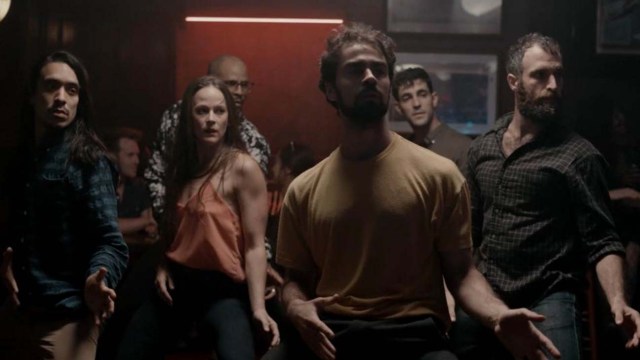
There’s early promise, characters slipping into stylized movement just skipping down the street. The dance scenes are glorious, a bluesy-klezmer bar scene, a Jewish wedding reception that takes traditional line-dancing into sexy modern dance, kids in a flashback, rapping and break-dancing on the subway.

But somewhere well before Eden mimes driving a car, conversing with another lover/alter ego in the “back seat,” I lost all interest in this exercise in indulgence.

Who can keep track of the assorted bearded little-known look-alikes with mismatched accents, none of them driving the “plot” or deepening our understanding of the human condition? Who wants to stay involved with Aviva and Eden breaking up, reconnecting and who-cares-what-comes-next?

Orate and strip, have sex, dance and argue. Then repeat, with different gender performers playing the characters.

It’s pretentious. It’s on-screen onanism, and rarely more than that.

1half-star

MPAA Rating: unrated, explicit sex and lots of it, full frontal nudity, slapping.

Cast: Zina Zinchenko, Bobbi Jene Smith, Tyler Phillips, Or Schraiber

Credits: Written and directed by Boaz Yakin. A Strand release.

Running time: 1:55

Posted in Reviews, previews, profiles and movie news | Comments Off on Movie Review: Dancers meet, muse and mate — a lot — in “Aviva”

Orlando’s Enzian arthouse reopens Friday

“The Trip to Greece,” which is the last of the Steve Coogan/Rob Brydon “road comedies” will be the first feature to show when The Enzian (www.enzian org) reopens June 12.

It’s a stitch, and scenic to boot. See it on a big screen.

The fine documentary about James Baldwin,” I Am Not Your Negro,” is also on the bill, appropriately enough, considering the times. That film is also being screened all over the Middle East at the moment, in solidarity with the nation’s protestors.

And Enzian is throwing in a little Hitchcock to sweeten the lot. Go to their websitefor showtimes.

Matinee prices on all shows the first week. Pack a mask if you’re worried and get out there. They’re perfectly set up for cinematic social distancing.

Posted in Reviews, previews, profiles and movie news | Comments Off on Orlando’s Enzian arthouse reopens Friday

AMC Theatres, $2.2 billion poorer, ready to reopen

https://t.co/grSL1bpngA https://t.co/I0sZ9n8RJN https://twitter.com/Variety/status/1270641857182253056?s=20

Flirting with financial ruin already, pummelled by the pandemic, AMC is reopening not a minute too soon. And might need a buyout to survive.

Posted in Reviews, previews, profiles and movie news | Comments Off on AMC Theatres, $2.2 billion poorer, ready to reopen

Documentary Review: ESPN’s “Long Gone Summer”

It was “the summer that saved baseball,” but what do we remember of it?

There was the majestic home run stroke of Mark McGwire, the joyous bounce of Sammy Sosa, urging balls over the fence as he cleared the batter’s box — the grins, the hugs, the good-sportsmanship, the thrill of “chasing the record.”

The summer of ’98 was months of following the best “feel good” sports story in decades for a game four years removed from a dispiriting, fan-repelling strike.

On TV and the radio, it was a nightly parade of epic home run calls from the announcer’s booth.

“To the track, to the WALL, it AIN’T coming back!”

“Get out GET OUT!

“A SMOKER into the left field seats!”

“Calling air traffic control…”

“Look-a there, LOOK-a there, heading for Planet MARIS!”

Mobs gathered on Waveland Ave behind Wrigley Field, the faithful wept and cheered in America’s most baseball savvy city, St. Louis. It’s all burned into the memory, even if we’ve almost tried to forget it.

This was the summer of Sosa, McGwire and Ken Griffey Jr. (“The Chosen One”) chasing the 37 year-old major league single season record for hitting home runs, “61,” set by Roger Maris in 1961. “Long Gone Summer,” the latest ESPN “30-for-30” documentary, takes us back there.

Director AJ Schnack (the political films “Caucus” and “Convention”) and his interview subjects recall the giddy highs of this chase, which, let’s face it, was a lot of fun. He fills the screen with most of those involved (Griffey isn’t here) — managers, teammates and even the Busch Stadium groundskeeper, who wound up on David Letterman before that summer was through. Legions of sportswriters and sportscasters tell stories, with Bob Costas, finally looking and sounding like the grand old baseball sage he’s been since his teens.

But always, hanging over it all, is the knowledge of what came later — the comeuppance, the realization that the “authenticity” (as Costas labels it) wasn’t there, and isn’t there now. In a game “where records matter,” the taint of PEDs, “performance enhancing drugs” all but erased this glorious year from memory and slapped asterisks, real-and-de facto, on all those dingers.

“In retrospect, there was a price to pay for it,” Costas intones in the film’s brief final act summary of the scandal that didn’t really unravel until years later.

But while it lasted…

Schnack leans heavily on the extensive TV coverage which included hours of footage of both the games, the homers, the players’ many many press interviews and lovely over-the-shoulder shots of the play-by-play announcers, including the nearly-peerless Jack Buck in St. Louis, as they beheld the spectacle of it all.

Buck, nearing retirement, burst into tears on air when the record was broken, as indeed did many another baseball fan. It was historic. And as the interviews (archival and fresh present day ones) show us the reserved, stoic McGwire and the effusive, buoyant Sosa not just bringing out the best in each other but having a veritable mutual love fest as they competed, it’s hard not to get choked-up all over again.

But of course, the hammer will come and the hammer will drop. The open-locker secret of McGwire’s magic ointments (not banned at the time), the suspiciously newly-bulked Sosa, coming out of nowhere to overtake Griffey and become the real challenger to McGwire and the record, all kind of spoiled it.

The fresh interviews for this show Sosa resisting admitting anything and McGwire trying not to dwell on it. Neither was banned from the game.

Still, we’re reminded by the historically-minded (columnist George Will) and by Roger Maris Jr., son of the long-dead Yankee slugger who lived in Mickey Mantle’s shadow, that Maris got death threats for chasing Ruth’s record in 1961 and lost his hair from the stress.

The only performance enhancing drugs Maris used were Philip Morris cigarettes, and maybe the occasional Schlitz. And the only shrine to Maris’s career is in his hometown of Fargo, North Dakota. For years it was tucked in a display case in corner of a local mall.

McGwire and Sosa aren’t in Cooperstown. Nor is current home run record holder and hat-size expander (a PED give-away) Barry Bonds.

But it’s fitting that “Long Gone Summer” feels truncated, cut off at the end. As glorious as the chase was at the time, as long as the “nobody cares” about PEDs ethos held the stage in the sport, among fans and sportscasters (and today’s online sports folk), the stain was still there. And it just grew.

There’s just enough here to remind us how we pushed memories of ’98 out of our baseball minds, a fleeting glimpse of Ferguson, Missouri (with a “Black Lives Matter” t-shirt in it) emphasizes just how long ago it seems.

And dwelling on the cheaters, summoning up sympathy for their plight, wouldn’t seem fair.

3stars2

MPAA Rating: unrated

Cast: Mark McGuire, Sammy Sosa, Bob Costas, Ray Lankford, Tony LaRussa

Credits: Directed by AJ Schnack, music by Jeff Tweedy. An ESPN “30 for 30” (June 14) release.

Running time: 2:00

Posted in Reviews, previews, profiles and movie news | Comments Off on Documentary Review: ESPN’s “Long Gone Summer”

Movie Review: Serial killers call when “Darkness Falls”

dark3

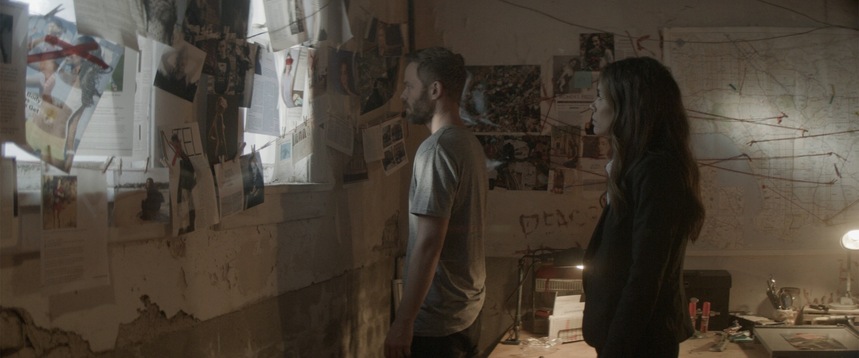
In “Darkness Falls,” Shawn Ashmore, playing a police detective, gets this crazy eye thing going when he’s trying to “think like they do” to figure out who murdered his wife, and made it look like a suicide.

Does he do that on TV’s “The Rookie?” Because man, it’s unnerving and it comes out of nowhere, a blast of “A Beautiful Mind” thrown into an early scene of a violent, grimly ridiculous serial killer thriller.

Considering we’ve seen Ashmore give away what he’s about to see in a moment when he’s supposed to be SHOCKED at finding his wife, bled out in the bathtub — while holding his sleepy little boy in his arms — the crazy eyes make a certain sense. He’s not got this whole acting/facial “indicators” thing worked out.

Yeah, that’s partly a direction problem. But Ashmore stands out as bad performing a script that was never going to be anything but awful, a dispiriting and ham-fisted psychological thriller with potential, and little else.

We’ve seen two armed strangers break in on the woman in the tub, the older man (Gary Cole) knowing her name and the name of her little boy asleep a few rooms away.

“Swallow these,” he orders her, giving her pills. As she dozes off in the tub of warm water, the razor comes out. It’s the perfect murder-disguised-as-suicide.

Detective Jeff Anderson (Ashmore) is eaten up with this loss, his lovely artist wife, mother of his child, taken. The little boy says “I dreamed a bad guy came into my room,” a clue unexplored. Jeff just KNOWS his wife didn’t kill herself.

He haunts every 10-56 (suicide) radio call in greater LA, “the suicide guy,” piling up departmental complaints which his captain and former partner (Daniella Alonso) tries to protect him from.

It’s been months. He needs to move on, get a homicide case that’ll take his mind off his loss.

“I AM working a homicide,” he growls.

And so he is, interviewing the first survivor of this string of suspicious suicides, palming off the kid on his mother (Lin Shaye), trying to “think like they do” to piece together the puzzle.

That mystery is just…daft. The confrontations with the villains (Richard Harmon is the co-killer)? Trite.

“Doesn’t it strike you how you and I are a lot alike?”

An interrogation that begins with “Tell me your story” and LITERALLY chases that line, seconds later, with “Why are you TELLING me all this?”

That is some seriously stupid writing, Giles Daoust. I guess “The Man Who Killed Hitler and then the Bigfoot” was inadequate writing prep for a police procedural.

French director Julien Seri (“Nightfare”) wasn’t going to save you, or the dude with the crazy eyes. “Darkness Falls” fails all up and down the line.

1star6

MPAA Rating: unrated, graphic violence, profanity

Cast: Shawn Ashmore, Daniella Alonso, Gary Cole, Richard Harmon and Lin Shaye

Credits: Directed by Julien Sire, script by Giles Daoust. A Vertical release.


Running time: 1:23

Posted in Reviews, previews, profiles and movie news | Comments Off on Movie Review: Serial killers call when “Darkness Falls”

Movie Review: Debating pregnancy, Down Syndrome and abortion with “The Surrogate”

surr1

Smart, educated and liberal New Yorkers debate morality “The Surrogate,” an indie drama that is almost all talk, and all of it good.

Jasmine Batchelor has the vibrant, idealistic and opinionated title role. Jess is an upper middle class 20something of independent means and independent thought, and a Columbia alumnus who just might correct your grammar if you dared call her “woke.”

Born into the upper middle class, a yoga-loving web designer and marketer for a non-profit, she is Buppy to her marrow.

“You’re describing every chick in Brooklyn.”

She is still keeping her life options open. She’s just shifted her boyfriend to “just friends” when we meet her. Doesn’t need the commitment.

Yet she’s agreed to be a surrogate for a gay couple, Josh (Chris Perfetti), whom she met when they were undergrads at Sarah Lawrence, and Aaron (Sullivan Jones). She’s not doing it for money. She supports their love and their commitment. It’s kind of an altruistic political statement, for her.

“They’re the new parents,” she over-shares with a waitress. “I’m just the…vessel!”

And then they get the prenatal test. She fetus has the extra chromosome that indicates Down Syndrome. Writer-director Jeremy Hersh’s movie is about the widening circle of debate about what they will decide to do about this.

That agonizing discussion is fascinating because of the pitfalls the movie avoids and what becomes obvious as Jess’s Achilles Heel. She is open and friendly, intelligent and curious. So she “works the problem” by finding a community center where Down Syndrome children can play together and parents can bond.

She immerses herself in that world and insistently ingratiates herself with one parent, Bridget (Brooke Bloom) and her adorable son, Leon (Leon Addison Brown).

What’s more, she insists Aaron and Josh come along for these info-gathering, get acquainted with the available support system sessions.

“It would be great if we could hang out with Leon’s family…”

Jess does all this without noticing the looks the gay couple exchanged, the way the diagnosis devastates Josh, who knew a Down child growing up. She doesn’t pick up on “Having a kid with Down Syndrome…it requires a lot.”

She peppers Bridget with questions without seeing the exhaustion in her eyes, without hearing how difficult it is, even for people of means, to take on this responsibility.

Maybe she’s disconnected, not facing the fact that sure, she can afford to be all-in. She won’t have to raise the baby, toddler, tween, teen and adult who will be dependent on her parents or others her entire life.

So the news that the couple have discussed all the options and decided on terminating the pregnancy might come as a shock, although outwardly, she seems fine with that.

It’s just that she insists on deepening her ties to the community center, to Bridget and Leon. Is she “working” Josh and Aaron?

Hersh gives every single character in this a defensible point of view and lets each make his or her case. Parents get involved. Siblings.

His attention to milieu all but mocks affluent Manhattan liberalism, people wanting to make moral yet political decisions but petty enough to have bones to pick with that precious TV cook, “The Barefoot Contessa,” Ina Garten, with and evolutionary biologist, ethologist and atheist Richard Dawkins.

“He’s ALT right!”

No, he isn’t.

The tone ranges from testy to distraught, but always “adult” in the insistence on talking this out.

It can seem too talkative, at times. But Hersh never lets us or anybody else off the hook. This is a very real situation and an incredibly difficult decision if you take all the financial, physical, spiritual and ethical aspects.

And Batchelor makes us see, appreciate and feel every step in Jess’s deliberations, from reasoning and bargaining to defensive and shrill. It’s a marvelous turn in a very smart movie, and we can only hope there are roles just as challenging residing in her bright and bright-eyed future.

3stars2

MPAA Rating: unrated, profanity

Cast: Jasmine Batchelor, Chris Perfetti, Sullivan Jones, Brooke Bloom

Credits: Written and directed by Jeremy Hersh.  A Monument release.

Running time: 1:33

Posted in Reviews, previews, profiles and movie news | Comments Off on Movie Review: Debating pregnancy, Down Syndrome and abortion with “The Surrogate”

Documentary Review: Remembering an air base and the bomber crews who flew from there — “Return to Hardwick”


In World War II, “the BIG one,” as veterans of it used to remind us, no plain was more ungainly than “The Flying Boxcar,” the B-24 “Liberator” bomber.
They flew in Europe and in Asia and took part in some of the epic air raids of the war in Europe. And no bomber group flew more missions in B-24s than The 93rd Bombardment Group, part of the “Mighty” Eighth Air Force.
“Return to Hardwick” is a remembrance of that group, built on the memories of those veterans still living when filmmaker Michael Sellers started this documentary, and on their descendants.
That’s the fresh angle to this standard-issue “What did you do in the war?” doc, the children, grandchildren and other family members curious about “Where grandpa fought,” “How my uncle died,” “What Dad’s base when he was in the service looked like,” and even “How mom met dad.”

Hardwick was one of the scores of airbases dotting the English countryside, most of them long abandoned, but places that tie a lot of American servicemembers to the landmark event in their lives. Hardwick, near Norfolk in East Anglia, is mostly a potato farm, now. But some of its “Nissen” huts (similar to American Quonset huts) are still there. And there’s a museum. Veterans and their descendants come back there as part of European vacations, and the locals keep up the place as tribute to America’s involvement in the fight to save the world from fascism.
Using archival footage, still photos on base and family photos, letters and diary entries (read by “Band of Brothers” actor Michael Cudlitz) and interviews with survivors of the group’s missions, “Return to Harwick” is a filmed memorial to sacrifice, duty and men (and women) who signed up “for the adventure” of leaving the provinces, farms and small towns of America for Europe and its all-consuming conflict.
Less successfully, the film uses digital animation to recreate planes on the flight line, taxiing to the runway.But  the colorful names on the still photos of the planes — Hell’s Wench, Tupelo Lass, Bear Down — photos of the then-young men and one Red Cross woman who served there, take us back.
Summarizing the raids — Berlin, Ploesti — is more than just repeating the standard Army Air Force description of the “Second Front” the fleets of British and American bombers opened by bombing German military installations, manufacturing, mining, transportation and oil refining. The infamous Ploesti B-24 raid is dissected in some detail.
“What’s the gas load?” was the first thing crew members wanted to know before each mission. That told them how far they’d be flying.
A movie this narrow in focus has a hint of “We made this for the families/video sold at a museum” about it, which “Return to Hardwick: The 93rd Bombardment Group” never overcomes. If you’ve ever visited the Eighth Air Force Museum on I-95 in north Georgia, you recognize how memories of that war and those who fought it are fading, and that “enthusiasts” alone might keep the history alive, but aren’t exactly creating generations of new WWII AAF buffs. (I’ve been the lone visitor walking through there a couple of times.).

And no, it’s not likely the children seen here, dragged along for these family expeditions, will repeat the journey their parents insist they pass along as a family tradition.

But any as the last World War II veterans pass from the scene, and movies about that war become rarer and rarer, a documentary like this reminds us of “The Good War,” the sacrifices it took to fight it, but also the horizon-broadening adventure of it all for a generation of Americans who got their first taste of the big, wide world in khaki.

2half-star6

MPAA Rating: unrated, some profanity

Cast: Narrated by Michael Cutlitz.
Credits: Directed by Michael Sellers.

Running time: 1:13

Posted in Reviews, previews, profiles and movie news | Comments Off on Documentary Review: Remembering an air base and the bomber crews who flew from there — “Return to Hardwick”

Movie preview: Party on as “BILL & TED FACE THE MUSIC”

Posted in Reviews, previews, profiles and movie news | Comments Off on Movie preview: Party on as “BILL & TED FACE THE MUSIC”

Movie Preview: “YOU SHOULD HAVE LEFT” — Seyfried and Bacon and one haunted house

They have a little girl
Daddy did something he got away with. And the house Knows…

Posted in Reviews, previews, profiles and movie news | Comments Off on Movie Preview: “YOU SHOULD HAVE LEFT” — Seyfried and Bacon and one haunted house

Classic Film Review: German gender bending, the 1933 original “Viktor und Viktoria”

vic3

The 1982 Blake Edwards farce “Victor/Victoria” was a landmark in the mainstream cinema’s treatment of gay subject matter on the big screen, and a giddy, Oscar-winning blockbuster to boot.

Not remotely as daring as the French “La Cage aux Folles” (1978), it still did something no Hollywood film had managed to do before — draw millions of Americans into a movie where “gay” wasn’t a crime, a punchline or a mental illness.

So why not have a Pride Month revisit of that film’s 1930s antecedent, the “daring” 1933 German musical “Viktor und Viktoria,” a last blast of cross-dressing whimsy to escape Weimar Germany as the Nazis came to power?

“Viktor und Viktoria” doesn’t have the overt sexuality of the Hollywood film that came 50 years later. The words “gay” and “homosexual” are never used, no overtly gay character is so-identified. So there’s little of that dishy, swishy hilarity that the legendary Robert Preston brought to the Julie Andrews/James Garner film.

The music is different. Franz Doelle and Bruno Balz were replaced by Henry Mancini and Leslie Bricusse.

But “Viktor” is a giddy delight in its own right, with bouncy tunes including a Spanish number that later became “The Shady Dame from Seville” in Hollywood, as well as sight gags and slapstick reminiscent of the just-vanquished silent film era and delightful star turns by the leads.

It’s a landmark of Queer Cinema partly by reputation, but mainly because of its remakes. This 1933 film was remade in French in 1934 (“Georges et Georgette”) and English (“First a Girl”) in 1935.

Fifty years later, the world was “ready” for the definitive remake.

A young, down-on-her-luck light opera coloratura (Renate Müller) can’t land a job with her pleasant but thin voice. And a seriously hammy actor (Hermann Thimig) is having the same trouble, only he lies to keep up appearances.

The lie is exposed when Susanne and Viktor re-meet at the Automat (cheap self-serve lunch counters, the rage in the 1930s). And then she spies one of his publicity photos. It isn’t just Hamlet and William Tell that Viktor insists he’s famous for. He can camp it up in a dress, when the need arises.

In this streamlined comedy, we don’t see the “Eureka” moment and aren’t treated to the coaching and “makeover” that turns Susanne into “Viktor…IA.” The two just show up at the vaudeville theater, dodge prying eyes as she/he changes into costume.

And then, the grand debut, a clumsy, forgets-her-lines vamp through this moon-eyed song about going back to Spain, finding love in Madrid, and tumbling into the orchestra pit as she does.

Director Reinhold Schünzel turns this scene into a knock-about riot, with the campy Viktor sitting with the orchestra, coaching Susanne/Viktoria on the stage, grabbing and taking over instrument after instrument and conducting, getting the music up to the tempo that works for this number and this act.

After all, it’s HIS number and HIS act that she’s performing.

One hint of multi-octave showing-off and one Big Reveal (the wig comes off) later, Viktoria is a star, a sensation signed to tour “Romania, Turkey, Italy, England” all the “Berlitz” (language school) countries.

On the British stop on the tour, she does her number in English. But that’s when she falls in with German expats, including ladykiller Robert (Anton Walbrook of “49th Parallel” and “The Red Shoes”). Can she keep her secret, even as she’s falling in love?

Can Robert believe he’s smitten with a very pretty “young man?”

vic1

The script it basically an operetta, lines and lines of dialogue (not all of it) are sung, exposition delivered in recitative, sung “live” on set — “I can sing, I can laugh, I can dance. I’m lacking much in finance.”

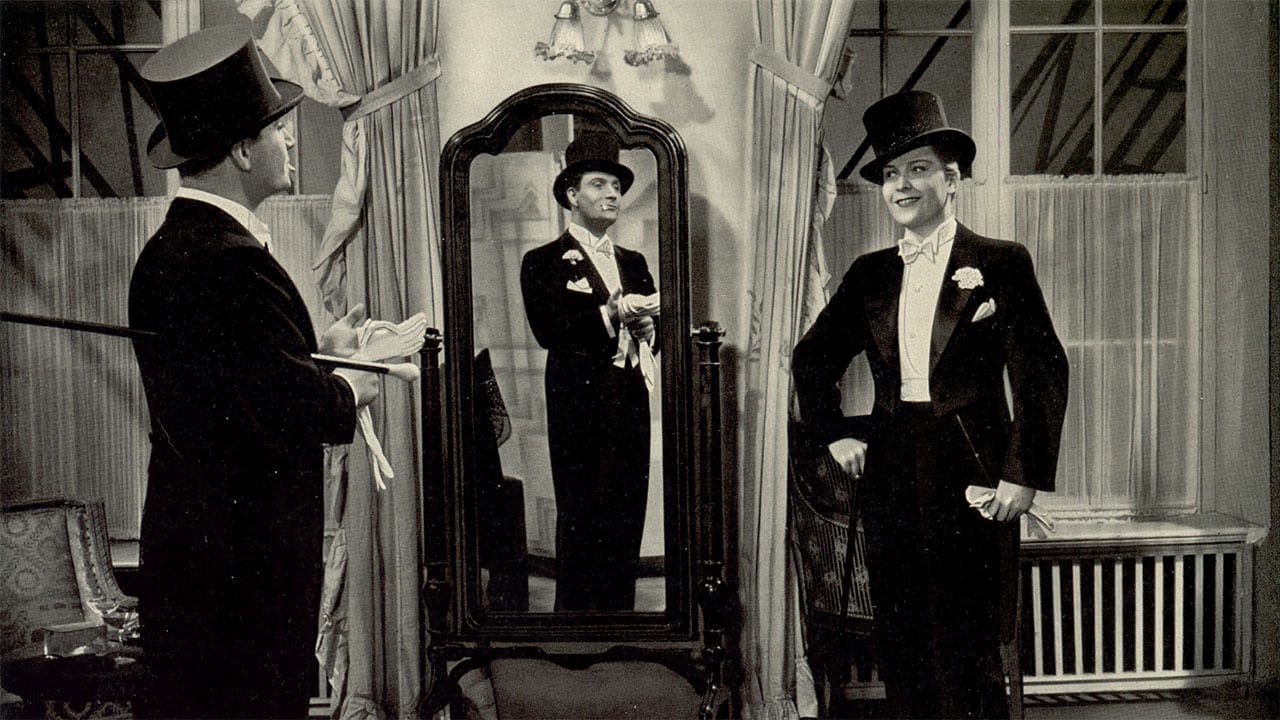
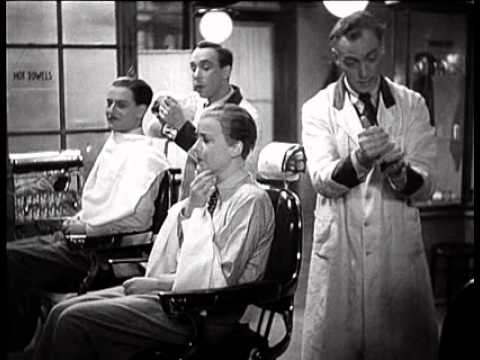
Müller and Walbrook are quite amusing in the “Let’s do things a couple of guys on the town do” scenes — smoking, drinking whiskey (Check out how Müller sidles onto a bar stool.), getting a shave at the barber’s and getting in a bar brawl at a waterfront dive.

The screenplay strips some of the sexual confusion Robert is feeling (much the way “Victor/Victoria” did) too early for this to really reach any sort of cutting edge treatment of sexuality.

Mastermind Viktor isn’t homosexual. He pines for another woman on the tour, who lusts after Viktor–IA.

But all the women ogling the quite-feminine Viktor–IA in the bar (inspiring the riot), the gender embarrassment the act creates in the audience, get the message across. This isn’t “Cabaret,” but for a lark of a cross-dressing musical, it’s an eye opener.

And go to the biographical links of the star and her director to learn the costs of questioning gender roles and mores and speaking out through the arts in a fascist regime.

The restored “Viktor und Viktoria” returns, via virtual cinema (visit your local arthouse cinema website) for Pride Month. If you liked the Julie Andrews version, you’ll get a kick out of this.

3stars2

MPAA Rating: unrated

Cast: Renate Müller, Hermann Thimig, Hilde Hildebrand, Friedel Pisetta and Anton Walbrook

Credits: Written and directed by Reinhold Schünzel, music by Franz Doelle, lyrics by Bruno Balz. A Kino Classics “virtual cinema” re-release.

Running time: 1:39

Posted in Reviews, previews, profiles and movie news | Comments Off on Classic Film Review: German gender bending, the 1933 original “Viktor und Viktoria”