I am posting this as I wait for a second weekend showing of “The New Mutants,” at a favorite cut price local cinema that reopened Friday.
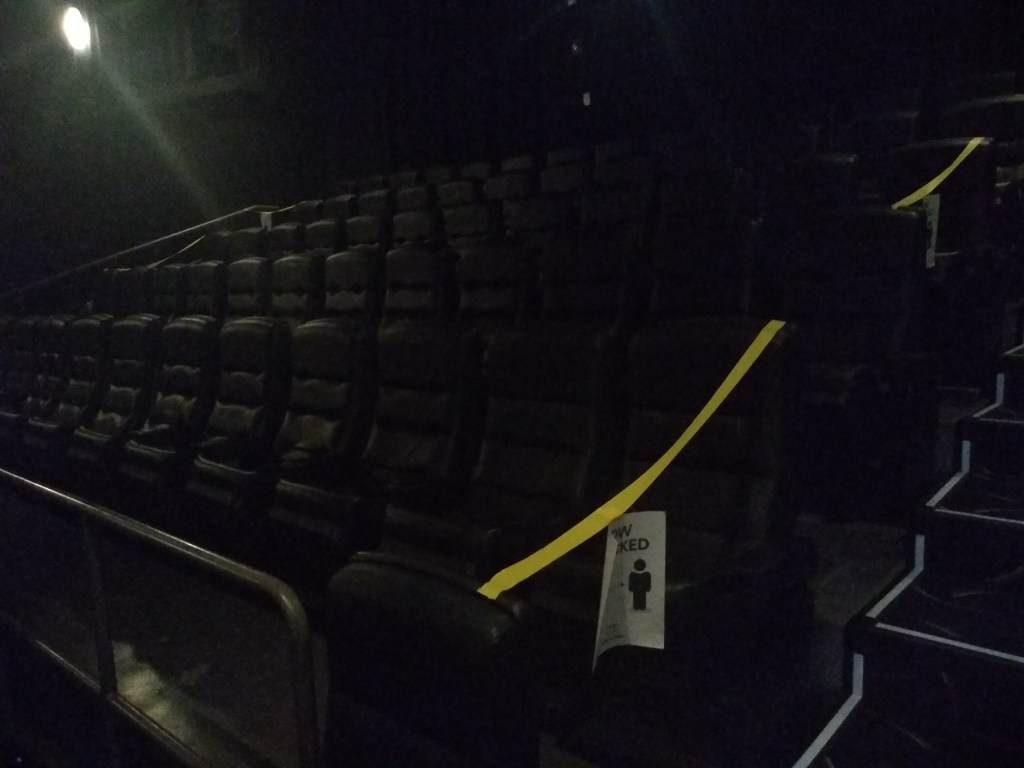
The taped-off sections of the AMC Classic 12 in New Smyrna Beach are illustrative of the hill Warner Brothers had to climb with Christopher Nolan’s $200 million blockbuster.
“Tenet” is on 2800 screens, but with those theaters at 40% capacity, a two and half hour long movie limiting showings beyond the shorter hours theaters are open after schools reopen, a $7000 or so per screen average was the best they could hope for. To reach $20 million for the “weekend” they had to open before the weekend and count LAST weekend’s Canadian opening.
No tears for Warner Brothers, though. Remember, the rest of the world has had much more competent virus response, fewer anti maskers. Globally, “Tenet” is at $146 million, a whopping $30 million of that from China.
Disney had a steaming service they could park “Mulan” on. It did about $6 million or so overseas. China will make it sink or swim. That’s where it opens next weekend.
“New Mutants” added screens and lost audience share, @ 60% down from last weekend. $2.8 million.
“Unhinged” still owns the drive in trade, another $1.6 million+.
Nobody is coming to “David Copperfield,” discriminating fans not wanting to risk going to even a nearly empty theater. $361,000 U.S.
Posted inReviews, previews, profiles and movie news|Comments Off on BOX OFFICE: “Tenet” manages a $20M Labor Day opening, “Mutants” die, “Mulan” made money in theaters…overseas
“The Lost Okoroshi” is a shambolic satiric fantasy from Nigeria that never quite finds the laughs it’s looking for or hits the targets of its satire.
It starts with promise and parks its heroic anti-hero in many a time-proven set-up. Director and co-writer Abba Makaba didn’t have the biggest budget, and the simple costumes and African production design are somewhat undone by sloppy, slow-footed editing.
It never quite scores, always a joke without a punchline, a lecture without much in the line of a point.
Raymond (Seun Ajayi) is a Lagos security guard haunted by nightmares. He dreams he’s being chased by spirits, costumed “masquerades” who seem to be calling to him to remember the old ways. He dreams of leaving the city with his wife (Judith Audu) and getting a farm because “our ancestors knew the good life.”
His friend, his displaced-in-the-city “Chief” (Chiwetalu Agu) shares that lament. He’s got a leg injury that won’t heal, because, he says, the herbs used in the country lose their potency in the city and he won’t go to “the white man’s hospital” or any place where Western medicine is practiced.
That doesn’t work out of the chief. Seeing his ghost in his dreams makes Raymond take stock of the Chief’s advice, to “embrace” the purple spirit Okoroshi who is chasing him. He is “a spirit who brings good luck” to those of good will, and “bad luck to the wicked.”
Raymond’s bad luck is to wake up the next day, masked and robed as Okoroshi, unable to shed the “costume,” only able to communicate with growls.
This is where the satire kicks in. The “masquerade” scares everybody — at first. But then he just becomes a part of the scene, dancing in the marketplace, pursued by a youngster with an eye on making a buck out of this “entertainer.”
Okoroshi foils Raymond’s boss’s attempt to choke out a sassy hooker (Ifu Ennada), stops wrongdoers in the act, and comes to the attention of a folk legend-loving psychotherapist (Tope Tedela) and under the influence of the Pythonesque Igbo People’s Secret Society of Heritage Restoration and Reclamation.
The IPSSHRR, “IPshurrrrr,” they call themselves, bicker over how to exploit this piece of folklore come to life, who has custody of Okoroshi, etc.
That, alas, is the only truly funny sequence in “The Lost Okoroshi.” The transition from Raymond to Okoroshi is blase, save for his wife’s search for help (flagging down a taxi proves tricky). The repetitive nightmare scenes (literally repeated footage, from the looks of it), cute dancing bits and the hooker dragging him to a nightclub all fall flat.
The “doctor” is acting in a horror movie, from the looks of him.
The performances are broad enough to be funny, but the editing allows funny bits and funny lines to just lie there, withering in the Nigerian sun.
Cheesy synthesizer music underscores too much of a film that plays better when African drumming, singing or what have you provides the music.
The blend of cutesie and coarse isn’t so much a flaw as another place where Makama doesn’t get the most out of sexual jokes. A whipping with a switch is all a guy who just tried to choke a sex worker to death earns for punishment? Aside from having Okoroshi in his nightmares?
And the ending is a downer out of tune with the movie that came before it.
The conceit, that go-go Nigerians are longing to recapture some of the folkways of “the ancestors” in between playing Nigerian princes on Internet scams, has promise. Nollywood should be able to produce something just as surreal, but more polished and potent than this.
“The Lost Okoroshi” doesn’t deliver the laughs or the social commentary to fully come off.
MPAA Rating: TV-MA, sex, profanity
Cast: Seun Ajayi, Judith Audu, Tope Tedela, Chiwetalu Agu
Credits: Directed by Abba Makama, script by Abba Makama, Africa Ukoh. A Netflix release.
We’ve seen so many variations on that “stalked on the highway” plot that it’s rare that one punches through and makes itself stand out.
The pulse-pounding third act of “Alone” puts it right up there with “Breakdown,” if not quite in realm of “Duel,” still the undisputed masterpiece of the genre.
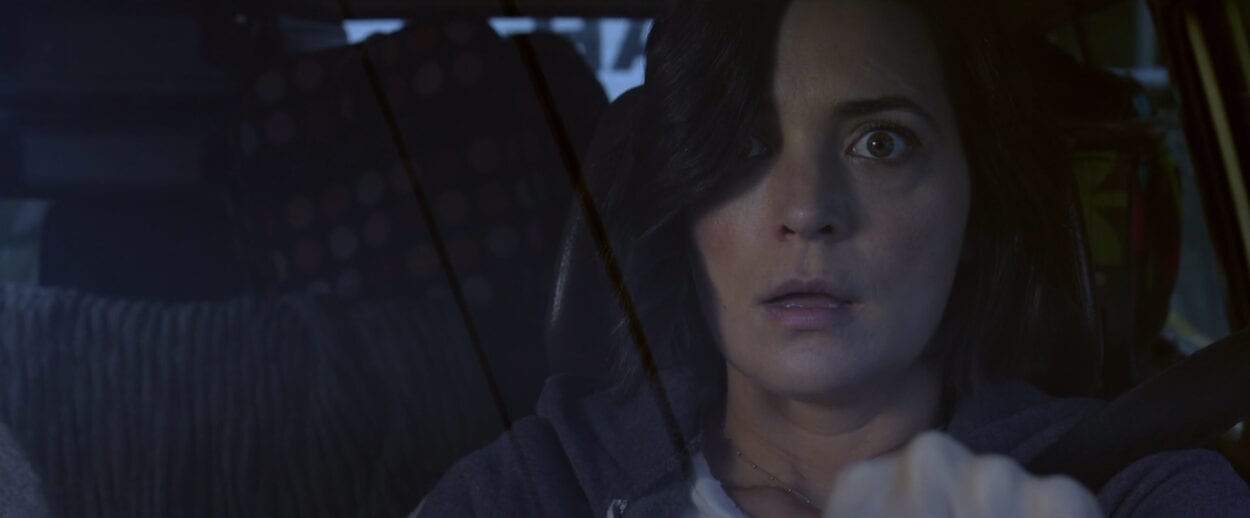
And Jules Willcox, its star and motorist-in-distress, gives a performance of fear, injury, fury and rage that totally sells this.
She plays Jessica, a woman fleeing the big city in her Volvo wagon, U-Haul trailer tucked in behind. She didn’t even tell her parents she was leaving.
We don’t find out, right away, what she’s leaving behind. And we don’t really know where she’s going. But you know if it’s a highway stalker thriller she won’t be taking the Interstate.
Jessica does almost everything right. The jerk going one-third the speed limit on the mountain road she was on didn’t like being passed, and endangers her life. She doesn’t forget, even as he turns his Grand Cherokee onto another route.
Of course he (Marc Menchaca) tracks her down again. But she won’t open her window to accept an apology she and we know is insincere. Still, she talks to him. Her only mistake.
“Scared you a little bit…Where you going? You have a name?”
She moves on from this second encounter, and later, when he expects her to stop as he feigns a breakdown (with his arm in a sling), she’s not buying that either. But eventually, he gets the drop on her.
Volvo’s get lousy mileage, kids. And every time you stop for a smoke could be your last.
Assaulted, kidnapped and barefoot, Jessica can’t plead her way out.
“You can let me go. I won’t tell anybody.”
“You think you’re the first one to say that?”
She’ll have to use her wits and her inner resolve to escape this brute.
B-movie and TV director John Hyams keeps the film on its feet, makes great use of what look to be Canadian north woods locations and keeps the camera tight on Willcox (TV’s “Bloodline”), who finds her inner Carrie-Anne Moss with this ferocious turn. We root for her and fear for her and cling to the hope that every injury, every wrong done her will be repaid in blood and rage.
The Mattias Olsson script portentously titles chapters “The Road,” “The River,” etc. And he falls into the “talks too much villain” trap, filling the soundtrack with bad guy claptrap.
“You know what I can’t stand? COWARDS!”
But “Alone” still takes a simple premise and smacks us around with it for 95 reasonably suspenseful, thrilling minutes. And that’s enough.
MPAA Rating: unrated, graphic violence
Cast: Jules Willcox, Marc Menchaca, Anthony Heald
Credits: Directed by John Hyams, script by Mattias Olsson. A Magnet release.
She’s a med student, or studying physics or gerontology, a poet or a painter, a film critic or a waitress.
And she lives in her head, narrating everything about this uncomfortable mid-winter road trip with her boyfriend of six weeks.
“What’s the point of going on like this?” she (Jessie Buckley) wonders. “It’s not going anywhere.”
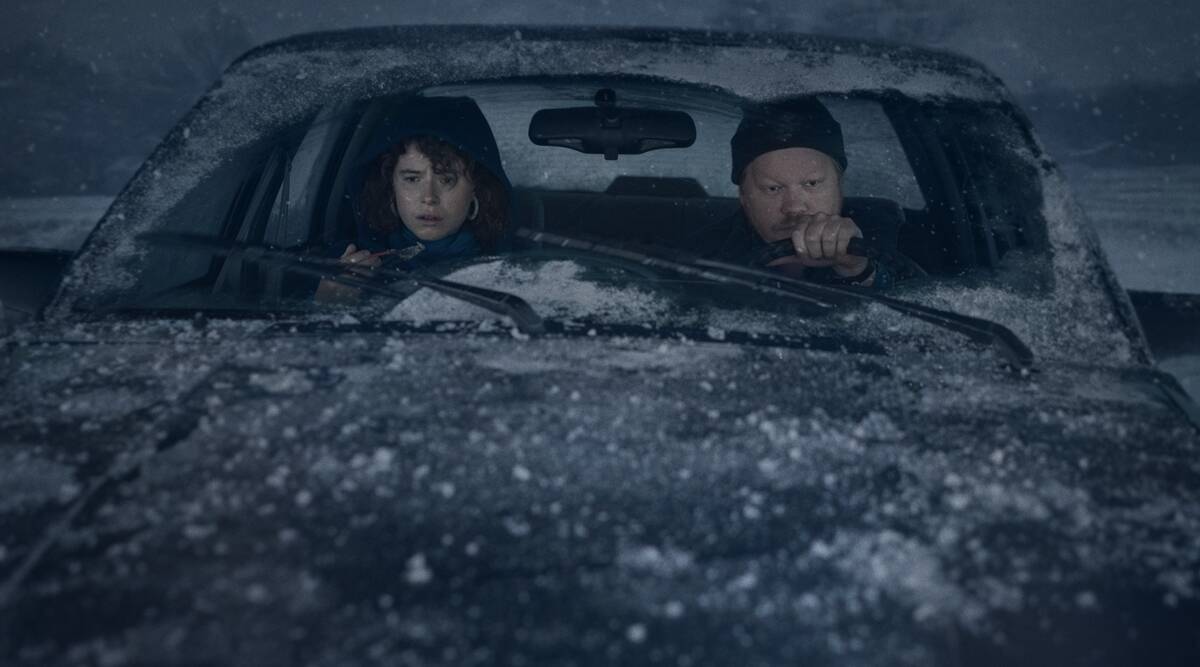
“I’m Thinking of Ending Things,” she says, but only in her head, and not to the guy driving through a near-blizzard for her to visit his parents.
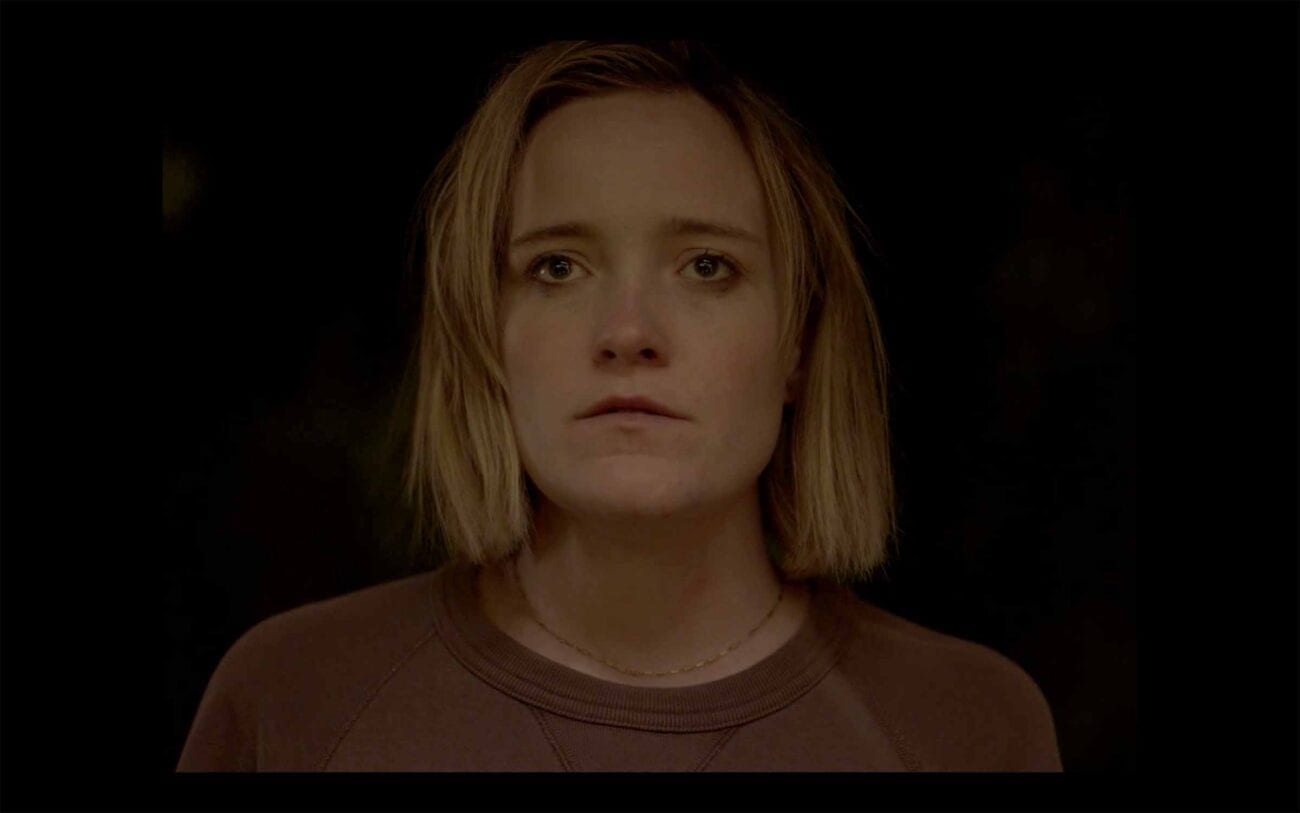
Yes, “Jake” (Jesse Plemons) is smart, “educated,” perhaps a physicist himself, maybe a painter — if you believe his brittle, smiling-through-the-misery mother (Toni Collette). But every time Jake opens his lips, monotonously mouthing arid banalities or pretentiously quoting Wordsworth or Emerson or David Foster Wallace, she dies a little.
God knows the viewer certainly does.
Charlie “Adaptation” Kaufman’s take on Iain Reid’s novel is cryptic, creepy and clever enough. It’s about loneliness and the risks entailed in ending it, maybe the risks one takes by doing nothing. And Kaufman uses age makeup, dance, unexplained interludes, animation and “Oklahoma!” the musical to make his points and send viewers online searching for answers to his “mystery.”
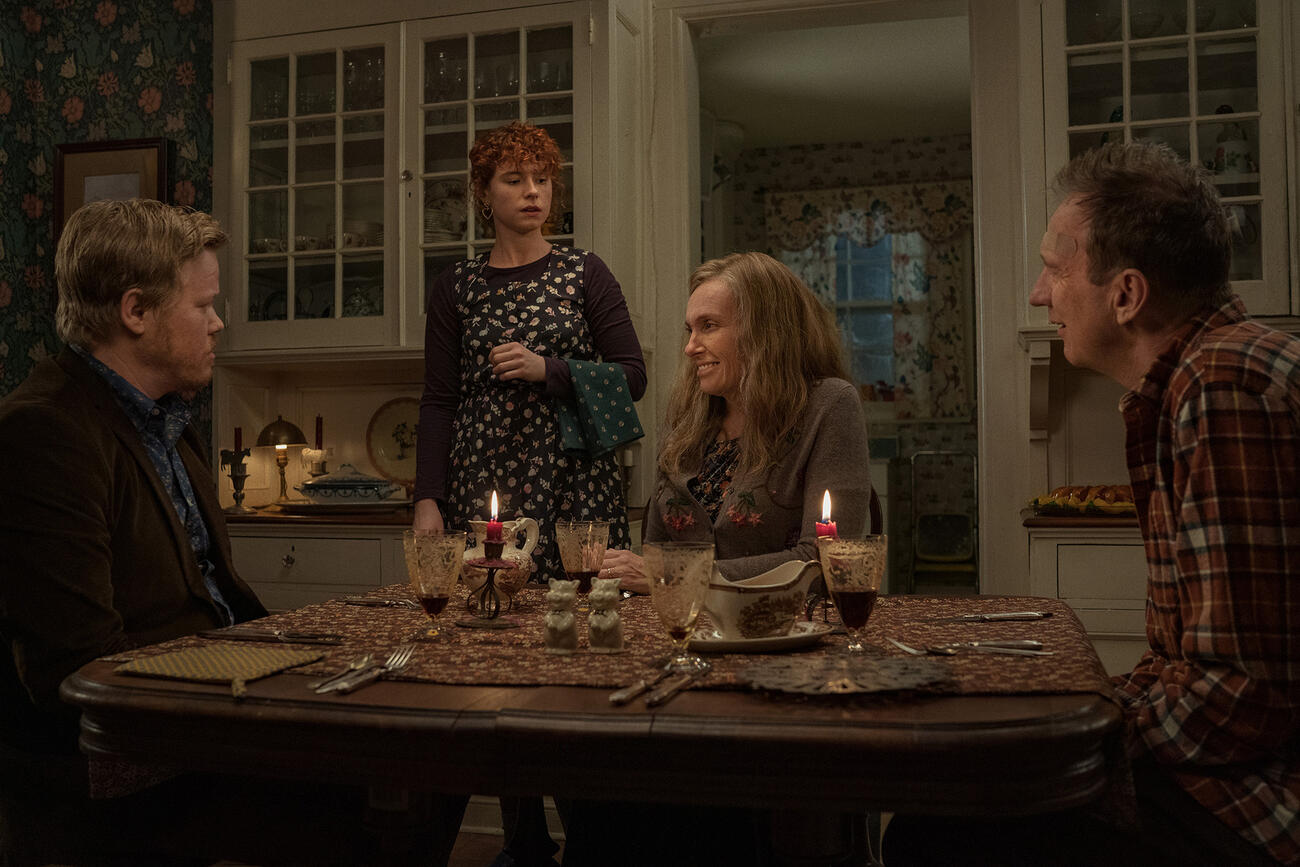
“The Young Woman” experiences an afternoon and evening driving far into the country to visit those farm parents (Collette and David Thewlis), react to their son’s indulgence of their eccentricities, and witness the ugly flashes of temper they bring out in him.
Mom tries so hard — too hard — “I am SOOoooo glad Jake found someone!”
Dad is a sometimes foul-mouthed curmudgeon, excusing the disastrous state of the livestock the same way he taught Jake to sugar-coat it.
“Life can be difficult on a farm.”
Through the uncomfortable drive there, the visit and the trip back home, the young woman is subjected to a troubling, argument-pierced meal, hallucinatory changes in her hosts –aging one moment, turning up younger the next — and the growing feeling that she’s ridden here with a “creeper” who won’t take her “Take me home” pleas seriously.
She seems like an unreliable narrator, or is she meant to be the narrator at all? All that voice-over (constantly interrupted by Jake attempting to make conversation), and yet, is this really her story?
Maybe it’s really about socially-awkward Jake, the gloomy idealist who believes “There’s someone for everyone.”
And then there’s the “janitor” (Guy Boyd) we see from time to time, cleaning a school, watching a crappy romance “Directed by Robert Zemeckis” on his lunch break.
To say nothing of the ending of “Ending Things,” which many an online or podcasting wag is interpreting, mainly by referring back to Reid’s source novel.
A telling moment — Jake badgers “Lucy/Louise” into reciting her new poem, “Coming home is hard” even with “a wife of a wife-shaped loneliness” waiting for you there. Hard to get happy, or optimistic, after that one. The title isn’t just talking about ending a relationship, is it?
The forlorn landscape (barely glimpsed), the menacing isolation of a blizzard on a country road late at night, the “boyfriend” who takes a shot at singing “Baby It’s Cold Outside…”
“You’re quoting a RAPE song to me?”
It all feeds into the overwhelming melancholy of the piece, where marriage and relationships, farms and farm food and farm families and the cozy comforts of “Oklahoma!” (including a rarely heard “trunk song” cut from the show) are upended and our unheroic heroine puzzles over just what life and “love” are all about, and if the risks one takes by diving in are worth it.
Plemons taps into deep reservoirs of charmless sadness as Jake. And he sings.
The Irish Buckley (“Wild Rose,” “Doolittle”) makes a fine surrogate for the viewer and tour-guide through the mind of Reid as interpreted by Kaufman. And if “The Young Woman” seems more perplexed than alarmed or depressed, that’s by design, too.
There’s none of the wistful romanticism and dark whimsy of “Eternal Sunshine of the Spotless Mind,” but plenty of the deranged storytelling of “Being John Malkovich” and “Adaptation” — minus the giddy playfulness Kaufman worked into those scripts.
You’ve got to be in the right frame of mind for “I’m Thinking of Ending Things,” which can be as much a downer and a chore as “Anomalisa” or “Synechdoche, New York.” In the end, it’s a morose puzzle of a tale that one can appreciate, even if you don’t mind if you never see it again.
MPAA Rating: R for language including some sexual references
Cast: Jessie Buckley, Jesse Plemons Toni Collette, David Thewlis, Guy Boyd and the voice of Oliver Platt.
Credits: Written and directed by Charlie Kaufman, based on the novel by Iain Reid. A Netflix release.
Christopher Nolan’s expected summer blockbuster has been delayed, repeatedly, all summer long thanks to the ongoing pandemic.
Even opening it Labor Day seems like a huge gamble, considering its $225 million budget. With 2800 screens showing it, all of them at 25-50% maximum allowed capacity, and much of the country understandably reluctant to sit for two and a half hours in a mask full of other customers who might not be as healthy or careful as they are, well…
But it’s not Christopher Nolan’s best film, John David Washington is still more “Denzel’s kid” than name-brand movie star, and Robert Pattinson, “The Batman” who has tested positive for COVID himself, aren’t the draw here.
I figure $20 million over three days might be the ceiling, based on the one or two arms this picture has tied behind its back. Theater hours are shorter, fewer shows per day, and the movie’s 2.5 hours long and they can’t sell all the tickets.
But Nolan’s devotees could give that record a run for its money. A $10,000 per screen average for three days would get it close to the record. We’ll know Sunday.
Will “Mulan” draw more subscribers to Disney+, where that potential summer blockbuster landed? I don’t know about that, either. It doesn’t have the same “not regular Disney customers” noise that “Hamilton” did. But it could goose the Mouse’s bottom line. Considering its $200 million budget, a lot of subscriptions, and many a $29.99 “stream it first” bonus payment will have to be made for it to go into the black.
What an odd duck of a kids’ comedy “H is for Happiness” is.
This Aussie confection tests one’s patience and foils attempts at interpretation. It takes forever to get going, and tends to balance every potentially giddy moment with a glum and depressing one.
Annoying, omnipresent voice-over narration grates on the nerves, a grieving, broken family resists every “cute” break from their grief and bitterness, and all the sight gags and attempts at jokes are sprinkled in to break the mood.
A teacher with a wacky lazy eye, and her martinet of a “relief teacher” (substitute) are juvenile plot devices, but hilarious.
“Do NOT mistake me for a human being!”
And then there’s the boy who hand-crafts what he figures (with some prompting) every twelve year-old girl wants for her 13th birthday — beach-ball inflatable artificial breasts.
It’s “Bridge to Terabithia” dark with a Down Under accent, and with so many whimsical touches that we figure that the filmmakers were hoping for a comedy, even if they settled for “just occasionally charming.”
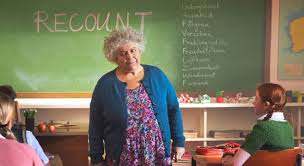
Daisy Axon is our heroine, an over-eager teacher’s pet named Candice Phee. We meet her as her teacher-with-the-lazy-eye (Miriam Margolyes) is charging her class with taking an assigned letter of the alphabet and turning it into an autobiographical essay to be performed at “Open Day” (Parents’ Day) assembly.
“A is for ‘assignment,'” freckled, pony-tailed Candice narrates, redundantly. But maybe she can do something with it that will fix her family.
“Everyone is miserable,” she admits. And when we meet her Mom (Emma Booth), still drowning in grief over Candice’s three-years-dead baby sister, we get it. Dad (Richard Roxburgh) has checked-out, too. He’s lost in grinding work, sad but also bitter that “Rich Uncle Brian” (Joel Jackson), his brother, cheated him when the tech company they co-owned sold.
“C is for ‘court case.'”
Bubbly chatterbox Candice isn’t popular at school. The queen mean girl (Alessandra Tognini) has nicknamed her “SN,” “special needs.”
Even school newcomer and new friend Douglas (Wesley Patten) wonders about her, telling his Mom (Deborah Mailman) something that makes her ask, “You are autistic, aren’t you?”
No. But when always address your uncle as “Rich Uncle Brian,” and Douglas as “Douglas Benson from Another Dimension,” you can see how people might be confused.
That last one, though, is all on Douglas. He’s sure that a fall from a tree sent him into another dimension, with a stand-in mother, the works. He’s all about solving this “multiverse” dilemma.
How will Candice mend her broken family, heal the rift between her dad and his brother, make Douglas want to stay in this dimension and deliver the perfect “Open Day” presentation as her crowning achievement?
How will Douglas’s inflatable boobs “gift” figure into all that?
Veteran children’s TV writer Lisa Hoppe scripted this, and first-time feature director (and Aussie TV vet) John Sheedy never quite gets a handle on the myriad moods and shifting tones this tale entails.
Hurling a relentlessly upbeat and enterprising tween at depression and grief, bitterness and loneliness is a tough sell.
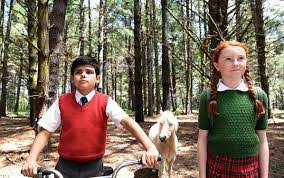
The whimsy feels forced and random. There’s a pony in the forest where Candice and Douglas Benson from Another Dimension wander and debate multiverses, and a cross-dressing costume-and-party shop proprietor turns up.
Cute. And?
That pretty much goes for the whole movie. “H is for Happiness” prioritizes “”feels” over coherence, weird-for-weird’s-sake touches over character development, while expecting endless voice-over narration to caulk over the cracks.
It doesn’t.
MPAA Rating: unrated, childhood trauma, an accident, scatological humor
Cast: Daisy Axon, Miriam Margolyes, Emma Booth, Wesley Patten, Joel Jackson, Deborah Mailman Richard Roxburgh and Alessandra Tognini.
Credits: Directed by John Sheedy, script by Lisa Hoppe. A Samuel Goldwyn release.
Mississippi-born filmmaker Jaclyn Bethany tells a story of love, madness and betrayal in “Indigo Valley,” adapted from her short film of the same title.
The original film was set and shot in Iceland. The feature-length version, alas, is not.
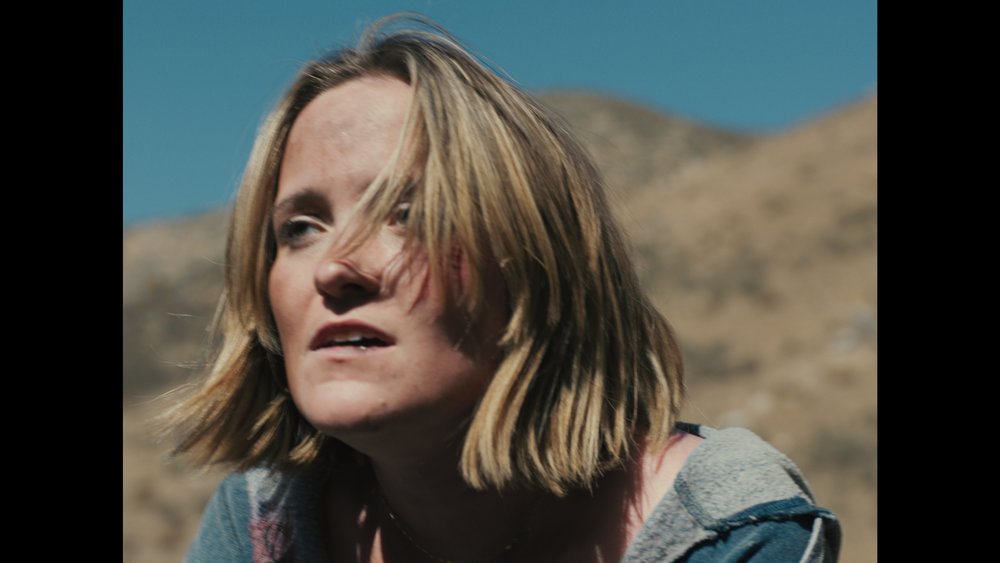
Bethany starred in both films as well, and uses the feature film to give herself many, many more brooding closeups capturing the mania her character — apparently a former child actress — lives with.
Closeups reveal many things; like an actress who telegraphs her gestures, so mannered in that every sense-dulling second, with every glower in a mirror, every theatrical splashing of water in her face, every over-considered, halting line reading, an inescapable truth faces her and anybody sitting through the 75 minutes of “Indigo Valley.”
She’s a bad actress.
And all that screen time she gives herself, all those close-ups? It’s all for tone and does nothing in terms of telling or advancing the paper-thin story.
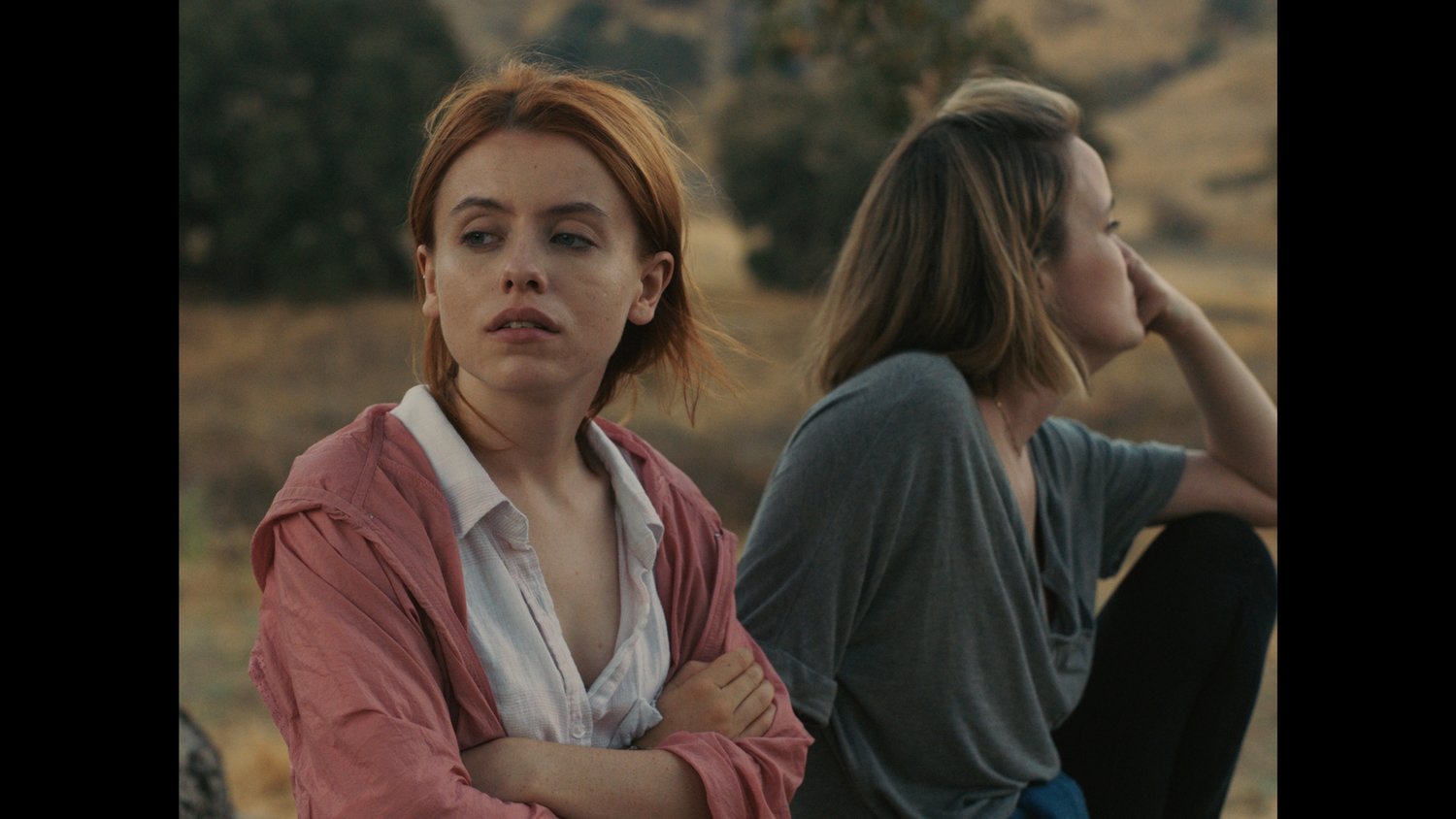
Impulsive, sad Isabella (Bethany) is just the person you want to check out of rehab and take with you on your honeymoon to a dude ranch out West. That’s what her estranged sister Louise (British actress Rosie Day of “Outlander”) does, with the blessing of her new husband, John (Brandon Sklenar of “Mapplethorpe” and recently, “The Big Ugly”).
Isabella fumes and tries to push the sister propping her up away. She picks up an employee of the ranch. She has a lot of flashbacks, as do Louise and John. We see how the painter Louise met the violinist John. And we see Isabella’s troubled connection to their early days together. She is obsessed with…somebody.
Isabella, as a character, is damaged, dazed and frankly dull. The lack of conversation in the film masks this only so much. Montages of her pink-haired youth — whispered madness or mournful pop underscoring them — don’t further illuminate the character, or explain her supposed appeal, sexual or otherwise.
“Life is made up of these kinds of moments,” she intones, at her most profound. “Sometimes we don’t understand them. Sometimes we do.”
Damn. I’m hustling across the bar to meet up with this Algonquin Roundtable conversationalist. Yes, the delivery of that line is as flat as the line itself.
There’s the germ of an idea here, about a short film’s worth. A full-length feature only exposes a sea of shortcomings. This is a “vanity project” in the worst sense of the phrase.
Cast: Jaclyn Bethany, Rosie Day, Brandon Sklenar
Credits: Written and directed by Jaclyn Bethany. A Giant Pictures release.
“Wan” and “bloodless” are the first words to leap to mind about this online dating/lawsuit-over-online-dating romantic comedy.
“Love Guaranteed” starts out on life support and never comes out of the coma.
It’s a creaking and sentimental followup by the screenwriters who gave us “Falling Inn Love,” and a star-vehicle for Rachel Leigh Cook, who broke into films with “She’s All That” in the last millennium.
A few promising gimmicks, a wilted one-liner or two, an easy rapport that never quite achieves “chemistry” between the leads, Cook and Damon Wayans, Jr., and a well-cast villain are what it has to offer.
Nothing funny or particularly charming is made out of any of those ingredients.
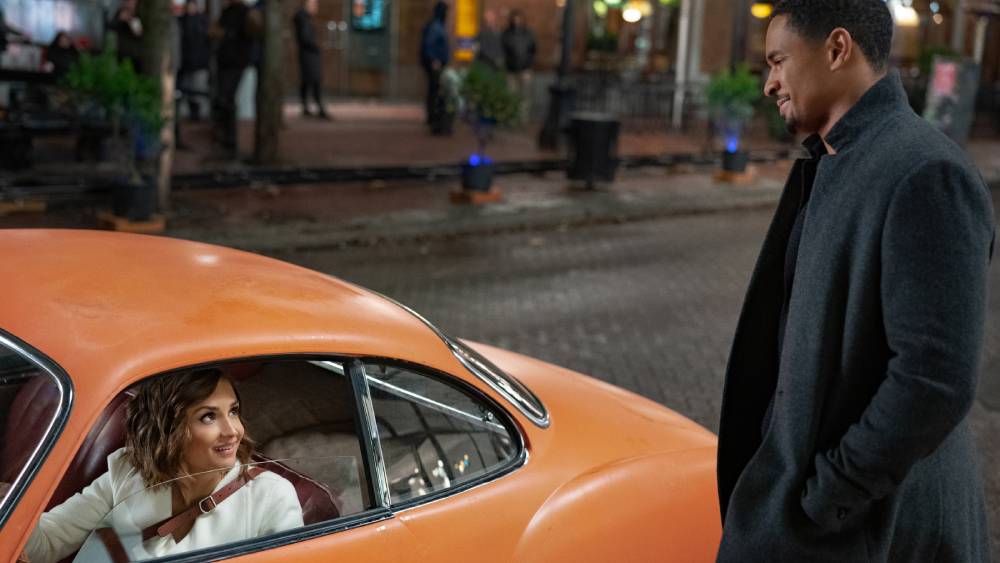
Cook is a crusading and struggling Seattle “civil litigator,” plucky but a little slow to figure out “sticking up for the little guy” isn’t all that lucrative when you’re not a megafirm of “ambulance chasers.” She drives a salmon-and-rust colored Karmann Ghia and her staff is always job hunting. Broke.
Wayans is Nick, the client who could change that. He’s been spending good money on this dating site, Love Guaranteed. He’s gone on 986 dates, spent money on decent restaurants for breakfasts, lunches and dinners. “Love” may be “Guaranteed,” but it hasn’t worked out for him.
Let’s sue!
Nick comes off as an “obnoxious, gross…shameless opportunist.” But hey, Mama’s Karmann needs work. Pay the bills.
The cleverest conceit here is how Nick, “dating in bulk,” names those dates “like ‘Friends’ episodes.”
“The One Who Talked About Cats,” “The One Who Brought her Parents” and “The One Who Got Drunk and Tried to Fight the Bus Boy” weren’t winners. Love Guaranteed, part of the “lifestyle empire” of influencer Tamara Taylor, has “guaranteed” right in its name. Slam dunk lawsuit, right? And Heather Graham plays Tamara. She’s sure to bring laughs, right?
Cook comes off as game but out of new ideas for how to make “plucky” and “idealistic” and “lonely” fresh.
Wayans has been cruising along on the famous name for a decade and has yet to make any sort of impression on the screen. Inoffensively bland, “safe,” and not able to land a punchline have become his screen persona.
Only Graham has the chance to cut loose, let her “spiritual seeker” Buddha-misquoting Bethenny Frankel-wannabe stick and jab. It’s the most colorful character here, and there’s not enough on the page for her to play.
It turns out “Love” isn’t “Guaranteed,” any more than laughs, relatable characters or anything else.
MPAA Rating: TV-PG
Cast: Rachel Leigh Cook, Damon Wayans, Jr., Heather Graham
Credits: Mark Steven Johnson, script by Elizabeth Hackett, Hilary Galanoy. A Netflix release.
It will be hard to top Rose Byrne’s canny, sexy take on the feminist icon Gloria Steinem, one of the standout performances in Hulu’s “Mrs America” series this past spring.
Alicia Vikander and Julianne Moore, and two younger actresses will take a shot in Julie Taymor’s “The Glorias” bio pic, coming to theaters and streaming on Sept. 30.
Janelle Monae and Timothy Hutton also star.
Bette Middler as Bella Abzug? On. The Nose. Not a pun, either.











 Movie Nation