
A serious film featuring teen siren Joey King? “Radium Girls” is about an infamous pre OSHA factory poisoning where workers were exposed to the stuff that made watches glow in the dark.
Good that this finally has a release date. Oct.23.
A serious film featuring teen siren Joey King? “Radium Girls” is about an infamous pre OSHA factory poisoning where workers were exposed to the stuff that made watches glow in the dark.
Good that this finally has a release date. Oct.23.
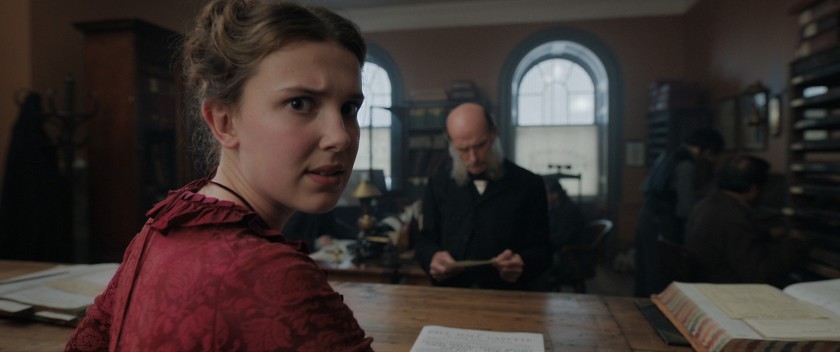
Tip of the hat to Netflix, for indulging the first star the streaming service has actually created with this bon bon of a showcase.
Millie Bobby Brown is the age of the character she’s playing, “Enola Holmes,” aka Sherlock Holmes’ plucky much-younger sister — 16. And the poise she demonstrates in every scene, the confidence in every British-accented line, lets her hold her own with the likes of Helena Bonham Carter, Henry Cavill, Fiona Shaw and Frances de la Tour.
She may be playing a self-conscious screen heroine — she turns to the camera as narrator, time and again, and does everything but wink at it. But we see the “Stranger Things” star invent in scenes, add bits of “business” to her performance.
She’s not just a producer of her own star vehicle. She’s figured out how to make a character larger than life, the little dickens.
The tomboyish Enola has to climb up through a trap door. Brown opens it with her head, because of course “Enola” would.
The movie? It’s a dizzy delight, a trifle long, some obvious sentimental bits — violent, here and there. But fun, start to finish.
Enola’s grown up all but estranged from her much older brothers, famous sleuth Sherlock and prissy bureaucrat Mycroft (Henry Cavill and Sam Claflin, both on-the-mark). Their feminist widowed mother (Helena Bonham Carter, still a spitfire) raised Enola to be smart, tough, intrepid and independent.
That comes in handy, because one day, mysterious Mum ups and disappears. Enola, “that’s ‘alone,’ spelled backwards,” wants to find her. Damned shame Mycroft insists she go to a finishing school (Fiona Shaw is the cruel headmistress). Sherlock? He’ll look into their missing mother. In. Good. Time.
Enola, who “knows nothing of the world,” must go out into Britain on the cusp of the 20th century and track down her mother and figure out what she’s up to.
She stumbles into the mop-topped young Viscount Tewskebury, Marquess of Basilwether (Louis Partridge), on the run from his family, his House of Lords future, and — as it turns out, a murderer (Burn Gorman, a Great Brit Villain).
“The game’s afoot!”
Just enough improbable-to-highly-improbable escapes, fights-to-the-death and derring do ensues, a tale of anagram clues and jiu jitsu, political “reform” and women’s suffrage and a whole lot of our heroine turning to the camera with “Bear with me” asides and the occasional “a-HA” look.
“The corsette,” she lectures, changing disguises, “a symbol of repression.” But one does what one “needs must.” Quite.
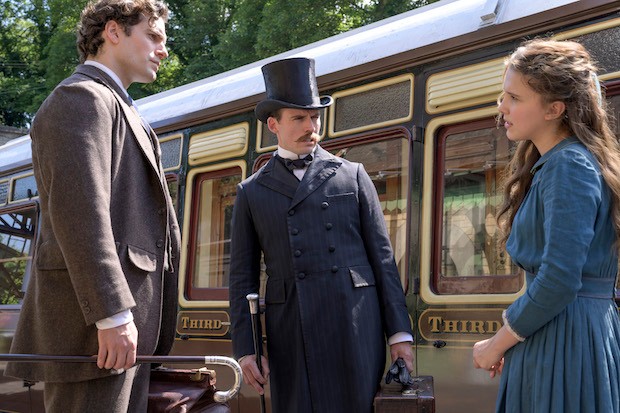
Director Harry Bradbeer (“Fleabag,” “The Hour”) shows off the period detail in this adaptation of Nancy Springer’s novel — late Victorian England, complete with three-wheeled “motorcars.” And he generally keeps the film and his heroine on their feet. The energy only flags in the third act, that business of tidying up every loose end.
Carter — seen in “inspire/teach the heroine” flashbacks — sparkles. Gorman always gives fair value and the chiseled Cavill suggests a much more reserved and internal Sherlock (can’t have him outshining Enola) than we’re used to seeing. Inscrutable.
“Sometimes, you must dangle your feet in the water to attract the sharks.”
But Brown is the marvel-in-motion who powers this machine. She lets this showcase make the case for a post-child-actress career, showing off pluck, comfort with stunts and something her chilly TV series rarely allows her — charm.

MPAA Rating: PG-13 for some violence.
Cast: Millie Bobby Brown, Henry Cavill, Helena Bonham Carter, Sam Claflin, Burn Gorman, Louis Partridge, Fiona Shaw, Adeel Akhtar and Frances de la Tour
Credits: Directed by Harry Bradbeer, script by Jack Thorne, based on the Nancy Springer novel. A Netflix release.
Running time: 2:03

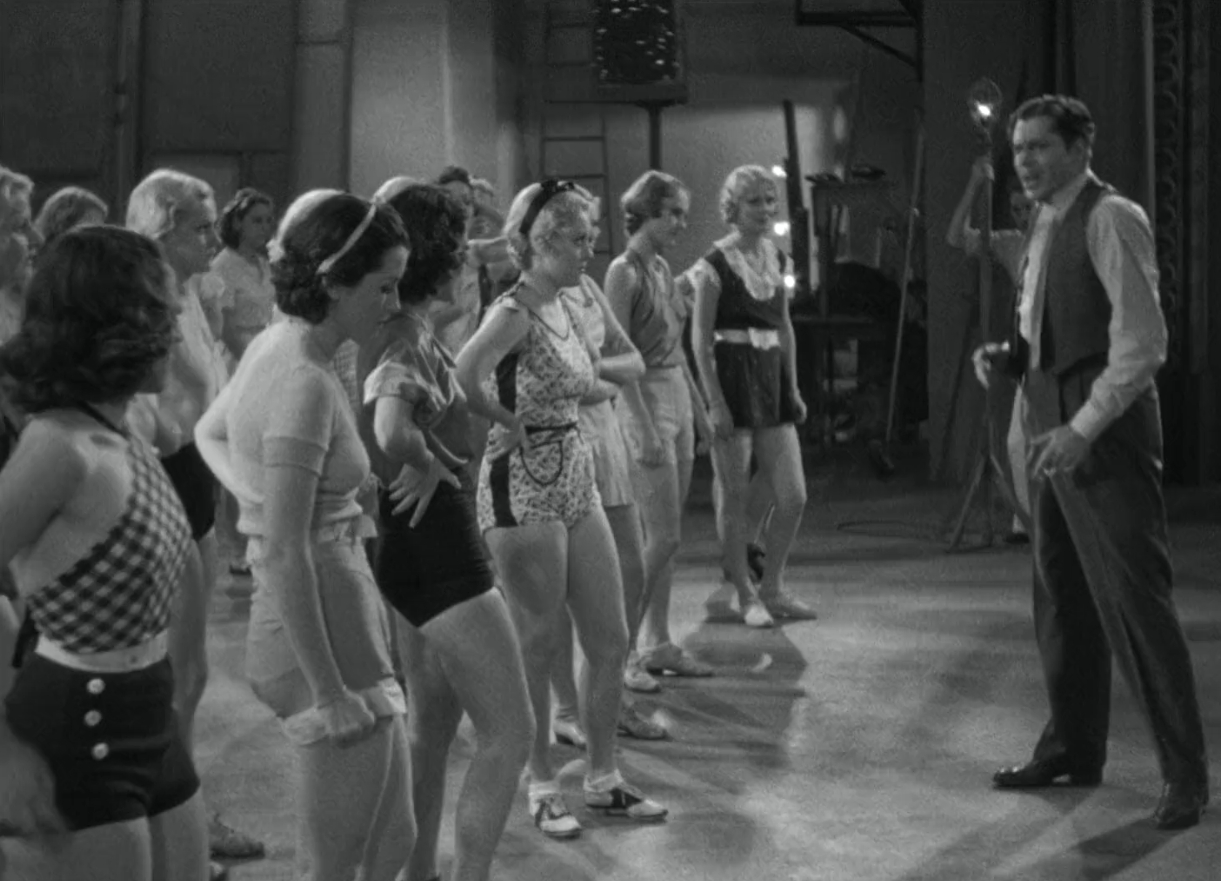
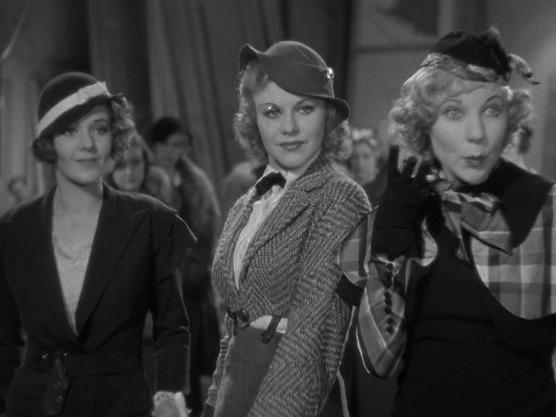
Long before it was a Broadway hit (in the ’80s), “42nd Street” was a musical adapted (from a novel) for the screen. And this 1933 film may be the oldest Hollywood musical to, as we say, “still hold up.”
The acting is OK. The story is pure corn and the songs — most of them — are dated and aging badly. It’s easy to see why other American Songbook tunes from the era were cadged and included in the Broadway adaptation in the ’80s.
“Shuffle Off to Buffalo” and “You’re Getting to be a Habit with Me” are about as good as it got.
But the production numbers, tap-heavy as they are, remain impressive. It’s the cast, the banter and the backstage at-a-musical-revue-in-rehearsal milieu that keep this picture fresh.
Warner Baxter plays a director in desperate need of one last hit, one that’ll set him up for life, even in the middle of the Great Depression.
He casts the show, gets a “star” (Bebe Daniels) who has a sugar daddy (Guy Kibbee) financial backer, lands “the kid” just for that moment when the star’ll have to be replaced opening night.
You know the drill.
Among those in the cast of this “Pretty Girl” are future star Ruby Keeler, future superstar Ginger Rogers, and George Brent and Dick Powell.
But the thing that had me spitting up my beer was the cattle call trash talk among the chorines.
“It seems that little Loraine’s hit the bottle again.” “Yeah, the PEROXIDE bottle.”
“Getta load of Miss Mountaineer here,” says a short chorine to an Amazon. “Ya parents mustabeen disaPOINTED, not having any ‘children.'”
“He looks like a Bulgarian boll weevil mourning its first-born.”
“You remember Annie Lowell?” “Not ‘Anytime Annie?’ Say, who could forget ‘er? She only said “No” once, and THEN she didn’t hear the question!”
Oh yeah, pre-Production Code movies could be pret-TY racy.
Other movies from the era were later adapted for Broadway, but none have the snap, crackle and pop of this “Chorus Line” before its time — no tears, no sentiment, just brassy dancers and singers and a director with a secret driving his mania for getting just one more hit in.
Don’t shuffle off to Buffalo without seeing it, see?

MPAA Rating: approved, and sassy
Cast: Warner Baxter, Ruby Keeler, Bebe Daniels, Una Merkel, George Brent, Ginger Rogers, Dick Powell, Guy Kibbee and George E. Stone.
Credits: Directed by Lloyd Bacon, script by Rian James and James Seymour, based on the novel by Bradford Ropes.
Running time:




Netflix’s batting average with animation takes a blow with “Pets United,” a competently-animated “Euro-Sino” production, a “Robots” and “Pets” mashup with no delights and zero laughs to its credit.
Roger, a stray dog (voiced by Patrick Roche) spends his days lounging about Robo City and his nights raiding fridges and supermarkets. He’s a wanted dog.
But not by any of the people there. The sheriff-bot chases him here and there, to no avail.
And no laughs, either.
Roger stumbles into a “pet” robot, clingy-annoying Bob who decides they’re “best friends for life.” I wholly support Felix Auer’s decision to give this annoy-o-bot James Corden’s accent.
Roger has life worked out, until that day when the evil bot-builder mayor (Eddie Marsan) goes mad for his “perfect world, a world without error, a world without FAILURE.”
Yup. The humans have to leave. Many forget their pets and leave them at the Pampered Pet spa, which is the second place Roger runs into Siamese cat Belle (Natalie Dormer).
The pets gathered there — pigs and hamsters and a red panda and kitties and Ronaldo the French poodle with an Italian accent — have to team up, get past the untended zoo animals and Save Our City.
“RRrrrrrrrronaldo fears neither death not the DEVIL.”
The digital design here is impressive, a candy-colored cartoon of a futuristic city with drones, bots, hover cars and maglev trains.
The animated motion of the critters is…adequate. It says a lot that the robots are far more convincing creations, with fluid motion and Wall-E/BB-8 design touches.
There are instantly forgettable musical moments. “We are the beasts…whoever fights us ees dead meat!”
None of the voices or one-liners break out, none of the sight gags land, even the pig and a pug on a skateboard.
“Pets United” could struggle a bit even to keep a toddler distracted for 92 minutes.

MPAA Rating: TV-Y7
Cast: The voices of Natalie Dormer, Patrick Roche, Naomi McDonald, Felix Auer and Eddie Marsan.
Credits: Written and directed by Reinhold Kloos. A Netflix release.
Running time: 1:32
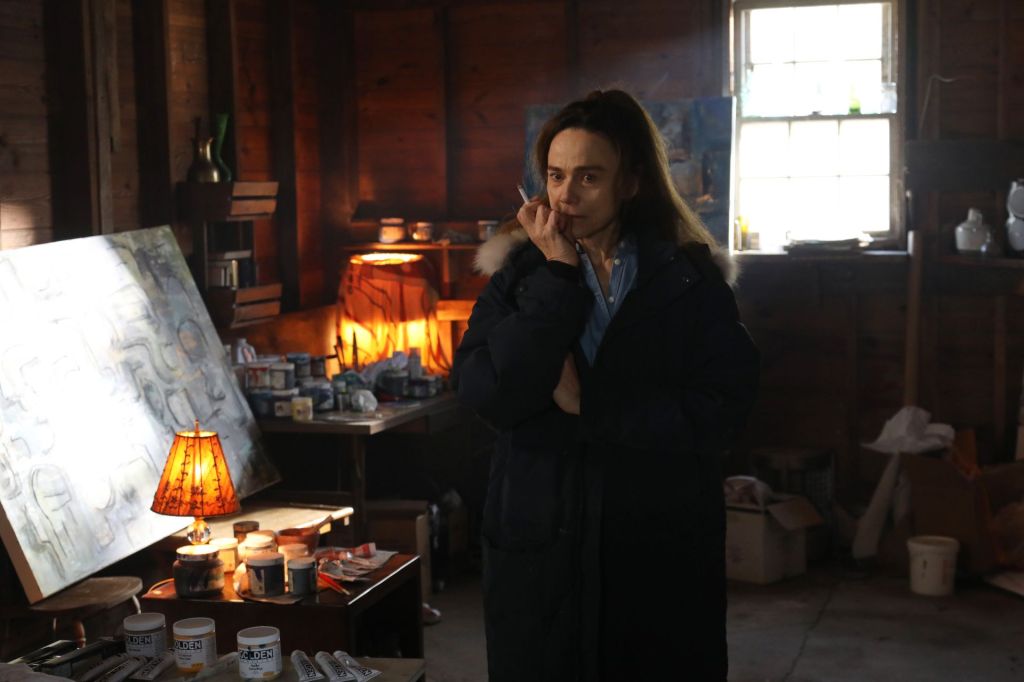
Lena Olin earns a fine showcase as the partner, organizer, caregiver and maybe muse of a famous artist in “The Artist’s Wife.”
This domestic melodrama from producer (“Call Me by Your Name”) and sometime director (“Last Weekend”) Tom Dolby touches on the artistic temperament, thwarted ambition, family estrangement and dementia in covering just a hint of the same ground that Glenn Close took an Oscar nomination for in “The Wife” a few years back.
Married to ancient painter Richard Smythson, played by that colorful curmudgeon Bruce Dern, Claire (Olin) may have accepted her lot, to have to hear her famous husband say “I create the art” in interviews, and “She creates the rest of our life.”
For Claire, that means running their designer home and keeping his art dealer (Tonya Pinkins) placated, but at bay while Richard struggles for inspiration.
“It’s very hard to look inside and paint what’s all gone,” he confesses, at one point — not to Claire. Richard is still teaching classes, but his “erratic” behavior — vulgar around the students, insulting, unfiltered and forgetful — is causing problems.
Claire knows he’s “lived his life on his own terms.” But he was rash and temperamental to start with. Now, he’s losing it. Her new duty is keeping the peace with the college and his impatient dealer, and not telling him about the dementia his doctor sees settling in.
She is overwhelmed. In his sentient moments, he’s a joker. Their marriage is “Twenty-five years of ‘Stop, please,” he cracks in public. But she’s at the point of asking their housekeeper what it took for her to end her marriage.
Claire could use some support. Sure, the reason she starts hassling Richard’s estranged daughter (Juliet Rylance) is “I want him to remember you.” But taking on these end-of-life decisions for a famous and famously-irascible husband is hardly a burden you want to bear alone.
Angela is a mother, going through a break-up of her own, and not interested. But Claire is nothing if not persistent. Some of the best scenes of “The Artist’s Wife” are ones where we find how seriously estranged those two have been, and Claire’s cluelessness, caught in between them.
She doesn’t even know Angela’s sexual preference, has never met her little boy.

The three-writer screenplay is on its sturdiest ground letting a fine cast get across love, devotion, schisms and pain. Olin has always been an open book as an actress. And Dern’s later years have given him plenty of showcases for his mercurial twinkle-to-tirade range. Stephanie Powers has a chewy bit part as an old artist friend of the couple, and Avan Jogia has a little to play with as Angela’s calm-troubled-waters nanny.
The script lacks much of the couple’s back-story. Was she his student? And it develops a hitch in its step all throughout the third act, where abrupt character reversals give away every contrivance.
This is more worth seeing for Olin and Dern’s tetchy and touching interactions, portraying a marriage of devotion and decay. Every filmmaker who preaches that “Casting is everything,” or 90 percent of everything, isn’t exaggerating. “The Artist’s Wife” proves it.

MPAA Rating: R for language, some graphic nudity and brief sexuality
Cast: Lena Olin, Bruce Dern, Juliet Rylance, Avan Jogia and Stephanie Powers.
Credits: Directed by Tom Dolby, script by Tom Dolby, Nicole Brending and Abdi Nazemian. A Strand release.
Running time: 1:34



If filmmaker Alex Gibney was an oncologist, he’d be the one you could rely on if you asked, “Give it to me straight, doc. Is it the Big Casino?”
He makes films that have a dogged devotion to the unvarnished truth. Scientology to Steve Jobs, the “real” story of Enron or Lance Armstrong, Gibney’s reputation as a documentary truthteller is unimpeachable.
So if you want the hard answers about Russian manipulation of elections and whether Donald Trump was “cultivated” as a “Russian asset” who might win the White House and pander to Russia’s interests, Gibney’s the guy to go through the Russian nesting dolls to give us something like the unvarnished truth.
“Agents of Chaos,” the two-part film he directed for HBO (premiering Sept. 23), uses that nesting doll image and allegory, scores of interviews and reiterations of the reporting of what we knew in 2016, and what we now know, to lay out — in clear but somewhat exhaustive detail — how it all went down.
“Agents” traces Russia’s 2013-2014 Ukrainian practice-run “lab” of public opinion manipulation, sewing division and seeding “fake news” to the St. Petersburg troll farm IRA, names the known names of the hackers who fed Wikileaks and willing American media companies stolen documents and gossipy emails, digs into “collusion” and draws conclusions.
Several of the principals involved in all this — Russian “connections” such as Felix Sater and Carter Page, ex-CIA chief John Brennan, Fusion GPS chief Glenn Simpson and email hack victim John Podesta are here.
Gibney and others pick at the “Steele Dossier” and “Guccifer 2.0,” the manufactured “hero worship” of Julian Assange and “insidious” Wikileaks (Gibney did an earlier film on them), “Trump Tower Moscow” and other blind alleys a salacious press corps chased while the more blunt truth was practically right out in the open.
Years of Trump singing Putin’s praises on Fox News are sampled, Trump’s parroting of Russian positions on everything from the EU and NATO to the myth of “American exceptionalism” are revisited.
Trump “does things for (Russia) in public that they can’t do for themselves,” one insider explains.
We’re tipped that, in movie terms, the Russians were acting as if “they were in some John LeCarre (“Tinker, Tailor Soldier Spy/The Russia House”) spy movie” while Trump’s team were playing roles in a New York “mob movie.”
We see how the troll farm in St. Petersburg learned on the fly, made research trips to Red State America and figured out how easily it would be to create fake social media profiles and fake Texas “secessionist” groups like Hearts of Texas on Facebook, not just to create and disseminated divisive memes, but more importantly — to amplify the hate, mistrust and bigotry that was already out there.
From Alex Jones’ InfoWars to CNN, everybody seemed to fall for it.
Gibney takes pains to show both “what Russia did to us,” and “what we did to ourselves” in this process.
Journalists, academics (historians) provide big picture perspective and analysis of Putin’s motives, Trump’s eager compliance, “authoritarian” playbook moves (assaults on protestors, blizzards of bald-faced lies, a daily outrage) and the “profound form of failure” of the media to avoid chasing mirage and not the real story.
In a year when such films and books (Andrew Weissmann, part of the Mueller team who has a new book out, is here) are legion, “Agents of Chaos” stands out for synthesizing so much of what we’ve heard, what we’ve come to believe about Russia and Trump (some of it mistakenly) and what exactly is on the line in November. It’s wearing and exhausting to go over all this again. But that’s nothing, the film suggests, to how alarming we should be that millions of our fellow citizens don’t look at Russia today with revulsion and fear — that they and we and Trump are remaking our democracy in Russia’s corrupt, autocratic image.

Cast: Margarita Simonyan, Felix Sater, Glenn Simpson, Victoria Nuland, John Podesta, John Brennan, Camille Francois, Andrew McCabe, David Hinkton, Andrew Weissmann, Carter Page, Michael Isikoff
Credits: Directed by Alex Gibney and Javier Alberto Botero, created by Gibney and Lowell Bergman. An HBO release.
Running time: Two episodes @2:00 each
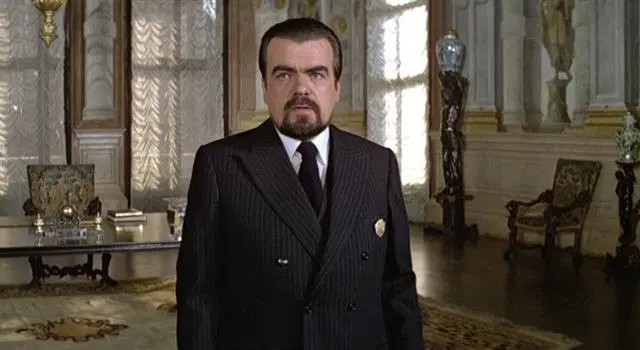
He was a good Bond villain in a daft Bond film, “Moonraker.”
“Look after Mister Bond. See that some harm comes to him.”
But the Paris-born French actor Michael Lonsdale, who died today at 89, was in two thrillers I have never been able to channel-surf past — “Day of the Jackal,” about the 1960s hunt for a hit man sent to kill DeGaulle, and “Ronin,” the last great John Frankenheimer action picture, an all-star espionage/heist thriller.
By that stage in his life, Lonsdale was all but retired, forgotten, by English language filmmakers anyway. Not by Frankenheimer. Great film, and Lonsdale — quiet, meticulous professionals were his forte — was terrific in a small role, explaining the story’s title to the audience, and to De Niro and Jean Reno.
Nicely done.

It might not be the best time to release a movie built around attacks of conscience. That’s a concept that’s taken a beating in the United States in recent years. We’re not living in Frank Capra’s America any more.
But here is “Foster Boy,” a kind of John Grisham Lite “feel good” legal drama with healthy helpings of melodrama, courtroom shenanigans and thriller touches. It’s “just a movie.” Still, with some very good performances, a couple of nice twists and a righteous cause — questioning the privatization of states’ foster care systems — it at least will make you nostalgic for the days when we could at least hope the corporately-coddled and sold-out might do the right thing.
Matthew Modine is the sell-out at the center of all this. He sips his fine wine in his Architectural Digest home, dons a custom-tailored suit and takes limos and corporate jets wherever his corporate clients need him, wherever he’s licensed to practice.
But Michael Trainer rues the day he pops into a Chicago courtroom, fresh off the jet from LA, to argue a case in front of Judge Taylor (Louis Gossett Jr.). Sure, he wins. But Taylor’s in…a mood.
“Have you ever done anything for anybody but yourself?” he grouses. That’s when he orders the high powered/perfectly-put-together corporate attorney to take on, pro bono, a civil suit involving a young man (Shane Paul McGhie) brought up in the hearing after Trainer’s.
Jamal Randolph was before the judge on a state matter. He’s in jail, nearing the end of another short sentence. But he has a civil case before the same court. His adoptive mother (Michael Hyatt) says they haven’t been able to find an attorney. Judge Taylor, putting his finger on the scales of justice, solves that problem with a thump of his gavel.
Trainer’s co-counsel mutters “How you think this kid is going to present?”
“Like a thug,” the rich attorney at law fumes.
There are things in this Jay Paul Deratany script that you don’t see in your typical courtroom drama. While shout-offs with a heavy-handed judge, questioning witnesses who’ve left the stand and are just sitting in the courtroom, with the judge allowing all this, may occasionally happen, it feels far-fetched. Get used to it.
Jamal was abused, repeatedly, while in foster care. He says the worst of it came when the private company running child placement for Illinois parked a known abuser client in a foster home Jamal was already in, and ignored his warnings and pleas for help.
Now he’s suing Bellcore and the woman who placed him in harm’s way — now a higher up there (Julie Benz) — for damages.
The Grisham touches are showing Jamal tased in court, in front of the jury, the illegal and downright violent measures that company (“Allie McBeal’s” Greg Germann is their CEO) undertakes to intimidate Jamal and Trainer, the over-the-transom “evidence” slipped to the Good Guys.
The Deratany touches are all the times Gossett’s judge allows the countless courtroom irregularities to slide, letting the pretty co-counsel (Lex Scott Davis) braid Jamal’s hair, and having Jamal read from his notebooks “of rhymes” — rapping testimony from his journals that relate his abuse.
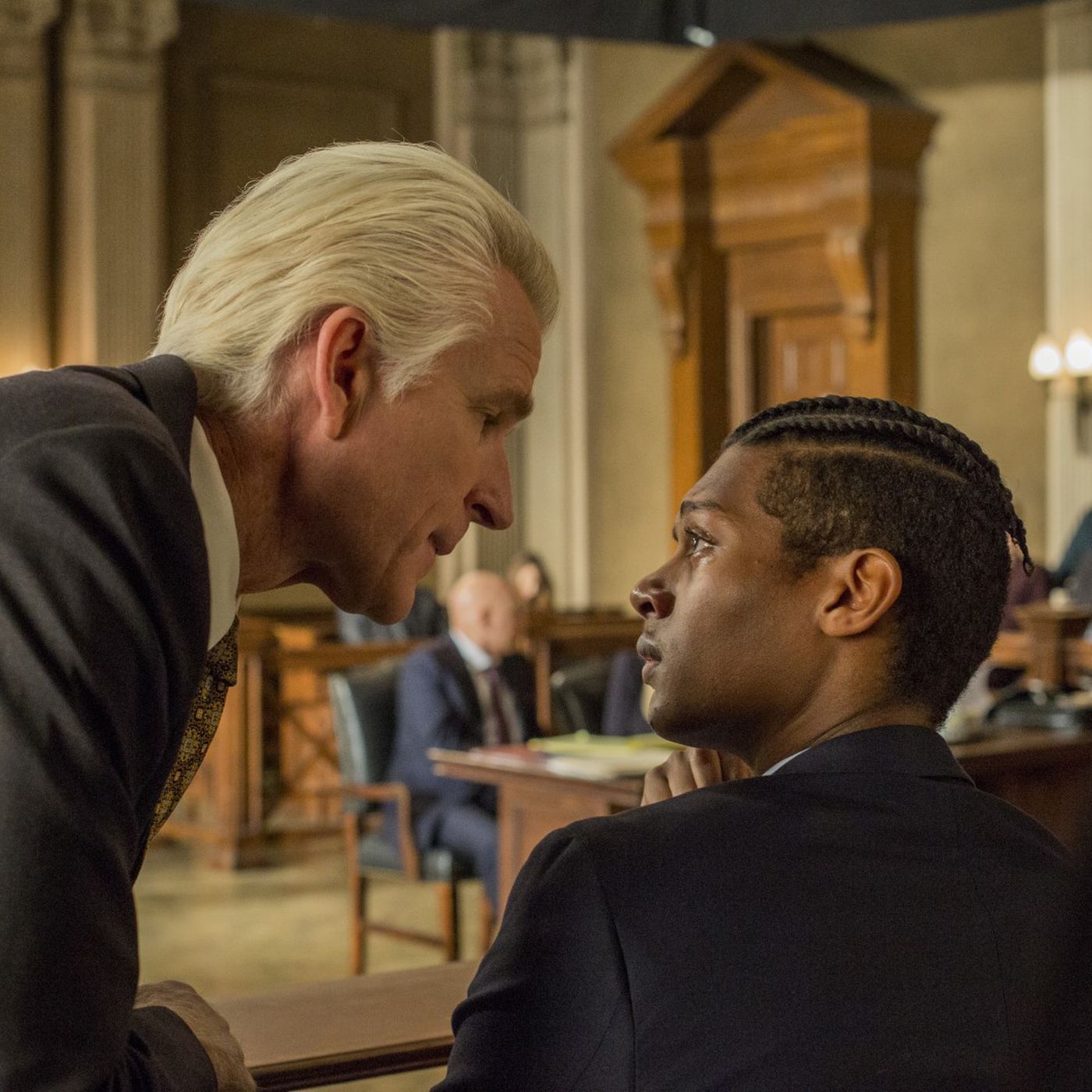
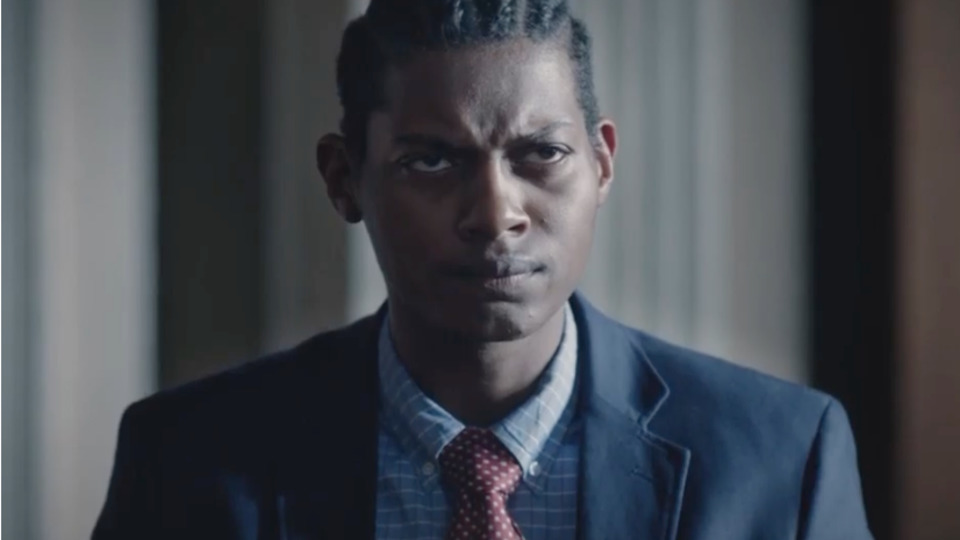
But McGhie (TV’s “Unbelievable”) and Modine buy in — hard.
McGhie bites off every bitter, resentful line this kid spits at “Three Piece,” his nasty nickname for the reluctant “suit” defending him.
And Modine makes his character’s arc or journey in the story not some fairytale of compassion, but a proud, callous and rich jerk who gets his back up — first at the judge, then at his client, then at the creeps who are rolling over that client.
“One thing I don’t do is LOSE.”
The “white savior” trope may be passe, but Jamal’s race isn’t what the story’s about. Foster care systems being privatized deal with all races of children, and aren’t as accountable as a state entity would be with any of them.
They’ve made an uneven melodrama that’s easier to get behind than to endorse for its cinematic realism. But I will. Maybe for old time’s sake.
MPAA Rating: Unrated, violence
Cast: Matthew Modine, Shane Paul McGhie, Louis Gossett Jr., Michael Hyatt, Julie Benz, Lex Scott Davis, Michael Beach, Greg Germann and Amy Brenneman
Credits: Directed by Youssef Delara, script by Jay Paul Deratany. A Gravitas Ventures release.
Running time: 1:49
And Cloris Leachman and Peter Dinklage and Kelly Marie Tran and Leslie Mann and Catherine Keeper and Clark Duke…
Thanksgiving, the Cave Family experiences the culture clash of dropping into the modern world.
Tom Wolfe’s book about the early days of the space program had swagger, suspense and humor. It was inspiring but fun.
Philip Kaufman’s glorious 1983 film was mythic, with the sweep of a Greek epic. It was sexy, sentimental and often hilarious.
The trailer to this October series Disney+ has no bravado, no seat-of-the-pants whimsy, none of that blustery “right stuff” that Wolfe brought into the culture. This feels like a dry post-patriotism take on TRS.
Maybe not the right approach. But we’ll see.

 Movie Nation