
Netflixable? Animated “Over the Moon” marries Chinese animation and sensibilities to Hollywood storytelling

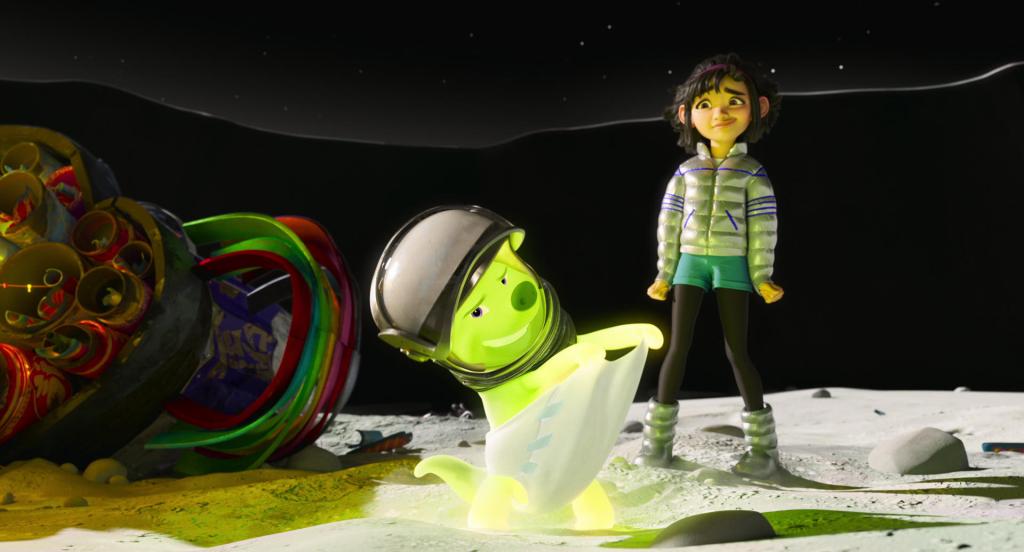
East meets West in the lightly charming children’s lunar fantasy “Over the Moon,” a Chinese-made Netflix movie that puts a modern Hollywood spin on a Chinese folk legend.

The animation, from “Kung Fu Panda” veterans Pearl Studios of Shanghai, is first rate, the songs pleasant if not particularly memorable.

The story? It’s a real “kitchen sink” affair, a “Mulan,” “Maleficent” and “Tron” mashup stuffed with science and silliness and oh-so-many-cute-sidekicks.

Is there a McDonald’s toy tie-in with this release in China, as of this month the world’s number one movie market?

Little Fei Fei grew up with her eyes on the skies, hearing her mother’s version of the story of Chang’e, the Goddess of the Moon, and Hou yi the archer. Theirs was a great love, but there were immortality pills and they were separated and Chang’e is doomed to spend eternity on the Moon.

“When she cries, her tears turn to stardust.”

Oh, and a giant space dog (a chow, of naturally) takes bites out of the moon each month, which accounts for the phases.

Years pass, songs come and go, and Fei Fei (Cathy Ang) becomes a motherless teen, running the Yanshi City bake shop with her dad (John Cho).

But this new woman in Dad’s life (Sandra Oh) triggers Fei Fei’s jealousy and memories of “the perfect family” that they were. As they make preparations — and moon cakes — for the annual Moon Festival, Science Girl plots and plans to build a rocket to take her to the moon.

She will prove Chang’e is real, that Mom’s stories were true, and revive her father’s memories of Mom, banishing Mrs. Zhong (Oh) forever.

The first sidekick is Bungee, Fei Fei’s pet rabbit. The first flashes of comedy come from Mrs. Zhong’s “rambunctious” son, tweener Chin (Robert G. Chiu). He’s convinced he has a super power. He can run through anything — walls, etc.

“No BARRIERS!” is his catchphrase.

When Fei Fei makes her lunar attempt, naturally “annoying” Chin stows away. The rocket has promise, but a teenager’s limitations in terms of planning. Luckily, there’s a little magical intervention from the Goddess herself.

But about that Goddess (Phillipa Soo of “Hamilton”). She’s not what Mom described. She’s hardly “alone,” and not doing much crying. She’s a pop diva, with an audience of loyal “fans,” sort of a Chinese Katy Perry or Rihanna in space, or Zeng Keni singing in English. Not a shrinking violet, in other words.

“I’m the light every night in your world,” she sings. Worship me.

Fei Fei meets her, and Chang’e has just two questions. “Where’s my gift?” And “What butcher cut your hair?”

Chinese Mean Girls are the meanest.

Fei Fei’s quest changes and that “proof” and “bring back our perfect family” priority tumbles away as she encounters “Biker Chicks” on Tron-cycles (literally giant “chicks), and a blobbish former “court jester” banned from court for being a motor-mouthed nervous talker who sounds like Ken Jeong.

Co-director Glen Keane is one of the major animators/designers of Disney’s recent classics — the Beast from “Beauty and the Beast,” “Pocahontas,” etc. Every character in this is well-conceived, visually. There’s even a “Kung Fu Panda” styled sketched and water-colored fantasy sequence, relating the story of Chang’e and Hou yi.

But “Over the Moon” is all over the place in terms of themes, plot and such. The film is much more interesting and fun on Terra Firma, capturing the routine of baking moon cakes, the banter of big family dinners celebrating the Moon Festival (listen for Margaret Cho and Kimiko Glenn there), maglev trains and the wonders of childhood.

The script allows for one emotional moment and just a couple of real laughs, as well as a few chuckles.

It’s not quite up there with Netflix’s lovely holiday offering from last year, “Klaus,” even if it is several steps above the studio’s animated “miss” “The Willoughbys.”

But it’s a pleasant kid-friendly diversion on a par with Pearl’s “Abominable,” and in a year when animated films aren’t heading to theaters or coming out at all, it might even be an Oscar contender.

MPAA Rating: PG

Cast: The voices of Cathy Ang, Phillipa Soo, Ken Jeong, Sandra Oh, Margaret Cho and John Cho.

Credits: Directed by Glen Keane and John Kahrs, script by Audrey Wells and Jennifer Yee McDevitt. A Pearl Studios film, a Netflix release.

Running time: 1:40
Posted in Reviews, previews, profiles and movie news | Comments Off on Netflixable? Animated “Over the Moon” marries Chinese animation and sensibilities to Hollywood storytelling

Netflixable? Surviving the Norwegian Apocalypse — “Cadaver (Kadaver)”

Edgar Allan Poe’s “The Masque of the Red Death” has been on a lot of people’s minds of late. Lucky, affluent people gathered for a masked ball, sickening and dying? Yes, it sounds like all manner of conservative “Super Spreader” events.

The Norwegian writer-director Jarand Herdal takes that basic premise and puts it in a post-apocalyptic setting with “Cadaver (Kadaver),” a thriller about guests invited to the last hotel for dinner and a show.

As even a passing knowledge of Poe, the briefest acquaintance with horror or the damned obvious title gives away where this is going, the pleasure in this thriller comes from tone, tricks, committed actors and execution. The writer-director, making his feature film debut, ensures that those come off with style.

Some sort of nuclear event — the old newspapers blowing down the ruined streets in perpetual gloom or rain aren’t clear — has brought on End Times. Accident during heightened tensions, or attack, it doesn’t matter. Bodies are everywhere as people die of starvation some months after the disaster.

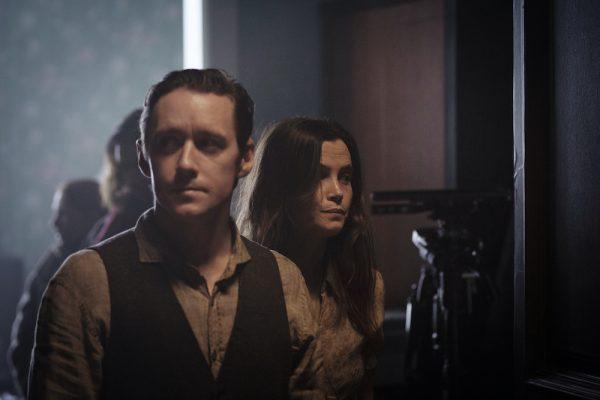
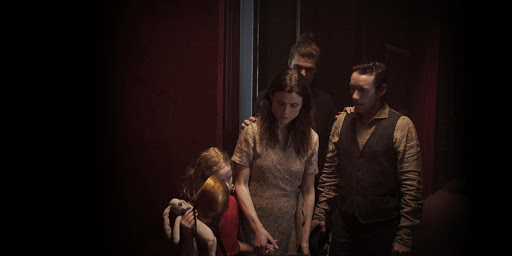
Actress Leonara (Gitte Witt) and husband Jacob (Thomas Gullestad) navigate this world of doom, where every closed door opens onto a fresh horror — a suicide, a desiccated corpse — with their ten year-old daughter Alice (Tuva Olivia Remman).

The adults take turns bucking each other up (in Norwegian, with English subtitles).

“We have nothing left.” “We have to hang in there. We have each other. We have Alice.”

In an every person for himself world, peril is everywhere, especially in the dark. Despair rules the daylight.

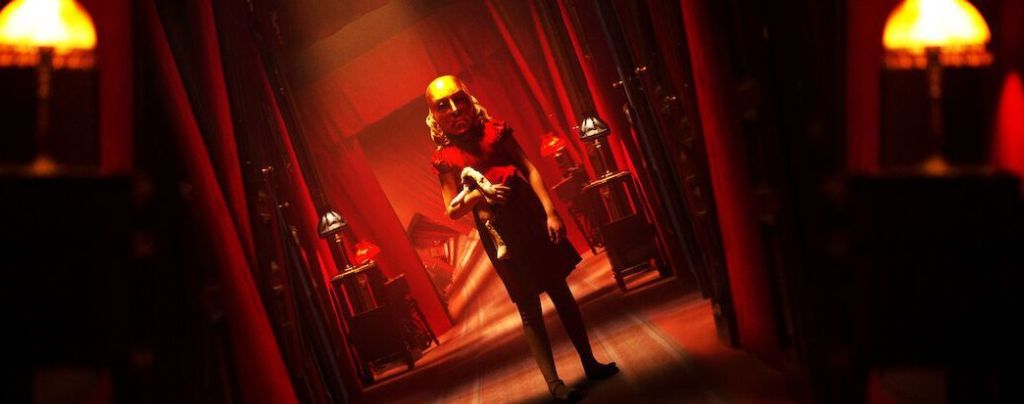
And then, a break, a lifeline. A barker advertises “dinner and a show” at The Hotel. Dress up, regain your humanity, if just for a night. How do they have food? How could there still be a staff? Don’t look a gift theatrical horse in the mouth.

But…your daughter. “This show isn’t for children.” Please, she’s an actress’s daughter. Look at the horror around you. What could shock or scar her now?

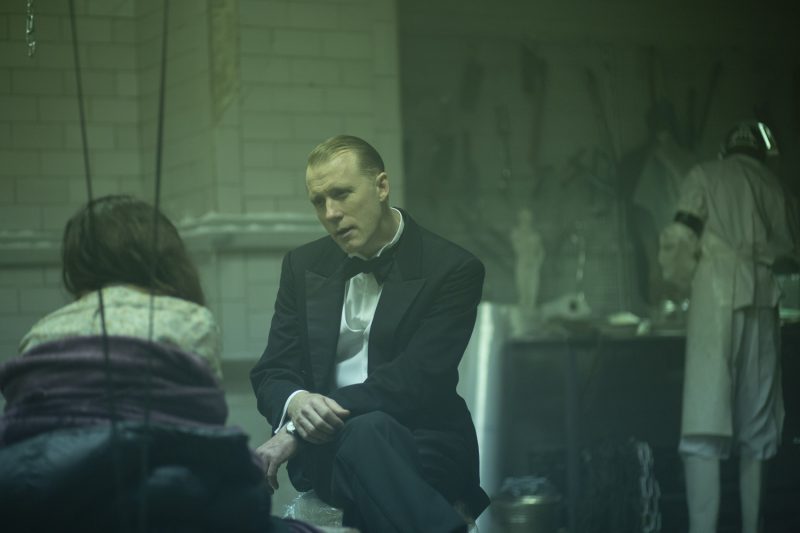
Mathias (Thorbjørn Harr) is the maître d’ and MC for the evening and their “first time guests.”

“Forget the world outside,” he urges. Eat, drink, enjoy, escape.

He presides over a vast wait staff and busy kitchen. And the show? You’re a part of it, everyone and everything you see will be “theater.”

It’ll be like “Tony & Tina’s Wedding,” with bickering and sex and oh, a little murderous violence.

See what I mean about “We know where this is going?”

Of course, Alice-the-wandering-child is separated from the parents. They’re hurled into a frantic search, “mid show,” for their child, through scores of rooms, kitchens, convincing themselves “It’s not real” right up to the point they know it is.

“Cadaver” relies too much on tropes and coincidences. But it succeeds or fails on the back of the performances, and they’re quite good. Witt in particular gets across a smart, dogged woman of the theater who isn’t falling for this or that and isn’t leaving without her daughter.

Harr gets across a sort of End Times louche. life, love, hope, the essentials of humanity, are but abstract concepts now. Doom does that to a guy. And when that takes hold, you don’t fear death, but you lose any sense of morality and humanity.

“Cadaver” is gorgeous to look at — the ruined city reminded me of that classic British post-nuclear thriller “Threads” — and well-played, but predictable enough to amount to a mixed bag of a thriller. Still, at under 90 minutes, it gets to its point and makes its impressions in a near rush, and wastes none of the viewer’s time doing it.

MPAA Rating: TV-MA, graphic violence, sex

Cast: Gitte Witt, Thomas Gullestad, Thorbjørn Harr, Tuva Olivia Remman, Trine Wiggen

Credits: Written and directed by Jarand Herdal. A Netflix release.

Running time: 1:27

Posted in Reviews, previews, profiles and movie news | Comments Off on Netflixable? Surviving the Norwegian Apocalypse — “Cadaver (Kadaver)”

Movie Preview: “Farewell Amor” from IFC

IFC has owned big stretches of this Year of the Pandemic box office.

This Dec.11 release isn’t a genre horror thriller or anything I’d that sort. And it looks intriguing, as most of IFC’s titles are.

Posted in Reviews, previews, profiles and movie news | Comments Off on Movie Preview: “Farewell Amor” from IFC

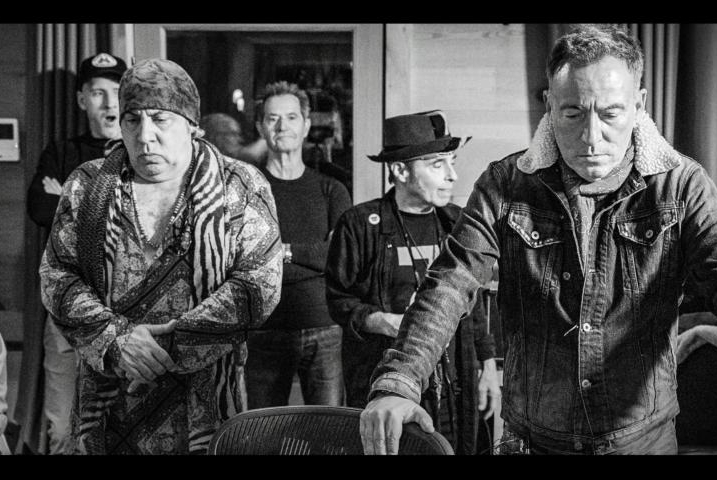
Documentary Review: Bruce summons the E-Street Band to produce “Letter to You”

Somewhere early on in Bruce Springsteen’s latest “gather musicians in my barn to cut a record” documentary, “Bruce Springsteen’s Letter to You,” the big question he invites us to ask of him becomes clear.

What becomes the pop star in winter?

Not just literal winter, of the “Hey guys, it’s SNOWING” exclamation from The Boss as “Jersey weather” Jersey winter sets in around them on his farm, in his recording studio barn in his beloved New Jersey.

Do you go on the road and stay there, like Willie and Dylan? Do you try your hand at other forms of writing, or keep composing songs for a shrinking fanbase? Have you worn out your ability to reinvent yourself, or do you keep looking for new frontiers?

Springsteen may have run through every single one of those options. And yet he remains the consummate artist who “must be heard.” In the words of the fiction writer Harlan Ellison, “I have no mouth and I must scream.”

As Springsteen, reciting from his poetic/quasi-pretentious liner-notes-run-amok narration, sets up each song in the set — reflecting on this friend from his first band (The Castilles) passing, on others he’s lost, on “the debt I still owe my Freehold (NJ) brothers-in-arms,” on how “pop was always a raucous meditation,” his “45 year long conversation” with The E-Street Band, both a finely tuned motor and an outfit that can still “float like a butterfly, and sting like a bee” — you can’t help but wonder if there’s a better venue for this conversation, this “letter.”

Sure, he’s proven all he ever needs to prove, and then some, on the road. He’s dominated Broadway. Sold millions of records in his day. But this film and his last one, a doc about a C&W bend in the road on his musical journey (“Under Western Stars”) feels stiff, stale, self-serving and self-conscious.

Of course it’s in black and white. But at least he’s not wearing an ill-suited cowboy hat.

The songs are a pleasantly-forgettable collection in the usual Springsteen keys and time signatures and sound awfully similar to earlier works in his restless Jersey soul canon.

He and the band are doing what they love to do, in a low-impact/less-effort “comforts of home” way. It’s “not a job, it is a calling” he narrates, “a vocation.” But in the arid air of a recording studio the music loses its life, the “conversation” with the audience is absent and the “letter” really does feel like a letter — a little over-familiar, a bit long-winded.

“I took all the sunshine and pain,” he sings, rhyming it with “happiness and pain,” stretching the Big Noun in the title tune an extra syllable or two, as he is wont to do.

“I sent it in my Le-HE-ter to you.”

He preaches from Book of Pop Revelations, “life in 180 seconds or less,” and sings “As Ben E. King’s (“Stand by Me”) fills the air, baby that’s the power of prayer.”

There’s a little interplay with the band, a few “notes” after this or that take of the tunes.

“Roy (Bittan) don’t play it up higher, just don’t play it so LOW.”

But there’s a lot more narration than banter. Ho. Hum.

The idea of anybody staying friends with people you’ve worked with half a century is a miracle. And we all get old, reflective and sentimental, Sundance. No shame or dishonor in that.

“We’re taking this thing til we’re all in the box,” is Springsteen’s toast as they wrap things up. An artist’s compulsion to keep making art is to be revered.

But if you’re known for being the world’s greatest live act, maybe that’s how you present your new songs to the faithful (he had a hand-picked “audience” for “Under Western Stars,” in the barn) — in a roadhouse, drinks clinking and conversation murmuring, hoots or muted applause road-testing every single song, a “narration” that’s more improvised and less self-conscious.

He’s not the head-case Dylan became, not the sell-out Jimmy Buffett perfected, not an oldies act like every contemporary that doesn’t fit those first two comparisons.

Is there no one in his time-tested circle who can tell him, “Yeah, let’s get the band back together, but go out among THE PEOPLE when we do?”

MPAA Rating: unrated, alcohol

Cast: Bruce Springsteen, Little Steven Van Zandt, Roy Bittan, Max Weinberg, Nils Lofgren, Patti Scialfa, Jake Clemons, Garry Tallent.

Credits: Thom Zimny, script.narration by Bruce Springsteen. An Apple TV+ release.

Running time: 1:26

Posted in Reviews, previews, profiles and movie news | Comments Off on Documentary Review: Bruce summons the E-Street Band to produce “Letter to You”

Classic Documentary Review: “I Am a Dancer” gives us Peak Nureyev

The Golden Globe-winning 1972 documentary “I Am a Dancer” is a straightforward, old-fashioned “dancer and the dance” film, very much a product of its time. It’s heavy on sweaty rehearsals but dominated by performance sequences from “Sleeping Beauty,” “La Dame aux Camélia” and “La Sylphide.”

But its value beyond being an artifact of its era is that it preserves the dancer who is its focus, the Russian ex-pat Rudolf Nureyev, forever on film at his glorious peak.

He’d been celebrated for over a decade when Pierre Jourdan brought his (much bulkier than today) camera into rehearsal studios and close to the stage for classic performances.

Nureyev’s liberating defection from the Soviet Empire in 1961 had created a sensation beyond his fame within the performing arts. Jourdan’s film, by no means an “intimate” portrait, has the 33 year-old dancer shrugging that “I live in suitcase. My only ground is my work.”

And that’s what Jourdan captures with his camera, the sweat of being at the barre with the entire corps de ballet, intensely focused, putting in the way as a French class-leader hums “Da da du…Arabesque…dum dum dum Pas de deux.”

Dame Margot Fonteyn, the British ballerina, already a legend when Nureyev pursued her as a partner, marvels at how well they meshed on stage, this “boy, half my age” with all his grace and athleticism.

The film’s dated and superficial treatment of its handsome, mop-topped subject may seem at arm’s length by modern standards. But gay dancers didn’t speak of their sexuality in the early ’70s.

Jourdan instead lets the performances take over the film. Still, there’s this glorious sequence where the star, who evolved into a choreographer, director and even conductor before his career and life were cut short by AIDS, shows his corps exactly what he wants.

He’s in street clothes and boots, and he swoops right in with all the ballerinas, boots thundering at every landing, teaching them the precise gesture, pose and position he desires.

MPAA Rating: unrated, smoking

Cast: Rudolf Nureyev, Dame Margot Fonteyn, Glen Tetley, narrated by Bryan Forbes

Credits: Written and directed by Pierre Jourdan. A Film Movement+ release.

Running time: 1:32

Posted in Reviews, previews, profiles and movie news | Comments Off on Classic Documentary Review: “I Am a Dancer” gives us Peak Nureyev

Movie Review: Father and child escape to “The Place of No Words”

A father bounces his child of three on his lap in bed.

In his mind’s eye, he has a different haircut, is fur clad like a Norseman of old, rowing the blond child to a rocky, Dark Ages shore.

It’s a fantasy world of their own creation, a quest he and the child are making up as they go along — him providing the muscle, the kid, babbling and inventing in Aussie-accented English, naming things, interacting with a fairy and learning the rules.

“If we see goblins?”

“We KILL’em!”

It takes a while to determine the beautiful, long-haired child is a boy, that his name is Bodhi.

We meet his mother at about the time we notice that some of Dad’s story game play is happening in a hospital bed.

Father and son are weaving a long-form fantasy around that which we don’t speak about, or that which few of us are comfortable talking about with our children — death.

“But I don’t LIKE games about being dead!”

Writer, director and star Mark Webber has been in films since the late ’90s (“Scott Pilgrim vs. The World,””Laggies,” “Don’t Worry, He Won’t Get Far on Foot”). When he writes and directs his own work (“Flesh and Blood”), he tends to tell stories about family WITH family.

“The Place of No Words” has Webber and wife Teresa Palmer (“Lights Out,” “Hacksaw Ridge,” “Point Break”) playing a married couple entertaining and trying to figure out a way to explain “Daddy’s sick” to their little boy, Bodhi Palmer.

It’s a somber, reflective and magically set fantasy in the vein of “Where the Wild Things Are,” with symbolic monsters to be faced and bested, befriended or at least accepted. But the real magic of the story might be the utterly natural way this family acts like a family, with a precocious, unaffected and engaging child the glue that holds it all together.

They filmed this indie jewel in Wales in between seasons of Mom’s SkyTV series, “A Discovery of Witches.”

Mom looks haunted, gaunt at times. “It’s been so heavy around here,” she confides to a friend. But she’s got to keep up bubbly appearances even as her husband Mark has reached “a place of acceptance.”

The film has literary allusions and a visual tone that beautifully matches an overcast “real” world with the rocky hills and mountains and moss-covered trees of father-and-son’s place of escape.

It’s not a deep treatment of a serious subject. But it is an affecting one, made more so by the players groping and grasping at emotions that strike a balance between parental sheltering of a child, protecting him from ugly reality, and the need to gently remove that shelter at just the right moment.

You have to be in the mood for it, but “The Place of No Words” is a touching, sweet and intimate fantasy unlike most any film you’ve seen, save for its much more expensive and less moving antecedent, “Where the Wild Things Are.”

MPAA Rating: unrated, some fantasy violence

Cast: Mark Webber, Bodhi Palmer, Teresa Palmer

Credits: Written and directed by Mark Webber. A Gravitas release.

Running time: 1:35

Posted in Reviews, previews, profiles and movie news | Comments Off on Movie Review: Father and child escape to “The Place of No Words”

Movie Preview: A twelve year old escapes poverty via fantasy, “Princess of the Row”

This indie drama has been a great favorite at film festivals, and it’s headed to theaters/streaming in early Nov.

Posted in Reviews, previews, profiles and movie news | Comments Off on Movie Preview: A twelve year old escapes poverty via fantasy, “Princess of the Row”

Movie Review: “Borat Subsequent Moviefilm,” just as outrageous, not as funny

The gags aim lower and the pranks seem more labored. The effort shows, as does the scripted fakery.

It’s harder for Sacha Baron Cohen to go anywhere looking like “stupid reporter” from Kazakhstan. Everyone, save for elderly Republicans and rural rubes, recognizes him.

Perhaps Sacha Baron Cohen and his “Borat,” “Bruno” and “Dictator” muse Larry Charles had run their course together. But “Borat: Subsequent Moviefilm” shows that Charles’ replacements — director Jason Woliner and seven credited writers (aside from Cohen) — aren’t a substitute for the furiously funny foil Cohen used to have around to bounce ideas off of.

And yes, the Rudy Giuliani sting is icky and funny, and is being somewhat oversold.

But “Subsequent Moviefilm,” coming fourteen years after “Borat,” still manages to find a few big, cringe-worthy laughs among America’s bigots and brainwashed Trumpists. Cohen is still able to hold up a mirror on country music/”Dog: The Bounty Hunter”/One America News nation and let us see how hilariously stupid and venal we can be.

The set-up — Borat (Cohen) gets out of prison after being locked up for years for “bringing shame to Kazakhstan.” The premier wants him to travel to America with a gift to bribe Trump, friend to the rest of the world’s “strong men” dictators.

It doesn’t go well. But at least he’s brought the daughter (Maria Bakalova) he never realized he had along for the journey. Well, she stowed away. And she “ate” the intended bribe-gift. But maybe Trump, or Mike Pence, will accept the 15 year-old as a gift, instead.

There are many gags about the value of women “where I come from,” and Borat’s and daughter Turat’s discovery that in America, women can drive cars and speak their minds.

A makeover is in order, suggested by an “Internet influencer” and “sugar baby.”

A debutante “consultant” is consulted, and a Macon, Georgia father-daughter cotillion is disrupted.

A bakery “accident” leads to the ingestion of a plastic decoration that only a “women’s counseling clinic” (Fundamentalists pretending to be an ob-gyn practice where women can obtain a legal abortion).

A Pence speech at CPAC is disrupted, as is a Republican Women meeting.

And then, there’s the COVID quarantine Borat talks a couple of fiftyish, Deep South and deep-down-the-rabbit-hole Fox News cultists/gun nuts/conspiracy loons into letting him share.

By the time Giuliani shows up, declaring in an interview with the 15 year-old Turat that “The Chinese manufactured the virus and spread it around the world,” Borat and daughter have traced the misinformation from the dunces who believe it to the frauds who feed it to them.

The film’s sentimental streak comes from the father learning his daughter is “human being,” and from having to give up Kazakhstan’s most cherished historical moment, “The Holocaust,” not because — as he learns on FACEBOOK — “it is hoax.” Borat’s eye-opening moment comes when he dresses “as Jew” and goes to a Synagogue in despair.

He is threatened with death back home if his mission fails, so he shows up as a Pinocchio-nosed, Hasidic-bearded, devil-tailed (and finger-nailed) “Jew” to end it all in a house of worship.

“Use your venom on me,” he tells two elderly Holocaust survivors. “I am very depressed.”

Cohen’s many disguises are lightly amusing, but the stand-out performance here is by the Bulgarian actress Bakalova. She is brazen. She is committed. She goes all-in on a string of shock-value stunts of ever-escalating vulgarity. And she pulls off the sexily-dressed teen “interviewing” Giuliani with convincing naivete and aplomb.

“I really feel like Melania right now!”

The topicality — filming this well into the COVID outbreak and shutdown — and eagerness to offend are what recommend “Borat: Subsequent Moviefilm.” It’s a fun character to revisit and an important time to bring him back.

Watch the original pre-Obama “Borat” and see how it predicted American decline due to gullibility and Trump-inflamed bigotry.

But there’s plenty of evidence here as well that it’s time for Cohen to let the cheap suit and outrageous accent go.

MPAA Rating: R (Graphic Nudity|Strong Crude & Sexual Content|Language)

Cast: Sacha Baron Cohen, Maria Bakalova and Rudolph Giuliani

Credits: Directed by Jason Woliner, script by Sacha Baron Cohen, Erica Rivinoja, Jena Friedman, Dan Swimer, Lee Kern, Dan Mazer, Peter Baynham and Anthony Hines.

Running time: 1:35

Posted in Reviews, previews, profiles and movie news | Comments Off on Movie Review: “Borat Subsequent Moviefilm,” just as outrageous, not as funny

Documentary Review: A Stunt Tour might be their big break, “After So Many Days”

Husband and wife folk-pop duo Jim Hanft and Samanta Yonak were newlyweds, married after a years long partnership as “Jim & Sam,” when they decided that one epic stunt was the key to them breaking through in the music business.

They would spend 2017 “playing one show a day, every day” as a way of keeping at it, pushing that “career progress” stone up a hill by “making something happen, every single day” musically.

It was a cute gimmick and a clever stunt, and it featured a rigorously-booked tour and a willingness to risk going broke in the process and a need for being generously flexible in their definition of a “gig.”

Because shows fall through. Weather acts up. Planning doesn’t take into account traffic jams. And being newlyweds, the stress of all that and this desire for success just might show up on stage.

“After So Many Days” is their self-filmed (cell phone cameras, mostly) account of that 365 day odyssey, skipping back and forth across the US, flying to Sweden more than once (apparently) to kick off Swedish and European tours, opening for LP in Brussels, having a “big break” show at South by Southwest go badly, playing in an aviation museum’s hangar in England, jamming on a ski lift, talking a London liquor store owner into letting them sing him a song, just to get that day’s gig in.

Hell, they sing to a drive-through barista at Starbucks at one point.

All of which, along with the fact that you’ve never heard of Jim & Sam,” point to a “Well, that didn’t work out as planned” documentary, an hour and twenty-six minutes of snatches of lovely harmonies singing mostly-forgettable tunes, rental cars and flights (not seen, mostly), bickering (gently) onstage and off, nothing here to mourn as tragedy or exult in as triumph.

They take this “crazy” chance on themselves, subleasing their LA flat to help finance the trip, “because NOT doing it would seem even crazier.”

They get advice from a European club owner/soup kitchen operator that “If you live the dream, the dream becomes real.”

And they play in a New York ice cream shop during a blizzard that cancels a raft of New England tour dates, stop and sing for a friendly and appreciative herd of cattle in Europe and even play through a sickbed performance in a UK hotel, summoning guests to come here even though one “band” member has a cold.

The mishmash of travel footage, marked only by show numbers (201, 242, etc) can be confusing, especially if you do the math and wonder what they did on LONG travel days where performing might not be possible, much less practical.

You come away a little impressed, if not particularly enthused. Remember “Once?” Singing couple falls in love singing duets? There’s nothing remotely emotional or as uplifting as any of the songs and scenes in that (fictional, improvised) film from a few years back.

“After So Many Days” lacks drama and pathos, and the humor is mostly in the vein of “Can you believe they’re playing in a Starbucks drive-thru and calling that a ‘gig?” The songs are limited to snippets, the travelogue — LOTS of trips to Sweden, where they have studio access and “fans” — is more impressive for the passport stamps than in the shows sampled.

They’re a cute couple, in that generic skinny jeans way. They harmonize well, and their songs have a (tiny) hint of edge to them. Are they still together? Are they still touring? Or is the song “Calling it Quits,” listed on assorted lyric websites, their farewell to “the dream?”

If so, at least they documented “our biggest show,” opening for LP in Belgium, getting a Euro-crowd to sing along with their drinking ballad, “Saturday Night and you’re all f—-d up again.”

“After So Many Days,” they’ll always have Brussels.

MPAA Rating: unrated, profanity

Cast: Jim Hanft, Samantha Yonack

Credits: Directed by Jim Hanft and Samantha Yonack, script by Natalia Anderson, Kyle Weber, Jim Hanft and Natalia Anderson.

Running time: 1:26

Posted in Reviews, previews, profiles and movie news | Comments Off on Documentary Review: A Stunt Tour might be their big break, “After So Many Days”

Netflixable? James, Thomas, Hammer and Dowd make a new “Rebecca”

This is not your grandmother’s — OK your GREAT grandmother’s — “Rebecca,” not the “Rebecca” of Du Maurier and Hitchcock.

And hang me for heresy, that’s not the worst thing in the world. The original plays as fusty and old-fashioned and its story beats and revelations are common currency in film culture these days.

So when this lavish, lush, well-cast and well-acted new Netflix “Rebecca” goes off the rails, as it were, it’s not necessarily going “wrong.” Although sometimes it is.

But it’s far more “faithful” than you’d expect from a trio of screenwriters who gave us “Race” (Jesse Owens bio pic), “Seberg,” “Kick-Ass” and “Kingsmen.” And it’s far more opulent and almost literary, not what one would guess you’d get from the director of the violent thrillers “Free Fire” and “High Rise.”

For Armie Hammer, playing a wealthy British widower to “the manner born” is no stretch.

“Downton Abbey” veteran Lily James is easy to see in a 1930s period piece. But this version of our unnamed “new” Mrs. de Winter gives us the plucky, working class James of “Baby Driver” and “Yesterday.”

Kristin Scott Thomas as the icy, scheming head of household staff Mrs. Danvers? That’s the very definition of “on the nose casting.”

But for me, the icing on the cake, the reason I’m endorsing this “Rebecca” and others are not, is first act scene-stealer Ann Dowd. The “Compliance” and “Handmaid’s Tale” veteran knocks it straight out of the park as our unnamed heroine’s imperious and cruel employer, Mrs. Van Hopper. She is everything one hates about the archetype of Old Money — insufferable, stupid and venal.

As an American snob who has hired an English “lady companion,” Dowd’s withering delivery of every insult is to be relished, none more than the final one she has to offer. Our “lady companion” has won the heart of the brooding but charming and seemingly kind Maxim de Winter (Hammer) after meeting him in Monte Carlo.

“When you trap a man between your legs,” she hisses, “they don’t stay around for long.”

The quick courtship of the rich man who was widowed just a year before raises eyebrows, infuriates the between-World-Wars French hotel staff and makes us fret for the working class girl swept up in wealth, comfort and mystery the moment she arrives at the estate the family has held “since the Tudors.”

That would be Manderlay, of “Last night I went to Manderlay again,” one of the most famous opening lines in all of mystery literature.

That’s what the new Mrs. de Winter is caught up in — “mystery.” How much did Max love the late Rebecca? How did she die? Why will he not speak of that, even though he mentions his “late wife” more often than any newlywed would like to hear?

Is she in danger?

Here is where James’ version of the heroine stands apart. There’s nothing passive about the character, or her way of playing her. She has agency, takes the initiative and merits the line “She’s far smarter than she looks” when it’s said of her later on.

She hears of “Max’s famous temper,” and spends too much time walking on glass around him. But she reaches for answers, snoops about. And she tries desperately to hold her own against the officious and callous ruler of the household staff, Mrs. Danvers.

Kristin Scott Thomas makes the woman’s every look and every line a judgment, hostile in intent. “When Mrs. de Winter was alive” seems to start every sentence. “Mrs. de Winter was very particular about her sauces,” punctuates a dinner menu insult.

Say hello to the genre’s biggest bitch.

And therein lies the fundamental flaw in any traditional adaption of “Rebecca,” reason enough to make this one different. Danvers is obviously hostile and prone to gas-lighting her new mistress. The doubt, the hunch that “maybe there’s a ghost” or that maybe this new situation is making the new Mrs. de Winter mad, or that she does or doesn’t know what her too-new husband is capable of, was always a hard sell. Why not dispense with some of that?

Hammer suggests plenty of menace, displacing the charm and simple kindness that started the romance.

Playing up other characters — the caddish cousin Jack (Sam Riley, a “bounder” if ever there was one) and Max’s sympathetic sister (Keeley Hawes, terrific) shows how this novel was malleable and rich enough to merit mini-series treatment back in the ’90s.

The settings are stunning, the motorcars — Max’s 1930s Bentley 3.5 litre roadster merits mention by the characters in the film — glorious.

But pint-sized James — you never realize how short her other leading men were until you see her paired with Hammer — carries this “Rebecca,” and I think carries it off, even as it’s taking us places no “Rebecca” has ever gone before.

It’s not a classic and not “Hitchcock,” but hell, thanks to James, Hammer, Thomas and Dowd, it’ll do.

MPAA Rating: PG-13 for some sexual content, partial nudity, thematic elements and smoking

Cast: Lily James, Armie Hammer, Kristen Scott Thomas and Ann Dowd

Credits: Directed by Ben Wheatley, script by Jane Goldman, Joe Shrapnel and Anna Waterhouse, based on the novel by Daphne Du Maurier. A Netflix release.

Running time: 2:03

Posted in Reviews, previews, profiles and movie news | Comments Off on Netflixable? James, Thomas, Hammer and Dowd make a new “Rebecca”