

Lionsgate has spent a couple of years making damned sure we knew their “Ballerina” Ana de Armas action vehicle was a John Wick spinoff.
All those trailers and commercials, hyping this thing — that cumbersome to the point of desperate title — “From the World of John Wick: Ballerina.”
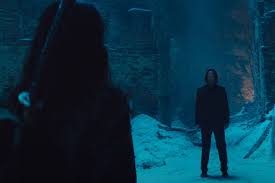
And after going to all that trouble to give Keanu Reeves a fitting sendoff to the company’s greatest franchise a couple of years back, they paid him a lot of money not to shave or get a haircut to come back to help prop it their “new” franchise.
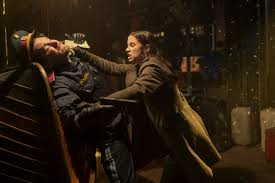
They splurged on epic brawls and bloodbaths that have petite de Armas punching, shooting, stabbing, choking and grenading her character’s way out of jams, cutting through legions of evil “x” scarred assassins in throw-downs, gun battles and a literal “fire” fight.
Stunt coordinators Kyle Gardiner, Jeremy Marinas and Domonkos Párdányi and their vast team earned their Eastern European hazardous duty pay on this one.
But “The World of John Wick” hotels, “tribes,” murder contract infrastucture, “rules” and codes and lots of punchouts don’t really add up to much of a movie. The story’s a mess, the cliches and conventions of this “world of assassins” collide as our heroine keeps tumbling into vast, conveniently unprotected weapons stashes and villains three times her throw-weight who never figure out “Just SIT on her.” Not once.
“Ballerina” rigidly follows the four “John Wick” films formula — a great wrong is committed, vengeance much be obtained because you bad guys messed with the wrong assassin. To get that revenge the hero/heroine must break the rules and conventions of the International and Ancient Order of Assassins of which John Wick is the most infamous member.
He’s the guy his fellow union members fear, the “Baba Yaga,” a “witch” with almost supernatural abilities to dodge bullets, absorb beatings, mow-down legions of bad guys and still stick a champagne glass stem through a foe’s eyesocket as a coup de grace.
“Knives Out” and “Ghosted” veteran de Armas plays a young woman who grew up in a ballet school for bodyguards and killers. Russka Roma is run by a heartless Russian (Anjelica Huston) who makes little Eva dance until her feet bleed.
Then, it’s off to martial arts class and the shooting range, because “one bullet well placed can change the world.”
Eva wound up there because her first killing — at about age 7 — couldn’t save her father when an assassination “cult” headed by The Chancellor (Gabriel Byrne) shows up to kill him.
She learns her profession, and twelve years later, she’s on the job — protecting some clients, killing to fulfill contracts on others.
“All these rules,” she mutters to The Director (Huston) and the hotelier Winston (Ian McShane). “Who do they serve?”
When she sets out to track down Dad’s killers, who have “X” branded on their wrists, she winds up in a Bavarian Alpine village full of killers, we might find out what that tattoo on her back means. Alas, that’s a little off message, when it comes to her bloody and shadowy profession.
“Underworld” veteran Len Wise directs this, a picture whose stunts and fights are impressive enough but whose performances and plot aren’t.
The great thing about the original “John Wick” was the dark humor. You steal a guy’s vintage Mustang and kill his little beagle? You’ve brought the WRATH of SATAN down upon us all!
There’s virtually no humor to “Ballerina” — “You broke my f—ing JAW!” “You’re still USING IT!” — and absolutely no heart.
We’re meant to swallow de Armas as a fiendish fighter who survives a string of stabbings (cauterizing is the new action heroine/hero self-surgery cure-all) and never seems to lose blood or muscle use because of it. Watching her head-butt anything more substantial than a cantaloupe is to laugh.
The idea of making this an “ancient” world means lots of work for actors longer in the tooth like McShane, Huston and the late Lance Reddick, still the concierge at the Hotel Intercontinental over two years after his death.
It also, in this film, gives us a villain who’s a bit creaky and gassed (Byrne). At least that almost makes us forget how bad a child actor is early on, and how unnatural Reeves’ line-readings remain well into his fifth decade in the movies.
Duuuude.
There are fight scene variations in this film that we have never seen the likes of. But hell’s bells, if you’ve sent John Wick off into the sunset, have the guts to not shoehorn him back into this movie with no logic to back up his presence here outside of the check you wrote Reeves to try and prop up a middling movie from the guy whose last big screen feature was a bad remake of “Total Recall.”

Rating: R, graphic, bloody violence and lots of it
Cast: Ana de Armas, Gabriel Byrne, Ian McShane, Catalina Sandino Moreno, Norman Reedus, Lance Reddick, Anjelica Huston and Keanu Reeves
Credits: Directed by Len Wiseman, scripted by Shay Hatten, based on characters and a “world” created by Derek Holstad. Lionsgate release.
Running time: 2:05



















 Movie Nation