Netflixable? “The Yin-Yang Master: Dream of Eternity” only seems that long

“The Yin-Yang Master: Dream of Eternity” is an effects-and-exposition-stuffed character-cluttered Chinese martial arts fantasy — heavy on the fantasy, light on the martial arts.

Dammit.

But rather than let the collage of images above suffice, I suppose I should give you more of a taste of what it’s like lest you invest two hours and twelve minutes of your time unwisely.

There are these priests in ancient Never Never China charged with defending against the Evil Serpent, “the first of all evil things,” whenever it rears its viperous head.

The assorted priests are summoned to the Imperial City to defend it against serpent skullduggery and other demons.

Two of the priests meet cute — and hostile. But you just know a bromance is aborning whenever Qing Ming (Mark Chao) throws down with Boya (Allen Deng),

“You talk the way you fight. Without thinking!”

They’ve all taken on “the austere duty of saving lives,” so they cast protection spells and cope with magical portal incursions into the city and infighting and suspicion in their ranks when people are murdered.

They conjure and fly and fight and meet on digital soundstage dreamscapes, camera circling them as they get profound or romantic or sarcastic.

“Are you saying I’m stupid?” “Sure am!” “Aren’t you the clever one?” “I will NOT be mocked!”

There are these guardians they’re teamed up with to supposedly “capture demon energy.” Is this based on a video game? Anyway, the guardians are whimsically-named Mad Painter, Crimsons Bird, White Tiger, Black Tortoise and Blue Dragon.

“Just my luck. Of all the guardians, I get the Blue Dragon.”

Yup, just your luck.

The effects are fine, although some of the digital landscapes are more convincing than others. The acting is generic and black, more a matter of makeup and costume and slo-mo digital fight choreography than “performance.”

It’s not thrilling, not romantic and lacking either, not much fun at all.

The priest and demonic deaths are impressive, even though the script is such a hash one is inclined to be culturally insensitive and call it “nonsense.”

MPA Rating: TV-14, violence, a little blood

Cast: Mark Chao, Allen Deng, Ziwen Wang, Jessie Li

Credits: Scripted and directed by Jingming Guo. A Netflix release.

Running time: 2:12

Posted in Reviews, previews, profiles and movie news | Comments Off on Netflixable? “The Yin-Yang Master: Dream of Eternity” only seems that long

Documentary Review: “The Act of Reading” (or dodging) “Moby Dick” inspires a film


The personal essay documentary is kind of old-hat now. Everyone who powers up a camera is at least tempted to pull a Michael Moore and make their movie largely about themselves and some sort of personal investigation or journey.

Mark Blumberg’s “The Act of Reading” harks back to the pre-Michael M. origins of the genre, to Ross McElwee’s quirky, droll and revealing personal journey films “Sherman’s March” and “Bright Leaf.” That’s the tone Blumberg goes for here — dry, personally insightful. He doesn’t deliver, but that seems to be his goal.

“Reading” is set up as an act of contrition. Blumberg flunked 11th grade English twenty years ago because he dodged reading “Moby Dick” and failed to file an essay on it. The film endeavors to “finish that book report I should have done for you,” to take us on a journey into the book, maybe show some appreciation of that teacher.

We meet people connected by blood to “Moby Dick’s” author, visit museums with ties to Herman Melville, hear from academics on the importance of reading, learn about dyslexia, see scenes from amateurish plays based on Melville’s life and adapting “Moby Dick,” and we hang with a great teacher in Austin, Texas.

Vicki Hebert wasn’t Blumberg’s teacher. Seeing the way she charms and challenges her high school class — dissecting this 19th century novel, breaking it into component parts, parsing characters and many a revealing sentence from the book, donning a facial tattoo in the style of Queequeg the harpoonist from the story — we can infer that maybe Blumberg would’ve read the damned thing had she been his teacher.

That could have been his organizing outline. And maybe his debut feature documentary wouldn’t be so scattered, indulgent and flat-footed.

The classroom material is rich, with Hebert facing the “mutiny in class” that she’s seen every other time she’s taught the novel, a “Why are you making us do this?” day. Kids break into study groups or fumble about in the darkness of the prose on their own. Or give up and go jump on their trampoline.

Blumberg frequently cuts into the annual New Bedford Whaling Museum “marathon reading” of “Moby Dick,” scores of fans watching, listening and pitching in to read the novel aloud, start to finish on a snowy winter’s weekend.

That’s where he meets Peter Gansevoort Whittemore, great great grandson of the author, a guy who takes his heritage seriously even as he jokes he’d never own up to that in high school “because everybody in school HATED ‘Moby Dick.'”

Blumberg’s wife also meets a Melville descendant, a yoga teacher and aspiring playwright named Elizabeth Doss, who scripted a play of the author’s life, imagining him as a woman as she struggled with marriage and getting the book into a publishable form.

Doss and Blumberg’s wife act out some of this play.

That isn’t really where this film went off the rails for me, but it hints at the mission creep to come. We meet the extended Blumberg family at dinner, drift off to a series of brother-to-brother chats where Blumberg finds out why his nurse/paddle-boarder sibling “never reads.” “Dyslexia” is his (self) diagnosis.

So we wander off into an exploration of that.

We’re treated to some on-the-spectrum/way-off-topic bickering in the filmmaker’s marriage, and ponder our clean-cut protagonist/director in fresh ways.

And we wonder what happened to the promising idea of “finishing the essay” on the book he long-ago promised his teacher, Janet Werner, a mea culpa picture that celebrates teachers, reading, a book that’s “required” and tough but dense, decipherable and the very definition of “literary fiction.”

Because that movie, with a sheepish protagonist humbled by his past and humbled further by learning about this book, why reading matters, why kids fear it and critics and academics now exalt it, would be worth watching.

The fact that he re-gathers his family, who tell him that very fact to his face over dinner for the finale, isn’t funny or cute and doesn’t let him off the hook, either.

MPA Rating: unrated, profanity

Cast: Vicki Hebert, Riccardo Pitts-Wiley, Janet Werner, Peter Gansevoort Whittemore, Elizabeth Doss, John Cleary, Maryanne Wolfe, Mark Blumberg and family

Credits: Directed by Mark Blumberg. A Barrow House release.

Posted in Reviews, previews, profiles and movie news | Comments Off on Documentary Review: “The Act of Reading” (or dodging) “Moby Dick” inspires a film

Movie Review: Robin Wright lives off the “Land” and off-the-grid

Robin Wright’s directing debut has a quiet, Earthy elegance about it that mirrors our image of the her as an actress and a public figure. “Land” takes the director and leading lady out of her natural milieu and puts her in nature in a spare, simple parable about the healing power of solitude.

We don’t hear her name, not straight away. But we do see her suffering, riven by grief, visiting a therapist. The hoary bromides, “reach out to people” and get them to help you cope won’t work here.

“Why would I want anyone else to feel this?”

Her sister (Kim Dickens) sees it, too and struggles to get a promise — Please…”don’t hurt yourself…for me.

But Emma, as she eventually reveals, has come to a decision. We see the closing at the realtor’s (Brad Leland), the rented SUV and U-Haul, and follow them as she heads to the Unibomber-remote cabin she’s bought in the mountains of Wyoming.

“You shouldn’t have any problems with trespassers,” the grizzled real estate agent jokes. She didn’t have to tell him what she’s told others. “It’s really difficult to be around other people.”

She seems out of her depth and naive to the agent, utterly underestimating the off-the-grid lifestyle she’s about to immerse herself in. But she’s got her few possessions, a not-quite weatherproof long-empty cabin, a “Game Processing Handbook” and a little other literature to guide her.

Fishing? Setting snares for trapping? Planting a garden? No problem. She’s got canned goods to survive on until that works out.

But we’ve seen her ditch her cell phone and send the rent truck back to town. She is beyond assistance when things go wrong.

The first “accident” isn’t fatal. The second mishap involves a bear visit. She dreams of a husband and child that are no longer with her, ghosts she packed for her move. Before long, those are hunger-driven hallucinations.

Good thing the handsome trapper (Demián Bichir) stumbles over her. Good thing he knows an above-the-call-of-duty nurse (Sarah Dawn Pledge).

The screenplay by Jesse Chatham and Erin Dignam is a cut-and-paste collection of archetypes marching stoically through a trail of “suffering in solitude” tropes. These were around long before Grizzly Adams taught Mountain Man ways to “Jeremiah Johnson,” before the Old Mariner instructed Josh Lucas sailboat living for his “Year in Mooring.”

Movies like this undersell the drudgery of surviving on your own. PBS did a series, “Frontier House,” that laid out the grueling math of simple firewood stockpiling. It’s exhausting and never-ending, as is getting water, killing game.

Such tales are on surer ground underscoring a single harsh truth. “The grieving process” might be the cruelest euphemism in the psychotherapist’s playbook.

Wright’s beautiful film features elegantly-composed shots, many of them “magic hour” sunsets with our heroine sipping her coffee or taking a tub bath outdoors in the golden light.

The acting is superb and spare, as you might expect. Wright could run an acting school and the cinema would be the richer for it. Here, it’s not just her but her co-stars who master understatement. Sarah Dawn Pledge is the least experienced of the lot and gets across big emotions and realizations in a single, simple look or gesture. Dazzling.

The formidable Bechir fills those Sage of the Mountains boots with ease.

“Only a person who has never been hungry would think starving is a good way to die.”

“Why are you helping me?” “You are in my path.”

But if you’re looking for surprises, look elsewhere. As a fan of this “Wild,””Into the Wild,” “All is Lost,” survival genre, I can say there is nothing here you can’t see coming, not from that breathtaking mountainside vantage point.

MPA Rating: PG-13 for thematic content, brief strong language, and partial nudity |

Cast: Robin Wright, Demián Bichir, Sarah Dawn Pledge, Kim Dickens and Brad Leland

Credits: Directed by Robin Wright, script by Jesse Chatham, Erin Dignam. A Focus Features release.

Running time: 1:29

Posted in Reviews, previews, profiles and movie news | Comments Off on Movie Review: Robin Wright lives off the “Land” and off-the-grid

Movie Preview: An Asian American kid has hoop dreams — “Boogie”

Posted in Reviews, previews, profiles and movie news | Comments Off on Movie Preview: An Asian American kid has hoop dreams — “Boogie”

Movie Preview: A vision of Apocalypse Soon,” “TIDES”

Dystopian enough for you?

Iain Glenn is the one face and voice I recognize in this Berlin FF premiere. Striking to look at. https://youtu.be/hw0m4B6UkHA

Posted in Reviews, previews, profiles and movie news | Comments Off on Movie Preview: A vision of Apocalypse Soon,” “TIDES”

Documentary Review: “Bullied” gets at WHY it happens among schoolkids

Back in a simpler or — let’s face it — more “simplistic” time, we didn’t seem to have this “bullying” problem that has taken hold of the national consciousness this past decade.

We thought we understood “Bullying is bad” as a culture. Movies from the dawn of Hollywood reinforced an idea that became a national credo, and even worked its way into our foreign policy.

How was Hitler described to us? A bully. We all got it. You don’t let a bully get away with it

From FDR and Jimmy Stewart’s “Destry” to Andy Griffith and columnist Mike Royko, the lesson was always the same. You stand up to bullies. They come for you, you “aim for the nose” Royko remembered his old man lecturing him.

But something has shifted in the culture, and that’s one of the threads tugged at in “Bullied,” the latest documentary on this subject.

Some of what we and who we see in “Bullied” is so familiar that you may confuse Professor Thomas Keith’s film with “Bully” or other films on the subject.

But where this collection of interviews, of schoolyard and school bus cell phone videos, CCTV footage, reality TV and Donald Trump rallies breaks from the pack is looking at root causes of bullying and trying yet another version of “What we can do about it” solutions.

Keith, who teaches Philosophy and Gender Studies at Cal State Polytechnic, gives us more anecdotes from grieving parents whose bullied children died — often at their own hands — and traumatized kids talking about facing bullying even now.

He also rounded up scores of academics as well as parents turned activists and media analysts to talk about “Why kids bully” in addition to repeating the awful statistics on teen suicides spiking in an age of cyber-bullying and five years of relentless coverage of a “Bully in Chief.”

Yes, it’s another thing that got a lot worse during the Trump years.

We hear about “Bully Culture,” how it is born because “bullying is a route to popularity…Kids would not bully if there was not a social benefit.”

Who gets bullied? Kids who don’t conform — “any minority,” Black or Hispanic or “foreign” or “LGBTQ” or the disabled or “on the spectrum” children with “social deficit” issues.

Why is such such a problem in youth? Because the “impulse control” area of the brain — the pre-frontal cortex — is the last part to develop.

Not that plenty of people never outgrow that impulse control. It’s almost triggering to see the athletes, coaches, rappers and others captured on tape name-calling, threatening, gay bashing and picking fights.

We see examples of “Bully Media,” from faux tough-guy Trump’s taunts from various podiums to reality TV’s other textbook illusion of conflict, the idea from assorted “Real Housewives” shows that “women (going) at each other is a natural state,” reinforced by faked, dramatized conflicts on every show in the Andy Cohen empire.

The controversial and canceled Netflix adaptation of the book “13 Reasons Why,” about bullying and why a character kills herself, is linked directly in a “Here’s how to kill yourself as a way out” connection to the suicides of bullied teens.

As this review suggests, “Bullied” covers new ground even as it feels, at times, as if it’s all over the place. Remember, an academic made it, not a professional filmmaker.

It’s still a useful addition to the national conversation, even if we’ve lost that cultural cohesion that recognized this hateful practice as wrong, to be resisted at every age, even when it’s a rich, incompetent businessman who never got in a real fight in his entitled life who lied and cheated his way into the Oval Office.

MPA Rating: unrated, violence

Cast:  Ron Avi AstorJennifer DavisKimya Dennis, Kirk Smalley, Eric James Borges, Thomas Keith, many others.

Credits: Directed by Thomas Keith. A Majestas Group release.

Running time: 1:07

Posted in Reviews, previews, profiles and movie news | Comments Off on Documentary Review: “Bullied” gets at WHY it happens among schoolkids

Netflixable? A prison bus thriller with a “Below Zero (Bajocero)” chill

A lot of thrillers begin with or feature a prison-bus break-out as a signature scene — “48 Hrs.” and “The Fugitive,” for instance. But here’s one that’s all about the break-out, or break-in depending on your point of view.

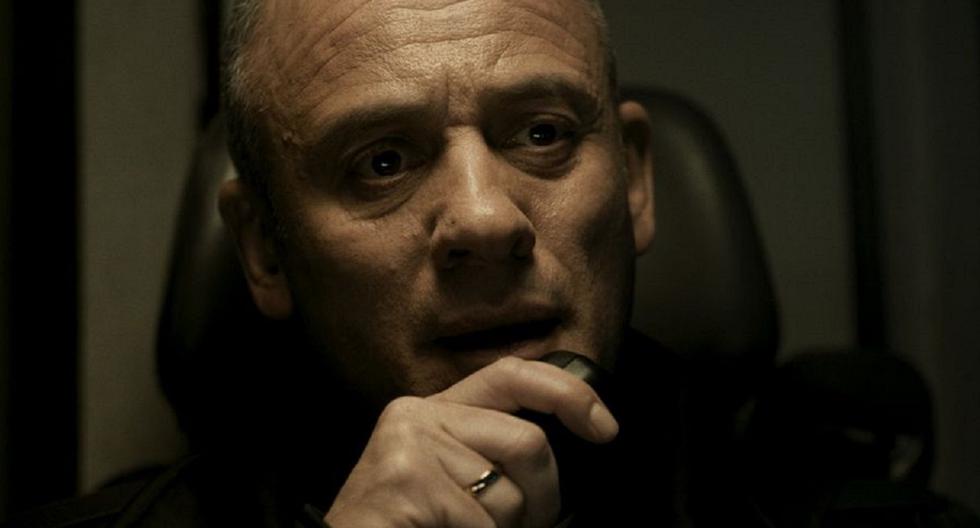
“Below Zero (Bajocero)” is a simple, brutal and harrowing Spanish thriller about an assault on a prison transport bus outbound from Cuenca in the harsh Spanish winter. Director and co-writer Lluís Quílez (“Out of the Dark”) throws misdirection plays at us that bely its simplicity and reliance on basically one location to make an action feature with quirky characters that set up quirkier twists.

That location is the interior of a maximum security prison bus, basically an “armored bunker” on wheels as the driver Martín (Javier Gutiérrez) declares, at one point. He’s a veteran cop on his first “transfer” in a long time.

He’s a family man teamed-up with the brutish Montesinos (Isak Férriz) to haul six dangerous inmates from one prison to another. “Discretion” and “surprise” dictate that they do this in the middle of the night.

But as we see the inmates rounded up to leave, we see one procure a key, and hide it even where a strip search won’t give it away. Ahem.

Montesinos is brusque, no nonsense, inclined to throw his weight around. Martín is the “rules aren’t there to be ‘relaxed'” and “You can’t beat up every dirtbag who gets in your face” stickler.

We’ll see who’s the smarter cop and who’s tougher when the bus is waylaid on a foggy surface road on this longest night of their lives.

The inmates are a colorful crew of varying ages and “types.” The dangerous Romanian human trafficker Mihei (Florin Opritescu) is the one they’re most worried about. Motor-mouthed Gollum (Andrés Gertrúdix) is a nuisance, young Nano (Patrick Criado) has as many tattoos as any of them, aged Pardo (Miquel Gelabert) is in for some major financial crime, tough-as-nails Rei (Édgar Vittorino) simmers in silence, unless you bring up his sister.

And then there’s the cunning and charismatic older con (Luis Callejo), who insists on going by (in Spanish with English subtitles) “my stage name, Ramis.” Like the rest, Ramis promises to be a handful. That’s why each has his own steel-walled cell for the ride.

And then the ride is intercepted. Do we know who pulled this off, “took care” of the escort police cruiser and blew out a tire? Do “they” know who has come to release them, or just one of them, with the possibility the attackers will kill everyone else on board?

After a few seriously illogical moments setting up this backroad hijacking, leaving wounded Martín on his own with six dangerous men, “Below Zero” settles in to a siege filled with surprises.

Callejo, who was Joseph in the Biblical thriller “Risen,” makes a colorful creep who can’t be trusted, even if he’s showing you his hand.

Gutiérrez, a Netflix staple thanks to “Assassin’s Creed,” “The Motive,” “Marshlands” and “The Occupant,” makes a believably over-matched cop who finds the nerve to bluff when his life is on the line.

But as “types,” these characters are all just “Who dies or lies next?” pawns to be played with in the Fernando Navarro and Quílez screenplay, one that considers every way to get into and out of a locked “armored bunker” with whoever’s trying to get at them outside, and a dozen ways to die inside.

It’s no “48 Hrs.” or “Fugitive,” but “Below Zero” is a good one, with or without subtitles.

MPA Rating: TV-MA, graphic violence, profanity,

Cast: Javier Gutiérrez, Isak Férriz, Florin Opritescu, Karra Elejalde, Andrés Gertrúdix, Patrick Criado, Miquel Gelabert, Édgar Vittorino and Luis Callejo

Credits: Directed by Lluís Quílez, script by Fernando Navarro, Lluís Quílez. A Moreno Films release on Netflix.

Running time: 1:46

Posted in Reviews, previews, profiles and movie news | Comments Off on Netflixable? A prison bus thriller with a “Below Zero (Bajocero)” chill

Movie Review: A romance shaken by “date rape” — “Test Pattern”

test2

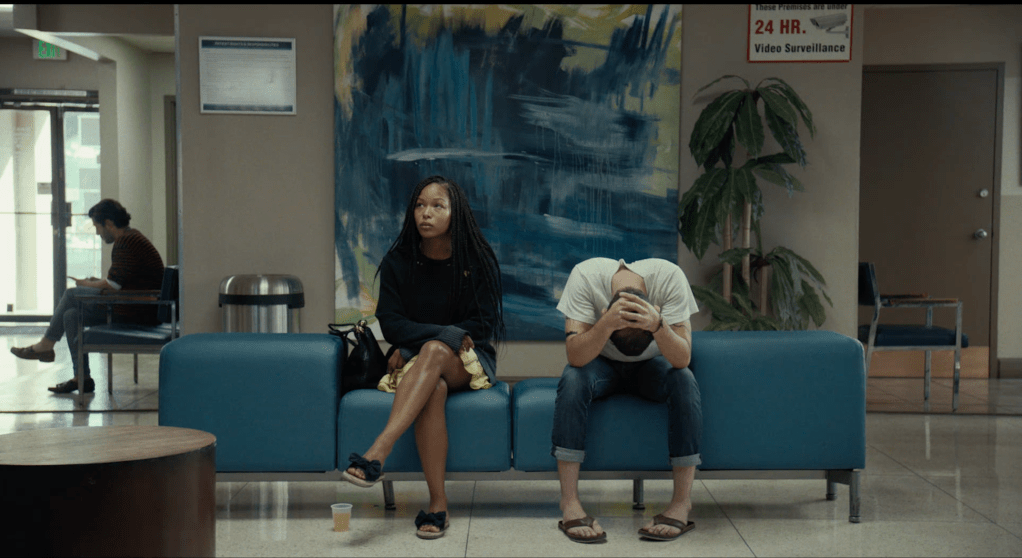
Writer-director Shatara Michelle Ford’s debut feature is as sober a treatment of the “date rape” drug experience as the cinema has ever shown us. “Test Pattern” captures the “how,” immerses us in the “now” and shows us the lives brought to a standstill by the experience and the soul-crushing systemic failures of the aftermath.

What Renisha (Brittany S. Hall) sees in Evan (Will Brill) that first night at an Austin bar is anybody’s guess. She’s beautiful, put-together, with an electric smile and a ready laugh. And she’s just there for a girls’ night out, dancing and drinks.

But one look, one dance and awkward, underdressed, unshaven and slightly balding Evan has to have her number. Even though he has no clue how to go about it, even though his clumsy approach isn’t particularly charming, she consents.

There’s “consent” a few dates later, too.

An interracial couple is born. We see that first date, hear her ambitions and learn he’s a tattooist. But just as we’re underlining our “out of his league and class” biases, raising an eyebrow on the mismatch — which has a whiff of white privilege about it — Evan delivers one of those compliments that stick. He won’t hear of her belittling her hope to “help” people and society in a future job.

“I feel like you always know what you’re talking about.”

A doting love affair, with breakfasts of “Your favorite,” affirming “I love yous” in every good-bye, cohabitation, new “ink” and new braids for her and the supportive confidence that has her in a new development director job at a non-profit, they’re destined to be together.

And then “that night” happens.

test1

Ford takes great pains to show us ways you don’t need a “date” for “date rape” to happen. The way it plays out here is quietly heart-breaking, good judgement overruled by a pushy friend and the pushy guys whom the pushy friend doesn’t see as a threat.

Drugs are involved. Ford and her leading lady make us experience the dazed, reduced-capacity inability to respond and escape, the confusion and the guilt.

How will Evan respond to this test? How will “the system?”

Using flashbacks to show telling moments in Renisha and Evan’s relationship, Ford hints at the blur of emotions sweeping over her heroine. And Hall makes us feel much of what Renisha does, a wide spectrum ranging from embarrassed resignation to humiliation to frustration.

Ford has made a downbeat, realistic treatment of this subject that doesn’t have a built-in call-to-arms as part of its make-up. That’s implied. Nobody, no couples, should have to go through this.

MPA Rating: Unrated, adult subject matter, alcohol and drug use

Cast: Brittany S. Hall, Will Brill, Gail Bean

Credits: Written and directed by Shatara Michelle Ford. A Kino Lorber release.

Running time: 1:23

Posted in Reviews, previews, profiles and movie news | Comments Off on Movie Review: A romance shaken by “date rape” — “Test Pattern”

Lynn Stalmaster, the Master Casting Director, dies at 93

They don’t hand out Oscars to every casting director, the person who puts pictures and names in front of filmmakers to give them ideas of how to turn their scripted characters into flesh and blood actors.

Lynn Stalmaster, “The Master Caster,” the most famous person ever to do this job, got one. The guy who cast “Superman,” “Tootsie,” “In the Heat of the Night” and scores of iconic films, has died. He was 93.

Look at that list of credits. Got to meet him once, as a cub reporter, and he pointed out the obvious — that no, he didn’t put Brando in “Superman” or Michelle in “To Gillian on Her 37th Birthday.” Stars are typically brainstormed by writers, directors and producers.

Casting directors can join in on that brainstorming and have a ready supply of ideas and glossy photos (back then) to show to filmmakers as suggestions that they’ve gleaned from reading the script.

And everybody who isn’t Dustin Hoffman or Pollack on “Tootsie” — maybe even Jessica Lange — came out of Stalmaster’s suggestions, arranged auditions and the like.

Look at that list of credits and smile.

Posted in Reviews, previews, profiles and movie news | Comments Off on Lynn Stalmaster, the Master Casting Director, dies at 93

Movie Review: Ponder the Sci-fi Paranoia of “Lapsis”

Here’s a good measure by how original a film is. How hard is it to come up with analogues, other titles this picture reminds you of?

The deftly paranoid indie “Lapsis” had me flashing back to “Brazil” and “Safety Not Guaranteed,” not that either of those films has that much in common with its story or style of storytelling.

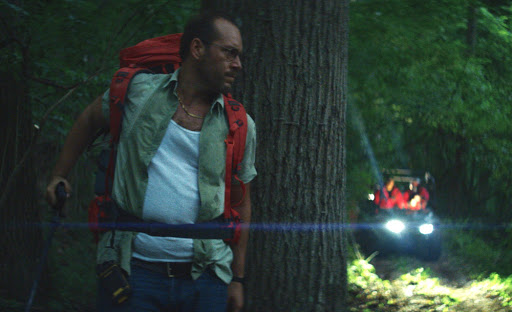
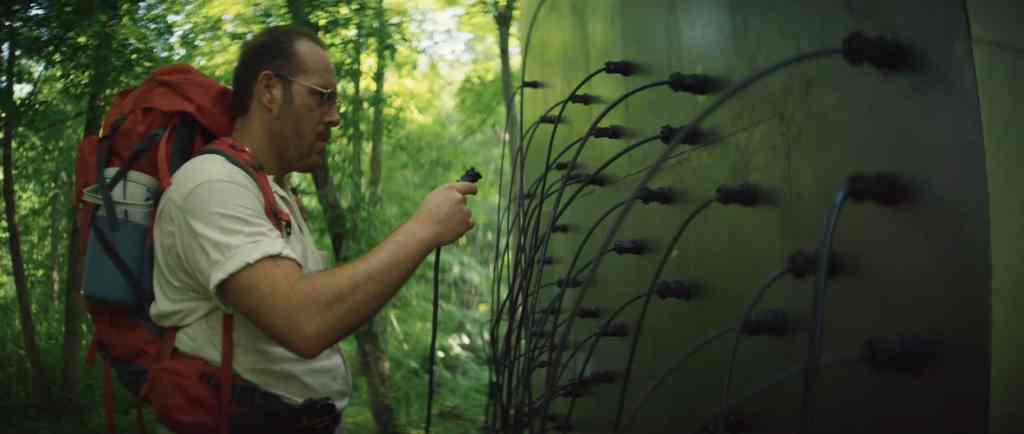
It’s about people hired by this megalithic cable corporation to tow tiny trailers unspooling wiring as they follow their phones’ GPS directions to these cube-shaped monoliths, tucked away in state parks. They plug in and “make a connection.” This allows encrypted, secure communication to speed up stock trading. Apparently.

But what it’s really about it is the traps of modern life. It’s a lucrative, exhausting menial job in which “cablers” are monitored constantly and in competition with cable-towing robots. Everything about it is sketchy, from the hustlers who pitch it at “cabler” fairs, those who trade “medallions” that certify you for the work to the supervisors who send you to a suburban ranch-style house’s garage for your gear and even the manner of payment — cash can be elusive, “points” are not.

There’s a new illness spreading, “Omnia,” another “Chronic Fatigue Syndrome” going around that prompts those who don’t have it to say, “Isn’t that the thing that’s all made up?”

That’s what Ray’s little brother Jamie has. That’s what has Ray (Dean Imperial) looking for something more lucrative than his airline luggage-delivery service gig, because Jamie (Babe Howard) needs to go to a very pricy clinic for treatment.

Health care is not a human right in this alternate reality, either.

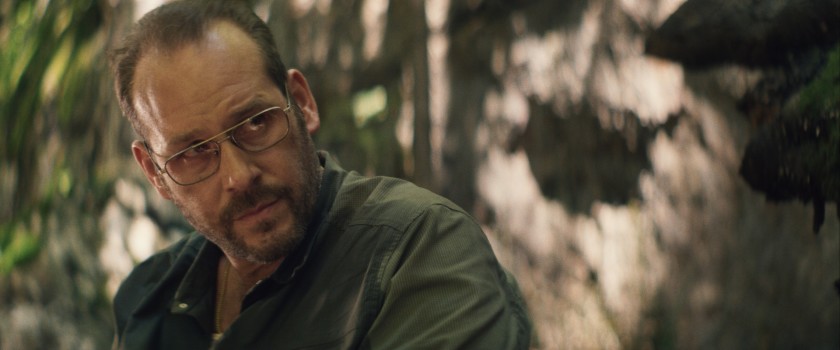
A few words about Mr. Imperial. You’ve never seen him in anything. He was a writer for TV’s “Imposters.” He’s balding, with a middle-aged spread, mustachioed and always three days since his last desperately-needed shave.

And he sounds just like James Gandolfini. I mean DEAD ringer. If anybody out there in Internetland wants to create a “Further Adventures of Tony Soprano” podcast, here’s your guy.

Ray has, a stranger tells him on first meeting, “a ’70s mobster vibe going on.” Naturally he lives in Queens.

But as tough and streetsmart as he can seem, Ray’s got a lot of questions for the wide-eyed pitchwomen and pitchmen staffing the booths at the cabler’s trade fair/symposium and training session.

“Is it, for sure, safe?”

They assure him it is, without noting how out of shape he is and how in-shape he may need to be. They say nothing of cablers who’re “unjustly detained or penalized.”

And nobody, not them, the tech who shows a room full of cablers a staticky old “training” video, and not Felix (James McDaniel) who sells Rsy a previously-used “medallion,” the one with the “trail name” “Lapsis Beeftec,” can wholly explain this technology, why it’s needed in a wireless age and why all this cabling is done in the woods by women and men who march hither and yon all day and sometimes into the night on “routes” to the next “Quantum” cabling interface cube.

“I don’t know what they hell’s going on!”

On the trail, his friendly but wary fellow cablers start to fill him in. It’s not until he runs into the serenely cynical and “cabler”-wise Anna (Madeline Wise) that he and we start to get some answers, but even then it’s not remotely completely clear.

As nothing I’ve described to you costs more than a short trip to a Lowes, an REI (camping gear and backpacks) and a still-operating Radio Shack, you can tell this is sci-fi of the mind, not the budget. Noah Hutton’s film isn’t about the tech or even the story, it’s about “this strange unaccountable feeling,” as Douglas Adams once wrote, “that something was going on in the world, something big, even sinister, and no one would tell me what it was.”

Is Jamie’s illness “real” or a product of the medical/pharmaceutical complex? The upselling that goes on at his “clinic” (Arliss Howard plays the doctor/used-car salesman running it) makes Ray wonder.

Is everyone having a “Quantum computer” really necessary? It’s a “planned obsolescence” trap with government in on this required “upgrade,” basically insisting that you have it — like HDTV or Turbotax. If you don’t buy in, you’re all but stuck in an alternate reality.

There’s a “sold my soul to the company store” vibe about “Lapsis,” this sense that people are lured in, pulled into debt slavery, laboring at seemingly well-paid menial labor just to pay debts that have been conjured up by a rigged system — a bit like the rising, entrapping debt of banks, insurers and cell phone companies.

But this being a movie, maybe SOMEbody knows what’s really going on and SOME people are conspiring to do something about it.

One last analogy here might by the no-budget sci-fi “Primer,” not an iconic title in the genre, but minimalist science fiction that sticks with you for years and gives you a lot to chew on.

That’s Hutton’s gift of “Lapsis,” a puzzling picture that challenges, leaves out “all the answers” and serves up Tony Soprano-lite as our intrepid, in-over-his-head tour guide through a hell of our own creation.

MPA Rating: unrated, profanity

Cast: Dean Imperial, Madeline Wise, Babe Howard, James McDaniel, Ivory Aquino, Dora Madison and Arliss Howard

Credits: Scripted and directed by Noah Hutton. A Film Movement Plus release.

Running time: 1:44

Posted in Reviews, previews, profiles and movie news | Comments Off on Movie Review: Ponder the Sci-fi Paranoia of “Lapsis”