Yes, that headline’s accurate, and sure, it’s a tease.
But that plot description of “Lamb” means something far more sinister now than it did in 1985, when this British production was released.
It’s a disturbing and odd drama about a young priest, played by a very young and lean Liam Neeson, who has a crisis of faith brought on by his work.
Brother Sebastian teaches at St. Kiaran’s School, a windswept, cliffside pile facing the howling Atlantic (actually the King Arthur’s Castle Hotel, Tintagel, Cornwall). He’s still young and idealistic enough to be sympathetic to his charges at this Catholic reform school. But he has to turn something of a blind eye to the heaping helpings of corporal punishment handed out by the older priests.
The arrival of tiny, troubled Owen Kane (Hugh O’Conor, who went on to play young Christy Brown in “My Left Foot,” and Coleridge in the recent “Mary Shelley”) opens that blind eye. The kid’s callous mother has given up on the ten-year-old’s backtalking, smoking, thieving and cursing ways. Not to worry, Brother Benedict (Ian Bannen) purrs. They’ll straighten him out.
Sebastian hears the boy’s sad story in counseling sessions and is appalled when the tiniest lad in the school is whipped for graffiti he couldn’t have drawn. Because he’s too bloody short. Brother Benedict is all understanding chuckles and shrugs — “as long as we punish SOMEone.”
“It’s the stick that shows we care,” he insists. “And if you use it, be sure to HURT’em!”
When Brother Sebastian’s father dies and leaves him a little money, his second thoughts about this vocation become more obvious. That leads to veiled threats from Benedict, who has the smug certainty of a goon in a theocratic Catholic state where the Church has influence everywhere. Has his eye on that inheritance, I dare say.
That’s what triggers the rash, half-planned escape. Sebastian will spirit away the child, go back to being Michael Lamb (his name before taking his vows) and go on the lam. Their travels will take them to Dublin and London, put Michael in one fix after another as he has to pose as the lad’s father, find a job and keep nosy members of the Irish diaspora from figuring out who they are.
There’s a lot of “Just what the hell is going on here?” tossed in with the obvious “What was he thinking?” in “Lamb.”
It’s a British production in the mid-80s, so the take on Catholicism and Irishness in general wasn’t going to be pre Good Friday Accords generous. Michael takes a construction job where other Irish workers (in London) ask if he’s “one of THEM” or “one of US” when he lies and says he’s from “The North.”
Bannen’s priest is almost comically sadistic, as if hinting at the horrors of Catholic orphanages and “laundries” in Catholic Ireland, crimes and injustices that would only come to light later.
Director Colin Gregg (“We Think the World Of You”), adapting a Bernard MacLaverty novel, keeps us guessing, and not in flattering ways. It’s a story that paints itself into a corner and limits itself to setting fire to the house that corner is in for its resolution.
Neeson shows the leading man promise that would only bear fruit a couple of years later, stealing “A Prayer for the Dying” from Mickey Rourke and “Suspect” from Cher. But we get little sense of his character’s impulsiveness in any of the earlier scenes here. His father’s pride in him joining a religious order is obvious. Why would he throw all that away? His “planning” seems limited to telling the boy to pack, stealing the school van and stopping at the first jewelers’ he sees to buy a fake wedding ring for his cover story.
As they take off on this rash odyssey, the overarching impression is naive, poor and unworldly — a young man who never learned the ways of the world and puts it all off on being “another stupid Irishman.” Poverty’s more like it, mate.
The movie’s melodramatic flourishes include Owen’s epilepsy and Michael’s constant use of the phrase, “Wait here, Owen.” Owen is troubled, with a serious health condition and zero impulse control. What could go wrong?
The kid is a foul-mouthed wonder, and between his profanity and Bannen’s twinkling sadism, “Lamb” flirts with being a comedy, here and there.
It isn’t. And more’s the pity. The stiff, symbolic crisis-of-conscience/priest-goes-mad drama doesn’t play, not today, anyway.
MPA Rating: unrated, smoking, profanity
Cast: Liam Neeson, Hugh O’Conor, Ian Bannen
Credits: Directed by Colin Gregg, script by Bernard MacLaverty, based on his novel. A FilmFour release.
It isn’t often that a documentary lumped under the general “nature film” label fundamentally changes our view of an animal, its environment and the natural world. I doubt many of those who labor in this science museum/ BBC/ “Nature” and Discovery Channel corner of the cinema harbor such expectations for their work.
But the gorgeous and almost shockingly moving “My Octopus Teacher” does just that, something that sets it so far above its genre that it might very well be the Oscar favorite for Best Documentary, judging from its many other awards.
South African cinematographer Craig Foster narrates the film and describes the burnout he was going through prior to taking his camera into the waters off the western Cape of Storms in his homeland. His prior work was almost entirely in the bush among the hunting cultures of Africa, and like all such films, required years of commitment and embedding and labor.
But snorkeling off the coast in “some of the wildest, most scary places to swim on the planet” gave him hints of that hunter’s cunning in the small, wonderfully-camouflaged octopus — the tracking, tricks, disguises and tactics it uses to hunt prey or avoid the “pyjama sharks” that are its primary predator. And as there’s precious little research of octopi in the wild, he set out to film an octopus “every day” for months on end and see what he’d learn.
He sees it as “a liquid animal,” and marvels at its ability to pick up shells and cover itself in them — dozens at times — to hide from prey or predators. It’s “an animal that has spent millions of years learning how to be impossible to find.”
Foster returns to the sea for hundreds of days and learns to “track” the octopus via the snail, crab and lobster shells it leaves behind after meals. He watches it reason through strategies in how to track and trap such creatures and sees its life-and-death struggle to avoid the long, cunning pyjama sharks.
And he breaks the human/animal barrier, getting close, letting the octopus check him out. He asks the question we want to ask at the moment we decide its worth asking.
“What is the octopus getting out of this” interaction?
His answer surprises us and upends some of the science on these “alien” creatures that seem a lot smarter and more social, despite their solitary existence, than anybody knew.
“My Octopus Teacher” has some of the most stunning underwater footage — of the churning kelp forest under the seas of the Western Cape — ever filmed.
If they gave out Oscars for degree of difficulty, this film would be a shoo-in. Even the equally enlightening and uplifting “Crip Camp” wouldn’t stand a chance by that yardstick. If you’ve ever snorkeled, you know how impossible getting all this footage between gulps of breath must have been.
Thankfully for us, Foster has the lungs, the eye and the heart to stick with this story, to tell it and to change the way we look at the natural world, all through the lessons of an octopus.
“Journey’s End” is the sort of movie we had every reason to expect Sam Mendes’ “1917” to be.
A remake of a 1930 James Whale film, when The Great War was fresh trauma for those who lived through it, itself an adaptation of a novel that was turned into a play, it has a marvelous claustrophobia, myopia and fatalism that was a part of the shared experience of those who endured trench warfare.
The mere fact that it could be turned into a play speaks volumes. Mendes’ sweeping, painterly film seems almost a fantasia of the war by comparison, two infantrymen out to deliver a message passing through a veritable Dante’s Inferno of the WWI No Man’s Landscape — complete with a nursing French mother trapped between the lines and a fighter plane crash.
“Journey’s End” is in the mud, in the holes in the mud, and there it remains.
“Journey’s End” follows a young prep school Lieutenant (Asa Butterfield, quite good) who shows up, a cockeyed optimist, willing to pull family strings (an uncle general) to get into the unit of an old family friend. It’s March of 1918, and Lt. Raleigh may be arriving mere months before the “End.” But the last gasp German “Spring Offensive” (“Kaiserschlacht”) is about to start. And requesting assignment to Captain Stanhope’s company, in the part of the line the Germans are massing to overrun? It’s your funeral, nephew.
Stanhope (Sam Claflin, outstanding) is almost furious at seeing this kid, the brother of a lady friend. He is short-tempered and drinking too much, lashing out at the cook (Toby Jones, of course), seething at the shell-shock of a subordinate (Tom Sturridge) and barely containing his contempt at the series of suicidal orders he’s receiving from on high.
Stanhope is every bit as aware as Hibbert (Sturridge) of the futility and waste of it all, more aware than the head-down, get-on-with-the-job Lt. Trotter (Stephen Graham). But if Stanhope shows fear or fatalism, morale will collapse and even more of Company C will be buried in the No Man’s Land of France.
Only the “much older man” they all call “Uncle,” Lt. Osborne (Paul Bettany, perfect) displays the steadiness of nerve that bucks up Stanhope and the rest. He’s not a hero, not some super patriot committed to the cause. He’s a stoic, a fatalist.
“”They stick at it. It’s the only thing a decent man can do.” Still, even he admits “Every little noise up there makes me feel sick.”
Theirs is a world of dugout and ditch — a bunker where they sleep, eat, drink and bicker, the trenches where all the men — especially the too-tall Lt. Obsorne — have to remember to duck at all times.
Snipers, machine gunners, artillery and the constant fear of gas are their daily routine. And with the collapse of Russia on the Eastern Front, the Germans are prepping for a rushed offensive to knock out the Allies before the American army is at full strength and in position to turn the tide.
If you read the plot and character descriptions above, you see the shortcomings of this Saul Dibb film, which was shot in Wales. It may have beaten “1917” into theaters, actually coming out on the 100th anniversary of the very battle it depicts. But it’s entirely conventional. The characters have become “stock” types, the setting is the setting of pretty much every World War I movie that isn’t about aviators or Africa. And the very claustrophobia it recreates is standard issue “All Quiet on the Western Front” boilerplate.
Stanhope’s rages and resentments, the naivete of “the boy,” the servile, knows-his-place cook and the “much older man” who is the sage of trenches are all “types.”
“1917” was so incident and action-packed as to be a fantasy version of the war. “War Horse” brought the scale of the suffering and stupidity of all home as well in a Spielberg-pretty nightmare.
“Journey’s End” is vivid, just visceral enough and has its moving moments. But it’s more like a poem we memorized in school, the stanzas brought back by a familiar line or character that’s entered common currency. Incapable of surprise, it settles for discomfiting comfort in the familiar.
MPA Rating: R, for some language and war images
Cast: Sam Claflin, Asa Butterfield, Tom Sturridge, Toby Jones, Stephen Graham and Paul Bettany
Credits: Directed by Saul Dibb, script by Simon Reade, based on the novel and play by R.C. Sheriff and Vernon Bartlett. A Lionsgate/Good Deed release, now streaming.
Gruesome violence and grisly backwoods “surgery,” blood and stitches and axes and arrows, sharp stone shards left as booby-traps for the unwary dominate “In the Earth.”
Kind of what you’d expect from a thriller built around mycorrhizal research deep in the forests of Britain, eh?
The pandemic picture from the director of “Free Fire,” “High Rise” and “Sight Seers” goes back to that earliest film, just in terms of setting and simplicity.
A contagion is decimating the planet. Scientists are looking for cures, scouring nature in search of medicinal plant life. But one scientist in particular is onto something even more amazing.
Joel Fry stars as Martin, a researcher who has trekked to Gantalow Lodge in Britain’s woodlands to pitch in. It’s been turned into a research station, with rigid testing/disinfectant protocols, the works. And that’s just getting in the door. Martin is must be guided, on foot, deep into the forest to meet a former colleague. Dr. Wendell, encamped two days walk away, hasn’t been heard from in months.
Another researcher, Alma (Ellora Torchia) will be his guide. The virus that is killing people everywhere is still “outside,” in the cities and towns. But here in the woods, something altogether weirder is going on.
“People get a bit funny in the woods,” is one sage’s suggestion.
Foreshadowing? Let’s talk about the forest creature of local lore, “Parnag Fegg,” something Alma’s read a bit about. But when things go sideways on their hike — abandoned campsites, odd noises, a midnight mugging, help from a mysterious survivalist named Zach (Reece Shearsmith) — it certainly seems like humans devolving into animals in a societal breakdown is to blame.
Writer-director Ben Wheatley takes an almost sadistic pleasure in setting up and showing, in excruciating detail, the gory injuries and gorier “treatments” that these hapless city folk face in those spooky woods.
There’s a neat inversion of “types,” with the women of the story (Hayley Squires plays our reclusive, encamped researcher) responsible for driving the plot through their own agency. as we use the term in cinema these days. Fry’s Martin is passive in their presence.
There’s not an awful lot here, but this may be the best of the “pandemic” movies — science fiction and horror that is both “of” this moment, and a parable about it.
MPA Rating: R for strong violent content, grisly images, and language
Cast: Joel Fry, Ellora Torchia, Hayley Squires and Reece Shearsmith
Credits: Scripted and directed by Ben Wheatley. A Neon release.
An Orlando-made dramedy that takes us back to the Hurricane Charley hit starring John Amos is the opening night premiere. That’s the trailer to “Because of Charley” above.
Karen Allen and Isabella Rosellini will appear, via Zoom, for A & As after “Starman” and “Blue Velvet,” respectively.
The 2021 edition of the Florida Film Festival will feature 161 films from 31 countries, movies shown at Maitland’s Enzian theater or streaming, with midnight movies, food films, music films — everything you love about film festivals, tailored to your COVID-19 precautions.
Our world isn’t “back to normal,” but here’s a sign we’re getting there.
I stumbled into “detectorists” when it hit Netflix some years back. But the streaming service had just the first two seasons of it, and while I binged it and absolutely adored it, I never got around to writing about it.
Coming back to the series after a third season of it brought things to a nice conclusion just renews its charms and makes the case for the best British “limited comedy series” since “Fawlty Towers,” or “Black Adder.” The best series are the ones whose creators know when they’ve done enough, with just enough episodes polished to as near perfection as they can make them to make them sit on the memory forever and ever.
Mackenzie Crook was probably best-known in America for being — along with short, balding Lee Arenberg — the scrawny half of Pintel and Ragetti, memorable recurring scurvy dogs in the “Pirates of the Caribbean” films.
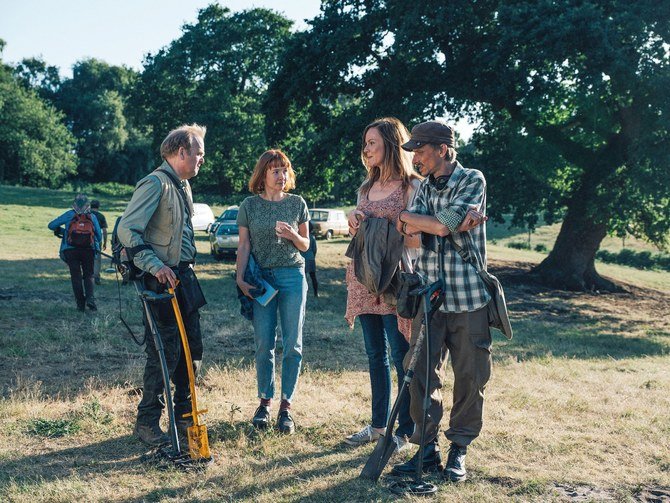
But the veteran British comic actor and sometime writer really made his mark when he conjured up a quintessentially English comedy about the oddballs who put on headphones, sweep the ground and “hunt for treasure” or at least antiquities in the fields, hills and forests of Blighty.
It’s a forlorn farce of quiet reserve and delicious melancholy, a satire of a nation of “hobbyists” and a twee spoof of not-quite-toxic male bonding at its most elemental. There’s romance and reward, rivalry and secrecy, but most of all loneliness in these 19 episodes about the lives and metal-detecting passions of our two heroes, Andy (Crook) and Lance.
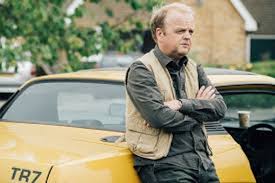
Crook created the series as a star vehicle for himself, and wrote most of the episodes. But as good as he is in it, and as droll as the writing always is, his master strokes are in casting, an entire “Island of Misfit Toys” of English eccentrics, beginning with Andy’s foil, Lance. If there is a British character actor who less embodies anyone you ever knew with the dashing moniker “Lance,” it is Toby Jones.
Jones has played Marvel villains and MI6 functionaries (“Tinker Tailor Soldier Spy”), professors, diplomats and Truman Capote. “Loneliness” comes through in much of his work, with hints of wit and resentment that the tall guy with more hair always “gets the girl.”
That’s Lance in “detectorists,” a quiet working-class fussbudget who drives a forklift by day, immerses himself in all sorts of nerd arcana, motors a 1978 Triumph TR-7 constantly in need of a tune-up, reads and watches quiz shows by night and gears-up for metal detecting with Andy on weekends.
They chat about history, who did what on which quiz show, and women. Andy lives with smart, sarcastic school teacher Becky (Rachael Stirling) and is finishing up archaeology studies, but is every bit as hapless as Lance when it comes to the fairer sex.
Lance is divorced from the flighty Maggie (Lucy Benjamin, daft and deliciously hateful here), who lives with the man she left him for and still uses Lance without a hint of pity.
But Lance, a bit of a poet and a stumbling mandolinist, is the one who sums up their quirky “hobby,” which they refuse to let anyone call “treasure hunting.”
“It’s the closest you’ll ever get to time travel.”
Through the series, with its romantic ups and downs and many near-misses and triumphs, we meet “detectorists” even more eccentric than Lance and Andy. There’s the president of their Danebury Metal Detecting Club,Terry (Gerald Horan, a delight) and the screwy, literate, might-have-buried-his-wife-in-the-paddock farmer Bishop (David Stern) whose land they’re sure has a Saxon king’s burial ship somewhere on it.
Then there are the rivals, the mirror-image pretentious nerds (Simon Farnaby, Paul Casar) they label “Simon & Garfunkel” for obvious reasons — riddling every conversation with “Bridge Over Troubled Water” and “Mrs. Robinson” and “Scarborough Fair” cracks — which neither academic twit gets.
Series creator Crook –a bug-eyed, hangdog sightgag — layers in metal detecting jargon, makes fun of the junk that’s mostly what they turn up (“buttons” through history is a recurring joke) and teases us with what they’re just missing — the “Saxon hoard” of coins and jewels just beyond their detectors’ range, the outline of the Saxon ship still visible in the grass growth, a Viking-era jeweled piece that would be any British detectorist’s Holy Grail.
“The Holy Grail is the Holy Grail of treasure hunting.”
“If you’re going to be pedantic the Ark of the Covenant is the Holy Grail.”
The “heroes” are badly-flawed, socially-awkward blokes who tamp down their one-upsmanship when they’re together, are secretive and duplicitous with rivals and the women in their lives, but never to each other. And underscoring every episode is a Celtic folk lament by singer songwriter Johnny Flynn, “I’llllll be yer TREA-aaaa-sure.”
There are moments in this understated show that approach the sublime. “detectorists” is by turns mournful and sad, wistful funny and, by default “twee.”
It’s quirky series with dry jokes, simple running gags, simpler sight gags and a sense of English creature comforts and sentimental modesty about it. The resigned celebratory suggestion after finding a “hammered” (hand-minted English coins of yore) — “The pub?” A simple, comfy reply — “Go on, then.”
If you’re treasure hunting for a show that’s short, bittersweet, droll and ironic, that knows when to make a bow and exit, you could do a lot worse than “detectorists.”
MPA Rating: TV-14, profanity
Cast: Toby Jones, Mackenzie Crook, Rachael Stirling, Gerald Horan, Simon Farnaby, Aimee-Ffion Edwards, Paul Casar, Lucy Benjamin, David Stern and Diana Rigg.
Credits: Created by Mackenzie Crook. A BBC4 production on Roku, Apple+, Amazon, etc.
The first hurdle one must clear is imagining a universe in which a four hour recut of “Justice League” needs to exist. But within the infinity of the multiverse, that’s a moot point.
“Zack Snyder’s ‘Justice League'” is a detailed, back-storied origin story with another origin story built in, an opera in effects and comic book movie conflict. It is slow — even when it isn’t playing out in slow motion.
Ponderous? Sure. Bloated? Oh yeah.
But one thing that’s obvious with Zack Snyder’s “finish the movie I started” version of a project that tragedy saw him turn over to jocular Joss Whedon. As “content,” this is pure gold, an HBO Max windfall. And that’s the perfect place to experience it, a “Godfather Saga” or “Lord of the Rings” or “Harry Potter” weekend but for the Superman/Batman/Wonder Woman/Batman and Flash set.
It’s been three and a half years since the Whedon-finished streamlined “Justice League.” I had to glance back over my review of that one to see why so much of this new version seemed different. Because it is.
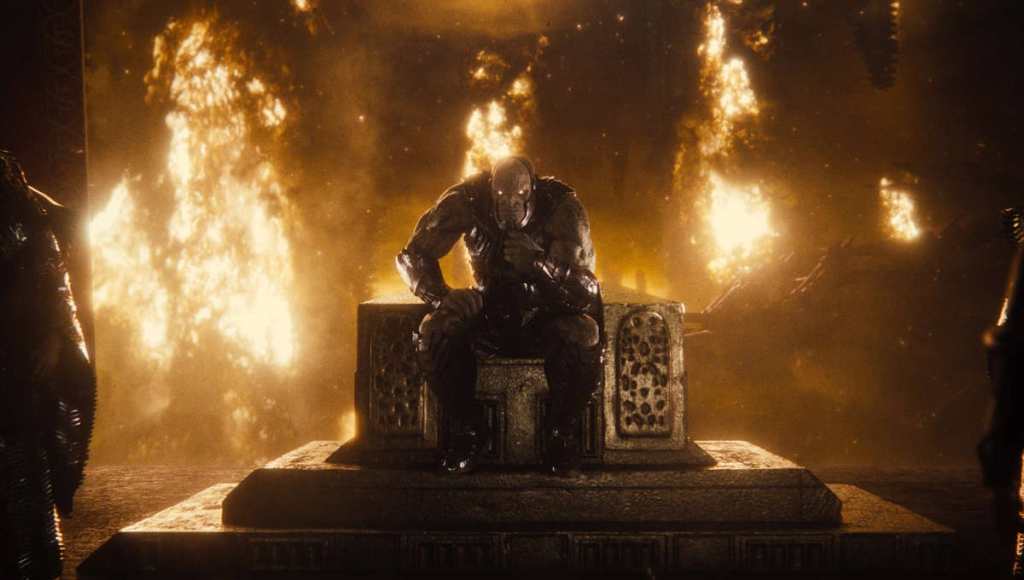
Whedon’s lighter touch is mostly gone, along with his two hour run time and his reducing the role of Cyborg, which infuriated actor Ray Fisher (understandably). The digital effects have been cleaned up, with a shiny, bristling Steppenwolf (voiced/mo-capped by Ciaran Hinds) now a visually formidable foe.
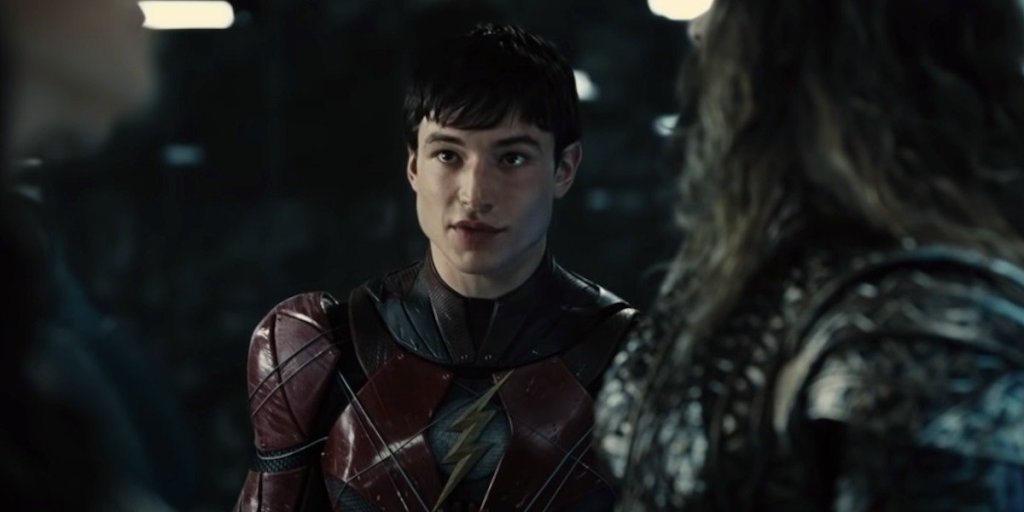
But thank heaven for Ezra Miller‘s Flash, who has a romantic white knight moment (with Kiersey Clemons) to rival the best emotional punches Christopher Reeve landed many “Supermen” ago.
“Wonder Woman, think she’d ever go for a younger guy?”
“She’s 5000 years old, Barry. They’re ALL younger guys.”
All this gloom and murk and exposition, here’s a rare hint of comic book comedy.
Gal Gadot‘s Wonder Woman is more badass than she’s been in her stand-alone movies, Jason Mamoa makes the most of his few chances to show brawny wit, Ben Affleck seems almost droll as Batman this time out.
“This is Alfred…I work for him.”
Little dollops of heart intrude on the effects, battle royales, epic digital sets and godlike alien staff meetings between Steppenwolf and his bosses, DeSaad and Darkseid (Did James Cameron name those two?).
Amy Adams‘ Lois Lane and Diane Lane‘s Martha Kent sell the sadness of the loss of Clark Kent, Henry Cavill, Amber Heard, Billy Crudup (Flash’s dad) and Joe Morton (“father twice over” to Cyborg) make decent impressions.
Of course, there are too many characters to track and do justice to, too much clutter in the derivative and silly story about aliens invading — Steppenwolf and his ParaDemons minions (Cameron could’ve named them, too.) — in search of Horcruxes, Infinity Stones or uh, “Mother Stones” that will allow universal omnipotence and an end to life on Earth.
Cyborg’s origin story puts him front and center in this, reducing a lot of others such as J.K. Simmons (Commissioner Gordon), Jesse Eisenberg (Lex Luthor), the voices of “Superman’s” father figures, Joe Manganiello and Heard to glorified cameos which show up, all the way through the “epilogue.”
Yes, this beast has big, long “chapters” to it. And an epilogue.
All of which add up to a “movie” that’s a lot closer to “content” than to cinematic art, or a movie that inspires, thrills, touches or moves, or a “movie” in the sense of a coherent story told with urgency.
But it’s often gorgeous to look at, and taken as a transitional film, one that moves this universe onto a streaming platform that needs it and the proper home for a filmmaker like Snyder (a thrilling “300,” a passable “Watchmen,” a decent zombie movie and…all sorts of this), “Zack Snyder’s ‘Justice League'” services the fans and just as importantly, the investors, who also “can’t get enough” of these characters, no matter what universe they occupy.
MPA Rating: R for violence and some language
Cast: Ben Affleck, Gal Gadot, Jason Momoa, Amy Adams, Ray Fisher, Diane Lane, Connie Nielsen, Joe Morton, Jeremy Irons, J.K. Simmons and Henry Cavill.
Credits: Directed by Zack Snyder, script by Chris Terrio. A Warner Brothers/HBO Max release.
The first words that come to mind when we think of the late Audrey Hepburn probably do her a grave disservice.
As the film critic Molly Haskell argues in the new documentary about Hepburn, “chic” and “fashion icon” and any word associated with her extraordinary appearance — the eternal Euro-gamine — might bring her instantly to mind. But “she so exceeds” mere descriptors like that, even if that’s how we remember her.
Helena Coan’s “Audrey” is a lovely gloss on a lovely, but too-short and too-troubled life, one of the last legends created in Golden Age of Hollywood studios (Paramount), an actress whose mystique outlived her and whose decade of charity work ripples ever outward, nearly 30 years after her death.
As great artists like to trace their training to this teacher who learned from Liszt or that one who studied under Stanislavsky, most famous UNICEF children’s charity ambassadors trace their involvement back to Hepburn — either directly, like her recruits Peter Ustinov and Roger Moore, or indirectly a generation later (Jolie, etc).
In her own words — generously sampled here in voice-over from radio, TV and filmed interviews — Hepburn reminds us that her great love, her first love was dance. Her realizing that World War II had taken her prima ballerina dream from her, then thinking “I was never very good” when she transitioned to musical theater, we get a hint of just how fortunate she and film fans are.
No mere dancer and few dancing actresses can make any great claim of fame. Hepburn, who danced in a few films in her time, became immortal through cinema, an actress with a dancer’s lightness and grace.
Friends, family, even descendants who barely knew her (and descendants of those who photographed her) sing her praises in “Audrey.” Colleagues such as Richard Dreyfuss (“Always”) and Peter Bogdanovich (“They All Laughed” speak glowingly of her work, and no-nonsense critic Haskell is here to state the obvious.
“You couldn’t take your eyes off of her” in person or on the screen.
Coan’s movie is most reliant on family and mid to late life connections from her personal life — her Roman and later Tolochenaz (Switzerland) neighbors. There are a lot more people who worked with her in film still around than the couple included here.
Coan’s film is more concerned with the broader strokes of her career, and the mostly-lovelorn life she experienced, from childhood until the last years before her death in 1993, when cancer took her at just 63.
So there’s no film-by-film breakdown of her movies, just the highlights — “Roman Holiday,” “Breakfast at Tiffanies,” a little “My Fair Lady ” We get instead lots of sweeping generalizations about her gift and her enduring appeal, an anecdote about saving the song “Moon River,” another about her panic at being dubbed in “My Fair Lady.”
I’ve read a biography or two about her, and don’t recall any that out and out called her parents, who split when she was six, upper class fascists — dyed-in-the-wool Nazi sympathizers.
Dutch-Belgian aristocrats, they doubled down on their beliefs when they shipped her from boarding school in London into Holland shortly before the Germans rolled through the Low Countries and occupied the continent for the next five years. Worried about what the Luftwaffe would do to Britain, they bet on the wrong horse.
She often repeated the story of how malnourished she and the other children of her Dutch generation were, and how that made her ripe for recruiting to UNICEF in the ’80s.
The film’s focus on that unloved childhood and her two marriages that turned sour underscores the ways she must have been unhappy, especially after her early retirement from films. But it also limits the film’s chance to show us the many magical moments she created on the screen.
At least we’re treated to a nice sampling of those images where the petite, pan-European, multi-lingual pixie with the elegant “line” to her frame — one that designers from Givenchy onward glorified — achieved something like onscreen perfection.
MPA Rating: TV-14
Cast: Audrey Hepburn, Richard Dreyfuss, Molly Haskell,
Emma Hepburn Ferrer, Sean Hepburn Ferrer, Peter Bogdanovich
Credits: Directed by Helena Coan. A Universal release on Netflix.





















 Movie Nation