

Movie Review: “Rose Plays Julie”

Sound or the lack of it is an under-appreciated element of cinema, so much so that films that pay extra attention to it stand out.

The Oscar-nominated “Sound of Metal” is wholly conceived around loud noise and learning to live in silent deafness. The filmmakers behind “Rose Plays Julie” take care to use muffled sound, soft ringing or stony silence to show not just the effect of injuries, but numbing shock and momentary disconnects from the world.

That underscores how Rose (Ann Skelly of TV’s “Vikings”) has become unmoored from her reality. A student at a Dublin veterinary school, she is reeling not just from the extended section of her lab study involving animal euthanasia. She’s gotten news and doesn’t know quite what to do with it.

She can’t complete that first phone call to London. But when she does, she catches the actress (Orla Brady of TV’s “Into the Badlands” and “Fringe”) in a World War I nurse’s uniform on the set.

“My name is Rose,” and although the actress once wrote “no contact” on the adoption forms, the young woman is reaching out “because I don’t know what else to do.”

This isn’t the most welcome contact Ellen Wise has had, and she lets that be known. But Rose won’t be rebuffed. She books a flight, checks out the address she was given, and seeing the house is for sale, contacts the agent for a showing.

We have plenty of time in the first act of this Christine Malloy/Joe Lawlor thriller to consider how shaken and disturbed this news has made Rose, who was “Julie” on her birth certificate. Stalking somebody by touring their home, looking at their photos and prescription bottles, meeting her (other) daughter (Sadie Soverall)? Creepy.

And finally getting some answers from Ellen doesn’t improve Rose’s mood or state. There’s a reason she wanted “no contact,” a reason she gave up an unplanned child in her ’30s, and no, it’s not just an “actress and career” thing.

“I was raped.”

Lawlor and Molloy tease out the push and pull of this daughter/biological mother “relationship” into a sort of resigned dread. We’re not sure who we can believe, not sure of Rose’s motives, not sure whether Ellen should be worried for herself or the man she names as her attacker.

And we’re REALLY weirded out by the many scenes of Rose’s veterinary classes and their animal deaths and necropsies.

Skelly makes Rose seem poker-faced and sane. But can we be sure? “Young and impulsive” is a universal truth. How will she act on what she’s trying to process? Numbed by news or stunned by violence, we hear the silences Rose slips into in a story she narrates.

The script also lays out the psychic pain of hearing all this in her ’20s. She’s had just enough time to rationalize that “It wasn’t my fault,” that “whatever the reason, I was wanted.” Now that’s off the table, and in the worst way imaginable.

The story’s direction becomes deflatingly predictable once all the various characters and plot elements are set up. But “Rose Plays Julie” is a psychological thriller where pathos, suspense and the silent confusion of our heroine compete for primacy. Start to finish, this is damned unsettling.

MPA Rating: unrated, violence

Cast: Ann Skelly, Orla Brady, Aidan Gillen 

Credits: Scripted and directed by Joe Lawlor and Christine Molloy. A Film Movement+ release.

Running time: 1:40

Posted in Reviews, previews, profiles and movie news | Comments Off on Movie Review: “Rose Plays Julie”

Movie Preview: Another tortured agent has lost his memory — “Trigger Point”

Yeah, there’s a whiff of Jason Bourne in “Trigger Point.”

Barry Pepper and Colm Feore are the stars in this spy-out-for-revenge thriller, opening April 23.

Posted in Reviews, previews, profiles and movie news | Comments Off on Movie Preview: Another tortured agent has lost his memory — “Trigger Point”

Movie Review — “Operation Varsity Blues: The College Admissions Scandal”

I had the wickedest thought while watching “Operation Varsity Blues,” Netflix’s docudrama about “The College Admissions Scandal.”

This is Hollywood’s revenge for the way that story was played in the American media.

Who were the faces of it? Two Hollywood parents trying to get C-student kids into A-list schools. Hell, the FBI even named their sting after a James Van Der Beek high school sports movie from 1999. And if the last four years of Ivy League-credentialed incompetence and corruption taught us nothing else, it’s that monied mediocrity isn’t just a Hollywood phenomenon.

So forget you-know-her and you-know-her-better. “Varsity Blues” gives us Bill McGlashan and Jane Buckingham, Gordon Caplan, Agustin Huneeus Jr. and Devin Sloane. If there’s a sin of omission here, it’s that “Varsity” doesn’t paint — through casting actors to recreate incriminating phone calls — a broad enough portrait of the indicted and accused. It’s not just rich WASPs and Jews, but there are Asian and Hispanic parents who were in this mess, too.

“Tiger King” producer Chris Smith directed this hybrid documentary, using scores of interviews with journalists and a few principals in the story, guidance counselors, lawyers and Feds, and recreations — with actors — of the hours of intercepted phone negotiations between the rich and the “coach” who had the inside track, the “side door” way of getting their middling student into her or his preferred Destination College of Choice.

Matthew Modine plays Rick Singer, performing every line straight off of transcripts of those wiretaps, so immersed in the part that we get a real sense of what a driven, focused but myopic bore this fellow must be.

A workaholic, onetime college basketball coach (allegedly with anger-management issues, not seen here), Singer reinvented himself as a sort of “life coach” and “college prep counselor” who developed relationships at elite schools and a way to get kids into those schools without buying Harvard a new wing on this building or naming rights for that one. He had, to borrow the names his companies went under, “The Key” to help these “Future Stars” get into “the right college.”

Modine’s Singer (and others) explain that there’s a “front door” way of getting in to USC, Stanford, Princeton and Yale et al — merit, outstanding scholarship, acclaimed “interests and activities,” with the weight of “legacy” enrollment and protected minority status helping. The “back door” way is through BIG donations to the school.

The “side door” Singer exploited was often a bogus connection to “niche” athletics — rowing, sailing, fencing teams, underfunded corners of the Full Ivy League/Seven Sisters/Stanford et al “experience.” Photograph a kid on a sailboat, or photoshop her head onto a coxswain in a rowing racing shell, get the coach to sign off on this “talented” potential “walk-on” (non scholarship) “athlete,” and that “set aside” gets your kid in.

“A donation to my foundation,” we hear Singer pitch, is all it takes — a few hundred thousand. Because that “foundation” has to make a “donation” to that program, or its coach, among others.

Singer would fudge and exploit minority status, even have a hired “proctor” for your little darling’s SAT or ACT test, somebody who would “correct” the answer sheets to get the desired grade.

And it worked, for years.

Smith uses the breathless TV news coverage to paint a picture of the extent of the scandal, and montages of students anxiously waiting to see if they got into their first, second or third choice school to show us just what college has become — a zero sum, all-or-nothing, social-media bragging rights game of American elitism in action.

And the elite, to ensure they remain elite, are desperate to pass on their status to their little darlings by getting them into the schools that “everybody wants to get into.” A corrupt need arises, and a corrupt coach and his corrupt USC et al insiders move to fill that need and get rich in the process.

The whole “scandal” could seem overblown to anyone clear-eyed and cynical enough to recognize that borderline illiterates like Donald Trump or third-rate thinkers like Jared Kushner aren’t getting their educational pedigree on the up-and-up. What’s “news” about that?

Smith and screenwriter Jon Karmen those they interview personalize it, hint at how this sort of Late Roman Empire corruption eats away at institutions, rots society and populates the highest echelons of government and business (not science and art, supposedly) with Brett Kavanaughs, Amy Coney Barretts and serial bankruptcy princes with success at their feet if they’re not too stupid to run every business they take on bankrupt.

Touching on how the rich even exploit fake “minority” status will rankle many. Learning how Singer encourages kids to fake “special needs” testing status so that the rich and not-that-sharp get days to take a test (with extra time for cheating) that the rest of America has to take in a single morning is guaranteed to blow any college applicant’s fuse.

“Operation Varsity Blues” tends to overwhelm us with such details, and not every phone call is damning enough to merit recreation. There’s “mission creep” in the movie as it tries to dissect how “going to college” became “go to THE college” in the American mindset. And while there might be one actual “victim” in all this, it is impossible to feel sorry for any of these misguided parents or their children, even if “she/he could have gotten in on his own.”

But it’s a healthy reminder that fighting corruption, even in something as mundane as college admissions, is vital to society’s health, that Americans need to at least believe there’s a “level playing field,” and that not guaranteeing that is how we mediocre our way from the top of the world to Banana Republic in just a generation.

MPA Rating: R for some language

Cast: Matthew Modine, John Vandemoer, Naomi Fry, Daniel Golden

Credits: Directed by Chris Smith, script by Jon Karmen. A Netflix release.

Running time: 1:42

Posted in Reviews, previews, profiles and movie news | Comments Off on Movie Review — “Operation Varsity Blues: The College Admissions Scandal”

Movie Review: “The Courier” plays his part in Preventing WWIII

“The Courier” is an engrossing espionage thriller set, as so many of them are, at that one point when the Cold War seemed most likely to turn nuclear hot.

Well-acted and early ’60s period perfect, about the worst you can say about it is that it’s a washed-out copy of “Bridge of Spies,” which is its easy analog and far more suspenseful and immersive.

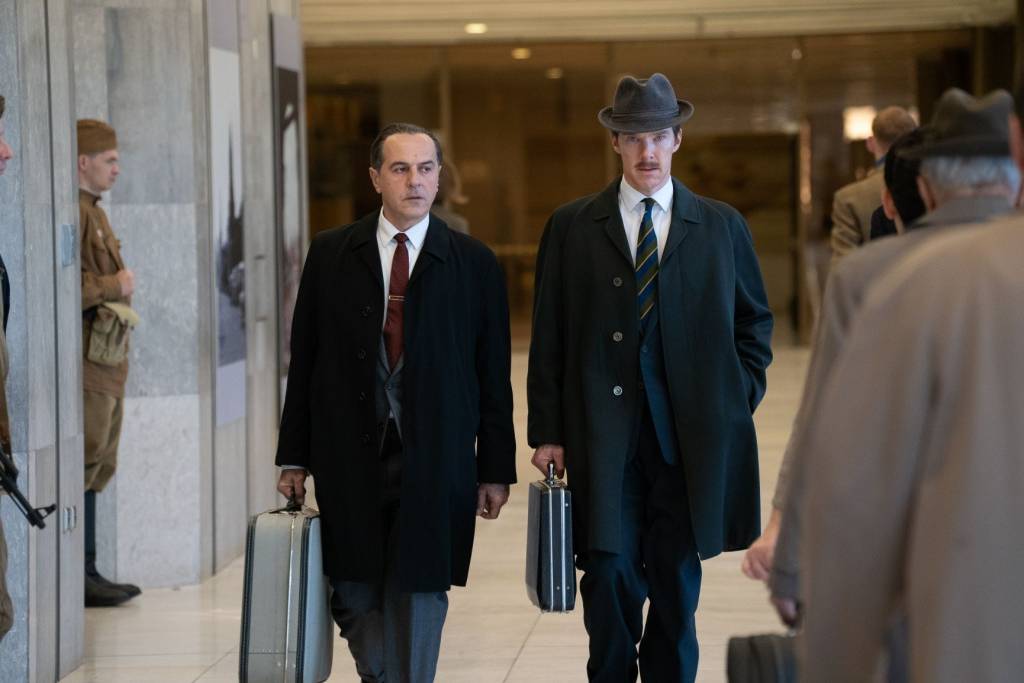
Benedict Cumberbatch is our unlikeliest of “heroes,” a chain-smoking, elbow-bending British salesman coerced into carrying messages between a Soviet turncoat and the West in the blustering, impulsive last years of Nikita Khrushchev’s rule.

How MI6, at CIA urging, settled on Greville Wynne as their go-between is skimmed over in Tom O’Connor’s script. A chance meeting that an espionage operator (Angus Wright) recalls in a pinch, a lunch date arranged, with a CIA intermediary (Rachel Brosnahan), fine food and a bit of booze and flattery and appeals to patriotism seal the deal.

Wynne’s bonafides are that he represents British firms wanting to sell machine parts, and has that salesman’s gift of remembering names and knowing when to lose when golfing with a client. He likes to eat, drink and smoke and travels the Eastern Bloc on sales calls. In “The War” he was a mere private who “never saw action.”

“The truth is, if this mission was dangerous, you’re the very last person we’d send,” his handler-to-be (Wright) purrs.

The Whitehall use of “mission” in an Oxonian accent should scare Wynne off. But he reads the papers. He might prefer to make sales inroads to the USSR “when things are a mite cooler,” tensions-wise. His would-be handlers’ leverage is simply this. Nuclear war is edging closer and the CIA has no inside information about Kremlin thinking or planning. If this Russian (Merab Ninidze) who has reached-out can’t help, the world’s only going to get more dangerous. Wynne relents.

Veteran stage director Dominic Cooke and screenwriter O’Connor skimp on the “tradecraft” — mere suggestions that “every Soviet is the eyes of the State,” a package hand-off here and there — building their thriller on the personal relationship between the salesman and the spy-trained Soviet who is a higher up with a ministry in charge of industry and trade.

Oleg Penkovsky is a father fretting over how “unstable” Khrushchev seems to him, and is desperate to “prevent a war.” He is also a spy, part of whose job “is to steal technology from the West.” He is confident and reassuring to his inexperienced “courier” of documents and microfilm.

“I am better at this than ‘they’ (the KGB/GRU) are.”

But hanging their film on that partnership depends on chemistry and the sense that a deeper bond is forming, as “Alex,” as he prefers to be called in English, escorts Wynne around Moscow, visits Britain on a trade trip and meets and dines with Wynne’s family (Jessie Buckley, Keir Hills).

We get plenty of the wining, vodka-ing, smoking and dining, and in the film’s cleverest touch, proof of Wynne’s grinning answer to that most important query if you’re trying to fit in with and trick Russians.

“Can you hold your alcohol?”

“It’s my one true gift!”

It’s that extra pathos, that intimacy that would personalize the stakes in this movie about a world lurching toward the Cuban Missile Crisis, that’s sorely missed here.

Cumberbatch makes Wynne a Brit of his times — reserved, stoic, suppressing emotions as he lives this secret life that his suspicious wife doesn’t know about. We get a hint that the salesman’s soul is finally reached when he learns to appreciate Russian ballet (“Swan Lake”), but little else that explains his later actions. The picture stumbles into a dry-eyed third act that should be wrenching but plays here as an extended epilogue.

Cumberbatch’s commitment to the role is most impressive in that stumbling third act, but this internalized performance is more historically appropriate than audience-endearing.

Buckley and Brosnahan are the players who give us more to latch onto than our buttoned-down leads. And if we’re handing out plaudits, kudos on landing a wonderful big screen Khruschev (Vladimir Chuprikov), and keeping the Soviet scenes “Russian” (with subtitles).

Our KGB villain (Kirill Pirogov) may not have enough scenes to make a big impression. But “The Courier” does a passable job of passing on the paranoia of a country where betrayal and summary arrest could come from anyone, at any time.

It’s that “passable job” that’s the rub here. As this “true story” hews closely to the plot points of many a spy thriller, “The Courier” invites comparisons that highlight its shortcomings, telegraphing punches that we sense are coming and failing to ever land a telling blow.

MPA Rating: PG-13 for violence, partial nudity, brief strong language, and smoking throughout

Cast: Benedict Cumberbatch, Merab Ninidze, Jessie Buckley, Angus Wright, and Rachel Brosnahan.

Credits: Directed by Dominic Cooke, script by Tom O’Connor. A Lionsgate film.

Running time: 1:51

Posted in Reviews, previews, profiles and movie news | 3 Comments

Netflixable? In Brazil, to find the bad guy, the cops know you have to “Get the Goat (Cabras de Peste)” first

OK, I laughed maybe half a dozen times at this Brazilian farce (in Portuguese, with English subtitles). And a couple of those were belly laughs.

One involves a martial arts brawl that comes out of nowhere, with the tide turned when the good guy wets a bar towel and uses it like nunchucks. Another is when two guys are trying to convince a goat to defuse a bomb for them by doing what goats do.

And don’t even get me started on the battle royale finale.

“Get the Goat” is a romp through “Beverly Hills Cop” starring “The Other Guys,” guys who in this case are hapless Brazilians.

The first is a rural “badass,” the son of an “action movie fanatic” father who named a daughter “Melgibson,” one son “Charlisbronson” and our “hero” Brucuilis. We meet him as he’s chasing down a Lothario who’s just stolen an electric fan from his lover’s cabana. “Bruce,” played by motor-mouthed funnyman Edmilson Filho (His “O Shaolin do Sertão” has similar manic “Hai-YA” mayhem.) is so cool, at least in his own mind, that he merits his own entrance music.

Ever heard “The Heat is On” in Portuguese? Just you wait.

Bruce is a real bull in a china shop in his little corner of Ceará province, the small town of Guaramobim. We learn Brazilian slang for “IDIOT” from his boss.

Trindade (Matheus Nachtergaele) is the seriously hapless pencil-pusher cop enlisted by Operation Thunderbolt and its chief Priscilla (Letícia Lima) to stage a buy from Ping Li (Eyrio Okura) that will get them closer to the mysterious Big Boss of the Brazilian drug trade, The White Glove. Trindade doesn’t take a bullet for her partner in that operation, which means he “got my best man killed,” according Priscilla. He’s promptly demoted to a small, sleepy São Paulo precinct.

When Bruce screws up one time too many and loses the town goat (formerly a city councilwoman) Celestrina and the mascot of their Rapadura Festival, he will stop at nothing to get her back, chasing the drug courier who winds up with her all the way to Trindade’s turf.

Can these two nitwits foil Ping Li, catch and “out” The White Glove and “Get the Goat” back?

I can’t say much for this silly script except that every so often, some of its low-hanging fruit produces jam.

Trindade isn’t eager to pursue a stolen vehicle case, but if a five year old “kid” named Celestine has been (literally) “kidnapped?” He’s all in, if confused.

They try to wring laughs out of a Chinese restaurant that might have some clues. If only they can get over their stereotypical ideas of who works there. No, they’re not Chinese and all martial artists. They’re locals.

They run a stake-out out of an Uber, leap to conclusions about who they’re after and get chewed out by Priscilla, who’s taken a Chief Inspector Dreyfuss attitude towards her own Inspector Clouseau. She has Trindade’s picture attached to her target at the firing range.

The fight scenes are antic and hilarious. Perhaps director Vitor Brandt realized this too late to add any, but the finale — a shoot-out/punch-out — is a doozy. The two leads click well enough to be funnier than their material, with only the slapstick and mugging (they get taken hostage a time or two) paying off.

This would be an eye-roller, coming out of Hollywood, which has taken more shots at this formula than any other. It almost gets by on just being jaunty. The funniest thing about “”Get the Goat” (original title, “Cabras de Peste”) is seeing timeworn Hollywood cop comedy tropes, gimmicks and gags through a Brazilian lens.

Not great, but it’s got a few laughs, so not that bad either.

MPA Rating: TV-14, gun violence, drug content

Cast: Edmilson Filho, Matheus Nachtergaele, Letícia Lima, Leandro Ramos and Evelyn Castro

Credits: Directed by Vitor Brandt, script by Vitor Brandt, Denis Nielsen. A Netflix release.

Running time: 1:37

Posted in Reviews, previews, profiles and movie news | Comments Off on Netflixable? In Brazil, to find the bad guy, the cops know you have to “Get the Goat (Cabras de Peste)” first

Movie Preview: Sean Patrick Flanery’s who you call when there’s an “Assault on VA-33”

Terrorists stage a vengeance attack on a Veterans Administration hospital on the day badass SP Flanery is there. Bad move.

Flanery’s getting himself in contention for King of the Action Bs (if Frank Grillo ever ages out of the crown).

This Paramount “Variations on a Theme from ‘Die Hard'” opens April 2.

Posted in Reviews, previews, profiles and movie news | Comments Off on Movie Preview: Sean Patrick Flanery’s who you call when there’s an “Assault on VA-33”

Movie Preview: A missing person as “superhero” — “My True Fairytale”

Having a hard time making heads or tails out of this trailer. Car accident, wakes up “superhero,” and/or “a missing persons case.

Emma Kennedy stars, Bruce Davison ,Joanna Cassidy and Corin Nemec are the more established names in the cast.

“My True Fairytale” opens April 9.

Posted in Reviews, previews, profiles and movie news | Comments Off on Movie Preview: A missing person as “superhero” — “My True Fairytale”

Movie Review: A VERY young Liam Neeson is a priest who runs off with a school boy in “Lamb”

Yes, that headline’s accurate, and sure, it’s a tease.

But that plot description of “Lamb” means something far more sinister now than it did in 1985, when this British production was released.

It’s a disturbing and odd drama about a young priest, played by a very young and lean Liam Neeson, who has a crisis of faith brought on by his work.

Brother Sebastian teaches at St. Kiaran’s School, a windswept, cliffside pile facing the howling Atlantic (actually the King Arthur’s Castle Hotel, Tintagel, Cornwall). He’s still young and idealistic enough to be sympathetic to his charges at this Catholic reform school. But he has to turn something of a blind eye to the heaping helpings of corporal punishment handed out by the older priests.

The arrival of tiny, troubled Owen Kane (Hugh O’Conor, who went on to play young Christy Brown in “My Left Foot,” and Coleridge in the recent “Mary Shelley”) opens that blind eye. The kid’s callous mother has given up on the ten-year-old’s backtalking, smoking, thieving and cursing ways. Not to worry, Brother Benedict (Ian Bannen) purrs. They’ll straighten him out.

Sebastian hears the boy’s sad story in counseling sessions and is appalled when the tiniest lad in the school is whipped for graffiti he couldn’t have drawn. Because he’s too bloody short. Brother Benedict is all understanding chuckles and shrugs — “as long as we punish SOMEone.”

“It’s the stick that shows we care,” he insists. “And if you use it, be sure to HURT’em!”

When Brother Sebastian’s father dies and leaves him a little money, his second thoughts about this vocation become more obvious. That leads to veiled threats from Benedict, who has the smug certainty of a goon in a theocratic Catholic state where the Church has influence everywhere. Has his eye on that inheritance, I dare say.

That’s what triggers the rash, half-planned escape. Sebastian will spirit away the child, go back to being Michael Lamb (his name before taking his vows) and go on the lam. Their travels will take them to Dublin and London, put Michael in one fix after another as he has to pose as the lad’s father, find a job and keep nosy members of the Irish diaspora from figuring out who they are.

There’s a lot of “Just what the hell is going on here?” tossed in with the obvious “What was he thinking?” in “Lamb.”

It’s a British production in the mid-80s, so the take on Catholicism and Irishness in general wasn’t going to be pre Good Friday Accords generous. Michael takes a construction job where other Irish workers (in London) ask if he’s “one of THEM” or “one of US” when he lies and says he’s from “The North.”

Bannen’s priest is almost comically sadistic, as if hinting at the horrors of Catholic orphanages and “laundries” in Catholic Ireland, crimes and injustices that would only come to light later.

Director Colin Gregg (“We Think the World Of You”), adapting a Bernard MacLaverty novel, keeps us guessing, and not in flattering ways. It’s a story that paints itself into a corner and limits itself to setting fire to the house that corner is in for its resolution.

Neeson shows the leading man promise that would only bear fruit a couple of years later, stealing “A Prayer for the Dying” from Mickey Rourke and “Suspect” from Cher. But we get little sense of his character’s impulsiveness in any of the earlier scenes here. His father’s pride in him joining a religious order is obvious. Why would he throw all that away? His “planning” seems limited to telling the boy to pack, stealing the school van and stopping at the first jewelers’ he sees to buy a fake wedding ring for his cover story.

As they take off on this rash odyssey, the overarching impression is naive, poor and unworldly — a young man who never learned the ways of the world and puts it all off on being “another stupid Irishman.” Poverty’s more like it, mate.

The movie’s melodramatic flourishes include Owen’s epilepsy and Michael’s constant use of the phrase, “Wait here, Owen.” Owen is troubled, with a serious health condition and zero impulse control. What could go wrong?

The kid is a foul-mouthed wonder, and between his profanity and Bannen’s twinkling sadism, “Lamb” flirts with being a comedy, here and there.

It isn’t. And more’s the pity. The stiff, symbolic crisis-of-conscience/priest-goes-mad drama doesn’t play, not today, anyway.

MPA Rating: unrated, smoking, profanity

Cast: Liam Neeson, Hugh O’Conor, Ian Bannen

Credits: Directed by Colin Gregg, script by Bernard MacLaverty, based on his novel. A FilmFour release.

Running time: 1:49

Posted in Reviews, previews, profiles and movie news | Comments Off on Movie Review: A VERY young Liam Neeson is a priest who runs off with a school boy in “Lamb”

Documentary Review: Nature filmmaker learns from “My Octopus Teacher”

It isn’t often that a documentary lumped under the general “nature film” label fundamentally changes our view of an animal, its environment and the natural world. I doubt many of those who labor in this science museum/ BBC/ “Nature” and Discovery Channel corner of the cinema harbor such expectations for their work.

But the gorgeous and almost shockingly moving “My Octopus Teacher” does just that, something that sets it so far above its genre that it might very well be the Oscar favorite for Best Documentary, judging from its many other awards.

South African cinematographer Craig Foster narrates the film and describes the burnout he was going through prior to taking his camera into the waters off the western Cape of Storms in his homeland. His prior work was almost entirely in the bush among the hunting cultures of Africa, and like all such films, required years of commitment and embedding and labor.

But snorkeling off the coast in “some of the wildest, most scary places to swim on the planet” gave him hints of that hunter’s cunning in the small, wonderfully-camouflaged octopus — the tracking, tricks, disguises and tactics it uses to hunt prey or avoid the “pyjama sharks” that are its primary predator. And as there’s precious little research of octopi in the wild, he set out to film an octopus “every day” for months on end and see what he’d learn.

He sees it as “a liquid animal,” and marvels at its ability to pick up shells and cover itself in them — dozens at times — to hide from prey or predators. It’s “an animal that has spent millions of years learning how to be impossible to find.”

And as “she” gets familiar with his non-threatening presence, they make a connection. Even recent decades of news accounts of octopi showing off their smarts in the world’s big aquariums didn’t prepare him, or us, for that.

“A mollusk shouldn’t be this intelligent.”

Foster returns to the sea for hundreds of days and learns to “track” the octopus via the snail, crab and lobster shells it leaves behind after meals. He watches it reason through strategies in how to track and trap such creatures and sees its life-and-death struggle to avoid the long, cunning pyjama sharks.

And he breaks the human/animal barrier, getting close, letting the octopus check him out. He asks the question we want to ask at the moment we decide its worth asking.

“What is the octopus getting out of this” interaction?

His answer surprises us and upends some of the science on these “alien” creatures that seem a lot smarter and more social, despite their solitary existence, than anybody knew.

“My Octopus Teacher” has some of the most stunning underwater footage — of the churning kelp forest under the seas of the Western Cape — ever filmed.

If they gave out Oscars for degree of difficulty, this film would be a shoo-in. Even the equally enlightening and uplifting “Crip Camp” wouldn’t stand a chance by that yardstick. If you’ve ever snorkeled, you know how impossible getting all this footage between gulps of breath must have been.

Thankfully for us, Foster has the lungs, the eye and the heart to stick with this story, to tell it and to change the way we look at the natural world, all through the lessons of an octopus.

MPA Rating: TV-G

Cast: Craig Foster, Tom Foster.

Credits: Scripted and directed by Pippa EhrlichJames Reed. A Netflix release.

Running time: 1:25

Posted in Reviews, previews, profiles and movie news | Comments Off on Documentary Review: Nature filmmaker learns from “My Octopus Teacher”

Movie Review: The Great War as “Journey’s End” for a generation

“Journey’s End” is the sort of movie we had every reason to expect Sam Mendes’ “1917” to be.

A remake of a 1930 James Whale film, when The Great War was fresh trauma for those who lived through it, itself an adaptation of a novel that was turned into a play, it has a marvelous claustrophobia, myopia and fatalism that was a part of the shared experience of those who endured trench warfare.

The mere fact that it could be turned into a play speaks volumes. Mendes’ sweeping, painterly film seems almost a fantasia of the war by comparison, two infantrymen out to deliver a message passing through a veritable Dante’s Inferno of the WWI No Man’s Landscape — complete with a nursing French mother trapped between the lines and a fighter plane crash.

“Journey’s End” is in the mud, in the holes in the mud, and there it remains.

“Journey’s End” follows a young prep school Lieutenant (Asa Butterfield, quite good) who shows up, a cockeyed optimist, willing to pull family strings (an uncle general) to get into the unit of an old family friend. It’s March of 1918, and Lt. Raleigh may be arriving mere months before the “End.” But the last gasp German “Spring Offensive” (“Kaiserschlacht”) is about to start. And requesting assignment to Captain Stanhope’s company, in the part of the line the Germans are massing to overrun? It’s your funeral, nephew.

Stanhope (Sam Claflin, outstanding) is almost furious at seeing this kid, the brother of a lady friend. He is short-tempered and drinking too much, lashing out at the cook (Toby Jones, of course), seething at the shell-shock of a subordinate (Tom Sturridge) and barely containing his contempt at the series of suicidal orders he’s receiving from on high.

Stanhope is every bit as aware as Hibbert (Sturridge) of the futility and waste of it all, more aware than the head-down, get-on-with-the-job Lt. Trotter (Stephen Graham). But if Stanhope shows fear or fatalism, morale will collapse and even more of Company C will be buried in the No Man’s Land of France.

Only the “much older man” they all call “Uncle,” Lt. Osborne (Paul Bettany, perfect) displays the steadiness of nerve that bucks up Stanhope and the rest. He’s not a hero, not some super patriot committed to the cause. He’s a stoic, a fatalist.

“”They stick at it. It’s the only thing a decent man can do.” Still, even he admits “Every little noise up there makes me feel sick.”

Theirs is a world of dugout and ditch — a bunker where they sleep, eat, drink and bicker, the trenches where all the men — especially the too-tall Lt. Obsorne — have to remember to duck at all times.

Snipers, machine gunners, artillery and the constant fear of gas are their daily routine. And with the collapse of Russia on the Eastern Front, the Germans are prepping for a rushed offensive to knock out the Allies before the American army is at full strength and in position to turn the tide.

If you read the plot and character descriptions above, you see the shortcomings of this Saul Dibb film, which was shot in Wales. It may have beaten “1917” into theaters, actually coming out on the 100th anniversary of the very battle it depicts. But it’s entirely conventional. The characters have become “stock” types, the setting is the setting of pretty much every World War I movie that isn’t about aviators or Africa. And the very claustrophobia it recreates is standard issue “All Quiet on the Western Front” boilerplate.

Stanhope’s rages and resentments, the naivete of “the boy,” the servile, knows-his-place cook and the “much older man” who is the sage of trenches are all “types.”

“1917” was so incident and action-packed as to be a fantasy version of the war. “War Horse” brought the scale of the suffering and stupidity of all home as well in a Spielberg-pretty nightmare.

“Journey’s End” is vivid, just visceral enough and has its moving moments. But it’s more like a poem we memorized in school, the stanzas brought back by a familiar line or character that’s entered common currency. Incapable of surprise, it settles for discomfiting comfort in the familiar.

MPA Rating: R, for some language and war images

Cast: Sam Claflin, Asa Butterfield, Tom Sturridge, Toby Jones, Stephen Graham and Paul Bettany

Credits: Directed by Saul Dibb, script by Simon Reade, based on the novel and play by R.C. Sheriff and Vernon Bartlett. A Lionsgate/Good Deed release, now streaming.

Running time: 1:47

Posted in Reviews, previews, profiles and movie news | Comments Off on Movie Review: The Great War as “Journey’s End” for a generation