
A long doc charting the rise and glory days of a pop queen, directed by a legitimate star doc maker (“The September Issue”).
I think the embargo on reviewing this is Thursday, so watch for that then.
A long doc charting the rise and glory days of a pop queen, directed by a legitimate star doc maker (“The September Issue”).
I think the embargo on reviewing this is Thursday, so watch for that then.
Love, and a terminal diagnosis. Andrea Bræin Hovig and Stellan Skarsgård co-star as “artist partners” put to the relationship test when she is diagnosed with cancer.
“Hope” is a shortlisted Oscar contender, so a nomination would ensure it’d get some distribution in the US. Looks intriguing.
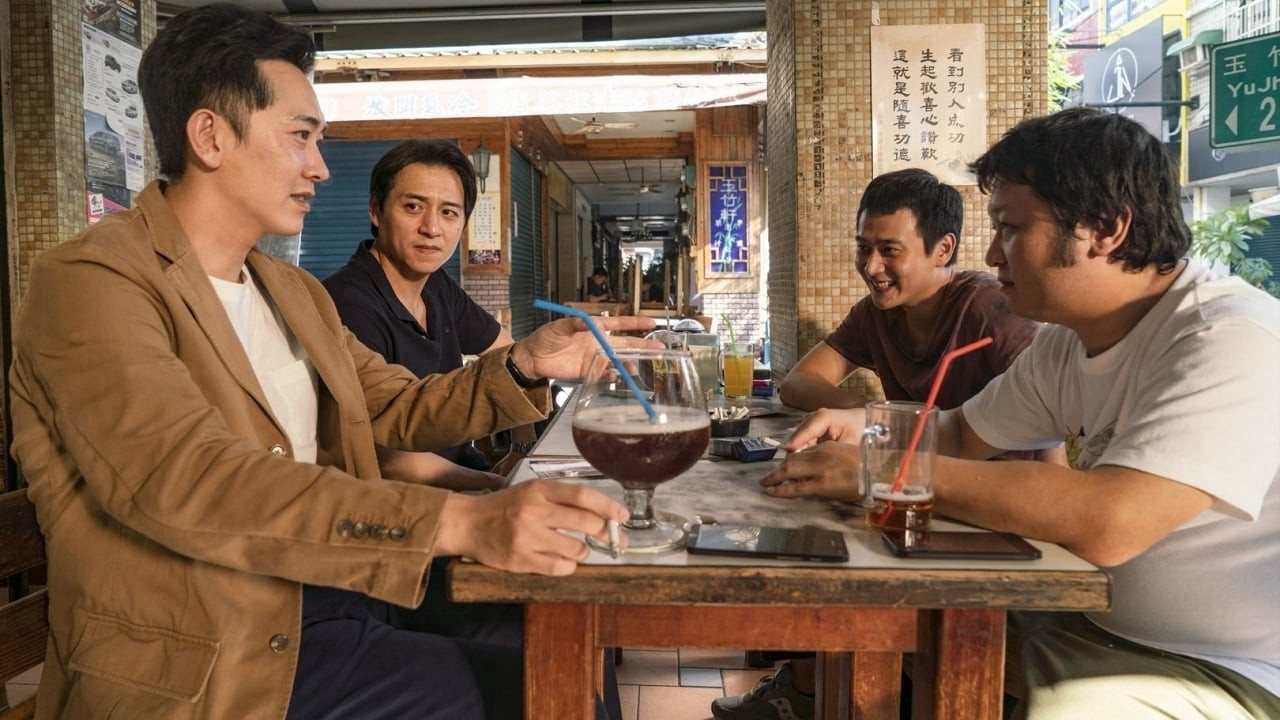
The director of “The Great Buddha +,” an award-winning Taiwanese crime dramedy, takes a stab at dark farce for his second feature film. He thought it’d be funny to title it “Classmates Minus,” as he’s made a dark and deadpan director-narrated comedy of four high school classmates who hit various walls and change directions in their lives when they hit their 40s.
Scattered laughs and quaint peeks into the culture adorn its two hours+ running time. Even allowing for cultural differences in the idea of pacing in a screen comedy, “Classmates Minus” is slow going. But here’s a taste of what you get if you go down this South Taiwan rabbit hole.
Writer-director Hsin-yao Huang introduces us to a sad, solitary stutterer nicknamed “Blockage” (Kuan-Ting Liu) who makes paper houses, cars, etc, to adorn a funeral pyre and let the deceased realize unfulfilled dreams of their lives in a dream house marking their death. Fan-Man (Jen-Shuo Cheng) is a frustrated office drone, a claims adjuster with an big insurer. The lump they all nicknamed “Tin Can” (Na-Dou Lin) is a lonely local field worker who helps find housing for the disadvantaged.
And Tom (Ming-Shuai Shih), unlike the others, is married — a filmmaker cooling his heels and learning his craft by making TV commercials. His wife (Zhi-Ying Zhu) indulges his dream career, and his nighttime talking-in-his-sleep “direction.”
“Action! FOCUS! Cut!”
“A never-fulfilled movie dream can quickly become a nightmare.”
The opening minutes of “Classmates Minus” aim to set a tone, a tracking shot following a filmmaker on a motor scooter, narrated by another filmmaker. It’s an homage to Italian Nanni Moretti’s “Caro Diario.”
As we follow these four friends’ drift through their daily lives, some scenes stand out and a few situations connect. But touching or droll, satiric or snide, the whole never really came together for me.
Tin Can almost ODs on diet pills, and stumbles into his high school crush, a beautiful woman who never knew he existed then, needs a house now and is getting by as a hooker.
Blockage lives with and takes care of his granny, and when she takes a turn for the worse, he sees a vision of the Golden Boy and Jade Girl, accompanied by Old Li — spirits who are harbingers of death. He doesn’t let that keep him from hiring a matchmaker and hoping he can get out a work or three that impresses the right woman.
Fan-Man heads towards a marriage and struggles with a dead-end job, where “doing the right thing” and “doing right” are distinctions the company makes and punishes him for not grasping.
And filmmaker Tom is abruptly recruited to run for a corrupt congressman’s seat, mentored by that congressman as he mounts a campaign and struggles to get some control of it himself and hand onto his marriage as well.
The film’s most farcical moment includes a vision of a Taiwanese action hero, who soothes nerves over a communication barrier with “You can just speak Chinese. There will be subtitles below.”
Moments like that, some snide remarks about Taiwan’s “chosen by heaven” founder-leader, General Chiang Kai-Shek and cynical politicking that interrupts’ one friend’s wedding and another’s funeral, point to a sunnier, sillier film than Huang manages here.
The characters are interesting enough, the setting and details as well. It’s just that everything one would lump together as “entertainment” is spread out, separated by dead screen time and dull sidebars.
Again, some of this is just different modes of movie-making for different audiences. That said, this was so slow it started to get on my nerves.

MPA Rating: TV-MA, violence, sex, profanity
Cast: Ming-Shuai Shih, Jen-Shuo Cheng, Kuan-Ting Liu, Na-Dou Lin, Zhi-Ying Zhu, Lotus Wang
Credits: Scripted, directed and narrated by Hsin-yao Huang. A Netflix release.
Running time: 2:02

Damn, blast and infernal curses. What have these well-meaning ninnies done to “Blithe Spirit?”
A game, sometimes arch cast and lush period design are wasted on a film that bears a faint resemblance to the play by Noel Coward.
Oh all right, more than a “faint resemblance.” The structure is roughly the same, and the characters are carried forth from the 1940s play, first put on film by David Lean. But those august names didn’t discourage British TV director Edward Hall (“Downton Abbey”) and three screenwriters from making a hash of things.
If you’re going to make it a period piece — And who doesn’t do that to “Blithe” these days?” — why bother wiping out Coward’s dialogue, resetting character motivations and only truly preserving the meanness?
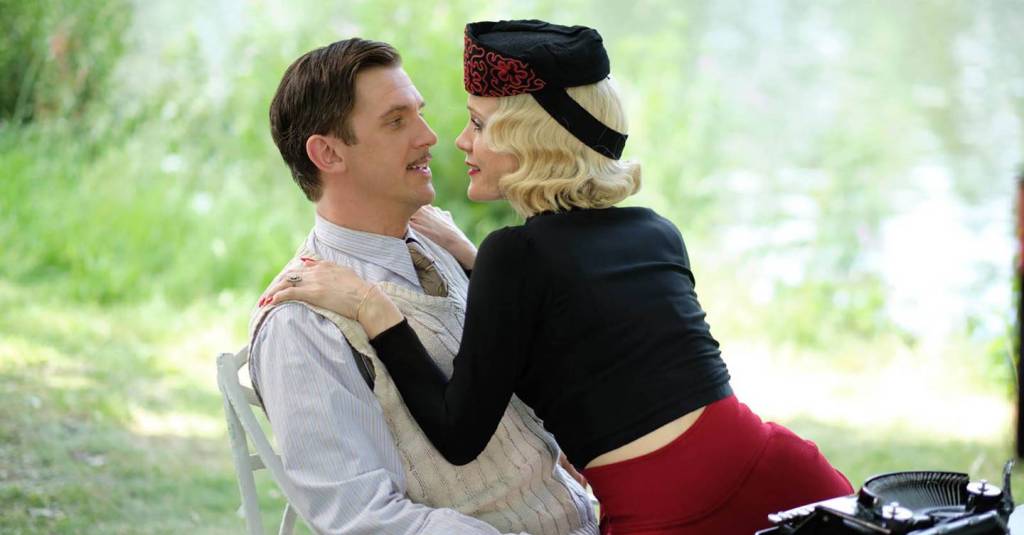
“Downton” alum Dan Stevens is our blocked mystery novelist, Charles Condomine, in this version struggling with an empty typewriter page over adapting his first novel for the silver screen.
It’s 1937, and his producer/father-in-law (Simon Kunz) thinks “Hitchcock would be the perfect director” for it.
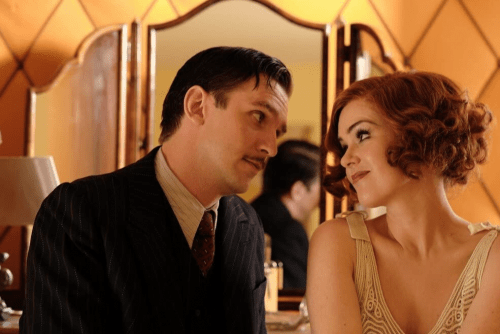
But Charles can’t get a handle on it, even though he’s adapting his own novel. Wife Ruth (Isla Fisher) tries to be understanding, but his tirades and drinking go on.
“Can I get you anything?”
“DIVINE intervention!”
Truth be told, he hasn’t written a word in years. It’s as if his first wife was his muse, and perky, bubbly Ruth is no substitute. He’s still being obsessed with Elvira, the first Mrs. Condomine. That’s even affecting his love life.
“Big Ben’s stopped chiming,” he gripes to his doctor-friend (Julian Rhind-Tutt). “It’s like playing billiards with a rope!”
Great joke…which George Burns told at 90.
At least the doctor can “fix” that. “Barbituates!”
“Is it habit-forming?” “Not in the least! I’ve been using them for years.”
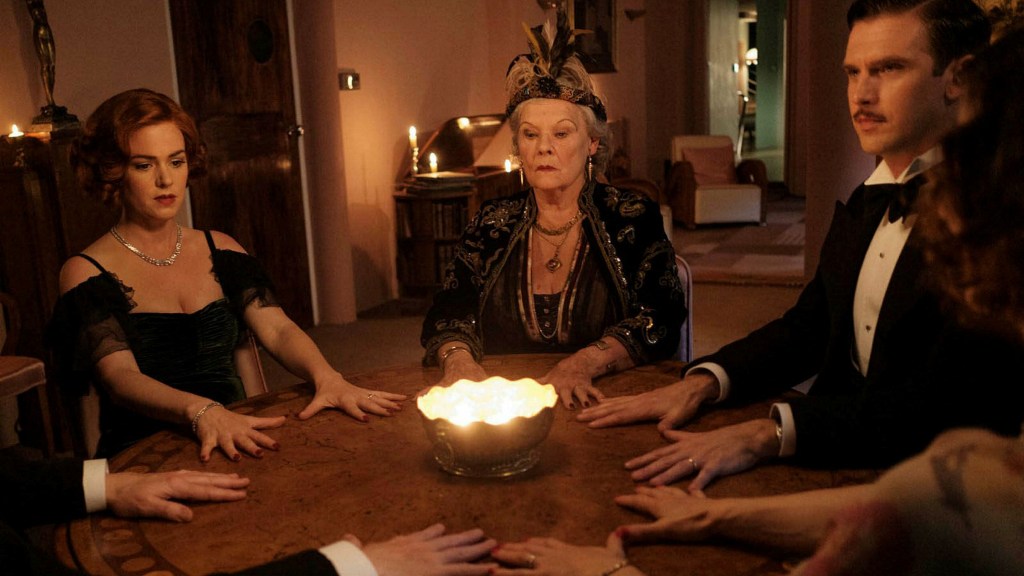
Charles fumbles about for a hook, a way to give his unwritten script an added kick. A night at the theater watching swami, spiritualist and hustler Madame Arcati (Judi Dench) fake-levitate and try to convince the punters that she can “break through to the other side” and talk to the dead might help.
That’s a bust, so Charles invites her for a private seance, “just for research” he assures himself and everybody else. Imagine his shock when shortly after that humbug his late wife shows up, confused and annoyed at the changes to her house, and wearing the jodhpurs, boots and riding gloves she had on the last time they were together.
“Elvira, you’re dead” rattles her. But as she’s played by scary spitfire Leslie Mann, we know that won’t be the end of it. She teases and taunts him, calls him “an astral bigamist,” and as he’s the only one who sees her, arguing back just has everybody thinking he’s barking mad, as posh limeys are wont to say.
The supernatural stuff is old hat, the “writing a screenplay” business is leaned on entirely too heavily (padding an already added-on ending) and the cruel touches just dampen spirits as the lighter moments are few and so flatly-written they don’t give this material the sparkle it once did.
I haven’t seen the play in ages, and all I remember from the experience is thinking “This is stodgy,” so it’s understandable that one would want to brighten it up with a little cinematic history. But Coward’s jokes were wittier than most of what we hear here.
Stevens mugs, Fisher vamps and Mann and Dench do their damnedest. But you can’t improve on Coward, and there’s no re-animating this corpse.

MPA Rating: PG-13 for suggestive references and some drug material.
Cast: Dan Stevens, Isla Fisher, Leslie Mann and Judi Dench
Credits: Directed by Edward Hall, script by Nick Moorcroft, Meg Leonard and Piers Ashworth, based on the play by Noel Coward. An IFC release.
Running time: 1:39
A local heroine, high school hoops star back in the down, is now a police detective in this seven episode series. Jean Smart plays her mom.
A murder mystery, something new from Kate? Count me present. April 18.
March 1, watch that broad with the scissors, the one they call “The Stylist.”
Sure, we couldn’t get our hair done at all for months and months. And now that we can visit a salon (in most places) THIS cautionary thriller comes along.
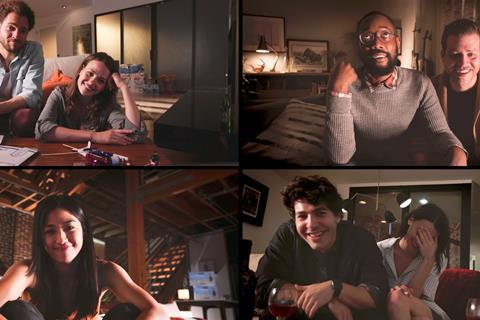
Making art — or at least a genre thriller — during the COVID lockdown is a daunting task, so hats off to the filmmakers of “Safer at Home.”
It’s more impressive as an exercise than thrilling, with a no-name cast and limited “action.” But they conjured up a movie out of a Zoom call split screen and a couple of handheld selfie-chases. In a medium that lives and dies by cinema’s control of time and the escalating suspense, which are largely a product of editing, they took a Hitchcockian shot at making movie that’s got very little editing.
“Safer at Home” is almost all performance and mise en scene. YOU try parking three couples and a single woman on four sets with limited visible backgrounds, captured on four split screens and getting a thriller out of that.
Thousands of years of live theater prove it can be done, but narrowing the frame of the story and the “world” you’re show in it requires a different way of thinking and a one-arm-tied-behind-your-back approach.
Three years into the pandemic (Dear Lord, let that NOT be the case.) and America ‘s lockdown has become the New Normal. Millions upon millions have died and curfews have gotten seriously strict.
But Evan’s (Dan J. Johnson) is having a birthday, so girlfriend Jen (Jocelyn Hudon) arranges a video conference birthday party.
They’re in LA, as is pal Ollie (Michael Kupisk) and his new live-in girlfriend Mia (Emma Lahana). Ben and Liam (Adwin Brown and Daniel Robaire) are in New York, and Harper (Alisa Allapach) is in Austin. That doesn’t mean they can’t share some laughs and a glass of champagne with their friend.
Maybe even a game or two. Maybe, if SOMEbody’s mailed “gift” reaches the other three locales, a little “Japanese” “off-the-chain Molly.
Damn, we’re still doing “off the chain” in the future? I lose that bet.
“Tonight is about forgetting…just one night, with NO consequences!”
After a little back and forth, they all ingest, they take up a round of “Never have I ever,” hard feelings come out and something bad happens, something the police would want to know about.
The movie scrambles to undo the “something bad,” and failing that, to keep the cops from finding out what happened and who might have caused it. They keep the conference going as assistance is offered, an escape is attempted and the evening escalates.
It doesn’t, really — escalate I mean. The little bit of running with a cell camera and the like amps up the energy enough to make us realize how dully static most of what came before was.
As with any movie with lots of split screen, figuring out which screen to concentrate on is an issue. As this was created during quarantine, finding something fascinating or at least interesting for characters to do within the confines of the four cinematic spaces can be a challenge.
And unless you think something covering her mouth and going “Oh my God” and somebody stumbling off to the toilet to throw up is scintillating cinema, you’d have to agree with me that the picture fails at this, too.
Never breaking free of its tight-screen limitations, it’s hard for any performance to register, although Hudon and Allapach have a close-up moment or two. Some of the most demanding acting takes place when characters step into the background of their one-fourth-size frame. Good luck getting the Academy’s attention with your power of emoting in that. We can’t even see faces.
Director and co-writer Will Wernick lets us see the storytelling problem-solving going on here, which is kind of fun. But the paucity of ideas is as obvious as the run-time, which is deceptive.
The film is bookended with long montages of pandemic coverage of the twice-impeached “former social influencer” botching the response to COVID-19. There’s even less “drama” scripted and shot here than you think.
Wernick is making a habit of “gimmick” movies like this. “No Escape” and “Escape Room” were his previous feature film outings, and “No Escape” at least had a lot more incident and actions and stuff going on.
“Safer at Home” is so trapped in its own gimmick, so myopic, so limited in action and lacking close-ups that build viewer empathy with characters, this becomes just an interested “failed” exercise.

MPA Rating: unrated, violence, drug above, sexual situations, profanity
Cast: Jocelyn Hudon, Emma Lahana, Alisa Allapach, Adwin Brown, Dan J. Johnson, Daniel Robaire, Michael Kupisk
Credits: Directed by Will Wernick, script by Will Wernick, Lia Bozonelis. A Voltage film, a Vertical release.
Running time: 1:25
Race and racism aren’t at the heart of the South African Apartheid-era legal drama “Shepherds and Butchers.” That’s almost certainly a flaw in the film, as the black victims of its central crime are not the focus, merely background for its story in a “Mississippi Burning” sort of way.
But in telling this “inspired by true events” story of a death penalty case of a white man murdering seven black men, the inhumanity of The State is exposed and its cost — to the oppressors who administer it, to the very government’s legitimacy in whose name these horrors are perpetrated — gets at race and racism indirectly and in ways that cut deep.
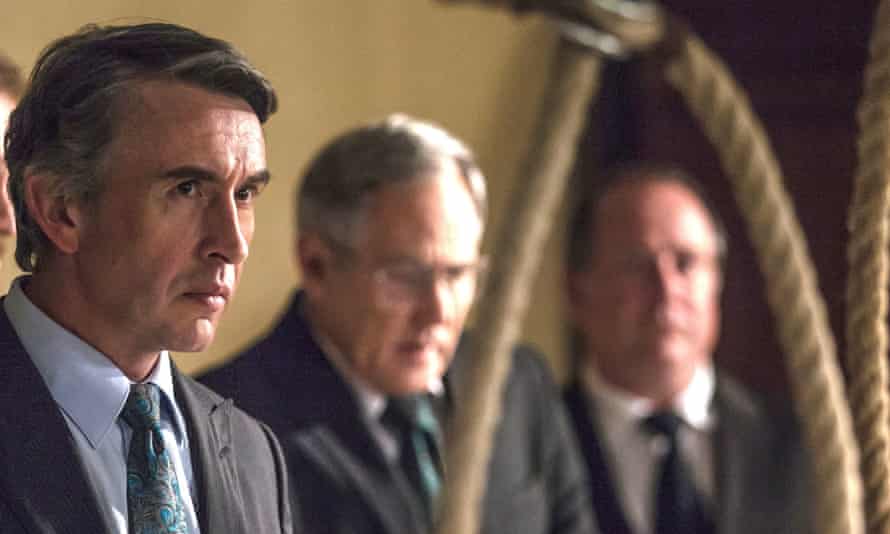
Steve Coogan stars as John Weber, an activist attorney whose issue isn’t Apartheid itself, but the death penalty. He is arm-twisted into taking on a hopeless case, a mass murder we witness in the film’s grim opening scene. His only defense?
“This was no act for which there are no legal consequences,” he insists. Circumstances triggered a mental state in his client, he will argue, that will make the court question “whether the accused can be legally responsible for what happened.”
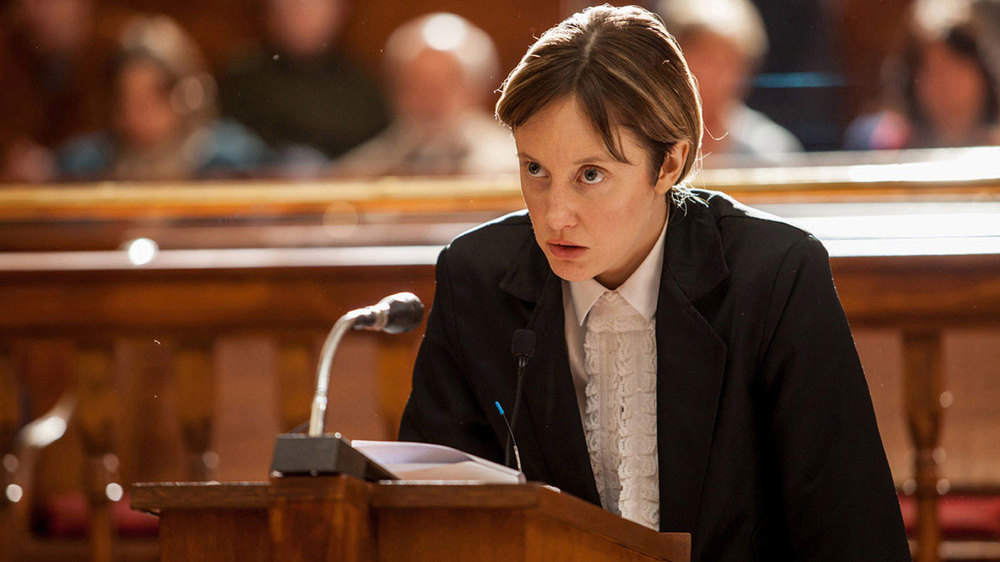
The judge looks perplexed. The prosecutor (the glorious Andrea Riseborough) all but rolls her eyes. But that’s what Weber will do — poke at this case through the prism of his own activism.
“Nobody gets away with killing seven people unless they’re the police,” Weber quips in private.
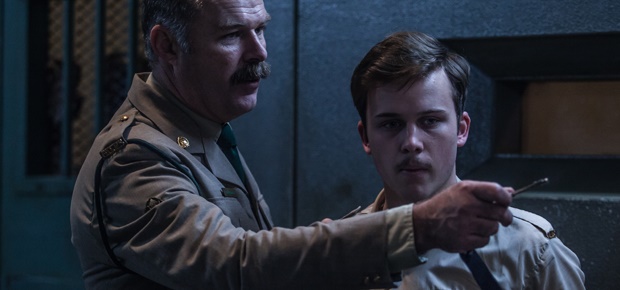
When young Leon Labuschagne (Garion Dowds) turned what looked like road rage into what seems like a racist mass shooting, he was at the end of a very bad day in a string of tortuous awful days. Leon is a warder, a guard at “Maximum,” the nearby Pretoria prison. His job is on death row.
We learn that Leon took the job young to avoid being drafted. This was during South Africa’s long war with guerillas and government forces in neighboring Angola, the late ’80s. Leon avoided murderous conflict by taking an essential, draft-immune job caring for, preparing and helping hang inmates sentenced to death.
In the year Leon was on the job, 164 people were hung, and he was present for all of those. On the day he snapped, they’d hung another seven — all at once.
Leon is reluctant to even have a defense mounted, reluctant to go into details, reluctant to make excuses and reluctant to take the court, via questioning, back to grimly awful events that might have sent him over the edge that night.
Weber’s activism on this subject has been in the abstract because of the secrecy with which South Africa carried out its executions. He leans on a special forces (usually deployed against Black Africans) brother in law for insight, Weber and we appreciate what the violence dictated by a white supremacist government is costing them all.
The film, based on a novel by South African attorney Brian Cox, recalls a South Africa where mass executions were common and the approved manner of doing things. Weber knows enough to be appalled. His co-counsel Pedrie (Eduan van Jaarsveldt) is anxious to save the accused. But he is the first pushback Weber gets from this line of attack.
Pedrie ticks off the terrible crimes of those Leon executed, hissing “Get rid of them, for GOOD” as the only solution. But as the trial digs into the secrecy, state-sponsored killing done without outside witnesses, the inhumanity of the system and the guards who perform it become clear. The chaos of the slaughter, the ugly details of what happens before, during and after a hanging is exposed and Pedrie and we are given pause. That snap judgement doesn’t seem so unassailable after all.
The details can’t help but bring to mind The Holocaust — wholesale slaughter “processed” by desensitized killers, all a part of a “machine” run by the heartless, criminally culpable “State.” What this does to everyone concerned is monstrous.
“Shepherds and Butchers” keeps the families of the victims at almost arm’s length, to its detriment. It barely gives us a feeling for the scores of the condemned Leon meets, feeds and must watch die. But even that is almost enough because the execution scenes are a nightmare — brutal and awful even when everything goes “right.” And we’ve learned with “drug cocktails” in this country and any place that still carries out hanging can tell you, sometimes things go wrong.
I found the picture moving in spite of its seeming unwillingness to wholly grapple with race and Coogan’s unwillingness to master the Afrikaner accent. He’s a gifted mimic, and Riseborough manages it. What gives?
But what it does wrestle with is profound, and profoundly disturbing.

MPA Rating: R for disturbing and violent content
Cast: Steve Coogan, Garion Dowds, Robert Hobbs, Eduan van Jaarsveldt, Nicola Hanekom and Andrea Riseborough.
Credits: Directed by Oliver Schmitz, script by Brian Cox, based on a novel by Chris Marnewick. A Distant Horizon film on Netflix.
Running time: 1:46
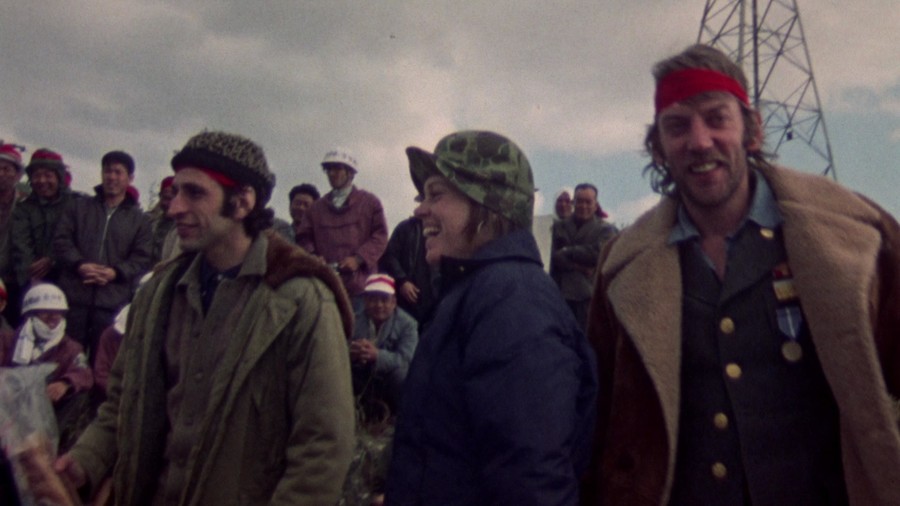
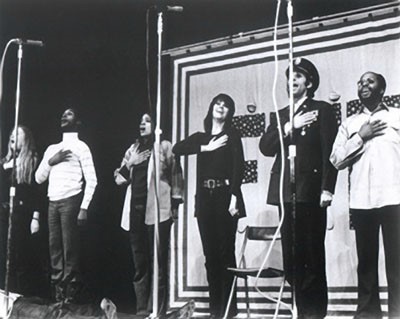
In 1971, the stars of the new thriller “Klute,” Jane Fonda and Donald Sutherland, took off on a tour of U.S. military bases. When they embarked for the bases of the Pacific Rim — Hawaii and the Philippines, Japan and Okinawa — they brought a film crew with them.
They’d sing songs, perform sketches and poetry and dramatic readings, gathering their material from “GI newspapers around the world.” It was, Fonda said then, “political vaudeville.” It was, she says now, designed “to be the opposite of the ‘pro war’ Bob Hope shows” of the time.
But while they would be performing for thousands of troops, they wouldn’t be allowed on the actual bases the sailors, airmen, Marines and soldiers were stationed in. Because when you name your tour “F.T.A.” and the GIs know that to mean “F— the Army,” officialdom was never going to let that happen. Even if the show’s theme song (singers Len Chandler and Rita Martinson were on board) changed the acronym to “FREE the Army,” that was never going up the flagpole of any U.S. military base.
Filmmaker Francine Parker’s documentary “F.T.A.” is an often amusing, occasionally raucous and always musical memoir of that tour, slapped together for a quick release back in the election year of 1972, a release that never happened.
“Long-suppressed” film? Maybe. But now this fascinating artifact is available for mass consumption, restored by Kino Lorber and earning a theatrical and digital release on March 5.
A blend of comedy, song and dance, drama and male and female servicemember interviews, it’s funny, biting and tuneful, and it takes you right back there if you lived through it. And it might be an eye-opener for activist “Ok, Boomer” millennials.
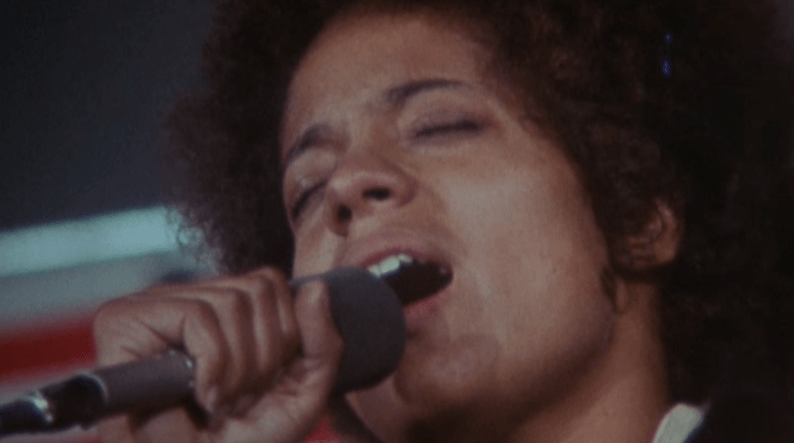
Fonda sings duets with actress/folkie Holly Near, a goofy riff on “Carolina in the Morning” that goes “Nothing felt diviner than to be in Indochina making MOoooooney.”
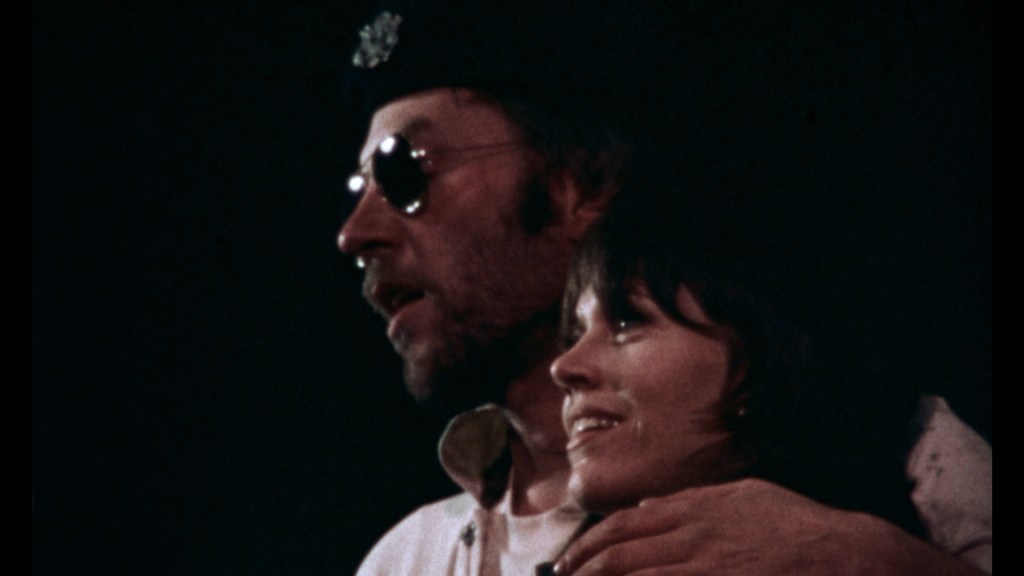
Sutherland memorizes and mesmerizes performing a long monologue from Dalton Trumbo’s 1930s anti-war novel “Johnny Got his Gun.”
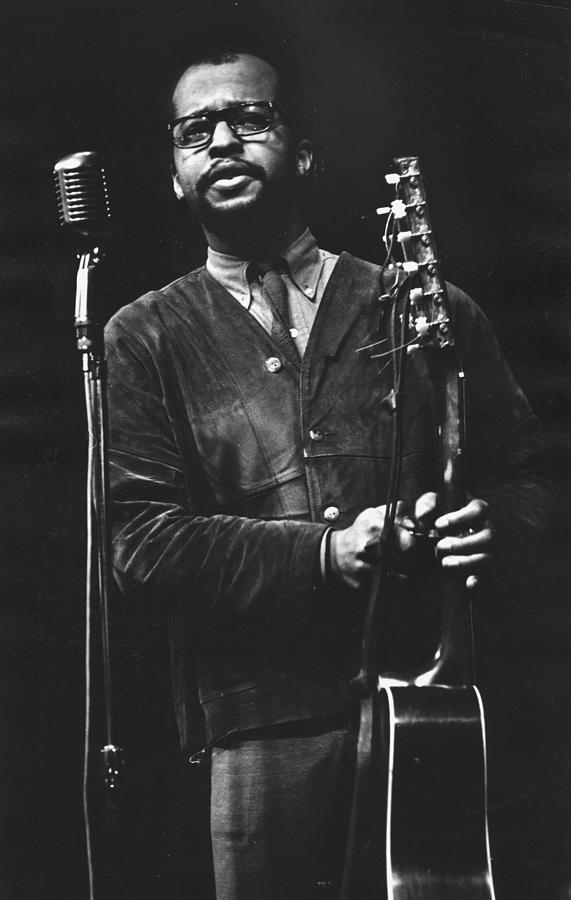
And folkie Len Chandler leads sing-alongs of some downright hilarious anti-war tunes, some composed expressly for this tour.
“First they draft your ass, then they uniform your ass, they arm your ass and then they train your ass. And then they bust your ass and then they break your ass and then they SHIP your ass and then they shoot your ass…”
He’s the stand-out performer here, but catching Sutherland channeling early George Carlin as he broadcasts a search and destroy mission in the manner of a college football play-by-play man is a hoot.
“The Hueys filled with our guys are landing, but no sign of Charlie…You know, the Vietcong are having a VERY good season.”
Fonda jokes with large (not “official” Hope base-visit “huge”) crowds, adding shows when they run out of room for the first performance, straining to get through all the material because “apparently, you have to be back in prison by midnight.”
None of which will play as funny to the generation — some of them veterans — who labeled her “Hanoi Jane.” And truthfully, despite the tour’s diverse cast and some stinging, funny seqments, not all of the material is aging well.
There’s a not-that-subtle suggestion of passive resistance and insubordination in some of their messaging, because that’s what prompted the tour. A lot of men and women in uniform were questioning the rationale, the inhumanity and the legality of what they were being ordered to do.
Over half the crew of the aircraft carrier U.S.S. Coral Sea had petitioned against returning to action off the coast of Vietnam, an unheard of and nearly mutinous act, prior to this tour.
Fonda sat for a 20 minute interview that will be attached to this release, remembering both the impetus for the tour and the times it took place in. She won’t win over or convince anyone who ever called her “Hanoi Jane,” but she’s on the money in pointing out that even much of the military had turned against the war by ’70-71.
The proof is in every sailor, airman or soldier who recalls feeling “I owed my country at least two or three years of my life” who had the courage to ask “What the hell are we in Vietnam for?” on camera for this film.

MPA Rating: unrated, violent images, profanity
Cast: Jane Fonda, Donald Sutherland, Rita Martinson, Len Chandler, Paul Mooney, Peter Boyle and Holly Near
Credits: Directed by Francine Parker. A Kino Lorber release.
Running time: 1:37


