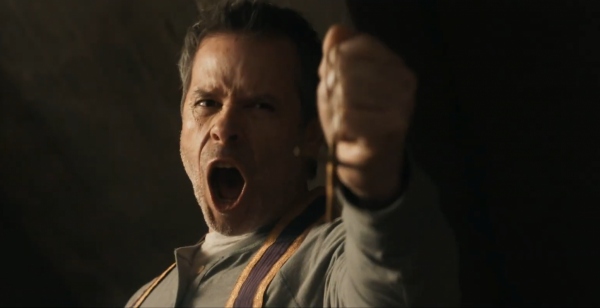
Movie Review: Dad’s dead, and whatever killed him is causing his family “Woe”

Something’s eating at Charlie. He’s working on this house at all hours, sawing and shoveling and whatnot.

The phone rings incessantly, but he won’t answer. He’s always popping in his ear buds and tuning out the world.

With his sister Betty about to marry Park Ranger Benny and trying to sell their Dad’s old Crown Victoria, with his mother fretting about the one year anniversary of his father’s death, Charlie’s got a lot on his mind. Or nothing at all.

What’s in that body-shaped bag we see him burying when we meet him, flies everywhere? And uh, was that a wraith we saw passing in the shadows behind him?

“Woe” is an oddly unsettling horror tale that packs most of its “action” — such as it is — in the finale.

Betty (Jessie Rabideau) is a bit fraught with all that’s going on. She never answers Benny’s (Ryan Kattner) “I love yous” with one of her own. He lets that slide off his back, struggling as he does to keep everybody on task. He’s constantly trying to get Charlie’s attention, to get him to commit to showing up to the wedding, to show any sign that he’s not catatonia walking.

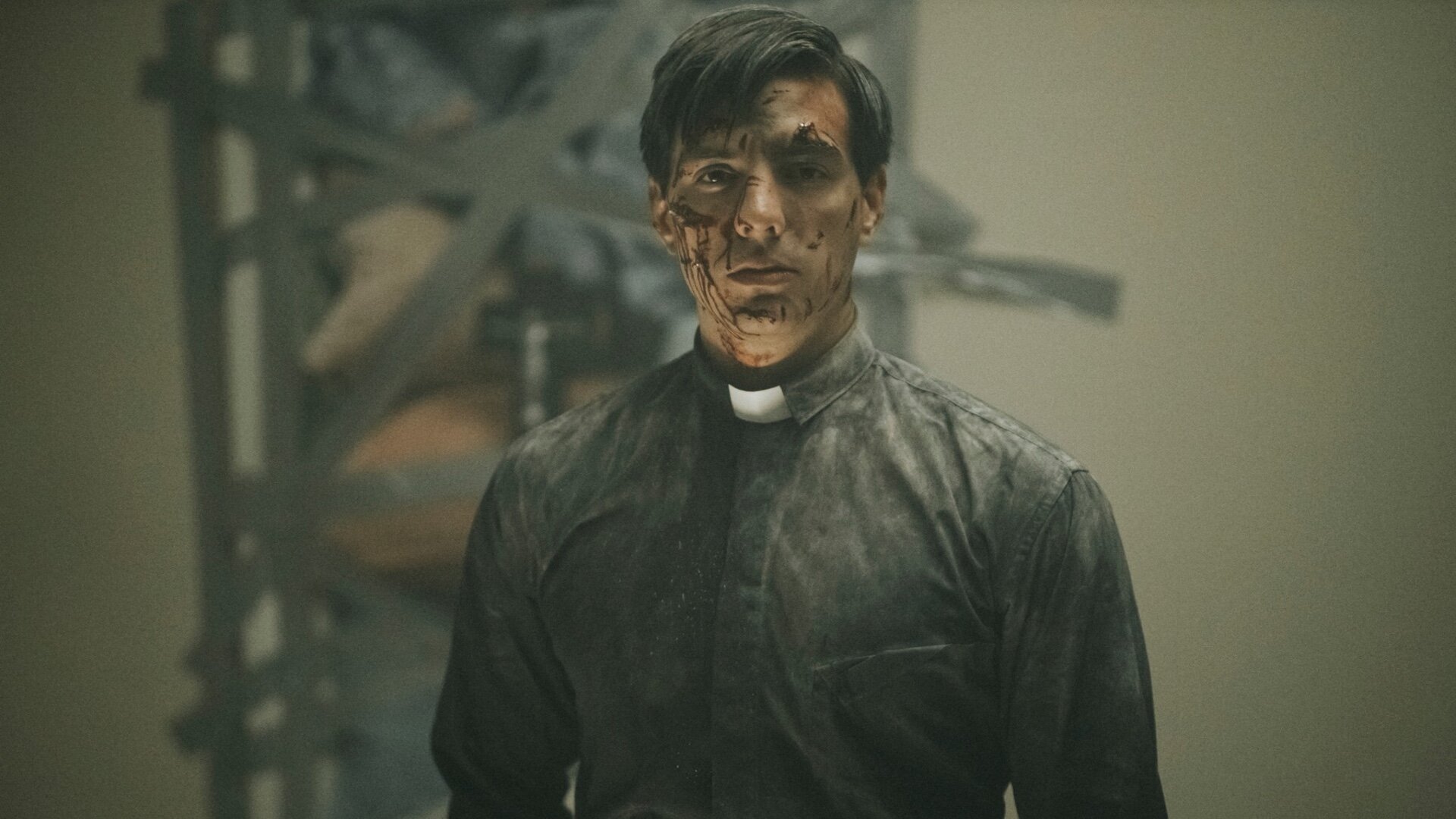
And Charlie? He’s seeing that wraith. He’s got bloody claw marks on his arms that he tries to hide. He eyes that huge wasp nest in his Dad’s yard with suspicion. And he hallucinates a fateful night in that Crown Vic, the car his father died in just a year before.

Maybe no-nonsense Uncle Peter (James Russo) can shake Charlie out of his tupor.

“This thing is going to destroy you, just like it did your father!”

The debut feature of Matthew Goodhue tries to get by on a chilly tone and a clever twist in that somewhat “action packed” finale. I’d say it does, except it doesn’t.

The performances have a sleepwalking blandness, dictated by the character requirements.

Too little of the mystery is divulged too slowly, in teeny, tiny revelations. There’s little suspense or urgency to Charlie’s plight. We’re missing a lot because a lot seems left out.

“Woe” is the filmmaker who can’t get more “horror movie” in an 85 minute film.

MPA Rating: unrated, bloody violence

Cast: Adam Halferty, Jessie Rabideau, Ryan Kattner, DeVaughn LaBon and James Russo.

Credits: Scripted and directed by Matthew Goodhue. A Gravitas Ventures release.

Running time: 1:25

Posted in Reviews, previews, profiles and movie news | Comments Off on Movie Review: Dad’s dead, and whatever killed him is causing his family “Woe”

Netflixable? Love is by turns “Sweet and Sour” in this Korean romance

“Sweet and Sour” is a Korean romantic fantasy that isn’t remotely as cute and clever as those who made it seem to think it is.

It’s a standard-issue “meet cute” romance about a plump nerd who falls hard for the nurse treating him for jaundice (hepatitis B), who falls in love, loses weight, and gets promoted into a job that threatens the relationship that was all he ever wanted out of life.

And then there’s the code, which toys around with the time as a mobius strip, an afterthought that does nothing for what has already been middling and formulaic, if not utterly without charm.

Da-eun (Chae Soo-bin) is an overworked contract nurse who gives endomorphic Jang-hyuk (Jang Ki-Yong) sweet-natured attention, and just a glimmer of hope that she might be interested in him as more than a saffron-colored (jaundice) patient.

He’s slack-jawed and moon-eyed in her presence, a nerd fresh out of engineering school, still living with his parents, with liver damage thanks to his student lifestyle (his constantly-texting pals are also endomorphs).

She’s harder to read. She takes advantage of him, dozes off in his cubicle, wolfs down his food (they’re working her to death) and flirts just enough to keep him on the hook.

Turns out, she is interested. And as they fall in love (a mostly off-camera eventuality), she commits and he is transformed into the sort of lean young hunk he thinks she deserves.

But his first job wins him a transfer from Incheon to Seoul, and right after they’ve moved in together. Paired up with the fellow new transfer Bo-young (Krystal Jung), we can see the sparks long before the characters in the movie do.

She’s manipulative, ambitious, uncouth and unethical. She eats like a pig and wears several meals on her blouse. But their “meet cute” is almost as cute as Jang-hyuk’s original cute meeting. And forced to work together on an, all-consuming bridge design project, their lives become work and the commute “home” to Seoul becomes a grind.

How will this all play out?

The tropes of such romances are pretty close to universal, as this installment in “Around the World with Netflix” demonstrates. His parents are shocked SHOCKED when Jang-hyuk gets his first-ever girlfriend. A night guard at his new firm tries to give him life-balance advice. There’s a ring, patterns of behavior that point to the rut that the “circle of (your) life” can put you in and performances that are more winsome than winning (save for Jung’s sloppy temptress turn as Bo-young).

None of which are quite charming or remotely amusing enough to make this come off. It’s “Sweet,” all right. Just not sweet enough. And the “sour” half doesn’t quite play, either.

The dopey, twisty ending? Let’s not go there, even if they did.

MPA Rating: TV-14, profanity, sexual themes

Cast:  Krystal Jung, Jang Ki-Yong, Chae Soo-bin

Credits: Scripted and directed by Kae-Byeok Lee, based on a novel by Kurumi Inui. A Netflix release.

Running time: 1:42

Posted in Reviews, previews, profiles and movie news | Comments Off on Netflixable? Love is by turns “Sweet and Sour” in this Korean romance

Series Review: A stellar cast decorates Stephen King’s “Lisey’s Story,” which helps

Whatever hardcore Stephen King fans get out of “Lisey’s Story,” with its suggestions of a writer’s supernatural powers and “visions,” haunted childhoods aging into crippling adulthoods and a post-mortem “bool (treasure) hunt” as the last gasp of a great love affair, I found it most fascinating in its dissection of fame and fandom.

Does that sound like “Misery?” That’s not the only prior King work referenced in this self-adapted screenplay — a violently obsessed “biggest fan,” a honeymoon in a snowy New Hampshire version of “The Shining’s” Overlook Hotel, torturing children with just a whiff of “It” — keen-eyed fans will find an Easter Egg here and there.

There’s a familiarity to all of this that gives the tale a “Stephen King’s Greatest Hits” feel, complete with flashbacks decorated with the music of King’s youth — Patsy Cline and Hank Williams and Roy Orbison.

Your patience for this eight part series may be gauged by your degree of devotion to Mr. King. I found it slow, obscure, structured to maximize the tedium and obscurity, and thus a little wearing. But then I didn’t get all the way through “Mr. Mercedes,” if that matters.

If King is anything at all like the writer character Scott Landon, whose fans have developed a cultish devotion that didn’t end with his death, then the Dean of America’s suspense/horror/fantasy novelists sees himself in a John Lennon light. Of course King has fans on the lunatic end of the spectrum, like the one who killed Lennon, like the one Landon attracts in “Lisey’s Story.”

Landon (Clive Owen, seen in flashbacks) is a tad messianic with “healing” powers, a creator of worlds that fans — some of them “not wired right” — will not let go of, much like his widow Lisey (Julianne Moore) is not ready to let go of the husband she lost.

Landon is dead. His wife is consumed with a life-draining grief, communicating with him in dreams, losing herself in flashback reveries. She needs answers, and he left her clues, “bools,” to lead her…back to him? To answers? To closure?

Why exactly is he dead if Lisey “saved” him? And there was this supernatural “All Landons are fast healers” thing he kept repeating to her, and even demonstrated to her. The movies beat that gimmick to death long before King published this novel (in 2006).

Lisey has Landon’s legacy to deal with, and a pushy academic (Ron Cephas Jones of “This is Us) all but demanding that she surrender Scott’s papers to a particular university.

As Lisey “saved” Scott from a crazed fan’s assassination attempt at a ground-breaking at that college and she’s not keen on that professor’s “role” in that rescue, she is hell-bent on preventing that handover, which includes unpublished works, no matter what the “fans” want.

“Most of them love you!”

“But it only takes one who doesn’t.”

Dane DeHaan channels Mark David Chapman (sans glasses) as an eerily obsessed, dead-eyed fanatic who takes this insult to academia, Landon’s legacy and his own ability to have more Landon stories, personally — and in the most psychotic ways.

There’s this Delphic pool where “The waters” have the power to not just heal, but to fascinate,” that may exist in more than just Scott’s fictive imagination.

“I have visions,” he always said. “I write them down. People pay to read them.”

The one person most connected to that “water” and Scott’s “world” might have been Lisey’s older sister Amanda (Joan Allen). But she’s gone mad, cutting herself even in the mental institution where Lisey and sister Darla (Jennifer Jason Leigh) have placed her.

So the threat is murderously real and in the physical world. The “help” might be in Scott’s “bools,” little clues, his supernatural “other world,” or it might be in Amanda’s cracked mind and her ready access to that world.

Is there any autobiography in “Lisey’s Story,” which one of the works King has labeled “his favorite” novel rather the way Cher is always labeling things “farewell tours?” Perhaps. Let’s hope not much.

The most adult thing presented here isn’t the fantasy escape from grief but the grinding, friction-causing shared responsibility of dealing with a mentally ill sibling given to cutting messages on her arms. Moore, Leigh and Allen are a perfectly matched trio of sisters, even if Amanda’s mental “escapes” to that pool are stingy with revealing their alleged meaning.

The film is at its most fraught whenever DeHaan is in the picture. He may play this stalking, threatening fan in one note, but it’s a helluva note.

But the series is at its eye-rolling worst in the endless Owen flashbacks, all pitched in somber-voiced tones, memories inside of memories, an invented language of childhood magic, “powers” and monsters. His performance doesn’t get across a love that transcends death. Owen isn’t usually as boring as he makes Scott.

The “drip drip drip” storytelling style of such series is built on us craving a solution to the plot threads, learning “the mystery” at the end of the “bool hunt,” figuring out if Lisey gets the better of her stalker or discovers the cure and closure for her grief.

The dialogue, however, is some of the sharpest King has slapped his name on.

“He said you would see it even before you saw it.”

As someone who never got that into the works of the omnipresent, prolific King, I lost that craving long before the author satiated it and finished “Lisey’s Story.”

MPA Rating: TV-MA, violence, profanity

Cast: Julianne Moore, Clive Owen, Jennifer Jason Leigh, Joan Allen, Dane DeHaan and Ron Cephas Jones.

Credits: Produced by J.J. Abrams, directed by Pablo Larrain, scripted by Stephen King, adapted from his novel. An Apple TV+ release.

Running time: Eight episodes @50-55 minutes each.

Posted in Reviews, previews, profiles and movie news | Comments Off on Series Review: A stellar cast decorates Stephen King’s “Lisey’s Story,” which helps

Classic Film Review: Is it time to finally “call the code” on “M*A*S*H” (1970)?

For years, whenever “M*AS*H,” popped up as I was channel surfing, I’d check to see where we were in the story, and often rewatch a big chunk of it.

Robert Altman’s breakthrough film, the one that taught us what “Altmanesque” means, casts its satire and ridicule far and wide, and some of the laughs and performances have aged well enough to matter.

Mimicking “The Last Supper” with a scene about a dentist (“introducing John Schuck”) whose solution to erectile dysfunction is a very public suicide, which is faked by our heroes, is blasphemy at its most amusing. The Vietnam War era futility, which the movie (based on Richard Hooker’s novel) twists into transgressive mockery at every turn, still plays.

I’ve always hated the lazy, run-time-devouring — if occasionally funny — “football game” that eats up the third act and tends to water down the picture’s anarchy when it is supposed to be underscoring it. It’d been years since I watched “M*A*S*H” past opening kickoff before sitting through it the other night.

But these days, though much of what earned the film that “R” rating back in 1970 is tame enough to put it on broadcast TV, the film plays like one long cringe.

And I’m not just talking about the hurt and stupefied look Tom Skerritt wears the moment Elliott Gould’s “Trapper John” shows up, pushing Skerritt into a veritable bit-player role, when he was star or co-star of the first act.

When one of the objects of your ridicule is the casual racism of the Korean War era ’50s, still present in the Vietnam ’70s, you’re walking a fine line. I’m not sure Altman was a racist, although all we know for sure about that is he was a native Kansas Citian who loved the jazz scene he grew up in there. And he gives a little agency to this or that African American or Korean character in the film.

But the racial slurs are on a Mel Brooks magnitude, and none of them play as funny any more. When the one thing you figure you have to bleep out is the racist nickname footballer/surgeon “Spear-chucker Jones” (Fred “The Hammer” Williamson) wears, without comment, you know your film isn’t standing the test of time. Altman, like Brooks with “Blazing Saddles,” had to recognize crap like that wasn’t earning laughs the right way when the film hit theaters, and only racists chuckle at it to this day.

And all that shrill, stereotypical sing-songy Radio Tokyo Japanese cover artist pop playing over the PA system might be here to emphasis the strangers meddling in a strange part of the world nature of “a land war in Asia.” But it was played for racial ridicule laughs.

Even more problematic is the naked sexism, both in the script and in what was worked out on the set. It goes far beyond the spin-off TV series’ leering and creepily aggressive womanizing.

Sure, take down the hypocritical religious prig Major Burns (Robert Duvall, deep into character). But the all-out assault on his almost-paramour, Major Margaret Houlihan (Sally Kellmerman) after giving her the nickname “Hot Lips,” is just patriarchal cruelty.

“Well, what’s the matter with her today?”

“I don’t know. I think it’s one of those ladies’ things.”

“Hot Lips” only gains acceptance after Burns is goaded into punching a taunting Hawkeye (Donald Sutherland) and is bedded by third-banana Duke Forrest (Skerritt). Ms. “By the Book’s” corruption is a viable target for satire. Her abject humiliation suggests a porcine boy’s club in the screenplay and its execution.

Women are objects, to make passes at and be passed around. The “sacrament” of that last supper? She’s nicknamed “Lt. Dish” in the opening scenes. Jo Ann Pflug would count game show panelist as her major credit after the film, largely due to the way she was treated on-screen here.

Altman never “went there” in terms of patriarchal, frat boy sexualization again. At least he didn’t make a habit of it, although there was that infamous photo of him, on oxygen, on the set of “A Prairie Home Companion,” with his hand up a starlet’s skirt.

Gould, wearing a 1970 pornstache, RayBans and silence (he makes his mark with few lines) stands out. Sutherland was far loopier/hippier in “Kelly’s Heroes.”

The Altmanesque characters-talking-over-each-other art was never more perfect that when Roger Bowen and Gary Burghoff — as Col. Blake and Cpl. Radar O’Reilly — did it.

A lot of people appearing here, including Kellerman, became part of Altman’s repertory company in the years and decades that followed.

From “Dr. Strangelove” through “M*A*S*H,” the ’60s are still widely regarded as the peak decade for cinematic satire, with Altman’s anti-war war film the exclamation point (more or less) on an era. I’ve taken college classes devoted to that subject and these films.

But unlike most of the others, the once-adored “M*A*S*H” is really showing its age. I’d go so far as to call it “obsolescent” now.

MPA Rating: R, blood, nudity, sexual situations, profanity

Cast: Donald Sutherland, Elliott Gould, Sally Kellerman, Robert Duvall, Tom Skerritt, Roger Bowen, Gary Burghoff, Rene Auberjonois, Jo Ann Phlug, Fred Williamson, Bobby Troup, Michael Murphy, Bud Cort and John Schuck

Credits: Directed by Robert Altman, script by Ring Lardner, Jr., based on the novel by Richard Hooker. A 20th Century Fox release.

Running time: 1:56

Posted in Reviews, previews, profiles and movie news | 2 Comments

Movie Preview: The hunters become the hunted — “Fear”

June 15 this one streams.

Posted in Reviews, previews, profiles and movie news | Comments Off on Movie Preview: The hunters become the hunted — “Fear”

Movie Review: “Take Me Somewhere Nice,” but Bosnia?

“Take Me Somewhere Nice” is a deadpan Bosnian/Dutch road dramedy adrift in the aimlessness of youth. So it’s not about the haphazard, clumsy and unhurried physical “journey” that our heroine undertakes. It’s more about a restless age and a rootless trio, making it up as they go along, acting on amoral impulse and haplessly tripping over each other every step of the way.

So, kind of random and unmoored? Yes it is.

Alma (Sara Luna Zoric) sets off from the Netherlands, where she and her mother (Sanja Buric) are somehow getting by, struggling to master Dutch, to visit her estranged father. He got “homesick” years ago and returned to their native Bosnia.

“The bastard!” is how Mom refers to him, but he’s sick. Alma will go see him in remote Podvelezje, maybe get a sense of where she’s from and who she is as she does.

But when she arrives, the cousin who picks her up, Emir (Ernad Prnjavorac) is an unhelpful, dismissive jerk. She can’t get her new suitcase open. And if she dares to go out and wander this city she doesn’t remember, with its new mall, cafes and juice bars, he leaves her locked out of his water-bottle stuffed (no food) flat.

But Emir has an “intern.” That’s the flirtatious, forward and friendly Denis (Lazar Dragojevic). We get the impression that he hits on anything that moves, but he’s probably working the angles with the girl from Western Europe. How is Holland, he wants to know?

“I hate the Netherlands (in Bosnian, with English subtitles),” she mutters. ” Cold weather, cold people.

Still, Denis tries to talk Emir into looking after his “family” and delivering her to her father. After he and Alma have sex before he’s even learned her name, of course.

Alma’s lackadaisical quest begins with dyeing her hair, and puts her on a bus, which she then misses, thus losing her luggage. She depends on the kindness of strangers in a sullen country where “customer service” must translate as one’s favorite swear word. Alma is scatterbrained, naive and sexualized every step along the way, much of it in the same blue minidress she unpacked upon arrival. Because she has no luggage, and even if she did, she couldn’t get the suitcase open.

The trio’s misadventures flirt with “picaresque” as they blunder their way cross country toward a remote hospital Alma is in no hurry to get to. They might make a classic “love triangle” if anything that they do — teens in heat, basically — could be called “love.”

Zoric’s Alma has an Aubrey Plaza blank stare about her, not smart enough to hold this place and these people in contempt, not really taking it all in, either. Alma is the kind of dunce who dumps fish food into a tropical tank where everything in it is dead and floating on the surface.

Writer-director Ena Sendijarevic goes for a “float through this” vibe that feels more like simple drifting in a general direction. There’s violence and other “this almost never happens to real people” melodrama. And once in a great while, something might strike you as funny.

But seeing Bosnia in all its rural, arid desolation tips us to why people leave, why young people despair of any sort of stimulus and why reckless risks — with cars, drugs, sex — maintain their international appeal among the youth of east and west, north and south.

“Take Me Someplace Nice” kind of washes over you the way the events depicted here wash over Alma. Nothing much happens, but when it does, you’re grateful for it, and content just to be “someplace” other than Bosnia as you observe it.

MPA Rating: violence, sex, drugs

Cast:  Sara Luna Zoric, Lazar Dragojevic, Ernad Prnjavorac

Credits: Scripted and directed by Ena Sendijarevic. A Dekanalog release.

Running time: 1:31

Posted in Reviews, previews, profiles and movie news | Comments Off on Movie Review: “Take Me Somewhere Nice,” but Bosnia?

Netflixable? The “Battle of Britain” through Polish pilots’ eyes — “Mission of Honor”

The Battle of Britain is one of those “finest hour” pieces of British history that almost instantly passed into legend, and has proven irresistible to filmmakers over the decades.

When Winston Churchill intoned that “Never in the field of human conflict was so much owed by so many to so few,” referring to the RAF fighter pilots who blunted a German air offensive and saved the island nation from invasion in the late summer and early fall of 1940, the prime minister was making a movie pitch, the ultimate “high concept” description of a story in a single sentence.

The ponderous all-star epic “The Battle of Britain” was the major effort to get real airplanes from the WWII into the air and film them staging air battles, with the likes of Michael Caine, Robert Shaw and Christopher Plummer piloting them, and Laurence Olivier in command on the ground.

Extensive aerial footage from that film showed up in “Dark Blue World,” (2001) a pretty good account of the battle as seen from the point of view of Czech pilots who, their country under occupation, climbed into the cockpit for Britain and kept her in the war.

And there’s even a little footage recycled from “Battle of Britain” in “Mission of Honor,” a lower-budget historical thriller that uses digital aircraft in most of the combat scenes, with the digital dogfights somewhat of a step up from the ones George Lucas served up in “Red Tails.”

This time, it’s the celebrated Poles of 303 Squadron, English-language mangling free spirits with a seething hatred for the Germans who invaded their country and killed friends and family.

It’s a standard-issue WWII aerial combat melodrama, a somewhat fictionalized account of the lives and exploits of such Polish aces as Jan Zumbach (played by Iwan Rheon), Witold Urbanowicz (Marcin Dorocinski) and the Czech 303 ace Josef Frantisek (Krystof Hádek).

Milo Gibson plays the Canadian John Kent, the commander of the “arrogant, irresponsible and ill-disciplined” corps, the fellow the pilots eventually nickname “Kentowski” with affection.

And then there’s the bluff Air Marshall and mastermind of the battle, Hugh Dowding (Nicholas Farrell of “Chariots of Fire”), the one more than willing to stick with “stash the Poles somewhere they’ll do the least harm,” until one of their number — the intrepid Urbanowicz, earns a try-out out of desperation (heavy RAF losses) and shoots that argument down.

“What if they’re all as good as Urbanowicz?” Then “the Poles will end up winning us this bloody war, if we’re not careful.”

“Mission of Honor” has men flashing back to the horrors they and their families faced when the Nazis rolled in and carrying those memories into furious battle. Some are braver than others, some more reckless, one takes a tumble for an “I always say ‘yes'” RAF lass (Stephanie Martini) who reasons “They could be dead tomorrow” or “WE could be dead tomorrow.”

National rivalries play out at the pub, unruly breaks in discipline, tragedy and seeing the horror of the air war up close — its corpses and burn victims — all standard issue for this sort of picture, make it into the Robert Ryan/Alastair Galbraith screenplay.

The cutest moments come in the first scenes as we see the Polish-Swiss Zumbach bluff his way past Germans by passing himself off as a Swiss watch salesman (wristwatch bribes) and steal a French trainer to make his way to Britain in. Rheon, in the lead role, makes the strongest impression among the cast, showing swagger and hot-tempered vulnerability in the part.

Not all of this is the literal truth, but a lot of it is. And while likewise, much is left out, this David Blair film makes for an entertaining gloss on real history and a pretty good digital updating of the WWII aerial combat thriller.

MPA Rating: unrated, graphic violence, sex, profanity

Cast: Iwan Rheon, Milo Gibson, Stephanie Martini, Marcin Dorocinski, Manuel Klein, Krystof Hádek and Nicholas Farrell

Credits: Directed by David Blair, script by Robert Ryan, Alastair Galbraith. A release.

Running time: 1:47

Posted in Reviews, previews, profiles and movie news | Comments Off on Netflixable? The “Battle of Britain” through Polish pilots’ eyes — “Mission of Honor”

Classic Film Review: Hoffman’s at his toughest doing “Straight Time” (1978)

Looking back, I think that two movies shaped and/or reinforced my views on “the criminal mind,” the folks who rob, cheat, vandalize and threaten as if they were born to it.

“Donnie Brasco” (1998) set in stone my hunch that what Deep Throat said about the Watergate Burglars and the GOP leadership holds true for criminals in general.

“The truth is, these are not very bright guys.”

In “Donnie Brasco,” even the “men with honor,” the “made men” of the New York mob, are busting into vending machines or parking meters, just to have a little change in their pocket. They’re willing to follow the awful “orders” they’re given because questioning dubious ideas and considering life’s other options never occur to them.

But the first movie that formed “THIS is what criminals really are” in my mind was one I screened as an undergraduate projectionist in the ’80s.

In “Straight Time” (1978), Dustin Hoffman‘s Max Dembo gets out of prison and would have us believe, in his self-martyred way, that his abusive parole officer (M. Emmet Walsh, in a role that would define the “heavies” he played) and society itself paints ex-cons into the corner that they find themselves in. Current social thinking backs at least some of that up.

But Max has impulse control issues. He lashes out at and pummels that parole officer. He hastily plots robberies because “it’s what I do.” “Real jobs,” the only ones he will be considered for, are beneath him.

And when he lands a more cautious partner for these bank and jewelry store heists (Harry Dean Stanton, never better), Max shows his twitchy impatience with “the real world,” his rush to get what he wants when he wants it and his rash, unreasoning willingness to risk re-capture or death when he pushes his “luck” every time he dives into a crime.

He finds an illegal poker game to rob.

“We just tip toe in, tip toe out and it’s all ours. There ain’t no cops because they can’t call.”

The hold-up is botched because the guy with the guns doesn’t show up, so Max u-turns and parks his girlfriend’s car in front of a closed pawn shop and, as if by instinct, figures out a risky way of burgling it to get the firearms he wants. Now.

He explodes in rage at the fellow who doesn’t deliver the guns and refuses to acknowledge that a getaway driver (a young and saner Gary Busey) gave him all the time in the world to exit a robbery, with alarms going off and cops on the way, that Max pushed beyond the limit.

People die because of Max’s impulse control.

Theresa Russell got an early big break playing the younger woman Max takes up with and imposes himself on upon getting out of prison, and she is impressively impassive in the role. Feigned “disinterested, but dangerous” became her calling card — blank-faced, seemingly passive, but sublimating a lot of emotions that she lets out just often enough to see there’s a will and a soul in there, even if it is an amoral one.

A very young Kathy Bates is sweetly impressive in her first major role, playing ex con Busey’s wife.

Director and sometimes actor Ulu Grossbard (“True Confessions,” “Georgia”) and “French Connection/Exorcist/Network” DP Owen Roizman capture LA at its late-70s seediest, the decade after “Once Upon a Time…in Hollywood.” “Straight Time” is state-institution florescent interiors, dirty neon or sun-burnt exteriors, ugly ’70s sideburns and earth tones, ugly ’70s cars.

There’s a sort of shared directing credit on this. If you want to know why “Tootsie” was the Oscar winner playing an uncompromising control-freak version of himself, “Straight Time” is one of the reasons for that legend. At this stage in his career, Hoffman might wear a Sydney Pollack (“All the President’s Men,””Tootsie”) out. He’d roll right over an Ulu Grossbard.

If we’re still talking about Hoffman, and he took a pretty good #MeToo punch (an absolute gift for throwing his weight around and being “inappropriate” with women), so even that’s a miracle, “Straight Time” stands out as one of his greatest performances.

He didn’t get to play the tough guy very often, but co-stars and others hint that he’s been an actor’s version of “tough” all along. He immerses himself in this guy’s world, his impulses, his martyrdom and his hypocrisy.

And if he said, a couple of years later upon finally winning an Academy Award for “Kramer vs. Kramer,” “well, the soap opera did it” for him, he had good reason. “Straight Time” is his great performance of the ’70s.

MPA Rating: R, violence, nudity

Cast: Dustin Hoffman, Theresa Russell, Harry Dean Stanton, M. Emmet Walsh and Gary Busey

Credits: Directed by Ulu Grosbard and (possibly) Dustin Hoffman, script by Alvin Sergeant and Jeffrey Boam, based on the Edward Bunker novel. Warner Brothers release.

Running time: 1:52

Posted in Reviews, previews, profiles and movie news | Comments Off on Classic Film Review: Hoffman’s at his toughest doing “Straight Time” (1978)

Netflixable? “Dancing Queens” is a Swedish drag

There’s a touching moment near the end of “Dancing Queens,” the new Swedish dramedy about a young female dancer who sneaks into a drag troupe.

Dylan (Molly Nutley) gets to dance a well-choreographed and photographed duet in a modern dance company, perhaps fulfilling her late dancer/mother’s destiny as she does. Lovely.

But then we remember this Swedish film’s title isn’t a play on the ABBA song and has nothing do with with ABBA.

We think back to all the drag numbers we’ve seen choreographed by Victor (Fredrik Quinones), young Dylan’s co-conspirator in getting her into the team at Queens, a Stockholm drag club. They’re unremarkable lip-sync productions still trapped in “I Will Survive.”

We recall that it’s — well 2021 — and people are still trotting out this “woman pretends to be a man pretending to be a woman” nonsense nearly 40 years after “Victor/Victoria,” and closing in on 90 years since the German film that inspired “Victor/Victoria.” The novelty’s gone, and kind of become offensive.

And one wonders, how do you say “WTF” in Swedish?

This lumbering, clunky contraption from the Land of Volvos and Dragon Tattoos is about a 20ish dancer (Nutley) who delivers packages, by boat, on the island she’s called home, teaching the town’s tiny tots dance at Dylan’s Disco, her dance studio, in her spare time. When they go home for the night, she “Flashdances” (sans water buckets) and weeps. Her mother died not 18 months before.

Bob Dylan-obsessed Dad (Mattias Nordkvist) is morose, picking out downbeat Bob Dylan songs on his guitar. Grandma (Marie Göranzon) frets away, and urges Dylan to go and audition for this modern dance ensemble in Stockholm. Which eventually, Dylan does.

Only she’s a month too late. That’s when an administrator with the company points her to the drag club where she can find a little work cleaning, and maybe fall under the gaze of choreographer-dancer Victor, trying to save Queens — the club — and its aging, overweight diva Tommy la Diva (Claes Malmberg) whose best lip-syncing is twenty years and fifty kilos behind him.

Dylan decides to strike a pose — as a guy — and Victor plays along and there’s your movie.

There is an informative debate on the trials and “life lived” that drag performers consider a must. We are all heroines in our own tragedy, in essence.

Funny fellow dancers who aren’t funny and apparently don’t realize that the slight, girlish new “girl” is a girl, drab choreography, sad interludes as we consider how people come to perform drag, “Dancing Queens” kind of has it all. And by “all” I mean nothing much.

MPA Rating: TV-MA, profanity

Cast: Molly Nutley, Fredrik Quinones, Claes Malmberg, Christopher Wollter, Emil Almén, Mattias Nordkvist and Marie Göranzon

Credits: Directed by Helena Bergström, script by Helena Bergström, Denize Karabuda. A Netflix release.

Running time: 1:50

Posted in Reviews, previews, profiles and movie news | Comments Off on Netflixable? “Dancing Queens” is a Swedish drag

Movie Preview: Hugh Jackman, Thandie Newton and Rebecca Ferguson star in “Reminiscence”

A memory researcher hunts his mind for the one that got away, a great lost love, in this Aug. 20 release.

Posted in Reviews, previews, profiles and movie news | Comments Off on Movie Preview: Hugh Jackman, Thandie Newton and Rebecca Ferguson star in “Reminiscence”