June 15 this one streams.


“Take Me Somewhere Nice” is a deadpan Bosnian/Dutch road dramedy adrift in the aimlessness of youth. So it’s not about the haphazard, clumsy and unhurried physical “journey” that our heroine undertakes. It’s more about a restless age and a rootless trio, making it up as they go along, acting on amoral impulse and haplessly tripping over each other every step of the way.
So, kind of random and unmoored? Yes it is.
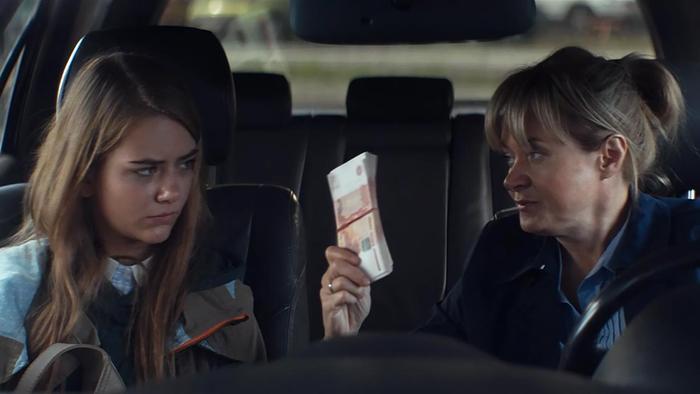
Alma (Sara Luna Zoric) sets off from the Netherlands, where she and her mother (Sanja Buric) are somehow getting by, struggling to master Dutch, to visit her estranged father. He got “homesick” years ago and returned to their native Bosnia.
“The bastard!” is how Mom refers to him, but he’s sick. Alma will go see him in remote Podvelezje, maybe get a sense of where she’s from and who she is as she does.
But when she arrives, the cousin who picks her up, Emir (Ernad Prnjavorac) is an unhelpful, dismissive jerk. She can’t get her new suitcase open. And if she dares to go out and wander this city she doesn’t remember, with its new mall, cafes and juice bars, he leaves her locked out of his water-bottle stuffed (no food) flat.
But Emir has an “intern.” That’s the flirtatious, forward and friendly Denis (Lazar Dragojevic). We get the impression that he hits on anything that moves, but he’s probably working the angles with the girl from Western Europe. How is Holland, he wants to know?
“I hate the Netherlands (in Bosnian, with English subtitles),” she mutters. ” Cold weather, cold people.“
Still, Denis tries to talk Emir into looking after his “family” and delivering her to her father. After he and Alma have sex before he’s even learned her name, of course.
Alma’s lackadaisical quest begins with dyeing her hair, and puts her on a bus, which she then misses, thus losing her luggage. She depends on the kindness of strangers in a sullen country where “customer service” must translate as one’s favorite swear word. Alma is scatterbrained, naive and sexualized every step along the way, much of it in the same blue minidress she unpacked upon arrival. Because she has no luggage, and even if she did, she couldn’t get the suitcase open.
The trio’s misadventures flirt with “picaresque” as they blunder their way cross country toward a remote hospital Alma is in no hurry to get to. They might make a classic “love triangle” if anything that they do — teens in heat, basically — could be called “love.”
Zoric’s Alma has an Aubrey Plaza blank stare about her, not smart enough to hold this place and these people in contempt, not really taking it all in, either. Alma is the kind of dunce who dumps fish food into a tropical tank where everything in it is dead and floating on the surface.
Writer-director Ena Sendijarevic goes for a “float through this” vibe that feels more like simple drifting in a general direction. There’s violence and other “this almost never happens to real people” melodrama. And once in a great while, something might strike you as funny.
But seeing Bosnia in all its rural, arid desolation tips us to why people leave, why young people despair of any sort of stimulus and why reckless risks — with cars, drugs, sex — maintain their international appeal among the youth of east and west, north and south.
“Take Me Someplace Nice” kind of washes over you the way the events depicted here wash over Alma. Nothing much happens, but when it does, you’re grateful for it, and content just to be “someplace” other than Bosnia as you observe it.
MPA Rating: violence, sex, drugs
Cast: Sara Luna Zoric, Lazar Dragojevic, Ernad Prnjavorac
Credits: Scripted and directed by Ena Sendijarevic. A Dekanalog release.
Running time: 1:31


The Battle of Britain is one of those “finest hour” pieces of British history that almost instantly passed into legend, and has proven irresistible to filmmakers over the decades.
When Winston Churchill intoned that “Never in the field of human conflict was so much owed by so many to so few,” referring to the RAF fighter pilots who blunted a German air offensive and saved the island nation from invasion in the late summer and early fall of 1940, the prime minister was making a movie pitch, the ultimate “high concept” description of a story in a single sentence.
The ponderous all-star epic “The Battle of Britain” was the major effort to get real airplanes from the WWII into the air and film them staging air battles, with the likes of Michael Caine, Robert Shaw and Christopher Plummer piloting them, and Laurence Olivier in command on the ground.
Extensive aerial footage from that film showed up in “Dark Blue World,” (2001) a pretty good account of the battle as seen from the point of view of Czech pilots who, their country under occupation, climbed into the cockpit for Britain and kept her in the war.
And there’s even a little footage recycled from “Battle of Britain” in “Mission of Honor,” a lower-budget historical thriller that uses digital aircraft in most of the combat scenes, with the digital dogfights somewhat of a step up from the ones George Lucas served up in “Red Tails.”
This time, it’s the celebrated Poles of 303 Squadron, English-language mangling free spirits with a seething hatred for the Germans who invaded their country and killed friends and family.
It’s a standard-issue WWII aerial combat melodrama, a somewhat fictionalized account of the lives and exploits of such Polish aces as Jan Zumbach (played by Iwan Rheon), Witold Urbanowicz (Marcin Dorocinski) and the Czech 303 ace Josef Frantisek (Krystof Hádek).
Milo Gibson plays the Canadian John Kent, the commander of the “arrogant, irresponsible and ill-disciplined” corps, the fellow the pilots eventually nickname “Kentowski” with affection.
And then there’s the bluff Air Marshall and mastermind of the battle, Hugh Dowding (Nicholas Farrell of “Chariots of Fire”), the one more than willing to stick with “stash the Poles somewhere they’ll do the least harm,” until one of their number — the intrepid Urbanowicz, earns a try-out out of desperation (heavy RAF losses) and shoots that argument down.
“What if they’re all as good as Urbanowicz?” Then “the Poles will end up winning us this bloody war, if we’re not careful.”
“Mission of Honor” has men flashing back to the horrors they and their families faced when the Nazis rolled in and carrying those memories into furious battle. Some are braver than others, some more reckless, one takes a tumble for an “I always say ‘yes'” RAF lass (Stephanie Martini) who reasons “They could be dead tomorrow” or “WE could be dead tomorrow.”
National rivalries play out at the pub, unruly breaks in discipline, tragedy and seeing the horror of the air war up close — its corpses and burn victims — all standard issue for this sort of picture, make it into the Robert Ryan/Alastair Galbraith screenplay.
The cutest moments come in the first scenes as we see the Polish-Swiss Zumbach bluff his way past Germans by passing himself off as a Swiss watch salesman (wristwatch bribes) and steal a French trainer to make his way to Britain in. Rheon, in the lead role, makes the strongest impression among the cast, showing swagger and hot-tempered vulnerability in the part.
Not all of this is the literal truth, but a lot of it is. And while likewise, much is left out, this David Blair film makes for an entertaining gloss on real history and a pretty good digital updating of the WWII aerial combat thriller.
MPA Rating: unrated, graphic violence, sex, profanity
Cast: Iwan Rheon, Milo Gibson, Stephanie Martini, Marcin Dorocinski, Manuel Klein, Krystof Hádek and Nicholas Farrell
Credits: Directed by David Blair, script by Robert Ryan, Alastair Galbraith. A release.
Running time: 1:47

Looking back, I think that two movies shaped and/or reinforced my views on “the criminal mind,” the folks who rob, cheat, vandalize and threaten as if they were born to it.
“Donnie Brasco” (1998) set in stone my hunch that what Deep Throat said about the Watergate Burglars and the GOP leadership holds true for criminals in general.
“The truth is, these are not very bright guys.”
In “Donnie Brasco,” even the “men with honor,” the “made men” of the New York mob, are busting into vending machines or parking meters, just to have a little change in their pocket. They’re willing to follow the awful “orders” they’re given because questioning dubious ideas and considering life’s other options never occur to them.
But the first movie that formed “THIS is what criminals really are” in my mind was one I screened as an undergraduate projectionist in the ’80s.
In “Straight Time” (1978), Dustin Hoffman‘s Max Dembo gets out of prison and would have us believe, in his self-martyred way, that his abusive parole officer (M. Emmet Walsh, in a role that would define the “heavies” he played) and society itself paints ex-cons into the corner that they find themselves in. Current social thinking backs at least some of that up.
But Max has impulse control issues. He lashes out at and pummels that parole officer. He hastily plots robberies because “it’s what I do.” “Real jobs,” the only ones he will be considered for, are beneath him.
And when he lands a more cautious partner for these bank and jewelry store heists (Harry Dean Stanton, never better), Max shows his twitchy impatience with “the real world,” his rush to get what he wants when he wants it and his rash, unreasoning willingness to risk re-capture or death when he pushes his “luck” every time he dives into a crime.
He finds an illegal poker game to rob.
“We just tip toe in, tip toe out and it’s all ours. There ain’t no cops because they can’t call.”
The hold-up is botched because the guy with the guns doesn’t show up, so Max u-turns and parks his girlfriend’s car in front of a closed pawn shop and, as if by instinct, figures out a risky way of burgling it to get the firearms he wants. Now.
He explodes in rage at the fellow who doesn’t deliver the guns and refuses to acknowledge that a getaway driver (a young and saner Gary Busey) gave him all the time in the world to exit a robbery, with alarms going off and cops on the way, that Max pushed beyond the limit.
People die because of Max’s impulse control.
Theresa Russell got an early big break playing the younger woman Max takes up with and imposes himself on upon getting out of prison, and she is impressively impassive in the role. Feigned “disinterested, but dangerous” became her calling card — blank-faced, seemingly passive, but sublimating a lot of emotions that she lets out just often enough to see there’s a will and a soul in there, even if it is an amoral one.
A very young Kathy Bates is sweetly impressive in her first major role, playing ex con Busey’s wife.


Director and sometimes actor Ulu Grossbard (“True Confessions,” “Georgia”) and “French Connection/Exorcist/Network” DP Owen Roizman capture LA at its late-70s seediest, the decade after “Once Upon a Time…in Hollywood.” “Straight Time” is state-institution florescent interiors, dirty neon or sun-burnt exteriors, ugly ’70s sideburns and earth tones, ugly ’70s cars.
There’s a sort of shared directing credit on this. If you want to know why “Tootsie” was the Oscar winner playing an uncompromising control-freak version of himself, “Straight Time” is one of the reasons for that legend. At this stage in his career, Hoffman might wear a Sydney Pollack (“All the President’s Men,””Tootsie”) out. He’d roll right over an Ulu Grossbard.
If we’re still talking about Hoffman, and he took a pretty good #MeToo punch (an absolute gift for throwing his weight around and being “inappropriate” with women), so even that’s a miracle, “Straight Time” stands out as one of his greatest performances.
He didn’t get to play the tough guy very often, but co-stars and others hint that he’s been an actor’s version of “tough” all along. He immerses himself in this guy’s world, his impulses, his martyrdom and his hypocrisy.
And if he said, a couple of years later upon finally winning an Academy Award for “Kramer vs. Kramer,” “well, the soap opera did it” for him, he had good reason. “Straight Time” is his great performance of the ’70s.
MPA Rating: R, violence, nudity
Cast: Dustin Hoffman, Theresa Russell, Harry Dean Stanton, M. Emmet Walsh and Gary Busey
Credits: Directed by Ulu Grosbard and (possibly) Dustin Hoffman, script by Alvin Sergeant and Jeffrey Boam, based on the Edward Bunker novel. Warner Brothers release.
Running time: 1:52


There’s a touching moment near the end of “Dancing Queens,” the new Swedish dramedy about a young female dancer who sneaks into a drag troupe.
Dylan (Molly Nutley) gets to dance a well-choreographed and photographed duet in a modern dance company, perhaps fulfilling her late dancer/mother’s destiny as she does. Lovely.
But then we remember this Swedish film’s title isn’t a play on the ABBA song and has nothing do with with ABBA.
We think back to all the drag numbers we’ve seen choreographed by Victor (Fredrik Quinones), young Dylan’s co-conspirator in getting her into the team at Queens, a Stockholm drag club. They’re unremarkable lip-sync productions still trapped in “I Will Survive.”
We recall that it’s — well 2021 — and people are still trotting out this “woman pretends to be a man pretending to be a woman” nonsense nearly 40 years after “Victor/Victoria,” and closing in on 90 years since the German film that inspired “Victor/Victoria.” The novelty’s gone, and kind of become offensive.
And one wonders, how do you say “WTF” in Swedish?
This lumbering, clunky contraption from the Land of Volvos and Dragon Tattoos is about a 20ish dancer (Nutley) who delivers packages, by boat, on the island she’s called home, teaching the town’s tiny tots dance at Dylan’s Disco, her dance studio, in her spare time. When they go home for the night, she “Flashdances” (sans water buckets) and weeps. Her mother died not 18 months before.
Bob Dylan-obsessed Dad (Mattias Nordkvist) is morose, picking out downbeat Bob Dylan songs on his guitar. Grandma (Marie Göranzon) frets away, and urges Dylan to go and audition for this modern dance ensemble in Stockholm. Which eventually, Dylan does.
Only she’s a month too late. That’s when an administrator with the company points her to the drag club where she can find a little work cleaning, and maybe fall under the gaze of choreographer-dancer Victor, trying to save Queens — the club — and its aging, overweight diva Tommy la Diva (Claes Malmberg) whose best lip-syncing is twenty years and fifty kilos behind him.
Dylan decides to strike a pose — as a guy — and Victor plays along and there’s your movie.
There is an informative debate on the trials and “life lived” that drag performers consider a must. We are all heroines in our own tragedy, in essence.
Funny fellow dancers who aren’t funny and apparently don’t realize that the slight, girlish new “girl” is a girl, drab choreography, sad interludes as we consider how people come to perform drag, “Dancing Queens” kind of has it all. And by “all” I mean nothing much.

MPA Rating: TV-MA, profanity
Cast: Molly Nutley, Fredrik Quinones, Claes Malmberg, Christopher Wollter, Emil Almén, Mattias Nordkvist and Marie Göranzon
Credits: Directed by Helena Bergström, script by Helena Bergström, Denize Karabuda. A Netflix release.
Running time: 1:50
A memory researcher hunts his mind for the one that got away, a great lost love, in this Aug. 20 release.


There’s a weight that hangs over “City of Ali,” a documentary that remembers the formative years that he spent there and the glorious funeral that Louisville threw its native son, Muhammad Ali, when he died in 2016.
It’s a film that celebrates his life, his “citizen of the world” and role model status attained through his public persona and civil rights activism, and details the lengths Louisville went to in order to honor him upon his death at age 74, in 2016, a man lauded in “the Louisville he helped create.”
The weight is the death of Breonna Taylor, the protests that sprang out of her shooting and the deaths, at the hands of police across America, of other men and women of color. That dampens, in ways the filmmakers could not have foreseen, an upbeat film that leans heavily on the mayor’s memories of how that funeral came about, and a Louisville PD spokesman’s testimony about the scale of the event which, like Ali himself, was larger than life.
Addressing Taylor’s death briefly, in an epilogue and mentioning, in the closing credits, that some of the still photographs of the Ali funeral used in the film were taken by a man killed in the nationwide protests about institutional racism and police violence, is a thoughtful response. But it doesn’t take away the feeling that the timing for this documentary is simply wrong.
And that’s a pity. Because that day in July of 2016, it wasn’t just the sporting world that paused, as ESPN devoted itself to round-the-clock live coverage, as CNN and news organizations from around the world captured the eulogies and the 20 mile long route the funeral procession through the city, winding into the West Louisville Ali grew up in.
Testimonial after testimonial in the film speaks of a city “united” by this event, a long-planned “teachable moment” envisioned by the champ which only grew bigger and grander right up until the day of the funeral.
Yet we have all the evidence we need that it didn’t last, didn’t create change.
Filmmaker Graham Shelby talked to Ali’s children and his widow, to neighbors, his childhood pastor and legions of Louisvillians — academics, fans, friends — as well as eyewitnesses to Ali’s impact on the culture. Shelby paints a loving portrait of the segregated city that gave birth to the man, shaped his ideology, taught him to box and made him speak out on the racism he witnessed growing up.
He was inspired to box by the loss of his treasured Schwinn bicycle, marching into a gym at 12 and saying “I’m gonna whip the thief that stole my bike.”
He had his first encounter with the American brand of Islam taught by Elijah Muhammad’s “Nation of Islam” in Louisville.
And when it came time to leave a permanent mark on the city, The Muhammad Ali Center came into being, a multicultural complex and museum designed to carry on his legacy as well as remember his life.
But as the city’s white mayor, Greg Fischer, relates here, “Muhammad’s history was VERY complicated in Louisville.”
No, he didn’t actually toss his Olympic gold medal in boxing into the Ohio River. But the “myth” was certainly believable, considering the racial climate in that southern state in the early 1960s.
The film remembers the gyms and trainers where then-Cassius Clay Jr. learned to box, and the rich white shakers and movers who invested in him and backed his career, and cringed when he converted to Islam and refused to be inducted into the Army.
We tend to gloss over just how much he was hated when the comically bragging boxer turned serious to denounce the Vietnam War years before public opinion turned against it. But Shelby’s film makes sure to remind us.
Here’s talk show host and ’60s media intellectual David Susskind practically spitting out his words denouncing Ali. “I find nothing amusing or interesting or tolerable about this man…He’s a disgrace.“
But here too are historians Doris Kearns Goodwin, and others, recalling his “titanic personality” and celebration of being “Black and pretty” at a time when Black America wasn’t letting itself think that way.
And here’s talk show host and friend Dick Cavett remembering Ali’s death.
“It was as if Mount Rushmore fell down.”
The funeral of an athlete and public figure who was, for years, “the most famous man in the world,” and certainly the best-known, was an extravaganza that did Louisville proud.
But it’s impossible to remember that without thinking of what has happened there since. The city and the champ and “City of Ali” deserve better.
MPA Rating: unrated
Cast: Muhammad Ali, Lonnie Ali, Rasheda Ali, Dick Cavett, Hannah Storm, Pastor Ahmaad Edmund, Asaad Ali, Rev. Jesse Jackson, Allan Houston, Doris Kearns Goodwin, Mayor Greg Fischer
Credits: Directed by Graham Shelby. An Abramorama release.
Running time: 1:21


Shakespeare has suffered much in the centuries since his death.
The plays that made him immortal have been rendered into musicals and science fiction and Westerns, Samurai epics and gangster tales. And yet he’s survived spinoffs (“Rosencrantz and Guildenstern Are Dead”), high schools turning “The Taming of the Shrew” into a pizza fight (I was there), Glenn Close playing Mel Gibson’s mother and Keanu and Leo.
So he will be around long after the instantly-forgettable bastardization that is “Hamlet/Horatio,” an “experiment” in rethinking “Hamlet,” the producers say, seeing his tragedy through the eyes of his pal Horatio.
That’s a lie, by the way. This is just “Hamlet Made Badly,” framing the story within the making of a film of the badly-acted, tone-deaf rewriting of the play, a “film” with stylized sets out of every Little Theatre production you’ve ever seen of “Hamlet,” the ones that could afford smoke machines.
Horatio (Themo Melikidze), for those who know the play, is a substantial character and the first one we meet, his entrance coming before the Prince of Denmark’s (Andrew Burdette). So the conceit itself isn’t idiotic.
But “going with it,” as we say in movie-watching land, is a chore I wouldn’t wish on anyone.
The execution…ugh. It’s not the play, but it kind of is — just rendered in stupor-inducing dullness acted in cringeworthy, unaffecting amateurish strokes.
The Hamlet is the least interesting, most blank-faced mealy-mouthed bore I’ve ever seen anointed with the greatest role in the English language.
This is uncinematic, unShakespearean and unworthy of wasting the savings of whatever relatives financed this unwatchable indulgence.
MPA Rating: unrated
Cast: Andrew Burdette, Themo Melikidze, Anna Maria Cianciulli, Michael Elian, Phage Nolte
Credits: Directed by Paul Warner, script by David Vando, borrowed from Shakespeare. A Glass House release.
Running time: 1:41


Here is a curated selection of the ways the avenging hitman/enforcer they call “Maximo” dispatches his foes in “Xtreme (Extremo).”
There’re knives, pistols, assault rifles and a samurai sword, a nail gun, a car lift, a VW Golf and the spikes of a headrest yanked out of a VW Golf. He uses his feet and his fists, and at one point, a drug dealer he’s beaten senseless is turned into nunchaku as he bludgeons the dealer’s protectors into submission or death as he does.
Maximo, the made-man with a mean streak played by stunt-man/actor Teo García (“Mal día para fumar”, is a most efficient killer. The movie he conceived and others built around this character is a standard-issue mixed martial arts/mob revenge tale, with over-familiar tropes, characters and scenes and far less efficient.
But as its a gangland thriller set in one of the world’s most beautiful cities — Barcelona — a film with epic brawls and shootouts, Japanese yakuza savagery and a body count to rival any given “Die Hard,” it’s worth a look.
Maximo is a trusted lieutenant in a crime family whose psychopathic son and heir, Lucero (Óscar Jaenada), uses him when he busts up a plan merger of “families.” The opening shoot-out/slaughter takes place in a drug lab and ends with mass summary executions of the lab techs.
Lucero spent some time out of the country, learning the ways of Japan and its criminal gangs, the yakuza. His treachery is next-level villainy, as he sends minions to murder Max and his son as they are about to go into hiding.
Max, along with Lucero’s smart but marked-for-death adoptive sister (Andrea Duro) lay low, biding their time for revenge. But Max’s interventions in the threats to teen drug dealer Leo (Óscar Casas) alter their plans. They know he’s still alive, “a combination of John Wayne and Bruce Lee,” and he does not care.
“Tell them when they come I’ll be ready for them, too” he growls (in Spanish with English subtitles, or dubbed).
Now, he’s got a surrogate son to save as he wreaks his revenge on Lucero’s gang, each massacre just another step on the ladder up to the Big Boss.
The bulldog-built García is great in the fights, with choreography, weaponry and editing turning every one on one, one on two or three brawls into a fist-and-feet-and-firearms of fury throwdown. He’s not the least bit interesting as a “character,” one-dimensional.
Other characters — a villain and his two most lethal henchmen — are archetypes, the plot pro forma and the sequences — a training montage here, a ritualistic wish-I-was-a-samurai dance there — seriously unsurprising.
Characters drift in and out of the story, basically getting in the way of a leaner, meaner movie that would have punched above its weight.
Still, without those extra characters, we’d have missed much of the movie’s “Look how gorgeous Barcelona is” moments.
MPA Rating: TV-MA, graphic violence, drug abuse
Cast: Teo , Óscar Jaenada, Andrea Duro, Óscar Casas and Isa Montalbán
Credits: Directed by Daniel Benmayor, script by Ivan Ledesma based on a story concept by Teo García. A Netflix release.
Running time: 1:52
This looks adorbs.