Movie Review: “Last Call” reminds us to be careful when we dial

lastcall.jpg

Two basic concepts separate the cinema from the theatrical stage.

In movies, filmed video storytelling, the filmmaker decides where the viewer’s focus MUST be. In theater, the viewer gets to make that choice. This actor, or that one, or that bit player having a little fun upstaging the leads, all can draw the eye and, if the director allows it, compete for the viewer’s attention.

And film, unlike most art forms, features utter mastery of time and space. Your locations are limited only by the filmmaker’s imagination. The ability to skip easily back and forth in time is also boundless, thanks to editing.

In the theater? Not so much.

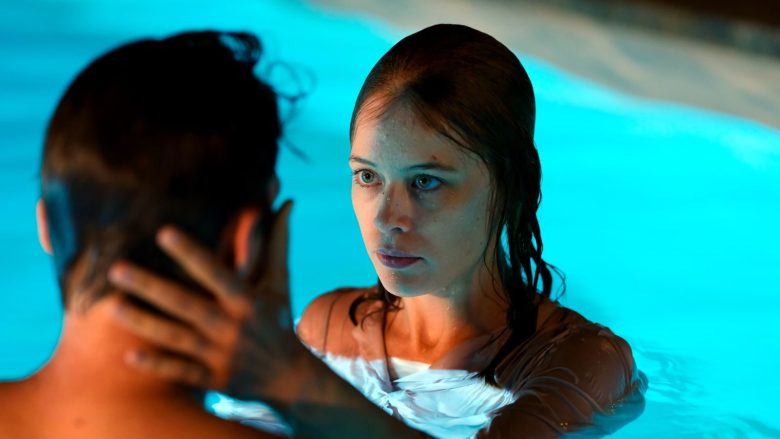
“Last Call” is in indie drama about a suicidal alcoholic who gets a wrong number when trying to reach a help/hotline. The after-hours custodian who answers finds herself inconvenienced, then trapped, then involved and finally committed to this call that may be a despairing man’s last lifeline.

It’s an inherently dramatic situation, with rising suspense, built-in pathos and the “ticking clock” countdown that all good thrillers lean on. It’s also stagey, “theatrical.” It could be dramatized with a stage, two actors, two pools of light and two prop phones. Simple.

Director/co-writer Gavin Michael Booth decided to jazz up that simple set-up in two ways. He shot his two actors — his wife Sarah Booth plays Beth, the working-mom/custodian, co-writer Daved Wilkins is Scott, the drunk on what might be he last bender — in two locations, and in real time. Their separate performances are contained in one, long take.

And he shows them both, all 70-odd minutes worth, on the screen at the same time — split screen.

That tosses “Last Call” into the category of novelty films, stunts.  Like Hitchcock in “Rope,” he’s leaning on the “long take,” which can be inherently suspenseful as the viewer is conditioned to expect edits, changes in points of view, etc., and the filmmaker isn’t providing any of those.

With split screen, like DePalma impersonating Hitchcock in “Dressed to Kill,” and many other examples of that camera trick (“More American Graffiti,” “The Thomas Crown Affair,” “Grand Prix,” etc.),  he’s forcing the viewer to decide on what to focus on.

We watch the barfly buy a bottle for the walk home as his favorite watering hole closes for the night. And we see the custodian, a student and single mom, running through phone numbers, trying to pinpoint why her older son hasn’t made it to the sitter’s yet.

Beth starts her nightly cleaning routine at the college, Scott drunk-dials (on a rotary phone) the wrong number, and their night — connected by phone — begins.

Scott talks in a slightly-slurred monotone, so much so that it’s a wonder Beth doesn’t dismiss him in a flash. They talk at cross purposes just long enough to establish that he doesn’t realize he’s not called the right number, and long enough for her to realize who he’s trying to reach. Not at first, though.

“Who’s answering the phones?

“No one, tonight.”

“What if people call?”

“It’s not my problem.”

Beth multi-tasks the way single moms do, distracted, trying not to be rude. And then Scott stumbles across the words that keep her from hanging up.

“It’s been a bad day…I had a son. He died.”

We know where this will go from that moment onward, with just a couple of possible twists crossing our minds as we do the math.

Does seeing all the action play out, on two halves of the screen and in real time, distract us enough to give the movie mystery and added suspense?

No. “Last Call” is enlivened considerably by Booth’s increasingly engaged and emotional performance. She will punch you in the heart before the film is finished.

This slight thriller doesn’t really suffer from its gimmicks. It’s just that director Booth learns what generations of filmmakers figured out before him, some of them masters of the medium. Every movie isn’t made this way because it’s anti-cinematic, as Hitch put it.

Editing, “montage,” is “the essence of cinema,” “The Master of Suspense” realized. Cutting, changing points of view, moving in tight on this actor or that prop, builds empathy and suspense. The speed of edits literally quickens the pulse (See a “Bourne” movie, any “Bourne” movie).

Take that away, force us to choose which character we’re going to focus on, and the gimmicks become pace-killing distractions.

The forlorn (and increasingly insistent) music by Adrian Ellis, a script that takes Beth from dismissive to too-obviously indulgent and “humoring,” and then to concerned, dialogue with flinty lines like “That’s the thing no one tells you about ‘rock bottom’ — it doesn’t exist” work with or without split screen.

They work a little less well when we can choose to ignore the drunk and focus on the increasingly frantic (still multi-tasking) Beth.

Booth has come too close to creating a filmed play — enlivened by long tracking shots of Beth scampering from room to room, phone to phone — to let this work as well as its thin, generic story would let it.

It was never going to be a dazzling addition to the genre. Is it enough to be remembered for the gimmick?

2stars1

MPAA Rating: unrated

Credits: Directed by Gavin Michael Booth, script by Gavin Michael Booth and Daved Wilkins

Cast: Daved Wilkins, Sarah Booth, Matt Maenpaa. A Mimetic Entertainment release.

Running time: 1:17

Posted in Reviews, previews, profiles and movie news | Comments Off on Movie Review: “Last Call” reminds us to be careful when we dial

Movie Review: Harry Potter effects wizards cook up “Dragon Kingdom

dragon1

The cinematic equivalent of Monty Python’s “The Cheese Shop” sketch, “Dragon Kingdom” proves that the Jolly Oldies never get over their love of curdled, cured milk.

It’s a “Lord of the Rings Lite” lark, the sort of film a bunch of film professionals might fling together in their spare time, with borrowed historic settings, vinyl and leather remainders from a shoe factory and all the makeup they can cadge from work.

Digital effects? It has dragons, passably animated ones, with incompetent dragon’s shadows painting in on sunny days.

It’s go a stone ogre and goblins or “Orcs” as J.R.R. used to call them, a cloven-hoofed ram-man and lizard people and Amazons, called Qatori, here.

A veritable “Army of Abominations,” they’re named. Because they are.

And that’s nothing to the zombies, called “Furies,” that the foppish evil prince (Jon-Paul Gates) uses to stage his coup to try and seize the “Twelve Kingdoms of Azeroth!”

A smattering of punchy banter — not nearly enough  — dresses up the dialogue.

“Any ideas?”

“Try not to DIE!”

Mostly though, what this no-budget action fantasy has, is good old British cheese — Cheshire to Wensleydale, Red Leicester to Teviotdale, and yes, I am using Wikipedia as my cheese thesaurus, because that’s allowed.

“Trampled by the dark army of Fury” begins the most exposition-heavy opening to a sword-and-sorcery epic since “Lord of the Rings: Return of the King.”

It’s not really about dragons. I think an earlier title was “Dark Kingdom.” They just thought “Dragon” would sell this thing.

The coup begins, Princess Elizabeth (CoINcidence?), played by Rebecca Dyson-Smith, has a narrow escape, protected by two pre-Medieval knights (Ben Loyd-Holmes, Ross O’Hennessy) and a couple of fierce-looking lady warriors (Zara Phythian, Jemma Moore).

The Princess of Zaldar, and yeah, I’m just making up the spelling of what I heard,  and her entourage make their getaway with a dragon’s egg. But like the dragons of the title, that’s a red herring.

The movie is REALLY about their attempts to reach the king via the Dark Kingdom.

But…but…”The Dark Kingdom is an evil place!” And…and…”No one has ever survived The Dark Kingdom!”

That’s where the haunted forest where the days are a trial and the knights are tested, the Qatori show their stuff and the princess can complain “But I want to learn to fight!”

Lame training sequence to follow.

I got a kick out of the period-appropriate historic village the film opens in, largely built from (plainly visible) mass production two by fours and the machine-milled lumber.

The assorted enemies in need of slaughtering have magical qualities, and really bad allergies. The zombies gurgle, perhaps a reaction to the burlap sack costumes they show up in.

“Can weapons not harm them?”

“Let’s cut off their heads and be done with it!”

“So THAT’s how we kill them!”

All this nonsense drifts into caves where there’s much hand-to-hand/ hand-to-claw combat.

And they top it all off by leaving things unresolved, in a Tolkien-esque sense.

Yes, there’ll always be an England and there’s always hope for a sequel.

Just don’t forget the cheese, and none of this “We’re fresh out” nonsense either.

1half-star

MPAA Rating: unrated

Cast: Ross O’Hennessy, Jemma Moore, Ben Loyd-Holmes, Rebecca Dyson-Smith, Zara Phythian

Directed by Simon Wells, script by Aston Benoit, Ben Loyd-Holmes. An Uncork’d Entertainment release.

Running time: 1:25

Posted in Reviews, previews, profiles and movie news | Comments Off on Movie Review: Harry Potter effects wizards cook up “Dragon Kingdom

Preview, “Parasite” — Bong Joon Ho’s latest

Hot off the presses. A thriller that’s not exactly what the title gives away.

From the director of “Okja” and “Snowpiercer” and “The Host.”

“Parasite” won the Palm d’Or at Cannes and opens Oct. 11.

Posted in Reviews, previews, profiles and movie news | Comments Off on Preview, “Parasite” — Bong Joon Ho’s latest

Preview, “LITTLE WOMEN”… again

The “Spider-Man” of chick pictures earns another all star remake.

Saoirse and Emma, Florence Pugh, Timothee Chalamet and Meryl Streep and Laura Dern.

Oh and Chris Cooper and Eliza Scanlen and Tracy Letts and so many others, all gathered for Greta Gerwig’s Oscar bait Christmas release.

Jeepers.

Posted in Reviews, previews, profiles and movie news | Comments Off on Preview, “LITTLE WOMEN”… again

Preview, Paul Feig and Emma Thompson’s “Last Christmas”

Emilia Clarke, Michelle Yeoh, Emma Thompson, a Nov. 8 release, a Brit based rom com for the holidays.

Can a “Game of Thrones” vixen carry a sentimental holiday romance?

Can Henry Golding, the love interest, show us more than his bland turn in “Crazy Rich You Know What?”

Posted in Reviews, previews, profiles and movie news | Comments Off on Preview, Paul Feig and Emma Thompson’s “Last Christmas”

Documentary Review — “ZZ Top: That Little Ol’Band from Texas”

top1.jpg

It’s not the most diverse musical genre, in its performers or in its fan base. But as “classic rock” finally starts to age its way into geezer biker bars and becomes the genuine “oldies radio” of today, it’s high time we paid tribute to the bands and artists that became synonymous with that label.

An Oscar winning Queen film here, an Elton John songbook and possible Oscar contending bio-pic there.

And here’s a tribute to the longest-lived, at least in terms of maintaining the same lineup, of them all.

The nickname “That Little Ol’Band from Texas” probably started life as a put-down, another way of ridiculing good ol’boys playing boogie blues as “party music” in Nudie suits, boots and cowboy hats. But here they are, ZZ Top, turning 50, still touring, still comprised of Frank Beard on drums, Dusty Hill singing and playing bass and Billy F. Gibbons, America’s answer to Clapton, on guitar and vocals.

“ZZ Top: That Little Ol’Band from Texas” is a straight, no-chaser band biography documentary, lacking flash and big name peers singing their praises and expert testimony to park them in their rightful place in music history.

Sure, Billy Bob Thornton’s a fan, and Steve Miller, Josh Homme (Queens of the Stone Age) and Dan Auerbach (The Black Keys) are here. But they’ll have to do, because those who inducted them into the Rock and Roll Hall of Fame, the performers that plucked them to be opening acts giving them early breaks (Jeff Beck, The Rolling Stones, Hendrix) are mostly gone or simply unavailable for this little tribute film.

It doesn’t really matter. The recording engineers who found their fat sound, a publicist who helped them gain respectability and build their brand and a few others help the trio tell their story, from Texas obscurity in the ’60s to MTV immortality by the 80s, still playing stadiums as they enter their 70s.

Hardcore fans will know much of what turns up here — the Dallas to Houston move that linked the three of them up, the performers that inspired that “power trio” lineup (Cream, The Jimi Hendrix Experience).

Did Hendrix really come up and profess admiration for their “nerve,” covering two of his songs while his OPENING act? Did Mick Jagger stand off stage in Honolulu in overalls, holding up a broom as his fake beard, while watching them open for The Stones?

One obvious thing I’d never considered while growing up with this music in the South of the 70s and 80s was “the mystique” Thornton and others speak of.

But from their first album, “Tre Hombres,” hiding their faces and putting the music out front worked. Growing beards just added a mask.

They broke big, and then sealed their brand identity for all time by coming back from a three year hiatus with synthesizer-backed blues, a hot rod logo and gorgeous young women and men “helped” to make love connections by a “cartoon version” of the band.

You didn’t have to ever buy a ZZ Top recording to know who they were, worldwide, Dan Auerbach of The Black Keys says. “It made them cultural icons.”

There’s silent home movie footage of the bands Dusty Hill and his brother started, still photos of early versions of the band Gibbons formed as a play on The 13th Floor Elevators. What’s on the highest floor? The “Top.” What do the great blues performers go by? Initials. B.B., meet “Z.Z.”

The film could have used more archival footage with sound, but when your mastermind manager Bill Ham decrees “no interviews” to build that early mystique, and they weren’t performing on TV, you can see the problem the filmmakers are up against.

Beard regales us with stories as maybe the most cheerful ex-addict we’ve ever met, getting his first big check, “$72,000, and I spent ever’BIT of it on drugs!”

Hill talks about taking a name-tag job as an airport baggage handler AFTER their break-out “Texas World Tour” (livestock on their giant Texas map stage) made them rich in the late ’70s, a working class gig just to get him grounded and clear his head.

And Gibbons, in his urbane drawl, recalls the night they played a show for a single paying customer in Alvin, Texas, for a fan who “still comes around to shows TO THIS DAY.”

top2.jpeg

The lighthearted tone of the whole affair is set by the wild-eyed Thornton, who marvels that catching them live was like “seeing BUGS BUNNY up there on the stage.”

They recreate the improvised “Blues Shuffle in C” that they jammed to the first time they rehearsed, and do it in the famed Gruene Hall, the oldest music hall in Texas. The “Texas meets Tennessee” traces in their blues-rock songs and the post-hiatus Gibbons infusion of “punk” and then New Wave into their tunes is surveyed.

And those tunes, that magical plucked chord progression that opens “La Grange,” with that rat-a-tat on the drum’s rim underneath it, the thumping, wailing post-disco giggle that made “Give Me All Your Lovin'” fodder for one of the stand-out videos in the history of MTV.

A year doesn’t go by when some ZZ Top song or three doesn’t feature in the trailer to an action film.

How’ve they managed to stay on speaking terms, working in harmony for 50 years? Everybody has an answer, but only Beard’s matters.

“I’ve found the people I was meant to play with,” he says. “I never wanted to quit, and never wanted to get fired.”

2half-star6

MPAA Rating: unrated, drug anecdotes, profanity

Cast: Billy Gibbons, Dusty Hill, Frank Beard, Billy Bob Thornton, Steve Miller

Credits: Directed by Sam Dunn. Written by Ralph Chapman and Sam Dunn. An Abramorama release.

Running time: 1:30

Posted in Reviews, previews, profiles and movie news | Comments Off on Documentary Review — “ZZ Top: That Little Ol’Band from Texas”

Preview, Terrance Malick’s “A Hidden Life”

A morality tale set in rural Germany during the run up to World War II.

Lots of nature, of course, features in “A Hidden Life,” lots of debate about Hitler and “free will.”

Malick’s films are always events. This one, unlike too much of his recent fare, looks watchable and worth the wider release Fox Searchlight will give it in December.

Posted in Reviews, previews, profiles and movie news | Comments Off on Preview, Terrance Malick’s “A Hidden Life”

Documentary Review — “David Crosby: Remember My Name”

crosby1.jpeg

The world’s had plenty of time to make up its mind about David Crosby of Crosby, Stills Nash & (sometimes) Young. Heaven knows the man himself has given us the necessary data to form a defensible opinion.

“Mouthy, self-righteous, self-destructive druggy” kind of works for some of us. His recent years, post-prison, post-recovery, post-“eight stints put in my heart,” maybe that’s softened a bit.

Then he’d go and do this or that. And we had our final cue. If the sweet, patience-of-a-saint Graham Nash, of “Our House” and “Teach Your Children” has given up, cussed him out and finally moved on, what business do we have sticking around?

Great harmony singer, fair picker, not the “hit songwriter” in any of his groups, a two-time Rock and Roll Hall of Fame inductee based on the harmony singing and rhythm guitar work, he’s gotten what he needed from “us,” what he deserved.

So hitting us and his interviewer, Fanboy’s Fanboy Cameron Crowe, with “I’m afraid of dying…and I’m close” at the opening of “David Crosby: Remember My Name” may move some to forgiveness, or closure or even redemption.

But I’m not sure this myopic “write my own obituary, and be brutal about it” film accomplishes that.

Crosby is an old man of 77 who teeters back and forth between “regrets” and “I have no regrets” here, admits using and misusing friends, colleagues and women, takes us down the heroin hole and into prison in Texas with him and regales us with tales of the Good Times — those early years of Crosby, Stills, Nash and then Young.

“Remember My Name” lacks fresh interviews with those many ex-collaborators who hate his guts, save for Roger McGuinn and Chris Hillman from The Byrds. Crosby was kicked out of that ’60s folk-rock group for turning “insufferable,” and there’s ample footage here backing that up.

Here he is at the Monterrey Pop Festival, blurting out his Kennedy Assassination conspiracy theory to a late-’60s audience that might have cared, but probably didn’t.

“Being a star makes you feel like you’re more important than you really are,” McGuinn explains. He and the other Byrds have long suffered the slings and arrows of Crosby’s unjustified mockery, but at least he and Hillman sat down for interviews, and participated in an animated recreation of the day they “fired” Crosby.

Stephen Stills isn’t here. The Graham Nash and Neil Young interviews are decades old, most of them, save for the recent ones where they say “never again” to the idea of working with Crosby.

I was pining for a chat with Melissa Etheridge, who had Crosby as sperm donor for the baby she had with Julie Cypher. She’s not going to take back that decision, no matter how much more Crosby flotsam has battered its way under the bridge in the 20 years since. But curiosity about how a prickly, self-absorbed and unfiltered diabetic and recovering addict was ever “the perfect choice” lingers.

Crowe and filmmaker A.J. Eaton chat with Crosby, get him to take them and us on a tour of his old hangs on the Sunset Strip and Laurel Canyon, where “I was the first (musician) to move here” to “get above the smog,” that second fact left out of the warmer and more musical “Echoes of the Canyon” documentary.

And they follow the not-quite-broke Crosby on the road during a 2017 tour, in fine voice singing his recent originals with a tight band, reveling in the “creative rebirth” that old farts’ music magazine Rolling Stone heralded five years ago.

His wife Jan frets that every time he leaves for a tour “I know he may never come back,” and he is quick to do what we all do in our ’70s — list his many life-shortening maladies. “When the light does go out, I hope it’s when he’s singing,” she adds.

But the film has no trouble at all making the case that it’s been a fascinating life.

The son of a “humanist” and an Oscar-winning Hollywood cameraman, Floyd Crosby, his older brother Ethan is the person he credits with getting him into music.

He won’t name the person who first gave him heroin.

“We took everything we had, and everything everybody else had,” Crosby recalls of one memorable “smashed” night in Chicago, going out to hear John Coltrane.

“There was boundaries I crossed that you haven’t thought up, yet,” he boasts. “I hurt a lot of girls. I hurt a lot of people…Were these girls addicted? Yes they were. And I did it.”

A ride-along in an Escalade takes them to the house where McGuinn and Hillman “fired me…came up in TWO Porsches,” and the house Graham Nash used to live in where Crosby, Stills & Nash formed, realizing “within 40 seconds” Nash has said, that they’d be great together.

“Our House” was composed there, while Nash was living with Joni Mitchell, who’d broken up with Crosby right before that.

On tour, the lilting voice and masterful vocal control is still there, as is the political fire. He gets all worked up all over again upon visiting the museum at Kent State. Neil Young admits Crosby was a driving force in getting him to write (Four Dead in) “Ohio.”

Crosby was the guy in the band who bought a sailboat (financed by Peter Tork of The Monkees) basically when he was in between bands. So he had a hand in inspiring “Southern Cross,” too.

But the history lesson and performance material don’t lighten the film. The shadow of death hanging over it doesn’t give it the gravitas of the wonderful and poignant Glen Campbell documentary, “I’ll Be Me.”

Crosby making the argument that Crosby, Stills, Nash AND YOUNG deserve to be admitted to the Hall of Fame, along with The Byrds and CS&N, is so self-serving that it grates.

And we understand all the hard feelings and “insufferable” label that have attached themselves to the guy.

Documentaries are utterly reliant on their subject to be appealing, and while “Remember My Name” does soften him a bit, it’s hard to make the case that it merits a total reevaluation of the man and his music.

He wishes he had more time, he says, wishes he hadn’t wasted years of his life being “smashed.” Perhaps its going to take more time for music lovers outside of his generation to appreciate him fully, as a creator and collaborator.

Let’s just say “Remember My Name” shows us, and him, the start of that process.

stars2

MPAA Rating: R for language, drug material and brief nudity

Cast: David Crosby, Jackson Browne, Jan Crosby, Roger McGuinn, Graham Nash, Neil Young, Stephen Stills and Cameron Crowe.

Credits: Directed by A.J. Eaton. A Sony Pictures Classics release.

Running time: 1:35

Posted in Reviews, previews, profiles and movie news | Comments Off on Documentary Review — “David Crosby: Remember My Name”

Book Review: Craig Ferguson muses about “Riding the Elephant”

For my money, Craig Ferguson did the best late night talk show of this millennium.

Not as searing and politically astute as Jon Stewart, not the populist cheerleader that Colbert has become, never built for the viral era that Jimmy Fallon and James Corden excel in, he was just good at being funny, flippant and making every interview — even the clunky ones that were never destined to go well — amusing.

You can find his chats from the “Late Late Show” all over Youtube, and many of these are marvels of quick wit, “performed” flirtation (way over the top, immunizing him from #MeToo, but they probably wouldn’t fly today) and bemused empathy.

Any model or starlet booked on the show had to be prepared for a level of joking around that could either make him, the burlesquing lech, or her look dizzy and foolish. It was usually him, no matter how dim the interviewee might seem.

An addict who recognized a drowning woman’s cries for help, he told people to back off Britney Spears. And after some grousing, they did.

I especially adored his conversations with his fellow Scots and sympathetic Irish — Billy Connolly, Ewan, Gerard Butler, Kelly MacDonald et al.

He seemed unusually good at things Letterman and Leno and all who followed them lost, the ability to listen and have a conversation. Colbert might get there, if he can get away from his note cards. Fallon, Kimmel, Conan and Noah are all poor interviewers, although Noah can summon up the seriousness necessary for big subjects and Colbert can be tough when he’s not phoning it in.

And we’d all kind of like to see how Samantha Bee might handle a full bore conversation show, and not one in the Oliver/Bee rant “reporting” style.

Ferguson’s done a legitimate memoir, “American By Choice,” which came out during his run on late night. “Riding the Elephant” is a collection or memories and musings in a philosophical line, anecdotes about the first member of his peer group who was facing early death, about how action hero and amateur pilot Kurt Russell read an earlier book of Craig’s and decided he was a “control freak” who didn’t really fear flying (and was right, apparently), and helped him get flying lessons.

Ferguson muses on psychotherapy, religion, running the table (almost) from “that ludicrous” “E-Meter” to “GuyWhoseNAmeYouCan’tEvenSay (not Voldemort)”, and the weight of growing up in Scotland and the UK, which he surmises has suffered through a century-long malaise thanks to the incredible losses the country endured in “The Great War,” World War I.

Yes, he had a near #MeToo scare, involving that very flirty/naughty interviewing “technique.” “Ribald,”he calls it, and the women who engage in it with him seem to agree.

He’s always most on point talking about addiction, his own alcoholism and the assorted “helpers” who pointed this out to him and finally convinced him to turn all that around. Like a lot of addicts, he presumes expertise and can be wearing in his self help sermonizing.

Sexual experiences, breaking out of being a bad punk drummer to become a bad standup before he got to be good at it, a Princess Diana anecdote, blistering criticism of what Britain’s royal family has really done to the country (ruined it ever becoming a “meritocracy,” for starters), the downside of “Fame” as we see it today, fan encounters — a lot of insightful riffs are packed into the anecdotes, and some sentiment that seems more Irish than Scots, if you buy into stereotypes. Which we dooooo.

He’s a marvelously dry anecdote relator and storyteller, so this is a breezy read.

We learn what “Bingo Wings” (arm flaps of women of a no-longer-sleeveless age) and “Hogmanay” (New Year’s Eve) are in his native tongue, and get a dizzy sampling of Scots conversation, written in dialect.

An encounter with a Glasgow drunk, after his own sobriety and fame, written in dialect, is a Glaswegian hoot.

“Ah’ve never seen yer stoopit American shooo oan the telly!”

He reiterates that he was bailing out of the talk show before Letterman announced his retirement, that he had no interest in the earlier gig, and was relieved to be rid of the one he had. Unlike the ever-shrinking Conan, he got out of it with a bit of dignity intact.

And he touchingly recollects his Peak Year, 2008, when it all went right — a year punctuated with his third (still going) marriage, the death of his mother, and one of his worst sets ever — in Atlantic City, New Year’s Eve, in the middle of a blizzard.

I interviewed him several times over the years, about an indie film he’d made (pre-“Late Late Show”), in conjunction with one of his “Don’t give a f— any more” stand up performances in Orlando during the run of the late night show and when he was offered up by a studio to talk about those “How to Train Your Dragon” movies, one of the few authentic Scots in that Scots-flavored Viking cartoon trilogy.

He was funny and biting and so profane he was hard to quote on a family newspaper, the potty mouthed haggis-shagging tosser.

He’s a self-taught wit, well-read high school drop out and I’d say turns an elegant phrase on the page, just enough profanity for Scots-shock value, even when bragging about hosting the July 4 concert in Boston for CBS, featuring the Boston Pops and later, Neil Diamond.

“He put his hand on my shoulder! ‘Reaching out…touchin’ me…touchin’ you…,” which means, no matter what you may achieve in your life, I’ll always be that little bit more awesome than you.”

Posted in Reviews, previews, profiles and movie news | Comments Off on Book Review: Craig Ferguson muses about “Riding the Elephant”

Djimon joins “A Quiet Place 2,” Brian Tyree Henry exits

Emily Blunt will be back, hubby Coach K is directing. Casting switches are kicking in at this stage.

“Djimon Hounsou is replacing Brian Tyree Henry in the sequel to ‘A Quiet Place’ https://t.co/w85wCOCC1z https://twitter.com/THR/status/1161152165559361541?s=17

Posted in Reviews, previews, profiles and movie news | Comments Off on Djimon joins “A Quiet Place 2,” Brian Tyree Henry exits